
TL;DR — Quick Summary
Common reasons for tree removal include disease, root damage, and hazard failure. Learn when Vancouver homeowners must act — and what BC bylaws require.
Common reasons for tree removal rarely announce themselves politely. They build in silence. Then one night, they collapse without warning.
Picture this. It's 2 AM. The wind is screaming through your neighborhood. Then you hear it — a crack like a rifle shot.
You run to the window. Your neighbor's 60-foot Douglas fir is lying across their roof. Three rooms. $80,000 in damage. Two weeks in a hotel.
The tree had been dying for two years. Bark peeling. A soft spot at the base. A lean developing on the southeast side. But it was big, it was beautiful, and nobody wanted to be the one to make the call.
We've seen this story play out dozens of times across Vancouver, Burnaby, North Vancouver, and Coquitlam. Our ISA-certified arborists get called in after the fact — when the damage is done and the insurance claim has already started. This guide exists so that doesn't happen to you.
TL;DR
- **Dead and dying trees** are the most common reason for residential tree removal in the Lower Mainland — and the warning signs are almost always visible before the failure
- **Root damage** to foundations, driveways, and sewer lines forces removal even when a tree looks healthy from the street
- **Storm damage** doesn't automatically mean removal — but an ISA-certified hazard assessment is required before you decide either way
- **BC municipal bylaws** in Vancouver, Burnaby, and surrounding cities require permits before removing most significant trees — fines can exceed $10,000 per tree
- **Pest infestations** like bronze birch borer and carpenter ants compromise structural integrity long before visible canopy symptoms appear
---
Is That Tree Actually Dead? How to Spot a Dying Tree Before It Falls
Here's the brutal truth. Most homeowners wait too long.
A dead tree doesn't fall the day it dies. It stands there for months — sometimes years — looking almost normal. Then one November storm changes everything.
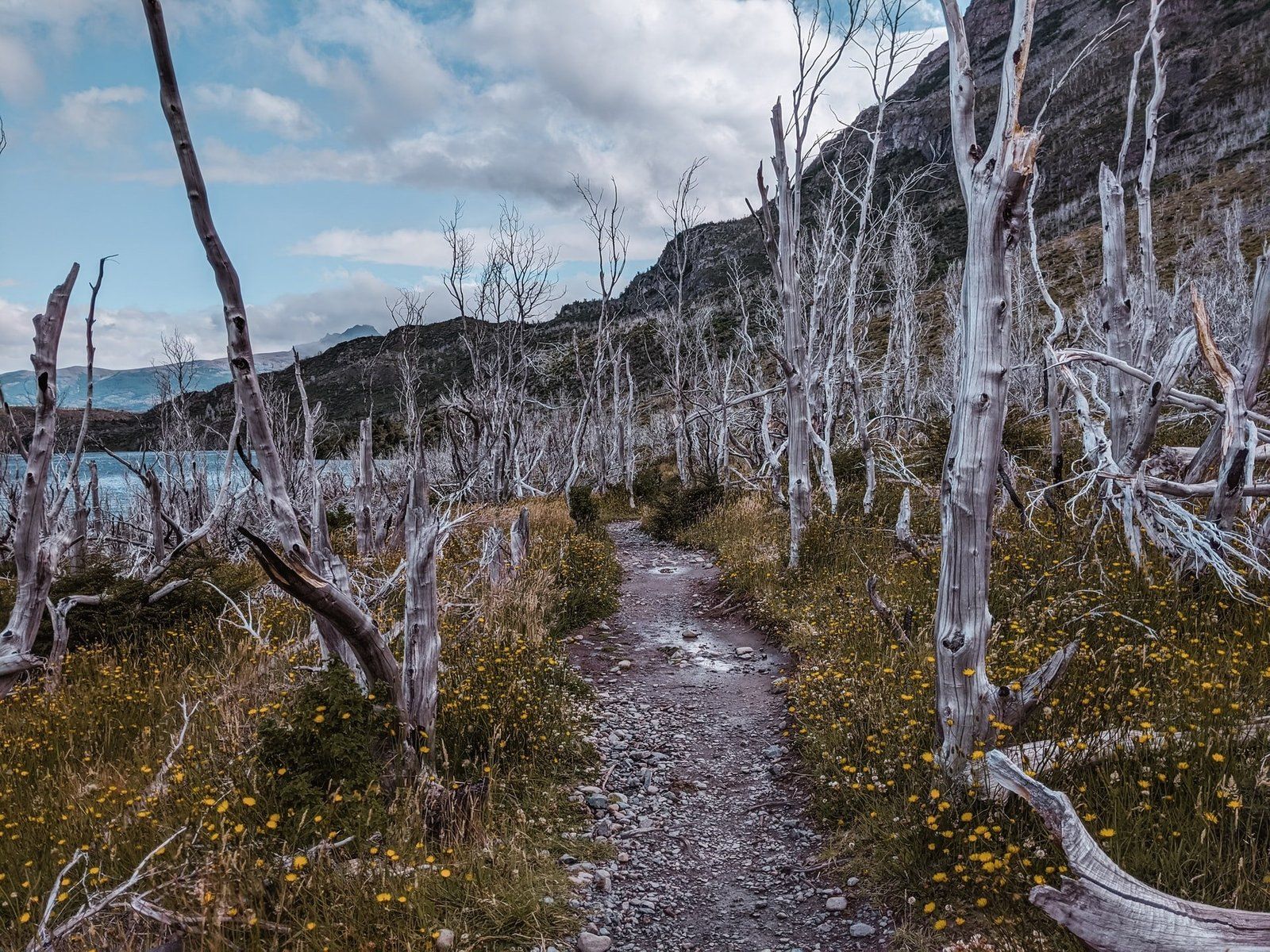
Dead and declining trees are the single most common reason for residential tree removal we see across Greater Vancouver. And the warning signs are almost always there, hiding in plain sight.
**What to look for:**
- **No leaves in spring.** This sounds obvious. But plenty of homeowners assume a bare tree in April is just "late to leaf out." By May, there's no excuse.
- **Bark that lifts or peels.** Healthy bark is firmly attached. When it starts coming off in sheets, the cambium layer underneath is dead.
- **Mushrooms at the base.** Fungi consume dead and decaying wood. A ring of mushrooms around your tree's base isn't charming. It's a warning.
- **Vertical cracks in the trunk.** Called "shakes," these signal internal wood decay. The tree looks solid outside. Inside, it's hollow.
- **Deadwood throughout the canopy.** If more than 30% of the canopy is dead, the tree is in serious decline.
According to the **International Society of Arboriculture (ISA)**, trees with advanced internal decay account for the majority of unexpected structural failures in residential settings. The ISA's Tree Risk Assessment standards — which our arborists are trained and certified in — identify decay detection as the most critical component of urban tree management.
In the Lower Mainland, the species most prone to silent internal decay include Big-leaf maple (*Acer macrophyllum*), ornamental cherry, and older Western red cedar (*Thuja plicata*). These trees can look vigorous on the outside for months after severe internal decay sets in.
The solution isn't to wait and see. An arborist report from an ISA-certified arborist uses non-invasive detection methods — resistograph drilling, mallet tap testing, and visual assessment — to find decay columns before they become a liability. You get a written assessment. You get clarity. And if removal is necessary, you have a documented case for the municipal permit process.
---
Can Root Damage to Your Foundation Justify Tree Removal?
Yes. And it happens more than you'd think.
Here's the scenario. You've got a 30-year-old Big-leaf maple in the front yard. It's gorgeous. The neighbors love it. But your driveway has been heaving for two years. The plumber pulled a root ball out of your sewer lateral last winter.
Root damage is one of the most compelling — and legally defensible — reasons for tree removal in BC.
**The four types of root damage we see most:**
1. **Foundation undermining.** Large lateral roots grow beneath concrete slabs and shallow footings. The pressure cracks foundations over years — slowly, invisibly. 2. **Sewer and drain infiltration.** Roots enter pipes through hairline cracks, then expand. A mature maple can completely block a 4-inch drain line. 3. **Driveway and sidewalk heaving.** The most visible form. Root flare expansion lifts concrete panels year by year. 4. **Underground utility conflict.** Roots wrap around buried gas lines, electrical conduit, and irrigation systems.
In Greater Vancouver, root damage is most common from large-canopied species: Big-leaf maple, horse chestnut (*Aesculus hippocastanum*), and European beech (*Fagus sylvatica*). Their lateral root systems extend 2–3 times the canopy radius.
If your tree is within 10 feet of your foundation, call an arborist before you call a contractor. Sometimes a root barrier installation can redirect root growth and save the tree. Other times — when root intrusion is already extensive — removal is the only permanent fix.
One important point: before removing any tree of significant size in Vancouver, Burnaby, or Coquitlam, a municipal permit is almost certainly required. We cover that fully below.
---
What Makes a Tree a "Hazard Tree" Under BC Standards?
The term "hazard tree" gets used loosely. But it has a specific technical meaning — one that matters for insurance, liability, and bylaw compliance.
Under **ANSI A300 standards** — the North American benchmark for arboricultural practice — a hazard tree is defined by two factors: **the likelihood of failure** and **the consequences of that failure**.
A leaning tree over an empty field is low consequence. The same lean over your children's bedroom window is extreme consequence. Same tree. Very different hazard rating.
**Six structural defects that define a hazard tree:**
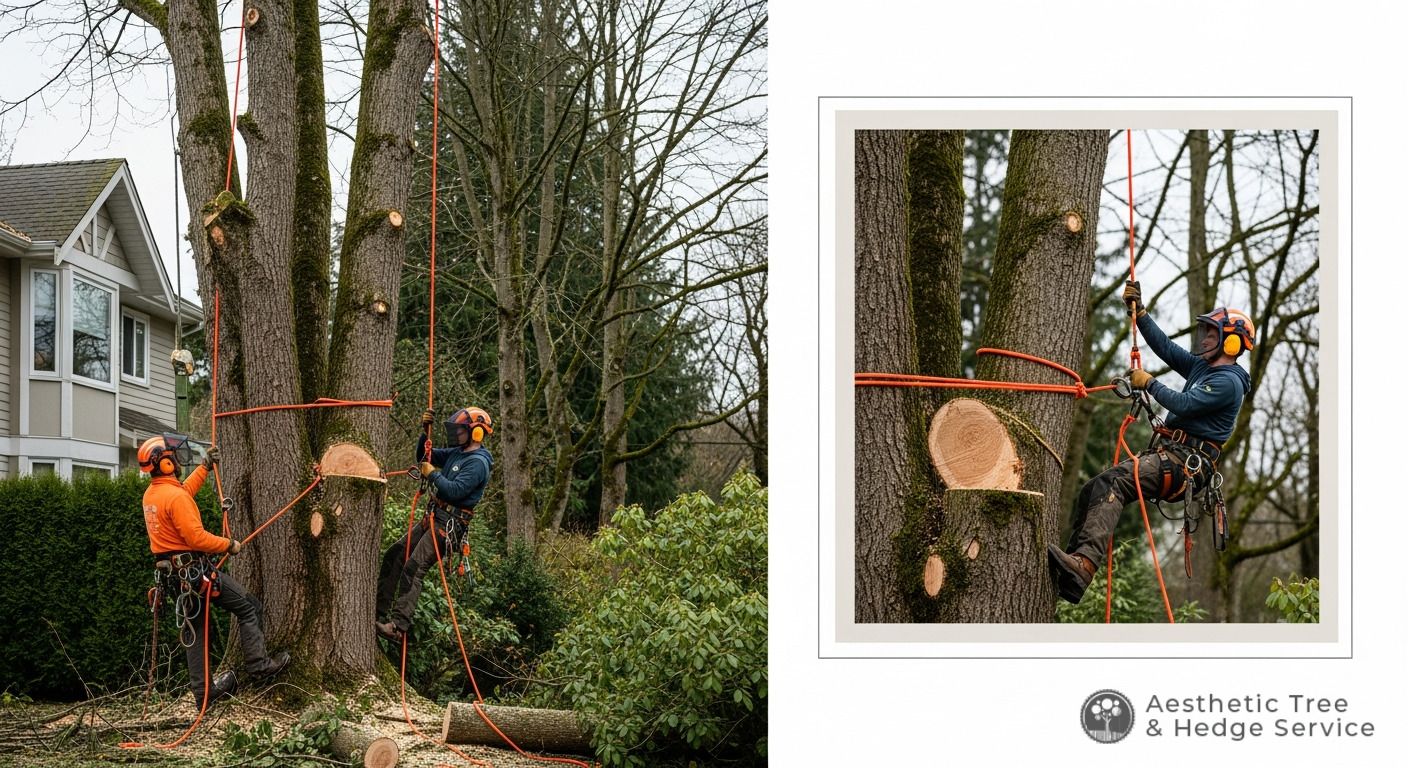
1. **Codominant stems.** Two or more equally-sized leaders growing from the same point. This creates a weak, included-bark union that splits under wind load. 2. **Root plate instability.** A tree that rocks in wind, or where the root plate visibly lifts on one side. 3. **Crown dieback exceeding 30%.** When more than a third of the canopy is dead, the tree can't support its own weight reliably. 4. **Decay columns in the trunk.** Detected via resistograph or sonic tomography. Invisible from the street. 5. **Previous topping cuts.** Topped trees grow multiple fast-growing, weakly attached shoots from the cut point. These are structurally connected by a thin bark layer only. 6. **Included bark between codominant stems.** Bark trapped between two trunks prevents proper wood formation. The union looks solid. Under load, it fails.
**WorkSafeBC** — the body governing all commercial tree work in BC — requires that every tree felling job be assessed for hazard conditions before work begins. According to WorkSafeBC's **Hazardous Work in Forestry bulletin**, tree felling remains one of the highest-risk occupational activities in the province. Proper hazard identification isn't just best practice. It's a legal requirement for every WCB-registered operator.
If you believe your tree meets the hazard definition, document it. Photos. Dates. An arborist assessment in writing. This protects you in a liability dispute and supports your permit application with the municipality.
---
Does Storm Damage Always Mean a Tree Has to Come Down?
Not always. But you need a professional assessment before you decide either way.
Storm damage is the most emotionally charged reason for tree removal. The tree you've watched grow for 20 years is cracked in two. Your first instinct is to get it out today.
Sometimes that's exactly right. Often, it isn't.
**When storm damage requires immediate removal:**
- The trunk has split to the root flare
- More than 50% of the root plate has been exposed
- The tree has struck a structure and remains an active hazard
- The remaining canopy is too damaged to sustain the tree's long-term health
**When storm damage does NOT require full removal:**
- A major scaffold branch has failed but the trunk and root structure are intact
- The crown is damaged but can be structurally pruned to reduce wind load
- Fewer than 30% of the main leaders are compromised
The difference matters — financially and ecologically. Emergency removal costs more than planned removal. And losing a mature tree permanently changes your property's canopy, privacy, and appraised value.
**BC Hydro** reported that in 2022–2023, windstorm events across Metro Vancouver caused tens of thousands of tree-related service interruptions. Trees near electrical infrastructure accounted for a significant portion of those events. If your damaged tree is within striking distance of a BC Hydro line, contact their **Vegetation Management** team before hiring any contractor. They have specific protocols for trees threatening electrical infrastructure.
When you need a fast answer after storm damage, our emergency tree service team responds across Vancouver, North Vancouver, Burnaby, and Coquitlam. We assess first. We remove only what has to go.
---
When Does a Pest Infestation Mean a Tree Has to Be Removed?
This is where most homeowners get blindsided.
Pests are quiet. The damage is inside the wood — invisible from the street. By the time you see external symptoms, the tree may already be structurally compromised.
**The pests we see most in Metro Vancouver:**
**Carpenter ants (*Camponotus* spp.):** These aren't wood-eaters. They're wood excavators. They hollow out galleries in decaying or moist wood. Finding carpenter ants in your tree doesn't automatically mean removal. It means the tree already has decay. The ants are a symptom — not the cause. An arborist can assess how far the decay has progressed.
**Western spruce budworm (*Choristoneura occidentalis*):** This defoliator attacks Douglas fir and true firs. Multiple years of defoliation can kill an urban tree outright. In already-stressed trees, even one severe infestation tips the balance toward decline.
**Bronze birch borer (*Agrilus anxius*):** Devastating to birch trees in BC. This beetle bores into the cambium layer, cutting off water and nutrient transport. By the time you see the D-shaped exit holes in the bark, the tree is in advanced decline. Removal is almost always necessary at that stage.
**Arborvitae leafminer and cypress tip moth:** These hit cedar hedges and Leyland cypress hard. Browning that spreads progressively from the inside out — not just the tips — is the signature.
According to the **Canadian Forest Service's 2023 Forest Health Conditions Report for British Columbia**, insect and disease agents account for more urban tree mortality across BC than any other single factor — including storm damage. The report identified western spruce budworm and bronze birch borer as the two most destructive agents in BC's urban forest over the 2021–2023 monitoring period.
Not every infested tree needs to come down. But you need a proper assessment. An arborist report identifies the pest, assesses structural compromise, and recommends a treatment or removal pathway — in writing.
---
Does Vancouver Have Bylaws That Force — or Restrict — Tree Removal?
Yes. And the fines are very real.
This is one of the most misunderstood aspects of tree removal in the Lower Mainland. Homeowners often assume: my property, my tree, my decision. That assumption is wrong — and costly.
**City of Vancouver:** The **Private Property Trees By-law (No. 10199)** requires a permit to remove any tree with a trunk diameter of 20 cm or more, measured at 1.4 metres above ground. Unauthorized removal can result in fines up to **$10,000 per tree**, plus a mandatory replacement planting requirement.
**City of Burnaby:** The **Tree Protection Bylaw (No. 14087)** protects trees exceeding 20 cm DBH on private property. Permits are required. Replacement trees are typically mandated.
**District of North Vancouver:** The **Tree Protection and Regulation Bylaw (No. 7637)** governs significant trees on private property. Heritage trees and trees with particular ecological value receive heightened protection.
According to the **City of Vancouver's 2023 Urban Forest Strategy Update**, Vancouver manages approximately 150,000 street trees and an estimated 1.2 million trees on parks and private property. The city has invested significantly in bylaw enforcement — including proactive inspections — as part of its 2030 urban canopy targets.
**The permit process typically includes:**
1. A written assessment from an ISA-certified arborist 2. An arborist report confirming removal is necessary 3. A replacement planting plan (usually one or more trees per bylaw requirement) 4. An application fee (varies by municipality)
We handle the full permit process as part of our tree removal service. You don't navigate the bylaw process yourself. We work across all these municipalities daily. We know exactly what each requires.
One critical detail: if the tree is on city property — or its roots extend onto city property — the rules are even stricter. The **City of Vancouver Street Tree By-law (No. 5531)** governs all street trees and boulevard trees. Removal is the city's jurisdiction, not the homeowner's.
---
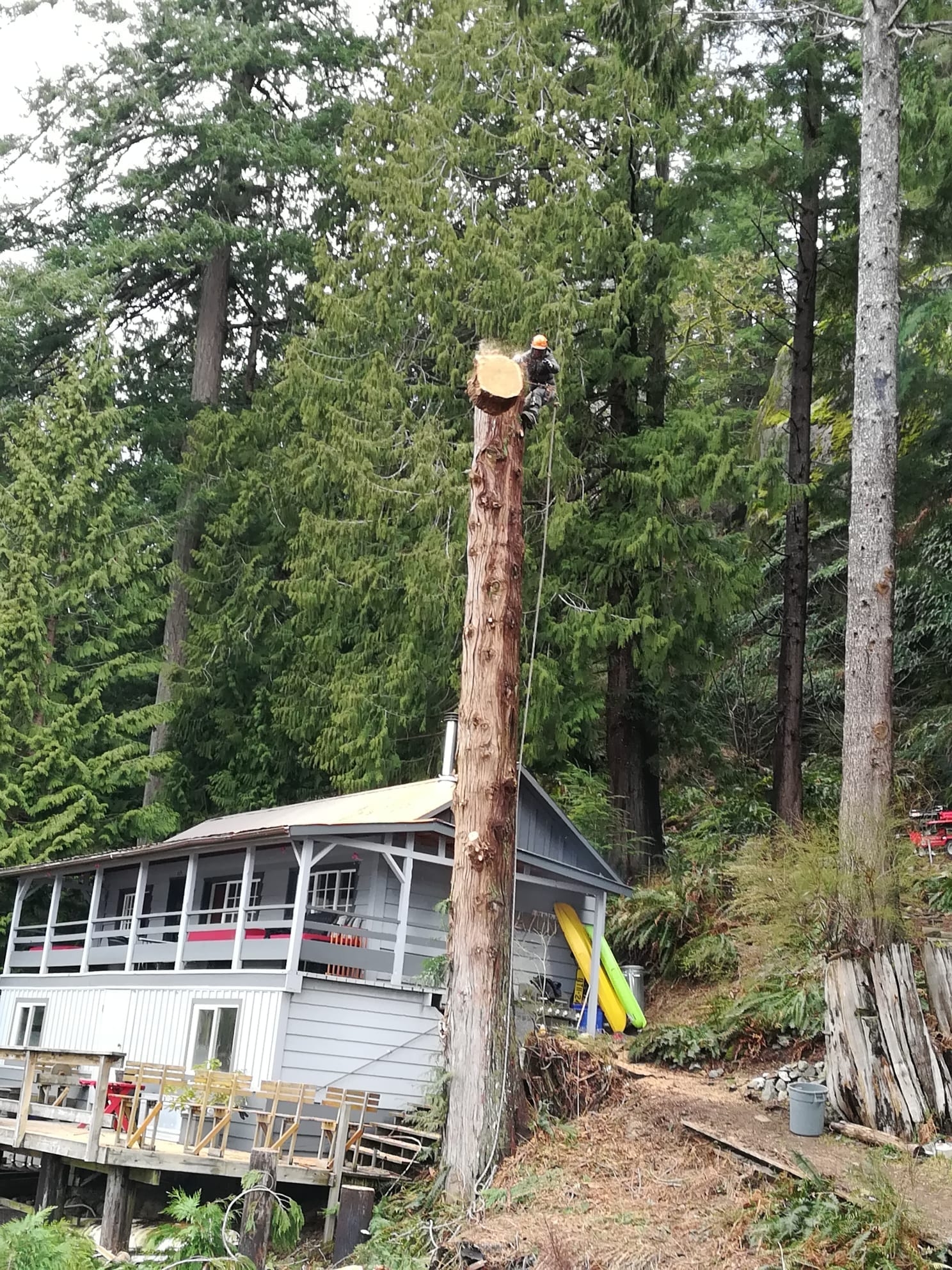
Is a Tree Too Close to Your House Enough Reason to Remove It?
Proximity alone is not the determining factor. But it's always part of the assessment.
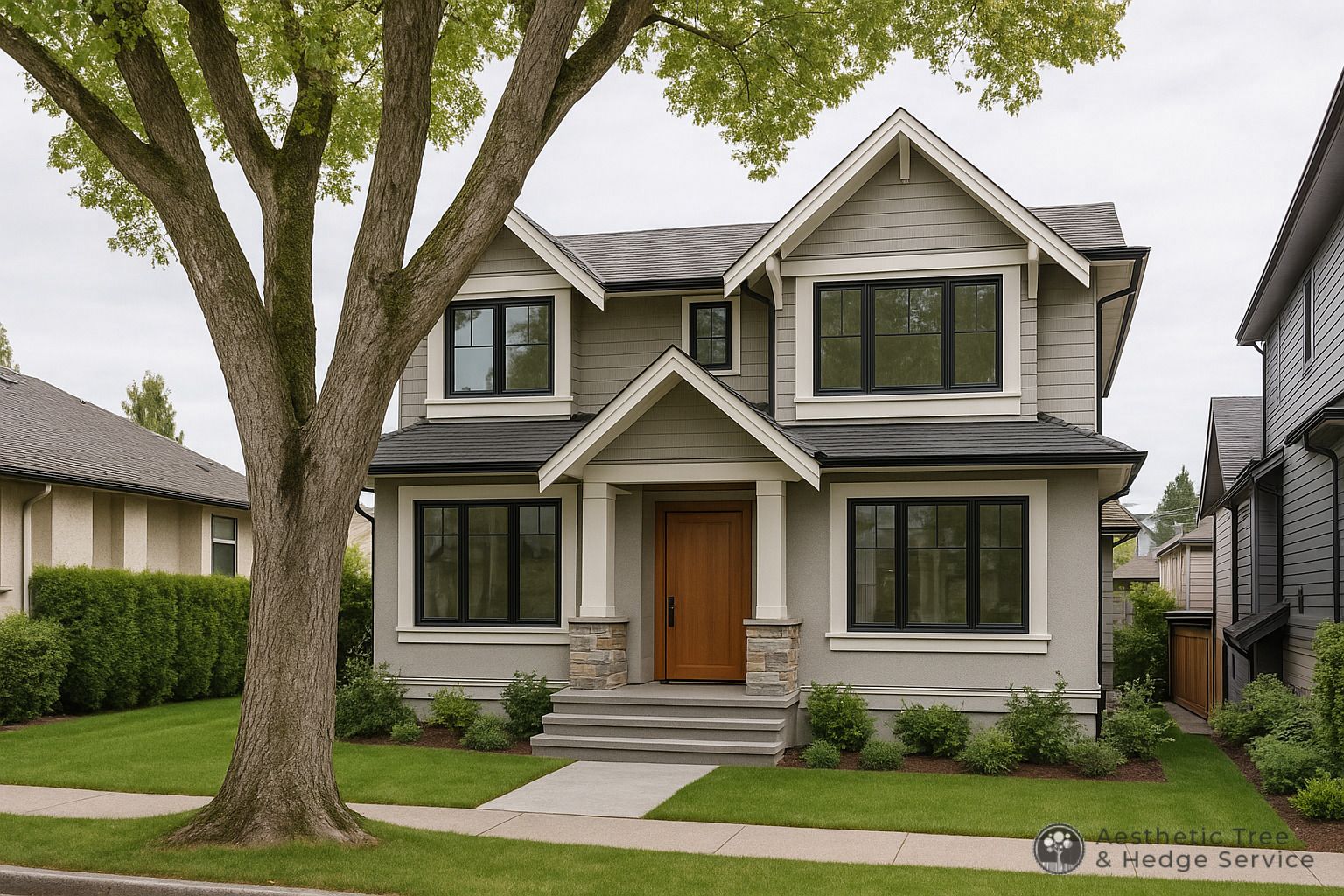
A healthy, well-structured tree 10 feet from your house may pose less risk than a declining tree 50 feet away. What matters is the combination: the tree's condition, its structure, its size, the direction of any lean, and the target beneath it.
**The situations where proximity drives the removal decision:**
- The root zone is actively undermining your foundation or sewer lateral
- The canopy overhangs your roof and causes ongoing debris damage or shades solar panels critically
- Branches routinely strike power lines, gutters, or roof flashing during windstorms
- The tree is within falling distance of your primary living spaces and shows structural defects
- The tree blocks critical sight lines near a driveway or intersection
Under ANSI A300 standards, the "target zone" is defined as any area where tree failure would cause significant harm. Trees with high-consequence targets directly beneath them are prioritized for hazard assessment — not automatic removal, but formal evaluation.
If proximity is your primary concern, start with a tree cutting and pruning consultation. Many trees that seem dangerously close can be managed through structural pruning and crown reduction — keeping the tree and reducing the risk to an acceptable level.
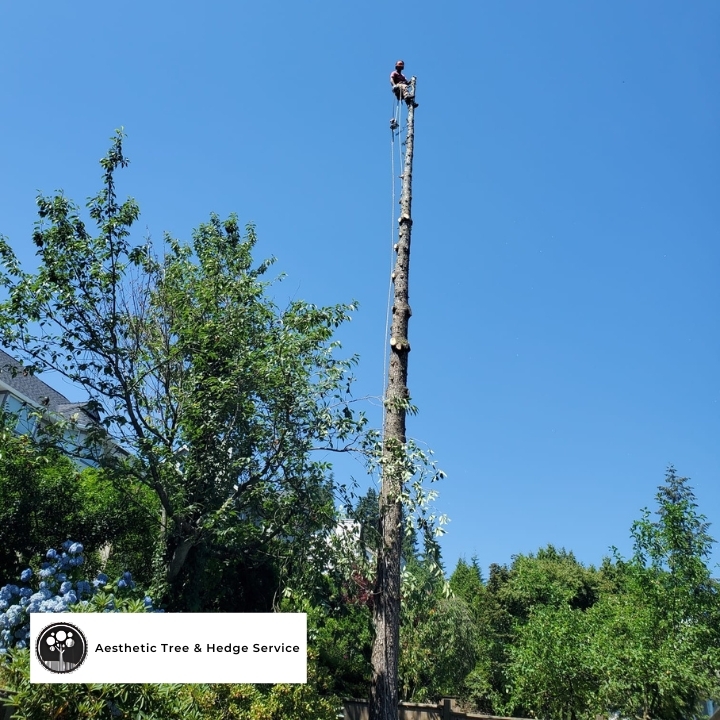
For trees genuinely too large or positioned too tightly for standard ground-based removal, we offer crane-assisted tree removal — a controlled, rigged takedown in confined spaces without damage to surrounding structures, fences, or landscaping.
---
What Happens After Tree Removal — Do You Need Stump Grinding?
Yes. And here's why you shouldn't skip it.
The stump is not inert. It's a decaying structure that continues affecting your property for years after the tree is gone.
**Why stumps need to go:**
- **Regrowth.** Big-leaf maple, cherry, and many other species sprout aggressively from a cut stump. You'll be managing regrowth for years without grinding.
- **Pest habitat.** Rotting stumps attract carpenter ants and wood-boring beetles. That's a pest beachhead meters from your home.
- **Fungal spread.** Root rot fungi travel from a stump through shared root grafts to adjacent healthy trees. Your removed tree can infect its neighbor.
- **Trip hazard.** Stumps become invisible under fallen leaves in October. They're a liability.
- **Replanting obstruction.** If you want a new tree or any landscaping in that space, the stump has to go first.
Our stump grinding service grinds the stump 6–12 inches below grade — below the root flare — eliminating regrowth, pest habitat, and the fungal spread risk. The wood chips produced are excellent mulch for surrounding beds.
We also offer on-site mulching so the material from your removed tree stays on your property, improving soil structure and moisture retention. It's one of the best things you can do for the trees and plants in the surrounding area.
---
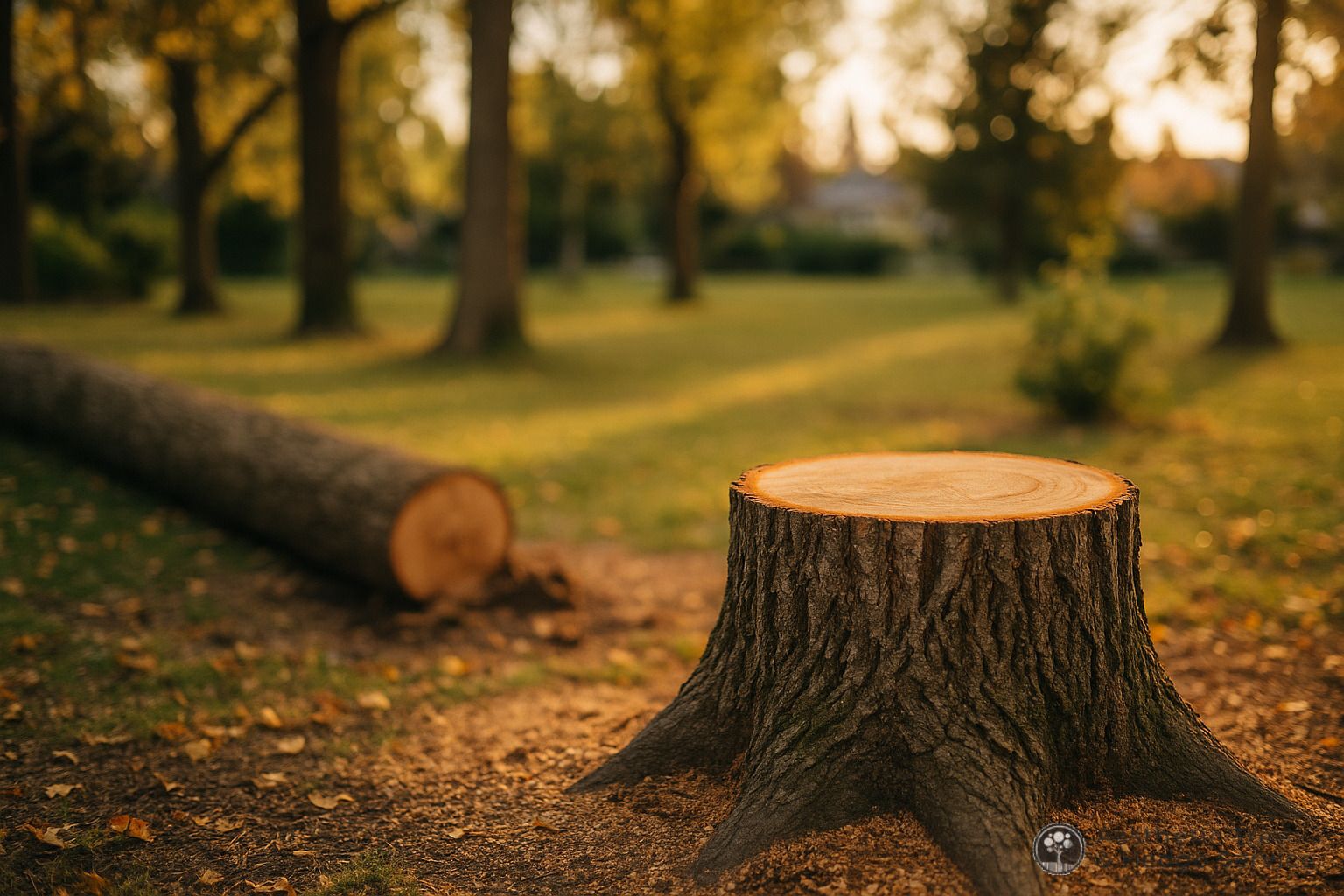
Don't Wait for the 2 AM Crack
Most homeowners call us after something has already gone wrong. A branch through the greenhouse roof. A stump that won't stop sprouting. A tree leaning five degrees further than last year.
The homeowner in that opening story? He'd looked at that Douglas fir a hundred times. He knew something wasn't right. He just kept telling himself: "It's been there 40 years. It'll be fine."
It wasn't fine.
If you have a tree you're watching — for any of the reasons in this guide — call Aesthetic Tree & Hedge Services for a free estimate. Our ISA-certified arborists serve Vancouver, Burnaby, North Vancouver, Richmond, Coquitlam, and the broader Lower Mainland.
**Call (604) 721-7370 for your free estimate.**
ISA-certified. WCB registered. Fully insured.
We assess. We advise. If removal is the right call, we do it right — with the permits handled, the bylaw requirements met, and the stump gone.
---
Frequently Asked Questions
**Do I need a permit to remove a dead tree in Vancouver?**
In most cases, yes. The City of Vancouver's Private Property Trees By-law No. 10199 applies to dead trees as well as living ones — provided the trunk is 20 cm DBH or larger. The exception is a genuine, documented emergency where the tree poses immediate risk. Even then, a post-removal notification to the city is required. An arborist report documenting the hazard condition supports both permit applications and emergency justifications. Get the report first.
**How do I know if my tree is actually a hazard?**
Look for: a lean that has changed or worsened recently, bark cracks or splits running vertically, visible decay cavities or soft spots at the base, mushrooms growing from the roots or trunk, and significant deadwood throughout the crown. These are the primary visual indicators. A formal hazard assessment by an ISA-certified arborist — using ANSI A300 protocols — is the definitive answer. We provide the rating in writing.
**Can a diseased tree be saved, or does it always need to come down?**
It depends on the disease, how far it has spread, and the tree's overall structural condition. Some fungal infections are manageable with pruning and targeted treatment. Bronze birch borer caught at an early stage may be treated with systemic insecticide. But a tree with advanced root rot, a compromised root flare, or structural failure from decay is typically a removal candidate. An arborist assessment is always the correct starting point — not a decision made from the ground based on visual signs alone.
**Who is responsible if my neighbor's tree falls on my property in BC?**
BC law is nuanced here. If the tree was healthy and fell due to an act of nature — wind, ice, a severe storm — your own home insurance typically covers the damage on your side of the property line. But if you can demonstrate the neighbor's tree was known to be dead, diseased, or hazardous — and the neighbor failed to act despite written notice — liability may shift. Document your concerns in writing. Send a formal letter. Request an arborist assessment. That paper trail is critical in a property damage dispute.
**What should I do if my tree is damaged but I'm not sure whether it needs full removal?**
Call an ISA-certified arborist before making any decision. Many trees that look severely damaged after a storm can be stabilized through structural pruning, crown reduction, or tree cabling — a system that supports codominant stems and reduces failure risk. Others cannot be saved. The goal of a proper hazard assessment is to give you an evidence-based answer, not to default to removal. An arborist who recommends removal should be able to show you exactly why, in writing.
---
*Written by Aesthetic Tree & Hedge Services, ISA-Certified Arborists serving Vancouver and the Lower Mainland since 2012. WCB registered. All assessments conducted under ANSI A300 standards.*
Before You Go
Where are you in your tree care journey?
Our Tree Care Services
ISA-certified arborists serving Greater Vancouver
Related Articles
Explore Our Tree Care Services
From expert pruning to safe tree removal, our ISA-certified arborists are ready to help across Greater Vancouver.
View Services