
TL;DR — Quick Summary
Landscaping rules Vancouver homeowners must follow before removing or pruning trees. ISA-certified arborists explain permits, bylaws, and fines.
Landscaping rules in Vancouver protect the city's urban forest, and they carry real legal consequences.
This is not just about garden aesthetics. Vancouver treats many mature trees as regulated assets. Before you hire a crew to cut anything down, prune aggressively, grind near roots, or start construction beside a large tree, confirm which rules apply to your property, your municipality, and the specific tree.
TL;DR
- In Vancouver, a private-property tree with a trunk diameter of 20 cm or more measured 1.4 m above grade generally requires a City tree-removal permit before removal.
- Unauthorized removal can lead to fines, replacement planting, remediation requirements, and additional costs beyond the original tree work.
- Dead, dying, or hazardous trees are not automatically exempt. Vancouver still expects proper documentation and, in most cases, a permit process.
- Emergency removal is limited to specific hazardous situations caused by natural damage, with a permit application required shortly afterward.
- Street trees belong to the City of Vancouver. Homeowners and private contractors cannot prune, remove, trench around, or damage them without authorization.
- Burnaby, North Vancouver, Richmond, Coquitlam, and other Lower Mainland municipalities each have their own tree bylaws. Vancouver's rules should not be treated as a regional standard.
- For removal, major pruning, construction near trees, neighbour disputes, or insurance documentation, an arborist report from an ISA-certified professional is often the safest first step.
Suggested image: Vancouver homeowner measuring trunk diameter at 1.4 m above grade before calling an arborist.
What Are Vancouver's Landscaping Rules and Why Do They Exist?
The main rule Vancouver homeowners run into is the City of Vancouver Protection of Trees By-law No. 9958. It applies to trees on private property, sets out when permits are required, explains how protected trees must be handled, and gives the City enforcement tools when trees are removed or damaged unlawfully.
The purpose is practical. Mature trees reduce stormwater pressure, shade hard surfaces, cool neighbourhoods during heat events, support birds and pollinators, store carbon, and contribute to the character of residential streets. A 70-year-old cedar, maple, fir, or cherry cannot be replaced immediately by planting a small nursery tree.
That is why the City regulates more than full removal. Root damage, topping, excessive pruning, grade changes, and construction activity near protected trees can all matter. From the City's perspective, one poorly handled tree may seem like a private landscaping issue, but hundreds of similar decisions across the city reduce canopy cover.
For homeowners, the practical takeaway is simple: before treating a large tree as ordinary landscaping, confirm whether it is protected and whether the planned work could be considered damage.
Do You Need a Permit to Remove a Tree on Your Vancouver Property?
Yes, if the tree meets Vancouver's protected-size threshold.
Under Vancouver's tree bylaw, a tree on private property generally requires a removal permit if its trunk diameter is 20 cm or more, measured at 1.4 m above grade. This measurement is commonly called diameter at breast height, or DBH. A 20 cm diameter trunk is about 64 cm around if you measure circumference with a tape.
If your tree meets that threshold, do not remove it first and try to sort out the paperwork later. The proper sequence is permit first, removal second.
A typical Vancouver tree-removal permit application may require:
- A site plan showing the tree location, nearby buildings, property lines, and work areas
- An arborist report from an ISA-certified arborist documenting species, DBH, condition, structure, and risk
- A clear reason for removal, such as hazard, disease, structural conflict, construction access, utility conflict, or property damage that cannot reasonably be corrected through pruning
- Replacement tree information where required by the City
- Protection details for retained trees on the site or adjacent properties
The City does not automatically approve removal of healthy protected trees. If the tree is structurally sound and there is no bylaw-supported reason for removal, the application can be denied.
Common Exceptions and Special Cases
You generally do not need a Vancouver tree-removal permit for a private-property tree under 20 cm DBH unless it is a replacement tree, part of an approved landscape plan, or tied to a development permit condition.
Dead, dying, or hazardous trees still need careful handling. Vancouver's bylaw includes permit pathways where an arborist certifies that a tree is dead, dying, hazardous, or damaged beyond recovery. That still points to documentation, not guesswork.
Emergency removal is different. If a tree becomes hazardous because of damage from a natural cause, the owner or occupier may remove it before obtaining a tree permit. Afterward, the owner must apply for the permit within 24 hours of removal, or on the next business day if the removal happened on a weekend or holiday.
That distinction matters. In our field experience, homeowners often say, 'It looked dead,' or 'We thought it was dangerous.' Those statements are much stronger when supported by dated photos, storm details, and an ISA-certified arborist's written assessment.
What Trees Are Protected Under Vancouver's By-law?
The 20 cm DBH rule captures many private-property trees in Vancouver, but some trees need extra attention.
Private-Property Protected Trees
Most homeowner questions start here. If the trunk is 20 cm DBH or larger, assume the tree is protected until confirmed otherwise. Multi-stem trees, older hedges with large stems, and trees near construction areas can require extra assessment.
Street Trees
Street trees are City assets. They may sit in the boulevard or right-of-way beside your property, but that does not make them yours. You cannot prune, cut, remove, trench around, or damage a street tree without City authorization.
This is one of the most common homeowner misunderstandings. A branch may hang over a driveway or sidewalk, but if it belongs to a City tree, private pruning can quickly become an enforcement issue.
Trees Tied to Development Approvals
A smaller tree may still matter if it was required as a replacement tree or included in an approved landscape plan for a new development. Do not assume size alone settles the question when the property has recent permits, strata records, or redevelopment history.
Neighbouring and Boundary Trees
If a neighbour's tree overhangs your property, BC property law may allow you to prune encroaching branches up to the property line. But you cannot damage the tree, destabilize it, or prune so aggressively that it loses health or structure. If the tree is protected-size, municipal bylaw risk sits on top of ordinary property-law risk.
For significant pruning near a property line, get an arborist to document the condition, proposed scope, and pruning standard before work begins.
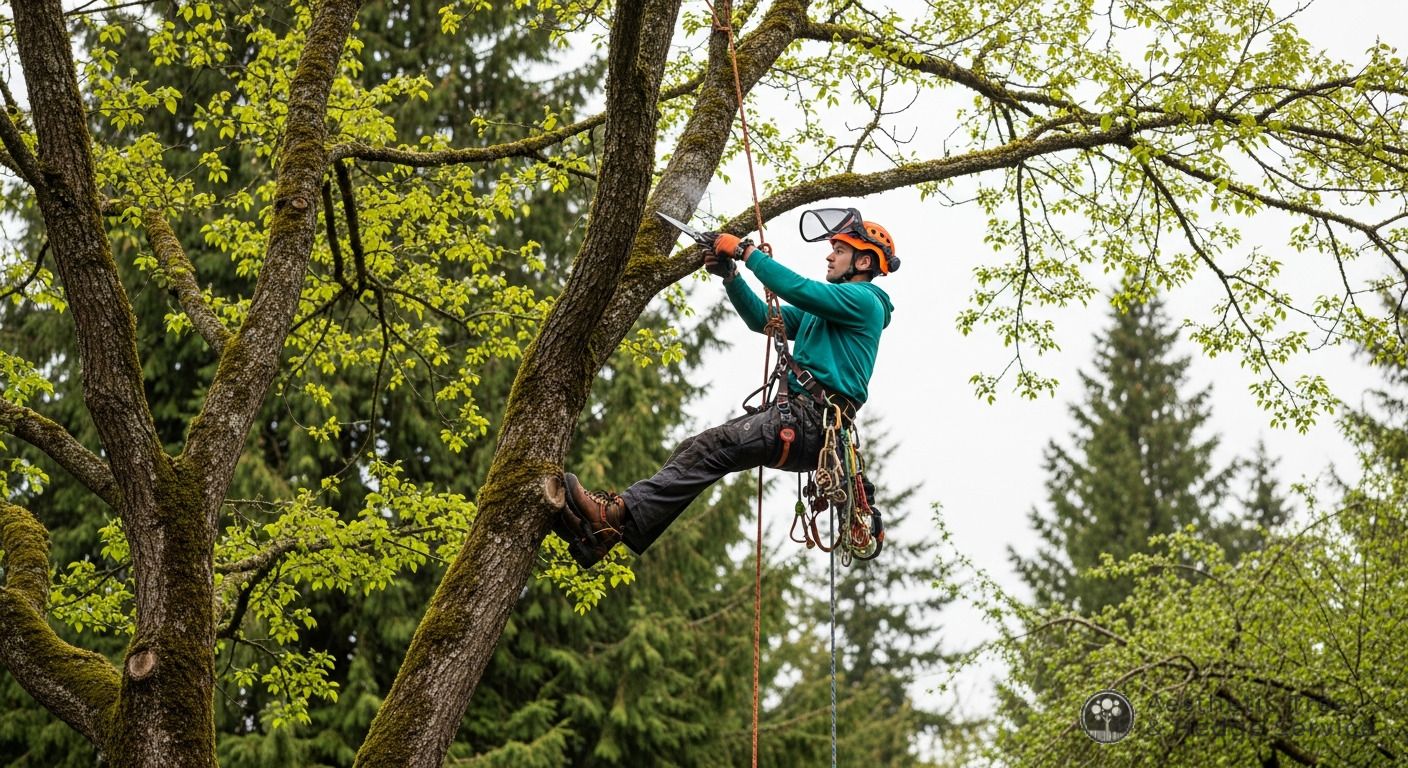
Suggested image: ISA-certified arborist inspecting a mature tree near a Vancouver property line.
What Are the Rules for Pruning and Hedge Trimming in Vancouver?
Routine pruning of your own private-property tree does not usually require a removal permit. But Vancouver's bylaw still prohibits damaging a tree, topping a tree, cutting roots improperly, or pruning in a way that creates risk to the tree's future health.
A qualified arborist does not treat 'pruning' as permission to remove half the canopy. Industry pruning work should follow recognized arboriculture standards, including ANSI A300 pruning practices. As a general rule, mature trees should not have an excessive portion of the living crown removed in one growing season unless a qualified arborist has a defensible reason.
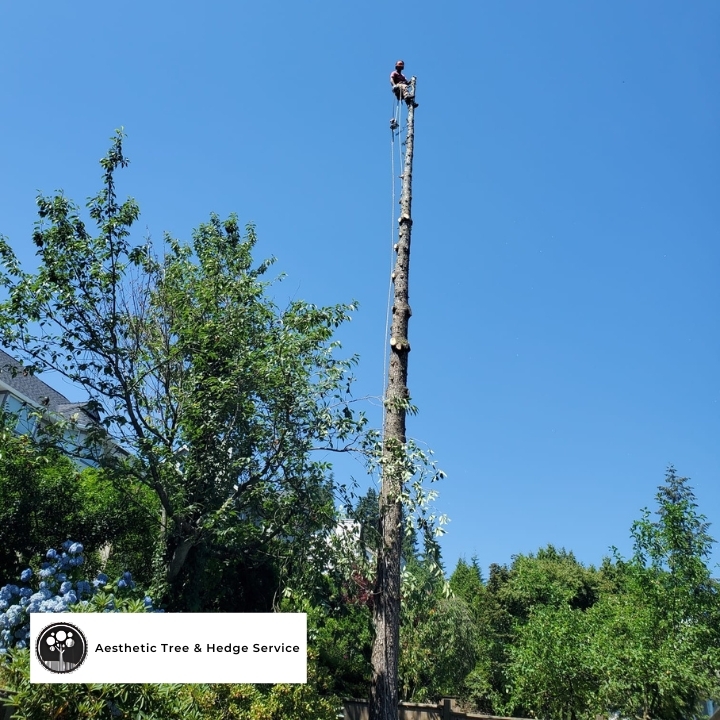
Topping is not proper pruning. Cutting a tree into a pole, stripping major laterals, or removing enough crown that the tree cannot recover can be treated as damage. That matters because Vancouver regulates harm to protected trees, not only complete removals.
Hedge Trimming
Hedge trimming is usually lower risk when the hedge is made of small stems maintained as shrubs. Mature cedar hedges, laurel rows, cypress screens, and older ornamental plantings can be different. They may include individual stems large enough to trigger tree-protection rules.
Before an aggressive hedge reduction, especially on an older cedar hedge, have an arborist check the stem sizes and structure. A hedge can look like one landscape feature while the bylaw treats individual stems as regulated trees.
What Happens If You Remove a Tree Without a Permit in Vancouver?
The consequences can be expensive, and the fine may not be the end of the matter.
Under Vancouver's Protection of Trees By-law, offences can carry fines and additional enforcement consequences. If more than one tree is affected, each tree can create a separate issue. The City may also require replacement planting, remediation, arborist documentation, or follow-up inspections.
Two misconceptions cause expensive problems:
- 'I'll just pay the fine.' The fine does not necessarily remove replacement or remediation obligations.
- 'The contractor did it, so it is not my problem.' The property owner is still responsible for ensuring site work complies with the bylaw.
The safer path is straightforward: arborist assessment, permit application where required, City decision, then removal if approved. Starting with a chainsaw creates avoidable risk.
Do Landscaping Rules Differ Across Burnaby, North Vancouver, Richmond, and Coquitlam?
Yes. Metro Vancouver does not have one uniform tree rule.
Municipal bylaws share a broad goal: protect mature trees, regulate removals, and require replacement where appropriate. But thresholds, exemptions, sensitive-area rules, replacement ratios, and application requirements differ.
City of Burnaby
Burnaby has its own tree bylaw and permit process. Protected-tree definitions, replacement requirements, and development-related tree rules should be checked before removal. Do not rely on Vancouver's 20 cm rule as a substitute for Burnaby's current requirements.
District of North Vancouver
The District of North Vancouver can be more restrictive because of steep slopes, watercourses, forested lots, and environmental development permit areas. Tree work that seems minor elsewhere may require review if the property sits near a stream, ravine, slope, or environmentally sensitive area.
City of North Vancouver
The City of North Vancouver is separate from the District and has its own tree rules. Homeowners should confirm the correct municipality before booking tree removal or major pruning.
City of Richmond
Richmond has its own tree-protection process, and properties near drainage features, ditches, riparian areas, or development sites may face added review. Flat land does not automatically mean simple approval.
City of Coquitlam
Coquitlam is a good example of why local checking matters. Coquitlam's rules are not identical to Vancouver's, and some ordinary private-property removals may be treated differently depending on the number of trees, location, sensitive-area status, and other restrictions.
The point is not that one city is easier or harder. The point is that the details change by municipality. A tree-removal plan that is legal in one Lower Mainland city may not be legal in another.
When Is an ISA-Certified Arborist Report Required?
More often than homeowners expect.
Often Required by the City or Another Authority
- Protected tree-removal permit applications
- Development permit or building permit applications where trees are on or near the site
- Tree impact assessments for excavation, demolition, subdivision, or rezoning
- Emergency-removal documentation after storm damage
- Hazard-tree assessments where safety is the reason for removal
Often Requested by Other Parties
- Insurance adjusters assessing storm or wind damage
- Strata councils reviewing landscaping work on common property
- Lawyers or mediators handling neighbour tree disputes
- Builders working inside a root protection zone
Strongly Advisable Even When Not Strictly Required
- Before pruning a large tree near a house, garage, lane, or neighbour's structure
- Before installing patios, retaining walls, driveways, or drainage near mature trees
- When buying a property with large trees close to the building envelope
- When a tree shows cracking, fungal growth, lean, deadwood, root disturbance, or canopy decline
An arborist report from an ISA-certified professional carries weight because it is a signed professional opinion, not a sales quote. The report documents condition, risk, species, DBH, location, recommended work, and the reason behind the recommendation.
In our field experience, the most expensive mistake is calling for a removal quote before confirming whether removal is legally available. The arborist report should come first because it tells you what options the City is likely to consider.
What Are the Rules for Trees Near Property Lines in BC?
Property-line trees sit at the intersection of BC common law and municipal tree bylaws.
The basic principles are:
- If the trunk is entirely on your property, you generally own the tree.
- If the trunk straddles the property line, it may be a boundary tree with shared ownership implications.
- You may generally prune encroaching branches and roots up to the property line.
- You cannot prune in a way that kills, destabilizes, or seriously damages the tree.
The municipal layer is where many disputes get complicated. If the tree meets Vancouver's protected-size threshold, damaging pruning can become a bylaw problem even if the branches crossed onto your side.
If you believe a neighbour's tree is hazardous, document it properly. A written ISA arborist assessment, photos, and dated communication create a record. If the tree later fails, that record can matter for insurance and liability.
For tree cutting near property boundaries, pre-work photos and a written scope are not bureaucracy. They are protection.
What Landscaping Work Requires BC Hydro Coordination?
Any tree work near overhead electrical equipment needs caution.
BC Hydro and WorkSafeBC clearance requirements can affect whether a private arborist can safely work near distribution lines, transformers, service drops, or transmission corridors. The exact rules depend on the line type, voltage, work method, and site conditions.
As a homeowner, do not guess. If a tree touches or grows close to overhead lines, contact BC Hydro before hiring a private crew. Many arborists will not enter utility clearance zones unless BC Hydro has assessed the site or completed utility-side pruning first.
A practical sequence is:
1. Identify whether the tree is near service, distribution, transformer, or transmission equipment. 2. Contact BC Hydro or the appropriate utility for direction. 3. Let the utility handle or clear the utility-side risk where required. 4. Have ISA-certified arborists complete the remaining private-property work once the site is safe and authorized.
Emergency tree removal near power lines is especially serious. Speed does not override electrical safety. If a damaged tree is touching lines, treat it as a utility emergency, not a normal tree-service call.
Suggested image: Arborist assessing a tree from a safe distance where overhead lines are present.
What Are the Rules for Stump Removal After a Permitted Tree Removal?
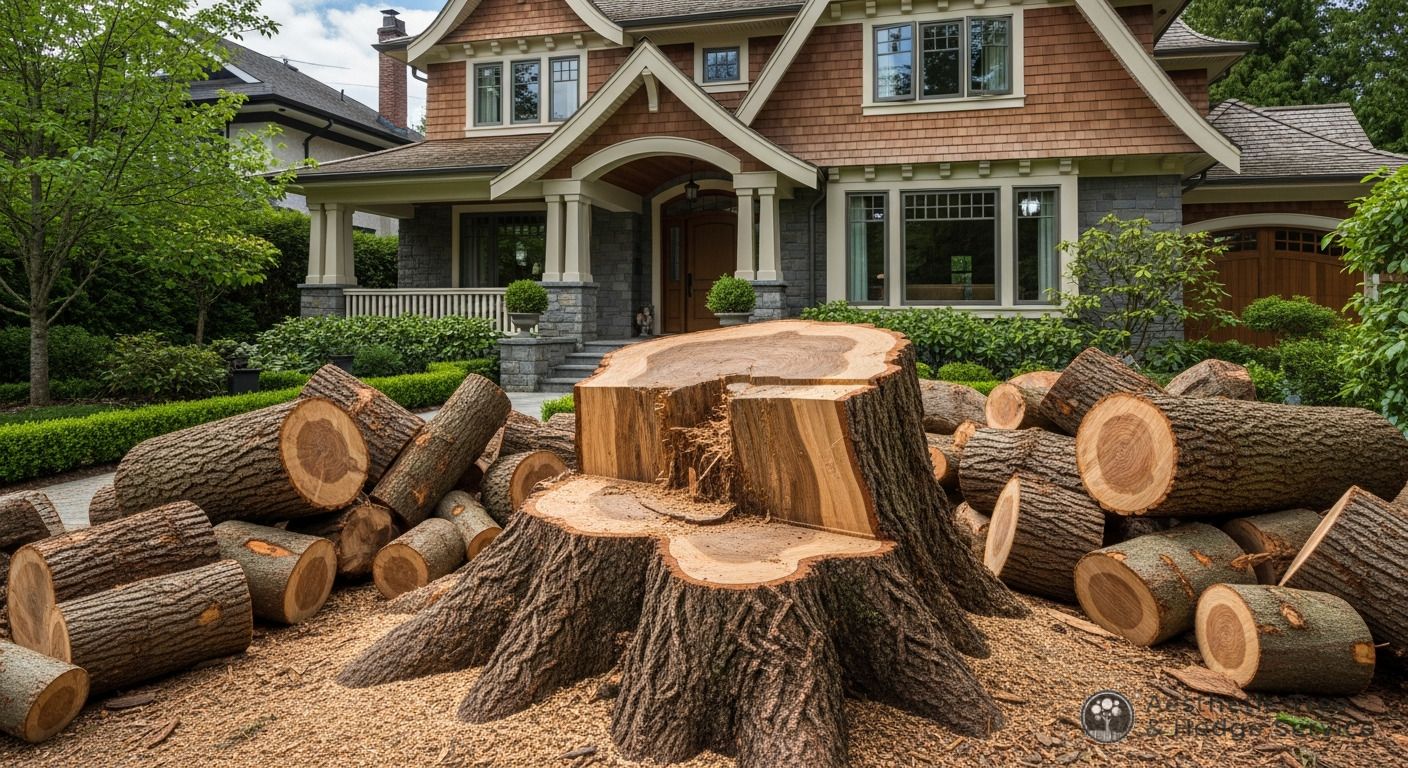
After a permitted tree removal, stump grinding is usually straightforward. The tree has already been approved for removal, and grinding the remaining stump normally does not require a separate tree-removal permit.
Root work near living protected trees is different.
Vancouver's bylaw protects trees from damage, and that includes roots. Excavating, cutting, compacting soil, changing grade, trenching, or chemically treating roots near a living protected tree can damage the tree even if the trunk is untouched.
For construction and renovation projects, work near protected trees may require a Tree Protection Plan, protection barriers, arborist supervision, and approved excavation methods. Root zones are not decorative. They are part of the living structure of the tree.
Stump grinding after permitted removal and root excavation beside a protected living tree are completely different jobs. Confirm which situation you are in before work starts.
Ready to Handle Your Tree Work the Right Way?
Whether you need a permit application, an arborist report, pruning guidance, hedge trimming, stump grinding, emergency tree work, or full tree removal, Aesthetic Tree & Hedge Services can help you assess the tree, document the condition, and complete the work properly.
We are ISA-certified arborists, WCB registered, and licensed to work across Vancouver, Burnaby, North Vancouver, Richmond, Coquitlam, and the Lower Mainland.
Call for a free estimate: (604) 721-7370
FAQ
Do I need a permit to prune branches off my own tree in Vancouver?
Usually, no. Routine pruning of your own private-property tree does not require a removal permit. But pruning must not damage the tree, top it, remove excessive live crown, or create future health risk. If the tree is large, near a structure, or close to a property line, get an arborist assessment first.
What is the minimum tree size protected in Vancouver?
Vancouver's Protection of Trees By-law applies to many private-property trees with a diameter of 20 cm or more, measured 1.4 m above grade. Smaller trees may still matter if they are replacement trees or part of an approved development landscape plan. Street trees are City assets and should not be touched without authorization.
Can I remove a dead tree without a permit in Vancouver?
Do not assume so. If the tree is protected-size, Vancouver's bylaw provides a permit pathway for dead or dying trees based on arborist certification or proof acceptable to the City. Emergency removal is allowed only in specific hazardous situations caused by natural damage, and a permit application must follow within 24 hours or the next business day after a weekend or holiday.
Can I trim branches from my neighbour's tree that hang over my yard?
You can generally trim encroaching branches up to the property line, but you cannot damage the tree or compromise its structure. If the tree is protected-size, excessive pruning can also create bylaw risk. For meaningful pruning near a boundary, document the work with an ISA arborist.
What happens if a tree on my property falls and damages my neighbour's house?
Liability depends on what was known or reasonably knowable about the tree's condition. If the tree had obvious decay, major lean, root damage, or previous failure signs that were ignored, liability risk increases. A current arborist report showing the tree was assessed and managed responsibly can help protect you.
How do I find out if my tree has special status?
Start with the City of Vancouver's tree-permit resources and property records, then have an ISA-certified arborist assess the tree on site. An arborist can document species, DBH, location, health, risk, and whether the tree is likely to require City review before work begins.
Before You Go
Where are you in your tree care journey?
Our Tree Care Services
ISA-certified arborists serving Greater Vancouver
Related Articles
Explore Our Tree Care Services
From expert pruning to safe tree removal, our ISA-certified arborists are ready to help across Greater Vancouver.
View Services