
TL;DR — Quick Summary
Why hire a professional for tree removal? One wrong cut risks your roof, a $10,000 bylaw fine, and a denied insurance claim. ISA-certified arborists explain.
Why hire a professional for tree removal? Because one wrong cut can cost you a roof, a neighbor's car, and a $10,000 bylaw fine — sometimes all at once.
Every spring in Vancouver, homeowners look at an overhanging fir or a tired old cedar and think: how hard can this be? One tree, one chainsaw, one afternoon. Then reality shows up.
Tree removal is genuinely one of the most dangerous jobs in North America. It's regulated in most Lower Mainland municipalities. And the gap between what a homeowner can do safely and what a trained arborist does is wider than most people realize.
This guide walks through the real risks, the real rules, and what a certified arborist does that a weekend and a rented chainsaw simply can't replicate.
TL;DR
- Tree removal is ranked among the **top 10 most dangerous occupations** in North America, per OSHA — even for trained professionals
- Vancouver's **Protection of Trees Bylaw No. 9958** requires permits for most mature tree removals; fines run up to **$10,000 per tree**
- **ISA-certified arborists** follow ANSI A300 industry standards — a baseline homeowners aren't trained to meet
- **WCB-registered companies** protect you from personal liability if a worker is injured on your property
- Professional teams assess lean, root tension, power line proximity, and drop zones before any cut — skills built through years of supervised field work
---
Is Tree Removal Really That Dangerous? The Data Says Yes.
This isn't a scare tactic. It's documented.
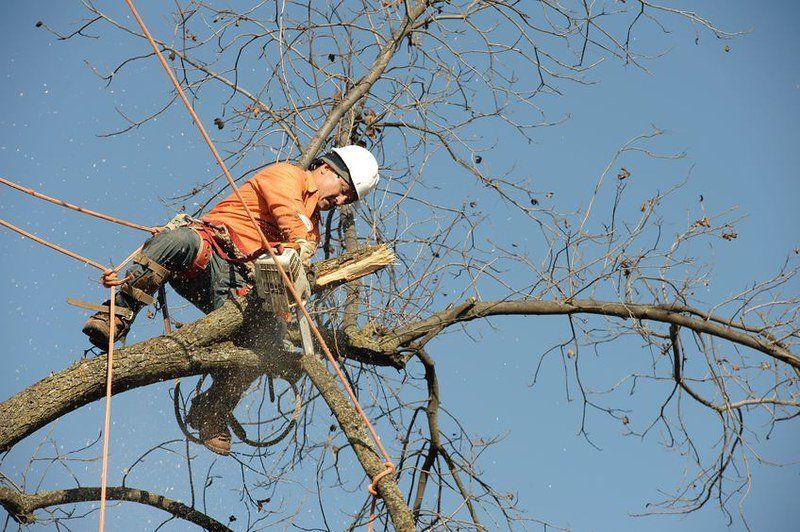
According to the **Occupational Safety and Health Administration (OSHA)**, tree care work is consistently rated one of the top 10 most hazardous occupations in North America. OSHA's Tree Care Hazard Alert identifies four primary injury mechanisms: falls from height, chainsaw contact, struck-by incidents from falling limbs, and electrocution from contact with energized power lines.
In British Columbia, **WorkSafeBC's 2023 Annual Report** identifies the agricultural, forestry, and resource extraction sector as having one of the highest serious-injury claim rates per 100 workers in the province. Falling trees and limbs contribute heavily to that number.
Here's what makes that data striking: those injuries happen to trained professionals. People wearing cut-resistant chaps, using engineered rigging systems, and working with years of supervised climbing experience behind them.
A homeowner with a borrowed chainsaw is not starting from that baseline.
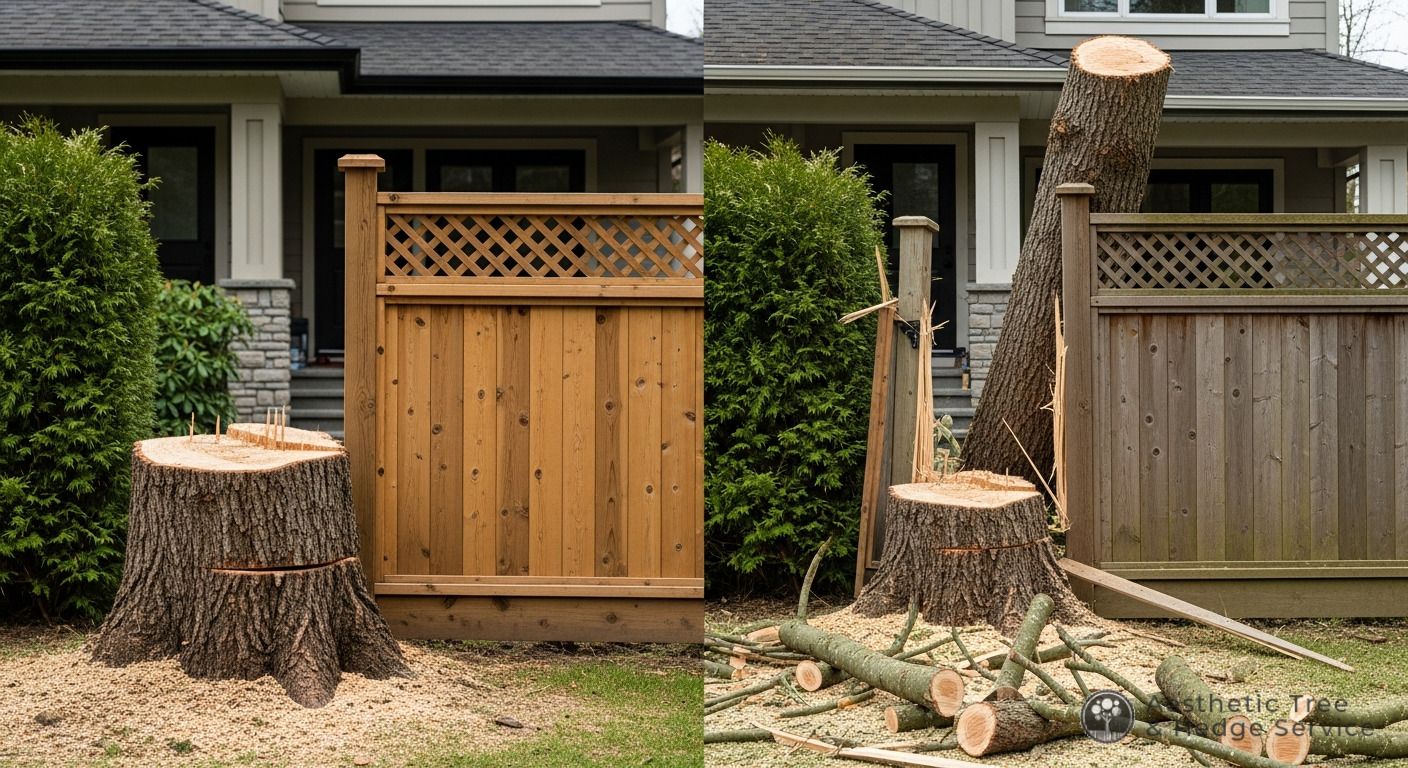
The physics of tree falling are also counterintuitive. A mature Douglas fir can weigh between 10,000 and 40,000 pounds depending on height and diameter. When a cut goes even slightly wrong, the energy stored in the tree's natural lean or root-system tension releases in unpredictable directions. Professionals call this "barber-chairing" — when a trunk splits vertically under tension rather than falling cleanly. It's sudden. It's violent. And it happens faster than anyone can step clear.
The most experienced arborists in Vancouver still treat every felling as a high-consequence operation. That's the right level of respect for the work.
---
What Goes Wrong When Homeowners Remove Trees Themselves?
Most DIY tree removal injuries don't happen at dramatic moments. They happen during setup. During a small, confident cut. During the moment someone decides they've got this.
Here are the specific failure modes we see most often in the Lower Mainland:
**Misjudging the lean.** A tree that looks like it leans away from the house often has root-system tension that redirects the fall. Certified arborists use a plumb bob, bore cuts, and a careful read of the crown to establish actual lean. Most homeowners skip this assessment entirely.
**No planned escape route.** ANSI A300 felling standards require a clear escape route — a 45-degree path away from the intended fall zone — before any cut is made. Homeowners typically don't plan this step. When a tree starts moving in an unexpected direction, there's nowhere to go.
**Power line contact.** Metro Vancouver lots frequently have BC Hydro overhead lines running along back lanes. A branch or trunk contacting a live line causes electrocution, fire, or neighborhood-wide outages. BC Hydro requires notification before any work near energized lines. Professional tree crews know this protocol and follow it.
**Damage to neighboring properties.** If your removal drops a tree across your neighbor's fence, vehicle, or structure, you're responsible. Whether your insurance covers it depends on the circumstances of how the work was done — more on that in the insurance section below.
**The stump problem.** Cutting the tree down is only the first step. A stump left in place continues to rot, attracts carpenter ants and other wood-boring pests, and creates a tripping hazard over time. Root systems from poorly handled removals can continue to heave pavement or compromise foundation drainage for years. Professional stump grinding in Vancouver removes the stump and surface roots cleanly — not just cuts the tree at grade level and walks away.
**Permit violations.** This is the surprise that catches homeowners off guard. In Vancouver, removing a mature tree without the required permit isn't just inadvisable. It's illegal — and the penalties reflect that.
---
Do You Need a Permit to Remove a Tree in Vancouver?
In most cases, yes. And this applies to trees on your own private property.
The **City of Vancouver's Protection of Trees Bylaw No. 9958** requires a permit to remove any tree with a trunk diameter of **20 centimetres or more** at 1.4 metres above grade. That covers the majority of mature trees on residential lots across Vancouver.
The bylaw isn't limited to full removal either. It covers significant pruning and any work that damages or destroys a protected tree's root system within the drip line.
Municipalities across the Lower Mainland have parallel bylaws with slightly different thresholds:
- **Burnaby:** Trees 20 cm DBH or larger on private property require a permit
- **North Vancouver District:** Protected trees 30 cm DBH or greater; permit required before removal
- **Coquitlam:** Significant trees at 30 cm DBH or larger need a city-issued permit
- **Richmond:** Managed tree protection policy; significant removals require city approval and documentation
The penalties for unauthorized removal are serious. In Vancouver, removing a protected tree without a permit can result in fines of **up to $10,000 per tree**. The City may also require replacement planting — sometimes at a ratio of multiple trees per tree removed — which adds cost and complication.
There are exemptions: trees posing imminent hazard, emergency situations, and trees removed under active development permits. But the exemption process requires documented technical justification — which is exactly what an arborist report provides. A formal hazard assessment from a certified arborist gives the City the documented basis for expedited permit approval when a tree is genuinely dangerous.
When you hire a professional arborist, the permit process is part of the job. They know which municipality you're in, what the size threshold is, what documentation is required, and how to file. You don't navigate this alone.
---
What Does an ISA-Certified Arborist Actually Do Differently?
Certification from the **International Society of Arboriculture (ISA)** is not a marketing credential. It requires passing a comprehensive examination covering tree biology, soil science, disease and pest diagnosis, pruning and removal techniques, cabling and bracing, and safety protocols. Maintaining the certification requires ongoing continuing education to keep pace with updated research and standards.
In practice, here's what that training difference looks like on your property:
**Site assessment before any cut.** A certified arborist walks the entire site before equipment comes out. They check soil saturation — a real variable in Vancouver's wet winters, where saturated soil dramatically affects root plate stability. They identify structural defects like co-dominant stems, included bark, or visible decay. They confirm the fall zone and assess power line proximity. They think through what happens if something goes wrong — and plan around that scenario.
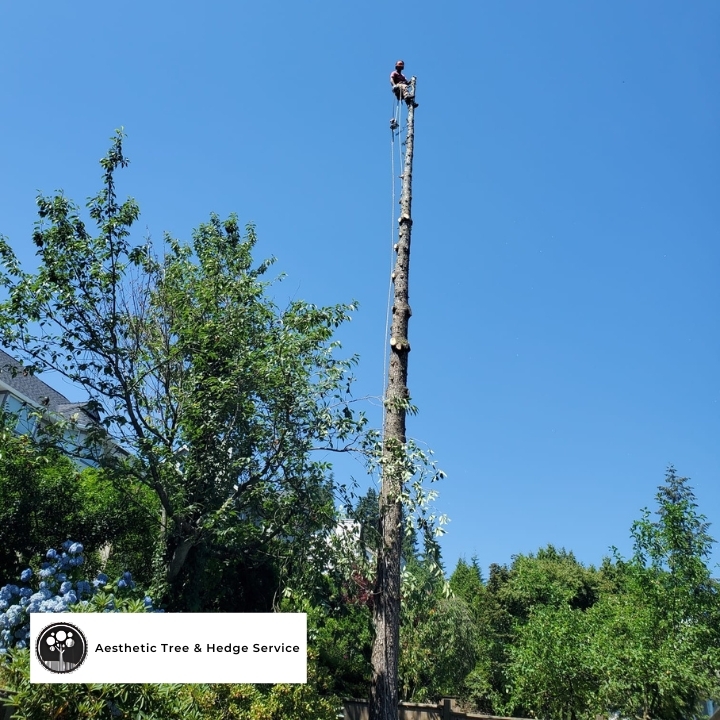
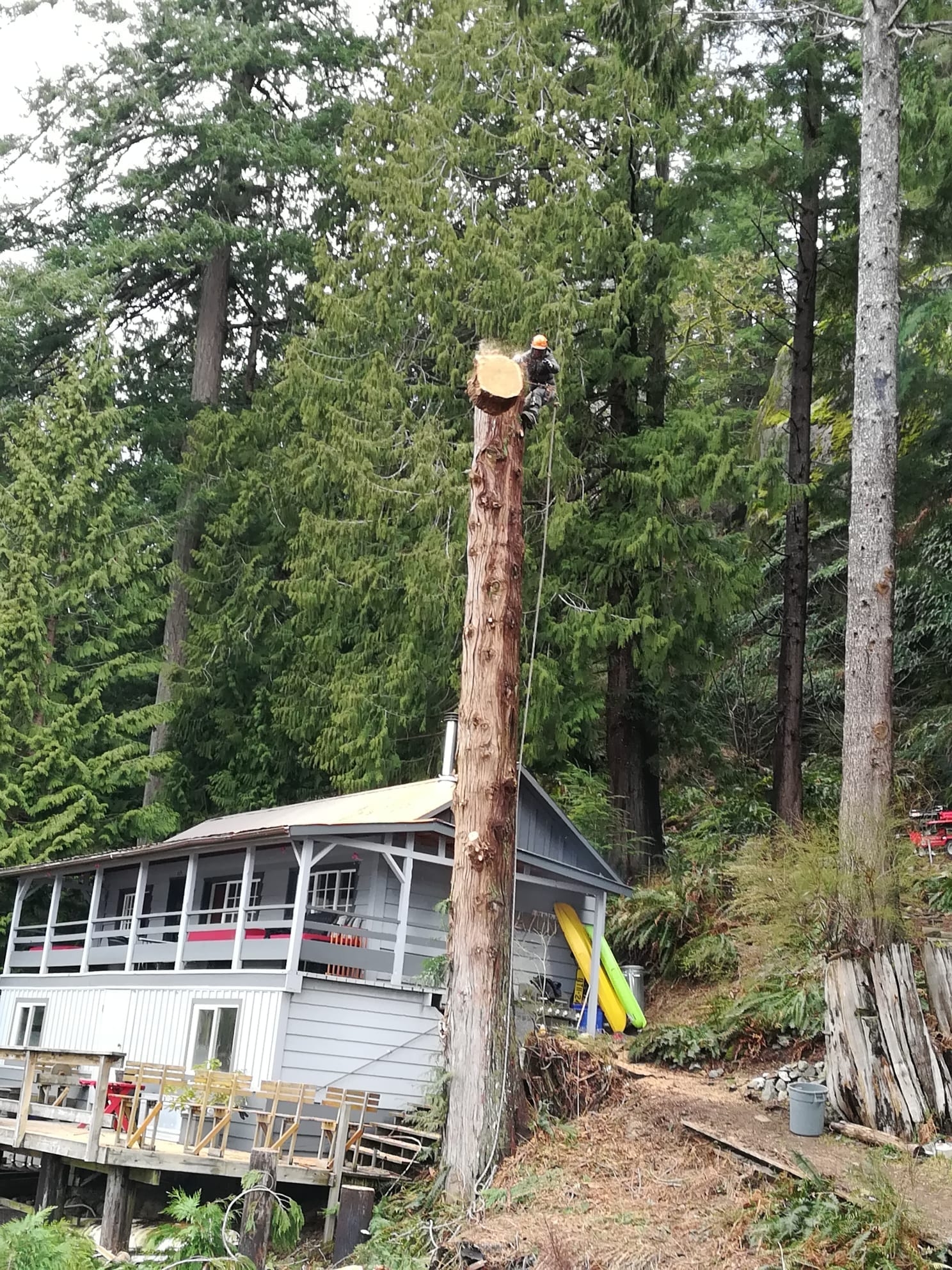
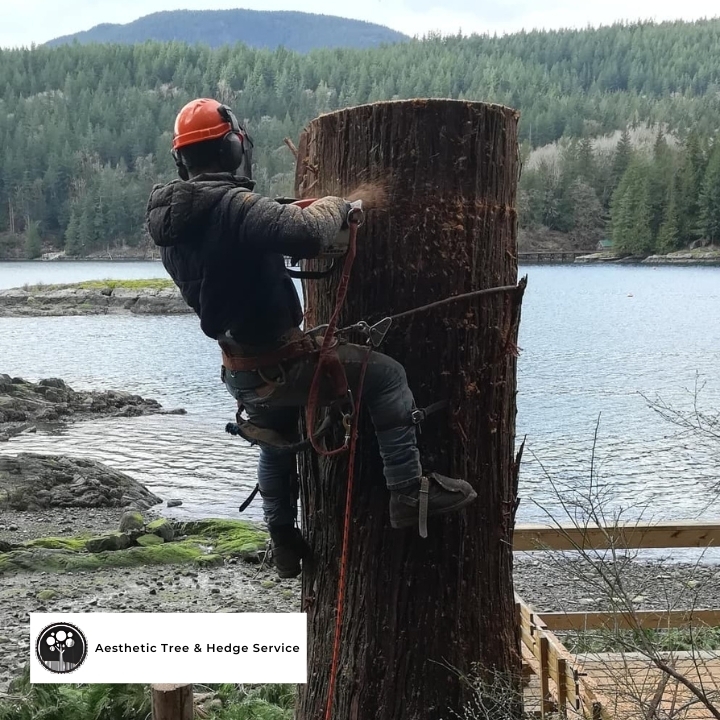
**Rigging and controlled lowering.** For trees near structures — which describes most residential trees in Metro Vancouver's dense neighborhoods — the full trunk cannot be felled in one piece. Professionals section the tree from the top down, using rigging systems to lower each section in control rather than dropping it. The equipment includes friction devices, redirect blocks, and load-rated ropes. For larger or access-constrained removals, we deploy crane tree removal equipment to lift sections safely over structures with zero ground-impact risk.
**ANSI A300 standards.** These are the industry benchmarks for professional tree care in North America. They define how trees should be pruned, what constitutes a proper cut, how structural hazards should be assessed, and how removal operations should be planned and sequenced. ISA-certified arborists are trained to these standards. Homeowners have no equivalent framework to work from.
**WCB (WorkSafeBC) registration.** If a tree worker is injured on your property and the company is not WCB registered, the liability can fall to you as the property owner. This isn't a theoretical scenario — WorkSafeBC takes unregistered employer situations seriously. Aesthetic Tree & Hedge Services carries current WCB registration, which protects both our crew and you.
**Cleanup and wood management.** Professional removal doesn't end at the cut. All debris, chips, and surface material are cleared. We also offer mulching services that convert chipped wood into usable garden mulch — keeping the material on your property as a soil amendment rather than sending it to landfill.
---
How Does Insurance Work When Something Goes Wrong?
This is where a lot of homeowners make a costly assumption.
If a tree falls on your structure during a storm or other natural event, your standard homeowner's insurance typically covers the structural damage — subject to your deductible and policy terms. Fallen tree damage from weather events is a standard covered peril under most policies.
If a tree falls on your structure during a DIY removal — or a removal performed by an uninsured contractor — the situation changes. The **Insurance Bureau of Canada (IBC)** has published guidance noting that claims arising from unauthorized alterations or work performed without required permits or proper licensing can be disputed or denied under standard homeowner's policies.
Before starting any tree work, ask your insurance provider directly: "If I remove a tree myself without a permit and something goes wrong, am I covered for property damage and personal liability?" Ask it explicitly. Get the answer before the work starts, not after.
Now factor in the full picture: your deductible, the possibility of a disputed claim, your neighbor's damaged vehicle or fence, and the out-of-pocket cost if an unregistered worker gets injured on your property. The math changes quickly.
Hiring a WCB-registered, fully insured professional closes all of these gaps at once. Aesthetic Tree & Hedge Services carries general liability insurance and WCB registration. If something unexpected happens during our work — which is extremely rare when done correctly — the coverage framework is already in place before any equipment leaves the truck.
---
What Equipment Does Professional Tree Removal Actually Require?
This is the question that clarifies how wide the gap really is.
A professional tree crew doesn't just bring a better chainsaw. They bring a full, purpose-built equipment set designed for working in complex, high-consequence environments:
- **Climbing saddles, ascenders, and lanyards** rated specifically for arborist use — not general construction climbing gear
- **Rigging blocks, ropes, and friction devices** engineered for controlled descent of heavy wood sections
- **Cambium savers** to protect bark at redirect points during rope rigging
- **Industrial wood chippers** that reduce debris to chips on-site, rather than leaving a yard full of brush
- **Stump grinders** capable of cutting 12 or more inches below grade
- **Cranes** for large or access-constrained removals
- **Full PPE:** cut-resistant chaps, arborist helmets with integrated face shields and ear protection, safety glasses, and steel-toed boots
That list is not optional equipment. It's the minimum setup for performing the work safely.
According to **Health Canada's 2022 Consumer Product Safety Report**, chainsaws account for thousands of emergency room visits annually across Canada. The majority of those injuries involve non-professionals using borrowed or rental equipment — most without cut-resistant protective gear of any kind.
The rental chainsaw doesn't come with the technique to use it safely at height, under a falling crown, or near energized power lines. The equipment is only as safe as the person operating it.
---
When Should You Call for Emergency Tree Service?
Some tree situations don't allow for scheduling and comparison shopping.
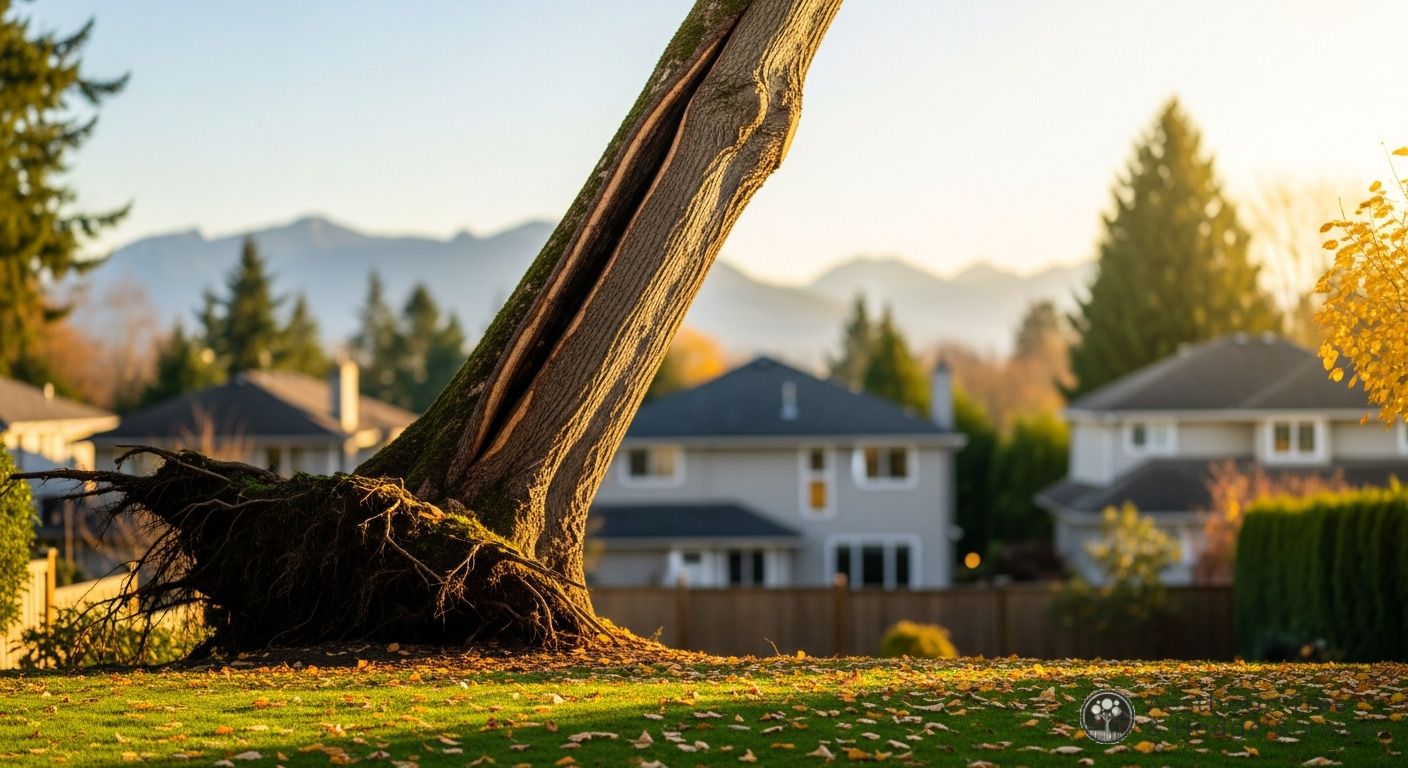
A windstorm drops a large limb across your driveway at midnight. Root heave from saturated soil causes a cedar to lean toward your roofline. A branch cracks partially through and hangs — held by a strip of bark — directly over your children's play area.
These situations call for emergency tree service, not a scheduled estimate appointment.
Common emergency scenarios we see across the Lower Mainland:
- Wind damage snapping co-dominant stems on Big-leaf maples — one of the most common tree structures in Metro Vancouver's residential neighborhoods
- Root plate failure on Western red cedars during prolonged rain events, when soil saturation reduces the friction and cohesion that holds shallow root systems in place
- Storm-damaged branches hanging partially attached — what arborists call "widow-makers" — which can release suddenly and without warning
- Sudden lean development in trees with active root rot or internal decay, where external appearance doesn't reflect structural failure
The critical instruction for any widow-maker or actively leaning tree: don't park or walk under it, and don't attempt to cut the partially-attached branch yourself. The load release is unpredictable. A professional assesses the approach first — before any equipment comes near the hazard.
Our emergency response team covers Vancouver, Burnaby, North Vancouver, Richmond, and Coquitlam for active hazard situations.
---
What About Hedge Trimming, Pruning, and Smaller Tree Work?
Not every job requires full removal. But not every smaller job is as low-risk as it looks, either.
Pruning a mature tree incorrectly causes long-term structural damage. Flush cuts that remove the branch collar strip the tree of its natural wound-closure chemistry. Lion-tailing — stripping the interior canopy of smaller branches — moves weight distribution to the branch ends, increasing wind-load stress and the likelihood of storm failure. Topping creates large wounds that the tree can't close, produces fast-growing but weakly attached epicormic shoots, and sets up future hazards rather than solving current ones.
In Vancouver's urban forest, these mistakes matter. Big-leaf maples, Douglas firs, and Western red cedars all respond badly to improper cuts. A topped Douglas fir produces vigorous epicormic shoots that look like recovery but are structurally weak — and significantly more likely to fail in the next major windstorm.
For hedges, the right cut angle and timing depend on the specific species. English laurel, cedar, and Portuguese laurel — three of the most common hedge plants in Metro Vancouver — each have different growth patterns and different tolerances for aggressive cutting. Improper timing or angle creates dead patches that take seasons to fill in, if they ever do. Our hedge trimming services are designed around species-specific growth patterns, not a generic "make it flat" approach.
The ANSI A300 pruning standard is straightforward on scope: stay on the ground with hand tools for low-hanging branches. Anything above 10 feet with power equipment — or any work involving a ladder and a chainsaw — requires proper fall protection and trained technique. This isn't excessive caution. It's the outcome of decades of injury data.
For a deeper look at what professional pruning actually involves, our guide to understanding arborists in Vancouver covers the technical side in detail.
---
How Do You Choose a Qualified Tree Removal Company in Vancouver?
Not every company with a truck and a chainsaw is a qualified arborist. Here's what to verify before anyone sets foot on your property:
**ISA Certification.** Ask if the arborists performing your work are ISA-certified — not just the company owner, but the people on the crew. The ISA maintains a public verification directory at isacertified.com where you can confirm credential status by name.
**WCB Registration.** Request the company's WCB account number and verify it at worksafebc.com. This takes two minutes and protects you from liability if an unregistered worker is injured during the job.
**General liability insurance.** Ask for a certificate of insurance showing active coverage. The minimum for professional tree work is $2 million in general liability. Ask specifically whether the policy covers tree work — some general contractor policies exclude it.
**Written, itemized estimate.** Any legitimate tree company provides a written estimate specifying scope of work, cleanup, stump handling, and disposal. Verbal estimates leave room for scope disputes. If a company won't put it in writing, that's your answer.
**No suggestion to skip the permit.** If a company recommends removing a protected tree without pulling the required city permit, walk away. They're exposing you to fines and eliminating the legal protection of a permitted work order — and telling you something about how they operate generally.
For more detail on evaluating and choosing tree services in the area, our arborists near me guide for Vancouver covers the full checklist.
---
FAQ
**Q: Do I need a permit to remove a dead tree in Vancouver?** A: In most cases, yes. The City of Vancouver's Protection of Trees Bylaw No. 9958 applies to trees 20 cm DBH or larger regardless of health status. Dead trees are not automatically exempt from the permit requirement. A certified arborist can document the tree's condition in a formal arborist report, which supports expedited permit approval when the tree poses a genuine hazard.
**Q: What's the most dangerous mistake homeowners make during DIY tree removal?** A: Underestimating lean and drop zone. A tree that "clearly leans away from the house" often has root-system tension that redirects the fall toward the structure. Professional arborists use plumb bobs, bore cuts, and wedge placements to control the fall direction. These techniques take years of supervised practice to execute safely.
**Q: Will my homeowner's insurance cover damage if I remove a tree myself and something goes wrong?** A: Not necessarily. The Insurance Bureau of Canada notes that claims arising from unlicensed or unpermitted work can be disputed under standard homeowner's policies. Ask your provider directly — before the work starts — whether DIY tree removal is a covered activity under your specific policy. Hiring a WCB-registered, insured company removes this ambiguity entirely.
**Q: How long does professional tree removal take?** A: It depends on the tree's size, location, and site access. A straightforward removal of a small-to-medium tree in an open area can take two to four hours. A large tree close to a structure — or one requiring crane work — can take a full day. Your arborist gives you a realistic time estimate during the on-site assessment.
**Q: Can I keep the firewood after my tree is removed?** A: Yes, in most cases. If you want firewood, tell your arborist before the job starts. They can cut the trunk into manageable rounds and leave them on-site rather than chipping everything. Keep in mind that green wood from a freshly removed tree needs six to twelve months of split-and-stacked drying before it burns efficiently.
---
Ready to Talk to a Certified Arborist?
Tree removal rewards the professionals who take it seriously. The risks — to your safety, your home, your neighbors, and your standing with the municipality — are real and documented.
Aesthetic Tree & Hedge Services brings ISA-certified arborists, WCB registration, and years of experience working with the mature urban trees and tight residential lots that define Vancouver's neighborhoods. We know the bylaws, we handle the permits, and we show up with the right equipment for the job.
Call us for a free estimate: **(604) 721-7370**. ISA-certified. WCB registered. Serving Vancouver, Burnaby, North Vancouver, Richmond, and Coquitlam.
Before You Go
Where are you in your tree care journey?
Our Tree Care Services
ISA-certified arborists serving Greater Vancouver
Explore Our Tree Care Services
From expert pruning to safe tree removal, our ISA-certified arborists are ready to help across Greater Vancouver.
View Services