TL;DR — Quick Summary
Tree removal Vancouver guide covers permit fees, bylaw fines up to $20,000, real cost data from HomeStars, and how to hire ISA-certified arborists safely.
Tree removal in Vancouver is not a weekend project. It is a regulated process governed by municipal bylaws, safety legislation, and — if the tree is large enough — a formal permit application that costs money, takes weeks, and requires an arborist report before you touch a branch.
We have handled thousands of removals across Metro Vancouver over the years. What we see again and again: homeowners who call us after they've already made a costly mistake. They removed a tree without a permit and got hit with a fine. They hired an unregistered crew and discovered they're personally liable for a workplace injury. They waited through three winter storms with a dead hemlock leaning toward their roof because they assumed removal would cost $5,000 when it actually cost $900.
This article gives you the facts. Real permit fees. Real cost ranges from third-party data. Real bylaw consequences. And a clear process for getting the job done right.
TLDR: 5 Key Takeaways
- You need a permit to remove any tree with a trunk diameter of 20 cm or more on private property in Vancouver. The first permit costs $113; each additional tree costs $324 within the same 12-month period (City of Vancouver).
- Removing a tree without a permit can result in fines of $1,000 to $20,000 per tree under Bylaw 9958, plus mandatory replanting at your expense.
- Tree removal in Vancouver costs between $200 and $8,600, depending on size, species, access, and proximity to structures (HomeStars, 2026).
- Always verify WorkSafeBC registration. If a tree crew isn't registered, you — the homeowner — can be held liable if a worker is injured on your property.
- Winter removals (December through February) are typically 10-20% cheaper because demand drops, giving you better scheduling flexibility and lower prices.
How Do You Know When a Tree Actually Needs to Come Down?
Not every problem tree requires removal. In many cases, strategic tree pruning can address hazardous limbs, restore structure, or extend the tree's useful life by years. Pruning is less expensive, less disruptive, and preserves your property's canopy — which the City of Vancouver is actively trying to expand.
But some trees are past the point of intervention. Here are the situations where removal is the responsible choice:
Dead or dying trees. A tree that has lost more than 50% of its crown, shows extensive bark separation, or has fungal fruiting bodies (shelf fungi, mushrooms) growing at its base is structurally compromised. Dead trees become brittle and unpredictable. During Vancouver's November and December windstorms — which in 2024 alone knocked out power to over 1.4 million BC Hydro customers, the most in the utility's history (BC Hydro, February 2025) — a dead tree near your home is not a theoretical risk. It is an active hazard.
Sudden lean or major structural cracks. A tree that has developed a new lean after a storm, or one with visible cracks at major branch unions or in the trunk, may fail without warning. This is different from a tree that has always grown at an angle — sudden lean indicates root failure or internal decay.
Root systems damaging foundations or infrastructure. Mature trees, especially species like bigleaf maple and poplar, can develop root systems that lift foundations, crack driveways, buckle sidewalks, and invade sewer lines. When root pruning isn't sufficient, full removal may be the only option.
Disease or pest infestation beyond treatment. Laminated root rot, a common fungal disease in Pacific Northwest conifers, can destroy a tree's structural integrity from the inside while the crown still looks green. Bronze birch borer, Asian long-horned beetle, and other pests can kill susceptible species within a few seasons. An ISA-certified arborist can identify these conditions through a systematic tree risk assessment.
Construction or development requirements. Sometimes a healthy tree sits directly in the footprint of a new addition, laneway home, or garage. In Vancouver's construction-active neighbourhoods — from Dunbar to East Vancouver, from Mount Pleasant to Hastings-Sunrise — this is a common scenario. The tree may be perfectly sound, but the building permit requires its removal.
Storm damage beyond recovery. After a major weather event, some trees lose so much canopy that they cannot recover a stable form. A topped or shattered crown will not grow back safely. BC Hydro reported that over half of all power outages in the province are caused by trees and vegetation contacting electrical infrastructure (BC Hydro, 2024). Drought-weakened trees across BC have made this problem worse: years of below-normal rainfall have left root systems shallow, trunks stressed, and branches brittle.
If you're unsure, the safest first step is an on-site assessment from an ISA-certified arborist. They evaluate the tree's species, condition, structural integrity, and risk level using standardized methods — including the ISA Tree Risk Assessment Qualification (TRAQ) protocol. Contact us to schedule one.
What Does Vancouver's Tree Protection Bylaw Actually Require?
The City of Vancouver's Protection of Trees Bylaw (No. 9958) is one of the stricter urban tree bylaws in Canada. Understanding it before you call a tree service will save you time, money, and potentially thousands of dollars in fines.
Do you need a permit?
If the tree is on private property and has a trunk diameter of 20 centimetres (approximately 8 inches) or more, measured at 1.4 metres above the ground (a measurement called DBH — diameter at breast height), you need a permit before removing it. That 20 cm threshold catches most mature trees. If you're unsure, measure the trunk's circumference — 64 cm circumference equals 20 cm diameter.
What does a permit cost?
The City of Vancouver charges $113 for the first tree removal permit in a 12-month period and $324 for each additional tree in the same period (City of Vancouver, current fee schedule). These fees cover the application and inspection process.
You will also need an arborist report from an ISA-certified arborist, which typically costs $200 to $500 depending on the scope. The report documents the tree's species, condition, reason for removal, and proposed replacement planting.
How long does the permit take?
Plan for 10 to 21 business days after the Urban Forestry Department receives a complete application. An urban forestry inspector may visit your property to assess the tree in person. If the tree is dead or poses an imminent hazard, you may qualify for an expedited review — but "imminent" means documented, immediate danger, not just inconvenience.
Your permit is valid for six months from the date of issue. If you don't complete the removal within that window, the permit expires and you must reapply.
What happens if you remove a tree without a permit?
Fines under Bylaw 9958 range from $1,000 to $20,000 per tree (City of Vancouver). The city can also issue stop-work orders and require you to plant replacement trees at your own expense — sometimes at a 2:1 ratio (two new trees for every one removed) at the Director of Planning's discretion.
These are not hypothetical penalties. Vancouver's Urban Forestry department actively investigates reports of unauthorized tree removal. Neighbours notice. Inspectors follow up. And the fines apply even if you didn't know about the bylaw.
What about replacement trees?
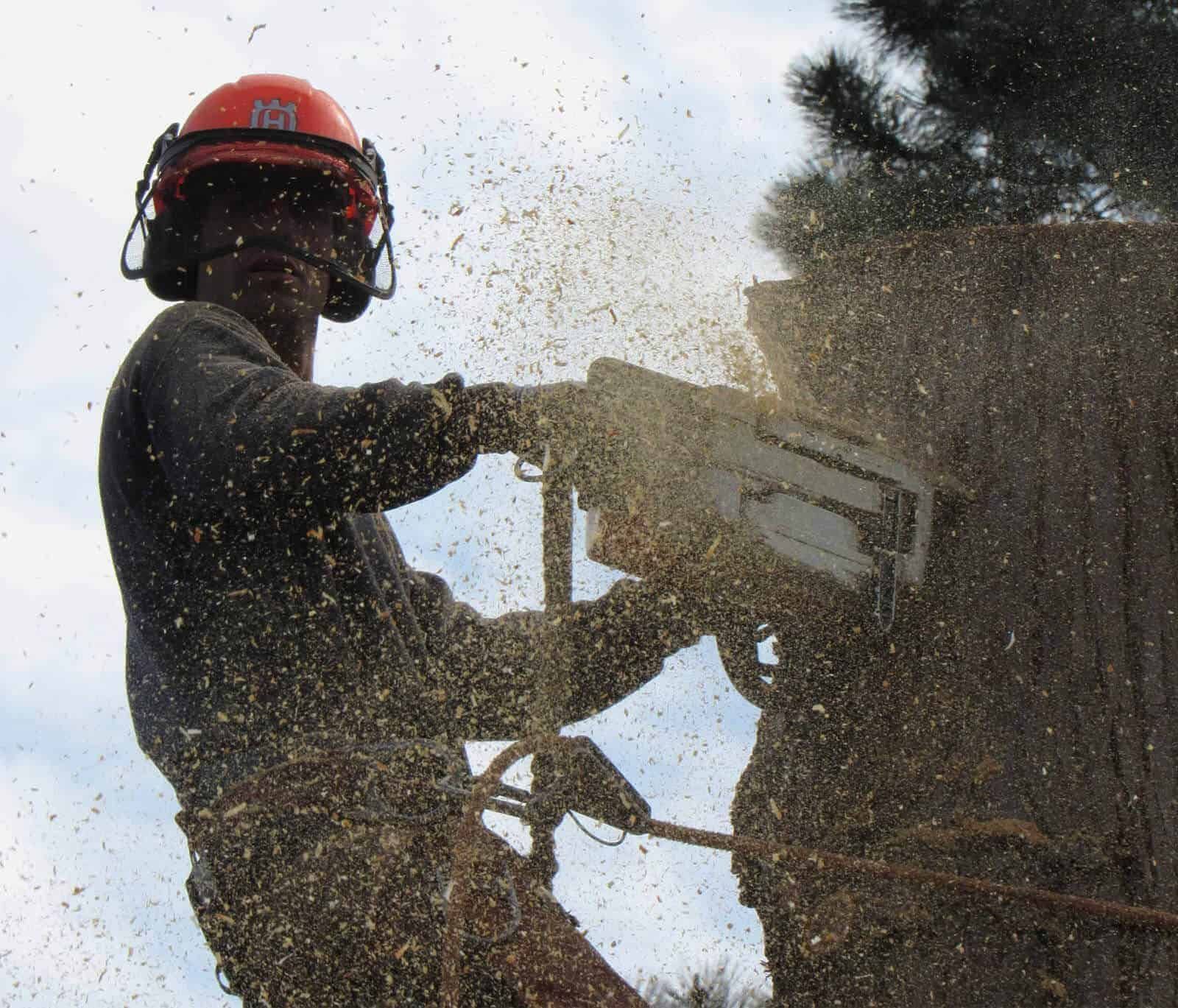

Almost every removal permit requires you to plant at least one replacement tree. The city maintains a list of approved species and minimum sizes. The standard ratio is 1:1, but for larger or more significant trees, the Director of Planning can require a 2:1 ratio or specify particular species to maintain neighbourhood canopy diversity.
Vancouver has set a target of increasing its urban canopy coverage from 23% to 30% by 2050 — requiring approximately 150,000 new trees, or roughly 6,000 plantings per year (City of Vancouver Urban Forest Strategy). Every permitted removal with a replanting condition is part of that strategy.
A reputable tree removal company will be familiar with this entire process and can guide you through the application, provide the required arborist report, and ensure compliance. If a company tells you permits are optional or suggests skipping the process, that is a red flag.
How Much Does Tree Removal Cost in Vancouver?
Cost is the question every homeowner asks first. The honest answer: it depends on the tree. But third-party market data gives us reliable ranges.
According to HomeStars (2026), tree removal in Vancouver costs between $200 and $8,600, depending on the tree's size, species, condition, location, and access. Here is how that breaks down:
Tree Size | Height | Typical Cost Range
Small | Under 30 feet | $200 – $500
Medium | 30 – 60 feet | $500 – $1,500
Large | Over 60 feet | $1,500 – $3,000+
Very large / complex | 80+ feet, near structures | $3,000 – $8,600
These figures are based on HomeStars 2026 market data and represent industry averages. Actual costs vary by tree species, size, access, and site conditions. Contact Aesthetic Tree for a free on-site assessment.
What drives the cost higher?
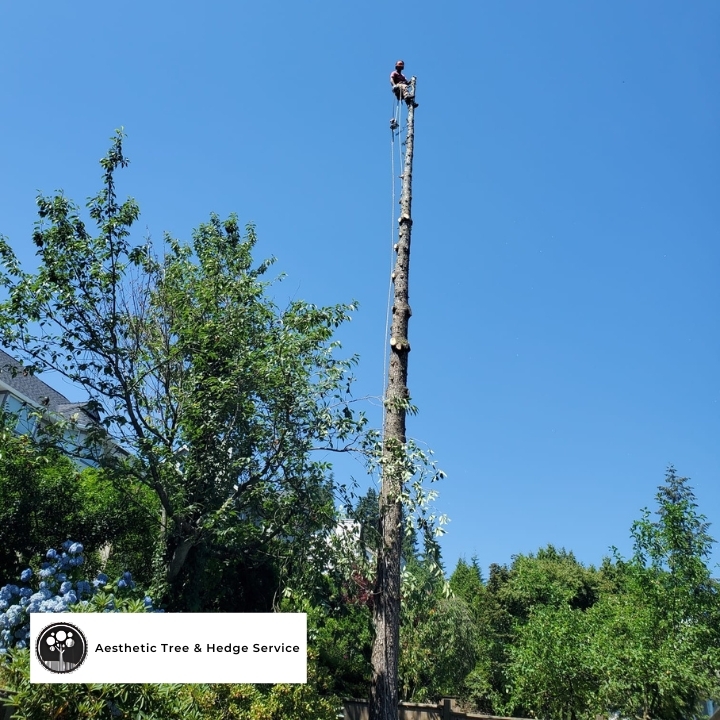
Proximity to structures. A 60-foot Douglas fir in an open yard is a different job than a 60-foot Douglas fir eight feet from your house with a power line running through its canopy. The second tree requires sectional dismantling — piece-by-piece removal using ropes, rigging, and sometimes a crane — which takes more time, more crew, and more specialized equipment.
Access limitations. If the tree is in a backyard accessible only through a narrow side gate, the crew cannot bring in a bucket truck or chipper close to the work zone. Every log and branch must be carried out by hand, adding hours to the job.
Tree species and wood density. A Western red cedar is lighter and easier to handle than a bigleaf maple of the same size. Hardwoods are heavier, denser, and harder on cutting equipment. Species like black locust or Garry oak are particularly dense.
Condition of the tree. Dead, decayed, or heavily leaning trees are more dangerous to remove because their failure patterns are unpredictable. This requires more conservative cutting strategies, additional rigging, and sometimes specialized insurance riders.
Permit and arborist report fees. Add $113 for the first permit (or $324 for additional trees) plus $200 to $500 for the required arborist report.
What about stump grinding?
After the tree comes down, you're left with a stump. Stump grinding reduces the stump to wood chips several inches below grade, allowing you to replant, sod, or proceed with landscaping. In Vancouver, stump grinding typically costs $150 to $500 per stump for standard-sized stumps, with larger stumps or those with extensive surface roots costing more (HomeStars, 2026).
Full stump removal — excavating the entire root ball — costs significantly more ($1,500 to $2,500) and is only necessary if you're building on the site or need the root system completely gone.
When is tree removal cheapest?
Winter months (December through February) are the off-season for tree care in Vancouver. Most homeowners don't think about trees until spring growth or fall storms make problems visible. That means winter pricing is typically 10 to 20% lower than peak-season rates, and scheduling is more flexible. For non-emergency removals, booking in winter is the most cost-effective strategy.
How Does Professional Tree Removal Actually Work?
Professional tree removal follows a structured process that prioritizes safety at every step. Understanding what to expect helps you evaluate whether a company is doing the job properly.
Step 1: On-site assessment
Before any work begins, an arborist visits your property to evaluate the tree's species, size, condition, lean, proximity to structures, overhead utility lines, neighbouring properties, and ground access for equipment. This assessment determines the removal strategy. It is not a formality — it is the most important step in the process because it dictates how every cut is made and where every piece of wood falls.
Step 2: Removal strategy planning
In Vancouver's dense urban neighbourhoods, trees are surrounded by homes, fences, power lines, gardens, and narrow lots. Arborists choose from three primary approaches:
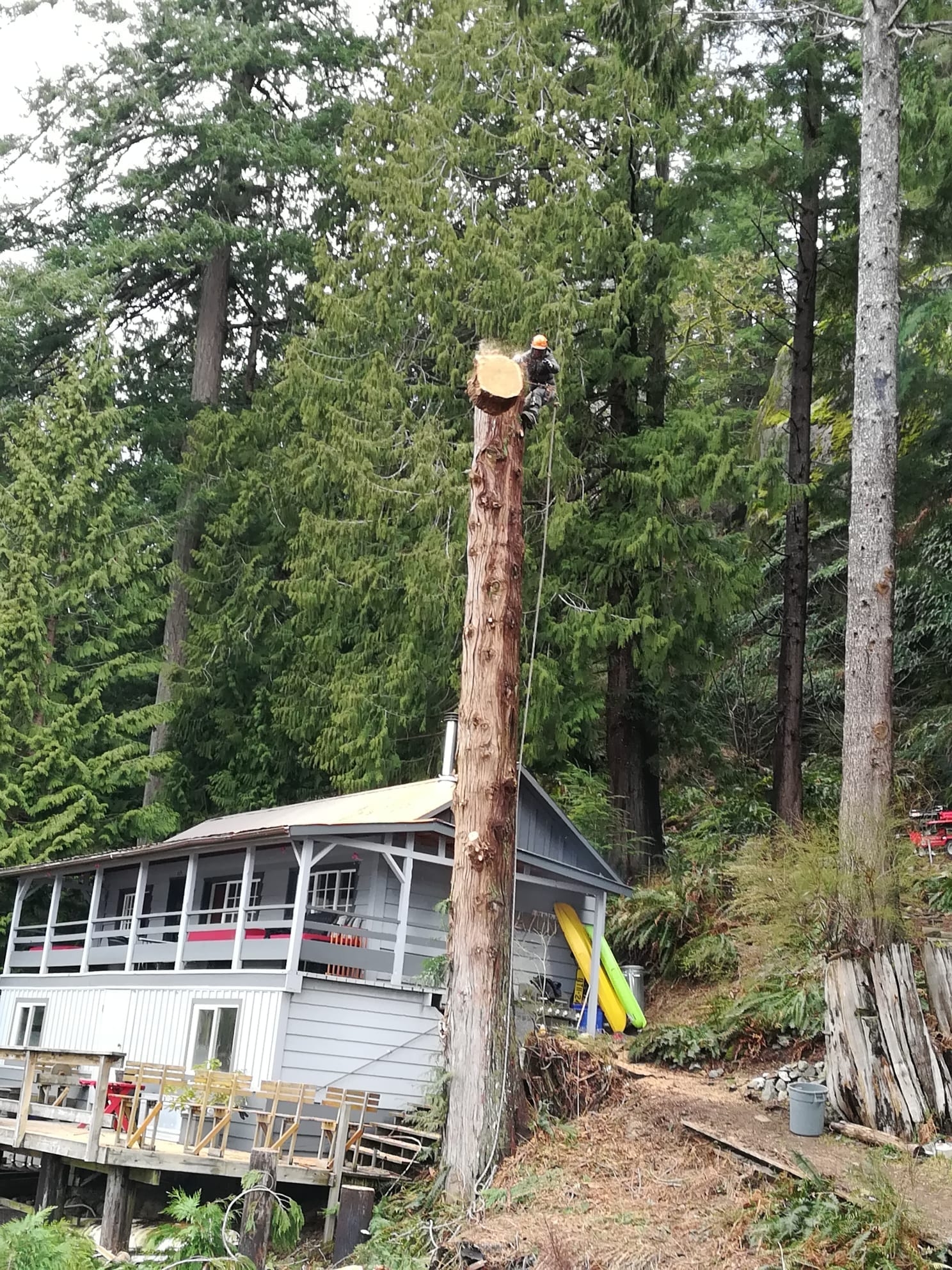
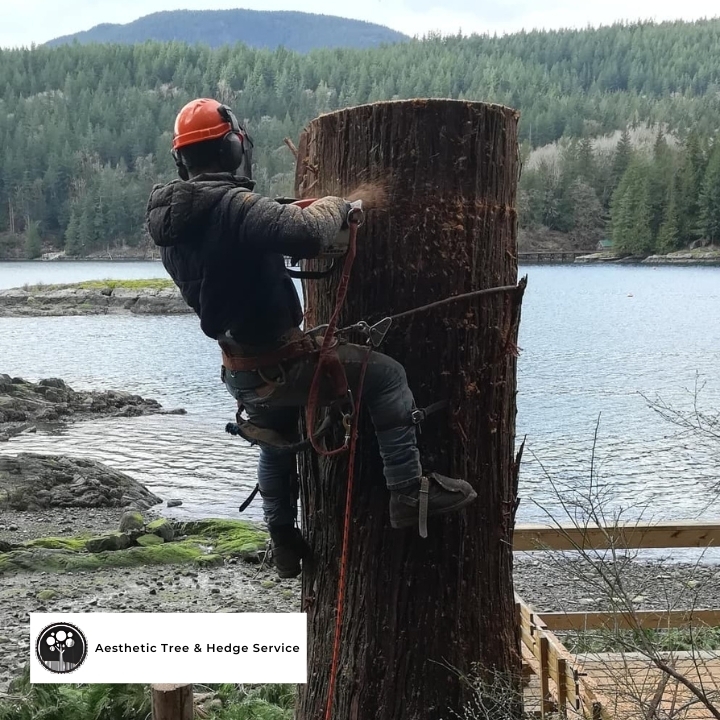
Sectional dismantling (rigging). The climber ascends the tree and removes it piece by piece, lowering sections on ropes to a controlled drop zone below. This is the most common method in residential Vancouver because it gives the crew precise control over where every piece goes. A skilled climber can dismantle a large tree in a 10-foot-wide work zone.
Crane-assisted removal. For very large trees, trees in extremely tight locations, or trees that are too dangerous to climb (severe decay, unstable structure), a crane lifts sections out from above. Crane work is faster but more expensive, and requires road access and sometimes a city road-use permit.
Straight felling. When there is enough open space — typically twice the tree's height — the tree can be felled in one controlled cut. This is the fastest and least expensive method, but rare in urban Vancouver. It may apply on larger properties or in commercial/industrial settings.
Step 3: Removal day
The crew establishes safety zones, positions equipment, and begins work. A professional team typically includes a climber, one or two ground crew members managing ropes and debris, and an equipment operator for the chipper and/or crane. The work area is kept tight to minimize impact on your yard, driveway, and neighbours.
Step 4: Cleanup and debris removal
A quality tree service chips branches on-site, bucks the trunk into manageable rounds (or loads and hauls them), rakes the work area, and leaves your property cleaner than they found it. This is not optional — it is part of the job. If a company leaves a mess, that tells you something about how they do everything else.
Step 5: Stump management
Most homeowners opt for stump grinding at the time of removal. Doing it during the same visit saves mobilization costs. The grinder reduces the stump to chips 6 to 12 inches below grade. The remaining root system decomposes naturally over several years and does not typically cause problems.
Why Does WorkSafeBC Registration Matter for Tree Removal?
This is the question most homeowners never think to ask — until something goes wrong. And when tree removal goes wrong, it goes very wrong.
Tree care is classified as one of the highest-risk occupations in British Columbia. WorkSafeBC sets the workers' compensation assessment rate for tree services at an average of $1.55 per $100 of payroll (WorkSafeBC) — one of the highest rates of any industry, reflecting the frequency and severity of injuries in this trade.
In December 2021, WorkSafeBC enacted amendments to Part 26: Forestry Operations of the Occupational Health and Safety Regulation, adding a dedicated subsection for Arborist Activities (WorkSafeBC, 2021). These regulations require:
- A qualified arborist must conduct a visual hazard assessment before any tree climbing begins
- A written tree-climbing plan that identifies hazards, specifies personal protective equipment, establishes communication protocols, and defines emergency rescue procedures
- Proper tree climbing equipment that meets current safety standards
- Emergency response and rescue procedures must be in place before work starts
What happens if you hire an unregistered crew?
If a tree service is not registered with WorkSafeBC and a worker is injured on your property, you — the homeowner — may be held financially liable for that worker's medical costs, lost wages, and rehabilitation. WorkSafeBC can also assess penalties against you as the "employer" if you hired an unregistered contractor.
This is not a theoretical risk. Unregistered tree crews operate throughout Metro Vancouver, typically advertising the lowest prices on classified sites. They carry no workers' compensation, no liability insurance, and often no ISA credentials. The price difference between a registered, insured crew and an unregistered one might be $200 to $500 on a typical job. The liability exposure if someone falls from a tree on your property is potentially hundreds of thousands of dollars.

Before hiring any tree service, ask for their WorkSafeBC registration number and verify it on the WorkSafeBC website. This takes two minutes and protects you from catastrophic financial exposure.
What Should You Look for When Hiring a Tree Removal Company in Vancouver?
The difference between a qualified arborist and someone with a chainsaw is training, insurance, and accountability. Here is what separates professional operations from the rest.
ISA certification
The International Society of Arboriculture (ISA) maintains the professional standard for tree care worldwide. As of 2022, there were 35,944 ISA Certified Arborists globally (ISA Annual Report). Certification requires passing a comprehensive exam, maintaining continuing education credits, and adhering to a professional code of ethics. An ISA Certified Arborist has demonstrated competency in tree biology, diagnosis, pruning standards, removal techniques, and risk assessment.
Beyond the base certification, the ISA Tree Risk Assessment Qualification (TRAQ) is an additional credential for arborists who specialize in evaluating whether a tree is safe to retain or should be removed. If your situation involves a potentially hazardous tree, a TRAQ-qualified arborist provides the highest standard of assessment.
Liability insurance
Beyond WorkSafeBC, the company should carry comprehensive general liability insurance — typically $2 million or more. This protects you if the crew accidentally damages your home, your neighbour's fence, a vehicle, underground utilities, or landscaping during the removal process. Ask for a certificate of insurance and verify it is current.
Local knowledge
Vancouver's tree species, soil conditions, rainfall patterns, and bylaws are specific. A company with deep local experience knows the difference between removing a Western red cedar on clay soil in Kerrisdale and a Douglas fir on sandy loam in Hastings-Sunrise. They understand the permitting process, have relationships with city inspectors, and know which species are on the city's approved replanting list.
Written scope of work
A professional company provides a written estimate that specifies: which trees are being removed, the removal method, what happens to the debris, whether stump grinding is included, permit responsibilities, and total cost. Verbal quotes and handshake agreements leave you with no recourse if the work doesn't match expectations.
References and reviews
Check the company's reviews on HomeStars, Google, and other platforms. Look for patterns in the feedback — consistent praise for cleanup, communication, and professionalism is a stronger signal than a single glowing review. Ask for references from recent jobs similar to yours.
What About Emergency Tree Removal After a Storm?
Vancouver's storm season runs roughly from October through March, with the heaviest windstorms typically hitting in November and December. The 2024 storm season was the worst on record: three major windstorms hit BC's South Coast and Vancouver Island in November and December, causing nearly one million customer outages combined (BC Hydro, February 2025).
BC Hydro reported that drought conditions over previous years had weakened trees across the province, making them more susceptible to wind damage. The utility tripled its vegetation management budget to approximately $150 million for 2025, up from $50 million a year a decade earlier (BC Hydro, 2025). That investment tells you the scale of the problem.
When is emergency removal necessary?
- A tree has fallen on your home, vehicle, or another structure
- A tree is leaning against power lines (call BC Hydro at 1-800-224-9376 immediately — do NOT approach)
- A tree is blocking your driveway or a public road and poses an ongoing fall risk
- A tree has partially failed and the remaining trunk or branches could fall at any time
How does emergency removal differ from planned removal?
Emergency tree work costs more because it happens outside normal scheduling, often in dangerous conditions, and requires immediate mobilization. There is no time for permit applications — the City of Vancouver allows removal of imminently hazardous trees with after-the-fact documentation. However, you must still notify Urban Forestry and provide an arborist report confirming the emergency after the work is done.
If you have a tree that concerns you before storm season, the most cost-effective approach is to get an arborist assessment in summer or early fall. A certified arborist can identify trees at risk of failure and recommend either preventive pruning or scheduled removal — both of which are cheaper and safer than emergency response.
Can You Remove a Tree on a Shared Property Line?
Trees on or near property boundaries are one of the most common sources of neighbour disputes in Vancouver. Under British Columbia law, a tree whose trunk straddles the property line may be considered shared property. You cannot unilaterally remove a shared tree without your neighbour's consent.
Even if the tree is entirely on your property, its branches or roots may extend onto your neighbour's land. Your neighbour has the right to trim branches and roots back to the property line on their side, but they cannot come onto your property to do so. Conversely, you can trim anything on your side.
If a tree on your property falls and damages your neighbour's property, your homeowner's insurance typically covers the claim — but only if you can demonstrate you maintained the tree reasonably. A documented arborist assessment showing you monitored the tree's condition is your best protection.
For boundary tree disputes, an ISA-certified arborist's report serves as an objective, third-party assessment of the tree's condition and any risks it poses. This report often resolves disputes before they become legal matters.
What Time of Year Is Best for Tree Removal in Vancouver?
Tree removal can be done year-round in Vancouver, but timing affects cost, scheduling, and logistics.
Winter (December – February): Deciduous trees are dormant and bare, giving climbers better visibility and easier access. Ground conditions may be wet, which can limit heavy equipment access on soft lawns. However, this is the off-season, so pricing is typically 10-20% lower and availability is better.
Spring (March – May): The busiest season for tree care as homeowners notice problems after winter. Nesting birds may be present — removal during nesting season requires additional care and potentially a wildlife assessment. Schedule early if you need spring work done.
Summer (June – August): Dry, stable ground conditions make this ideal for crane access and heavy equipment. Deciduous trees are in full leaf, which adds weight and wind resistance but makes diseased or dead branches easier to identify.
Fall (September – November): An excellent time for pre-storm assessments and preventive removals. Booking before storm season means you avoid emergency pricing and get your trees handled before the wind arrives.
For non-urgent removals, winter or early fall offer the best combination of pricing, availability, and conditions.
What Happens to the Wood After a Tree Is Removed?
Most homeowners don't think about this until the truck pulls away. With a professional service, branches are chipped on-site and either hauled to a green waste facility or left as mulch for your garden (your choice). The trunk is bucked into rounds and loaded for disposal.
Some species produce valuable wood. Western red cedar, Douglas fir, and bigleaf maple rounds can be milled into lumber, turned into furniture, or split for firewood. If you want to keep the wood, let your arborist know before removal day — they can cut and stack it on your property instead of hauling it away, which may reduce your removal cost.
For hedge trimming debris and smaller branch material, chipping is the standard disposal method. The resulting wood chips make excellent garden mulch and help suppress weeds.
Frequently Asked Questions
How much does it cost to remove a tree in Vancouver?
According to HomeStars (2026), tree removal in Vancouver ranges from $200 for small trees under 30 feet to $8,600 for very large or complex removals near structures. The median cost for a typical residential removal of a medium-sized tree (30 to 60 feet) falls between $500 and $1,500. Stump grinding adds $150 to $500 per stump. Permit fees ($113 for the first tree) and arborist report costs ($200 to $500) are additional. These figures are based on HomeStars market data and represent industry averages. Actual costs vary by tree species, size, access, and site conditions. Contact Aesthetic Tree for a free on-site assessment.
Do I need a permit to remove a tree on my property in Vancouver?
Yes, if the tree has a trunk diameter of 20 cm or more (measured at 1.4 metres above the ground) on private property in the City of Vancouver. This is mandated by the Protection of Trees Bylaw No. 9958. The permit application requires a site plan, an arborist report from an ISA-certified arborist, and the applicable fee ($113 for the first tree, $324 per additional tree). Processing takes 10 to 21 business days. Removing a tree without a permit can result in fines of $1,000 to $20,000 per tree.
Can I remove a dead tree without a permit in Vancouver?
Dead trees may qualify for an expedited permit review, but you should still apply. The City of Vancouver's Urban Forestry department can fast-track applications for trees that are confirmed dead or pose an imminent safety hazard. If a dead tree requires true emergency removal (it has fallen or is about to fall on a structure), you can proceed with removal and submit documentation after the fact. You will still need an arborist report confirming the tree was dead or imminently hazardous.
How long does the tree removal permit process take?
A complete application — including the arborist report, site plan, and fee — typically takes 10 to 21 business days to process through the City of Vancouver's Urban Forestry department. An inspector may visit your property during this period. Once approved, the permit is valid for six months. If you don't complete the removal within six months, the permit expires and you must reapply.
What is the replacement tree requirement after removal?
Vancouver's Protection of Trees Bylaw typically requires at least one replacement tree for every tree removed. The standard ratio is 1:1, but the Director of Planning can require a 2:1 ratio for significant trees. The city specifies acceptable species and minimum planting sizes. This requirement supports Vancouver's goal of reaching 30% urban canopy coverage by 2050, up from the current 23% (City of Vancouver Urban Forest Strategy). Your arborist can recommend appropriate replacement species based on your property's space, soil, and sun conditions.
Get a Professional Assessment From Aesthetic Tree & Landscaping
If you have a tree on your Vancouver property that concerns you — dead, damaged, leaning, diseased, or in the path of construction — get a professional opinion before making decisions. Aesthetic Tree & Landscaping employs ISA-certified arborists who conduct thorough on-site assessments, explain your options in plain language, and handle every step from permits to cleanup.
We are WorkSafeBC registered, fully insured, and experienced across Vancouver's neighbourhoods — from the old-growth stumps of Shaughnessy to the street trees of Commercial Drive. Whether you need an arborist assessment, emergency storm response, hedge maintenance, or a straightforward removal with stump grinding, we do the job right the first time.
Contact us today to schedule your free on-site assessment.
Before You Go
Where are you in your tree care journey?
Our Tree Care Services
ISA-certified arborists serving Greater Vancouver
Explore Our Tree Care Services
From expert pruning to safe tree removal, our ISA-certified arborists are ready to help across Greater Vancouver.
View Services