
TL;DR — Quick Summary
dos donts tree pollarding vancouver guide for safe pruning, bylaws, timing, species, and arborist help. Call AestheticTree.
Yes, pollarding can kill a tree if performed incorrectly, too aggressively, or on unsuitable species. Trees stressed by disease or poor soil are especially vulnerable - repeated over-pollarding depletes stored energy, permanently weakening the tree. ISA-certified arborists evaluate each species before recommending pollarding to ensure the technique extends rather than shortens the tree's lifespan.
That sentence can save you a tree.
It can also save your roof, your permit record, and your insurance file.
Pollarding is not the same as topping. It is not a fast haircut for a tree that got too tall. It is a strict pruning system. It starts when the tree is young. It repeats on a set cycle. It uses the same pruning points year after year.
Done right, it can manage certain deciduous trees in tight urban spaces. Done wrong, it creates decay, weak shoots, and storm risk.
In Vancouver, that matters. Our wind, rain, dense lots, overhead service lines, and municipal tree bylaws leave little room for guesswork.
Aesthetic Tree & Hedge Services works with Vancouver, Burnaby, North Vancouver, Richmond, Coquitlam, and the Lower Mainland. We are ISA-certified and WCB registered. We look at structure first. Then species. Then bylaw status. Then targets like houses, lanes, wires, sheds, and sidewalks.
If a tree needs reduction, pruning, removal, or a formal report, the answer starts with assessment. Not a chainsaw.
TL;DR
- Pollarding is a formal pruning method for selected young trees. It is not topping.
- Do not pollard mature Douglas fir, cedar, birch, cherry, or most conifers.
- Vancouver private trees 20 cm DBH or larger need care under the City of Vancouver Protection of Trees By-law No. 9958.
- Proper work follows ANSI A300 standards and ISA arboriculture practice.
- If a tree is hazardous, storm-damaged, or too close to a structure, get an arborist inspection before cutting.
What Is Tree Pollarding, And Why Do Vancouver Homeowners Ask For It?
Tree pollarding is repeated pruning back to fixed points on a young tree.
The first cuts create a pollard head. New shoots grow from that head. Later pruning removes those shoots back to the same point. The tree then regrows again from the same knuckle.
That is the system.
It is common in parts of Europe. You see it on London plane, willow, lime, and some maples. It keeps trees small in streets, courtyards, and formal landscapes.
Vancouver homeowners ask for it for three main reasons.
First, the tree is too close to a house. Branches touch gutters. Leaves fill drains. Moss builds on roofs.
Second, the tree blocks light. This comes up often in Kitsilano, Mount Pleasant, Kerrisdale, and East Vancouver. Lots are tight. Homes are close. One wrong tree can shade a whole yard.
Third, the tree feels too tall. That feeling is real. But height alone is not a defect.
A tall Douglas fir can be sound. A short topped maple can be dangerous. Risk comes from structure, defects, roots, decay, load, exposure, and targets. It does not come from height alone.
That is why an ISA-certified arborist does not start with: how low do you want it?
We start with: what is the tree trying to become, and what is the safest legal way to manage it?
For many trees, the better service is selective pruning, crown reduction, cabling, or removal. If removal is needed, review professional tree removal in Vancouver before you let anyone cut into a protected tree.
Is Pollarding The Same As Topping A Tree?
No. Pollarding and topping are not the same.
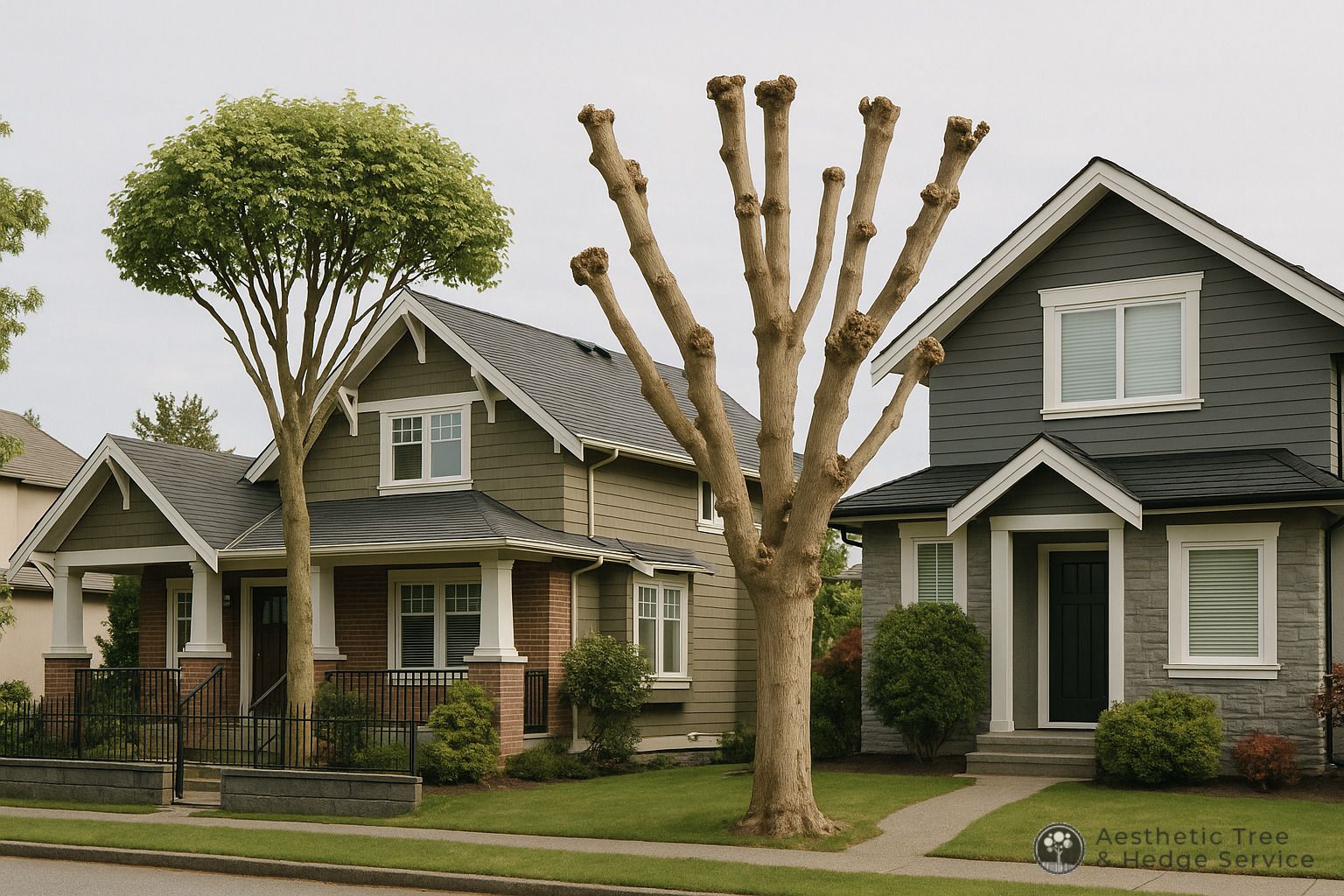
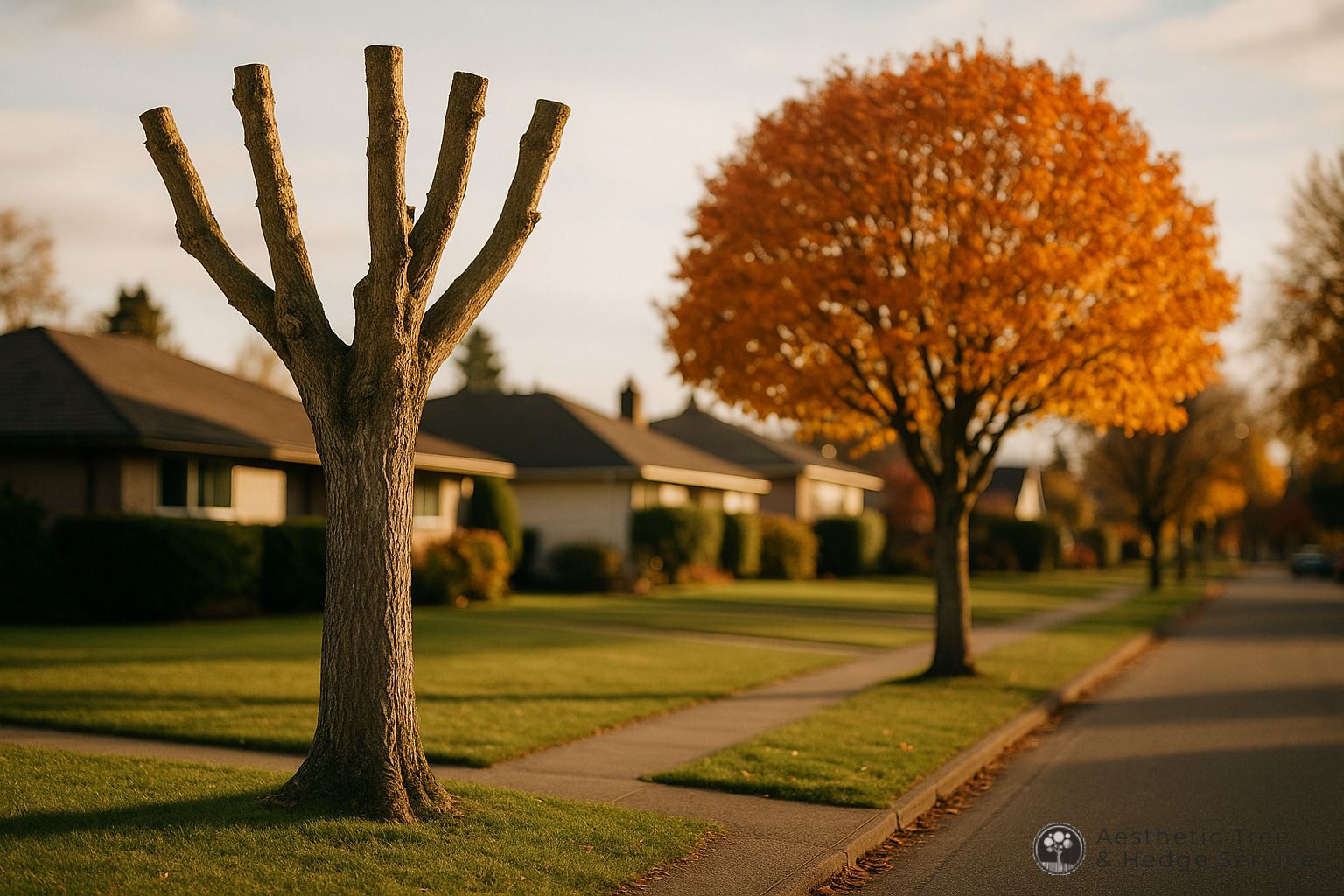
Topping is the rough cutting of major limbs or stems to stubs. It ignores branch collars. It ignores future structure. It removes large parts of the live crown in one job.
Pollarding is planned. It starts young. It returns to the same pollard heads. It is repeated before shoots become large limbs.
That difference matters because trees do not heal like skin. They seal and compartmentalize wounds. Big cuts on mature wood leave large decay columns. Once decay enters, the tree has to wall it off.
Some trees do this better than others. Many do it poorly.
The Washington State Department of Natural Resources says topping leads to fast weak shoots and large open cuts that invite decay and insects. The Arbor Day Foundation also warns that topping creates weakly attached sprouts and decay fungi entry points.
That is the problem.
A topped tree often looks smaller for one season. Then it pushes hard upright shoots. Those shoots grow fast. They attach around damaged tissue. They catch wind. They break.
So the owner asks for more cutting.
Then the cycle gets worse.
This is why ANSI A300 pruning standards matter. The Tree Care Industry Association describes ANSI A300 as the standard practices and specification guide for arborists and tree care work. These standards separate proper pruning from damaging cuts.
In our experience, the word pollarding often gets used when the real request is topping. A homeowner wants less height now. A poor contractor says yes. The tree pays later.
A good arborist slows the job down.
When Is Pollarding Actually Appropriate In Vancouver?
Pollarding is appropriate only when four conditions line up.
The species must respond well. The tree must be young enough. The site must need size control. The owner must commit to repeat cycles.
That last part is missed most often.
Pollarding is not one visit. It is a maintenance contract with the tree. If you stop for too long, the new shoots become heavy limbs. Then cutting them back creates large wounds. At that point, the work becomes a damage problem.
Good candidates can include willow, poplar, London plane, linden, and some maples. Even then, the exact tree matters.
Poor candidates include Douglas fir, western red cedar, birch, cherry, spruce, hemlock, and most mature conifers. These trees do not respond to pollarding like a plane tree on a London street.
The Lower Mainland adds more pressure.
Vancouver has wet winters. Fungal decay pressure is real. Wind events load canopies. Dense soils and construction damage roots. A heavy-handed cut can push a tree from manageable to unstable.
Pollarding works best when it is designed into the tree early. That means the tree was planted in the right spot. It was trained young. The cuts were small. The pruning points were chosen with care.
If your tree is already mature, do not ask for pollarding as a rescue.
Ask for a hazard assessment.
For structure, clearance, and size reduction, start with professional tree cutting in Vancouver. The goal is not just to remove wood. The goal is to leave a tree that can stand, seal wounds, and grow with less risk.
What Are The Biggest Do's Of Tree Pollarding In Vancouver?
Do start with species identification.
This sounds basic. It is not optional. A Big-leaf maple, a Norway maple, a cherry, and a cedar all respond in different ways. A cut that one tree tolerates can ruin another.
Do measure DBH before work. DBH means diameter at breast height. In Vancouver, that means measured 1.4 metres above ground. The City of Vancouver says private property trees with a trunk diameter of 20 cm or greater need a permit for removal under Protection of Trees By-law No. 9958. A 20 cm diameter trunk is about 64 cm in circumference.
Do check whether the tree is private, shared, boulevard, or city-owned.
Street trees are not yours to cut because they sit near your frontage. Many boulevard trees belong to the City. If you cut one without authority, you create a legal problem.
Do follow ANSI A300 pruning standards. This means correct cut placement. It means pruning with an objective. It means no random stubbing.
Do prune at the right stage. Pollarding should start when the tree is young and vigorous. Mature initiation creates high decay risk.
Do keep cycles short enough. Once shoots grow too large, the pollard heads become overloaded.
Do inspect attachment points. Pollard heads can hide cracks, included bark, decay, and old wounds.
Do keep tools sharp and clean. Ragged cuts slow closure and expose more tissue.
Do protect the root flare. The best crown work fails if the root system is buried, cut, or compacted.
Do call a certified arborist when the tree is near a house, lane, neighbour line, service wire, retaining wall, or slope.
A tree is a structure. Treat it like one.
What Are The Biggest Don'ts Of Tree Pollarding In Vancouver?
Do not pollard a mature tree because it feels too tall.
That is the most expensive mistake in tree care.
Do not remove the top of a conifer. A topped cedar or Douglas fir does not become a tidy small tree. It becomes a damaged tree with altered structure.
Do not leave long stubs. Stubs die back. Decay follows the dead wood into larger limbs.
Do not flush cut. Cutting into the branch collar removes the tree's natural defence zone.
Do not strip the inside of the crown. This is called lion-tailing. It pushes weight to the ends of branches. It makes limbs more likely to whip and fail.
Do not remove too much live foliage at once. ISA pruning guidance for mature trees states that, in general, no more than 25% of the crown should be removed in one pruning event. Younger trees tolerate more pruning than mature trees. Old trees tolerate less.
Do not prune during severe heat or drought stress unless safety requires it.
Do not use climbing spikes on a live tree being retained. Spikes wound the stem. Those wounds create infection points.
Do not cut near energized lines. BC Hydro tells the public to stay at least 10 metres away from a downed or damaged power line and call 9-1-1. For trees near utility conductors, use qualified line-clearance workers.
Do not assume a hedge and a tree are treated the same. Hedge work is often cosmetic and repeated. Tree pruning is structural. If your concern is cedar screening or laurel overgrowth, look at hedge trimming services in Vancouver, not tree pollarding.
Do not ask for the cheapest cut.
Ask what the tree will look like in five winters.
Do Vancouver Tree Bylaws Affect Pollarding Or Heavy Pruning?
Yes. Bylaws matter before heavy work starts.
The City of Vancouver Protection of Trees By-law No. 9958 relates to private property trees. The City states that a permit is needed to remove any private tree with a diameter of 20 cm or greater, measured at 1.4 metres above ground.
The City also states that if trees 20 cm or larger are present, an arborist report is required for a development permit application.
That second point matters for renovations and rebuilds. A tree does not have to sit in the middle of a new foundation to affect a permit. Trees on your lot, nearby lots, and boulevards can shape the plan.
Pollarding itself is not always removal. But heavy pruning can become injury. If cuts harm a protected tree, you still have a problem.
North Vancouver adds another layer. The City of North Vancouver says a permit is required for removal or extensive pruning of protected trees, while basic pruning under sound arboriculture practice often does not need a permit.
Burnaby has its own Tree Bylaw. Its materials refer to protected trees and tree cutting permits, with replacement requirements when removal is approved.
Richmond, Coquitlam, and other Lower Mainland cities have their own rules.
So do not use one city's rules in another city.
This is where homeowners get caught. They read a forum answer. They hire a cutter. The job crosses the line from pruning into damage or removal.
For permit support, construction planning, or bylaw review, use an arborist report in Vancouver. The report gives the city a professional assessment. It also gives you a written basis for decisions.
Which Vancouver Trees Should Not Be Pollarded?
Most Vancouver trees should not be pollarded.
That is the clean answer.
Do not pollard Douglas fir. It is a tall conifer with a natural central leader. Removing that leader changes the whole tree.
Do not pollard western red cedar. Cedars can be hedged when managed as hedges from youth. A mature cedar is different. Hard cuts into old wood often leave bare gaps and stress.
Do not pollard birch. Birch is prone to stress and decay after large cuts. It also bleeds sap heavily during certain seasons.
Do not pollard cherry. Cherries are prone to disease and gum flow after bad pruning. Large heading cuts make this worse.
Do not pollard spruce, hemlock, pine, or fir. These are not pollard trees for residential Vancouver lots.
Use caution with Big-leaf maple. It can sprout strongly, but large cuts on mature stems decay. A topped maple can become a forest of weak shoots.
Use caution with ornamental pears and plums. They can look responsive after cutting. That does not mean the structure is sound.
Better candidates, under the right conditions, include willow, poplar, linden, London plane, and some young maples.
Even then, age and history decide the answer.
A willow pollarded from youth can be managed. A mature willow hacked back after decades is a failure risk waiting for rain and wind.
The species list is not permission. It is a starting filter.
A site visit still matters.
What Happens If A Mature Tree Is Topped Instead Of Pollarded?
The tree reacts fast.
It loses leaf area. That reduces food production. It exposes inner bark to sun. It opens large wounds. It triggers dormant buds.
Then the sprouts come.
Those sprouts are often called water sprouts or epicormic shoots. They grow fast because the tree is trying to replace lost leaf area. Fast does not mean strong.
Many sprouts attach near the surface of damaged wood. As the old cut decays, the new shoots gain weight. The attachment gets worse. The tree looks full again. But it is less safe.
This is the trap.
A topped tree can look leafy after two summers. Homeowners relax. Then a windstorm arrives in November. A sprout cluster fails. A limb lands on a roof, fence, or vehicle.
Purdue Extension calls topping an unsatisfactory pruning method. It notes that topping stimulates numerous upright branches. The Arbor Day Foundation warns that topping increases danger from weak sprouts and decay fungi.
That is why we use hazard assessment language. Not beauty language.
Bad pruning turns a maintenance issue into a risk issue.
If the tree already has large topping cuts, get it inspected. Some topped trees can be retrained over time. Some need staged reduction. Some need cabling. Some need removal.
If removal becomes the safer path, plan the whole job. That includes cleanup, stump height, access, and roots. After removal, stump grinding in Vancouver helps restore the area and reduce trip hazards.
How Does Pollarding Affect Tree Safety During Vancouver Storms?
Pollarding changes wind load. That can help when done right. It can hurt when done wrong.
A properly maintained pollard has smaller annual shoots. It carries less sail area than a full crown. It can be useful on certain street or courtyard trees.
A neglected pollard is different.
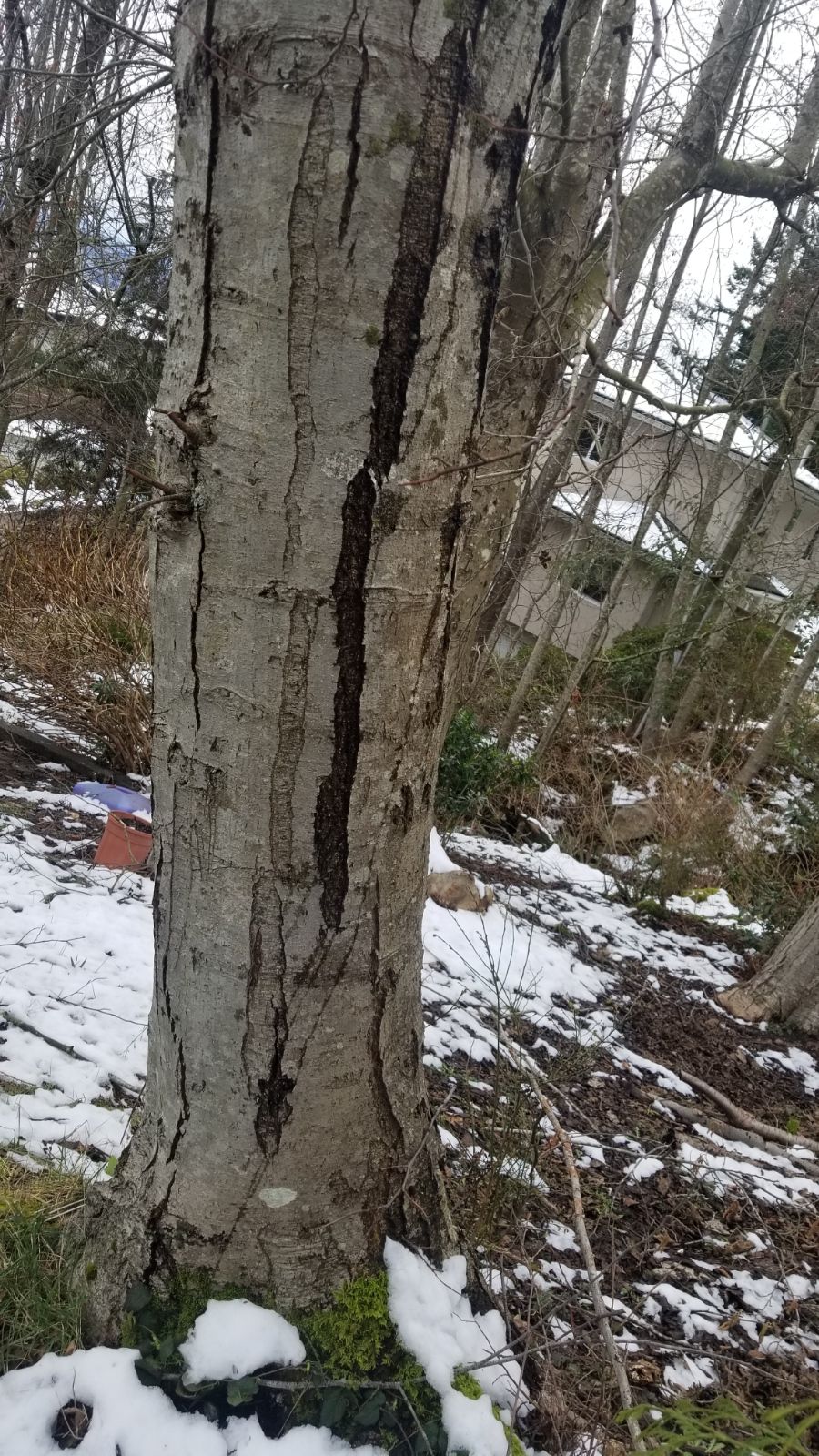
Old pollard heads can crack. Heavy shoots can peel away. Decay can hide under swollen knuckles. The tree can look managed from the ground while defects build above sightline.
Storm risk in Vancouver is not theoretical.
BC Hydro said in 2023 that dead and damaged trees and branches were expected to contribute to power outages during storm season, after drought and weather stress. The American Public Power Association reported in 2023 that public power utilities attributed about 16% of outages to trees. It also cited a 2019 CNUC survey where trees caused 23% of outages and 21.7% of outage minutes across utility types.
Trees near conductors need special care. They are not DIY pruning jobs.
Trees near homes need the same seriousness. A branch over a bedroom is a target issue. A cracked union over a driveway is a target issue. A decayed trunk beside a lane is a target issue.
That is why reduction cuts must preserve structure. Removing the top does not remove risk. It often moves the risk into new weak growth.
If a tree has split, shifted, dropped a major limb, or started leaning after wind, call for emergency tree service. Do not stand under it to take better photos.
Why Does Urban Canopy Data Matter Before You Cut A Tree?
Because every private tree is part of Vancouver's climate system.
That sounds large. It is also local.
The City of Vancouver says the urban forest includes about 150,000 street trees, 36,000 specimen trees in golf courses and parks, and more than 1 million trees across 444 hectares of public forests and woodlands.
The City also reports Vancouver's current canopy cover at 25%, with a target of 30% by 2050. The 2025 Urban Forest Strategy update says the city has grown canopy by four percentage points since 2013.
Metro Vancouver reports that tree canopy cover within the Urban Containment Boundary, the Regional Core, and the whole region each decreased by 1% between 2014 and 2020.
Those numbers explain why bylaws are strict.
They also explain why good pruning matters. A living mature tree is hard to replace. A new sapling does not give the same shade, stormwater interception, habitat, or cooling as a mature canopy.
The 2021 heat dome proved the value of shade. A peer-reviewed 2022 study in the Canadian Medical Association Journal examined community deaths during the catastrophic heat dome in Greater Vancouver. It found deaths were linked with areas of lower greenness and higher deprivation. A 2023 Nature Communications study reported that BC Coroners Service attributed 619 deaths to the event, with 93% occurring from June 25 to July 1.
This is not an argument to keep every tree at any cost.
Dead, dying, hazardous, and wrong-tree-wrong-place cases are real. But it is an argument against panic cutting.
A tree that can be retained safely should be retained. A tree that cannot be retained should be removed legally and replaced wisely.
What Should You Ask An Arborist Before Pollarding A Tree?
Ask direct questions.
Do not ask only for a price. Ask for the reasoning.
Start with these:
- What species is this tree?
- Is it young enough for pollarding?
- Has it been pollarded before?
- Are there existing pollard heads?
- Are there signs of decay, cracks, included bark, or root damage?
- What bylaw applies in this city?
- Is a permit or arborist report needed?
- What ANSI A300 pruning objective will be used?
- How much live crown will be removed?
- What will the tree need next year?
- What happens if we do nothing?
- What is the safer alternative?
A good arborist can answer without pressure.
They can also say no.
That matters. Some jobs should not be sold. If a customer asks us to top a mature conifer, the answer is not a nicer version of yes. The answer is a different plan.
That plan may be crown cleaning. It may be clearance pruning. It may be end-weight reduction. It may be cabling. It may be removal if the risk is high and the bylaw path supports it.
Tree care is not about making the tree smaller at any cost.
It is about matching the cut to the tree's biology and the site's risk.
What Are Better Alternatives To Pollarding For Vancouver Homes?
Most homes need one of six alternatives.
Crown cleaning removes dead, dying, diseased, broken, or weak branches. It is often the first step for safety.
Crown reduction reduces height or spread using proper lateral cuts. It is different from topping. The remaining branch must be large enough and well placed.
Clearance pruning gives space from roofs, gutters, chimneys, lanes, sidewalks, and structures. It should not strip one side of the tree bare.
Structural pruning trains young trees before defects become expensive. This is the best time to fix crossing limbs, codominant stems, and weak attachments.
Cabling supports specific weak unions when removal of the limb is not the best option. It does not make a bad tree good. It reduces movement at a known defect. For split stems or valuable trees, review tree cabling.
Tree replacement solves wrong-tree-wrong-place problems. If a tree will always fight the site, removal and replanting can be the safer long-term answer. Good replacement choices in Vancouver depend on soil, mature size, light, drought tolerance, and bylaw rules. See tree planting if the better answer is a new tree that fits.
For hedges, use hedge methods. Cedar hedges, laurel hedges, and yew hedges need regular side and top trimming. They do not need tree pollarding language.
For roots near hardscape, use root assessment. A lifting driveway or cracked path does not always mean the tree must go. Root barriers, mulch, soil care, or redesign can help in selected cases.
The right alternative depends on the target.
Roof clearance is one problem. Power line conflict is another. Sewer conflict is another. Decline is another.
One cut does not solve all of them.
When Should Vancouver Homeowners Schedule Pollarding Or Major Pruning?
Timing depends on species, objective, and risk.
For many deciduous trees, dormant season pruning is preferred. Late winter often gives clear structure visibility. The tree is not pushing full leaf. The work can be planned before spring growth.
Some trees bleed sap when pruned at certain times. Birch and maple can bleed in late winter or early spring. Bleeding alone does not always mean harm, but timing still matters.
Cherry and other Prunus species are often better pruned in dry periods to reduce disease pressure. Heavy wet-season cuts can raise problems.
Avoid major pruning during heat stress. Vancouver summers are hotter than they used to be. A tree already fighting drought does not need a large leaf loss.
Avoid major non-emergency pruning during active nesting season unless the site has been checked. Birds and wildlife matter, and crews need to follow applicable rules.
Emergency work is different.
If a limb has cracked, a stem has split, or a tree is hung up after a storm, safety comes first. The right crew can stabilize, remove, or reduce the hazard.
Pollarding cycles should be planned. Do not wait until shoots are large and heavy. The whole point is small, repeated cuts.
In Vancouver, we often see homeowners wait too long. A tree was once pollarded. Then five or seven years pass. The regrowth becomes heavy. Now every cut is bigger. The tree is less forgiving.
If your tree has old pollard heads, book an assessment before the next storm season.
How Can You Tell If A Pollarded Tree Is Becoming Hazardous?
Look for warning signs.
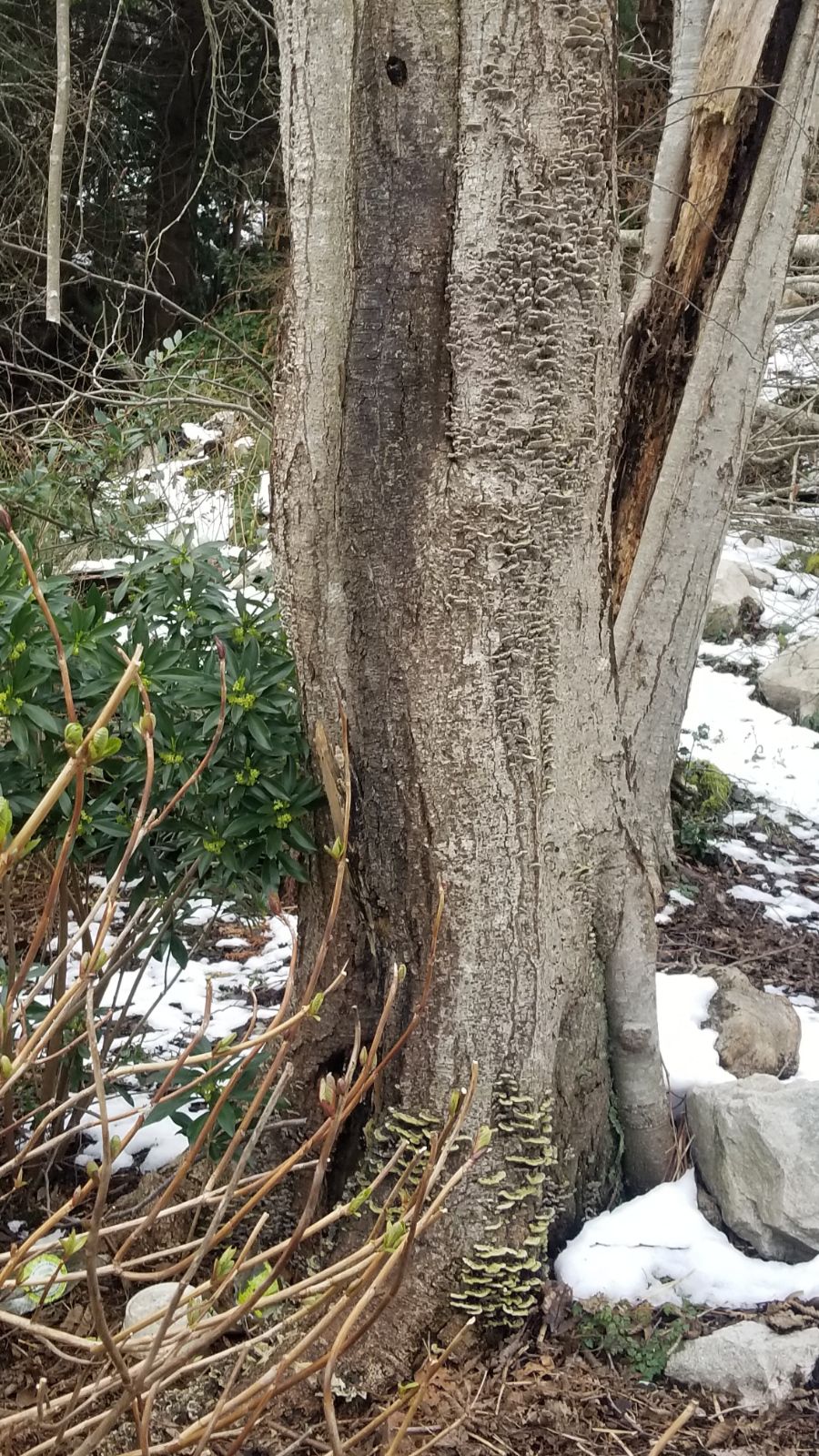
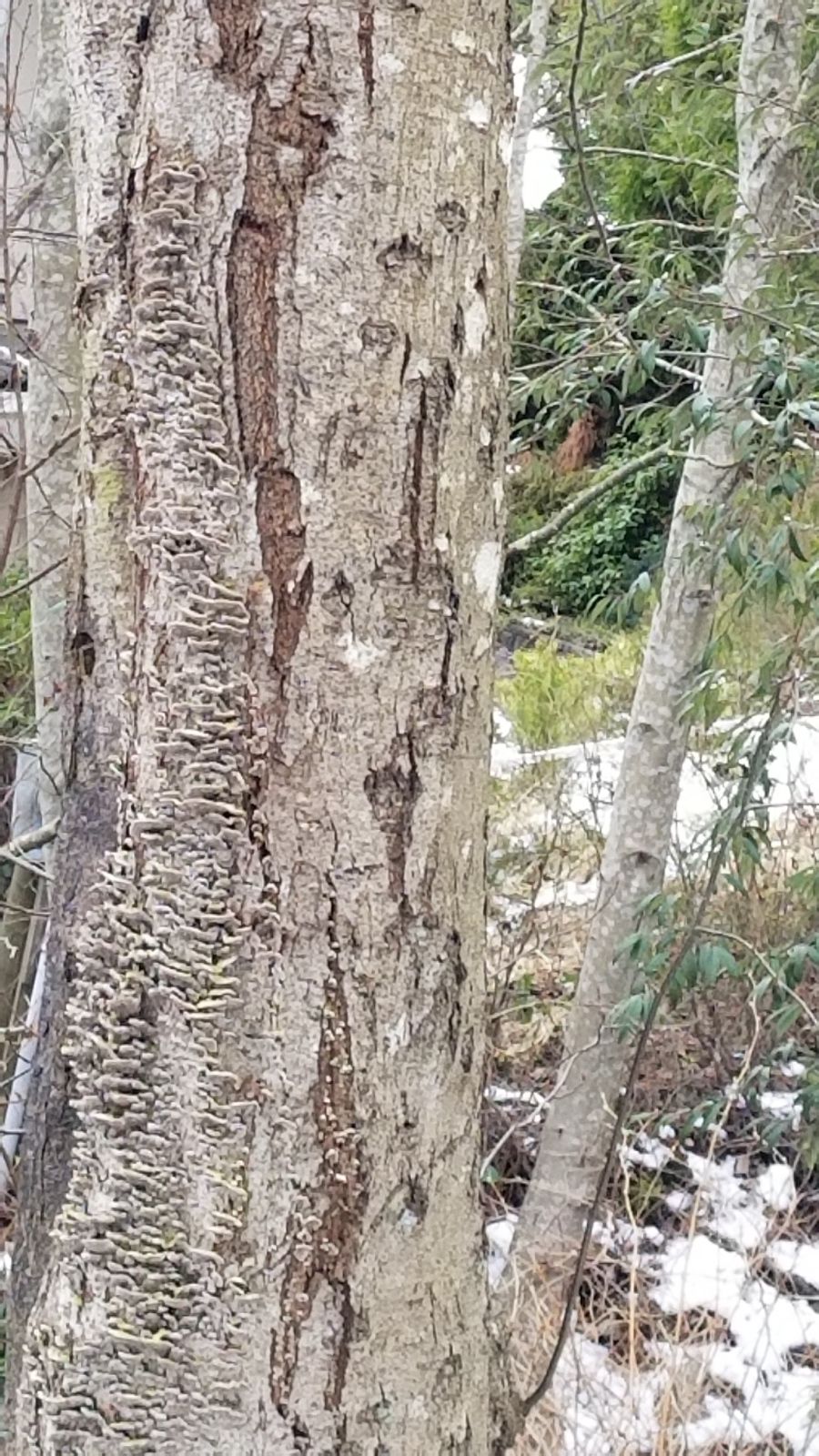
Cracks around pollard heads are serious. So are seams running down from old cuts. Fungal brackets on the trunk or limbs are serious. Cavities below old pruning wounds matter.
Watch for heavy clusters of upright shoots. If several large shoots arise from one old wound, that cluster needs inspection.
Look at the ground. Soil lifting on one side can mean root movement. New lean after rain or wind is a red flag.
Look at the root flare. If soil or mulch covers it, decay and girdling roots can hide there.
Look at targets. A defect above a shed is one level of risk. The same defect above a bedroom, sidewalk, lane, or service drop is another.
Listen during wind. Creaking does not always mean failure, but repeated noise from a union deserves attention.
Check the history. Was the tree topped years ago? Were large limbs removed? Did construction cut roots? Was soil piled over the base? Did a trench cross the dripline?
These details tell the real story.
Homeowners often focus on leaves. Arborists focus on load paths.
Where is the weight? Where is the defect? What is below it? What happens if it fails?
That is the safety question.
What Should You Do Before You Let Anyone Cut Your Tree?
Take five steps.
First, identify the tree. If you do not know the species, do not approve heavy pruning.
Second, measure DBH. In Vancouver, 20 cm at 1.4 metres above grade is a key threshold for private tree removal rules.
Third, confirm ownership. Private tree, neighbour tree, shared boundary tree, boulevard tree, and city tree are different cases.
Fourth, ask for the pruning objective in writing. The objective should be clear. Crown clean. Crown reduction. Clearance. Structural pruning. Pollard maintenance. Hazard reduction.
Fifth, confirm cleanup and disposal. Branches, chips, trunk wood, and access all affect the job plan.
Do not approve vague language like cut it back hard.
That phrase has destroyed many trees.
Ask where cuts will be made. Ask how much live crown is being removed. Ask what the tree needs after the work.
If the contractor cannot explain branch collar, DBH, live crown, decay, species response, or bylaw status, stop.
Chainsaw skill is not arboriculture.
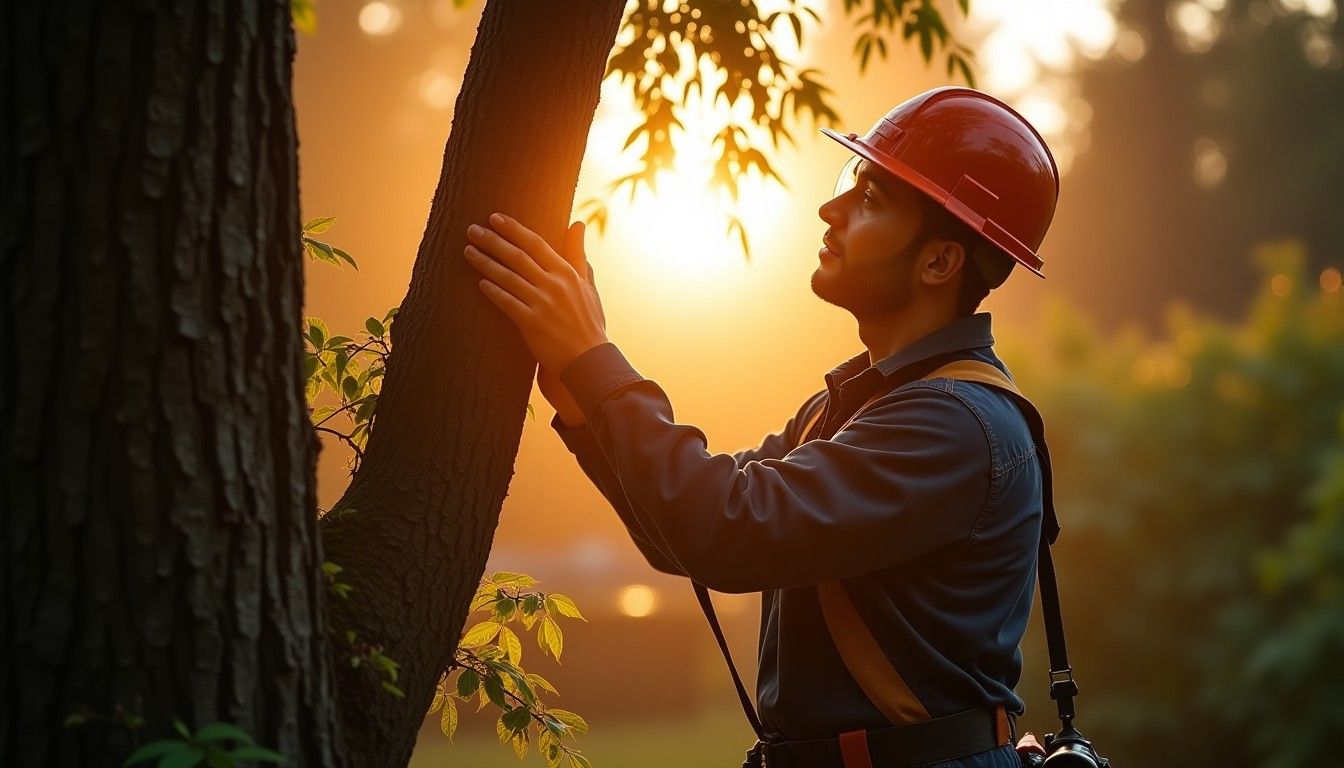
Aesthetic Tree & Hedge Services brings ISA-certified assessment, WCB registration, and local bylaw experience to the job. We work across Vancouver and the Lower Mainland, where one property can involve tight access, steep grades, service lines, protected trees, and neighbour concerns.
That mix needs judgment.
FAQ
Is pollarding legal in Vancouver?
Pollarding can be legal when done as proper pruning and when it does not injure or remove a protected tree without approval. Vancouver private trees 20 cm DBH or larger are regulated for removal under Protection of Trees By-law No. 9958. Heavy work should be checked before cutting. If the pruning is extensive, tied to development, or risks tree injury, get an arborist report.
Can I pollard a cedar tree in Vancouver?
No, not in the normal arboricultural sense. Mature cedars are poor candidates for pollarding. Cedar hedges can be trimmed when managed correctly, but that is hedge maintenance. A mature western red cedar should not be topped to make it shorter. If it is hazardous or badly placed, get an ISA-certified assessment.
How often should a pollarded tree be pruned?
A true pollarded tree needs regular repeat pruning before shoots become large limbs. The cycle depends on species, site, and growth rate. Many managed pollards need attention every one to three years. Waiting too long turns small maintenance cuts into large damage cuts.
What is the safest way to reduce a tree's height?
The safest method is proper crown reduction using reduction cuts to suitable lateral branches. This must follow tree biology and ANSI A300 standards. Topping is not safe height reduction. If the tree cannot be reduced without damage, removal and replacement may be safer.
Should I call an arborist before pollarding a tree?
Yes. Call an ISA-certified arborist before pollarding, topping, or heavy pruning. The arborist will identify the species, assess defects, check bylaw status, and recommend the right work. For a free estimate, call Aesthetic Tree & Hedge Services at (604) 721-7370. ISA-certified arborists, WCB registered.
Related: For more on this, see Can Pollarding Kill a Tree? 5 Mistakes That Permanently Damage Trees.
Found this helpful? Follow our tree care insights directly on Google.
Make us your preferred source on GoogleBefore You Go
Where are you in your tree care journey?
Our Tree Care Services
ISA-certified arborists serving Greater Vancouver


Explore Our Tree Care Services
From expert pruning to safe tree removal, our ISA-certified arborists are ready to help across Greater Vancouver.
View Services