
TL;DR — Quick Summary
Get a tree removal permit in Vancouver the right way. Which trees need permits, how to apply, timelines, and fine risks — ISA-certified arborist guidance.
Getting a tree removal permit in Vancouver is step one — before any chainsaw comes out.
Skip it, and a $10,000 fine is on the table. Mandatory replacement planting too. At your expense.
This guide gives you the complete process. Which trees need permits. How to apply. How long it takes. When you might not need one at all.
We've prepared hundreds of arborist reports for Vancouver permit applications. Here's what you need to know from start to finish.
---
TL;DR
- Trees 20 cm or more in diameter at breast height (DBH) are protected under Vancouver's Private Tree Bylaw 9958 and require a permit before removal
- You apply online through the City of Vancouver's development portal; an ISA-certified arborist report is required in almost all cases
- Standard processing takes 5–15 business days; hazard trees can be expedited with proper documentation
- Removing a protected tree without a permit can result in fines up to $10,000 per tree, plus mandatory replacement planting costs
- Immediate life-safety emergencies allow removal without advance permit — but you must notify the City within 5 business days with documented arborist justification
---
Do You Need a Tree Removal Permit in Vancouver?
If your tree is 20 cm or more in diameter, you need a permit. That's the rule.
Vancouver's Private Tree Bylaw 9958 governs trees on private property. The measuring point is diameter at breast height — 1.4 metres above the ground. Chest height on an average adult.
If the trunk is 20 cm across at that point, you cannot remove it without City approval first.
There's a second category to check before you assume it's a standard application: heritage trees. The City of Vancouver maintains a Heritage Tree Register. These trees are protected regardless of size. A heritage-listed specimen may be smaller than 20 cm DBH and still require more rigorous review.
Street trees are different entirely. The tree in the boulevard, between the sidewalk and the road — that belongs to the City of Vancouver. You don't apply for a permit. You contact Urban Forestry and report your concern. They assess it and decide.
The 20 cm DBH threshold catches most significant residential trees. A mature Douglas fir, a large Big-leaf maple, a cedar that's been in the ground for decades — these all qualify. Measure first. Don't assume.
---
Which Trees Are Protected Under Vancouver's Private Tree Bylaw?
Bylaw 9958 creates three protected categories.
**Trees with DBH ≥ 20 cm** This is the standard threshold. Any species. Any condition (with specific exceptions for dead or emergency hazard situations, covered below). If it meets the diameter requirement, it's protected.
**Heritage Trees** Listed on the City of Vancouver's Heritage Register. These have been designated for age, species rarity, historical association, or cultural significance. Applications involving heritage trees go through additional review.
**Special Significance Trees** Trees not on the heritage register but designated by the City for ecological or neighbourhood reasons. Less common, but worth confirming before you proceed.
Species that most commonly trigger the 20 cm threshold in Vancouver residential yards:
- **Douglas fir** (*Pseudotsuga menziesii*) — BC's provincial tree. It grows fast. Large DBH develops sooner than most homeowners expect.
- **Big-leaf maple** (*Acer macrophyllum*) — wide-spreading crowns, often multi-stemmed. Multiple stems can each exceed 20 cm individually.
- **Western Red Cedar** (*Thuja plicata*) — slow-growing but long-lived. Large specimens are common in older Vancouver neighbourhoods.
- **Black cottonwood** (*Populus trichocarpa*) — reaches large DBH faster than most species. Common near drainage areas and creek corridors.
- **Horse chestnut and ornamental elms** — widely planted in older residential areas across Vancouver, Burnaby, and North Vancouver.
If a tree in your yard has been growing for more than 15–20 years, treat it as likely protected until you measure it.
---
How Do You Apply for a Tree Removal Permit in Vancouver?
The City processes tree permit applications through its online development portal. Here's the full process.
**Step 1 — Measure the tree** Confirm DBH at 1.4 m above ground. If it's under 20 cm and it's not a heritage or street tree, no permit is required. If it's at or above 20 cm, continue.
**Step 2 — Hire an ISA-certified arborist** For virtually all applications involving protected trees, you need an arborist report prepared by an ISA-certified arborist. The report documents species, size, health, structural condition, risk rating, removal justification, and replacement planting recommendations.
This is where many homeowners misjudge the process. The permit isn't just a form you fill out. It's a documented case for why this specific tree should come down. The arborist report is your evidence file.
Our arborist report service in Vancouver is built specifically to meet the City of Vancouver's submission requirements. Every report follows ANSI A300 standards and includes the ISA risk assessment framework the City's reviewers expect to see.
**Step 3 — Complete the online application** Submit through the City of Vancouver's development portal (devapps.vancouver.ca). You'll need:
- Property address and Parcel ID (PID)
- Tree species, DBH, and location on the lot
- Site plan showing the tree's position
- Arborist report
- Application fee payment
**Step 4 — Wait for City review** The City's Urban Forestry team reviews the application. Standard processing runs 5–15 business days. Documented hazard applications can be expedited.
**Step 5 — Receive the decision** Approved permits come with conditions. The most common: replacement planting. The City may specify the number of trees, acceptable species, planting location, and timeline for fulfillment.
**Step 6 — Complete the work within the permit window** Permits are valid for a defined period — typically six months to one year. Work must be done before expiry. Permit conditions (including replacement planting) must be fulfilled.
---
How Long Does a Vancouver Tree Removal Permit Take?
Standard applications take 5–15 business days. One to three weeks in most cases.
Factors that extend processing time:
**Incomplete applications.** Missing an arborist report or site plan sends the application back to you. That adds days or weeks before the review clock restarts.
**Heritage review.** If the tree is on or near a heritage property or appears on the City's heritage register, additional review layers apply.
**Peak season volume.** Spring and summer bring higher application volume. Processing times stretch during high-demand periods.
**Replacement tree negotiations.** If the City wants replacement planting and the conditions need to be worked out, that adds time before final approval.
Hazard trees can move faster. A tree with documented structural failure risk — crown damage from a storm, advanced decay at the root flare, major included bark in a co-dominant stem — can qualify for expedited review. The key is documentation. A clear arborist assessment that establishes the hazard and the failure risk gives the City what it needs to act.
In our experience, the most common reason applications get delayed isn't the tree itself — it's incomplete paperwork. A well-prepared submission with a thorough arborist report moves cleanly through review. A thin submission with vague condition descriptions gets kicked back.
If you're dealing with an immediate safety concern, call us first. We can assess the situation and advise on whether an emergency tree service call is the right move — and what documentation you'll need regardless.
---
What Does It Cost to Get a Tree Removal Permit in Vancouver?
The City of Vancouver charges a processing fee for tree permit applications. According to the City of Vancouver's published fee schedule (available at vancouver.ca), the application fee for private tree permits varies based on the number of trees and the application type. These are municipal government fees — not arborist or contractor fees.
In addition to the City's fee, you'll have costs associated with the arborist report required as part of the application. These vary based on the complexity of the assessment, the number of trees being evaluated, and site access factors.
*These figures reflect the City of Vancouver's published fee schedule. Actual costs vary by application scope and tree count. Contact Aesthetic Tree for a personalized assessment of the full process.*
One cost many homeowners don't budget for upfront: replacement planting. If the City attaches replacement conditions to the permit, you're responsible for those trees — species selection, purchase, and installation. The ratio can be multiple replacement trees per removed tree, depending on the specimen's size and significance.
The total cost of a permitted tree removal — permit fee, arborist report, removal, stump grinding, and replacement planting — is always less than the cost of an unpermitted removal that results in a fine.
---
What Happens if You Remove a Tree Without a Permit in Vancouver?
This is the part most homeowners learn about after it's too late.
Under Vancouver's Private Tree Bylaw 9958, unauthorized removal of a protected tree is a bylaw offence. The penalties are real and applied.
**Fines up to $10,000 per tree.** That's for a first offence. Repeat violations carry higher penalties under the bylaw.
**Mandatory replacement planting.** The City can order you to plant replacement trees on the property. The ratio can be several trees per removed tree. You pay for the stock, the installation, and any required monitoring period.
**No reversal of what's done.** The tree is gone. The fine and replacement order still stand.
Enforcement is primarily complaint-driven. Tree removal is visible and audible. It happens during daylight hours. Vancouver residents are engaged with their neighbourhood's urban canopy. Neighbours report unauthorized removals.
The math is straightforward. The permit process costs you a few weeks and a reasonable fee. An unpermitted removal can cost you $10,000 in fines plus mandatory planting costs — all for work that would have been fully approved with proper process.
Don't gamble on it.
---
Can You Remove a Tree Without a Permit in Vancouver?
Yes — in specific, defined situations.
**Trees under 20 cm DBH** If the trunk diameter at 1.4 m above grade is under 20 cm, and the tree isn't a heritage tree or street tree, no permit is required in the City of Vancouver. Measure accurately. Don't estimate.
**Dead trees** Bylaw 9958 includes an exception for trees that are verified dead. But "dead" is a professional determination, not a homeowner's guess. A tree that dropped its leaves last fall isn't necessarily dead. Witches' broom, epicormic sprouting, and stress response can all look like decline without being death. An ISA-certified arborist can confirm status. Even for dead trees, having documentation is wise before removal.
**Immediate emergency situations** If a tree presents an immediate threat to persons or property — a major storm brings down half the crown onto your roof, a root failure causes lean toward a structure — emergency removal can proceed without advance permit. But the law requires you to notify the City of Vancouver's Urban Forestry department within 5 business days with documentation: arborist assessment, photos, and evidence of the hazard.
"I was going to get around to it" is not an emergency. "The crown split in last night's windstorm and is resting on the house" is. The documentation must support the emergency claim.
**Small fruit trees** Bylaw 9958 contains provisions for certain small fruit trees below a defined size threshold. Check the current bylaw at vancouver.ca for the specific applicable conditions, as these provisions can be updated.
When uncertain, measure first and consult a certified arborist before proceeding.
---
Do Other Lower Mainland Municipalities Require Tree Removal Permits?
Every major municipality in Metro Vancouver has tree protection bylaws. The rules differ. The principle is the same.
**Burnaby** Burnaby's Street Tree Bylaw and private property tree protection provisions require permits for removal above their DBH threshold. The process mirrors Vancouver's in structure but uses Burnaby's own application system.
**City of North Vancouver and District of North Vancouver** Both jurisdictions have active tree protection bylaws. The District of North Vancouver has particularly comprehensive private tree protection provisions. Many large conifers in residential areas of the District are protected, and the permit review process can be thorough.
**Richmond** Richmond's Tree Protection Bylaw covers private property trees above their specified DBH threshold. Trees in or adjacent to environmentally sensitive areas face additional protection layers.
**Coquitlam** Coquitlam's Tree Management Bylaw requires permits above their threshold. They also apply protection to certain species regardless of size.
**Surrey** Surrey has evolved its tree protection bylaws substantially over the past decade. Requirements are particularly active in areas with significant natural tree cover.
If you're outside Vancouver proper — Burnaby, North Vancouver, Richmond, or Coquitlam — confirm your municipality's specific rules before proceeding. DBH thresholds differ. Application processes differ. But unpermitted removal risks fines in all of them.
Aesthetic Tree serves homeowners across Metro Vancouver. We know the specific permit requirements in each municipality. When we come out for an assessment, we tell you exactly what's required before a single cut is made.
---
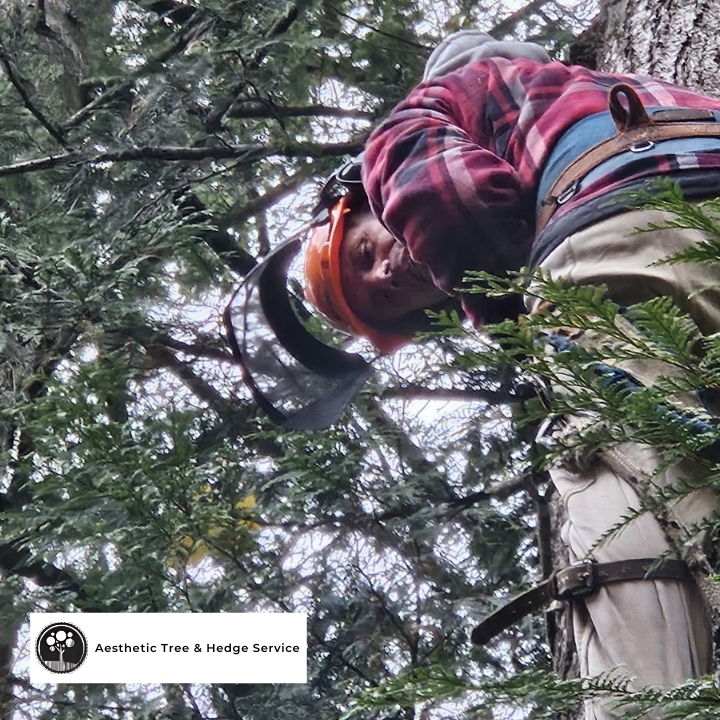
Do You Need an Arborist Report to Apply for a Vancouver Tree Permit?
For trees 20 cm DBH or larger in Vancouver, yes — in almost all cases.
The arborist report is the evidence file for your application. It documents:
- **Species identification** — accurate botanical and common name
- **Tree measurements** — DBH, height, crown spread, crown condition
- **Health assessment** — disease, pest damage, wound response, root flare condition
- **Structural assessment** — crown architecture, co-dominant stems, included bark, any prior failures
- **Risk rating** — conducted under ISA's Tree Risk Assessment Qualification (TRAQ) framework
- **Removal justification** — the arboricultural case for why removal is the appropriate management option
- **Replacement planting recommendations** — species suitable for the site and conditions
This is not a formality. It's a professional evaluation conducted to ANSI A300 standards — the North American benchmark for tree care practice. Municipalities rely on arborist reports to make informed permit decisions.
A report that uses vague condition language, skips the risk rating, or fails to make a clear removal case can delay or sink an application. A report prepared to a low standard costs you time and often a second report fee.
Our arborist reports are prepared by ISA-certified arborists following ANSI A300 protocols. Every report is written to meet the City of Vancouver's submission requirements — and to make the permit reviewer's job straightforward.
---
What Happens After Your Tree Removal Permit Is Approved?
The permit is approval to proceed — within conditions. Read them before you schedule anything.
**Replacement planting conditions are common.** The City may specify the number of replacement trees, acceptable species, on-property planting location or City boulevard planting requirement, and the timeline for fulfillment. These conditions are not optional.
**Permit validity windows matter.** Most private tree permits in Vancouver are valid for six months to one year from the date of issue. Work must be completed before expiry. Don't let approval sit while you decide — schedule promptly.
**Use a qualified, insured contractor.** The permit is issued to the property owner. If removal is done improperly — damaging adjacent trees, utilities, structures, or neighbouring property — liability rests with you. WCB-registered, ISA-certified contractors give you documented professional coverage.
For tree removal in Vancouver, we handle the full removal including debris clearing and clean-up. After the tree is down, the stump remains — a trip hazard and a site for fungal growth that can spread to adjacent trees. Our stump grinding service resolves this in the same site visit or as a standalone follow-up.
**Fulfill replacement planting within the permit timeline.** Failure to meet permit conditions is its own bylaw violation. The City does follow up.
---
How Does Vancouver's Urban Forest Strategy Shape Tree Permit Decisions?
Vancouver's Private Tree Bylaw doesn't exist in a vacuum. It's the enforcement mechanism for a larger goal.
The City of Vancouver's Urban Forest Strategy (2018–2027) set a target to maintain and grow the city's tree canopy toward 30% coverage. According to City of Vancouver reporting, the urban canopy covered approximately 22% of the city's land area at the strategy's baseline period. Closing that gap requires active canopy protection.
The strategy also documents that Vancouver manages approximately 150,000 street trees, with new plantings averaging several thousand per year as part of the canopy expansion program. Private property trees represent a significant share of the city's total canopy — which is precisely why private tree removal is regulated.
This context shapes how applications are reviewed. The City isn't just deciding whether this specific tree should come down. It's managing cumulative canopy loss across the city. Applications that present strong arboricultural justification — documented disease, structural failure risk, root conflict with foundations or utilities, construction necessity — move through cleanly. Applications with weak or absent justification face scrutiny.
Frame your application around what the tree actually is. Diseased: document the disease. Structural hazard: document the failure mechanism. Infrastructure conflict: document the conflict. That's what reviewers are looking for.
---
Which Tree Species Are Hardest to Get Removal Permits For in Vancouver?
Some species face higher scrutiny — not because a separate restricted list exists, but because of their ecological significance and canopy contribution.
**Mature Douglas fir.** BC's provincial tree. Large specimens in residential yards almost always exceed the threshold by a significant margin. They provide canopy, habitat, and carbon sequestration. Permit applications for healthy Douglas firs require compelling justification.
**Mature Western Red Cedar.** Long-lived and ecologically significant in the Pacific Northwest. These trees represent irreplaceable old-growth remnants in urban contexts. The City takes their removal seriously.
**Heritage-listed specimens.** Any tree on the City of Vancouver Heritage Tree Register requires additional documentation and may face conditions that effectively require retention rather than removal. These applications should be approached with the expectation of a thorough review.
**Trees adjacent to protected areas.** Trees near riparian zones, foreshore areas, or environmentally sensitive areas may face additional review layers beyond the standard bylaw process.
Not every application for these species fails. But the bar is higher, and the documentation standard must be met. We assess the full permit path before any work begins — so you know what you're facing before investing in the process.
---
FAQ
**Q: Can my neighbour remove a tree on their property without notifying me first?**
They can apply for a permit without consulting you, yes. The permit process doesn't require neighbour notification for private trees on residential lots. However, if you believe the tree is on or near the property line, or actually on your property, that's a legal question requiring a BC Land Survey. If a neighbour proceeds without your knowledge on a shared or boundary tree, your recourse is a legal dispute, not a permit objection. If you have concerns about a large tree near the property line, get a survey first.
**Q: My tree is protected. Does that mean I can never remove it?**
No. Protected status means you need a permit — not that removal is impossible. The City grants removal permits regularly for trees that present documented hazards, have significant disease or structural failure risk, or are in direct conflict with permitted construction. A thorough arborist report making the arboricultural case is the key to a successful application.
**Q: How do I know whether a tree is on City property or my private lot?**
Street trees in the boulevard or public right-of-way belong to the City of Vancouver. Trees within your property line belong to you. If you're uncertain of your exact property boundary, a BC Land Survey provides a definitive answer. Your property title and registered lot plan are also useful starting points.
**Q: What if a tree falls and damages my neighbour's property before I can get a permit?**
Liability depends on documented knowledge. If a certified arborist had already identified the tree as a hazard in a written report and you didn't act on it, your exposure is significant. If the failure was sudden and had no prior documented warning signs, the situation is different. The practical lesson: act on hazard assessments promptly. Don't let documented risks sit unaddressed. Carry adequate home insurance. And if you're concerned about a tree's condition, get a professional assessment on paper.
**Q: Can I do the tree removal myself once I have the permit?**
Property owners can perform work on their own property in British Columbia. Legally, yes. But tree removal — particularly felling trees near structures, fences, utilities, and neighbouring property — is among the most dangerous tasks a non-professional can attempt in a residential setting. Gravity doesn't negotiate. Trees don't always fall where you expect. When things go wrong, the damage is fast and irreversible. Most homeowners hire qualified contractors. We're WCB registered and ISA certified — which means you have documented professional liability protection on every job we complete.
---
Ready to Move Forward? Call Aesthetic Tree.
You've got the full picture. Here's the next step.
If your tree is over 20 cm DBH, call us before you do anything else. We'll assess it, confirm the permit requirement, and prepare the arborist report your City of Vancouver application needs. We know the permit system. We've been through this process hundreds of times.
If it's a hazard situation — the tree is leaning, cracking, showing active decay, or came through the last windstorm in rough shape — call us immediately. We document emergencies properly and advise on the fastest path forward.
**Aesthetic Tree & Hedge Services** ISA-Certified Arborists. WCB Registered.
Call for a free estimate: **(604) 721-7370**
Tree removal in Vancouver · Arborist reports · Emergency tree service
Before You Go
Where are you in your tree care journey?
Our Tree Care Services
ISA-certified arborists serving Greater Vancouver
Explore Our Tree Care Services
From expert pruning to safe tree removal, our ISA-certified arborists are ready to help across Greater Vancouver.
View Services