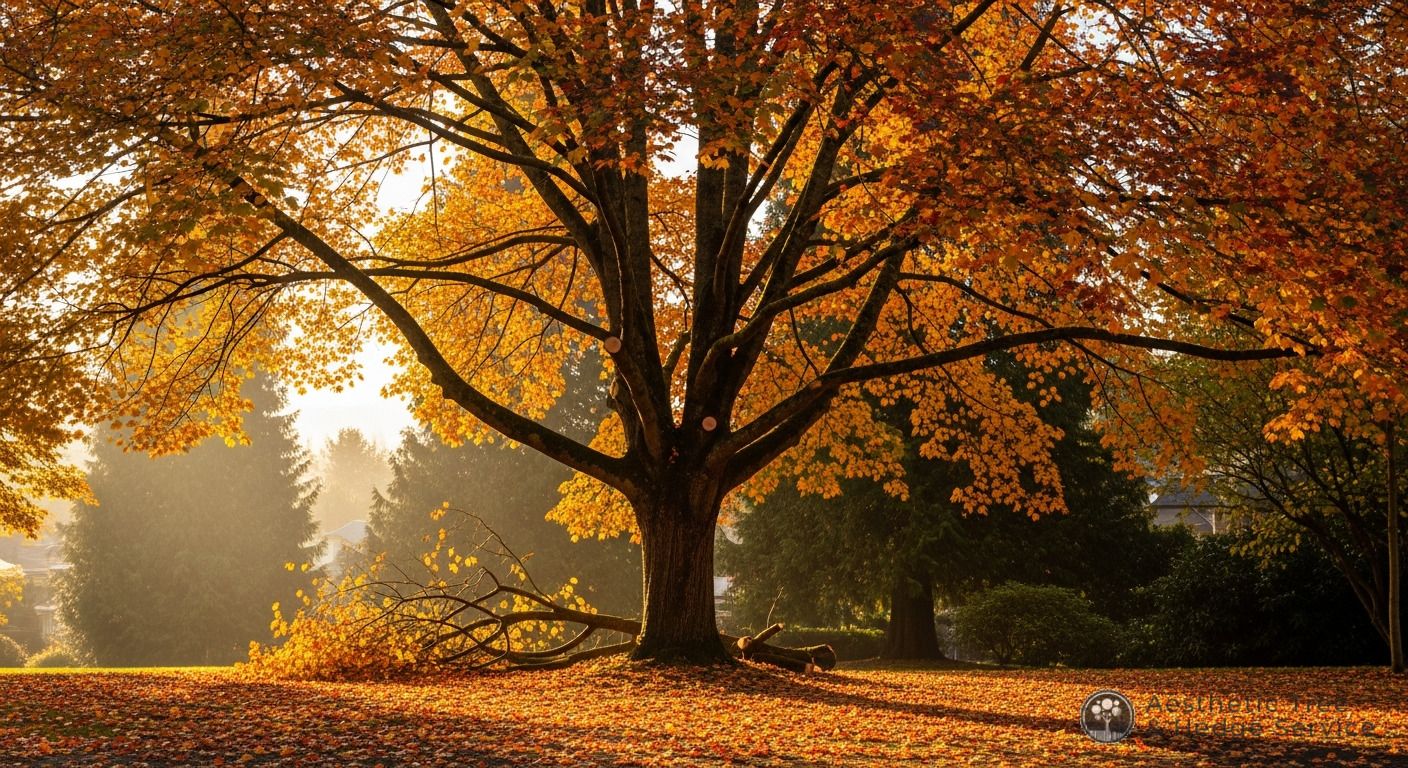

TL;DR — Quick Summary
Autumn trees Vancouver care requires action before November. ISA-certified arborists share pruning timing, hazard signs, bylaw rules, and what to do now.
Autumn tree care in Vancouver begins earlier than most homeowners expect.
By the time October rains arrive, your window for certain treatments is already narrowing. Trees are entering dormancy on their own schedule. Many structural problems that cause damage in a winter storm are visible in October, if someone knows where to look.
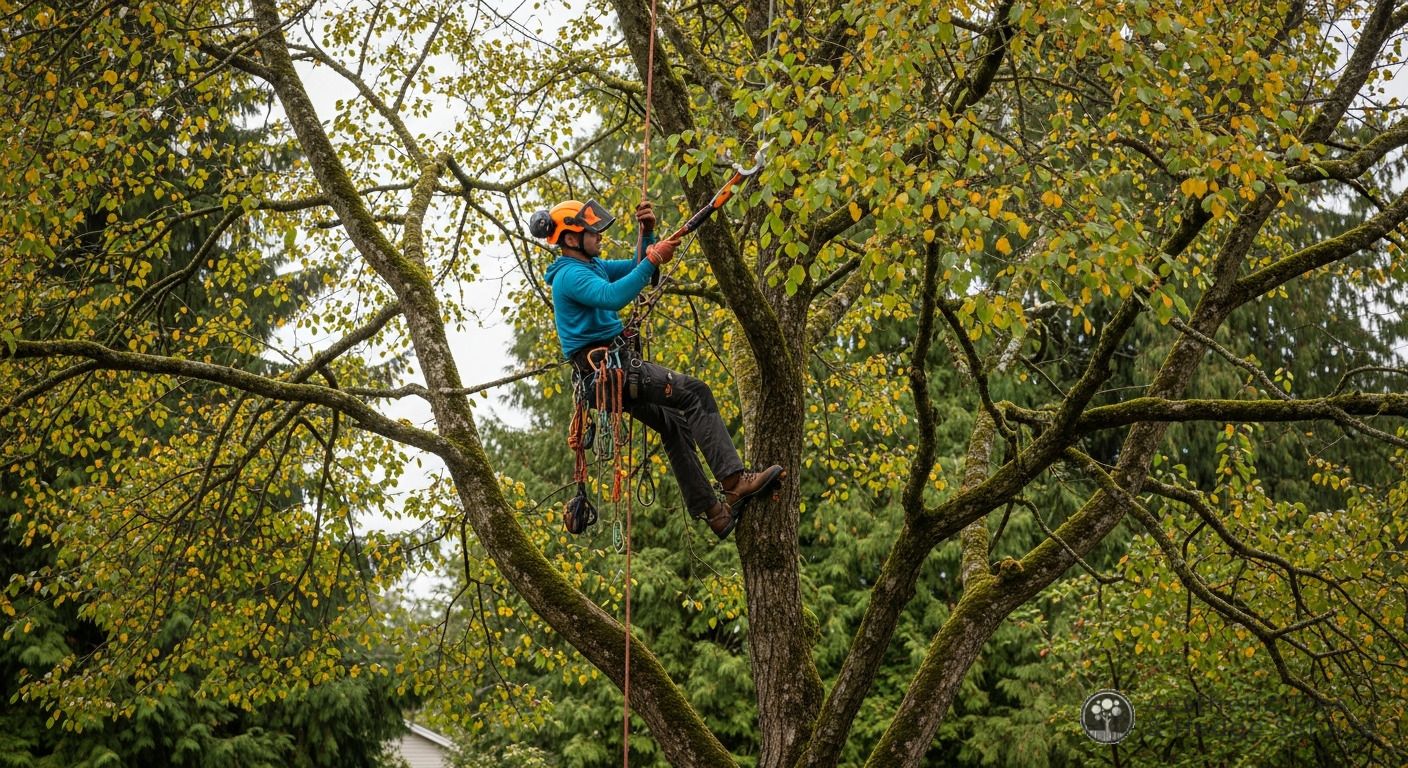
This is a guide for Vancouver homeowners who want to do right by their trees before Pacific storm season arrives. It covers timing, species risks, bylaws, and the seven signs that a tree needs professional attention now, not after a windstorm makes the point.
- **Autumn is a good time** to inspect trees before Vancouver's winter storm season.
- **Pruning timing matters.** Most deciduous trees should be pruned late October through February, after leaves drop and structural problems become visible.
- **Big-leaf maple and Douglas fir** are large trees worth checking before storm season. Look for dead wood and structural defects.
- **City of Vancouver bylaws** require a permit to remove a private tree 20 cm or more in diameter, measured 1.4 m above the ground. Fines run from $500 to $10,000 per offence, and each tree counts separately.
- **Call an ISA-certified arborist** if you see leaning, cracks, dead branches, or fungal growth at the base of any tree on your property.
What Actually Happens to Vancouver Trees in Autumn?
Vancouver doesn't have a textbook autumn. We don't get hard frosts that stop tree growth abruptly. Instead, we get a slow transition. September brings drier, cooler days. October adds heavy Pacific rain systems. November opens the door to windstorms.
Deciduous trees, Big-leaf maple, red oak, ornamental cherry, pull nutrients back into their trunks and root systems as growth slows. Leaves yellow and fall. The energy stored in roots fuels next spring's push.
Evergreen conifers, Douglas fir, western red cedar, Grand fir, show almost no visible change. But their root zones are quietly shifting resources. They become more susceptible to waterlogged soil conditions as autumn rains saturate Metro Vancouver's clay-heavy soils.
That's the real autumn risk. Not the leaves. The invisible structural vulnerabilities that winter storms will test.
Which Vancouver Trees Are Most Vulnerable in Fall?
Species matters. Not every tree needs the same attention.
**Big-leaf maple** (*Acer macrophyllum*) is the largest maple in Canada, reaching 36 metres, according to the BC Tree Book. Large specimens can develop included bark: a structural flaw where two major branches fuse with bark trapped between them. Under winter wind load, that junction can split.
**Douglas fir** is structurally strong, but it develops root vulnerabilities in urban settings with compacted soil and restricted root zones. Mushrooms at the base of a Douglas fir in autumn are worth having an arborist look at.
**Japanese maple** is thin-barked, so avoid bark wounds from mowers, trimmers, or rough pruning cuts.
**Western red cedar** naturally sheds interior foliage in patches during autumn, a process called flagging. Many homeowners mistake it for die-off. It isn't. But drought is a real threat: the City of Burnaby advises against cedars as replacement trees because many have been dying off suddenly due to drought conditions.
**Ornamental cherries** are everywhere here: the Vancouver Cherry Blossom Festival counts about 43,000 cherry trees across the city. An old cherry with dieback, cracks, or decay is worth a professional look before December.
Knowing your species is the first step. The second is knowing the timing.
When Should You Prune Trees in Vancouver, Fall or Late Winter?
For most deciduous trees, **late October through February** is a common pruning window. The timing isn't arbitrary.
After leaves fall, an arborist can see the tree's full structure for the first time since spring. Crossing branches, dead wood, co-dominant stems, and structural defects that hide in summer foliage become visible.
Simultaneously, trees in full dormancy are less stressed by pruning cuts. Their vascular systems have slowed. Many fungal pathogens are less active when temperatures drop and growth has stopped.
There are exceptions. **Never prune cherry, plum, or other Prunus species in wet conditions.** Canker diseases can enter fresh pruning wounds in wet weather, so wait for a dry stretch.
**Evergreen conifers** don't require seasonal pruning but handle structural work well in autumn. What they cannot tolerate is topping, cutting the central leader. The International Society of Arboriculture calls topping perhaps the most harmful tree pruning practice known. It is not a viable way to reduce height and may increase risk over time.
Hedges benefit from autumn shaping. A light trim in October helps English laurel and cedar hedges hold their form through winter. If your hedges are overdue for attention, our hedge trimming services in Vancouver can help.
Heavy cuts carry legal limits in some cities. The City of North Vancouver, for example, does not permit topping or removing more than 25% of a protected tree's crown in one season.
How Do You Spot a Hazardous Tree Before Winter Storms?
There are seven signs every Vancouver homeowner should know.
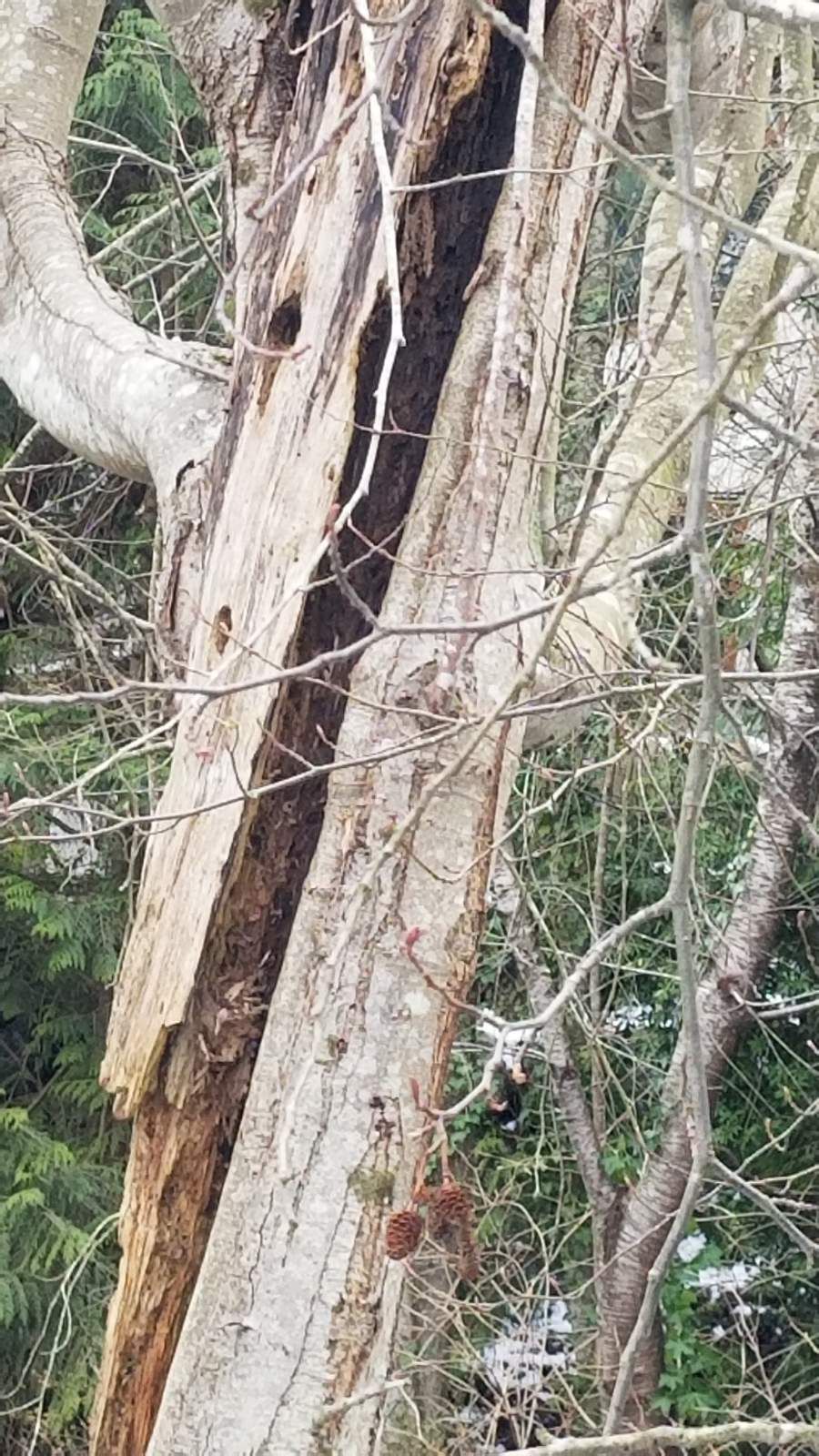
**1. Dead wood in the upper canopy.** Branches that didn't leaf out last spring. Bark that peels and stays peeled. In Douglas fir or Big-leaf maple, dead branches over 10 cm diameter are a falling risk in wind.
**2. Included bark at branch unions.** Look for a crease where two major branches meet. Bark trapped inside the fork, rather than flaring outward, is a structural weakness that can split under load.
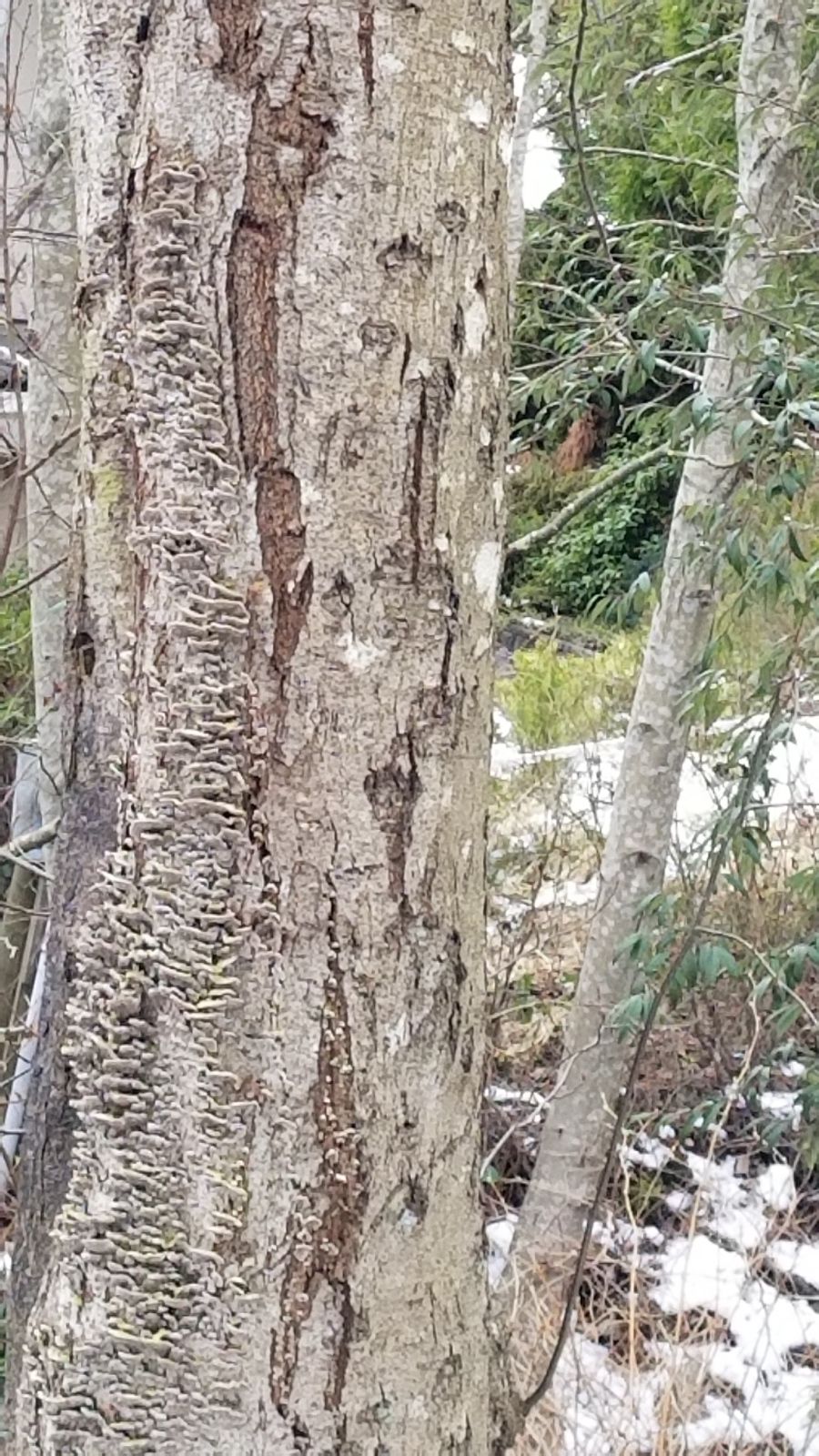
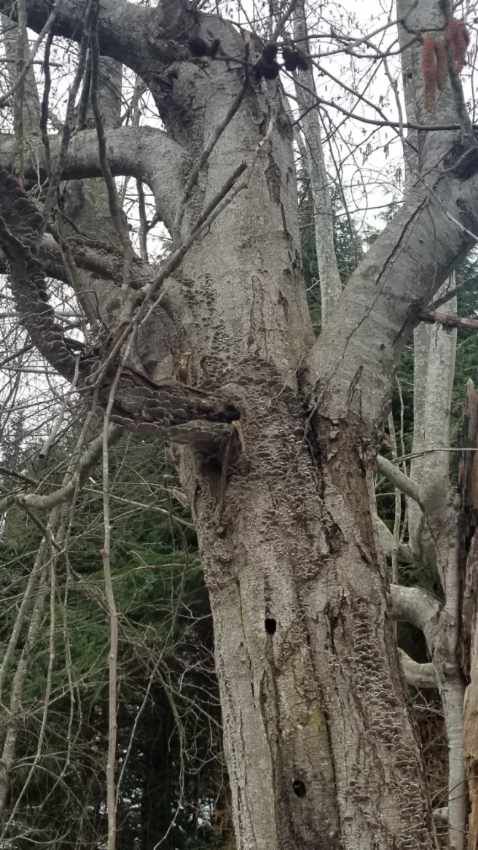
**3. Mushrooms or bracket fungi at the base.** *Ganoderma* species (artist's conk) on the trunk indicate internal wood decay that may not be visible from outside. Never ignore them.
**4. Increased lean.** A tree that has leaned for years may be stable. A lean that has *increased*, especially with soil heaving at the base, is an emergency, not a watch-and-wait situation.
**5. Crown dieback.** When only part of the canopy is dying, it usually signals root damage, soil compaction, or vascular disease. It's a diagnostic finding, not a cosmetic problem.
**6. Cracks in the trunk or major limbs.** Horizontal cracks especially. When they appear, the tree needs immediate professional evaluation.
**7. Soil heaving around surface roots.** Autumn rains can expose roots that were already struggling. Major roots lifting from saturated soil indicate compromised anchorage.
If you see any of these, don't schedule spring. Our emergency tree service in Vancouver is available 24/7 across the Lower Mainland.
What Do Vancouver Bylaws Actually Say About Autumn Tree Work?
The **City of Vancouver Protection of Trees By-law No. 9958** requires a permit to remove any tree on private property with a diameter of 20 cm or more, measured 1.4 m above the ground. Fines run from **$500 to $10,000 per offence**, and a breach that affects more than one tree counts as a separate offence for each tree.
Neighbouring cities set their own rules:
- **Burnaby Tree Bylaw** (on properties without a development application, protects conifers 30 cm and larger and deciduous trees 45 cm and larger in diameter)
- **City of North Vancouver Tree Bylaw No. 8888** (permit to remove protected trees 20 cm or larger in diameter)
Work that doesn't involve removal, pruning, hazard assessment, cabling, typically doesn't require a permit. Heavy cutting can still breach a bylaw: Vancouver's By-law 9958 treats cutting a tree so it becomes hazardous, loses its characteristic appearance, or dies prematurely as unlawful damage.
Autumn is a good time to start permit applications if you're planning spring removals. The City of Vancouver asks for an arborist report with a private tree removal application, so getting your **arborist report for Vancouver** prepared early gives you time before spring work.
One complication homeowners underestimate: if a tree is on your property but overhangs the boulevard or a neighbour's yard, the rules get more complex. Work near property lines almost always warrants professional advice before any cutting begins.
How Do You Prepare Trees for Vancouver's Wet Winters?
Preparation isn't just pruning. It's the whole tree system.
**Mulching.** Apply 7–10 cm of wood chip mulch around the root zone in October. This insulates roots from temperature swings and retains moisture through freeze-thaw cycles. Keep mulch 15 cm away from the trunk flare, piling it against bark can encourage decay. Our mulching service can apply it at the right depth with clearance from the trunk.
**Soil aeration.** Vancouver's clay-heavy soils compact badly under sustained rain. An air spade opens the root zone without severing roots and restores oxygen access for roots through waterlogged winter months. This matters most for trees near driveways, construction zones, or hardscaped surfaces.
**Cabling and bracing.** Trees with co-dominant stems or weak branch attachments can be stabilized with dynamic cabling systems. These reduce failure risk through wind events. Cables need periodic inspection and aren't permanent, but for a tree worth keeping, they can buy time. Our tree cabling service installs and inspects these systems.
**Pre-dormancy watering.** After a dry summer, trees can enter autumn short of water, and the first rains may not soak deep into the root zone right away. A deep watering in early October helps trees enter dormancy fully resourced.
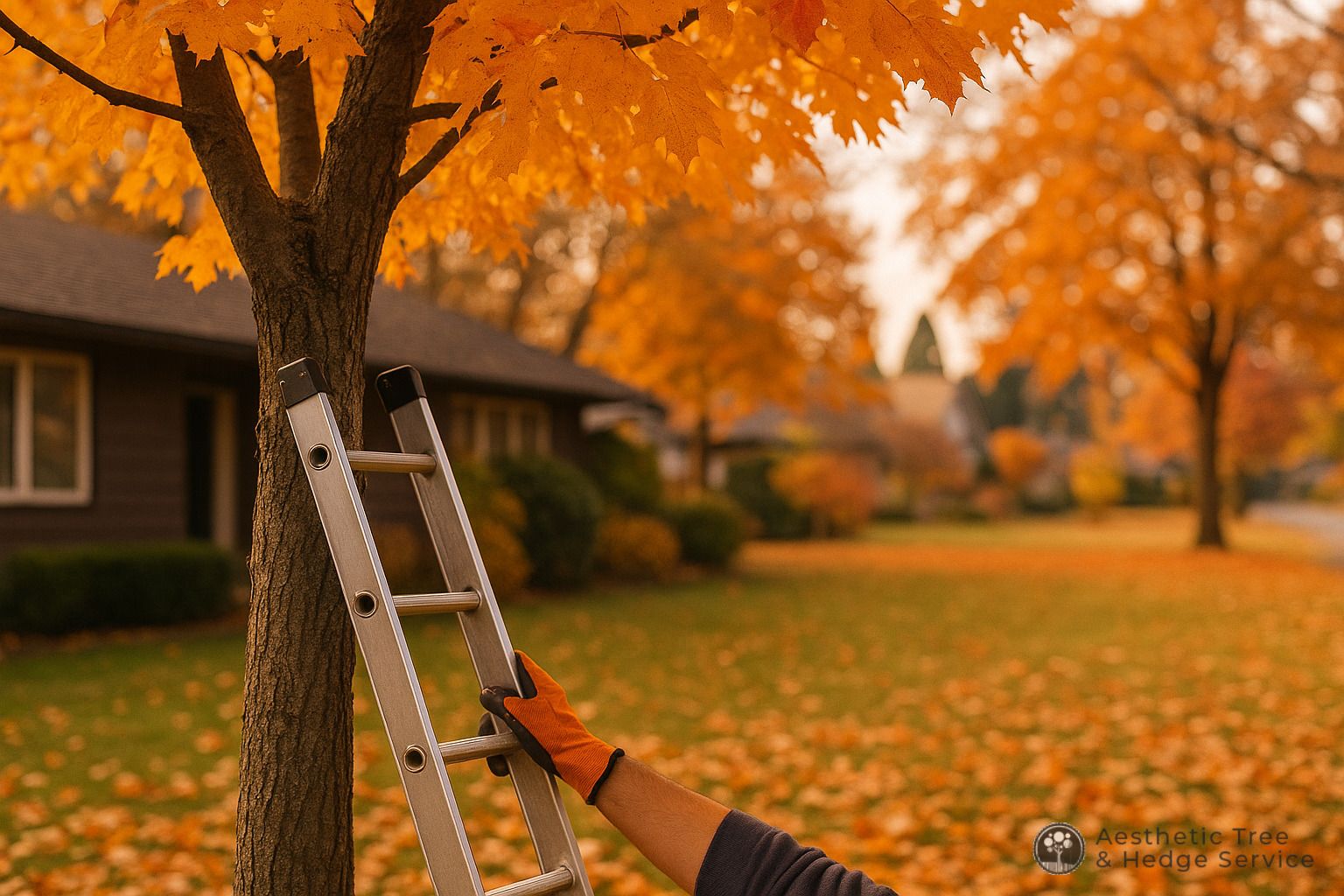
**Removing hazardous material.** Dead branches and compromised limbs should come down before December. For trees requiring access above 12 m, professional tree cutting in Vancouver by ISA-certified climbers is the appropriate approach, not a homeowner with a ladder and a hand saw.
What Does a Professional Autumn Tree Assessment Actually Cover?
A certified assessment isn't a casual walk-around. It follows a structured inspection protocol.
Here's what an ISA-certified arborist evaluates:
**Crown inspection:**
- Live crown ratio
- Dead wood volume and location in the canopy
- Structural defects, included bark, co-dominant stems, cracks
- Pest and disease evidence
- Epicormic growth (a stress indicator in conifers and stressed hardwoods)
**Trunk and stem:**
- Bark condition and wound closure stage
- Signs of decay, hollow sound on percussion, fruiting bodies, soft spots
- Abnormal swelling or fluting at the root collar
**Root zone and soil:**
- Soil grade changes around the trunk base
- Root flare visibility (buried root flares are a long-term health concern)
- Evidence of root severance from excavation or paving
- Compaction indicators
**Risk and target assessment:**
- What is the failure pathway for this tree or limb?
- What would be struck if the tree or major limb fell?
- What is the probability of failure multiplied by consequence severity?
That last calculation matters most. Risk isn't about whether a tree will fail. It's about what it would hit. A declining tree over an empty lot carries lower risk than a smaller, healthier tree overhanging a bedroom.
Our arborists hold the ISA Tree Risk Assessment Qualification (TRAQ), a standardized method for assessing tree risk.
When Does a Tree Need Removal Rather Than Pruning?
Removal should be the last option. But some trees have passed the point where pruning reverses the trajectory.
Clear indicators that merit a removal discussion:
- More than 50% of the crown is dead or structurally compromised
- Decay has reached the structural core of the trunk
- The tree is dead and poses a falling risk to structures or people below
- Root damage is severe enough to have compromised anchorage
- The tree carries an unmanageable disease load with no viable treatment path
Removal requires permits in most Lower Mainland municipalities. In many urban situations, trees near buildings, fences, power lines, a straight fell isn't possible. That's where our crane tree removal service becomes necessary. Crane removal gives precise control over where each section lands, even in confined spaces.
After removal, the stump stays. A stump left in place can host wood-decay fungi and block replanting. Stump grinding below grade clears the way for replanting.
Should You Plant New Trees This Autumn in Vancouver?
Yes. Autumn is a good planting window, as is spring. The City's own Urban Forestry team plants new trees between November and April.
Autumn planting gives roots weeks to establish before summer heat stress arrives. A tree planted in October enters spring with months of root establishment, not a standing start.
The City of Vancouver's **2025 Urban Forest Strategy** targets 30% tree canopy by 2050, up from about 25% today. Trees planted on private lots count toward that goal.
For successful establishment:
- Dig the planting hole 3× the width of the root ball, not deeper
- Don't amend the backfill, native soil encourages natural root extension outward
- Stake only if the site is exposed to wind, and remove stakes after one year
- Water weekly through November if rains are inconsistent
Species selection matters as much as timing. Our tree planting service starts with sun, soil, overhead utilities, and the tree's mature size.
Frequently Asked Questions
**Is it too late to prune trees in Vancouver once the leaves have fallen?**
No, it's a good time for most deciduous species. Once leaves drop, the full branch structure is visible. ISA-certified arborists can identify crossing branches, dead wood, and structural defects that hide in summer foliage all season.
**Do I need a permit to prune a tree on my property in Vancouver?**
Pruning typically doesn't require a permit in Vancouver, but removing a private tree 20 cm or more in diameter does under the Protection of Trees By-law No. 9958. Cutting a tree so heavily that it becomes hazardous, loses its characteristic appearance, or dies prematurely counts as unlawful damage under that bylaw. Confirm requirements with your specific municipality before any major work, as bylaws vary across Burnaby, North Vancouver, Richmond, and Coquitlam.
**What's the difference between an arborist report and a tree assessment?**
A tree assessment is an on-site evaluation of a tree's health, structure, and risk level. An arborist report is a formal written document prepared by an ISA-certified arborist. The City of Vancouver asks for one with a private tree removal permit application, and for development permit applications where trees are 20 cm in diameter or larger.
**How often should I have my trees professionally inspected?**
For most residential properties, once a year is appropriate, ideally in autumn before storm season. Trees near structures, power lines, or high-traffic areas warrant more frequent inspection.
**My neighbour's tree overhangs my property. What rights do I have in BC?**
Overhanging branches are commonly trimmed back to the property line without entering the neighbour's property, but tree bylaws still apply, and heavy cuts to a protected tree can breach them. If you notice a defect, tell your neighbour in writing. For large trees or significant damage risk, consult both an ISA-certified arborist and a property lawyer.
Ready to Book an Autumn Tree Assessment?
Don't wait for a November windstorm to tell you what an arborist would have found in October.
The ISA-certified team at Aesthetic Tree & Hedge Services assesses trees across the Lower Mainland. Every crew member is covered by WorkSafeBC, we carry $3 million in liability insurance, and our pruning follows ANSI A300.
**Call for a free estimate: (604) 721-7370**
We identify hazards. We explain your options honestly. And we do the work right.
Found this helpful? Follow our tree care insights directly on Google.
Make us your preferred source on GoogleOur Tree Care Services
ISA-certified arborists serving Greater Vancouver

Explore Our Tree Care Services
From expert pruning to safe tree removal, our ISA-certified arborists are ready to help across Greater Vancouver.
View Services