
TL;DR — Quick Summary
Tree removal Richmond requires permits, ISA-certified arborists, and careful planning. Here's what experienced arborists want you to know before you call.
- Tree removal in Richmond needs a City permit for any tree 20 cm or more in diameter at 1.4 m above the ground, under Tree Protection Bylaw No. 8057.
- Richmond approves removal only when a tree is dead, dying, hazardous, or in unresolvable conflict with buildings or utilities.
- A tree that looks healthy from the street can have deep rot inside. Looking at it from outside is not enough to know if it's safe.
- ISA certification and WCB registration matter. Hiring a contractor who is not registered with WorkSafeBC can leave you liable for their unpaid premiums.
- Putting off a flagged hazard tree can turn a planned job into an emergency.
Does Tree Removal in Richmond Require a Permit, Even on My Own Property?
Yes, if the tree is 20 cm or more in diameter.
Richmond's Tree Protection Bylaw No. 8057 applies to trees on private land as well as City land. It also covers any tree, whatever its size, in an environmentally sensitive area.
The size test is a trunk diameter of 20 cm or more, measured 1.4 m above the ground, on a tree capable of reaching 4.5 m tall. Normal pruning of trees or hedges to ANSI A300 standards does not need a permit.
What the permit application asks for:
- The property address and legal description, the registered owner's name, and a letter of authorization if you are not the owner
- The tree's species, diameter, and approximate height, and the reason for removal
- An arborist report, site plan, or replanting plan if the City asks for supporting documents
- Photos or a plan that clearly show where each tree is
After the fee is paid and a complete application is received, the City inspects the site to confirm ownership, the reason for removal, species, height, and diameter. The City contacts you when the permit is ready, and the approved permit must be displayed on site 72 hours before the tree comes down.
Replacement planting is required for each tree removed. On non-development sites the ratio is 1:1, with a minimum 6 cm caliper deciduous tree or a 3.5 m conifer, planted on the same lot within one year of the permit. Hedging cedars are not accepted as replacements.
Aesthetic Tree handles permit applications, including the arborist report. Skipping the permit is costly: on conviction, the bylaw sets fines of $1,000 to $50,000, and each tree counts as a separate offence.
If a contractor says you don't need a permit for your Richmond property, they either don't know the bylaw or they're cutting corners. You don't want either kind of contractor on your lot.
How Do ISA Arborists Decide Whether a Tree Needs Removal or Just Pruning?
Not every declining tree has to come down. The decision comes from a real assessment, not a guess or quick look.
Here's how a sound assessment works:
Crown assessment. Pruning should follow ANSI A300 standards, which Richmond's bylaw bulletin names for normal pruning. If much of the crown is dead or badly damaged, pruning alone won't fix it.
Root zone inspection. Soil heaving around the base means roots are moving. Sawdust near roots or at soil level often means insects or rot working from below. Fungal conks, shelf-like growths at or near ground level, can mean rot inside the trunk is advanced.
Internal decay testing. For trees with possible rot or visible cavities, an arborist may use a resistance drilling tool. A thin needle passes through the wood and records how firm it is, and soft readings point to decay. How much sound wood is left, together with what the tree could hit, guides the decision.
Site context. A tree with some decay in a field is different from the same tree leaning over a Richmond roof or near BC Hydro power lines. What the tree could hit if it falls matters. It changes the urgency even if the tree's condition is the same.
Ask for every check to be documented with photos and written notes before any work starts.
Some trees do better with targeted tree cutting and pruning. Others have gone too far. The assessment shows which.
What Warning Signs Tell You a Tree on Your Richmond Property Is Dangerous?
Some signs are obvious. Others you won't see unless you know what to look for, which is why declining trees catch homeowners off guard.
Signs at the base:
- Fungal conks (shelf-like growths) at or near ground level. They can mean decay inside is advanced.
- Soft or discoloured wood where bark has cracked, split, or come off
- Soil heaving on one side around the base, the root plate is lifting
- Sawdust or crumbling wood near the roots, meaning borers or deep rot
Signs in the crown:
- Heavy one-sided dieback, dead branches on one side while the other side looks okay. This often follows root disease or damage to one side of the tree.
- Epicormic growth, thick clusters of small shoots growing straight from the main trunk. This means stress. The tree is trying to replace a failing crown.
- Dead branches hanging or barely attached. Arborists call these widow makers because they can drop without warning.
Post-storm changes: A tree that didn't fall in a windstorm isn't automatically safe. If the root plate shifted, even slightly, the tree's hold on the soil changed. A post-storm hazard assessment tells you whether what's still standing is still stable.
If you see any of these signs, get a documented assessment before the next windstorm makes the decision. If a tree has already fallen or is touching a structure, our emergency tree service is there when you need it.
What Makes Richmond Tree Removal Different From Other Lower Mainland Cities?
Richmond's rules make it different. The City approves removal only for trees that are dead, dying, hazardous, or in unresolvable conflict with buildings, structures, or utilities, so a healthy tree that is simply in the way may not qualify.
Site conditions still matter. Wet soil can reduce how well roots grip, so a new lean or a lifted root plate after heavy rain deserves an assessment.
Wet soil limits equipment access. Heavy equipment crossing a soft, wet lawn can leave ruts. Ask how the crew will protect the lawn along equipment paths.
Drainage after removal. After stump grinding, ask how the hole will be backfilled so the area settles evenly.
Topping is not a shortcut. Richmond's bylaw prohibits topping trees on private and City property, and the City warns it can lead to fines of up to $50,000 per tree.
Our arborists hold the International Society of Arboriculture's Tree Risk Assessment Qualification (TRAQ). A tree isn't assessed alone. Its condition, the site, and what it could hit all factor into the risk rating.
For what Richmond removal involves on your property, see our tree removal service.
What Should You Ask Before Hiring a Tree Removal Company in Richmond?
Skipping these checks can leave you exposed, and you may not find out until something goes wrong.
Ask for WCB registration and verify it. WorkSafeBC says a homeowner who hires a contractor that is not registered or not in good standing could be liable for the insurance premiums that contractor owes. Don't just take the contractor's word. Request a clearance letter, free and online at worksafebc.com, before any work starts.
Ask for ISA certification and check the number. The International Society of Arboriculture certifies arborists and runs an online directory where you can check a credential. Owning a chainsaw doesn't make someone an arborist. Get the certification number and check it.
Request liability insurance and call the insurer. A liability insurance certificate is the start, not the end. Call the insurance company directly to confirm the policy is active and covers the work on your property. Certificates can be old or from policies that have ended.
Ask whether they pull permits. If a contractor says permits aren't required for your Richmond tree, they either don't understand the bylaw or plan to skip it. Richmond's bylaw applies to private property trees 20 cm or more in diameter. A contractor who skips permits is one you don't want.
Get clear on what's included. Full removal can mean felling the tree, removing all sections and debris, grinding the stump below grade, and cleaning up. Ask whether stump grinding is included or quoted separately. Know the scope before you agree.
WorkSafeBC's Occupational Health and Safety Regulation has a part for forestry operations and similar activities (Part 26). Ask the crew lead how they set up drop zones, protective gear, and communication on site.
What Happens on Removal Day, Step by Step?
Here's the process from your first call to final cleanup.
The initial call. Expect questions about the tree's location, size, and what you're noticing, leaning, dead branches, fungal growth at the base. A job that needs a permit usually needs an on-site visit before a useful quote.
On-site assessment. The arborist should walk the property with you and look at the tree, nearby buildings, overhead utility lines, and where equipment can go. You should get an assessment with clear reasoning, not just a price.
Permit application. The application goes to the City of Richmond with the tree's species, diameter, height, reason for removal, and any supporting documents. Aesthetic Tree handles this paperwork for clients. Removal can't go ahead until the permit is issued, and the permit must be displayed on site 72 hours before work starts.
Removal day setup. A good crew walks the property again, protects lawns and fences along equipment paths, and marks the drop zone. Nobody should enter it during cutting. Crew members should wear protective gear such as chaps, a hard hat, and eye and hearing protection.
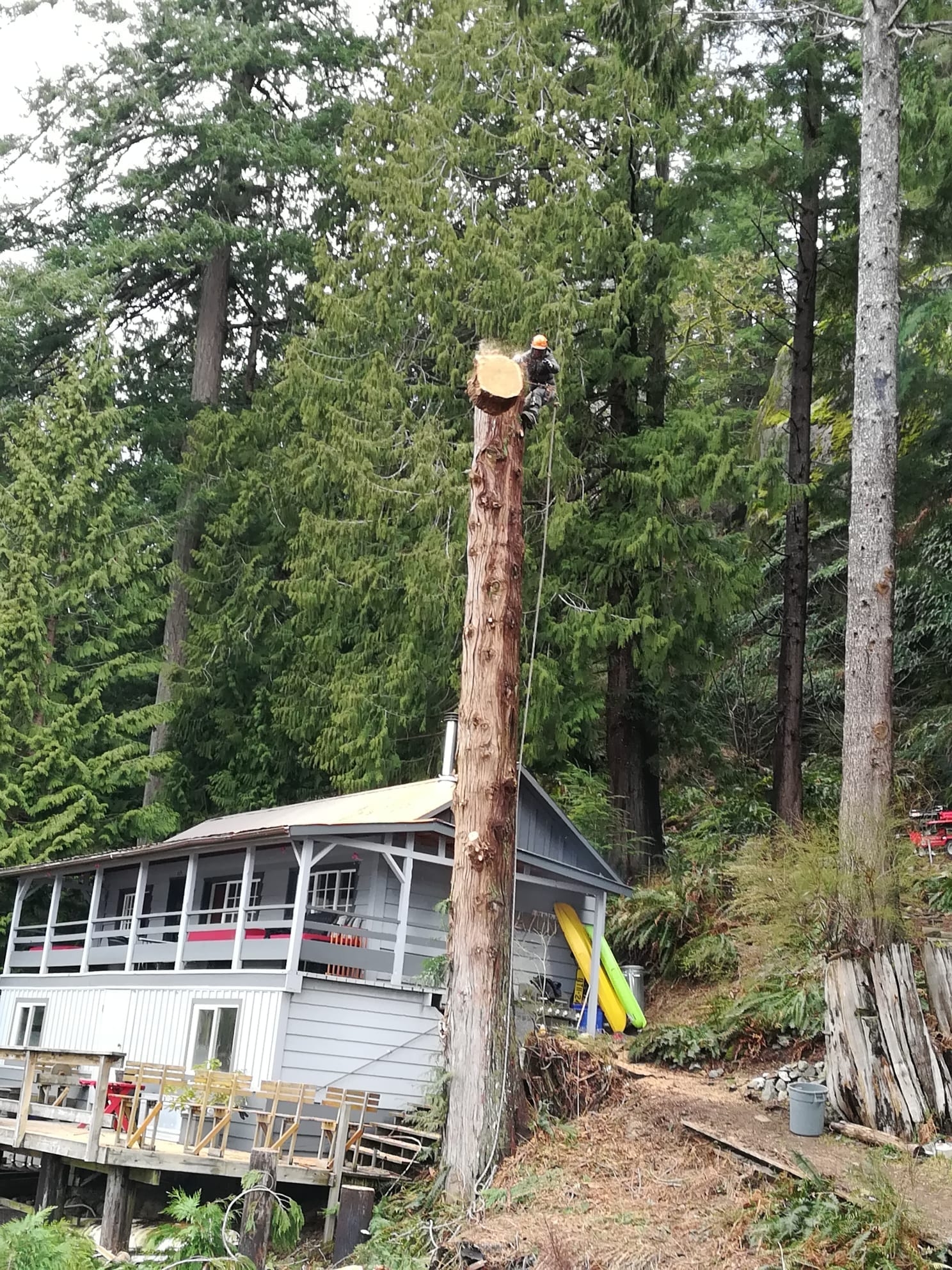
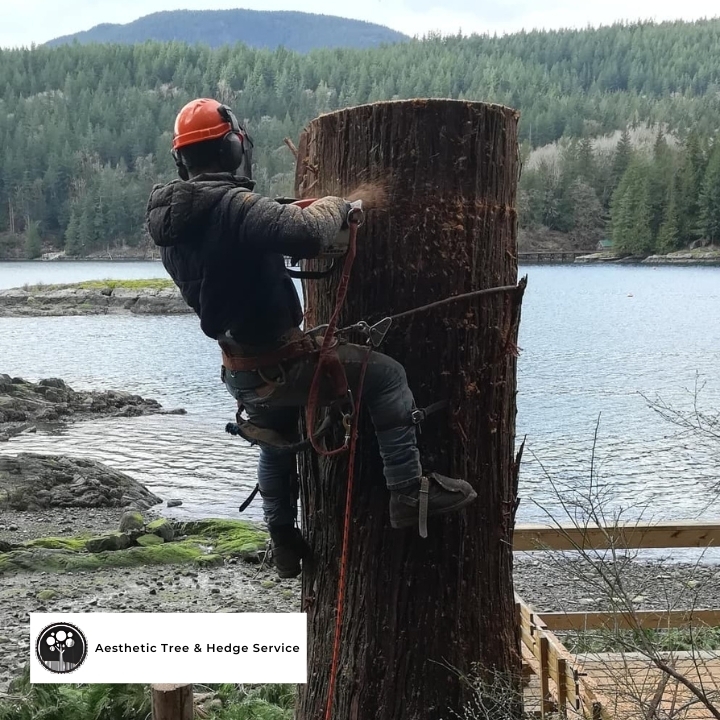
Section-by-section removal. Trees near buildings or fences, or with limited drop space, are usually taken down in sections from the top, using rope and rigging so pieces are lowered instead of free-falling. A heavy section that lands wrong can roll or bounce into buildings and vehicles. Stay well clear of the drop zone.
Stump grinding and cleanup. The stump is ground below grade and the hole backfilled. Agree in advance that all wood, branches, chips, and debris will be cleared.
What Does It Actually Cost to Wait on a Hazard Tree?
Waiting on a flagged tree isn't neutral. It has a cost, and most homeowners see only part of it.
Emergency removal costs more. A scheduled removal on a weekday morning, with good equipment access, good soil conditions, and time to plan, costs less than an emergency call after a windstorm puts a tree through your roof. Emergency mobilization, crane access to a damaged property, working at midnight in rain and wind, coordinating around structural damage: it all costs more than the job would on a Tuesday morning. Actual costs vary by site complexity, crew size, equipment, and timing. Contact Aesthetic Tree & Hedge Services for an assessment of your specific situation.
Insurance doesn't cover everything. Homeowner policies differ on what they cover after a tree falls, such as damage to gardens, debris removal, or temporary housing. Check your policy before you need it.
Emergency permits are still permits. Richmond's bylaw exempts a tree only when it has been severely damaged by natural causes and poses an imminent danger. A tree with known defects that you chose to wait on still goes through the permit process, although the City waives the application fee for imminently hazardous trees.
A documented assessment creates a record. If you have an ISA arborist's hazard assessment and choose to wait anyway, you have proof of when you knew and what the risk was. This can matter in insurance discussions later. If you have no assessment, you're making an undocumented decision about a known risk.
If you're not sure whether your tree is a real hazard or just declining slowly, an arborist report gives you the documented proof to decide clearly. If things have already gotten worse, our emergency tree service is available when you can't wait.
Ready to Book a Tree Removal Assessment in Richmond?
Don't let a windstorm decide for you.
Aesthetic Tree & Hedge Services provides ISA-certified arborist risk assessments, full permit handling with the City of Richmond, and complete tree removal and stump grinding services across the Lower Mainland. Our arborists hold TRAQ, and every crew member is covered by WorkSafeBC.
Call for a free estimate: (604) 721-7370
ISA-certified arborists. WorkSafeBC coverage for every crew member. $3M liability insurance.
Found this helpful? Follow our tree care insights directly on Google.
Make us your preferred source on GoogleOur Tree Care Services
ISA-certified arborists serving Greater Vancouver

Explore Our Tree Care Services
From expert pruning to safe tree removal, our ISA-certified arborists are ready to help across Greater Vancouver.
View Services