
TL;DR — Quick Summary
Arborist jobs in British Columbia require ISA certification and WCB coverage. Here is what certified crews carry — and what to check before you hire.
What Certifications Do Arborist Jobs in British Columbia Actually Require?
Canada does not have one single arborist licensing body. In BC, anyone can pick up a chainsaw and advertise tree services. This matters for property owners to understand.
What separates a real arborist company from an unsafe one comes down to two things: the credentials they have earned and the laws they must follow.
ISA Certified Arborist is the industry standard. The International Society of Arboriculture runs this credential worldwide. To earn it, candidates must pass an exam on eight topics: tree biology, how to spot problems, pruning methods, planting and plant care, utility work near power lines, safety, urban forestry, and soil science. They must also have several years of full-time tree work before they can take the exam.
Certification does not end after the exam. The ISA requires certified arborists to complete 30 continuing education units every three years. This keeps them current on ANSI A300 standards, new tree disease research, and the latest climbing and rigging practices.
Utility Arborist certification is a separate qualification that is essential for work near power lines. In the Lower Mainland's dense neighborhoods, it is hard to avoid power lines overhead. A crew without utility arborist training working near live power lines puts everyone at risk — the crew, the homeowner, and people on the street.
First Aid and CPR certification is essential. Both the ISA and WorkSafeBC recognize that arborists work at heights with power equipment. A medical emergency on site without a trained first aid person can become a serious injury or death.
WCB (WorkSafeBC) registration is not a credential you earn — it is a legal requirement. Every worker on a BC job site must be covered by WorkSafeBC. This matters for homeowners: if an unregistered worker is injured on your property, you may be personally liable. Always check WCB account status before any crew starts work.
Why Do Some Arborist Companies in BC Skip These Requirements?
The honest answer: credentials cost money and time. Not every company wants to pay for them.
ISA certification exam fees, study materials, and the required years of experience cost money. Keeping certification current through continuing education takes additional time every three years. WCB premiums for tree work are high.
Companies that skip these requirements can charge lower prices than certified operations. They attract homeowners looking for the cheapest quote.
What these companies are betting on is that nothing goes wrong.
That bet does not always pay off. A falling branch can damage a neighbor's car. A worker can be injured without WCB coverage. A tree can be removed without the required municipal permit. Each of these situations can cost far more than the original savings. A company offering a price well below market is almost certainly cutting corners somewhere.
The Douglas fir in your backyard is worth more than your car. You would not take your car engine to an uncertified mechanic. Your trees deserve the same level of care.
What Does WorkSafeBC Actually Require for Tree Work in BC?
WorkSafeBC classifies tree care as high-hazard work. This classification exists for a reason.
According to WorkSafeBC, falling from height and being struck by falling objects are leading causes of serious injury and death in tree work in BC. The sector's injury rate ranks it among the more dangerous trades in the province.
WorkSafeBC's Occupational Health and Safety Regulation requires tree care employers to:
- Conduct a written hazard assessment before work begins
- Establish an exclusion zone around work areas
- Ensure workers wear personal protective equipment appropriate to the task
- Follow ANSI A300 standards for climbing and rigging operations
- Keep a trained first aid person on site for work of certain duration and risk level
These are legal requirements, not guidelines. When you see a crew working without hard hats, without a ground-level spotter, and without visible protective gear, that crew is not cutting corners on comfort. It is operating outside BC law.
For emergency situations, WorkSafeBC guidance is clear. When a tree has partially failed or is touching power lines, stop work first. Establish exclusion zones. Call BC Hydro or the relevant utility to turn off any energized lines in or near the tree before anyone approaches. ISA hazard assessment protocols follow this same sequence. Skipping either step creates conditions for serious injury or death.
Staying calm under pressure matters just as much as knowing the protocols. Explaining to a homeowner why work cannot begin right now — when a failing tree is leaning against their neighbor's property — takes communication skill that comes only from real experience on job sites.
How Do BC's Tree Bylaws Affect Arborist Work Throughout the Lower Mainland?
Every major municipality in the Lower Mainland has tree protection bylaws. They are not all the same. Working across Vancouver, Burnaby, North Vancouver, Richmond, and Coquitlam means understanding multiple different rules.
The City of Vancouver's Private Tree Bylaw requires a permit for removing or significantly changing any tree with a trunk diameter of 20 centimetres or more, measured at 1.4 metres above ground. Heritage trees and city-designated protected trees have additional restrictions regardless of size.
The permit process typically takes four to eight weeks or longer, depending on how complex the application is and how busy the municipality is. This affects project planning. A homeowner expecting a tree removed next Tuesday may not realize why the work cannot begin for three to four weeks — until someone explains that the application is waiting in the queue. Removing a tree without a permit brings fines that can exceed the job cost.
Burnaby and Richmond operate under similar rules, with their own diameter thresholds and permit timelines. North Vancouver District and City keep separate bylaws with their own requirements. Winter is often the busiest season for removals because deciduous trees are dormant and pruning stress is lower — but it also means permit applications are being processed during that same window, and timelines matter.
For the arborist report that most Lower Mainland municipalities require before issuing a permit, the report must be signed by an ISA Certified Arborist. Municipalities will not accept a report signed by an uncertified person. If a company cannot provide that signed report, the permit process cannot move forward — and the work cannot legally happen.
Soil saturation adds another regulatory and safety factor specific to the Lower Mainland's rainy season. If ground is saturated, root plates can shift unexpectedly during removal work. Professional crews check ground conditions before starting and adjust their approach as needed. An arborist report that does not account for seasonal soil conditions is missing important information.
What Red Flags Should You Watch For When Evaluating Arborist Companies in BC?
Five warning signs should end the conversation:
No ISA certification. Verify credentials directly on the ISA website. The ISA keeps a public directory of certified arborists that you can search by name and location. A company claiming certification that does not appear in that directory is not being truthful.
No WCB confirmation. Any legitimate company can provide their WorkSafeBC account number when asked. You can verify active registration status directly with WorkSafeBC. If a company refuses or cannot provide account information, assume there is no coverage.
No written estimate. A reputable arborist provides a written scope of work that describes the species, the task, the equipment, and the cleanup. Verbal quotes protect no one.
Topping instead of crown reduction. Topping — making heading cuts through the main trunk or primary branches — is not a legitimate pruning practice. It exposes large wound surfaces to decay and produces weak watersprout regrowth with poor branch attachments. It is not a professional technique. Any company recommending it should not be on your property. Improper cuts can introduce disease, weaken structure, or kill the tree entirely. The difference between a heading cut and a proper lateral reduction cut determines whether the tree survives.
Pressure to sign immediately. A professional operation does not need you to decide today. High-pressure sales tactics are common among unqualified operators because their work cannot stand up to review.
For mature trees that may require tree removal or significant tree cutting, the stakes are high enough that checking credentials before any crew starts work is time well spent.
What Makes Arborist Work in BC Different From Other Regions?
British Columbia's native tree species require knowledge that does not transfer from other provinces or the US without adjustment.
Western Red Cedar is perhaps the most challenging for crews without local experience. Cedar wood is soft and brittle. It behaves differently under load than species from Eastern Canada. Inside, cedar can carry rot that is invisible from the outside — a tree that looks sound from the ground can have a severely compromised core. Climbing spurs, which drive directly into bark, cause lasting damage to cedar that they would not cause to Douglas fir or most hardwood species. Knowing this is not just a soft skill in the Lower Mainland. It is the difference between a job done right and a tree destroyed.
Big-leaf maple handles pruning differently than ornamental maples common in Ontario. Big-leaf maples bleed sap if pruned at the wrong time of year. Improper timing attracts pests and opens disease pathways at fresh cut surfaces. The correct pruning window is late winter to early spring, before leaves emerge — and only where structurally necessary. A crew with experience only in Eastern Canadian species may not know this.
Douglas fir is the dominant large tree across most Lower Mainland properties. Mature specimens routinely reach 30 metres or more. A storm-damaged Douglas fir with a lifted root plate leaning against a neighboring property — with power lines running through the crown — requires a full rigging operation, established exclusion zones, and an arborist with documented hazard tree assessment training. The same company handling your hedge trimming may not have the equipment or crew for a structural removal of that size.
Invasive species add another layer of complexity. Tree of Heaven (Ailanthus altissima) resprouts aggressively from cut stumps without appropriate treatment. A crew unfamiliar with the species can complete what looks like a successful removal, only to have multiple new stems emerge within a single growing season. English Holly (Ilex aquifolium) requires its own management approach. Local experience with BC invasives is not a bonus — it is a job requirement.
What Does a Certified Arborist Job Site Actually Look Like in BC?
Understanding what professional tree work looks like helps you evaluate what you are getting when a crew arrives.
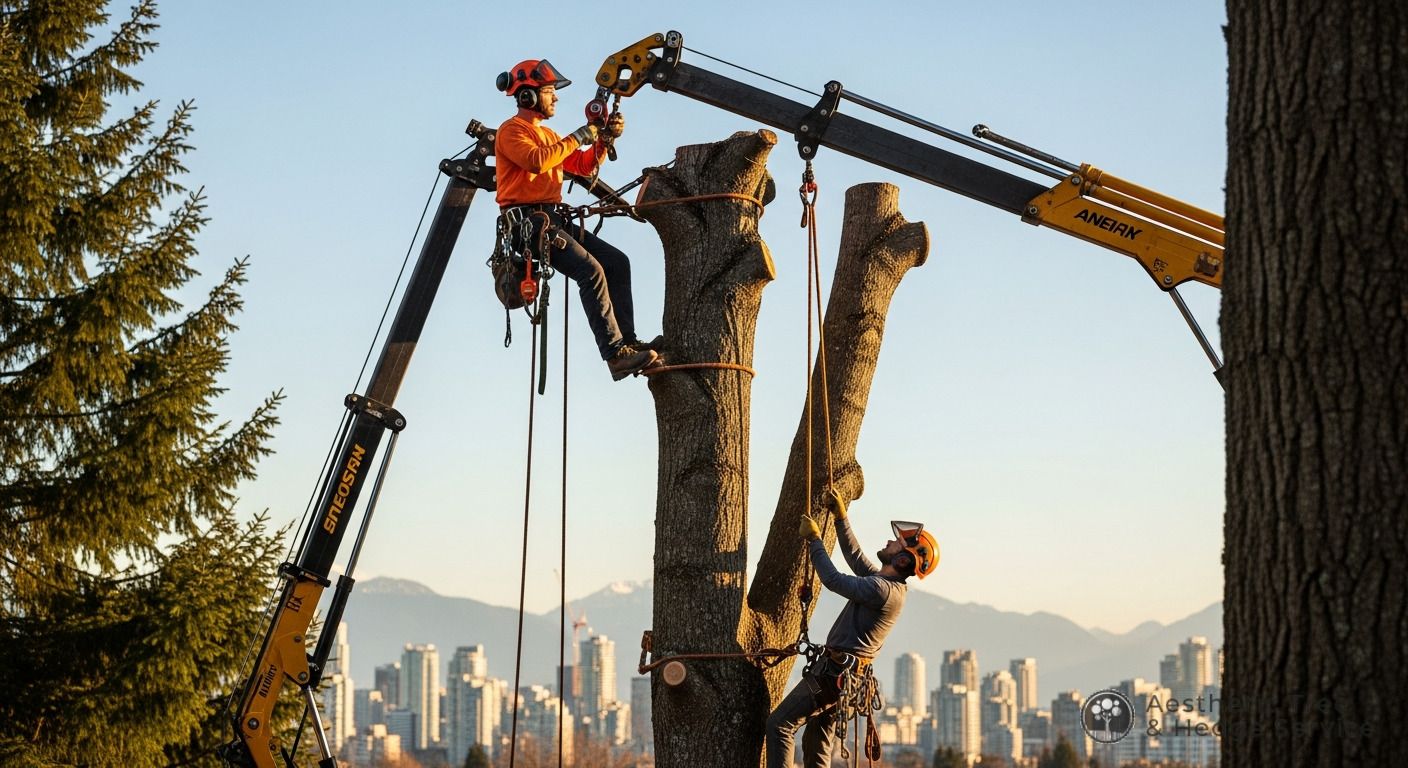
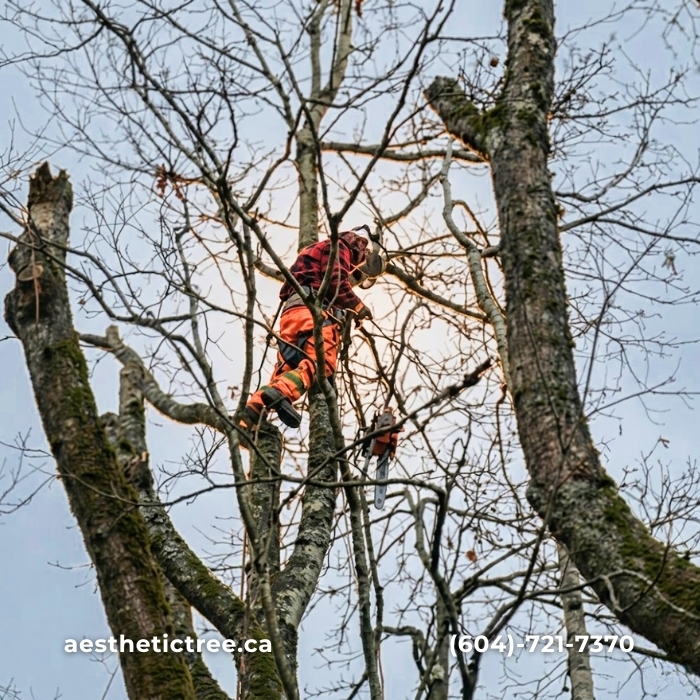
A properly equipped and staffed arborist crew arrives with:
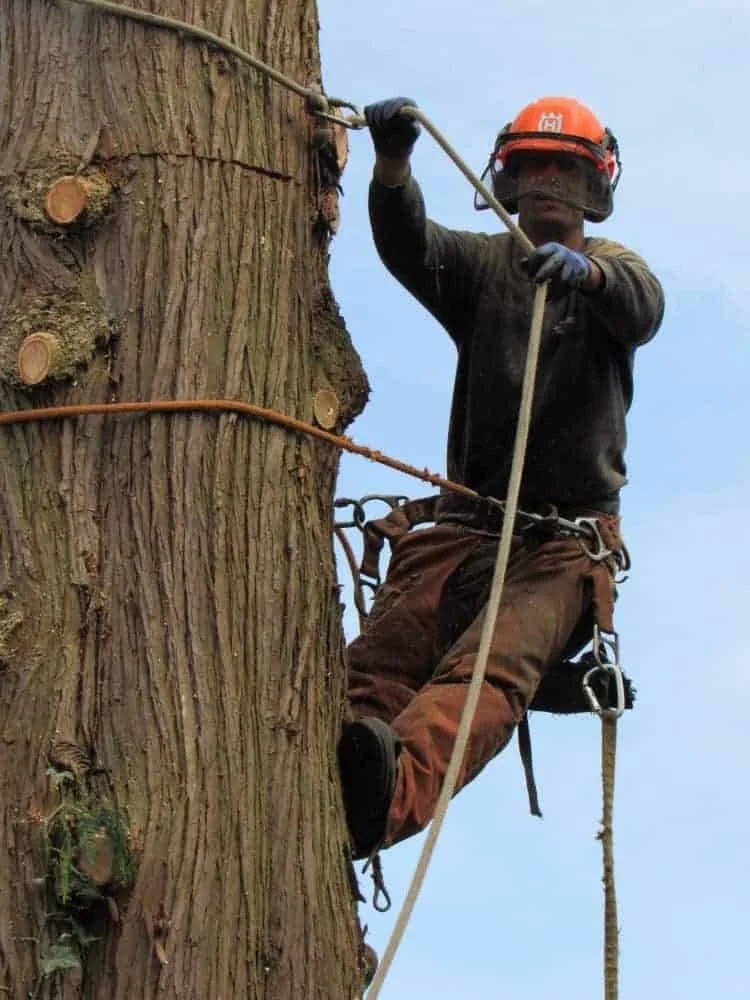
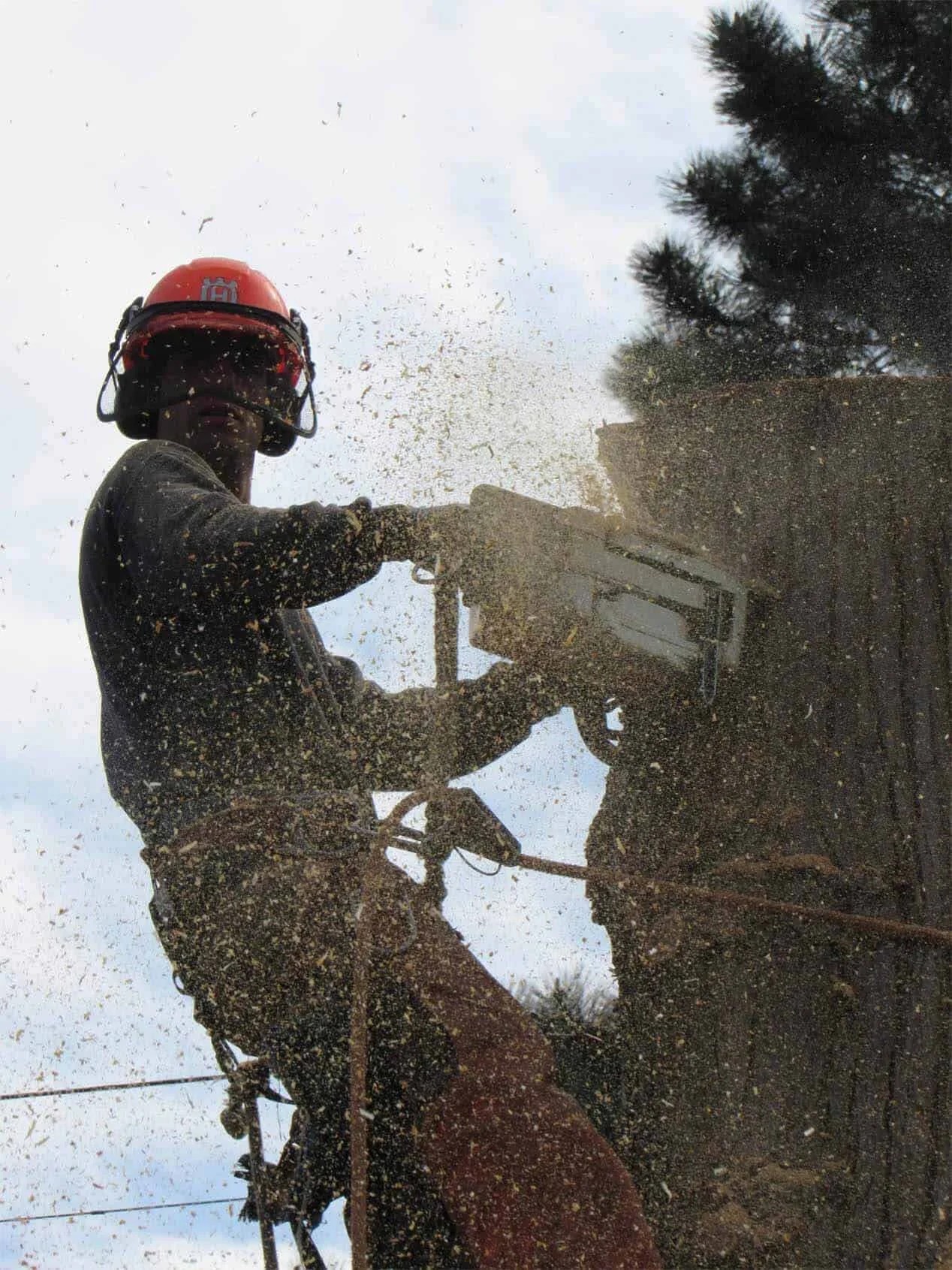
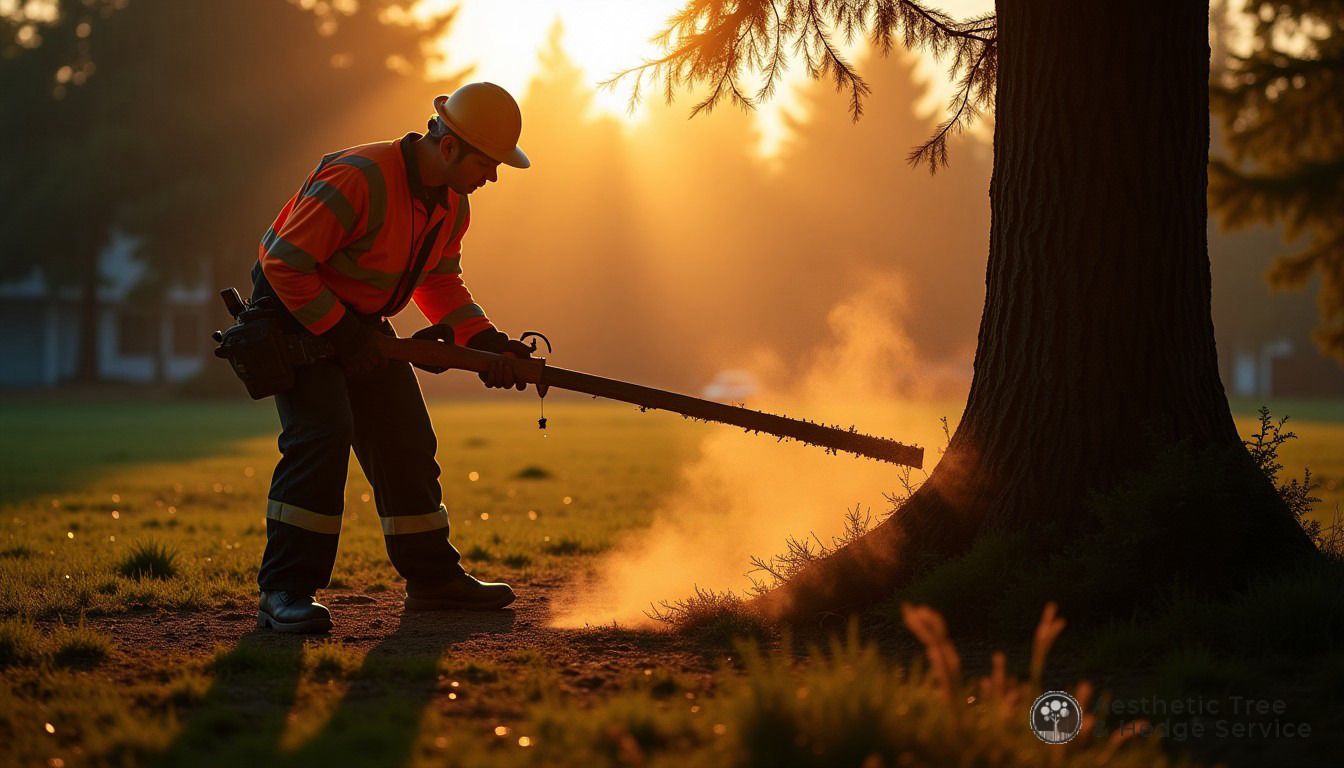
- Hard hats, chainsaw-protective chaps, eye and hearing protection in active use — not stored in the truck
- Ground crew with dedicated spotters — the climber is never working alone
- Rigging gear: ropes, blocks, and friction hitches for controlled lowering of wood sections
- A chipper truck on accessible jobs — chipping happens on site where lane access exists
- Written documentation referencing the species, the task, and any required municipal permit number
Narrow lane access, fiber optic lines, and entangled canopy require different approaches. In those cases, wood may come down by hand and be lowered to the ground section by section. That kind of job takes more time. A similar-sized removal with clean access might take one day; a constrained site with overhead infrastructure can take three. The time difference is not inefficiency — it is the cost of doing the work correctly without damaging adjacent property or utilities.
For follow-up work — stump grinding after a large removal, or an emergency tree service call after storm damage — job site logistics differ based on conditions. For emergency work, exclusion zones are established first, always. The utility company is contacted before any climber approaches a tree touching energized lines.
The presence of proper PPE is the fastest visual indicator of a legitimate operation. A crew without visible safety equipment is communicating something important about their standards.
What Are the Wages and Career Paths for Arborist Jobs in British Columbia?
For those considering arborist work as a career in BC, it is worth understanding the pay and progression path clearly.
Entry-level positions involve ground work: feeding the chipper, handling debris, learning rigging basics under the supervision of a certified climber. Ground crew roles build the foundational awareness that climbing positions demand. According to Canada's Job Bank occupational profiles, median hourly wages for arborists in British Columbia range from approximately $22 to $35 per hour, depending on certification level, specialization, and employer.
> *Pricing figures in this article are based on available market data and regional industry reports. They represent typical ranges and are not reflective of case-by-case project pricing. Contact AestheticTree for a personalized assessment.*
Utility line clearance work — which requires additional certification — commands premium rates that reflect the additional hazard.
ISA Certified Arborist status typically means a step increase in both pay and responsibility. Utility Arborist certification, required for line clearance contracts with BC Hydro and FortisBC contractors, commands wages that reflect the additional training and risk involved.
The standard credential path runs: 1. Entry-level ground work with a certified employer 2. First Aid and CPR certification (required for site work above defined risk thresholds) 3. Several years of full-time arboriculture experience 4. ISA Certified Arborist exam 5. Continuing education and career advancement
At the top of the ISA credential stack sits ISA Board Certified Master Arborist — the highest designation in the profession, held by a small number of practitioners globally. That level of documented mastery commands corresponding pay and typically leads to consulting, expert testimony, or senior supervisory roles.
The path takes time. It requires physical work, continued study, and the discipline to pursue certification even when the market does not always pay for it. The arborist companies that attract and keep certified practitioners build operations where that investment matters — to the company's long-term reputation and to clients who trust them with trees that, in some cases, are older than the house itself.
FAQ
What certifications should I look for when hiring an arborist in British Columbia?
At minimum, look for ISA Certified Arborist status. You can verify this directly through the ISA's public online directory by searching by name or location. For any work near power lines, the crew should also hold Utility Arborist certification. All workers must be registered with WorkSafeBC — ask for the company's WCB account number and confirm active status directly with WorkSafeBC before work begins. First Aid certification should be present on site for any job involving height or power equipment.
Do I need a permit to remove a tree on my private property in Vancouver?
In most cases, yes. The City of Vancouver's Private Tree Bylaw requires a permit for removing or significantly changing any tree with a trunk diameter of 20 centimetres or more at 1.4 metres above ground. Similar bylaws apply in Burnaby, Richmond, North Vancouver, and Coquitlam, each with their own thresholds and permit timelines. The process typically takes several weeks. An ISA Certified Arborist can prepare the required arborist report and help you through the permit process. Removing a protected tree without a permit brings substantial fines.
How do I confirm a tree company has active WCB coverage in BC?
Ask the company for their WorkSafeBC account number and request a clearance letter. You can verify active registration status directly with WorkSafeBC. Any legitimate company provides this without hesitation. If a company refuses or cannot produce account information, do not proceed. An unregistered worker injured on your property may create personal liability for you as the property owner — your homeowner's insurance may not cover that claim.
What is the difference between tree topping and crown reduction?
Topping means making heading cuts through the main trunk or primary branches, leaving large wound surfaces exposed to decay and producing multiple watersprouts with structurally weak attachments. It is not a legitimate arborist practice. Crown reduction is a controlled reduction of a tree's height or spread that follows the natural branch structure, making cuts to lateral branches large enough to take on the terminal role. Crown reduction performed by a certified arborist following ANSI A300 standards keeps structural integrity. Topping shortens a tree's life and creates hazard conditions within a few growing seasons. If a company recommends topping, find a different company.
What should I budget for professional arborist work in the Lower Mainland?
Pricing varies by tree size, species, site access, equipment required, and whether a municipal permit is needed. Professional arborist work in the Lower Mainland reflects the cost of certified labor, properly maintained equipment, WCB premiums, and liability insurance specific to tree care. These figures represent industry averages based on market data and vary by project scope, site conditions, and species. Contact Aesthetic Tree & Hedge Services for a personalized assessment of your specific trees and property.
---
Arborist jobs in British Columbia carry real requirements — and those requirements exist for good reason. The ISA certification, WCB coverage, and local species knowledge that define a professional operation are not bureaucratic details. They are the difference between work that protects your property and work that creates new problems.
Aesthetic Tree & Hedge Services is ISA-certified and WCB registered. We work throughout Vancouver, Burnaby, North Vancouver, Richmond, and Coquitlam. Call us for a free estimate: (604) 721-7370.
---
Test Your Knowledge
1. How much hands-on work experience must someone complete before becoming eligible to sit for the ISA Certified Arborist exam?
- A. 1 year of tree service work
- ✅ B. Several years of full-time tree work
- C. Several years in any outdoor profession
- D. No prior experience is necessary
*The article specifies that candidates must have significant full-time tree work before they can take the ISA exam.*
2. Which requirement is legally mandatory in BC for all tree work, rather than simply an industry best practice?
- A. ISA Certified Arborist credentials
- B. ANSI A300 climbing and rigging training
- ✅ C. WorkSafeBC registration and worker coverage
- D. Completion of a utility arborist certification
*WorkSafeBC registration is described as a legal requirement that protects workers and homeowners, whereas certifications like ISA are industry standards.*
3. If a tree crew encounters a partially failed tree touching power lines, what is the first action they must take according to safety protocols?
They must stop work immediately, establish exclusion zones, and contact BC Hydro or the relevant utility company to de-energize the power lines before anyone approaches the tree.
4. Why are some BC tree companies willing to offer prices significantly lower than certified competitors?
They avoid the costs and time commitments of certifications, continuing education, and WorkSafeBC premiums, betting that no accidents will occur on their job sites.
Found this helpful? Follow our tree care insights directly on Google.
Make us your preferred source on GoogleBefore You Go
Where are you in your tree care journey?
Our Tree Care Services
ISA-certified arborists serving Greater Vancouver
Explore Our Tree Care Services
From expert pruning to safe tree removal, our ISA-certified arborists are ready to help across Greater Vancouver.
View Services