

TL;DR — Quick Summary
10 reasons why we should cut down trees — structural failure, disease, root damage and more. Vancouver ISA arborists explain what warrants removal.
Arborists recommend cutting a tree down when it can't be made reasonably safe or healthy. The usual reasons are structural defects, advanced disease or decay, a dead tree, a dangerous lean, severe storm or root damage, and risk to nearby structures.
Tree removal is the last option, but the wrong tree left standing can damage property and injure people.
In Vancouver, removing a private-property tree 20 cm or more in diameter, measured 1.4 m above the ground, requires a permit under the Protection of Trees By-law No. 9958. Neighbouring municipalities set their own rules.
Before hiring anyone for the work, ask for a WorkSafeBC clearance letter. If the business isn't registered and paying premiums, you could be held responsible for its unpaid premiums.
Why Do ISA Arborists Recommend Cutting a Tree Down?
Tree removal is never the first choice.
Pruning, cabling and bracing, and plant health care can often keep a tree safely in place, and those options should be considered first.
But some trees reach a point where removal is the only responsible call. The danger is too high. The tree can't be made safe. Or it's already dead.
This article covers 10 conditions an arborist looks at before recommending removal.
Removal decisions often come down to a combination of factors, such as a structural defect, active decay, and a house in the fall zone. Here are the 10 reasons in detail.
Reason 1: Structural Failure, When Does It Mean a Tree Must Go?
Structural defects are a common reason for removal.
It's not always visible from the ground. That's the danger.
An arborist starts by looking for co-dominant stems. These are two main stems growing from a single trunk at a tight angle. Over time, bark gets trapped between them, called included bark. That junction is a weak point. It can fail without warning, even in calm weather.
Next: cracks. A vertical crack running down the trunk is a red flag. A horizontal crack at a graft union or old pruning wound is worse. Open cracks expose wood to moisture and decay organisms.
A single defect doesn't always mean removal. Arborists look at how defects combine and what the tree could hit if it failed.
A co-dominant stem alone may not trigger removal. Co-dominant stem plus lean toward a structure plus fungal conks at the base? That's a different conversation entirely.
If you see a crack running down the trunk, call an arborist before the next windstorm.
Reason 2: Advanced Tree Disease, How Do You Know When It's Too Late?
Some diseases are manageable. Others are not.
One disease arborists take especially seriously:
Armillaria root rot also called honey fungus. It attacks and kills roots, spreading through the soil on root-like cords called rhizomorphs. Clumps of honey-coloured mushrooms sometimes appear on infected stumps in autumn, and the most reliable sign is white fungal sheets between the bark and wood at ground level (source: RHS, Honey fungus).
Some diseases spread to neighbouring plants. Honey fungus spreads through the soil from infected roots, and UC IPM notes that Armillaria and Ganoderma can spread to nearby trees through root grafts. Removing a badly infected tree, stump, and roots can protect what's around it.
When disease has reached the root crown and is spreading into the structural root system, that's usually the end of the road.
Reason 3: A Dead Tree, Is It Always a Hazard?
A dead tree is a hazard. The question is how urgent.
Dead wood loses structural integrity over time. Bark falls off. Branches become brittle and dry. The root system stops anchoring the tree to the soil.
Dead trees can fall in calm weather. They don't need a storm.
Here's how arborists confirm a tree is dead, not just stressed:
- No leaves, buds, or new growth for an entire growing season
- Bark peeling in large sheets with nothing green beneath
- Scratch the bark: dead tissue is dry and brown throughout, no green cambium
- Twigs snap cleanly and dry, no flex, no live wood moisture
A stressed tree looks similar in some ways. It may lose leaves early. It may have a sparse canopy. But it still has living tissue. A stressed tree can sometimes be saved.
A dead tree cannot. It shouldn't be left standing near any structure, power line, or area with foot traffic.
Professional tree cutting is almost always the fastest and safest resolution for a confirmed dead tree.
Reason 4: Proximity to Structures, How Close Is Too Close?
Location changes everything.
An arborist looks at what sits in a tree's fall zone, known as the target. A house is a high-value target. So is a deck, a driveway, a vehicle, or a child's play area.
The closer a compromised tree is to a high-value target, the lower the acceptable risk threshold.
Root proximity matters too. Large trees growing close to a building can have roots near footings, drains, and pipes, though the risk depends on the species, the root pattern, and the soil. Vancouver's by-law allows a removal permit where an accredited plumber certifies that tree roots are damaging a drainage or sewage system, or an arborist certifies that the tree is damaging property in ways standard arboriculture can't fix.
- Foundation cracks and settling
- Drainage disruption from root mass beneath the soil
- Blocked and broken underground pipes
Trees that are otherwise healthy may still warrant removal if the root system has compromised the foundation and the damage is ongoing. Removing the tree doesn't undo the damage, but it stops further root growth and pressure.
Stump grinding is almost always necessary after removing a tree close to a structure. Roots left in place continue to decompose and can create soil voids below grade as they break down.
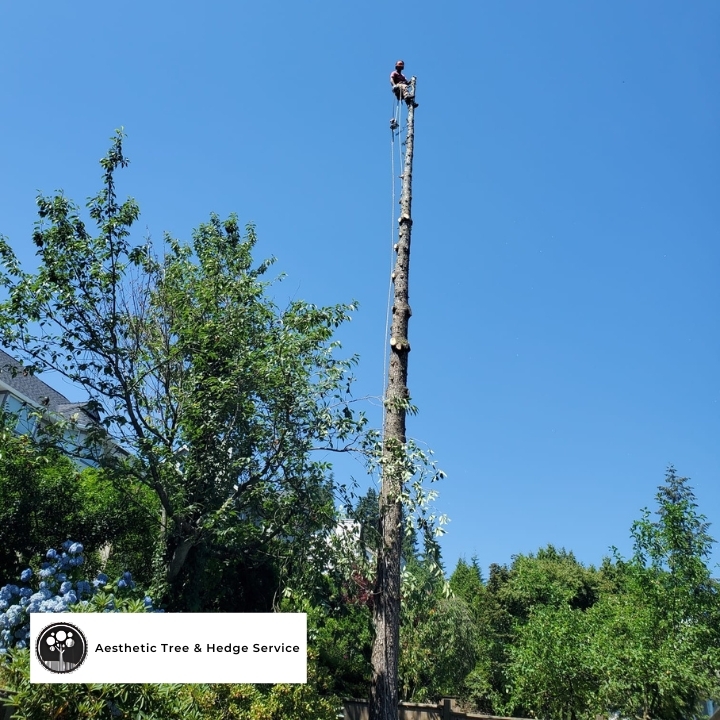
Reason 5: Storm Damage, When Is It Beyond Recovery?
Not every storm-damaged tree needs to come down.
A snapped branch, even a large one, can often be corrected with proper pruning. The rest of the tree may be completely sound.
But certain types of storm damage are not recoverable:
- Trunk split at a major crotch or union point the structural integrity is gone
- Partial uprooting the root ball is lifting on one side. This tree is actively failing
- Loss of a large part of the live crown the tree may survive, but it's now a compromised structure with new co-dominant stems and asymmetrical weight loading
- A new lean toward a structure after the storm especially combined with any of the above
Fall and winter windstorms often expose structural weaknesses that were hidden until wind loaded the tree.
Don't wait to see what happens next. If a storm-damaged tree is leaning toward a house, fence, or power line, that's an emergency tree removal situation. Call the same day.
Reason 6: Fungal Decay, What Do Shelf Fungi Tell You About a Tree's Future?
Fungal conks on the trunk or base of a tree are a diagnostic tool for arborists.
When a fruiting body is visible on a tree, it is usually associated with advanced decay, and the decay can extend far above or below the conk (source: UC IPM, Wood Decay Fungi in Landscape Trees).
Different fungi indicate different decay patterns:
Ganoderma conks usually found near ground level. Ganoderma causes white rot of the sapwood and heartwood in roots and trunks (source: UC IPM), so it's a primary concern for failure at the base.
Laetiporus sulphureus (sulphur fungus, or chicken of the woods), causes a brown heart rot and is one of the few brown rot fungi of hardwoods; its hosts include oak, maple, cherry, fir, pine, and spruce. Wood with brown rot is dry, fragile, and crumbles into cubes (source: UC IPM).
Trametes versicolor (turkey tail), commonly found on cut and fallen wood and on wounded areas of living trees, and it can colonize the sapwood of trees stressed by drought, sunburn, freeze damage, or wounding (source: UC IPM). A marker of ongoing decline.
Multiple fungal species on the same tree, or conks combined with a lean and root disturbance, is a high-risk combination that typically results in a removal recommendation.
An arborist report documents fungal decay findings in writing, which supports a permit application.
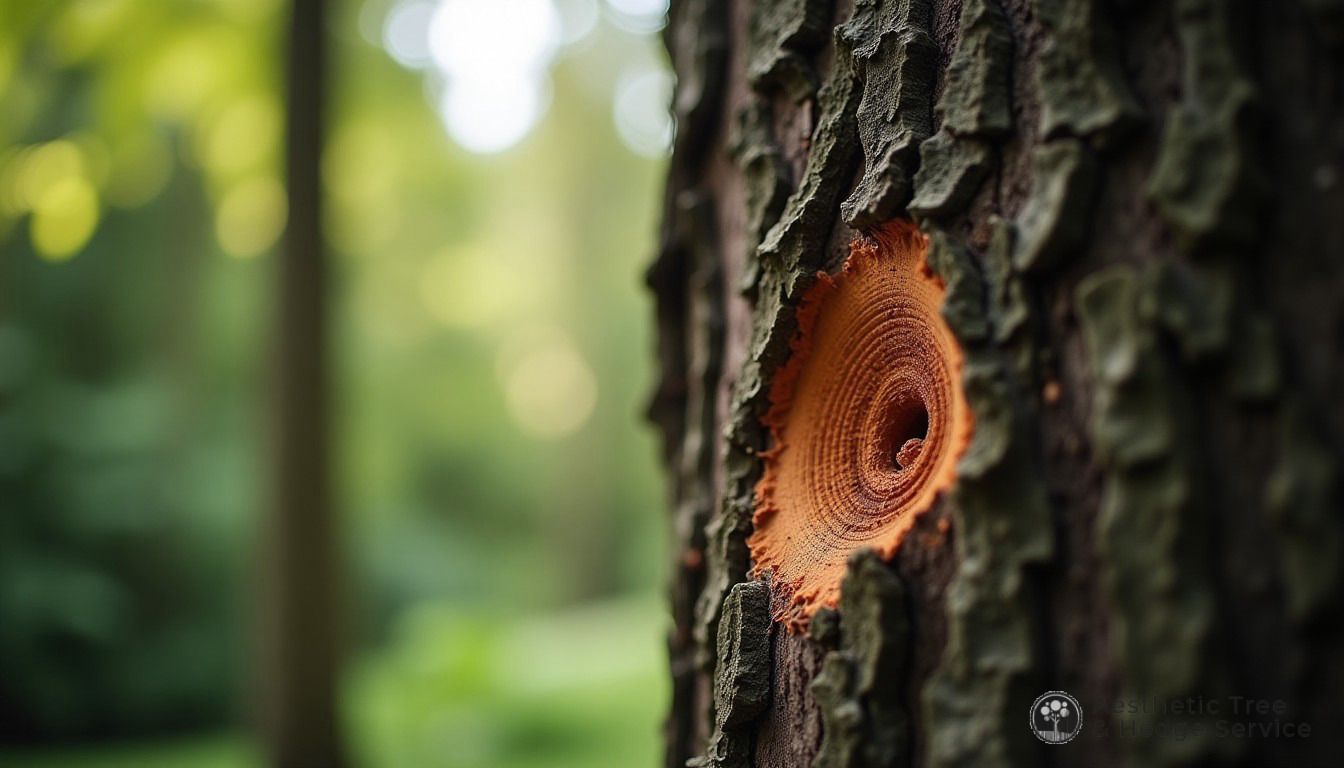
Reason 7: A Dangerous Lean, When Does It Become a Removal Case?
Trees lean. It's not always a problem.
A wind-trained coastal Douglas fir leans. A tree growing on a slope leans. These can be completely stable.
The risk question is what caused the lean, and whether it's progressing.
Lean with a lifting root ball you can see raised soil on one side and exposed roots on the other. This tree is beginning to overturn. It can progress to full failure quickly, especially after rain saturates and loosens the soil.
Lean with no root disturbance the tree has probably always grown at that angle. The root system has adapted. It may be completely stable with no removal risk.
New lean after a storm even without visible root disturbance, a new post-storm lean means structural loading has shifted. Requires immediate professional assessment.
Don't try to eyeball it and draw your own conclusions. Context matters. An arborist brings measuring tools and assessment criteria that a visual inspection from your yard can't replicate.
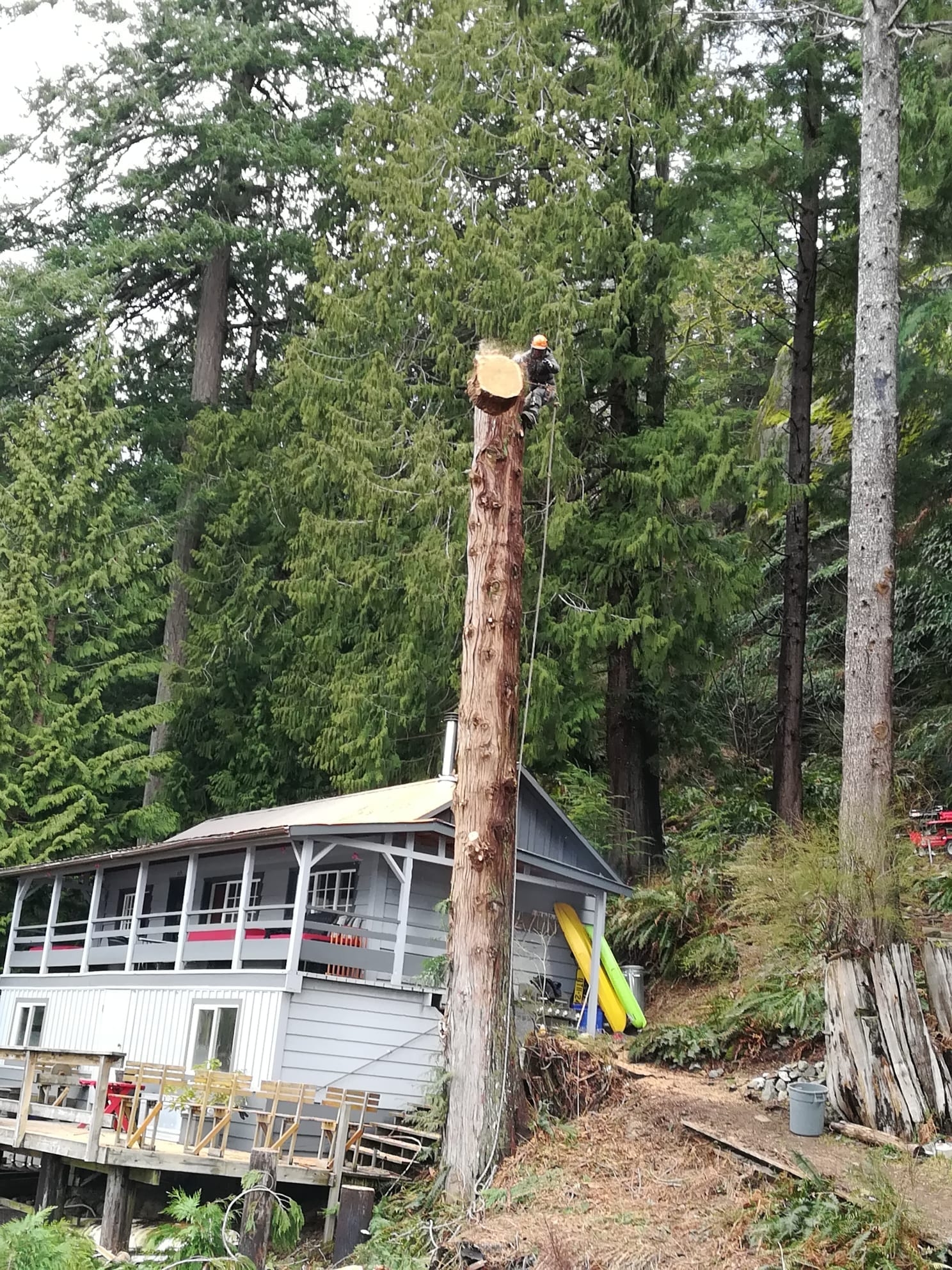
Reason 8: Vancouver's Tree Protection Bylaws, How Do They Affect Your Removal Decision?
This is where homeowners get stuck.
You can't simply cut down a protected tree on your property because you want to. Not in Vancouver. Not in Burnaby, North Vancouver, or Coquitlam.
City of Vancouver The Protection of Trees By-law No. 9958 requires a permit to remove a private-property tree 20 cm or more in diameter, measured 1.4 m above the ground. Fines range from $500 to $10,000 per offence. The full by-law text is available at vancouver.ca.
Burnaby Burnaby's Tree Bylaw No. 10482 protects conifers 30.5 cm or more and broadleaf trees 45.7 cm or more in diameter on lots without a development application, and any tree 20.3 cm or more once a development application is in. Trees in streamside protection areas are also protected. Fines run $2,000 to $10,000 per violation.
North Vancouver (City and District) the City and the District of North Vancouver are separate municipalities, so check the rules with the one that covers your address.
Coquitlam check the City of Coquitlam's current tree rules for private property before any removal.
Permit applications are often supported by an arborist report that documents why the tree needs to come down.
The permit system exists to check that a removal is justified, not to block every removal. Vancouver's by-law, for example, allows a permit where an ISA-certified tree risk assessor certifies that a tree is hazardous.
A full tree removal assessment from an ISA-certified arborist gives you the written documentation you need for the permit process.
Reason 9: Severe Root Damage, When Has the Foundation Failed?
Roots are the foundation of the tree. Damage them enough, and the tree can't stand, or survive.
Root damage in residential settings typically comes from:
- Trenching and construction cutting through major structural roots during excavation for utilities, driveways, or additions
- Soil compaction heavy equipment traffic over the root zone crushing the pore spaces that roots need for oxygen and water exchange
- Grade changes adding soil over the root zone buries the root crown; removing soil exposes and severs structural roots
- Utility installation gas, sewer, and water lines routed through the critical root zone
A tree can tolerate losing some feeder roots. Structural roots near the trunk are different. Lose a major buttress root on the side where the tree leans, and you've fundamentally changed its failure risk.
Signs that root damage may be severe enough to warrant removal:
- Sudden canopy wilt without drought or visible disease
- Crown dieback beginning at the branch tips and working inward
- Fungal growth at the root crown following excavation
- New lean after root zone disturbance near the structure
Root damage doesn't always show up immediately. A tree can look fine for a full growing season after major root cutting, then decline rapidly. If your tree took root zone damage during recent construction, monitor it closely and have it assessed.
Reason 10: Why Do Construction Projects and Invasive Species Justify Tree Removal?
Not all removals are emergency calls. Some are planned.
Construction clearance A tree in the footprint of a permitted addition, new garage, driveway, or foundation repair may need to come down. In this case, removal is scheduled, not reactive. An arborist report documents that the tree cannot be preserved around the construction zone and supports the municipal permit application. This is orderly work with time to plan it properly.
Invasive tree species Not every tree belongs in a Lower Mainland urban landscape. Some cause ecological harm. Trees listed by the Invasive Species Council of BC include:
*Ilex aquifolium* (English holly), an evergreen with spiny leaves and shiny red berries, listed by the Invasive Species Council of BC.
*Robinia pseudoacacia* (black locust), also listed by the Invasive Species Council of BC; it can grow 12 to 30 metres tall.
Removing an invasive tree lets you replant with something better suited to the site. Choose the replacement carefully: Burnaby, for example, currently advises against cedar as a replacement tree because cedars have been dying off suddenly due to drought (source: City of Burnaby). The Invasive Species Council of BC keeps species profiles at bcinvasives.ca for reference.
Before You Call an Arborist, What Should You Do First?
A few steps to take before the arborist arrives:
1. Identify the tree species or prepare a description: bark colour, leaf shape, any cones or fruit present. Species matters for disease diagnosis and bylaw thresholds. 2. Measure the trunk diameter at a standard measurement height this determines whether a permit is required in your municipality. 3. Take photos from multiple angles trunk base, crown, any visible decay, any lean. Photo documentation speeds up the on-site assessment considerably. 4. Note what's in the fall zone is there a structure, fence, vehicle, or power line that could be struck? 5. Check your municipality's tree bylaw confirm whether your tree size triggers permit requirements before assuming either way.
If the tree is actively dangerous, leaning after a storm, partially uprooted, branches already on your roof, skip the checklist entirely. Call for emergency tree service immediately.
What Happens to the Stump After Tree Removal?
The stump is part of the removal decision.
A stump left in the ground decays gradually over multiple years, depending on species and moisture.
While it decays, it can:
- Host honey fungus (Armillaria), which spreads through the soil to nearby plants
- Create a tripping and mowing hazard in your lawn
- Keep sending up root suckers, on species prone to suckering
- Leave a soil void as larger roots decompose below grade, causing depressions in your lawn
Stump grinding takes the stump down below lawn grade and turns it into wood chips. Clear out the chips and top up with soil before you reseed or replant.
For trees removed near hedges or maintained garden areas, grinding keeps the stump out of the way of future planting and maintenance.
It's almost always the right choice when a tree is removed near a structure, active lawn, or high-use area.
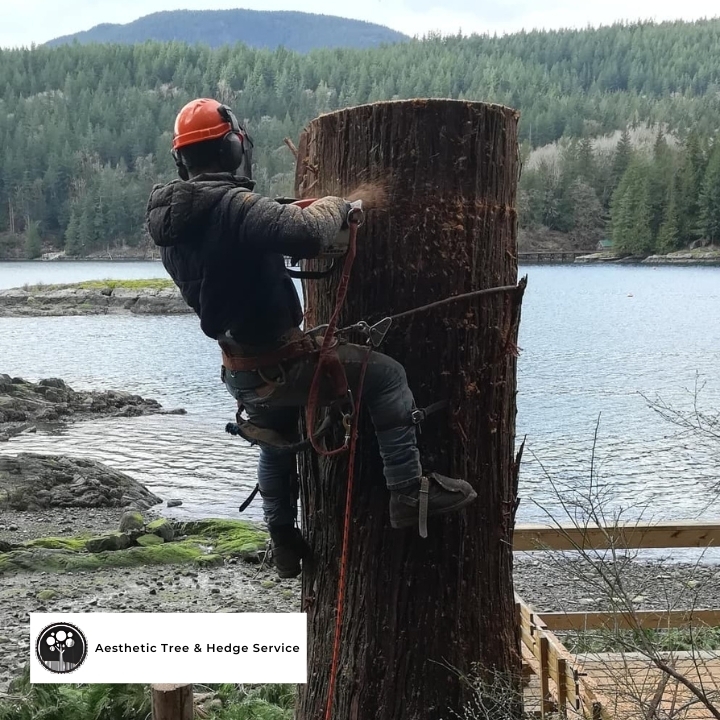
Found this helpful? Follow our tree care insights directly on Google.
Make us your preferred source on GoogleOur Tree Care Services
ISA-certified arborists serving Greater Vancouver

Explore Our Tree Care Services
From expert pruning to safe tree removal, our ISA-certified arborists are ready to help across Greater Vancouver.
View Services