
TL;DR — Quick Summary
What does ISA certified mean? Learn the 10 exam domains, how it ties into Vancouver permits, and how to verify any arborist's credentials.
- ISA certified means passing the International Society of Arboriculture's 200-question exam, which covers 10 knowledge domains including tree biology, pruning, soil management, tree risk and safe work practices.
- The ISA Certified Arborist program launched in 1992. Certification is valid for three years; to renew, an arborist retakes the exam or earns at least 30 continuing education units.
- ANSI A300, the American National Standard for tree pruning, lists topping as an unacceptable pruning practice and sets out where pruning cuts go.
- In Vancouver, tree removal permit applications call for an arborist report prepared by an ISA Certified Arborist.
- Verify credentials before any crew starts work: enter the arborist's certification number in ISA's Verify a Credential tool at treesaregood.org.
What Does ISA Certification Actually Require You to Know?
The International Society of Arboriculture traces its roots to a 1924 shade tree conference. It launched the ISA Certified Arborist program in 1992. ISA says passing the exam shows an internationally accepted fundamental level of knowledge and skill, though certification isn't a licence to practise.
The exam has 200 multiple-choice questions across 10 areas: tree biology, tree identification and selection, soil management, installation and establishment, pruning, diagnosis and treatment, trees and construction, tree risk, safe work practices, and urban forestry. Questions come from a job task analysis survey of working arborists.
For example: How much branch can you safely remove in one session? When should you keep a damaged tree instead of cutting it down? How do you tell the difference between a beetle infestation and a fungal disease? Those are the kinds of practical calls the exam is built around.
Certification doesn't last forever. Each certification is valid for three years. To renew, an arborist either retakes the exam or earns at least 30 continuing education units tied to the exam's 10 domains.
ISA's Verify a Credential tool at treesaregood.org lets you enter a certification number and confirm it's genuine. ISA also lists credential holders in its online Spotlight Directory, although holders can choose to keep their listing private. Check before you hire anyone.
How Does ISA Certification Change the Quality of Pruning Cuts?
Here's the test most homeowners skip: ask for close-up photos of recent pruning cuts. Not before-and-after shots of the whole tree. Close-ups of the actual cut ends.
The branch collar is the swollen area at the base of a branch. ANSI A300 says a cut that removes a branch should be made close to the trunk or parent branch without cutting into the branch collar or leaving a stub. Woundwood growing over a pruning cut is what the standard calls closure. A flush cut into the collar doesn't meet the standard.
Flush cuts can look clean from a distance. Close-ups show whether the collar was left intact.
ANSI A300 is the American National Standard for tree care operations, and its pruning part sets out how and where pruning cuts are made.
Topping (cutting branches back to stubs, or to side branches too small to take over as the leader) is listed as an unacceptable pruning practice in ANSI A300. ISA warns that topping can lead to unacceptable risk, tree stress and decay. You can still find crews that offer topping as a quick fix, so ask before you hire.
If you're arranging tree cutting in Vancouver, ask directly: do your arborists follow ANSI A300 standards? A certified arborist will know exactly what you mean and give you a clear answer.
What Can an ISA Certified Arborist See That a Non-Certified Crew Misses?
Many tree problems build up over time, and spotting them takes training. ANSI A300 says an arborist or arborist trainee shall visually inspect each tree before beginning work.
Tree risk is one of the 10 domains on the ISA Certified Arborist exam, and ISA offers a separate Tree Risk Assessment Qualification (TRAQ) for arborists who assess tree risk formally.
The same defect can mean very different things depending on the species, the size of the tree and what's underneath it. A split limb over an empty lawn isn't the same problem as one over your roof.
Certified arborists don't just notice these signs. They measure the risk, weigh the evidence, and write down their findings. They tell you whether a tree is an immediate danger or just needs watching. That matters when the tree is three metres from your living room.
That documentation is also what makes an arborist report in Vancouver part of a tree removal permit application. In Vancouver, that report needs to come from an ISA Certified Arborist.
Why Does WCB Registration Matter as Much as ISA Certification?
These are two different credentials. You need both.
ISA certification answers one question: Can this person do the work correctly?
WCB registration (WorkSafeBC) answers another: Who pays if something goes wrong?
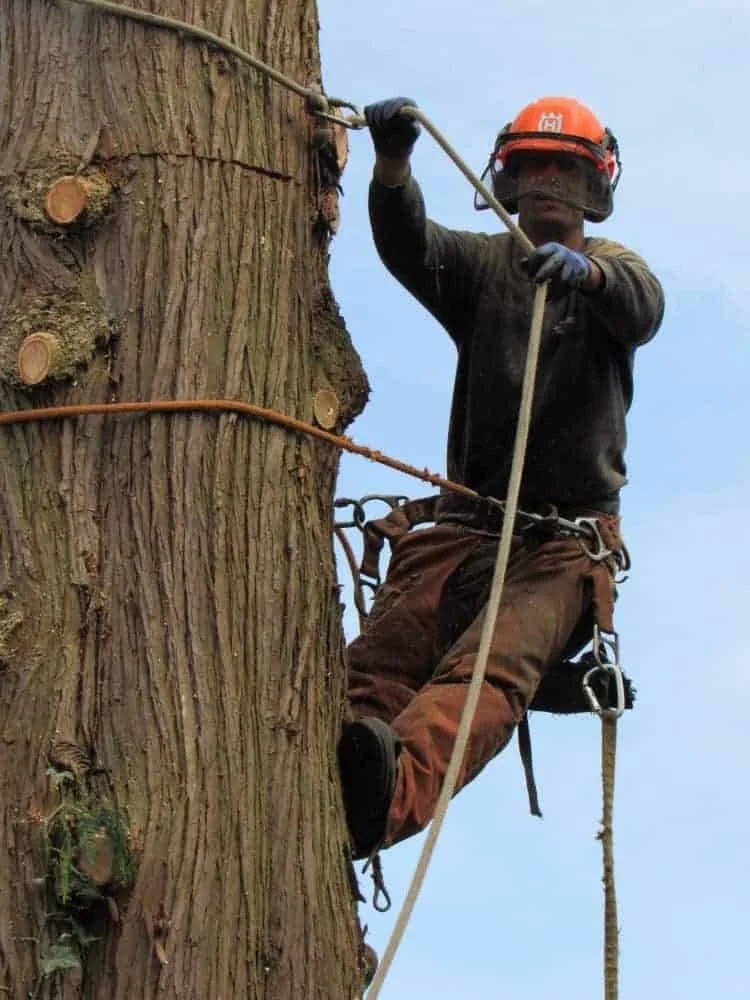
WorkSafeBC's Occupational Health and Safety Regulation has specific rules for tree-climbing work, including a documented climbing plan with emergency and rescue procedures, and a climbing system inspected by a qualified arborist before it's first used on each work shift. This isn't an industry with room for mistakes.
When you need emergency tree service after a storm, you don't have time to thoroughly check credentials mid-crisis. That's why getting to know a certified, insured crew before an emergency matters.
Hire a contractor who isn't registered with WorkSafeBC, or isn't in good standing, and you could be held liable for the insurance premiums they owe. A clearance letter addressed to you, which you can request free online at worksafebc.com, protects you from that. It doesn't rate the contractor's safety record or the quality of their work, so it doesn't replace checking credentials.
Always ask for two documents before any crew climbs your trees:
1. The arborist's ISA certification number (verify at treesaregood.org) 2. A current WCB clearance letter
Both requests are standard. A professional crew provides both without hesitation. If they deflect or make excuses, stop right there.
Aesthetic Tree & Hedge Services works with ISA-certified arborists, carries WorkSafeBC coverage for every crew member (certificates on request) and holds $3 million in liability insurance.
What Does ISA Certification Mean for Permit-Required Tree Work in Vancouver?
Check whether you need a permit before anyone cuts.
The City of Vancouver's Protection of Trees By-law No. 9958 requires a permit to remove a private-property tree 20 cm or more in diameter, measured 1.4 m above the ground. Burnaby, Coquitlam and Richmond each have their own tree bylaws with their own rules. Coquitlam, for example, lets owners remove up to two protected-size trees a year without a permit in most cases, so check the rules for your city before work starts.
In Vancouver, a tree removal permit application calls for an arborist report prepared by an ISA Certified Arborist. Without the permit, the removal isn't authorized.
Removing a protected tree without a permit is a by-law violation. Ask the City what penalties and replacement requirements could apply before you take that risk.
Our team provides arborist reports across Vancouver and handles permit paperwork for tree work in the cities we serve.
How Do ISA Certified Arborists Handle Tree Removal Differently?
Removal is the last option, not the first answer. A certified arborist evaluates whether the tree can be saved, how disease is progressing, and what's around it before recommending removal. Trees showing early decline might be saved through cabling, crown reduction, or targeted treatment. Removal is recommended only when the tree poses unacceptable risk that can't be managed, or when disease has gone too far to recover.
When removal is the right call, everything on the site determines how to do it. A tree in an open backyard is a different job from a tree wedged against a fence, hanging over a roof, or near power lines. How to fell the tree, what rigging to use, and what equipment to bring all depend on what's in the fall zone.
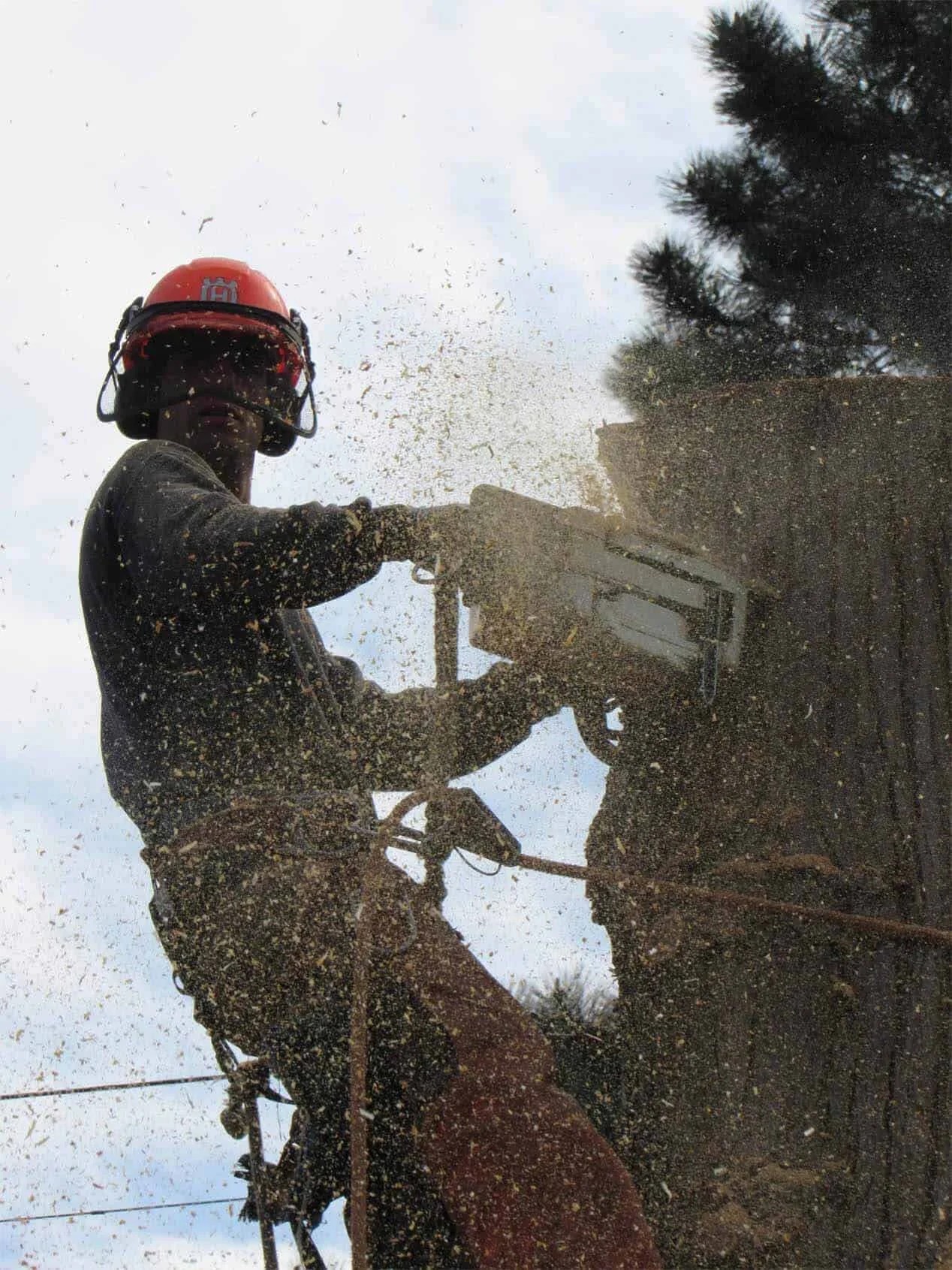
Tree removal in Vancouver in tight urban spaces requires controlled section-by-section lowering rather than a straight fell. That technique requires knowledge of rigging, load paths, block placement, anchor point selection. ANSI A300 says ropes or other equipment shall be used to lower large branches to the ground where necessary. Guesswork with heavy wood in a tight yard is how roofs and fences get damaged.
Dead trees call for extra caution. Internal decay changes weight distribution in ways you can't see from outside. A trained arborist assesses likely decay before the first cut.
After the tree is down, stump grinding clears the root zone. The right grinding depth depends on your plans: shallower for lawn restoration, deeper if you plan to replant in the same spot.
Does ISA Certification Apply to Hedge Work and Ornamental Tree Pruning?
Yes. ANSI A300 covers the care of trees, shrubs and other woody plants, so the same pruning standard applies to hedges and ornamental trees.
For hedges in the Lower Mainland, common species include cedar, yew and laurel, and each responds differently to pruning. How hard to cut, when to cut and which tools to use should match the species.
Timing matters too. Those decisions come from understanding plant biology, which is the ground the ISA exam covers.
Our team provides hedge trimming services across Vancouver. Whoever trims your hedge, ask how they'll time the cuts for your species.
How Do You Verify an Arborist Is ISA Certified Before You Sign?
Verification is quick.
Go to treesaregood.org, open Find an Arborist, choose Verify a Credential, and enter the arborist's certification number to confirm it's genuine.
Certification is valid for three years and has to be renewed, so confirm the credential is current, not just that it once existed.
Then ask three more questions before signing:
- Can you provide a WCB clearance letter showing active coverage for your crew?
- Does your company carry commercial general liability insurance? (Ask to see the certificate, not just a verbal yes)
- Do your arborists follow ANSI A300 pruning standards? Ask what branch collar removal means. A certified arborist explains it right away.
A professional company answers all of these questions directly. One that deflects or can't explain ANSI A300 basics is not operating at a certified level, regardless of what the website says.
Call Aesthetic Tree & Hedge Services for a free on-site estimate, (604) 721-7370. ISA-certified arborists, WorkSafeBC coverage for every crew member and $3 million liability insurance. Serving Vancouver and the Lower Mainland.
FAQ
What Does ISA Certification Actually Require You to Know?
The International Society of Arboriculture traces its roots to a 1924 shade tree conference.
How Does ISA Certification Change the Quality of Pruning Cuts?
Here's the test most homeowners skip: ask for close-up photos of recent pruning cuts.
What Can an ISA Certified Arborist See That a Non-Certified Crew Misses?
Many tree problems build up over time, and spotting them takes training.
What Does ISA Certification Mean for Permit-Required Tree Work in Vancouver?
Check whether you need a permit before anyone cuts.
How Do ISA Certified Arborists Handle Tree Removal Differently?
Removal is the last option, not the first answer.
Does ISA Certification Apply to Hedge Work and Ornamental Tree Pruning?
Yes. ANSI A300 covers the care of trees, shrubs and other woody plants, so the same pruning standard applies to hedges and ornamental trees.
Found this helpful? Follow our tree care insights directly on Google.
Make us your preferred source on GoogleOur Tree Care Services
ISA-certified arborists serving Greater Vancouver
Explore Our Tree Care Services
From expert pruning to safe tree removal, our ISA-certified arborists are ready to help across Greater Vancouver.
View Services