Tree Service Vancouver | 24-Hour Arborists
TL;DR — Quick Summary
Not every storm-damaged tree needs a midnight call. Vancouver's ISA-certified arborists explain the 3 emergencies that can't wait—and what to do right now.
- Not every fallen branch is a 24-hour emergency, but three specific situations require a same-night arborist call in Vancouver.
- If a tree or limb has brought down or is touching a power line, treat the line as live: stay back 10 metres and call 911, as BC Hydro advises. Tree crews can't prune or fell near energized high-voltage lines until WorkSafeBC's safety conditions are met.
- A "hung-up" limb suspended above a roof, vehicle, or walkway is a true emergency, it can drop at any time and warning signs are often invisible.
- Before any emergency work starts, ask the crew about ISA certification, WorkSafeBC coverage, and liability insurance.
- Waiting until morning on the wrong situation can mean property damage or insurance complications you did not see coming.
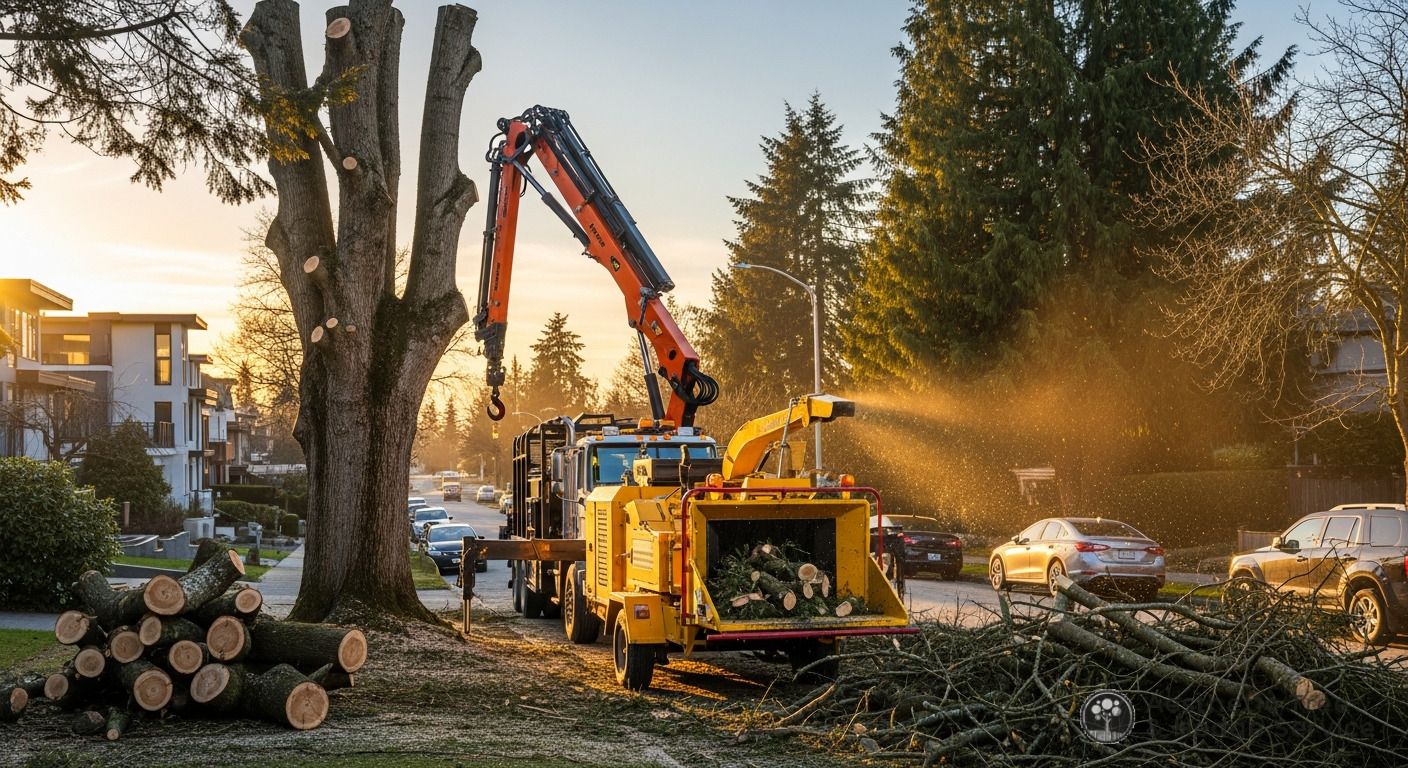
Picture a scenario like this one (it's illustrative, not a specific case).
Three in the morning. An atmospheric river has been dumping rain on Vancouver's North Shore for hours. A homeowner hears something, a deep pop, like a gunshot, and finds their Douglas fir listing noticeably toward their neighbour's roof.
They spend hours calling "24-hour tree services" found through a late-night search. Some never show. Others arrive without proper climbing gear. One quotes a price verbally, asks for cash upfront, and when asked for WorkSafeBC documentation, becomes unresponsive.
By morning, the tree has failed. Property damage to the neighbour's structure follows.
The harder problem is that homeowners can't easily tell the difference between a tree situation that needs an emergency call and one that doesn't, or what to look for when they make that call.
Here is what Vancouver's ISA-certified arborists actually assess in the middle of the night, and how homeowners can make the right decision.
What Counts as a True Tree Emergency in Vancouver?
It helps to sort storm-related tree situations into three categories: genuine emergencies that need same-night service, urgent situations that should be handled by first light, and non-urgent situations that can wait for a business-day quote.
The problem is that it is difficult to tell which category you are in when you are standing in a dark backyard in the rain.
The decisive question is not "is the tree damaged?" Major windstorms often damage trees. The decisive question is this: is there an active, specific target at immediate risk right now?
Our tree services in Vancouver cover both emergency response and scheduled assessments, but they require different decisions on your end.
A target in arboricultural terms is anything a failed tree or limb would strike. A roof. A vehicle. A person's regular path. A structural wall. A deck people sleep near. A walkway that cannot be closed.
If a compromised tree or limb is positioned directly over an active target and there is credible evidence of structural failure, visible cracking at the attachment point, a visible lean that was not there before, limb still attached but obviously fractured and suspended, that is an emergency.
If the tree is down but no longer poses an immediate threat to a structure or a person's movement, it may be urgent but not a same-night job. A tree flat on a lawn, well away from any occupied space, can typically wait until morning.
If the damage is primarily cosmetic, snapped ends of branches, smaller limbs on the grass, debris without a live hazard source, it is a clean-up job, not an emergency.
When Does BC Hydro Need to Come Before Anyone Else?
This is the situation with the highest consequences.
If a tree, limb, or branch has brought down a power line or is touching one, the rule is straightforward: deal with the electrical hazard before calling any tree company.
The reason is both technical and legal. BC Hydro advises treating any downed or damaged line as live, even if it isn't sparking, smoking, or buzzing. People can be at risk without touching the line, which is why WorkSafeBC sets minimum approach distances for work near energized conductors.
Part 19 of WorkSafeBC's Occupational Health and Safety Regulation sets the rules for tree work near energized high-voltage overhead lines. Before pruning or falling close to those lines, the site must be inspected by a qualified person authorized by the owner of the power system, and work within the minimum distances needs a certified utility arborist or qualified electrical worker on site directing it. This is not optional.
If a tree has brought down a power line in your yard or on the boulevard in front of your home, stay back 10 metres (about the length of a bus) and call 911, as BC Hydro advises. To report a power outage, call BC Hydro at 1 800 BCHYDRO (1 800 224 9376). Then call for a tree assessment.
Do not assume the line is dead because it is quiet or the lights in your house are still on. BC Hydro's advice is to consider any downed or damaged line live.
Is a Hung-Up Limb Actually the Most Dangerous Situation?
Yes, and it is often the least obvious one.
A "hung-up" limb is a branch or section of a tree that has fractured at the attachment point but has not yet fallen. It may be suspended by adjacent branches, snagged on a structure, or propped by a smaller tree. From the ground, particularly in darkness and rain, it can look like a branch that is leaning a little.
It is not.
A hung-up limb still carries its full weight. The fracture point has little or no structural integrity left. What holds it in place is friction, an adjacent branch that may also be under load, or a strip of bark. None of these are predictable or durable.
The fact that a limb has not fallen yet is not reassuring. It is the problem.
If you suspect a limb above a roof, vehicle, walkway, or deck is hung-up, even if you are not sure, treat it as the emergency it is. Don't go under it. Don't send someone else under it to check. Don't wait until you can see it better in daylight. If the limb is over a vehicle, move the vehicle if you can do so safely from a distance. If the limb is over a regular egress, a front door, a pathway to the road, close off that area immediately.
This is a situation where calling a 24-hour tree service that has ISA-certified arborists and climbing equipment matters specifically. A crew that cannot safely climb in the dark, assess the fracture point, and rig a controlled drop cannot help you with a hung-up limb.

What Does a Legitimate 24-Hour Arborist Do Differently?
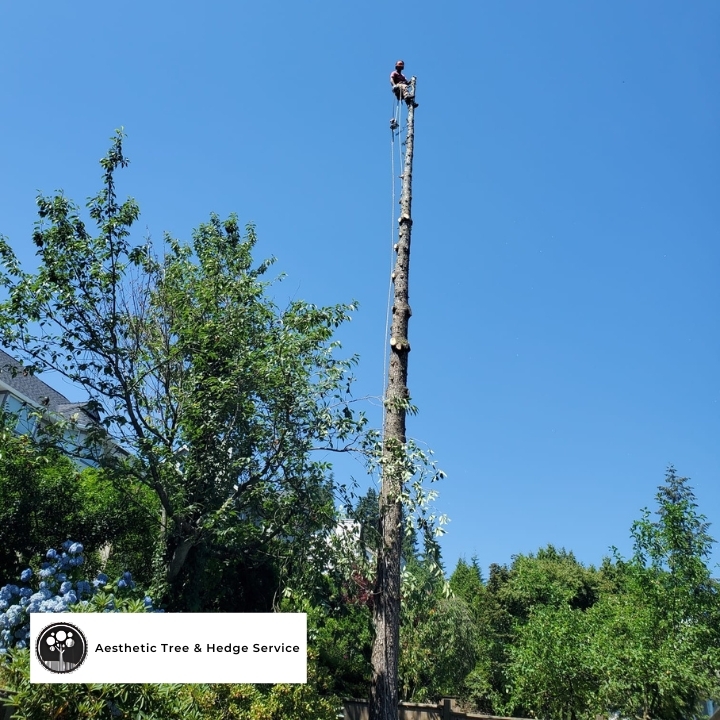
When a qualified tree crew arrives for an emergency response at 2 AM, there is a process, and it is not just starting up the chainsaw.
Site safety assessment first. Work should begin with a site walk (ANSI Z133 is the American safety standard for arboricultural operations). The crew identifies overhead hazards, checks for utility proximity, assesses the target zone, and determines fall paths before any cutting begins. In an emergency scenario, this step takes longer in darkness and wet conditions, not shorter.
The TRAQ assessment. The Tree Risk Assessment Qualification (TRAQ) is an advanced ISA credential specifically designed for structured risk evaluation. Not every arborist has it, but crews doing storm-damage emergency response should have access to it. TRAQ-trained arborists rate risk based on how likely the tree or part is to fail and the target it could strike. This is how you distinguish a hung-up limb over a driveway from a hanging limb over an empty field.
Rigging for controlled removal. In emergency scenarios in Vancouver, the target situation is often a tight space, a fir overhanging a fence, a maple section above a garage, a cedar hung-up on a roofline. Safe removal in these situations is a rigging job, not a felling job. The crew sets up anchor points, attaches lowering lines, and brings the piece down in sections with controlled descent. This requires certified climbing equipment and trained personnel.
WorkSafeBC compliance. Emergency does not mean the occupational health and safety requirements go away. WorkSafeBC regulations apply at 2 AM the same as they do at 2 PM. If you hire a contractor who isn't registered with WorkSafeBC or isn't in good standing, you could be held liable for premiums they owe; a free WorkSafeBC clearance letter protects you.
When you call a 24-hour tree service in Vancouver, ask these four questions before agreeing to anything. You can also review what to expect from a professional arborist assessment before committing to any work:
- Do you have ISA-certified arborists on the crew tonight?
- Are you registered with WorkSafeBC and in good standing, so I can get a clearance letter?
- Do you carry liability insurance?
- What is the scope of work and when can you provide it in writing?
A legitimate emergency arborist will answer all four without hesitation.
What Do You Do Before the Arborist Arrives?
The period between making the call and the crew arriving is when homeowners make decisions they later regret. Here is what the first hour should look like.
Move everyone away from the hazard zone. Identify the likely impact zone if the compromised tree or limb fails. Clear it. If this is a section of your roof overhang zone or a section of your yard, make it inaccessible until the crew is on site. If children or pets have access to that space, close it off now.
Document the situation. If it is safe to do so from a distance, take photos or video. This is useful for insurance, for communicating with the arborist, and for the City of Vancouver if permit documentation becomes necessary. Don't approach the tree to get a better angle. Zoom works.
Check your strata or city obligations. If you are in a strata property, your strata bylaws may require you to notify the strata council within a specific timeframe when a tree emergency involves common property or an adjacent lot. For strata-adjacent tree work in areas like North Vancouver or Burnaby, tree permit rules differ by municipality, so confirm which apply before non-emergency work continues. Check your strata bylaws or contact the strata council after the immediate hazard is secured.
Call your insurance company to document the event. You don't need to file a claim immediately, but documenting the timing of the emergency and the steps you took creates a record. If property damage occurred, to your home, a vehicle, a structure, or a neighbour's property, this documentation matters significantly.
Do not begin amateur removal. A tree or limb that has already partially failed is unpredictable. The fracture location, the actual load distribution, and the failure mode are not visible from the outside. Leave it exactly where it is and wait for trained personnel.
Does Vancouver's Tree Bylaw Apply During Emergencies?
This question comes up regularly after storms, and the short answer is that it depends on the situation.
The City of Vancouver's Protection of Trees By-law No. 9958 regulates the removal of trees on private property and prohibits pruning that puts a tree's health at risk. In most cases, removing a protected tree requires a city-issued permit. Section 9 of the by-law covers emergency removal.
What this means practically: if a tree becomes hazardous because of damage from a natural cause, the owner can remove it before getting a permit. But a permit application must follow within 24 hours of the removal, or on the next business day if the removal happens on a weekend or holiday. A written assessment from a certified arborist documenting the specific defects supports that application.
This is another reason the identity of your 24-hour tree service matters. Outside an emergency, removing a hazardous tree in Vancouver requires certification from an arborist who is an ISA-certified tree risk assessor, and a crew without qualified arborists can't document the hazard for your permit application.
If your emergency tree situation involves a tree likely to be protected under Bylaw No. 9958, any tree with a trunk diameter of 20 cm or more measured at 1.4 m above grade, ask the arborist crew at the start of the callout whether they will document the hazard assessment for bylaw purposes.
How Is Emergency Tree Work Different From Regular Tree Service?
Three practical differences matter for Vancouver homeowners.
Timing and crew. Emergency response means any hour, in any weather, with the people and equipment needed for the specific hazard. A legitimate 24-hour tree service has on-call arborists and the ability to mobilize climbing equipment, rigging, and appropriate safety gear on short notice.
Scope is narrower. Emergency work addresses the specific hazard. If a limb is over your garage, the emergency crew removes that limb and secures the hazard. Full cleanup, stump grinding, and additional pruning follow in a scheduled job. Understanding this distinction prevents a mismatch between what you authorize at midnight and what you expect to see when you check in the morning.
Documentation requirements are higher. Because emergency work may involve protected trees, insurance claims, or neighbour property impacts, documentation becomes critical. ISA-certified arborists can produce the written assessment that insurance adjusters, bylaw officers, and strata managers need.
What Areas Does Aesthetic Tree Serve for Emergency Response?
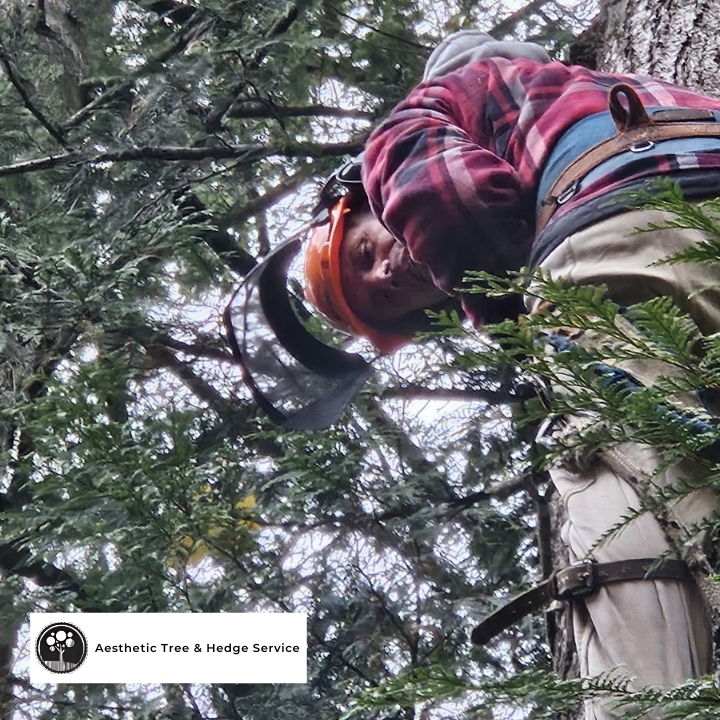
Aesthetic Tree & Hedge Services provides 24-hour emergency tree response across Greater Vancouver.
Our ISA-certified arborists hold TRAQ, and every crew member is covered by WorkSafeBC.
Call 604-721-7370 for emergency response.
FAQ
What qualifies as a 24-hour tree emergency in Vancouver?
A 24-hour tree emergency involves a compromised tree or limb that is directly over an active target, a roof, vehicle, walkway, or occupied structure, and shows signs of imminent failure. Hung-up limbs, trees with visible root plate movement, and trees contacting power lines are the most common emergency scenarios.
Should I call BC Hydro before calling a tree service if a tree hits a power line?
Yes, the electrical hazard comes first. If the line is down or damaged, stay back 10 metres and call 911, as BC Hydro advises. To report an outage, call BC Hydro at 1 800 BCHYDRO (1 800 224 9376). Tree crews can't prune or fell near energized high-voltage lines until WorkSafeBC's Part 19 conditions are met.
Does the City of Vancouver's Tree Bylaw apply to emergency removals?
Yes. Section 9 of By-law No. 9958 lets an owner remove a tree that has become hazardous from natural-cause damage before a permit is issued, but a permit application must follow within 24 hours of removal (or on the next business day after a weekend or holiday). An ISA-certified arborist's assessment supports that application.
What is the TRAQ designation and why does it matter?
TRAQ stands for Tree Risk Assessment Qualification, an advanced credential issued by the International Society of Arboriculture. It trains arborists in a standardized, systematic process for assessing tree risk. In Vancouver, a tree removed as hazardous must be certified by an arborist who is an ISA-certified tree risk assessor.
Can a homeowner remove a storm-damaged tree themselves?
Attempting self-removal of a structurally compromised tree is dangerous. The failure mode of a fractured attachment point is not visible from the outside. Leave any tree that is over a structure, near a power line, or showing visible structural failure to trained personnel.
Does Aesthetic Tree provide a written scope for emergency callouts?
Quotes are provided on-site, and you can ask for the scope in writing before work begins. Aesthetic Tree also provides insurance claim documentation for emergency work.
How do I prepare while waiting for the emergency arborist to arrive?
Clear the impact zone, document the hazard with photos from a safe distance, notify your strata if applicable, contact your insurance company to document the timing, and do not attempt any amateur removal.
For emergency tree service in Greater Vancouver, call Aesthetic Tree & Hedge Services at 604-721-7370. ISA-certified arborists. WorkSafeBC coverage for every crew member. 24/7 emergency response.
Found this helpful? Follow our tree care insights directly on Google.
Make us your preferred source on GoogleOur Tree Care Services
ISA-certified arborists serving Greater Vancouver
Explore Our Tree Care Services
From expert pruning to safe tree removal, our ISA-certified arborists are ready to help across Greater Vancouver.
View Services