Arborist Consulting in Vancouver: What Every Homeowner Must Know
TL;DR — Quick Summary
Arborist consulting in Vancouver covers tree permits, hazard assessments, and ISA reports. ISA-certified team, WCB registered. Free estimate: (604) 721-7370.
- Arborist consulting is a formal tree assessment by an ISA-certified arborist — and the City of Vancouver requires an ISA-certified arborist's report with private tree removal permit applications
- Vancouver's Protection of Trees By-law (By-law No. 9958) protects private trees with a trunk 20 cm or more in diameter; removal without a permit can bring a fine of $500 to $10,000 per offence
- A consultation covers hazard evaluation, disease diagnosis, construction impact planning, and formal written arborist reports
- Check ISA certification and WorkSafeBC coverage before hiring — a WorkSafeBC clearance letter protects you from a contractor's unpaid premiums
- Call Aesthetic Tree & Hedge Services for a free consultation: (604) 721-7370
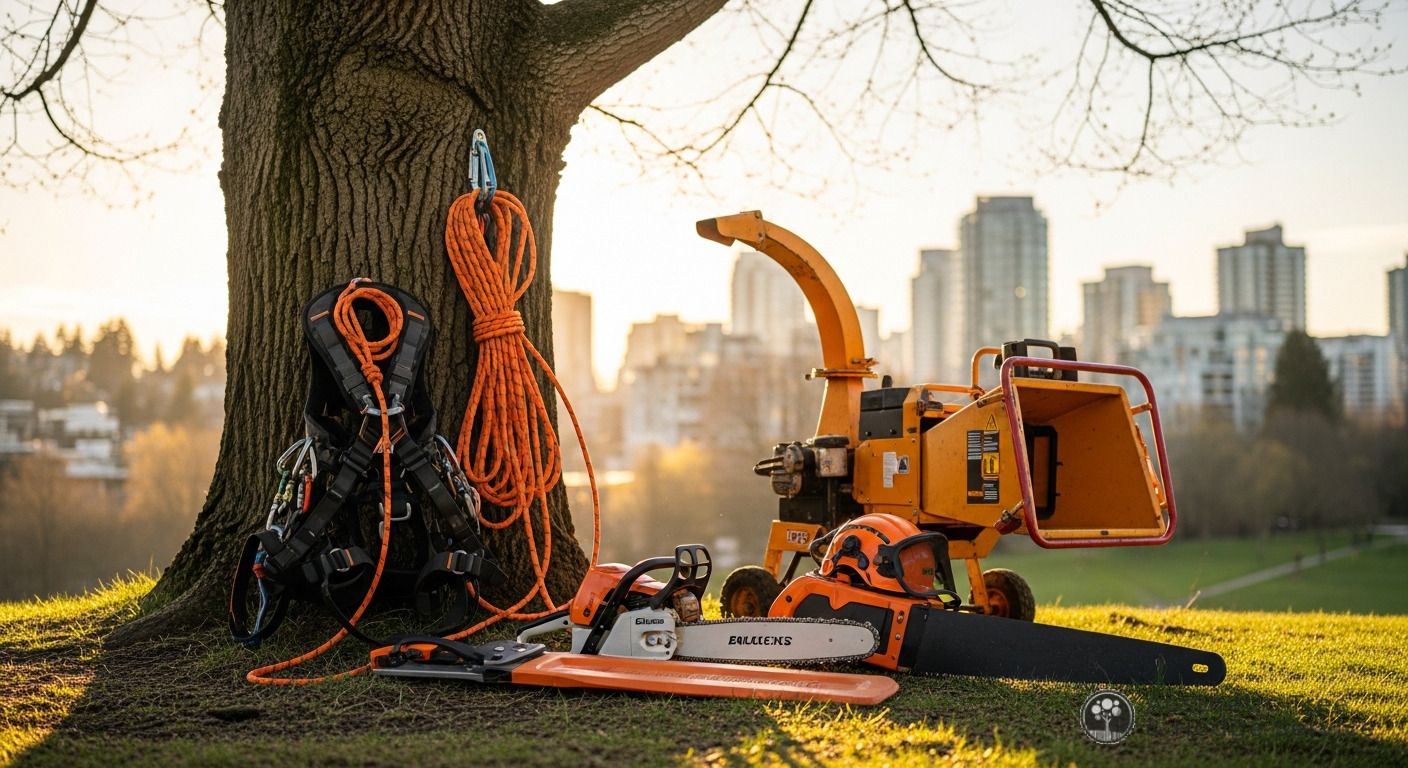

Arborist consulting is where every serious tree decision starts. You're planning a renovation. A tree near your house looks wrong. The city wants documentation before you remove anything. A certified arborist consultation gives you the evidence you need — to act legally, safely, and without surprises.
This guide covers what arborist consulting includes, when Vancouver bylaws require it, and how to tell a credible arborist report from one that city hall will reject.
What Does Arborist Consulting Actually Cover?
Most homeowners picture a quick site visit. It's more than that.
A formal consultation by an ISA-certified arborist involves several distinct assessments. Each is documented to a published standard.
Tree Risk Assessment
Arborists evaluate structural integrity using the ISA Tree Risk Assessment Qualification (TRAQ) framework. They look for root zone defects, crown asymmetry, co-dominant stems, decay, and deadwood. Every finding is documented to ANSI A300 Part 9 standards. The output is a formal risk rating: Low, Moderate, High, or Extreme.
Tree Health Assessment
Disease and pest infestations progress before they become visible. A certified arborist identifies the specific pathogen — not just "the tree looks sick." Specific findings lead to specific treatment. Vague impressions don't.
Pre-Construction Tree Protection Plans
In Vancouver, trees kept on a development site must be protected during construction, and so must neighbouring and boulevard trees at risk of damage. The arborist sets the protection zone, specifies barrier fencing placement (Schedule A of By-law 9958 sets barrier distances), and sets conditions for work in the root zone. If trees 20 cm or larger are on the site, an arborist's report is required for the development permit application.
Formal Arborist Reports
These are the documents that go to the city. A valid report includes the arborist's ISA credentials, tree inventory data (species, diameter at breast height, crown spread, condition rating), hazard assessment findings, and specific recommendations. For development applications, section 7.2 of Vancouver's By-law 9958 lists the details the City needs in the arborist's report.
Property Transaction Assessments
Some buyers ask for a tree assessment before closing, especially on lots with large trees near the house. It gives both sides a documented record of tree condition at the time of sale.
When Do Vancouver Homeowners Need Arborist Consulting?
Six situations either require a consultation or make one strongly protective:
1. Before Removing Any Large Tree
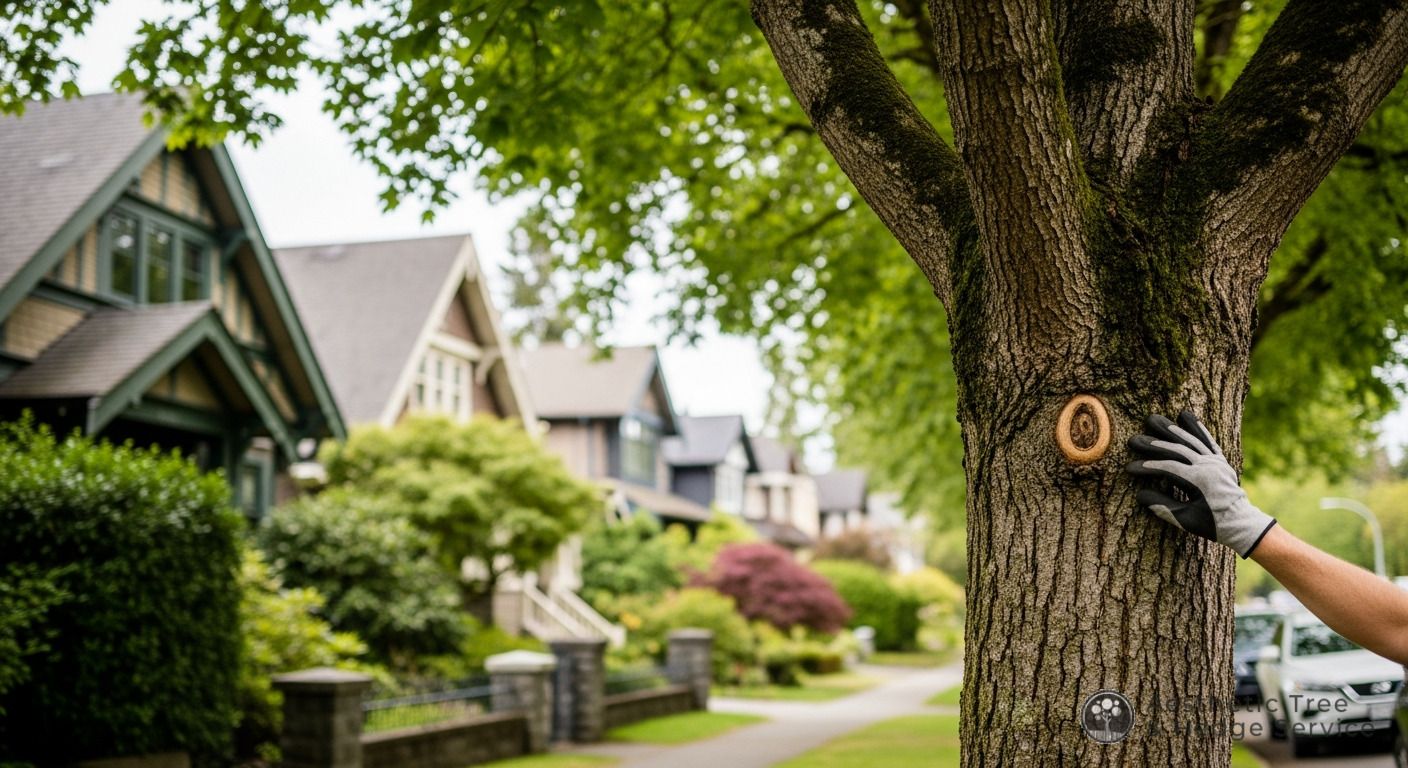
Vancouver's Protection of Trees By-law (By-law No. 9958) protects private trees with a trunk diameter of 20 cm or greater, measured at 1.4 m from the ground. Removal without a permit is an offence carrying a fine of $500 to $10,000 (section 11.8), and the City requires a replacement tree for any removed tree larger than 20 cm. An arborist's report documents the removal rationale and supports your permit application.
2. Before Construction or Renovation
Excavation within a tree's root protection zone can damage the roots a tree depends on. A pre-construction assessment creates the documentary record you need.
3. After Storm Damage
A cracked limb or compromised root plate is a liability. An arborist documents the damage and assigns a formal risk rating using ISA TRAQ methodology. That rating matters for insurance claims and neighbour disputes. For urgent situations, our emergency tree service is available across Vancouver and the Lower Mainland.
4. When a Tree Shows Signs of Decline
Sparse foliage in July. Premature leaf drop. Mushrooms at the base. Deadwood in the upper crown. These aren't cosmetic issues. They're structural and biological warnings. Professional diagnosis is how you separate a treatable condition from a removal situation.
5. For Neighbour or Strata Disputes
A written report from an ISA-certified arborist documents tree condition, location, and risk in a form a neighbour, strata council, or court can review. A verbal opinion leaves no record.
6. For Pre-Sale Property Disclosures
In BC, the Property Disclosure Statement is voluntary, but a seller who knows about a material latent defect (one a reasonable inspection wouldn't reveal) can still be liable for not disclosing it, according to the British Columbia Real Estate Association. A pre-sale arborist assessment documents tree condition before an offer lands.
What Are the ISA Certification Requirements — and Why Do They Matter?
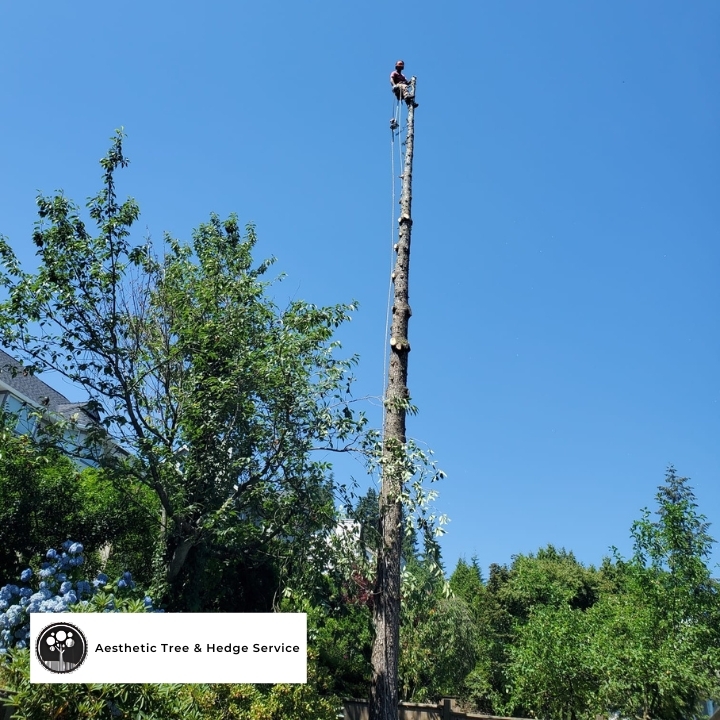
The International Society of Arboriculture (ISA) manages the global certification program for arborists. ISA traces its roots to the Shade Tree Conference, which first met in 1924.
To earn ISA Certified Arborist status, a candidate must:
- Have at least three years of full-time arboriculture experience, or a combination of education and practical experience
- Pass the ISA Certified Arborist exam, a 200-question multiple-choice test
- Recertify every three years by earning 30 continuing education units or retaking the exam
ISA's Tree Risk Assessment Qualification (TRAQ) trains arborists in a standardized, systematic process for assessing tree risk. Not every ISA-certified arborist holds it. It matters in Vancouver: to remove a tree because it is hazardous, By-law 9958 requires the tree to be certified hazardous by an arborist who is an ISA-certified tree risk assessor. If your tree is near a structure and you need a formal risk rating, ask specifically for TRAQ-qualified personnel.
Why does certification matter? The City of Vancouver requires tree removal permit applications to include a report prepared by an ISA-certified arborist. A report from an uncertified individual doesn't meet that requirement, and you've paid for a document you can't use.
WorkSafeBC coverage matters for a different reason. If you hire a contractor who isn't registered with WorkSafeBC or isn't in good standing, you could be held liable for insurance premiums they owe. A free WorkSafeBC clearance letter addressed to you, available online, protects you from that.
Verify both credentials before signing anything:
- ISA certificate number: verify at treesaregood.org
- WorkSafeBC status: request a free clearance letter at worksafebc.com
What Do Vancouver's Tree Bylaws Actually Require?
Requirements vary by municipality. Here's the practical framework across the Lower Mainland:
City of Vancouver
The Protection of Trees By-law (By-law No. 9958) protects trees on private property with:
- A trunk diameter of 20 cm or greater (measured at 1.4 m from ground)
- Smaller trees that were planted as replacement trees or required as part of a development
Removing a protected tree requires a permit, and applications must include a report from an ISA-certified arborist. The by-law also prohibits pruning or cutting a tree in a way that puts its health at risk.
City of Burnaby
Under the Burnaby Tree Bylaw, a protected tree is any tree 20 cm or more in diameter on a property with a development application. On other properties, conifers 30 cm or more and deciduous trees 45 cm or more in diameter are protected.
District of North Vancouver
The District's Tree Protection Bylaw 7671 regulates "large-diameter trees" (75 cm or more in diameter) as well as "protected trees" as the bylaw defines them. Confirm with the District before assuming you're exempt.
City of Coquitlam
Coquitlam's Tree Management Bylaw 4091 protects trees 20 cm or more in diameter measured 1.4 m from the ground. In most cases owners can remove up to two protected-size trees per year without a permit, and developers may be asked to provide a certified arborist's assessment of existing trees.
For work requiring an arborist report in Vancouver, expect it to include the arborist's ISA credentials, a tree inventory with diameter measurements and condition ratings, a risk rating where hazard is in question, and specific recommendations.
How Much Does Arborist Consulting Cost in Vancouver?
Third-party market data provides the benchmark.
HomeAdvisor's arborist cost guide (U.S. market, U.S. dollars) reports that arborists charge $75 to $150 for a general tree inspection, and that formal tree reports cost up to $700. Vancouver prices can differ.
*These figures are based on HomeAdvisor market data and represent industry averages. Actual costs vary based on project scope, materials, and site conditions. Contact Aesthetic Tree & Hedge Services for a personalized assessment.*
What's the Difference Between an Arborist Report and a Tree Risk Assessment?
These terms are used interchangeably. They're not identical.
An arborist report is a written document. It may cover tree health, structural condition, recommended work, permit justification, or a full property tree inventory. It's the deliverable — the document that goes to the city, your lawyer, or your insurer.
A tree risk assessment is a specific methodology — the ISA TRAQ process — used to evaluate the probability and consequence of tree failure. The output is a formal risk rating with a recommended action timeline.
A risk assessment is often one section within a broader arborist report. But not every arborist report includes a formal TRAQ assessment. If your tree shows structural failure signs — root plate heave, large trunk cracks, significant lean toward a building — ask specifically for TRAQ-qualified personnel.
The distinction has practical consequences. In Vancouver, a removal permit on hazard grounds needs the tree certified as hazardous by an ISA-certified tree risk assessor; a general opinion letter doesn't meet that condition. Both are arborist documents. Only one is a formal, methodology-backed risk rating.
What Does the Arborist Consulting Process Actually Look Like?
Here's what a thorough consultation involves:
Step 1: Scope Definition
Before the site visit, define the scope: how many trees, what purpose — permit, hazard concern, pre-sale, pre-construction — and which municipality. The report type depends on these answers.
Step 2: Site Visit and Field Assessment
The arborist physically inspects every tree in scope: measuring diameter at breast height (DBH), assessing crown structure and condition, examining the root flare, probing for decay where indicated, and photographing the trunk, crown, root flare, and any structural defects.
Step 3: Analysis and Report Preparation
The arborist applies the relevant standard to the field findings. Recommendations should be specific and measurable. Not "monitor this tree" — but, for example, "remove the co-dominant stem with included bark and re-inspect the root collar within 12 months."
Step 4: Delivery and Permit Support
The report should carry the arborist's signature and ISA credential number. Aesthetic Tree also handles the permit application for clients who need one.
Step 5: Follow-Through on Recommended Work
If the consultation identifies the need for tree cutting or structural pruning, Aesthetic Tree's ISA-certified arborists can carry out that work too.
Do Trees Add or Subtract From Your Property Value?
The research points both ways.
A study by Donovan and Butry (2010), published in *Landscape and Urban Planning*, found that street trees in Portland, Oregon added an average of $8,870 (U.S.) to house sale prices and cut time on the market by 1.7 days.
The reverse also applies. A structurally poor tree near a house is something a buyer's inspector may find, and a seller who knows about a material latent defect can face liability for not disclosing it.
A pre-sale arborist consultation produces one of two outcomes. Either the trees are documented as healthy, or risks are identified and dealt with before listing. Both beat having the buyer's home inspector find something first.
What Questions Should You Ask an Arborist Before Hiring?
The right questions separate credentialed professionals from general landscapers:
- "What is your ISA certification number?"
- "Are you ISA TRAQ qualified for formal tree risk assessment?"
- "Is your company WCB registered in British Columbia?"
- "Have you prepared reports accepted by the City of Vancouver?"
- "Which ANSI A300 standard applies to this scope of work?"
- "Will the report include field photographs, DBH measurements, and a condition rating table?"
Every legitimate ISA-certified arborist answers these immediately. These are baseline credentials — not selling points. Hesitation is a warning sign.
Do I Need Arborist Consulting for Tree Removal in Vancouver?
If the tree measures 20 cm or more in diameter at 1.4 m above the ground: yes.
A 20 cm diameter works out to roughly 64 cm around the trunk, according to the City of Vancouver, so many established trees on residential lots meet the threshold. Measure before you assume a tree is exempt.
Aesthetic Tree manages this process from start to finish. We prepare the arborist report, handle the permit application, and perform the tree removal after the City approves it. You don't manage city hall. We do.
After removal, stump grinding completes the job — eliminating the trip hazard, stopping root regrowth, and restoring the space for replanting or hardscaping.
FAQ
What qualifications must an arborist consultant have to work in Vancouver?
Look for ISA Certified Arborist status, issued by the International Society of Arboriculture. The City of Vancouver requires tree removal permit applications to include a report prepared by an ISA-certified arborist. If a tree is being removed as hazardous, the by-law requires certification from an arborist who is an ISA-certified tree risk assessor, so ask about ISA's Tree Risk Assessment Qualification (TRAQ). Before signing any contract, verify ISA credentials at treesaregood.org and get a WorkSafeBC clearance letter at worksafebc.com.
How long does a consultation and written arborist report take?
Timing depends on the number of trees, the type of report, and the site. A single tree takes far less time than a multi-tree development site. Ask for a written turnaround estimate when you book, and ask whether a rush option is available.
Can an arborist report prevent my neighbour from removing their protected tree?
Not directly — but it provides the evidence base for a formal complaint. In Vancouver, removing a protected tree without a permit is an offence under By-law 9958, and the City accepts reports of suspected unauthorized tree removal. Reporting it to the City is strengthened by a professional assessment documenting the tree's size, condition, and regulatory status. A written report leaves a record; a verbal opinion doesn't.
Is arborist consulting required for routine hedge trimming?
Routine hedge trimming doesn't require an arborist report. But in Vancouver, removing a hedge can need a permit if the combined diameter of its largest two or three stems at 1.4 m is 20 cm or more, so check before cutting a hedge down. On strata property, a Vancouver tree permit application needs written consent from the strata council president or vice-president.
What makes an arborist report legally defensible in Vancouver?
A defensible report includes: the arborist's ISA credential number, a formal tree inventory with species, DBH, height, and condition ratings, risk classification using ISA TRAQ methodology, field photographs taken at standardized angles, and recommendations that reference the specific ANSI A300 standard applied. The report must be signed by the certified arborist who conducted the site assessment — not by office staff.
Call Aesthetic Tree & Hedge Services for a Free Estimate
Arborist consulting is the first step before any significant tree decision — removal, construction, dispute, or sale.
Don't skip it. The permit application, the insurance claim, the neighbour dispute — every one is harder without documented professional assessment.
Aesthetic Tree & Hedge Services employs ISA-certified arborists, and every crew member is covered by WorkSafeBC. We serve Vancouver, Burnaby, North Vancouver, Richmond, Coquitlam, and the wider Lower Mainland.
Call us for a free estimate: (604) 721-7370
Related: For more on this, see arborist port coquitlam: 7 checks before hiring.
Related: For more on this, see Tree Removal in Richmond: 5 Things ISA Arborists Want You to Know Before You Call.
Related: For more on this, see Trees Near Power Lines Vancouver.
Found this helpful? Follow our tree care insights directly on Google.
Make us your preferred source on GoogleBefore You Go
Where are you in your tree care journey?
Our Tree Care Services
ISA-certified arborists serving Greater Vancouver
Explore Our Tree Care Services
From expert pruning to safe tree removal, our ISA-certified arborists are ready to help across Greater Vancouver.
View Services