
TL;DR — Quick Summary
deep root barrier installation vancouver guide for protecting trees, sidewalks, pipes, and foundations. Call Aesthetic Tree for a free estimate.
deep root barrier installation vancouver is not just a landscaping job. It is tree work, soil work, and risk control in one trench.
That matters in Vancouver.
We have tight lots. Older sewer laterals. Big trees close to houses. Rain-heavy soils. Laneways. Retaining walls. Shared fences. Add one mature cedar, Big-leaf maple, Douglas fir, or willow near a driveway, and the question gets serious fast.
Can you protect the pipe, path, patio, or foundation without harming the tree?
Often, yes. But only when the work starts with the roots, not the plastic panel.
A deep root barrier is a vertical underground barrier. It redirects root growth away from a structure or utility. It does not make roots disappear. It does not fix a broken sewer line by itself. And it does not give anyone permission to cut major structural roots without an arborist assessment.
That is where an ISA-certified arborist earns their keep.
At Aesthetic Tree & Hedge Services, we look at root flare, species, soil, grade, target structure, tree stability, and municipal rules before recommending a barrier. Sometimes the right answer is a barrier. Sometimes it is root pruning. Sometimes it is an arborist report in Vancouver, pipe repair, selective pruning, or full removal with a permit.
This guide explains how deep root barriers work in Vancouver and the Lower Mainland. It also shows when they are smart, when they are risky, and what to ask before anyone starts digging.
TL;DR
- Deep root barriers redirect roots. They do not kill roots or repair damaged pipes.
- In Vancouver, tree work near protected trees can trigger permit, arborist report, and tree protection rules.
- Root barriers work best before serious damage starts, or after a proper diagnosis.
- The trench depth, barrier type, species, soil, and root pruning method matter.
- Call Aesthetic Tree & Hedge Services for a free estimate at (604) 721-7370. Our team is ISA-certified and WCB registered.
What Is a Deep Root Barrier, and How Does It Work?
A deep root barrier is an underground wall placed between roots and something you want to protect.
That may be a sewer lateral, driveway, retaining wall, foundation, patio, pool edge, or sidewalk. In Vancouver, it is often a tight urban problem. A mature tree grew well for decades. Then the hardscape changed around it.
Roots follow oxygen, moisture, and easier soil. They do not hunt concrete like a target. But they exploit cracks, loose joints, wet soil, and low-resistance paths. If an old clay pipe leaks, roots find that water. If compacted soil forces roots upward, they lift pavers. If a trench gives them better air and moisture, they grow there.
A root barrier changes that path.
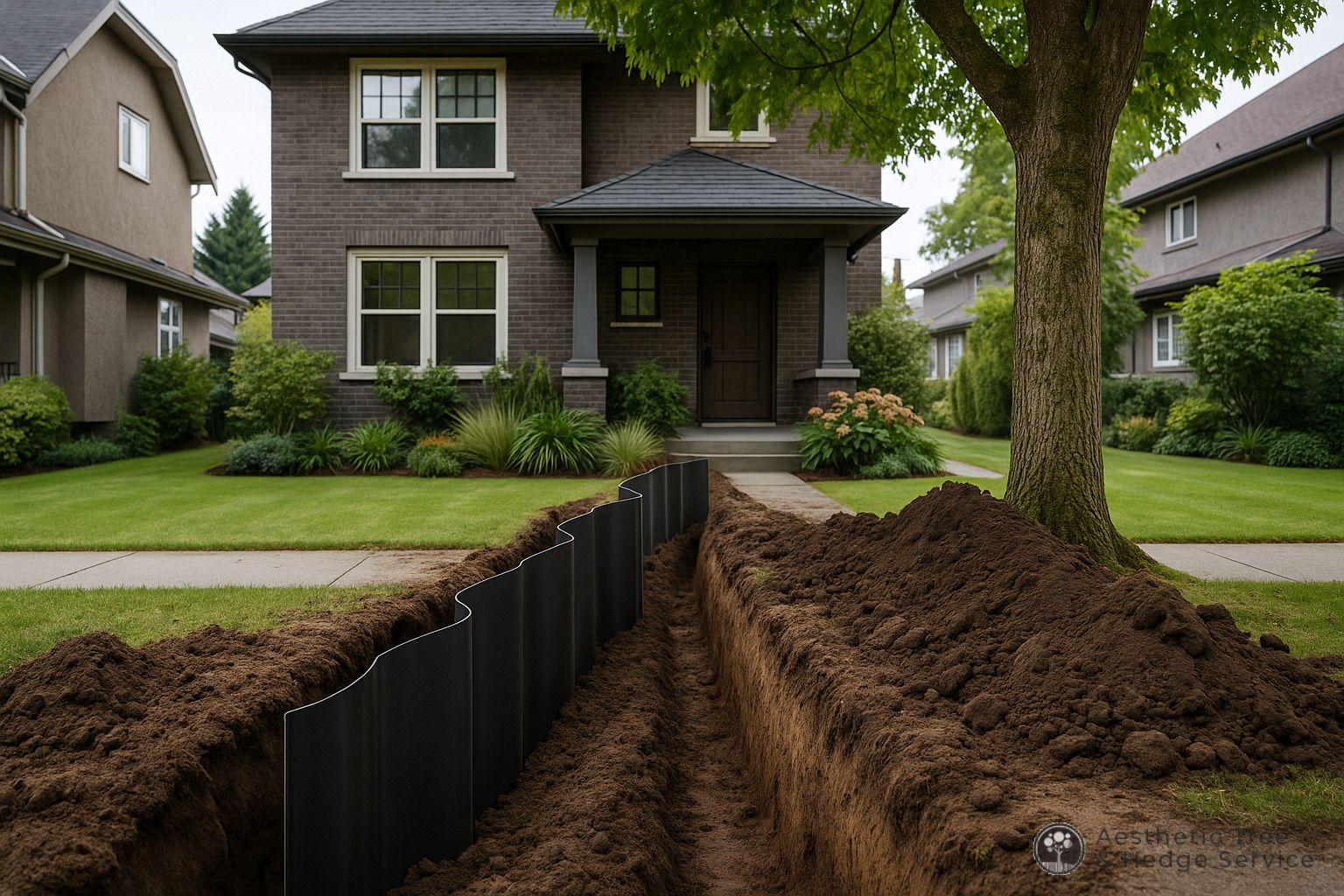
Most modern barriers use high-density plastic panels. Good panels have vertical ribs. Those ribs guide roots downward instead of letting them circle along the barrier face. The top edge usually sits slightly above final grade. That helps stop roots from growing over the barrier.
The International Society of Arboriculture sells a Root Management Best Management Practices guide as a companion to ANSI A300 tree care standards. The ISA describes root management as work that inspects, prunes, and directs roots to support tree life while reducing infrastructure conflict. That is the right frame. This is not brute-force digging. It is root management.
A deep barrier is different from a shallow bamboo barrier. Bamboo spreads by rhizomes near the surface. Tree roots are different. A mature tree has structural roots, absorbing roots, and a root plate that helps anchor it. Cut the wrong roots, and the problem shifts from lifted concrete to tree failure.
That is why we inspect before we install.
A proper root barrier plan answers five questions:
- What species is the tree?
- How large is the trunk at 1.4 metres above grade?
- Where is the root flare?
- What structure or utility is at risk?
- Can roots be pruned without making the tree unstable?
If those answers are vague, stop. The barrier plan is not ready.
When Do Vancouver Homeowners Need Deep Root Barrier Installation?
Homeowners usually call about root barriers after they see damage.
The common signs are easy to spot:
- Driveway slabs rising near a tree
- Pavers lifting in a line
- Fence posts shifting
- Soil mounding beside a retaining wall
- Sewer backups tied to root intrusion
- Roots visible near a foundation edge
- A new build planned near a retained tree
- A neighbour dispute over boundary roots
But visible damage is only part of the story.
In our experience across Vancouver, Burnaby, Richmond, Coquitlam, and the North Shore, the better question is not, “Can we block the roots?” It is, “What is making the roots grow there?”
A pipe leak draws roots. Poor drainage draws roots. Compacted soil pushes roots up. A shallow growing bed can make sidewalk conflict worse. A new trench can cut roots that were holding a tree steady.
Deep root barrier installation makes sense when the barrier protects a clear target and the tree can tolerate the work.
Good use cases include:
- Protecting a repaired sewer lateral from future intrusion
- Separating a new patio from nearby roots
- Reducing repeat driveway lifting near a known root path
- Protecting hardscape beside a young or mid-sized tree
- Guiding roots away from a new retaining wall
- Supporting a tree protection plan during construction
Weak use cases include:
- Trying to save a fully failed pipe without plumbing repair
- Cutting roots on one side of a large leaning tree
- Installing a barrier too close to the trunk
- Digging through major roots without an arborist
- Using a barrier as a substitute for municipal approval
If a tree is already hazardous, the priority changes. We assess risk first. If removal is required, homeowners may need a permit and a proper plan. Our tree removal Vancouver service covers those situations when pruning or root management will not solve the risk.
Root barriers are useful. They are not magic.
What Vancouver Tree Rules Affect Root Barrier Work?
Vancouver tree rules matter because root work can damage a protected tree.
The City of Vancouver Protection of Trees By-law No. 9958 applies to trees on private property. According to the City of Vancouver, a permit is required to remove any private tree with a diameter of 20 centimetres or greater, measured at 1.4 metres above ground. The City also states that an arborist report is required for development permit applications when trees 20 centimetres or larger are present.
That 20-centimetre number is important. A homeowner may think, “We are not removing the tree.” Fair. But deep trenching near the root zone can still injure it.
The by-law also sets tree protection expectations during development. The City states that retained trees on the site must be protected, and adjacent or boulevard trees at risk of damage must be protected too. The City’s by-law definition of a protection barrier includes a barrier at least 1.2 metres high, with distance requirements set by Schedule A.
Here is the practical meaning.
If you are installing a root barrier near a regulated tree during a renovation, laneway build, driveway rebuild, drainage repair, or fence project, you may need arborist input before excavation. If the work affects a boulevard tree, the City’s role becomes even more direct.
Burnaby, Richmond, North Vancouver, and Coquitlam also have their own tree bylaws. They are not identical. A barrier plan that works in East Vancouver may need a different approval path in Burnaby or North Vancouver.
This is why we document species, trunk diameter, root zone conditions, and proposed work. When the project needs a formal report, we prepare the right arborist documentation instead of guessing.
For homeowners planning construction near trees, start with an arborist report. It is cheaper to plan around roots than to repair a damaged tree, failed inspection, or neighbour conflict later.
How Deep Should a Root Barrier Be in Vancouver Soil?
The correct depth depends on the tree, target, soil, and barrier purpose.
There is no honest one-size answer.
A shallow barrier may help with surface roots under pavers. A deeper barrier may be needed near sewer laterals, retaining walls, or new hardscape. The barrier must also be installed with enough length beyond the target area. If the barrier stops too soon, roots simply grow around the end.
Depth is only one part of performance.
The barrier also needs:
- A clean trench line
- Correct panel orientation
- Vertical ribs facing the tree side when specified
- A top edge set above grade
- Proper backfill and compaction
- Protection for exposed roots during the work
- Clean root cuts when pruning is required
Vancouver soils vary a lot. Kitsilano can be sandy. East Vancouver lots often include fill and compacted layers. North Vancouver sites can bring slope, rock, and drainage concerns. Richmond brings high water table issues and soft soils. Coquitlam lots can combine clay, slope, and large conifers.
Roots respond to those conditions.
A barrier installed in poor soil can create a new problem. Water may collect on one side. Roots may turn along the panel. The tree may lose access to useful rooting space. If the barrier is too close to the trunk, root loss can stress or destabilize the tree.
This is where an arborist looks past the product label.
We assess root flare, canopy, lean, species, soil moisture, grade changes, and target distance. We also look for signs of previous damage, such as old trench lines, girdling roots, decay, mushrooms near the base, or lifting soil.
If the tree has already lost roots on one side from construction, another trench may be a bad idea. In that case, we may recommend pruning, soil care, cabling, removal, or another route.
Can Root Barriers Protect Sewer Lines, Foundations, and Sidewalks?
Yes, root barriers can protect infrastructure when the cause is correctly diagnosed.
Let’s start with sewer lines.
A 2001 research review by Randrup, McPherson, and Costello, published in the Journal of Infrastructure Systems and listed by the U.S. Forest Service, reported that roots are associated with more than 50% of sewer blockages. The same review found that interference is more likely in older systems, cracked pipes, shallow pipes, small-diameter pipes, and fast-growing species.
That matches what arborists and plumbers see in the field.
Roots usually enter pipes through defects. They exploit cracks and joints. They do not need a large opening at first. Fine roots enter, then thicken, trap debris, and create repeat backups.
A barrier helps after the plumbing issue is repaired. It is not a substitute for pipe work. If a line is cracked, call a plumber for camera inspection and repair. Then use arborist-led root management to reduce repeat intrusion.
Sidewalks and driveways are different.
A 1995 Arboricultural Journal study by Barker and Peper, also listed by the U.S. Forest Service, found that several root barrier types in field experiments reduced shallow root development near sidewalks. The study also warned that barrier design matters because poor designs can lead to circling roots.
That is a key lesson.
A barrier is not just a sheet in the ground. Design affects root behaviour.
Foundations need even more care. In Metro Vancouver, roots are often blamed for foundation cracks when drainage, settlement, expansive soil, or old construction details are also involved. Roots can worsen existing weaknesses. But they are not always the first cause.
Before installing a barrier near a foundation, we look at:
- Tree species and size
- Distance from trunk to wall
- Soil moisture pattern
- Drain tile condition
- Grade slope
- Existing cracks
- Root size and direction
- Signs of tree stress
If a tree is too close, too large, and already harming the structure, removal may be the safer long-term choice. If removal is approved and completed, stump grinding in Vancouver may also be needed before hardscape repair.
Which Trees Cause the Most Root Conflicts in the Lower Mainland?
Any tree can conflict with infrastructure in the wrong place.
Still, some species create more calls than others because of size, growth rate, and root behaviour.
In the Lower Mainland, common root-conflict trees include:
- Willow near wet areas or old pipes
- Poplar and cottonwood near services
- Big-leaf maple near driveways and paths
- Cedar hedges planted too close to walls
- Douglas fir on tight urban lots
- Cherry and plum near older hardscape
- Large conifers near retaining walls
This does not mean these are bad trees.
It means they need enough rooting space. A Big-leaf maple is a valuable native tree. It also grows large. A Douglas fir can be excellent on the right site. It can be a serious hazard on the wrong one. Cedar hedges give privacy, but a mature hedge planted against a fence or drain line can become a maintenance problem.
City context matters too.
The City of Vancouver says its urban forest includes 150,000 street trees, 36,000 specimen trees in golf courses and urban parks, and more than 1 million trees across 444 hectares of public forests and woodlands. The City also reports Vancouver had 25% canopy cover in 2022 and a target of 30% by 2050.
That tells us two things.
First, trees are public infrastructure. They cool streets, manage rain, and add value.
Second, urban trees live beside hard infrastructure. Conflict is normal. The answer is not always removal. It is better planning, better pruning, better planting, and better root management.
If you are replacing a problem tree, choose species and placement carefully. Our tree planting service helps match species to soil, space, bylaw context, and future canopy size.
How Is Deep Root Barrier Installation Done Safely?
Safe installation starts before the shovel.
The first step is assessment. We inspect the tree, target structure, access, grade, and soil. We measure trunk diameter where needed. We look for protected-tree issues and nearby utilities. We also ask what changed. New patio? New sewer repair? Driveway lift? Flooding? Construction next door?
Next comes diagnosis.
If sewer roots are suspected, a plumber should confirm the pipe condition with a camera. If the issue is hardscape lift, we inspect root size and direction. If the work is near a protected tree, an arborist report may be needed.
Then we plan the trench.
A root barrier trench should avoid major structural roots where possible. When roots must be cut, cuts should be clean. Tearing roots with a machine is poor practice. Exposed roots should not sit in sun or wind. Soil should go back in a way that avoids air pockets and drainage traps.
Many jobs follow this broad sequence:
1. Confirm tree, target, and bylaw constraints. 2. Locate utilities before excavation. 3. Mark the barrier line and work zone. 4. Expose roots carefully near the critical zone. 5. Prune only roots that must be pruned. 6. Install panels to the planned depth and length. 7. Keep the top edge slightly above final grade. 8. Backfill with suitable soil. 9. Water and mulch as needed. 10. Monitor the tree for stress.
ANSI A300 Part 8 covers root management as an industry standard area. The Tree Care Industry Association notes that this standard includes root pruning to reduce infrastructure damage and tripping hazards. That standard-based mindset matters. It keeps the job tied to tree health, not just construction speed.
If canopy reduction is needed to balance root loss, it should be selective and standards-based. Avoid topping. Avoid random limb removal. When pruning is part of the plan, use a certified crew familiar with tree cutting in Vancouver and ANSI A300 standards.
Can a Root Barrier Hurt or Kill a Tree?
Yes. A badly planned barrier can harm a tree.
The highest-risk mistakes are easy to name:
- Digging too close to the trunk
- Cutting large structural roots
- Trenching on the tension side of a leaning tree
- Removing too much absorbing root area
- Leaving roots exposed during hot or dry weather
- Installing a barrier that traps water
- Creating circling roots around the panel
- Backfilling with poor soil
Root loss can show up slowly.
A tree may leaf out weakly the next spring. It may drop needles. It may show smaller leaves, dead twigs, or canopy thinning. In worse cases, root decay or instability follows. A large tree with a weakened root plate can become a hazard during wind or saturated soil conditions.
This is why we do not treat root barriers as a handyman project.
Root pruning and trenching need judgement. A cedar hedge is not a Douglas fir. A young ornamental cherry is not a mature Big-leaf maple. A flat Richmond yard is not a sloped North Vancouver property. Species, age, soil, exposure, and existing defects all change the risk.
When a tree is already unstable, root barrier work is not the first move. A hazard assessment comes first. If the tree presents an urgent risk, call for emergency tree service. Wind, rain, root failure, and saturated soil can turn a root issue into a safety issue.
We care about preserving trees. We also care about houses, people, and crews. Safety wins.
What Should You Ask Before Hiring a Root Barrier Installer in Vancouver?
Ask questions that reveal whether the company understands trees.
A root barrier installer should be able to explain the tree risk, not just the trench depth.
Start with these:
- Are you ISA-certified?
- Are you WCB registered?
- Will you inspect the root flare and root zone first?
- Do I need a tree permit or arborist report?
- How will you locate utilities?
- What barrier material do you use?
- How deep and long will the barrier be?
- Which roots will be pruned?
- How will you protect exposed roots?
- What signs of stress should I watch for after installation?
Be careful if someone gives a fast answer without seeing the tree.
Also be careful if they frame removal as the only answer before inspection. Sometimes removal is right. Sometimes it is not. Vancouver bylaws also restrict removal of protected trees, so a casual removal plan can create legal and safety trouble.
A good arborist will explain options in plain language. For example:
- Barrier plus pipe repair
- Barrier plus hardscape rebuild
- Root pruning plus mulch and monitoring
- Construction protection plan
- Tree removal permit support
- Replacement planting
- Hedge removal or hedge replanting
For cedar hedges, the root issue often connects with height, width, and long-term maintenance. If the hedge is staying, proper hedge trimming services in Vancouver help manage canopy weight and access. If it is being replaced, spacing and species choice matter more than quick planting.
The best root job is the one you do not have to redo.
How Do Root Barriers Fit Into Construction, Laneway Homes, and Renovations?
Construction is one of the biggest root-risk moments on a Vancouver property.
A tree can live for 50 years, then lose critical roots in one afternoon of excavation. The damage may not look dramatic at first. But the tree has lost stored energy, absorbing roots, or anchorage. Decline often shows later.
This comes up with:
- Laneway homes
- Drain tile replacement
- Sewer lateral replacement
- Driveway rebuilds
- Retaining walls
- Fence footings
- Garage demolition
- Patio installation
- New service trenches
The City of Vancouver states that all retained trees on development sites require protection. Adjacent trees and boulevard trees at risk of damage must also be protected. For sites with trees 20 centimetres or larger, arborist reporting can be part of the development permit path.
Root barriers can support construction when they are part of the plan early.
For example, a barrier may define a hard edge between a new driveway and a retained tree. It may protect a repaired utility corridor. It may help guide roots away from new paving. But it should not be added late as a patch after roots have already been cut.
The order matters.
Call an arborist before excavation. Not after the machine is on site.
We often coordinate with homeowners, builders, plumbers, and landscape contractors. The goal is simple. Protect the tree where possible. Protect the structure where needed. Keep the work within bylaw and safety rules.
If a tree cannot be retained safely, the path changes. A permit may be required. Replacement planting may be needed. The stump may need grinding. The site may need a new species that fits the finished space.
That is a better outcome than saving the wrong tree in the wrong place.
What Maintenance Is Needed After a Root Barrier Is Installed?
A root barrier is not a set-and-forget item.
Trees keep growing. Soil settles. Hardscape shifts. Drainage changes. Roots may try to grow over the top or around the ends. The tree may also need extra care after root pruning.
After installation, watch for:
- Wilting leaves
- Early fall colour
- Needle drop
- Dead twigs
- Cracks in soil near the trunk
- Mushrooms near the root flare
- New lifting at the barrier end
- Water pooling along the trench
- Roots crossing over the top edge
Watering matters after root work, especially during dry summer stretches. Mulch can help moderate soil temperature and moisture. Keep mulch off the trunk. The root flare should stay visible. Buried root flares invite decay and girdling root problems.
The City of Vancouver’s 2025 Urban Forest Strategy states that hotter, drier summers and more intense rainfall events are part of Vancouver’s climate future. That matters after root work. A stressed tree has less margin during heat and drought.
Plan a follow-up inspection. For higher-risk trees, monitoring is not optional. It is part of responsible care.
A barrier protects one side of the relationship between tree and infrastructure. The tree still needs good soil, water, space, and pruning.
Is Deep Root Barrier Installation Better Than Tree Removal?
Sometimes. Not always.
A root barrier is better when the tree is healthy, stable, valuable, and has enough rooting space left after the work. It is also better when the infrastructure issue is specific and fixable.
Removal is better when the tree is hazardous, severely declining, structurally compromised, or planted in a place where future conflict is certain. Removal may also be the only practical path when a large tree is too close to a foundation, retaining wall, or utility corridor.
The decision should be evidence-based.
We look at:
- Species
- Trunk diameter
- Canopy condition
- Root flare condition
- Lean and load
- Soil and drainage
- Distance to target
- Existing damage
- Bylaw status
- Replacement options
Homeowners often want a simple answer. We get it. Tree problems are stressful. They involve homes, neighbours, safety, and money.
But simple answers can be expensive when they are wrong.
If the tree can be retained, root management may preserve shade, privacy, and property value. If the tree cannot be retained safely, proper removal protects people and structures. Both can be responsible choices.
The difference is assessment.
FAQ
Do I need a permit for deep root barrier installation in Vancouver?
Not always. But you may need an arborist report or city approval if the work affects a protected tree, development site, adjacent tree, or boulevard tree. Vancouver requires permits for removal of private trees 20 centimetres or greater in diameter, measured at 1.4 metres above grade. Root trenching near such trees should be assessed before work starts.
Will a root barrier stop roots from entering my sewer line?
A barrier can help reduce future root pressure after the pipe defect is repaired. It will not fix a cracked, leaking, or joint-failed pipe. Get a plumbing camera inspection first. Then have an ISA-certified arborist assess the tree and root zone.
How close can a root barrier be installed to a tree?
It depends on species, trunk size, age, soil, lean, and site conditions. Installing too close can remove important structural roots. That can stress or destabilize the tree. An arborist should inspect before trenching near any mature tree.
Are root barriers useful for cedar hedges?
Yes, in some cases. Cedar hedge roots can conflict with fences, drains, and narrow beds. But hedges also need enough soil and water to stay healthy. Barrier work should be paired with good spacing, pruning, and soil care.
Who should install a deep root barrier in Vancouver?
Use an ISA-certified, WCB registered tree care company that understands root pruning, ANSI A300 standards, municipal bylaws, and local species. Aesthetic Tree & Hedge Services provides root assessment and root barrier service across Vancouver and the Lower Mainland.
Deep root barrier installation is careful work. Done well, it protects structures and keeps good trees in place. Done badly, it can create tree decline, repeat damage, or a safety hazard.
Call Aesthetic Tree & Hedge Services for a free estimate at (604) 721-7370. Our ISA-certified arborists are WCB registered, local, and practical. We will inspect the tree, explain the options, and recommend the safest path for your property.
Before You Go
Where are you in your tree care journey?
Our Tree Care Services
ISA-certified arborists serving Greater Vancouver
Related Articles
Explore Our Tree Care Services
From expert pruning to safe tree removal, our ISA-certified arborists are ready to help across Greater Vancouver.
View Services