
TL;DR — Quick Summary
Tree cabling and bracing is the structural support that keeps a defective Vancouver tree standing through windstorm season. This ISA-certified guide explains how cabling and bracing work, the ANSI A300 standard that governs them, when a tree is a candidate, and what installation costs as market data.
On the night of November 14, 2021, an atmospheric river parked itself over the South Coast of British Columbia and dropped more rain on Metro Vancouver in 24 hours than the region usually sees in the first half of November. Environment and Climate Change Canada logged sustained winds of 70 to 90 km/h across the Lower Mainland. By morning, our crews were fielding calls from Point Grey to Coquitlam — and a striking number of the failures we assessed were not whole trees uprooted, but limbs and co-dominant stems that had split away at a weak union. Many of those failures were preventable.
Tree cabling and bracing is the discipline that prevents them. It is one of the least understood services in arboriculture, partly because a well-installed support system is invisible from the ground and partly because homeowners are rarely told it exists until a tree has already failed. After more than 20 years assessing, pruning, and supporting trees across Greater Vancouver, our ISA-certified arborists have installed support systems on hundreds of structurally compromised trees — and watched those same trees ride out the windstorms that brought their unsupported neighbours down.
This guide explains how cabling and bracing actually work, when a tree is a candidate, what the recognized industry standard requires, and how the system fits into the broader job of keeping a mature Vancouver tree safe. One ground rule before we start: no support system is a substitute for a proper structural assessment by a certified arborist. The hardware only does its job if the diagnosis behind it is correct.
What Is Tree Cabling and Bracing, and How Does It Work?
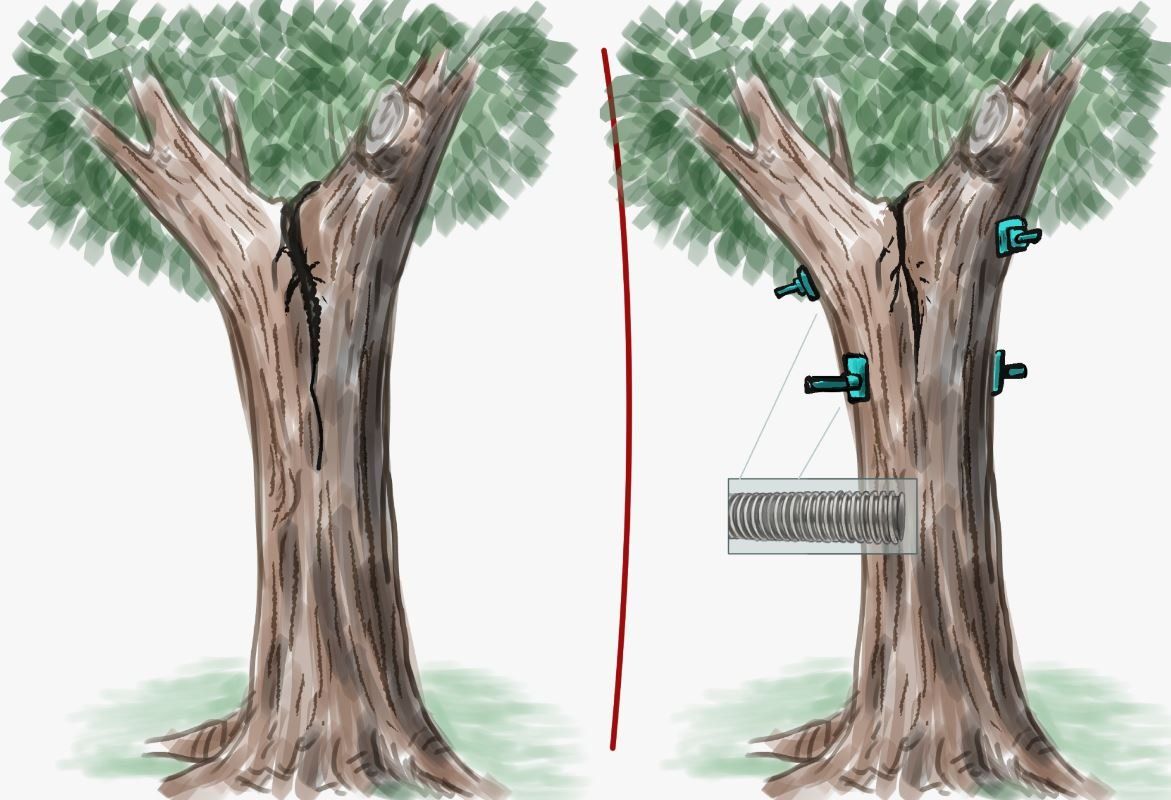
Tree cabling and bracing is a structural support system installed in a living tree to reduce the risk that a weak branch, a split trunk, or a poorly attached stem will fail. It does not make a tree stronger in the way fertilizer or pruning might. It changes the mechanics of how loads — wind, the weight of wet snow, the mass of the canopy itself — move through the tree, so that a defect is shared, restrained, or relieved rather than allowed to tear itself apart.
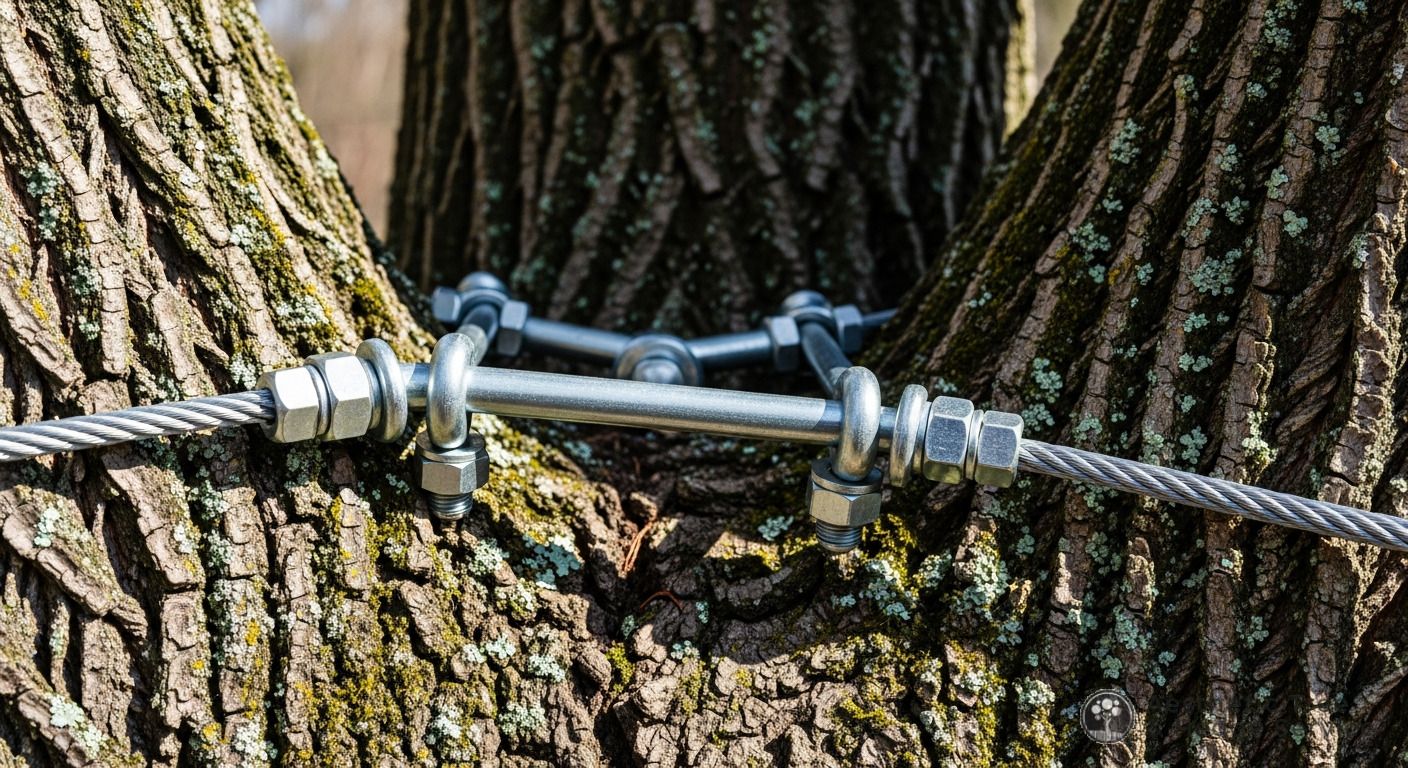
There are two distinct techniques, and they solve two different problems. Cabling is the installation of flexible steel cable or a synthetic rope-based system high in the canopy, typically in the upper two-thirds of the affected stems. It limits how far two leaders can move apart from each other in a gust, so a weak fork is never loaded to the point of splitting. Bracing is the installation of a threaded steel rod directly through a defect — most often through a crack, a split, or an included-bark union — to provide rigid, direct support exactly where the wood is failing. Cabling restrains movement; bracing holds a specific weakness together. Many trees with a serious defect receive both: a rod through the union and a cable above it to keep wind load off the repair.
The most common defect both techniques address is the co-dominant stem with included bark. When a tree grows two roughly equal trunks from a single point instead of one dominant leader, bark often becomes trapped in the V between them. That trapped bark prevents the two stems from knitting together with sound, continuous wood. The union looks solid. It is not. It is two trees pressed against each other, and a strong enough lateral load will pry them apart — usually low, usually catastrophically, and usually in the first serious storm of the season.
What Industry Standard Governs Tree Support Systems?
This is the question that separates a professional installation from a liability. Tree support systems in North America are governed by ANSI A300 (Part 3): Supplemental Support Systems, the American National Standard for tree care operations, with technical guidance detailed in the companion ISA Best Management Practices for Tree Support Systems. These documents are not optional reading for an arborist — they define hardware selection, placement, sizing, and installation method, and they exist because improperly installed cabling can be worse than no cabling at all.
A few requirements from the standard matter to you as a homeowner, because they are the things a cut-rate operator gets wrong. The standard distinguishes between dynamic systems (synthetic, slightly elastic, designed to allow some natural movement so the tree keeps building reaction wood) and static systems (steel cable and rod, rigid, used where movement must be tightly limited). It specifies that cable hardware must be sized to the diameter of the stems being supported and the loads expected — not guessed at. It requires that anchors be installed correctly into sound wood, and that on a static system the cable be attached with through-hardware rather than driven lag hooks, because screw hooks can pull out and create the very wound that invites decay.
There is also a hard limit the standard implies and that we treat as a rule: hardware supports a structural defect; it does not resurrect a structurally failed or severely decayed tree. If the wood an anchor must bite into is already compromised by rot, the system has nothing sound to hold. A tree that far gone is a removal conversation, not a cabling conversation, and an honest arborist will tell you so on the first visit.
How Do You Know If a Tree Needs Cabling or Bracing?
You usually cannot tell from the ground, and that is the single most important sentence in this article. The defects that cabling addresses are structural and often subtle — a tight fork, a hairline crack, a lean that developed after a neighbour's tree was removed and changed the wind exposure. A certified arborist diagnoses these by climbing or closely inspecting the tree, reading the architecture of the canopy, and frequently checking suspect wood with a sounding mallet or, where decay is suspected, a resistance drill. That said, several warning signs should prompt you to book an assessment.
A co-dominant trunk with a tight, narrow fork
If your tree splits into two near-equal trunks and the angle between them is narrow and V-shaped rather than a broad, open U, you are looking at the textbook candidate for a support system. Big-leaf maple, the most common large native broadleaf in Vancouver yards, is especially prone to this growth habit. So are many ornamental cherries and the fast-grown silver maples planted across East Vancouver and Burnaby in the post-war decades.
A visible crack, seam, or bulge at a union
A vertical seam running down from a fork, a ridge of bark where two stems meet, or a subtle bulge are all signs the union is moving and the tree is trying to compensate. A crack that has opened after a storm is an urgent finding. A tree with a fresh split in a major union is not a cabling job to schedule next month — it is a same-week priority, and if the cracked stem overhangs a house, a deck, or a walkway, it may be an emergency.
A heavy lateral limb extending over a target
A long, horizontal limb reaching out over a roof, a driveway, a children's play area, or a neighbour's property puts a heavy load on its own attachment point. The further out the weight sits, the harder it pulls on the wood holding it. Even a sound limb of that geometry can fail under a load of wet snow. Where removing the limb would disfigure the tree or is not warranted, a cable to a higher anchor can keep it within safe limits.
A mature, valued tree you are not prepared to lose
Sometimes the trigger is not a dramatic defect but the value of the tree itself. A century-old Garry oak, a heritage copper beech, a Douglas fir that defines a property — these trees are effectively irreplaceable on a human timescale. For a high-value tree with even a moderate defect, a support system is cheap insurance against a loss that cannot be undone.
Why Does Vancouver's Climate Make Tree Support Systems Important?
Vancouver does not have the violent convective storms of the Prairies or the hurricanes of the eastern seaboard. What it has is something arborists arguably worry about more: a long, reliable season of wind-loaded, saturated trees. The structural risk to a Lower Mainland tree is a product of three local conditions stacking on top of one another.
First, the trees are tall. Vancouver's signature conifers — Douglas fir, Western red cedar, western hemlock — routinely exceed 30 metres in mature residential settings. Height multiplies the force a defect must withstand: the taller the tree, the longer the lever the wind has to work with, and the greater the strain on every weak union below.
Second, the soil is wet for months. Metro Vancouver receives well over 1,000 millimetres of precipitation a year, the bulk of it from October through March, and that water saturates root plates exactly when the windstorms arrive. A tree with a structural defect in its canopy and a softened, waterlogged root anchor below is being tested from both ends at once.
Third, the windstorm season is long and the events are getting attention. The November 2021 atmospheric river is the most-cited recent example, but the pattern repeats — the South Coast saw damaging windstorms again through the winter of 2024, with BC Hydro reporting tens of thousands of customers losing power in single events as trees and limbs came down on lines. Environment and Climate Change Canada's regional climate summaries have noted a trend toward more intense fall and winter rain events on the South Coast. For a tree owner, the practical reading is simple: the load is not getting lighter, so the structure has to be sounder.
When a tree does fail in one of these storms, the response is a different service entirely. A limb on a roof or a split trunk threatening a structure is an emergency tree service call — fast, hazard-focused work. Cabling and bracing is the opposite: the calm, planned work you do in the dry months so the emergency call never has to be made.
What Does Professional Cabling and Bracing Installation Involve?
A correct installation is methodical, and understanding the steps helps you tell a professional crew from an operator improvising with a hardware-store turnbuckle.
Step 1 - A documented structural assessment
Before any hardware is chosen, a certified arborist assesses the tree: the species, the specific defect, the soundness of the wood at every proposed anchor point, the loads the system will face, and whether the tree is even a viable candidate. This assessment is the foundation. A cable installed on the wrong tree, or one that should have been removed, is money spent making a hazard look maintained.
Step 2 - Reducing the load with pruning
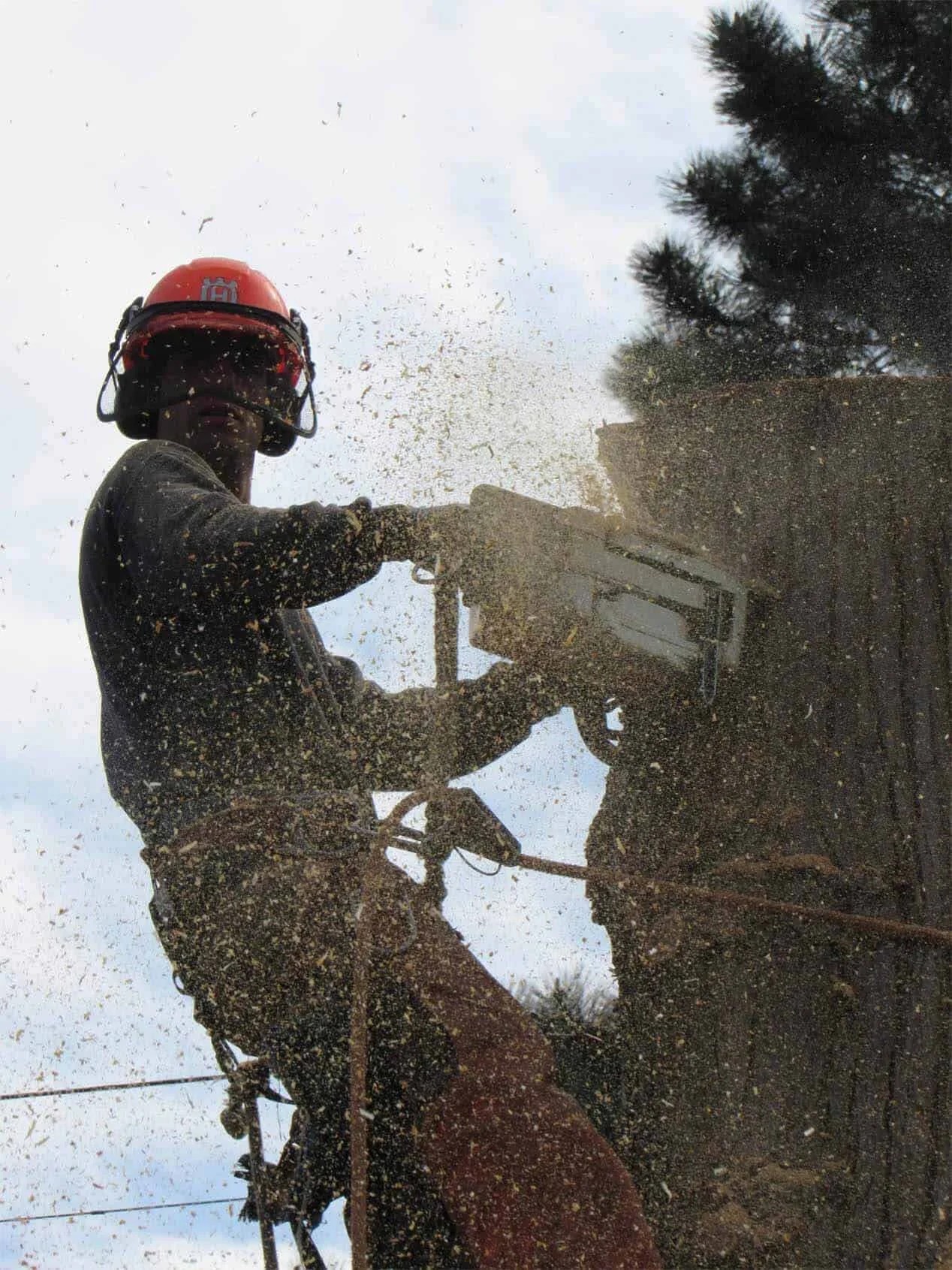
Hardware almost never works alone. The arborist will typically prune to reduce the weight and wind-sail of the defective stems first — a measured crown reduction or selective thinning that lowers the demand on the union before the cable is asked to manage the rest. Skipping this step overloads the hardware.
Step 3 - Placing and sizing the cable system
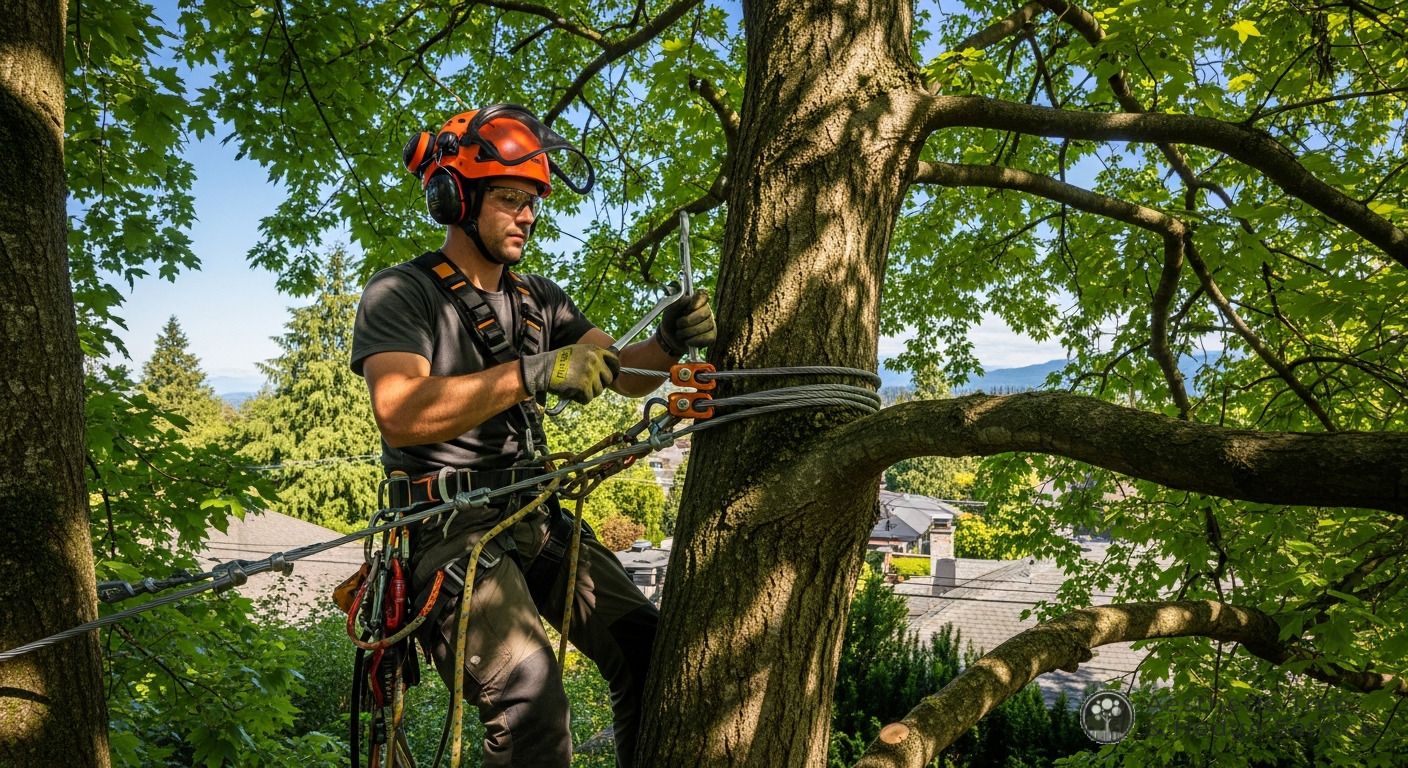
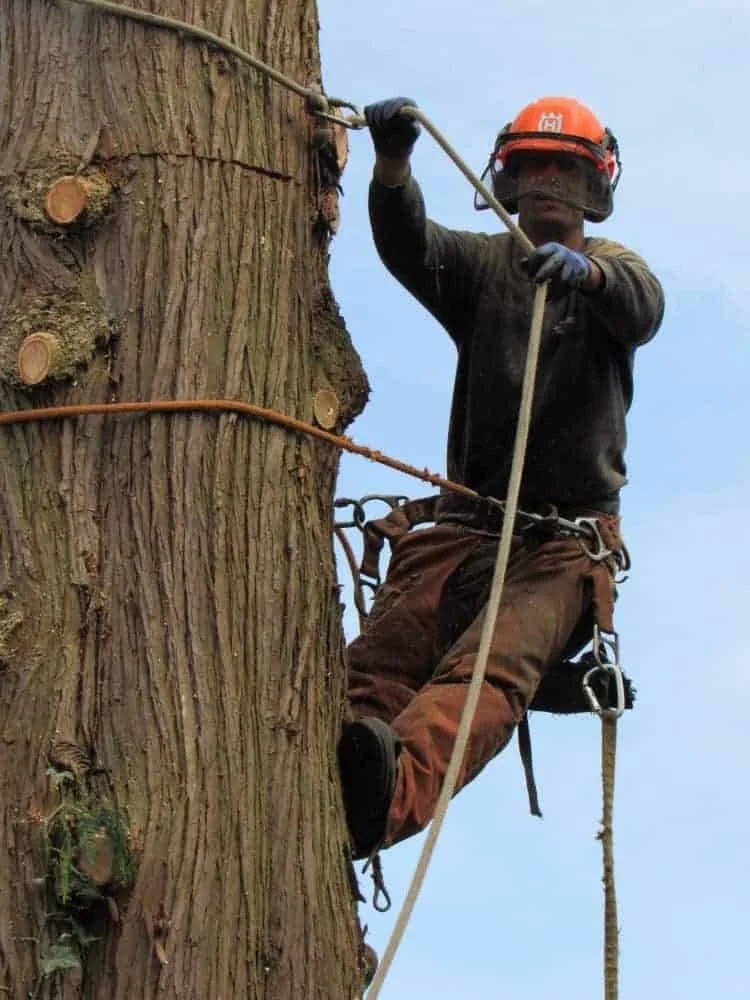
Cables are installed high — generally in the upper two-thirds of the supported stems — because placement that high gives the system the mechanical advantage to control movement with the least force. Hardware is sized to the stem diameters and expected loads per the ANSI A300 standard. On the dominant approach for most residential trees, a synthetic dynamic cabling system is selected so the tree retains the gentle movement it needs to keep building its own supporting wood.
Step 4 - Installing bracing rods through the defect
Where a crack or split needs direct, rigid support, threaded steel rods are installed through the defect, drilled and seated into sound wood on both sides, with the ends finished correctly. Bracing rods and an overhead cable are frequently paired: the rod holds the seam, the cable keeps storm load off it.
Step 5 - Documentation and a re-inspection schedule
A support system is not installed and forgotten. A professional installation comes with documentation of what was placed where, and a recommended re-inspection interval — typically annually, and always after any significant windstorm. Trees grow, hardware can be outgrown, and a cable that fit perfectly five years ago may now need adjustment or replacement. The standard treats inspection as part of the system, not an optional extra.
How Much Does Tree Cabling and Bracing Cost in Vancouver?
Cost depends on the size of the tree, the number of cables and rods the structure requires, the difficulty of climbing and rigging the canopy, and the pruning needed alongside the hardware. As industry market figures for the Lower Mainland, a single-cable installation on a modest residential tree commonly falls in roughly the $300 to $700 range, while a larger tree needing multiple cables, bracing rods, and a load-reducing prune more typically runs $800 to $2,000 or beyond. National cost guides such as HomeGuide report comparable ranges, generally citing tree cabling between about USD $250 and $1,000-plus per tree depending on size and complexity.
These figures are industry ranges based on published market data and our field experience in Metro Vancouver. They are not a quote. Actual cost varies with the tree, the site, the defect, and current conditions, and the only honest price comes from an on-site assessment. The number worth keeping in perspective is the comparison: a support system is a small fraction of what it costs to remove a large failed tree, repair a roof, replace a fence, or — the cost no one wants to price — deal with an injury. The Insurance Bureau of Canada has repeatedly reported record severe-weather claim years in Canada, and storm-driven tree damage is a recurring contributor to residential property claims.
How Long Does a Cabling System Last, and What Maintenance Does It Need?
A properly installed support system is a long-term measure, but it is not permanent and it is not maintenance-free. The hardware itself — steel cable and rod, or a quality synthetic system — can serve for many years, but the living tree around it never stops changing. The wood the anchors sit in grows. The canopy gets heavier. Over time the tree may grow over and around the hardware, which is normal, or a stem may outgrow the capacity of the original cable.
Because of this, the ANSI A300 standard and every responsible arborist treat inspection as built into the system. The practical maintenance schedule for a Vancouver tree is straightforward: a professional inspection of the support system at least once a year, and an additional check after any major windstorm. During those inspections the arborist confirms the hardware is sound and correctly tensioned, looks for new defects elsewhere in the tree, and reassesses whether the system still matches the tree it was built for. A homeowner who installs a cable and never looks at it again has bought a false sense of security. A homeowner who keeps the tree on an inspection schedule has bought what they actually wanted: a tree that is genuinely safer, and stays that way.
Frequently Asked Questions
Will cabling and bracing guarantee my tree won't fail in a storm?
No honest arborist will promise that, and you should be skeptical of one who does. A support system significantly reduces the risk that a known structural defect will fail, and a correctly cabled tree is far more likely to ride out a Vancouver windstorm intact than the same tree left unsupported. But trees are living structures exposed to extreme and unpredictable loads. Cabling manages a specific, diagnosed weakness; it does not make a tree storm-proof. The honest framing is risk reduction, not risk elimination — which is exactly why annual inspection is part of the service.
Is cabling better than just removing the dangerous part of the tree?
It depends entirely on the tree, and that decision belongs in a certified arborist's hands, not a sales pitch. Sometimes the right answer is pruning alone — reducing a heavy limb so it no longer needs support. Sometimes it is a support system. Sometimes the defect is so severe, or the wood so decayed, that no hardware can make the tree safe and removal is the responsible call. A good arborist presents all of the options honestly, including the one that earns them the least money. Cabling exists to preserve a tree that is worth preserving and can genuinely be made safer — not to keep a failed tree standing.
Can I install tree cabling myself with hardware from a building store?
This is one of the most dangerous shortcuts a homeowner can take. Improper cabling is worse than no cabling: it adds load to anchor points without the engineering to support it, it can mask a defect that should have triggered removal, and a screw-in lag hook that pulls out under load creates a fresh wound and a falling cable. Correct installation requires a structural diagnosis, hardware sized to the stems and loads under the ANSI A300 standard, anchors placed in sound wood, and the climbing skill to work the upper canopy safely. It is certified-arborist work, full stop.
When is the best time of year to have a tree cabled in Vancouver?
The ideal window is the dry season — late spring through summer — when conditions are stable, the crew can work the canopy safely, and the system is in place well before the fall and winter windstorm season arrives. The exception is an urgent defect. If a tree has a fresh crack or a split union now, you do not wait for better weather; that is a same-week assessment, because the next storm does not check the calendar.
How often does a cabled tree need to be re-inspected?
At minimum once a year, and additionally after any significant windstorm. Trees grow and hardware can be outgrown, so a system that fit perfectly when installed needs periodic checking and occasional adjustment or replacement. Annual inspection also catches new defects developing elsewhere in the tree. Re-inspection is not an upsell — the ANSI A300 standard treats it as part of the support system itself.
Does the City of Vancouver require a permit to cable a tree?
Cabling and bracing is maintenance work and generally does not require a tree permit the way removal does — the City of Vancouver's Protection of Trees Bylaw (Bylaw No. 9958) regulates the removal and significant alteration of trees, not the installation of a support system. However, rules differ across Metro Vancouver municipalities, and any associated pruning can have its own limits, particularly on protected or heritage trees. A certified arborist familiar with your municipality will confirm what, if anything, applies before work begins — which is one more reason the assessment comes first.
Protect a Valued Vancouver Tree Before the Next Storm
If you have a tree with a co-dominant trunk, a visible crack, a heavy overhanging limb, or simply a mature tree you are not prepared to lose, the time to act is the calm, dry part of the year — not the morning after a windstorm. The first step is never the hardware. It is a proper structural assessment by an ISA-certified arborist, which tells you honestly whether your tree is a candidate for a support system, needs pruning, or has a problem hardware cannot fix.
Aesthetic Tree & Hedge Services has assessed, pruned, and installed support systems on trees across Vancouver, Burnaby, the North Shore, and the Tri-Cities for more than two decades, working to the ANSI A300 standard on every job. If a storm has already caused damage, our emergency tree service responds fast. If the storm has not happened yet, that is the better call to make. Contact our team to book an assessment of your tree.
Cost figures in this article are industry ranges based on published market data and our field experience — they are not a quote. Standards referenced: ANSI A300 (Part 3) Supplemental Support Systems and the ISA Best Management Practices for Tree Support Systems. Storm and climate data: Environment and Climate Change Canada and BC Hydro public reporting. Written by the ISA-certified arborists at Aesthetic Tree & Hedge Services. Copywriter voice: David Ogilvy.
Cabling and bracing decisions are always made in conjunction with a formal risk assessment. The standard tool for documenting that assessment — and the document local governments, insurers, and strata councils most commonly require — is the arborist report Vancouver. A written arborist evaluation captures the tree's structural condition, failure probability, and recommended mitigation before any hardware is installed.
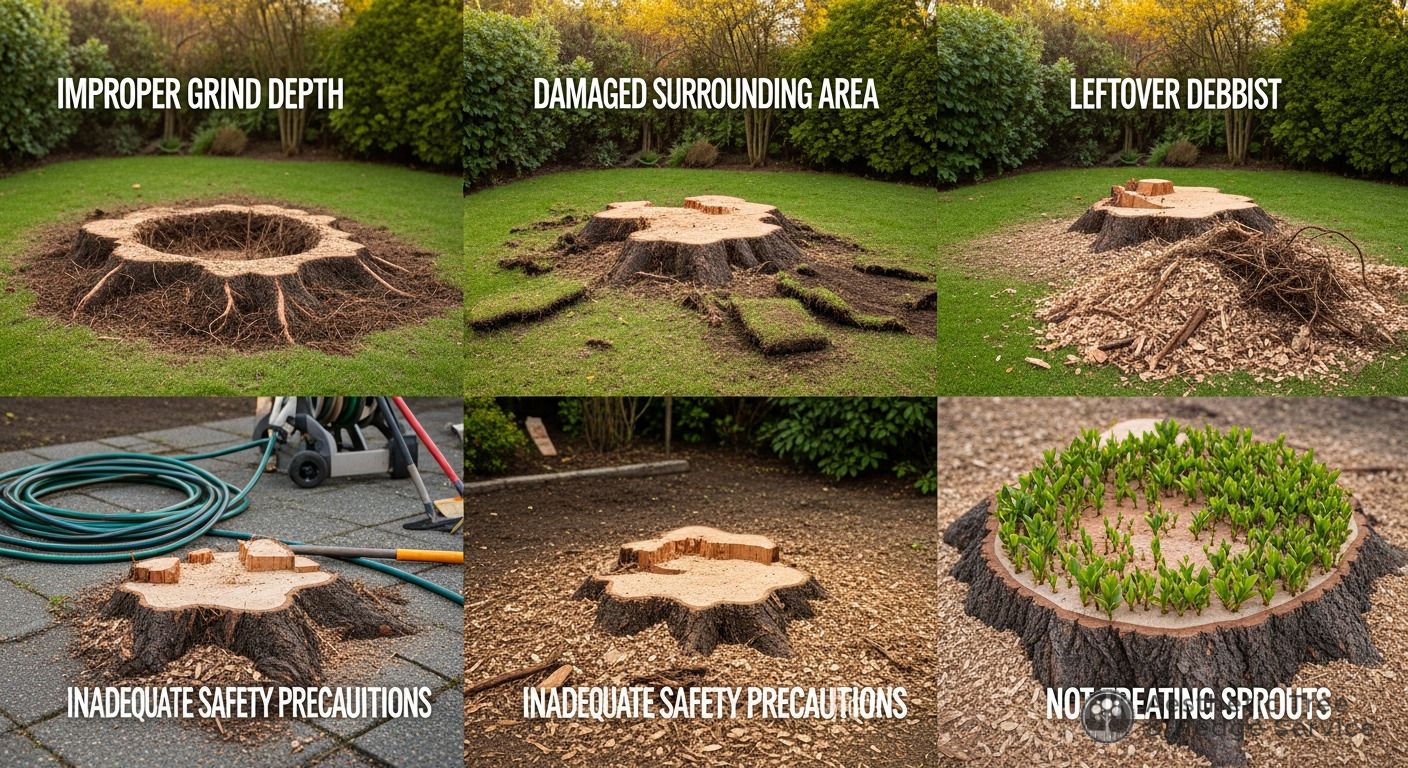
Sometimes a cabling assessment reveals that the defect is too severe for hardware to make a meaningful difference. In those cases the recommended path is removal, handled under our tree removal Vancouver service. The stump that remains can then be cleared through our stump grinding Vancouver service — and if you want to understand the safety protocols a professional grinding crew brings to that task, read our guide on the hidden risks and safety protocols in stump grinding operations.
Storm damage is the scenario where cabling most visibly earns its keep, but knowing the warning signs before a storm hits is equally important. Our article on 6 signs you need emergency tree care covers the failure indicators that signal when hardware support is overdue, and when the situation has already crossed into emergency territory. If a storm has already struck, our 24/7 emergency tree service Vancouver team responds around the clock to secure and remove structurally compromised trees across Vancouver, Burnaby, and the North Shore.
Before You Go
Where are you in your tree care journey?
Our Tree Care Services
ISA-certified arborists serving Greater Vancouver
Explore Our Tree Care Services
From expert pruning to safe tree removal, our ISA-certified arborists are ready to help across Greater Vancouver.
View Services