

TL;DR — Quick Summary
Stump grinding is hazardous because of thrown debris, buried utilities, and an exposed cutting wheel — but every one of those risks is controllable. This ISA-certified guide explains the WorkSafeBC framework, the BC 1 Call locate step, and exactly how a professional Vancouver crew makes the job safe.
A stump grinder looks almost friendly. It is a wheeled machine, often not much bigger than a ride-on mower, that quietly turns a tree stump into a pile of mulch. Homeowners rent them by the day from equipment yards across Vancouver every weekend of the summer. And every summer, the same machine sends people to the emergency room.
Here is the part nobody renting you the machine tends to mention. A stump grinder's cutting wheel can spin at well over 1,000 RPM, studded with steel teeth that throw wood chips, gravel, and buried objects at the speed of a power tool with no guard between them and you. It is one of the more demanding machines in residential property work — not because it is complicated to switch on, but because everything that can go wrong with it goes wrong fast.
This guide is not written to frighten you off the job. It is written to show you exactly how a certified crew controls the risk — the inspections, the regulations, the site preparation, and the equipment discipline that turn a genuinely dangerous machine into a routine, safe operation. By the end, you will know precisely what a competent Vancouver stump grinding service is doing on your property that a rental-yard machine and an afternoon of confidence cannot replicate.
The short version, if you read nothing else: stump grinding is hazardous because of thrown debris, underground utilities, and the machine's exposed cutting wheel — and every one of those hazards is manageable with the right inspection, the right call to BC 1 Call, the right personal protective equipment, and an operator trained to WorkSafeBC standards. Risk in this trade is not eliminated by luck. It is eliminated by process.
What Makes Stump Grinding More Dangerous Than It Looks?
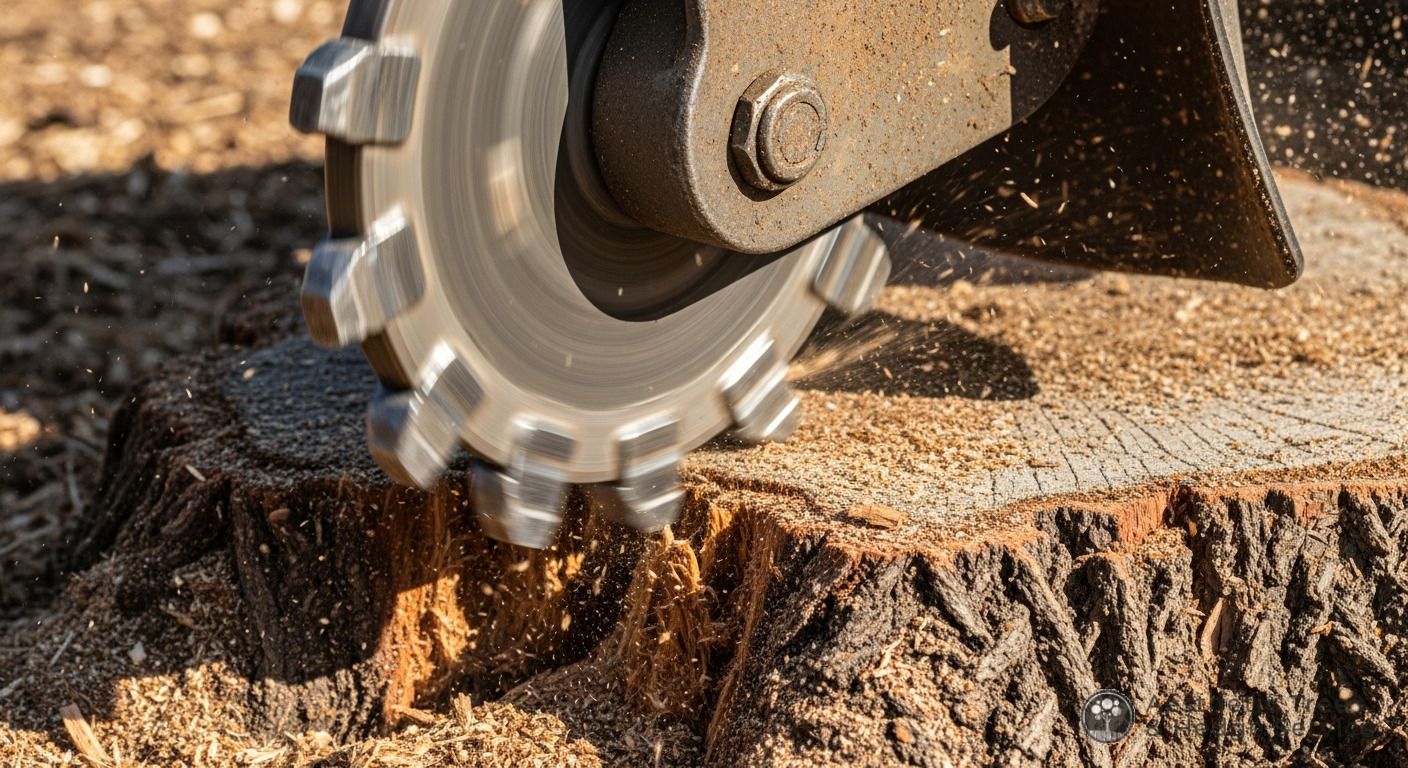
The danger is easy to underestimate because the machine is slow-moving and the task seems simple: position the cutting wheel over the stump, sweep it back and forth, the stump disappears. The hazards are not in the concept. They are in the details.
The cutting wheel and thrown debris
The grinding wheel is a steel disc fitted with carbide-tipped teeth, and it does not discriminate. It chews wood, but it also catches and hurls anything embedded in or near the stump — rocks, old fence staples, buried bricks, a forgotten length of rebar, children's toys lost in the lawn years ago. Those objects leave the wheel as projectiles. The strike zone is not just the operator's position; debris can travel well beyond the machine, which is why a professional crew clears and barricades a perimeter, not just the spot they are standing on.
What is hidden underground
A tree stump is the visible top of a root system, and that root system grew through the same ground your gas line, your water service, your hydro feed, your irrigation, and your low-voltage landscape wiring run through. A grinder typically cuts 20 to 30 centimetres below grade to take out the root flare — more than deep enough to find a shallow service line. Striking a buried utility is not a minor mistake. It can mean a gas leak, an electrocution risk, or a flooded yard, and it is the single most preventable serious incident in the trade.
Kickback, stability, and the slope problem
Push the wheel too aggressively and it can grab and kick back. Park the machine on a slope or soft ground — common on Vancouver's hillside lots in North Vancouver, West Vancouver, and the east-side ravines — and a heavy grinder can shift or tip. Stability is a function of reading the site before the engine starts, not reacting once it is running.
Noise, vibration, and fatigue
A grinder is loud enough to damage hearing without protection, and the constant vibration through the controls causes fatigue and, over time, real injury. A tired operator makes worse decisions. Professionals manage exposure, rotate tasks, and wear rated hearing protection because the hazard is cumulative, not just dramatic.
What Safety Regulations Apply to Stump Grinding in BC?
This is where a professional operation and a weekend rental genuinely diverge. In British Columbia, occupational safety is governed by WorkSafeBC under the Workers Compensation Act and the Occupational Health and Safety Regulation. A licensed tree service grinding stumps as a business is operating inside that legal framework. A homeowner with a rented machine is not — and that gap is not a technicality.
Under the OHS Regulation, an employer is required to identify hazards, assess the risk, and put controls in place before work begins. For powered equipment, that means guarding, safe operating procedures, and training. Part 3 of the Regulation covers the general duty to ensure the health and safety of workers; the parts addressing tools, machinery, and personal protective equipment set out the specific requirements for a machine like a stump grinder — including that operators be properly instructed and that the equipment be inspected and maintained.
There is a second piece that matters before any digging or grinding in BC: BC 1 Call. BC 1 Call is the free provincial service that coordinates the location and marking of buried utilities. A professional crew submits a locate request and waits for the underground services to be marked before a wheel touches the ground. It is the law's logic in action — identify the hazard before you create the risk — and it is the step a rushed homeowner skips most often.
The practical takeaway: when you hire a properly licensed and insured stump grinding company, you are not just buying labour. You are buying a WorkSafeBC-compliant safety system, liability coverage if something goes wrong, and a crew whose entire process is built around regulations you would otherwise be managing alone.
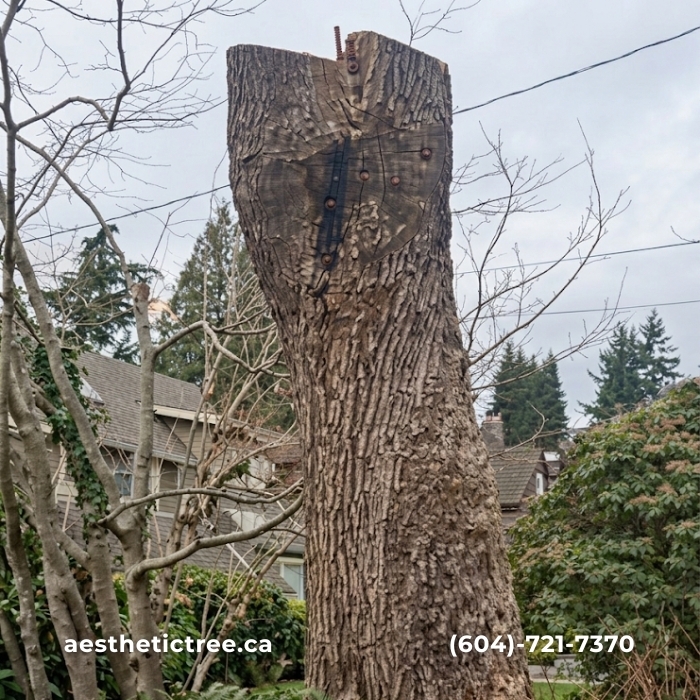
How Does a Certified Crew Actually Control These Risks?
Reading a list of hazards is useful only if you also see how each one is handled. Here is what a competent crew does on a Vancouver stump-grinding job, hazard by hazard.
Step 1 - The pre-work site assessment
Before equipment comes off the trailer, the crew lead walks the site. They note the slope, the ground condition, the access route for the machine, the proximity of the stump to the house, the fence, the patio, and the property line. They identify where people and pets will be. They confirm the BC 1 Call utility locate has been done and read the paint and flag markings on the ground. Nothing about this step is dramatic. It is also the step that prevents the worst outcomes.
Step 2 - Clearing and barricading the work zone
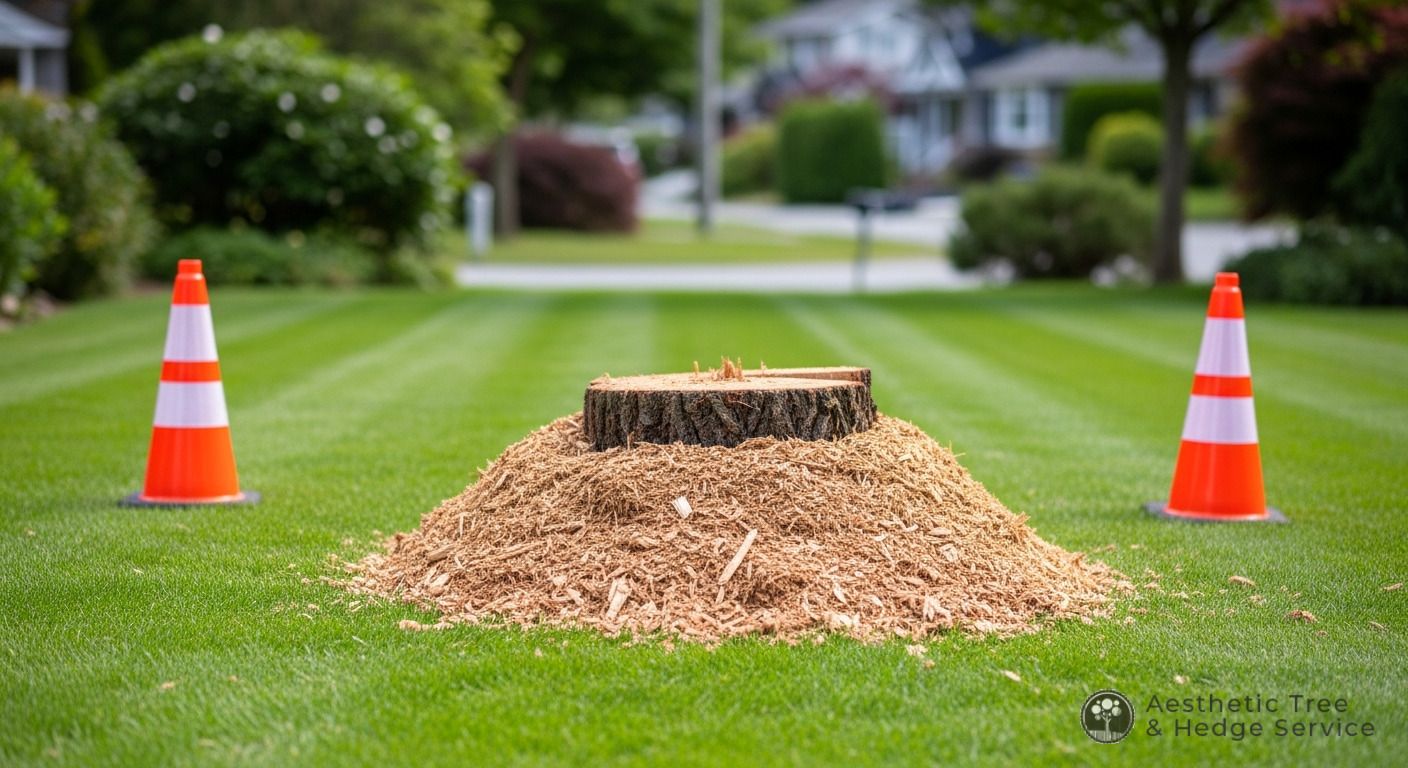
The area around the stump is cleared of loose stone, debris, and anything the wheel could throw. The crew establishes a perimeter — barriers, cones, or a crew member keeping people back — sized to the real throw distance of debris, not the polite distance that feels sufficient. On a residential job, keeping children, pets, and curious neighbours out of that zone is a constant, deliberate part of the work.
Step 3 - Personal protective equipment that is actually rated
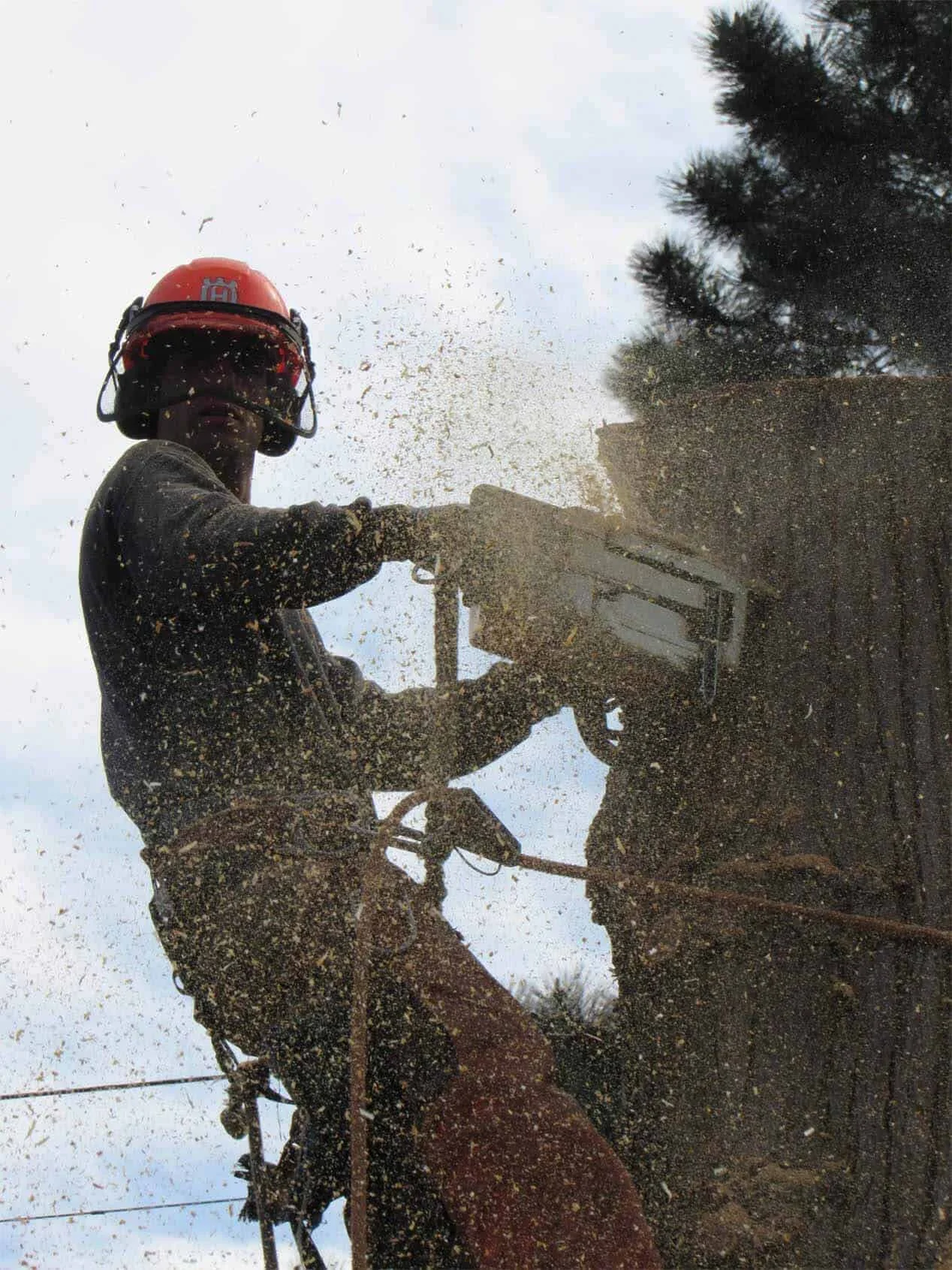
A professional operator wears full eye protection, often combined with a face shield, because thrown chips do not aim. They wear rated hearing protection, sturdy gloves, and protective footwear. This is not optional gear kept in the truck. It is worn for the entire operation, every time, because the hazard is present the entire operation, every time.
Step 4 - Machine inspection and controlled operation
The grinder is inspected before use — teeth, guards, hydraulics, controls — because a missing or dull tooth and a damaged guard both change how the machine behaves. During grinding, a trained operator uses smooth, controlled sweeps, lets the wheel do the work rather than forcing it, and keeps the machine stable. Experience is what tells an operator when the wheel has found a rock instead of a root, and to ease off rather than push through.
Step 5 - Knowing the depth and stopping at the right point
A professional grinds to the depth the next use of the ground requires — deeper for replanting, shallower for turf — and stops there rather than chasing the entire root system blindly. They know which roots matter and which can be left, and they avoid grinding toward a marked utility line. Judgement about where to stop is as much a safety skill as a quality one.
Is Stump Grinding Safer Than Other Stump Removal Methods?
Homeowners often weigh grinding against the alternatives: digging the stump out, burning it, or using chemical stump removers. Each carries its own risk profile.
Excavating a stump by hand or with a mini-excavator is heavy, slow work that disturbs a large area of soil and still has to contend with the same buried utilities. Burning a stump is genuinely hazardous and, across most of Metro Vancouver, restricted or prohibited outright by municipal fire and air-quality rules — open burning is not a realistic residential option here. Chemical stump removers are slow, take months, and introduce products you may not want in a garden where children and pets play.
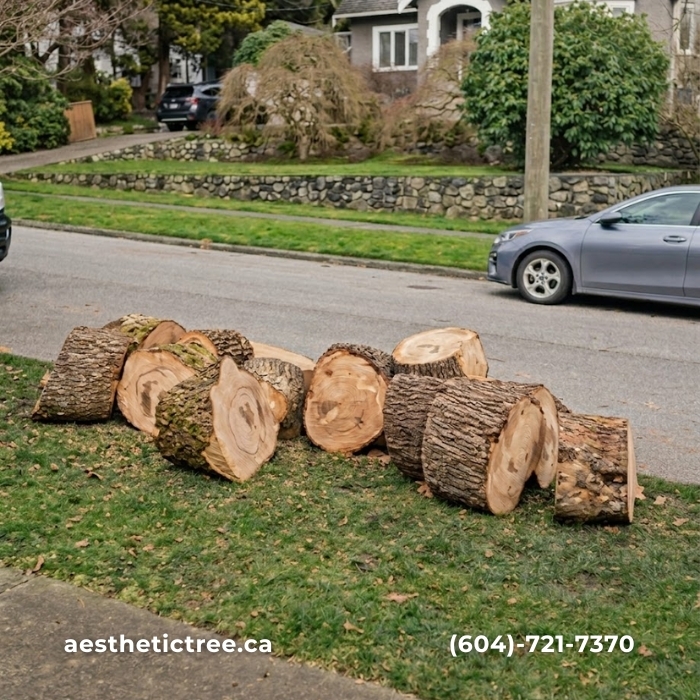
Professional grinding is, for most Vancouver properties, the controlled choice: it is fast, it confines the disturbance to the stump itself, and in trained hands its risks are well understood and well managed. Grinding is also frequently the final step after a tree removal, and it is worth confirming up front whether a removal quote includes the stump or leaves it as a separate job — the stump does not vanish with the tree.
What Should Homeowners Know Before Renting a Stump Grinder?
If you are still weighing a do-it-yourself rental, weigh it honestly. The machine is available to rent, and a small stump in open, debris-free ground with no utilities anywhere near it is, in fairness, the lowest-risk version of the job. But be clear-eyed about what the rental does not come with.
It does not come with a utility locate — that is on you to arrange through BC 1 Call, and skipping it is how the serious incidents happen. It does not come with training; a five-minute counter briefing is not operator instruction. It does not come with the rated protective equipment you need, or with liability coverage if a thrown rock breaks a window, damages a fence, or worse. And it does not come with the experience to read a slope, feel a kickback coming, or recognise the moment the wheel has hit something it should not. The rental fee is the cheapest part of the job. The risk is the expensive part, and it transfers entirely to you the moment you start the engine.
For a large stump, a stump near the house or a utility, a stump on a slope, or a yard where anyone embedded landscaping over the years, the math favours hiring a crew. You are paying a professional to absorb a risk that is genuinely theirs to manage — and they have the regulations, the training, and the insurance to do exactly that.
Frequently Asked Questions
Is it safe to grind a tree stump myself with a rented machine?
It can be done safely on a small, isolated stump in open ground with no utilities nearby — but only if you replicate what a professional does: arrange a BC 1 Call utility locate first, wear properly rated eye and hearing protection, clear and barricade a generous debris perimeter, and operate the machine with controlled, unhurried movements. The risk rises sharply with stump size, slope, proximity to your house or services, and any chance of buried objects. The rental does not include the training, the protective gear, or the liability coverage — those become yours the moment you switch it on.
Why do I need to call BC 1 Call before grinding a stump?
Because a stump grinder cuts 20 to 30 centimetres below ground level to remove the root flare, which is deep enough to strike a shallow gas, water, hydro, or communications line. BC 1 Call is the free provincial service that arranges for buried utilities to be located and marked before any ground-disturbing work. A professional crew always submits a locate request and waits for the markings. Striking a buried utility is the most serious — and most preventable — stump-grinding incident, and the locate request is what prevents it.
What safety equipment do professional stump grinders wear?
A professional operator wears full eye protection, frequently with an added face shield, because the cutting wheel throws chips and debris unpredictably. They also wear rated hearing protection against the machine's noise, sturdy gloves, and protective footwear. The gear is worn for the entire operation, every time — the hazard from thrown debris and noise is constant while the wheel is turning, so the protection has to be constant too.
How deep does a stump grinder go, and can it damage my yard?
A grinder typically removes the stump and root flare to roughly 20 to 30 centimetres below grade — deeper if you plan to replant in the same spot, shallower if you only need to lay turf. A professional crew confines the disturbance to the stump itself and leaves you a manageable pile of wood mulch and a fillable hole. Damage to the surrounding yard generally comes from an inexperienced operator grinding too wide or too aggressively, or from a machine driven across soft, wet ground — both of which a trained crew avoids by reading the site first.
Does stump grinding remove the entire root system?
No, and it is not meant to. Grinding removes the stump and the main root flare, after which the remaining roots, now disconnected from the tree, gradually decay in the soil over the following years. A professional grinds to the depth your intended use of the ground requires and stops there, rather than chasing every root — chasing roots blindly is both unnecessary and a way to wander toward a buried utility. If you intend to replant a new tree in the exact spot, mention it so the crew can grind deeper and wider for you.
Is burning or chemically removing a stump a safer alternative in Vancouver?
Generally no. Open burning of stumps is restricted or prohibited across most of Metro Vancouver under municipal fire and air-quality rules, and it is hazardous regardless. Chemical stump removers are slow, take months to work, and introduce products into a garden where children and pets may play. For most Vancouver properties, professional grinding is the faster, more contained, and — in trained hands operating under WorkSafeBC standards — the better-controlled choice.
Get Your Stump Removed by a WorkSafeBC-Compliant Crew
A stump grinder is a serious machine, and the difference between a routine job and a trip to the hospital is process — the utility locate, the site assessment, the barricaded perimeter, the rated gear, and an operator trained to do this every day. That process is exactly what a professional stump grinding service brings to your property, and it is what a rental-yard machine leaves entirely up to you.
Aesthetic Tree & Hedge Services has ground out stumps across Vancouver, Burnaby, the North Shore, and the Tri-Cities for more than 20 years, working as a licensed, insured, WorkSafeBC-compliant operation on every job. If you have a stump left behind from a recent tree removal — or one that has been an obstacle in your yard for years — contact our team for an honest assessment and a safe, clean grind.
Regulatory framework referenced: WorkSafeBC, the Workers Compensation Act, and the Occupational Health and Safety Regulation of British Columbia; BC 1 Call buried-utility locate service. This article describes general industry safety practice and is not a substitute for professional advice on a specific site. Written by the ISA-certified arborists at Aesthetic Tree & Hedge Services. Copywriter voice: Joanna Wiebe.
The risk management thinking behind professional stump grinding connects directly to how certified arborists approach all structural tree work. Before a grind, a site assessment sometimes reveals that the stump's root system is interacting with a living tree nearby. In those cases, an arborist report Vancouver documents root proximity, utility conflicts, and soil disturbance risk so the crew can plan accordingly — the same evidence base that drives cabling and removal decisions.
For broader context on how certified arborists assess structural risk in living trees before removal, our guide on tree cabling and bracing for storm protection is worth reading alongside this article. It explains the engineering discipline that determines when a tree is worth saving with hardware versus when removal and grinding is the right outcome for the property.
Knowing when a situation has crossed from routine maintenance into an emergency is equally important. Our article on 6 signs you need emergency tree care covers the failure indicators that require immediate response — and if a tree adjacent to a planned grind site is showing structural distress, our 24/7 emergency tree service Vancouver team is available around the clock across Vancouver, Burnaby, and the North Shore.
Found this helpful? Follow our tree care insights directly on Google.
Make us your preferred source on GoogleBefore You Go
Where are you in your tree care journey?
Our Tree Care Services
ISA-certified arborists serving Greater Vancouver



Explore Our Tree Care Services
From expert pruning to safe tree removal, our ISA-certified arborists are ready to help across Greater Vancouver.
View Services