
TL;DR — Quick Summary
Stump removal in Vancouver costs more when homeowners make avoidable mistakes. ISA-certified arborists reveal what to know first.
Stump removal goes deeper than most homeowners expect. A tree's root zone can extend far beyond the trunk and the outer spread of its branches (source: ISA, Avoiding Tree Damage During Construction).
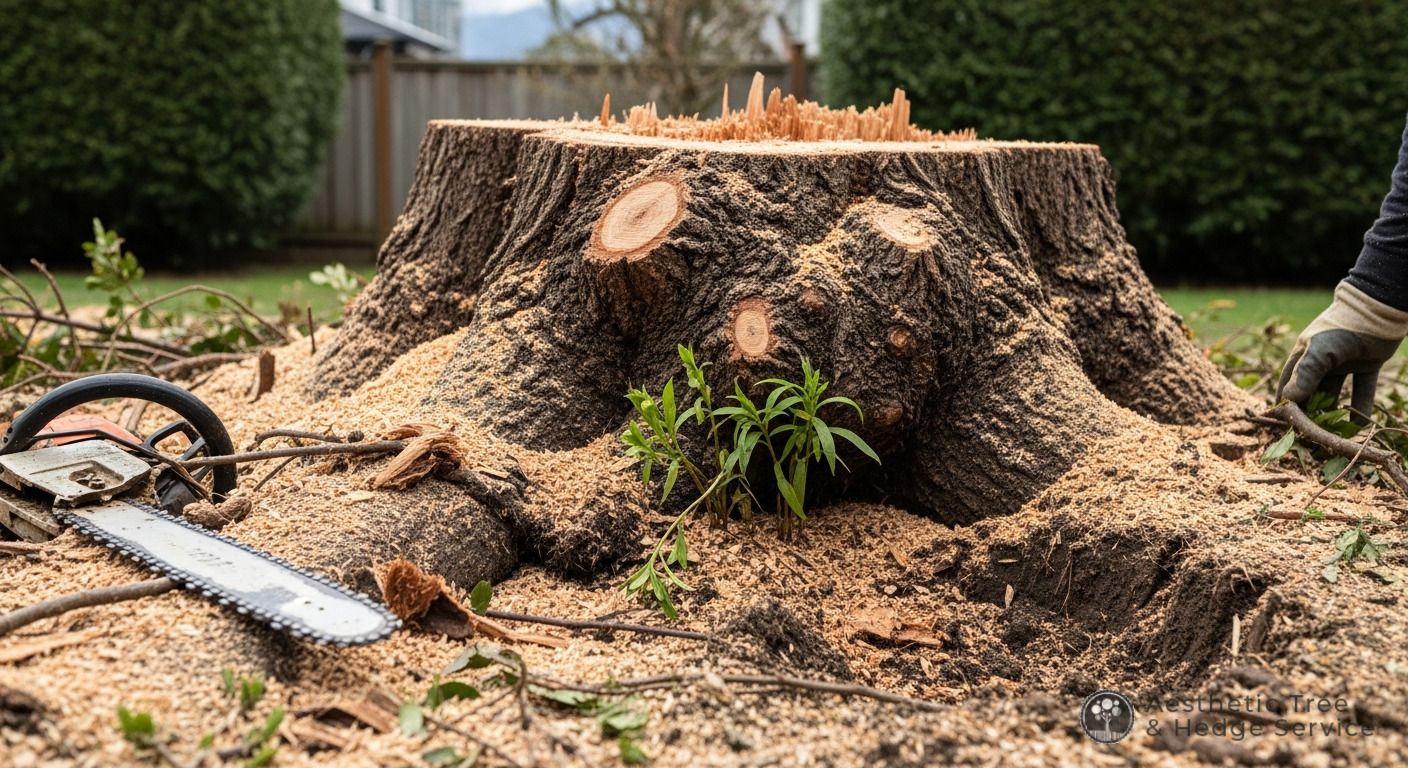
Grinding doesn't remove roots. It chips the stump down below the soil surface, and the roots stay underground and decompose over time.
Wet, heavy soil and tight access can slow grinding and complicate excavation.
Stumps infected with honey fungus (Armillaria) need the infected stump and roots dug out, not just ground. The fungus spreads through the soil from infected root material (source: RHS, Honey fungus).
What Do Most Homeowners Get Wrong About Stump Removal?
Stump removal is a professional arboricultural service that eliminates the above-grade trunk and, depending on the chosen method, some or all of the underground root system left after a tree is felled. The job is often bigger than it looks, because a tree's root zone can extend far from the trunk and beyond the outer branch spread.
Most homeowners look at the visible chunk of wood and assume that's the whole problem. It's not. ISA notes that a tree's root zone can extend far from the trunk and outer branch spread, and the part essential for the tree's health and stability is called the critical root zone (source: ISA, Avoiding Tree Damage During Construction).
That matters for two reasons. First, it affects the complexity of removal. Second, it determines what you can safely do with the soil afterward.
The second misconception is time. A small stump in soft, open ground is a short job. A large conifer stump with a dense root mass in heavy, wet soil takes much longer.
Third: most people assume grinding means complete removal. It doesn't. Grinding chips the visible stump down below grade, but the roots stay in the ground and decompose over years. For most lawn areas, that's acceptable. For building or replanting, it matters.
Understanding what stump removal actually involves helps you ask the right questions before you hire anyone. Our stump grinding specialists in Vancouver can assess the site first so nothing is unexpected.
Is Stump Grinding the Same as Full Stump Removal?
No. These are different services with different outcomes.
Stump grinding uses a rotating carbide-tipped wheel to chip the trunk down below grade. The machine removes wood mass but leaves the root system underground. Roots decompose naturally over several years. For aesthetic purposes, eliminating the visible obstruction, grinding gets the job done.
Full excavation is different. Equipment and manual labor physically remove the stump and as much of the root system as accessible. It takes longer and costs more. But there are situations where it's the only right answer.
Excavation is the better choice in a few situations:
Diseased trees. If the removed tree had honey fungus (Armillaria root rot), grinding isn't enough. The fungus spreads through the soil from infected roots on root-like cords called rhizomorphs, and the RHS says the only effective remedy is to dig out and destroy all infected stump and root material. UC IPM also notes that Armillaria and Ganoderma can spread to nearby trees through root grafts.
Planned construction. Decaying roots create voids. A deck or shed built over a grinding site can settle unevenly as organic matter breaks down underground. Excavating before you build avoids that risk.
New tree planting in the same footprint. After grinding, the old stump spot is full of wood chips and roots rather than soil. Remove the root mass and chips and replace them with good soil before planting, or plant a short distance away.
The decision always starts with one question: what do you want to do with this space?
What Does Stump Removal Actually Cost in Vancouver?
Cost is driven by more than diameter. Most people don't know this until they see their quote.
Professional stump grinding in North America varies widely based on project scope and regional factors.
Costs vary significantly by project scope, tree species, soil conditions, root depth, and site access. Contact Aesthetic Tree & Hedge Services for a personalized assessment of your specific property.
Here's what most homeowners don't factor in:
Depth, not just diameter. Diameter isn't the only factor. How deep the work needs to go, and whether roots have to come out too, changes how long the job takes.
Species. Different species leave different stumps and root masses, so your arborist should identify the tree before quoting.
Access complications. A commercial-grade stump grinder needs a clear path. Gates that are too narrow require disassembly. Landscaped areas need protection measures. Routing equipment through tight spaces adds labor time billed accordingly.
Debris disposal. Grinding produces a significant volume of wood chips. Some clients keep them for mulch, they work well for pathways and garden beds. Others want complete removal. Transport and disposal of material is part of the project scope, not an afterthought.
Utility location. Before any grinding or excavation begins, request a utility locate through BC 1 Call. Locate requests are free and can be submitted online at bc1c.ca or by calling 1-800-474-6886. Gas lines, irrigation conduit, and electrical runs near the stump change the approach entirely.
Why Does Vancouver's Soil Make Stump Removal More Difficult?
Soil conditions vary from lot to lot across the Lower Mainland, and they change how a stump job goes.
Wet, sticky soil can clog grinding equipment and slow cutting, so the same stump can take longer in a wet month than a dry one.
In low-lying areas, deep excavation can reach groundwater, which may need to be dealt with before work can safely continue.
Dense planting creates a third issue in older neighbourhoods. Established trees often share soil with their neighbours, and their root systems can overlap. Grinding aggressively through that zone can sever roots belonging to healthy neighbouring trees. Controlled grinding depth and hand digging around adjacent root zones are the careful approach.
Hiring a registered contractor matters here too. WorkSafeBC advises checking that any business you hire is registered and paying premiums, because otherwise you as the customer could be held responsible for them. A clearance letter from WorkSafeBC confirms the company's status.
What Happens When DIY Stump Removal Goes Wrong?
One risky DIY method: burning.
Some homeowners try to soften a stump with a chemical product and then burn it out. It sounds controlled. It can get out of hand.
Burning a stump near fences, sheds, or dry vegetation is a fire risk, and municipal fire bylaws may restrict outdoor burning. Check with your municipality before you try it, or choose grinding or excavation instead.
Our tree removal team in Vancouver can assess a stump and the trees around it before you choose a removal method.
The second common DIY mistake is underpowered equipment. Consumer-grade grinders available at tool rental shops are designed for small stumps in soft soil. They're not built for mature cedar stumps in Lower Mainland clay. Rental grinders can break grinding teeth, jam on dense root material, and leave the stump in worse shape than before, more jagged, harder to access, with damaged wood that now requires different handling.
How Do Certified Arborists Protect Surrounding Trees During Stump Removal?
Protection begins before the machine arrives.
The first step is a root flare assessment. The root flare, where the trunk transitions and widens into the root system, is visible above ground on most trees. An ISA-certified arborist uses it to determine root system orientation, depth, and proximity to adjacent trees and structures. This shapes every decision about equipment positioning and grinding depth.
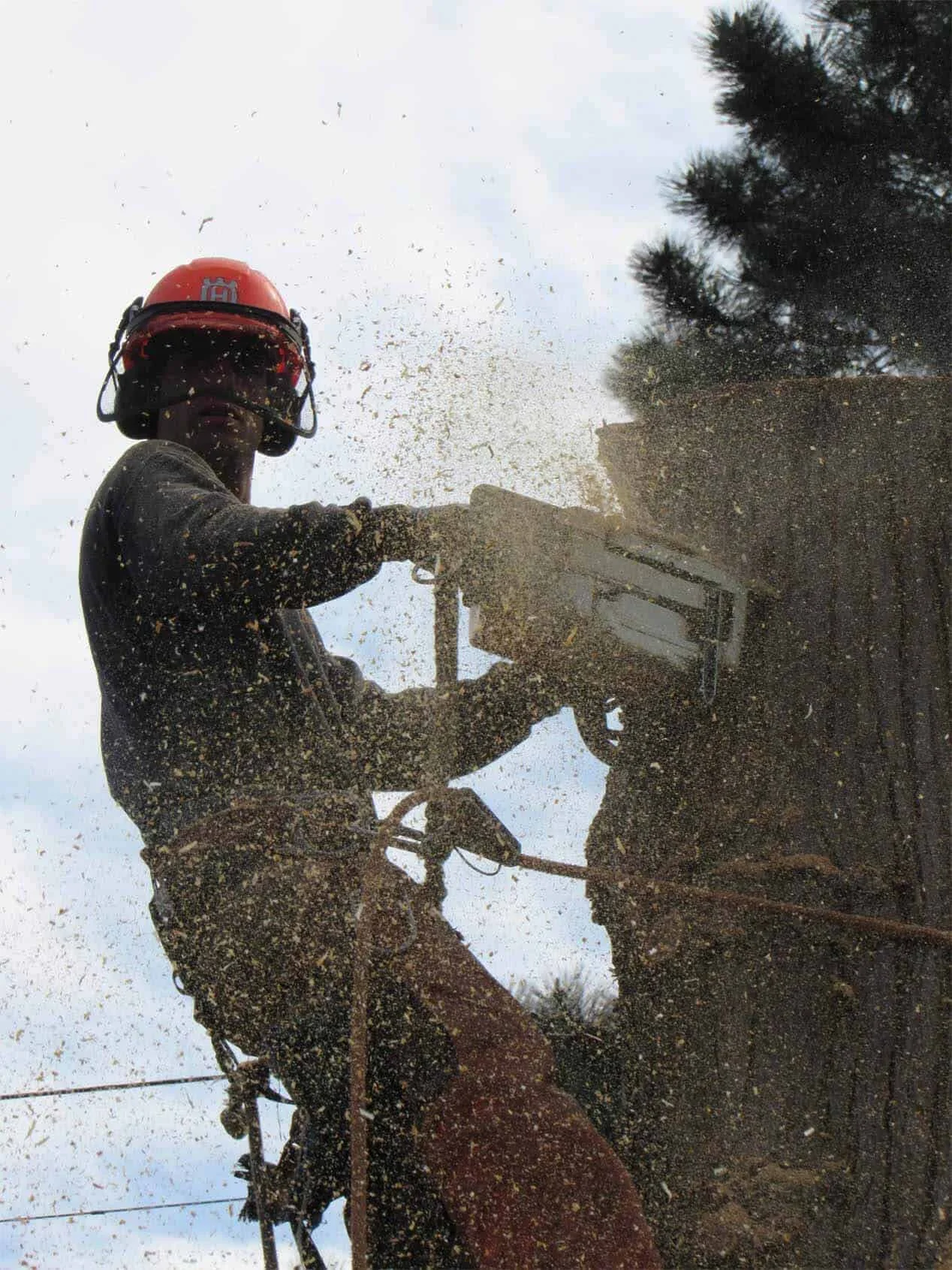
For work near established trees, debris shields help. Chips thrown from a grinding wheel can wound the bark of nearby trees, and wounds let decay-causing fungi in.
Grinding depth is controlled precisely. Near adjacent trees with overlapping root zones, the depth is adjusted to avoid severing structural roots. Structural roots anchor the tree. Cut them without assessment and you create a new hazard tree where there wasn't one before.
When roots are complex and intertwined, as they can be in older, established gardens, hand excavation is often the safer approach. Careful manual digging around critical root zones is slow work. It costs more. But it protects the roots of healthy neighboring trees while still accomplishing the removal. No machine exercises the same judgment as an arborist working by hand in a root zone.
Before any ground disturbance, request a utility locate through BC 1 Call. Gas lines, water mains, and irrigation systems run through residential lots, and their location determines where equipment can safely operate.
For complex removals near structures or heritage trees, an arborist report in Vancouver documents site conditions, identifies risks, and recommends the appropriate method before any work begins. That documentation protects property owners as much as the trees.
Can You Replant in the Same Spot After Stump Removal?
Yes, but timing and conditions matter.
After grinding, the root mass stays underground and breaks down slowly, and the old stump spot is filled with wood chips rather than soil.
A practical approach after grinding: clear out the chips, add good soil, and consider planting slightly away from the old stump so the new roots grow into undisturbed ground.
If you want a new tree in the exact footprint of the old one, excavating the root mass before planting is a better path than waiting. Remove the root material, amend the soil, and plant into clean ground.
For stumps with honey fungus, the stakes are higher. The fungus feeds on infected stump and root material and spreads from it through the soil. The RHS recommends digging out and destroying all infected material, and choosing plants that are rarely affected by honey fungus when you replant (source: RHS, Honey fungus).
Our emergency tree service responds 24/7 to storm-damaged and failing trees. If a failed tree turns out to be diseased, factor that into your replanting plan.
Do You Need a Permit for Stump Removal in Vancouver?
Tree bylaws are written around trees, so the permit question usually comes up at the removal stage rather than the stump stage. But the two are connected, and the distinction matters.
The City of Vancouver's Protection of Trees By-law No. 9958 requires a permit to remove private-property trees 20 centimetres or more in diameter, measured 1.4 metres above grade. Fines under the by-law range from $500 to $10,000 per offence. If you have a removal permit, check its conditions for anything that applies to the stump.
If the stump is all that remains from a previous removal, and no permit was obtained at the time, the situation requires clarification with the city before any work proceeds. Don't assume previous owners handled it correctly.
Lower Mainland municipalities each have their own tree protection bylaws. Burnaby, North Vancouver, Richmond, and Coquitlam operate under different thresholds and application requirements. The rules aren't uniform across the region. A crew familiar with municipal bylaws throughout the Lower Mainland knows which municipality requires what, before the work begins, not after.
Our tree cutting services in Vancouver include permit consultation as part of the assessment process. You don't need to work through municipal bylaw requirements alone.
A stump looks like a simple problem. It usually isn't. The species, root depth, soil conditions, proximity to utilities, and surrounding tree health all factor into what the right approach is, and what it costs.
ISA-certified arborists assess all of this before recommending anything. A free estimate gives you real information before you commit: what method fits the situation, what the scope actually involves, and what happens to that space after the stump is gone.
Aesthetic Tree & Hedge Services serves the Vancouver area with ISA-certified, WCB-registered arborists. Call for a free estimate: (604) 721-7370.
Found this helpful? Follow our tree care insights directly on Google.
Make us your preferred source on GoogleOur Tree Care Services
ISA-certified arborists serving Greater Vancouver

Explore Our Tree Care Services
From expert pruning to safe tree removal, our ISA-certified arborists are ready to help across Greater Vancouver.
View Services