
TL;DR — Quick Summary
Can pollarding kill a tree? Yes — done on the wrong species, at the wrong time, or too aggressively. An ISA-certified arborist explains what Vancouver homeowners must know.
- Pollarding can and does kill trees, but only when done on the wrong species, at the wrong time, or by removing too much at once.
- The RHS names London plane and common lime as the trees pollarding suits best. Conifers such as Douglas fir and western red cedar are not on its list of trees suited to pollarding.
- Pollarding has to be repeated on a regular cycle. If a pollard is left too long, the regrowth can become heavy and weakly attached.
- Metro Vancouver bylaws restrict heavy cutting: Vancouver's Protection of Trees By-law prohibits topping, and Burnaby's Tree Bylaw treats topping a protected tree as damage.
- Done correctly, on the right tree, by someone trained to do it, pollarding is an accepted pruning technique.
Can pollarding kill a tree? That question deserves a straight answer. Yes, it can. But it doesn't have to. Whether pollarding keeps a tree manageable or destroys it comes down to three things: the species, the timing, and the technique. Get all three right, and a tree can be pollarded for many years. Get even one wrong, and the tree can go into a decline that is hard to reverse.
Here's what every Vancouver homeowner should know before anything gets cut.
What Is Pollarding and Why Do People Do It?
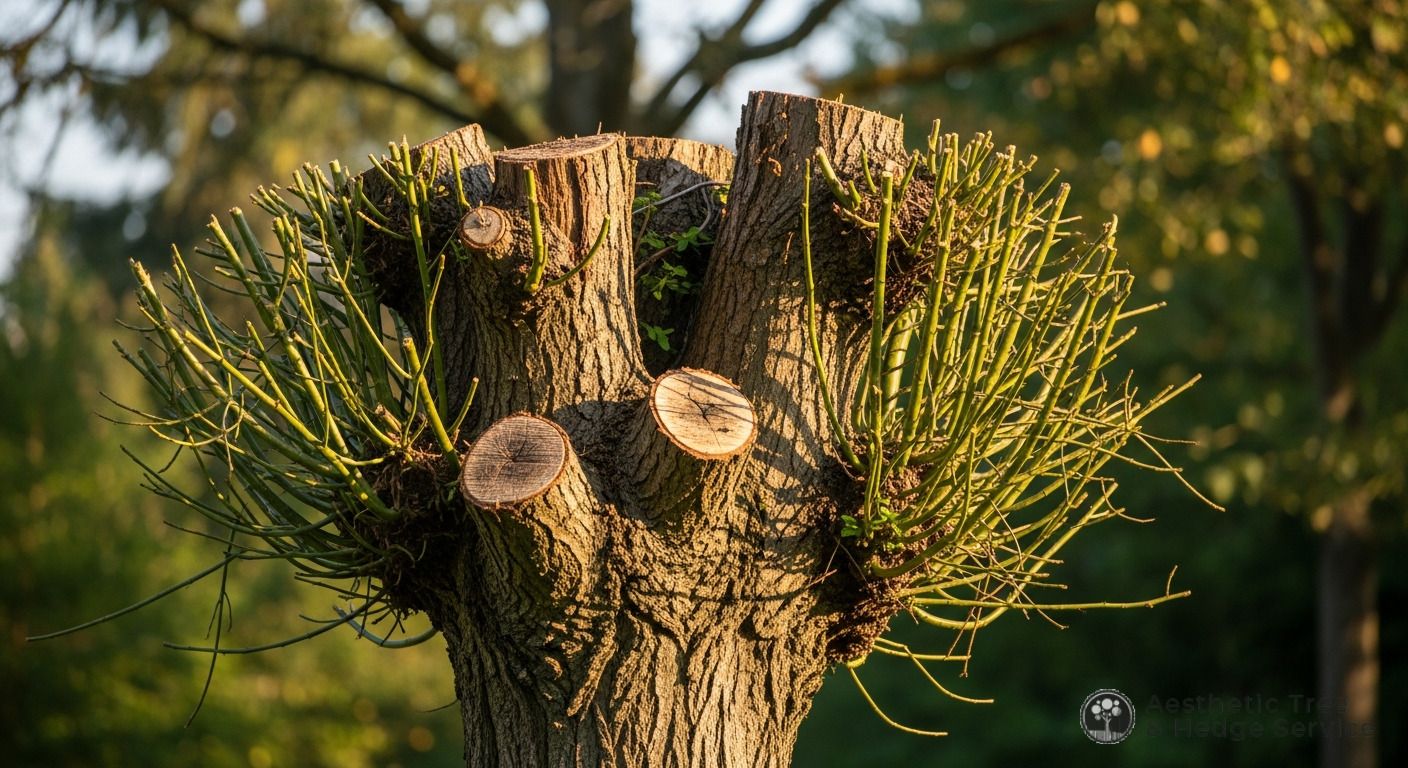
Pollarding is a pruning method that keeps a tree smaller than it would naturally grow. It is normally started once a tree reaches a chosen height, and regular cutting then holds the tree at that height (source: RHS, Pollarding). The branches are cut back to the same points each cycle, and the new shoots that grow from those points are removed again next time.
People request pollarding for real, practical reasons:
- A tree planted years ago now crowds the roofline or a power line
- It blocks light that the garden needs
- It was simply the wrong species for the available space
Pollarding is used most often on London plane and common lime (source: RHS). It works on those trees because the species match the method. Problems start when crews apply the same cuts to trees that respond very differently, and that mismatch is where trees get into trouble.
Which Trees Can Handle Pollarding, and Which Will Die?
This is the most important question in the whole conversation. Get it wrong, and you won't immediately see a dead tree. You'll see one in slow decline. That's often worse, by the time the damage is obvious, it can't be undone.
Trees that tolerate pollarding well:
- Willows (Salix spp.), traditionally pollarded, but the RHS warns that a neglected willow pollard can shed weakly attached branches
- London plane (Platanus × hispanica), one of the two trees the RHS names first for pollarding
- Lime or linden (Tilia spp.), the RHS names common lime (Tilia × europaea) as a main pollarding subject
- Mulberry (Morus spp.), on the RHS list of trees pollarding can be used on
Trees that are poor candidates for pollarding:
- Douglas fir (Pseudotsuga menziesii), a conifer, and not on the RHS list of trees suited to pollarding
- Western red cedar (Thuja plicata), also a conifer, and also not a traditional pollarding subject
- Most maples (Acer spp.), the RHS lists only some, such as box elder (A. negundo), as suitable, and advises against cutting maples in spring, when they are prone to bleeding sap
Douglas fir and western red cedar are among the Lower Mainland's best-known trees, and neither is a pollarding subject. If a crew offers to pollard your cedar or fir, get a second opinion from an ISA Certified Arborist before anything is cut.
When past mishandling has already compromised a tree beyond recovery, our tree removal team in Vancouver assesses whether the tree can be saved, or whether safe removal is the right call.
What Happens Inside a Tree When Pollarding Goes Wrong?
A tree's response to a cut isn't passive. It's biological. Understanding what actually happens inside helps explain why bad pollarding does such lasting damage.
The science here rests on work by Dr. Alex Shigo, who spent 25 years as a scientist with the U.S. Forest Service. He showed that trees don't heal wounds the way animals do. Instead, they wall off decaying tissue, a process he called Compartmentalization of Decay in Trees (CODIT). ISA notes that a healthy tree can close a correct pruning cut if the wound isn't too large, but few trees can defend the multiple severe wounds left by heavy cutting (source: ISA, Why Topping Hurts Trees).
When pollarding goes wrong, here's the sequence:
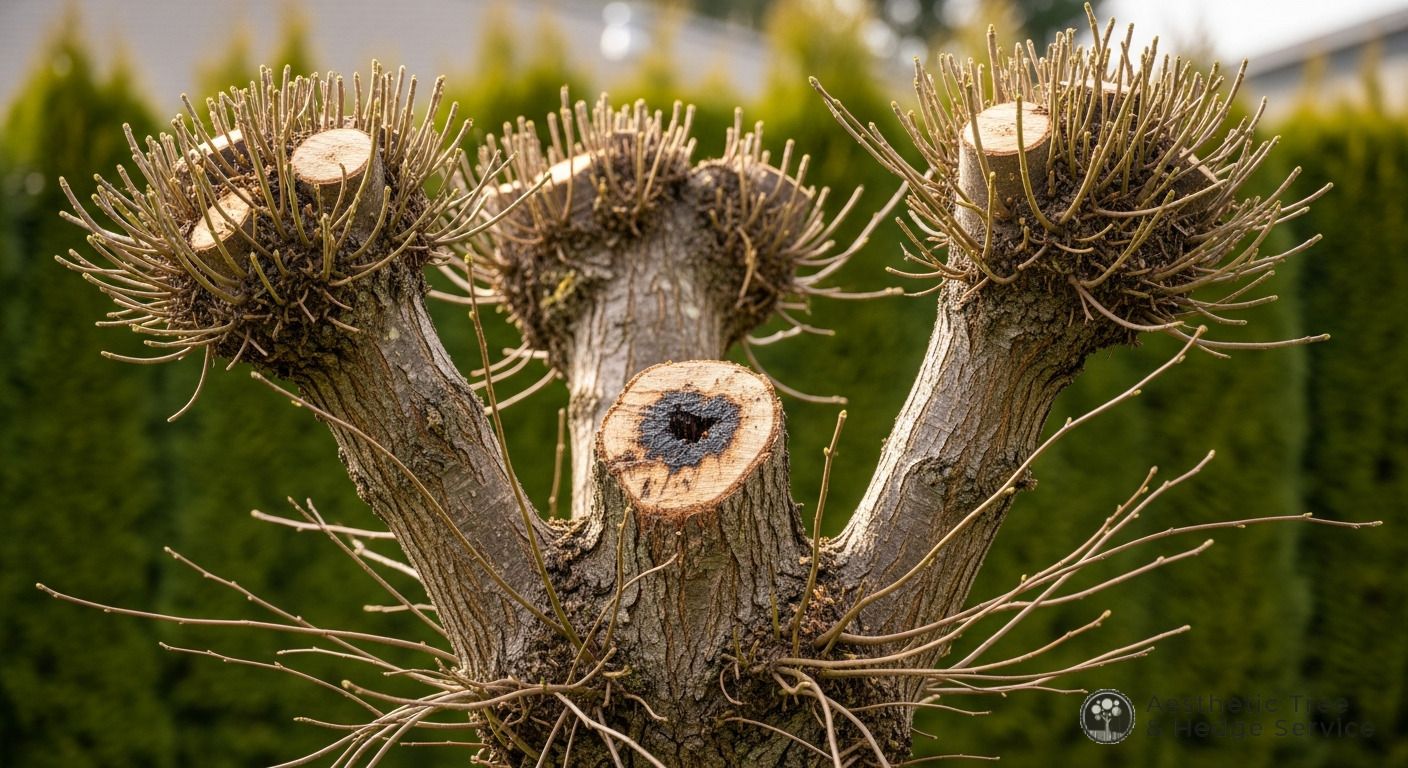
Stage 1, Epicormic explosion. The tree responds to sudden crown loss by pushing epicormic shoots out from dormant buds near the cut stubs. They grow fast. They look like recovery. They're not. These water sprouts are weakly attached, with poor structural connection to the stem. A windstorm can take them off without warning.
Stage 2, Wound overwhelm. A large, blunt stub creates a wound the tree's compartmentalization system struggles to contain. Decay fungi enter. They establish. They work inward. For years, the tree looks fine from the street.
Stage 3, Energy crash. Pollarding strips a huge proportion of leaf area at once. Leaves make energy. No leaves means the tree draws entirely on carbohydrate reserves stored in its roots and stem. If that tree was already under stress, drought year, compacted soil, root damage from nearby construction, those reserves are already depleted. The tree can't recover from both the cut and the stress simultaneously.
Stage 4, Canopy dieback. The top of the tree begins to die back. Small twigs first. Then larger branches. By the time this is visible from the yard, the internal damage is years old.
The timeline varies by species. Species matters. Site conditions matter. Past pruning history matters.
How Much Can You Remove at One Time Without Killing a Tree?
This is where many DIY mistakes happen.
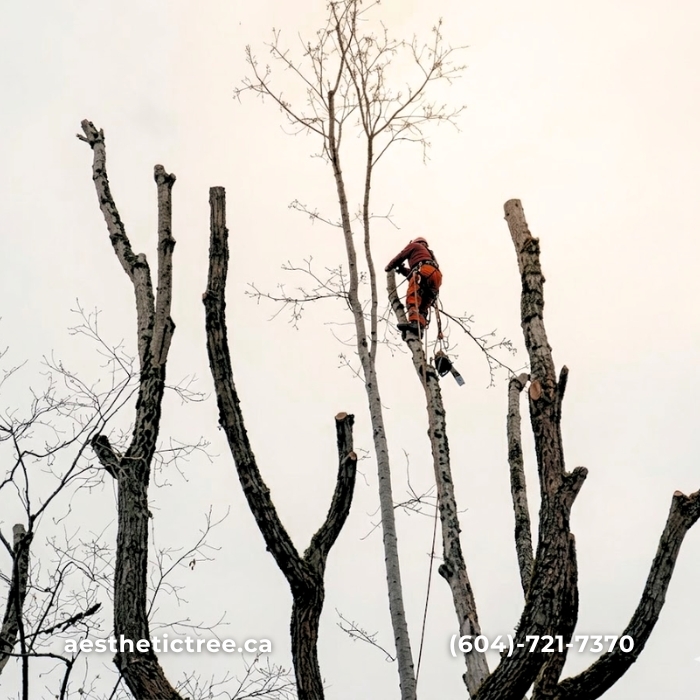
ISA notes that topping can remove 50 to 100 percent of a tree's leaf-bearing crown. Removing that much leaf area can starve a tree, and a tree without the stored energy to regrow its leaves will be seriously weakened and may die (source: ISA, Why Topping Hurts Trees).
A first pollarding cut on a large, established tree removes a similar share of the crown. That is why starting a pollard on a mature tree that has never been pollarded is risky: it strains both the tree's energy reserves and its ability to wall off decay at the same time.
ISA's guidance on pruning cuts points the same way. Correct cuts are made just beyond the branch collar, where a healthy tree can close the wound if it isn't too large. Cuts that leave stubs between branches may never close, and the exposed wood begins to decay (source: ISA, Why Topping Hurts Trees).
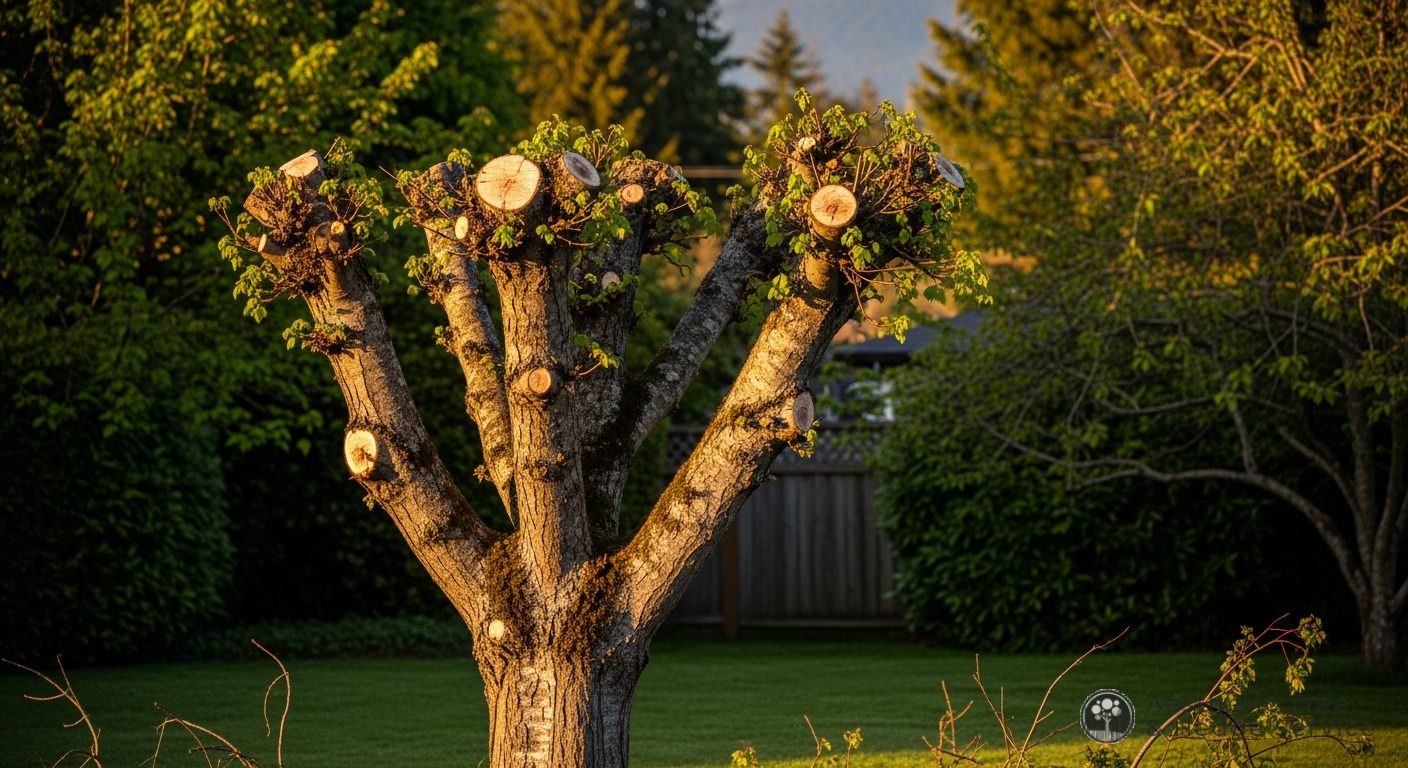
A properly managed pollarding program works differently. The tree develops swollen knuckles, or pollard heads, at each cut point, and new shoots grow from them. Cut back to the knuckle on a regular cycle and you are removing young growth, not mature scaffold branches.
Starting pollarding on a mature tree that has never been pollarded is a high-risk decision. The biology simply doesn't support it the way it would on a young tree that's been trained from the start.
When Is the Right Time to Pollard in Vancouver?
Timing is not a secondary consideration. It changes the outcome.
The RHS recommends late winter or early spring for pollarding most trees. The main exception is maples, which are prone to bleeding sap if cut in spring.
- The tree is dormant. Its energy is stored in the roots and stem, not the leaves.
What not to do:
Don't treat summer as the default. The RHS says summer pollarding can work, but the new growth may be poor if the tree is suffering from scorch or drought.
What's the Difference Between Pollarding and Topping?
The distinction is critical. And it's the one homeowners most consistently get wrong.
Topping is the indiscriminate cutting of tree branches to stubs, or to lateral branches that are not large enough to take over as the leader. The tree pushes out many weakly attached shoots below each cut, and stubs it can't close begin to decay. ISA describes topping as perhaps the most harmful tree pruning practice known (source: ISA, Why Topping Hurts Trees).
Pollarding is a managed system. Suitable species. The same cut points each cycle. Regular maintenance. Done consistently on suitable trees, it is an accepted pruning technique.
The visual result can look similar from the street, both leave a crown of stubs with epicormic growth in spring. But the biology and long-term outcomes are completely different.
A badly topped or wrongly pollarded tree can end up needing full tree cutting. Then there's a stump to deal with. Our stump grinding service handles that, but it's an entirely avoidable outcome when the original species assessment is done right.
Do You Need a Permit to Pollard a Tree in Vancouver or Burnaby?
Not for ordinary pruning, but heavy cutting is restricted, and the rules differ by municipality.
Not for ordinary pruning, but heavy cutting is restricted, and the rules differ by municipality.
The City of Vancouver's Protection of Trees By-law No. 9958 requires a permit to remove private-property trees 20 cm or more in diameter, measured 1.4 metres above the ground, and it lists topping a tree, or pruning it so it is unlikely ever to regain its characteristic appearance, among prohibited activities. Burnaby's Tree Bylaw No. 10482 allows pruning to accepted arboricultural practice without a permit but treats topping a protected tree as damage, with fines of $2,000 to $10,000 per violation. Other Lower Mainland municipalities set their own rules.
Key points homeowners regularly miss:
- Heavy cutting can count as damage or prohibited pruning under a bylaw, even if the tree stays in the ground
- Boulevard and park trees are managed by the city (in Burnaby, by the Parks Department), so contact the municipality rather than pruning them yourself
Before any major pollarding work, get an arborist report from an ISA-certified arborist. It documents the tree's condition and whether the planned work needs a permit. Skipping this step can lead to bylaw fines and, in Burnaby, an order to plant replacement trees.
What Are the 5 Most Dangerous Pollarding Mistakes?
Each of these causes real, preventable damage.
Mistake 1: Pollarding the wrong species
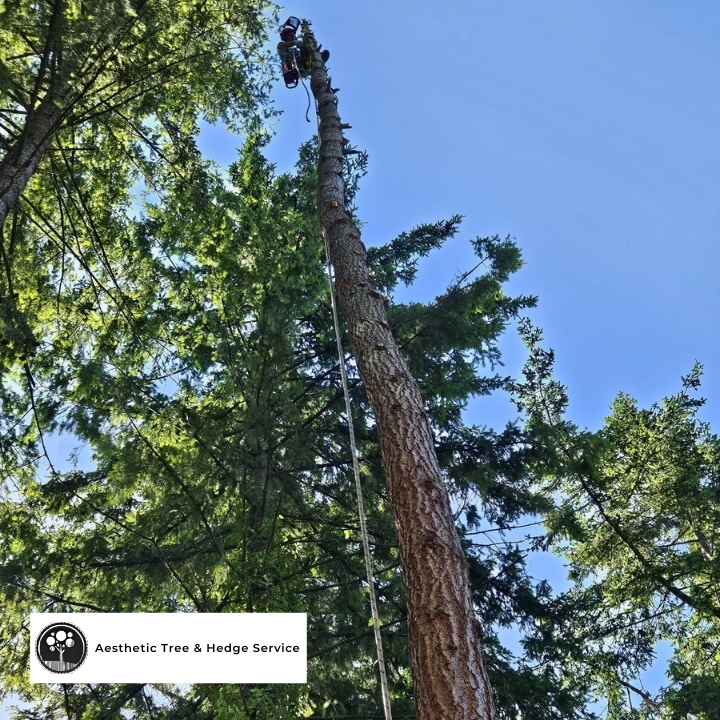
This is the first thing to get right. Conifers such as Douglas fir and western red cedar are not traditional pollarding subjects, and neither appears on the RHS list of trees suited to the technique. If someone quotes you a pollarding price for a cedar or fir, get a second opinion.
Mistake 2: Cutting into the branch collar
Pollarding cuts go back to the knuckle, not into the parent limb. ISA's guidance is to cut just beyond the branch collar and never into it. A cut into the collar leaves a wound the tree is less able to close, which gives decay organisms an easy way in (source: ISA, Why Topping Hurts Trees).
Mistake 3: Starting on a mature, never-pollarded tree
Removing a large portion of a mature crown at once is not a pruning operation, it's a crisis for the tree. The root system, energy storage, and internal structure of a mature tree all developed in relationship to its crown. Taking that crown away in a single session leaves the tree unable to recover its energy balance. The risk is compounded for trees already under environmental stress.
Mistake 4: Skipping the annual maintenance cycle
Once you start a pollarding program, you don't get to stop. The epicormic shoots that grow from the knuckles each year are numerous, fast-growing, and attached at structurally weak points in the wood. Miss one year. Miss two. Those shoots are now large-diameter limbs with poor union angles and almost no structural taper. A wind event, and the Lower Mainland gets significant ones, can bring them down without warning. The risk to structures, vehicles, and people directly below is real.
If committing to annual maintenance isn't feasible, don't start a pollarding program. In many cases, regular hedge and canopy management through selective pruning can address the underlying problem, the tree is too large for the space, or it's encroaching on a structure, without locking the property into an annual maintenance obligation.
Mistake 5: Using dirty or dull cutting tools
Every cut is an open wound. On fire blight hosts such as pear and apple, UC IPM says dipping shears in 10% bleach between cuts might be wise when removing fast-moving infections, though where you make the cut matters far more than cleaning the tools. Clean, sharp tools also make cleaner cuts.
When Does Pollarding Damage Become an Emergency?
Most pollarding damage shows gradually. But some situations call for immediate response.
Watch for:
- Large epicormic shoots or scaffold branches that split from the main stem after a wind event
- Visible cracking at the pollard knuckle, especially on knuckles that have been maintained for several years
- Sudden canopy failure in a single section of the tree
- Fungal fruiting bodies, mushrooms, conks, bracket fungi, appearing at or near cut stubs
Any of these signals means structural integrity is compromised. Don't wait. Epicormic shoots that grow from pollard knuckles are structurally weaker than primary scaffold branches and fail with less warning. In Metro Vancouver, where windstorms in fall and winter are common, a compromised pollarded tree is a genuine hazard.
For split limbs, overhanging deadwood, or storm-damaged trees of any kind, our emergency tree service is available around the clock in Vancouver and the surrounding Lower Mainland.
When Should You Call an ISA-Certified Arborist Before Starting?
Before anything gets cut. Not after.
The real answer to "can pollarding kill a tree" is: it depends on what a certified arborist finds when they look at your specific tree on your specific site. Species, age, health status, root zone conditions, past pruning history, proximity to structures, and municipal bylaw requirements all factor in. None of those variables are assessable from the internet.
Call before cutting if:
- The tree is taller than 10 feet, anything requiring a ladder and a chainsaw is a serious injury risk
- You're uncertain about the species
- The tree is near a structure, fence line, power line, or slope
- The tree has never been pollarded before
- You've seen signs of past topping or poor pruning cuts
- The tree may be protected under your municipality's tree bylaw
An ISA-certified arborist's assessment tells you whether pollarding is the right approach, or whether selective crown reduction, removal, or leaving the tree alone is actually the better answer. Sometimes the most practical solution is professional tree cutting and replanting with a species better suited to the available space. The arborist's role is to give you that information honestly, before you've committed to a course of action that can't be undone.
Call Aesthetic Tree & Hedge Services for a free estimate before anything gets cut. Our arborists are ISA-certified, every crew member is covered by WorkSafeBC, and we serve the Lower Mainland and Sea-to-Sky corridor. Reach us at (604) 721-7370.
Related: How Much Does an Arborist Make in BC? What Sets Pay
Found this helpful? Follow our tree care insights directly on Google.
Make us your preferred source on GoogleOur Tree Care Services
ISA-certified arborists serving Greater Vancouver

Explore Our Tree Care Services
From expert pruning to safe tree removal, our ISA-certified arborists are ready to help across Greater Vancouver.
View Services