
TL;DR — Quick Summary
Signs emergency tree care Vancouver homeowners miss. 7 expert-verified warning signs from ISA-certified arborists. Free estimate: (604) 721-7370.
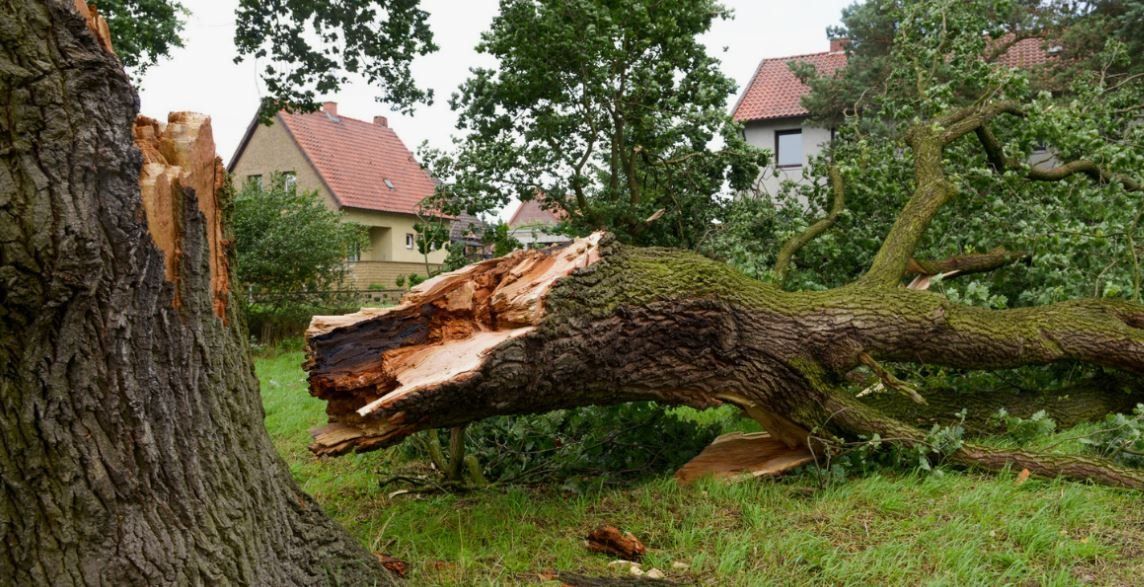
Signs emergency tree care Vancouver homeowners need isn't always obvious. A tree can look healthy on the outside and be structurally compromised inside. Our ISA-certified arborists have assessed thousands of trees across the Lower Mainland. Here are the seven signs we see before a tree fails — and what you should do when you spot them.
TL;DR
- Seven specific signs indicate a tree needs emergency arborist assessment — most are visible from the ground.
- Hanging branches ("widow makers") are the leading cause of tree-related injuries in Metro Vancouver.
- Vancouver's wet winters accelerate internal decay. Fungi and root rot spread faster in saturated soils than in drier climates.
- City of Vancouver Bylaw No. 9958 applies even in emergencies, but immediate hazard removals have a streamlined permit provision.
- Call (604) 721-7370 immediately if you see any of these signs. Don't wait for the next storm.
Why Do Trees Suddenly Fail in Vancouver — And What Does the Data Show?
Tree failure isn't random. It follows patterns.
According to WorkSafeBC's occupational hazard classifications, tree felling and related operations are among the highest-fatality occupations in British Columbia. Most serious incidents involve trees that showed pre-failure signs the homeowner didn't recognize.
The ISA (International Society of Arboriculture) publishes risk assessment protocols used by certified arborists worldwide. These protocols identify three primary failure indicators: structural defects, fungal colonization, and root zone damage.
Vancouver's climate makes this worse. Environment Canada data shows Metro Vancouver receives between 1,200 and 1,900 millimetres of rain annually — among the highest in any Canadian city. That moisture feeds fungal decay inside trunks and roots year-round. A tree that looks healthy in July can be structurally compromised by November.
BC Hydro's annual reliability reports consistently identify tree contact as the leading cause of unplanned power outages across Metro Vancouver — ahead of equipment failure and wildlife incidents. The utility runs ongoing tree-clearance programs across the region at significant annual cost.
The numbers all point the same direction. Trees fail here. They fail predictably. And most failures can be prevented if you know what to look for.
What Are the 7 Warning Signs Your Tree Needs Emergency Arborist Service in Vancouver?
Sign 1: Hanging Branches That Are Dead or Partially Attached
The tree care industry has a specific name for these: widow makers.
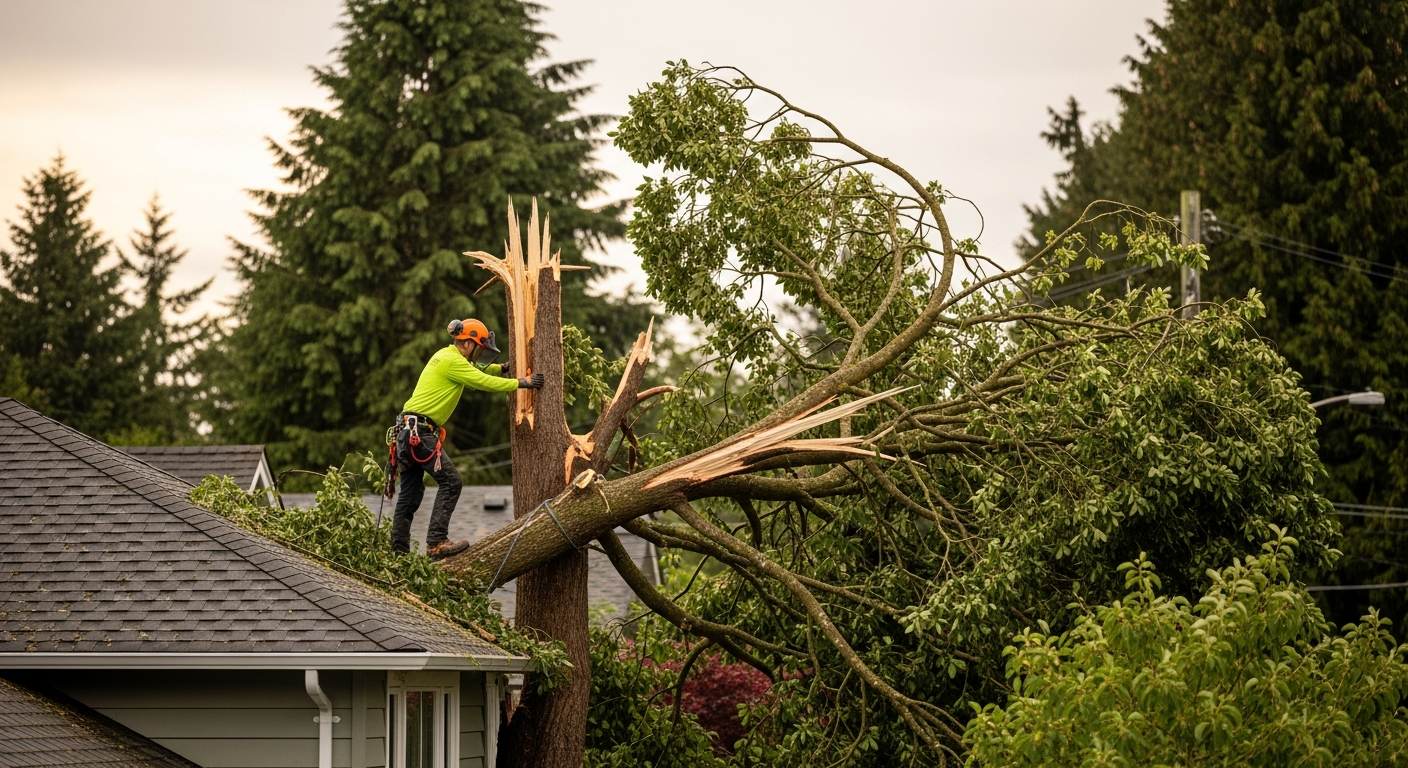
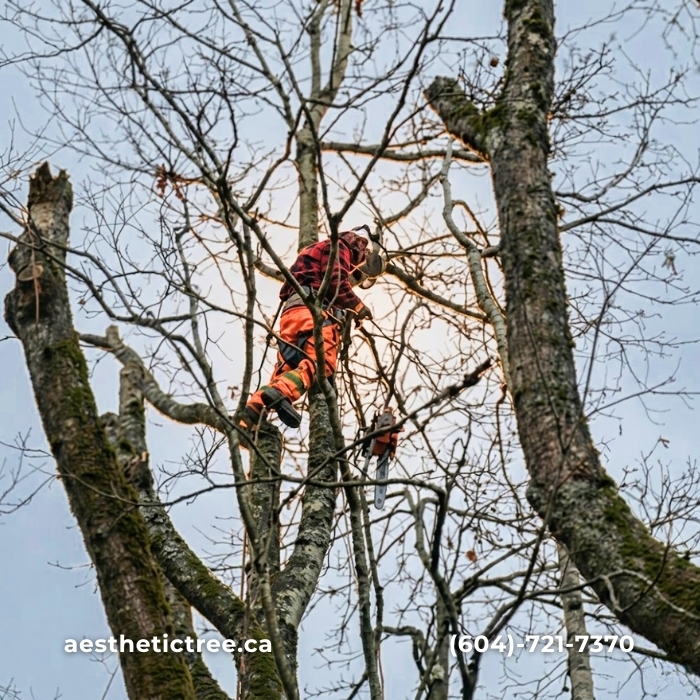
A widow maker is a branch that's dead, broken, or partially detached but still suspended in the canopy. Gravity and wind finish the job — usually when someone is underneath.
Spot them by looking for brown or bare branches when surrounding ones are fully leafed out. Look for an angled branch that crosses or rests on another. Look for jagged or torn wood at the attachment point.
In our experience assessing trees across Vancouver, North Vancouver, and Burnaby, widow makers account for more emergency calls than any other defect. They're typically caused by ice loading during late-season storms or by dead-branch die-back from fungal infections spreading through the canopy.
This isn't a "wait until spring" situation. If you see a hanging branch over a walkway, driveway, deck, or play area — call an arborist the same day.
Sign 2: Sudden or Dramatic Leaning After a Storm
A slight natural lean is normal. A sudden lean is not.
If a tree leans noticeably more after a wind event or heavy rain, the root plate has shifted. The soil is no longer anchoring the root system. The tree is on borrowed time.
Check the base carefully. Look for soil heaving — a mound or ridge on one side where roots have lifted. Look for cracks in the ground near the trunk base. These are physical evidence that root anchorage has failed.
ANSI A300 (Part 9) — the industry standard for tree risk assessment, used by certified arborists across North America — classifies sudden lean with soil disturbance as a high-probability failure indicator. Our team applies this standard on every assessment.
Don't mistake this for a maintenance issue. A tree with a failed root plate needs removal, not pruning. If you see this sign, contact us for emergency tree service immediately — before the next rain event saturates the soil further.
Sign 3: Cracks, Splits, or Open Cavities in the Trunk
A sound trunk is continuous. A compromised trunk isn't.
Look for:
- Vertical or diagonal cracks running along the trunk
- Co-dominant stems with included bark growing between them
- Hollows or open cavities where bark has separated from the wood
- Visible dead wood inside the tree at any opening
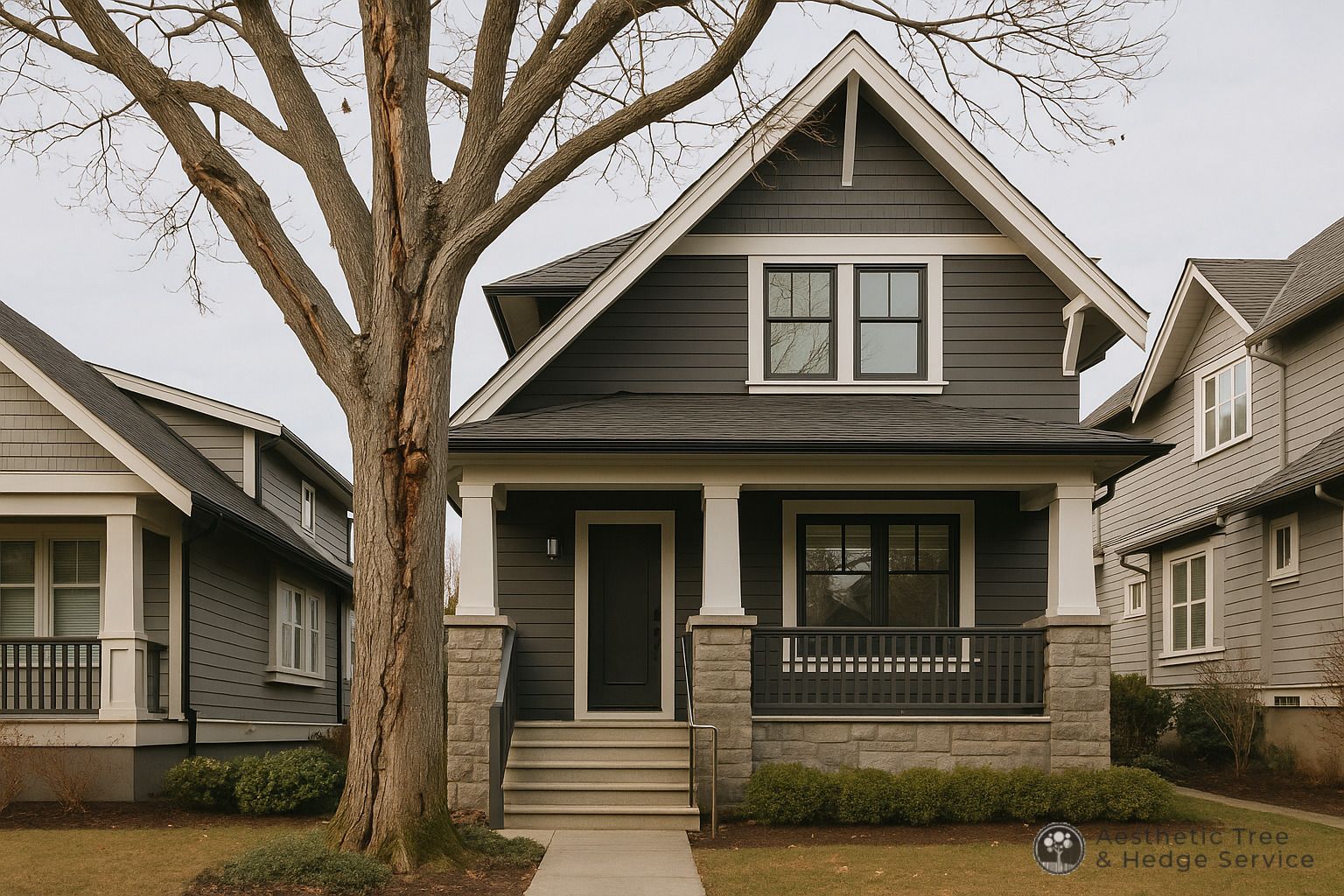
Co-dominant stems with included bark are particularly dangerous in coastal BC. Included bark means two stems grew together without forming a proper structural union. Under load — wind, ice, or a heavy crown — they split apart suddenly and completely.
The City of Vancouver's Urban Forest Strategy (updated 2020) identifies structural defects in co-dominant stems as a priority hazard in the city's 147,000-tree public canopy. The same structural physics apply to private property trees.
A cracked or split trunk requires a physical assessment by a certified arborist. There's no safe way to evaluate the extent of internal damage from a distance.
Sign 4: Mushrooms, Conks, or Fungal Growth at the Base or on the Trunk
Fungi are not cosmetic. They're diagnostic.
When you see mushrooms or shelf fungi — also called conks — growing from a tree's trunk or base, a fungal pathogen is already decomposing the wood inside. The visible fruiting body represents months or years of internal decay. By the time you see it outside, the damage inside is significant.
Two common culprits in Metro Vancouver trees:
**Armillaria (Honey Fungus):** Attacks roots and the trunk base. Produces clusters of honey-brown mushrooms in autumn. Causes root rot that kills a tree from the bottom up. Common in Douglas fir, big-leaf maple, and cedar.
**Ganoderma (Artist Conk):** Produces hard, shelf-like brackets on the lower trunk. Decays heartwood, hollowing the tree structurally while the outer shell appears intact. Common in ornamental and street trees across Vancouver.
According to BC Ministry of Forests Forest Health publications, Armillaria root disease is the most widespread tree disease in British Columbia — affecting urban and forest trees throughout the province.
Once conks or mushrooms appear, the tree has already lost significant structural integrity. This is an emergency sign, not a maintenance note.
Sign 5: Dead Crown or Widespread Branch Die-Back
A healthy tree leafs out across its entire crown. A tree in crisis doesn't.
Look for sections of the crown — especially the upper crown — where branches are bare while surrounding ones are fully leafed out. That's called crown die-back, and it's a symptom of something failing below the surface.
Die-back causes include:
- Root damage from construction activity or soil compaction
- Drought stress (Vancouver's dry summers since 2021 have accelerated this in established trees)
- Chronic fungal infection spreading through the vascular system
- Girdling roots that strangle the tree's water uptake over years
- Trenching or landscaping work that severed major roots
Dead upper branches are hazard material waiting for a wind event. They're dry, brittle, and they fall without a storm to trigger it. If more than 30% of the crown is visibly dead, the tree needs professional assessment before the next rain event hits.
A formal arborist report documents the structural risk in writing — a requirement for insurance claims and municipal permit applications when action is needed quickly.
Sign 6: Raised Soil, Exposed Roots, or Ground Heaving Around the Base
The root plate is the anchor. Disturb it, and the tree becomes unstable.
Ground heaving — soil pushed up on one side of the trunk — means roots have lifted during a wind event or heavy rain. The root system is no longer in full contact with stable ground.
Exposed surface roots that are cracked, broken, or freshly uncovered by erosion are another indicator of compromised anchoring.
This pattern is common after Metro Vancouver's atmospheric river events. According to Environment Canada, the November and December 2021 atmospheric river sequence set rainfall records at multiple monitoring stations across the Metro Vancouver region. Saturated soil dramatically reduces root anchorage strength — a well-documented phenomenon in forestry engineering research. A tree that holds firm in dry summer conditions can uproot in the same wind speed when soils are waterlogged.
If your tree shows ground heaving, don't install new plantings or root barriers nearby without an arborist assessment first. Root system health must be evaluated before any ground disturbance near the base.
Sign 7: Lightning Strike Damage
Direct lightning kills sections of a tree instantly. The damage is obvious: a vertical scar running down the trunk, exploded bark, and immediate branch death in the affected section.
But lightning damage isn't always total or obvious. A tree can survive a strike with significant internal structural damage. The heat of a lightning bolt flash-boils the moisture inside the trunk, fracturing wood from the inside outward. The tree stays upright — but it's not sound.
If you saw a flash near a tree during a storm, inspect the bark afterward. Look for a narrow spiral or vertical groove where bark has blown off. Look for splits in the wood visible below the scar line.
Struck trees that appear intact need professional assessment within 72 hours. In many cases, they need structural cabling or removal — not simply time to recover on their own.
When Is a Tree Situation a True Emergency vs. When Can It Wait?
Not every tree issue is a same-day call. Here's how to make the distinction.
**Call for emergency tree service immediately when:**
- A tree or large branch has already fallen on a structure, vehicle, or utility line
- A tree is actively leaning or visibly moving during a wind event
- A hanging branch is directly above a walkway, entrance, roof, or occupied outdoor area
- The tree has made contact with overhead BC Hydro power lines
- A visible crack or split in the trunk has opened within the last 24–48 hours
**Schedule a priority assessment within 2–3 days when:**
- You see fungal growth at the base or trunk for the first time
- A section of crown has died back since last season
- Ground heaving is present but the tree isn't actively moving or shifting
**Book a routine assessment when:**
- You notice gradual lean but there's no soil disturbance around the base
- Dead branches are in the interior of the crown, away from structures or targets
- You need formal documentation for an insurance or permit file
The practical test: is there a target — a person, vehicle, structure, or power line — that would be struck if the tree or branch failed right now? If yes, that's an emergency. If no, it's a priority assessment. Apply that test before calling so we can triage the response correctly.
How Do Vancouver's Rain and Wind Events Make Tree Emergencies More Common?
Vancouver's climate is genuinely hard on trees. Most cities don't deal with this combination.
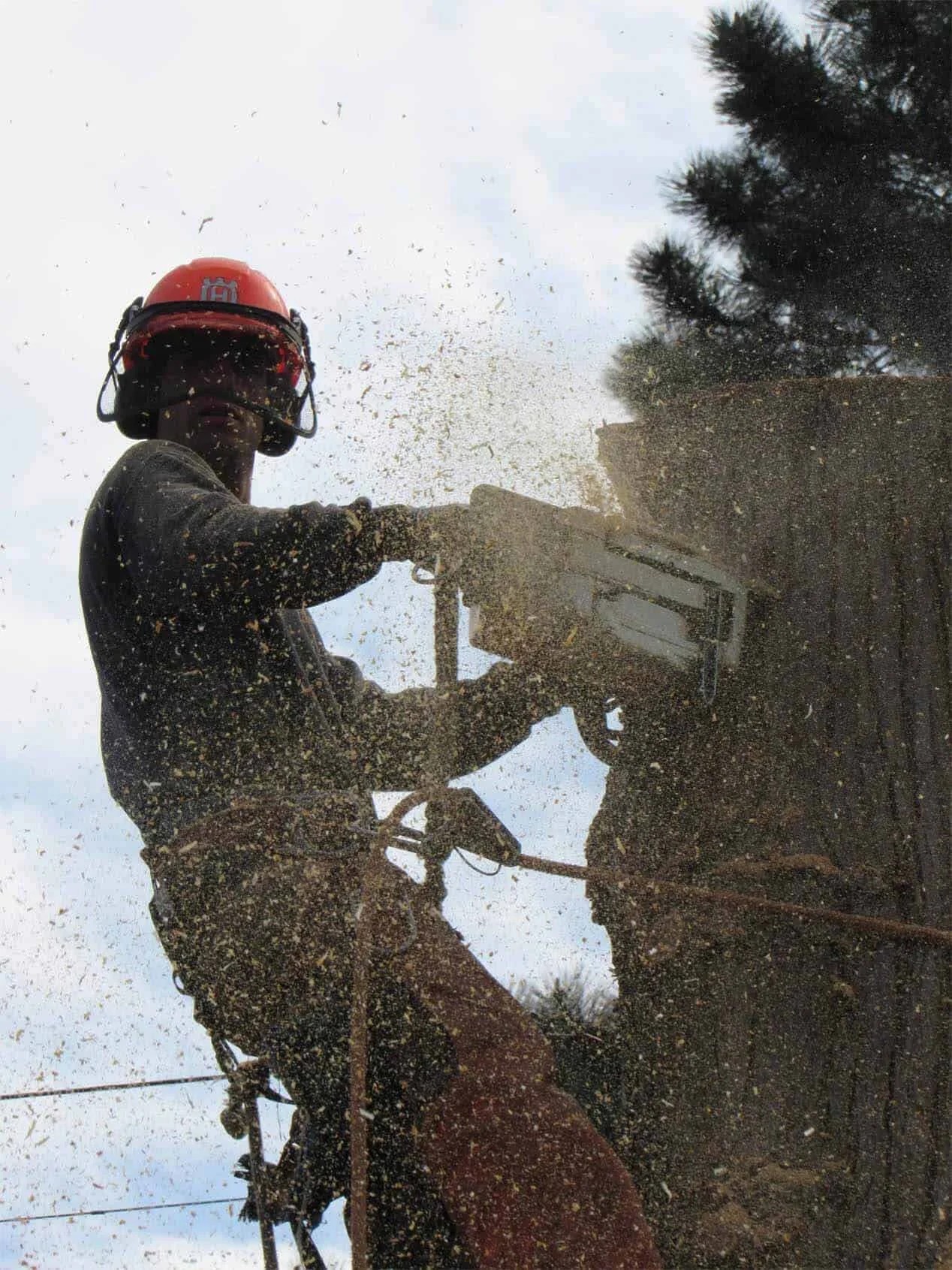
The mix of saturated winter soils, Pacific windstorms, and increasingly dry summers creates a stress cycle that degrades structural integrity faster than in drier climates. Metro Vancouver's windstorms follow the Pacific storm track — systems that build over the North Pacific and make landfall on the BC coast with little topographic buffering.
Environment Canada's climate records for Metro Vancouver document multiple significant windstorm events per year with sustained gusts exceeding 70 km/h. Recent examples: the December 2018 windstorm that downed over 200 trees in Stanley Park alone, and the November 2021 atmospheric river sequence that caused province-wide structural damage.
Saturated soil is the critical factor. A tree that holds firm in dry conditions can uproot in the same wind speed when soils are waterlogged. Root systems grip soil through friction. Waterlogged soil loses that friction rapidly.
Big-leaf maple and red alder — two of the most common broadleaf species in Metro Vancouver residential properties — are particularly susceptible to root rot in persistently wet conditions. Douglas fir is structurally strong but develops brittle top sections as it matures. Those brittle sections become projectile hazards during high-wind events.
After any major windstorm or heavy rain event, walk your property with these seven signs in mind. Post-storm inspections catch secondary failures — trees that were already stressed and tipped over the edge by a weather event — that happen two to three weeks after the main storm.
Does the City of Vancouver Tree Bylaw Apply During a Tree Emergency?
This is the most common question we hear on emergency calls. The short answer: yes, but with a practical provision for immediate hazards.
**City of Vancouver Bylaw No. 9958** (the Street Tree Bylaw) governs boulevard trees between the sidewalk and curb. Private property trees are protected under the **Vancouver Private Tree Bylaw**. Both require a permit to remove a protected tree.
In genuine emergencies, the rules have a practical exception built in. Under both bylaws, emergency removal can proceed without a prior permit when:
- The tree has already failed and is blocking public access or creating an immediate safety hazard
- The tree poses imminent danger to life, documented by a certified arborist on site
- Work is performed by a qualified arborist operating within WorkSafeBC safety guidelines
After emergency removal, notification to City of Vancouver Urban Forestry is required within 24 hours. The attending arborist provides written documentation of the hazard condition and actions taken.
For non-emergency removal of protected trees, a formal arborist report for Vancouver supports the permit application. Our reports meet the documentation requirements for all Metro Vancouver municipalities — Vancouver, Burnaby, North Vancouver, Richmond, and Coquitlam. We know these bylaws cold. That's part of what ISA certification prepares arborists to handle.
What Happens During an Emergency Tree Response?
When you call (604) 721-7370, here's exactly what our team does.
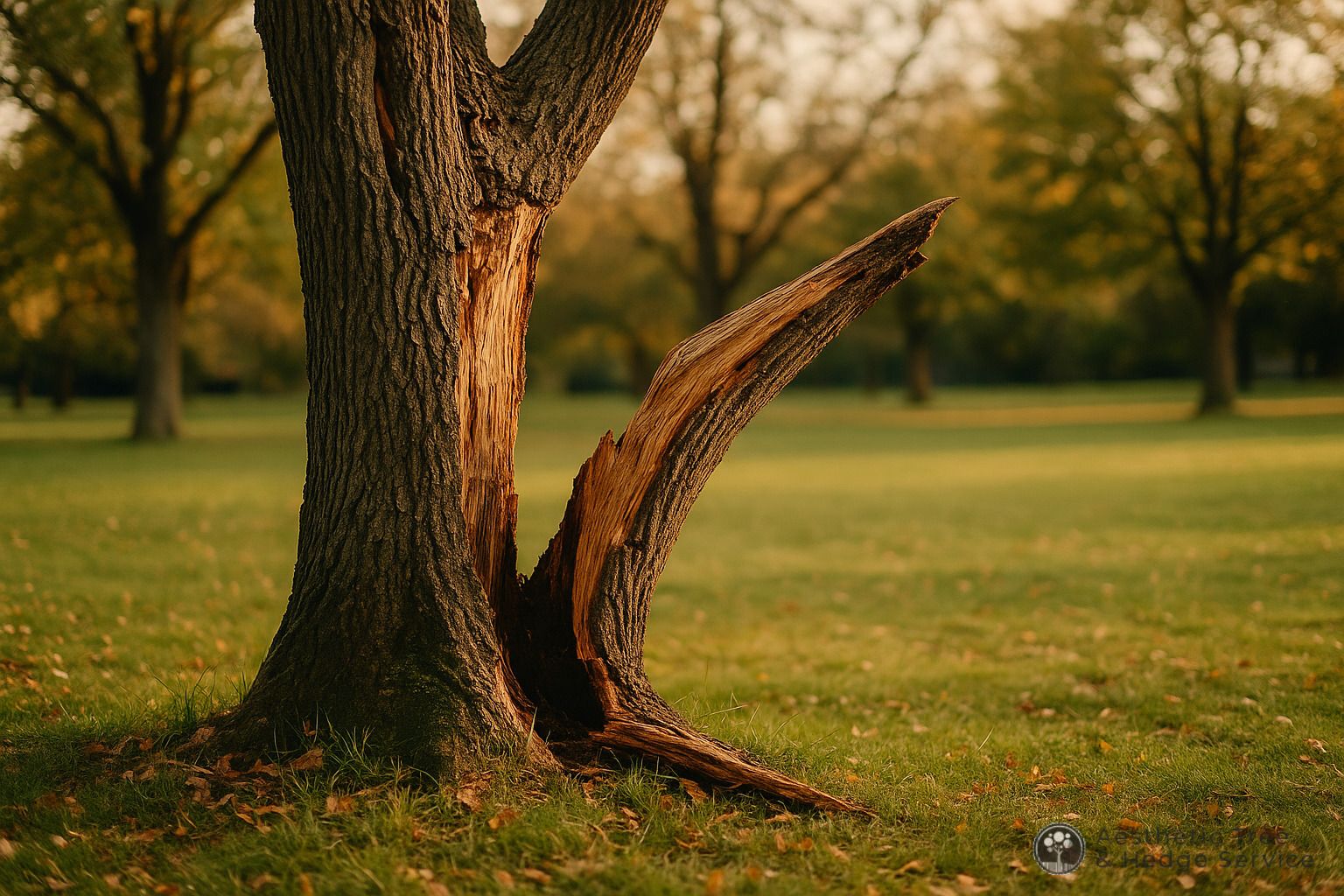
**Step 1 — Initial triage assessment** We ask about the immediate target. Is there a structure, vehicle, or person at risk right now? Photos sent via phone help us assess urgency before arrival. This determines response priority and crew size.
**Step 2 — Site arrival and hazard zone establishment** Our crew establishes a hazard zone before any work begins. This is a WorkSafeBC requirement. No one works under a suspended load until the zone is secured and communicated.
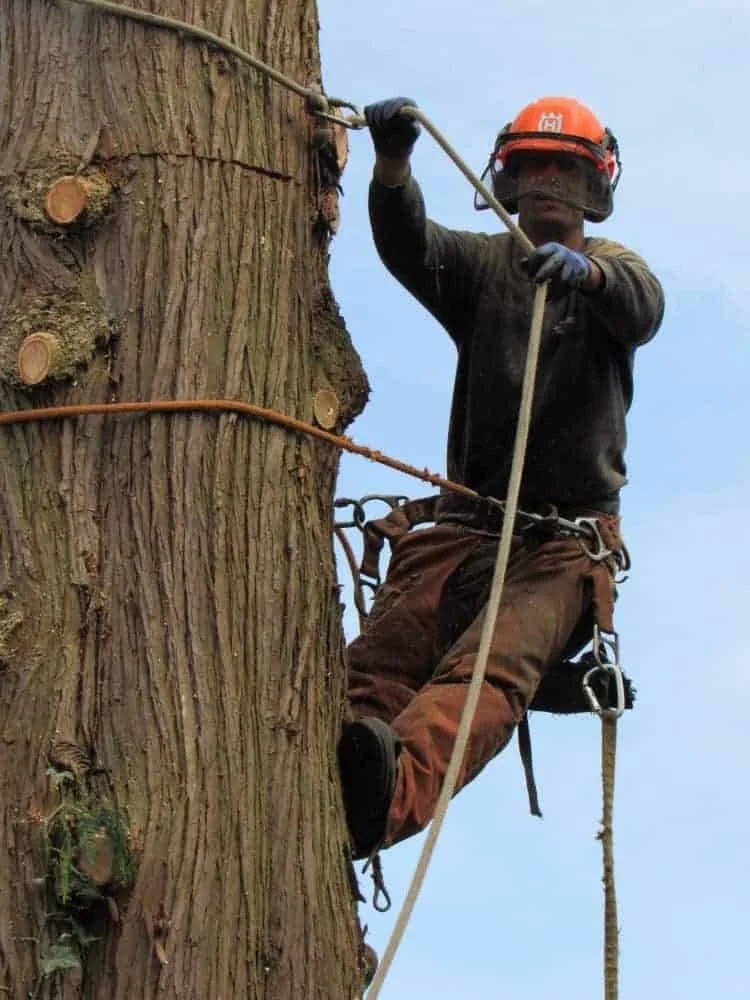
**Step 3 — Sectional removal from the top down** For most emergency scenarios, we use a sectional rigging system — removing the tree in controlled pieces and lowering each section to the ground. For tight urban lots common in East Vancouver, Burnaby, and North Vancouver, this method keeps debris off structures and neighbouring property.
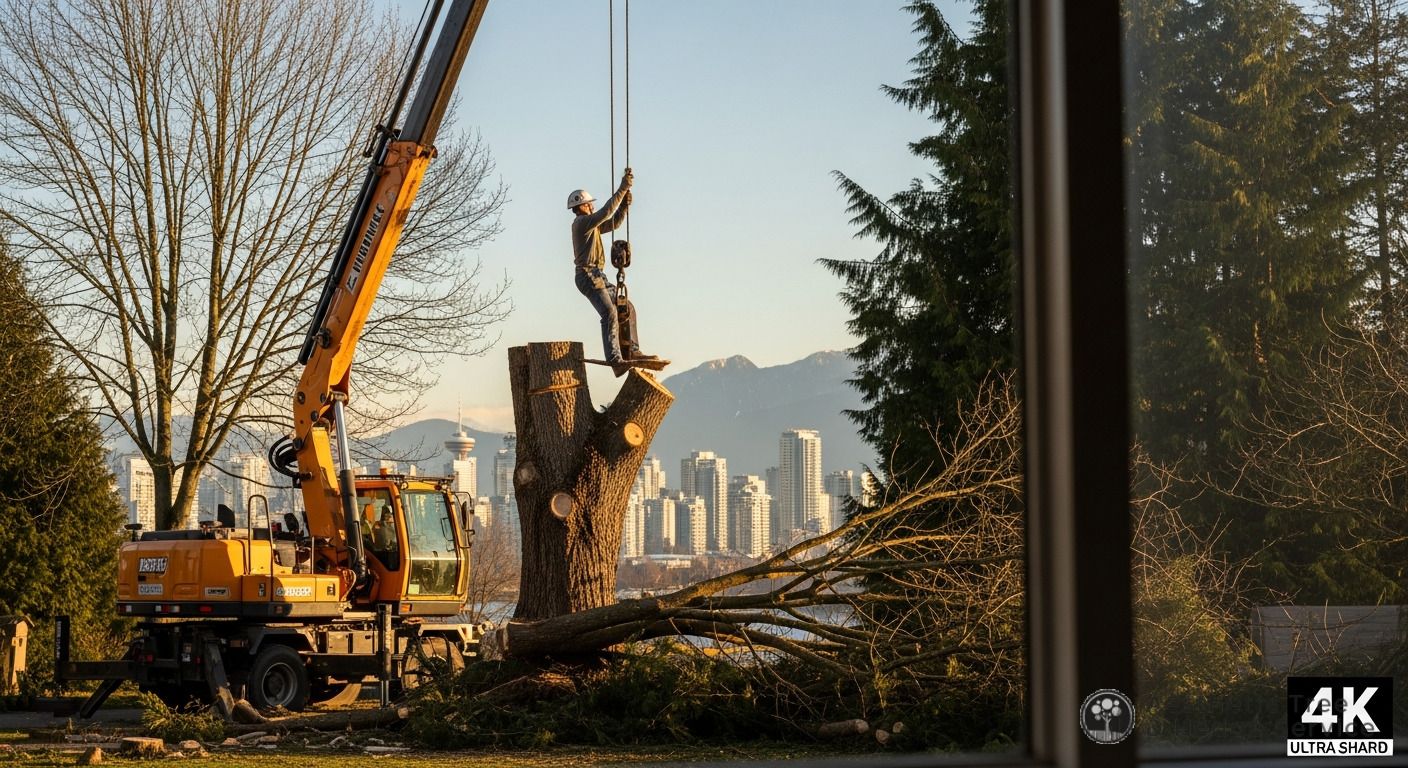
For larger removals or trees positioned over rooftops and outbuildings, we bring in a crane. Crane tree removal lifts sections directly upward and away, avoiding ground damage in confined spaces and allowing precision placement of heavy wood.
**Step 4 — Stump management** After the tree is down, you have options. We can leave a flush cut at ground level, or grind the stump below grade. Stump grinding removes the root crown and prevents future fungal colonization from the remaining wood — an important step when the original removal was triggered by decay.
**Step 5 — Written documentation** We provide written documentation of the hazard condition, the work performed, and any required bylaw notifications. This record is essential for insurance claims, neighbour disputes, and municipal compliance.
---
If you've spotted any of these signs on your property, don't wait for a storm to test the tree. Call Aesthetic Tree & Hedge Services at **(604) 721-7370** for a free estimate. Our ISA-certified, WCB-registered arborists serve Vancouver, Burnaby, North Vancouver, Richmond, Coquitlam, and the Lower Mainland. For emergencies, we respond same-day.
FAQ
**Q: How quickly can an ISA-certified arborist respond to a tree emergency in Vancouver?**
For active hazards — a hanging branch over a doorway, a tree actively leaning, or a tree that's already struck a structure — same-day response is standard. Call (604) 721-7370 directly. For priority assessments where the hazard exists but isn't immediately imminent, we typically schedule within 24–48 hours. During major storm events, response queues extend due to volume, so call as early as possible.
**Q: Will my home insurance cover emergency tree removal in Vancouver?**
Most BC home insurance policies cover emergency tree removal when the tree damages an insured structure — your home, a fence, or a detached garage. Coverage for trees that fall without striking a structure varies by policy and insurer. The Insurance Bureau of Canada recommends reviewing your policy specifically for "falling object" and "tree removal" clauses. Our written documentation of the hazard condition and emergency response supports your claim file directly.
**Q: Can I remove a dead tree on my own property without a permit in Vancouver?**
Not necessarily. Vancouver's Private Tree Bylaw protects trees meeting size thresholds — including dead ones. A dead tree with a trunk diameter of 20cm or greater at standard measurement height typically requires a permit before removal, unless it presents an immediate documented safety hazard. Before touching a dead tree, call 311 to reach City of Vancouver Urban Forestry, or consult a certified arborist for an on-site assessment first.
**Q: What tree species in Metro Vancouver are most likely to cause emergency situations?**
In our experience across Metro Vancouver, the species most commonly involved in emergency calls are: big-leaf maple (prone to large limb failure in wet conditions), red alder (fast-growing, short-lived, and prone to internal decay after age 30–40), and ornamental cherry trees (brittle wood, high susceptibility to storm damage). Mature Douglas fir can develop brittle top sections that fail in high-wind events. Cedar generally holds well but is susceptible to root rot in compacted urban soils. Species identification is part of every risk assessment we perform.
**Q: What's the difference between emergency tree service and regular tree removal?**
Emergency service is activated by an immediate or imminent hazard — a tree or branch that poses a risk to life or property right now. It means same-day mobilization, hazard zone establishment, and controlled sectional removal. Regular tree removal in Vancouver is a planned operation: scheduled in advance, permits applied for if required, and executed at a time that works for all parties. Emergency response reflects the urgency and resources required for immediate hazard situations. Both services follow ANSI A300 standards and WorkSafeBC requirements.
Before You Go
Where are you in your tree care journey?
Our Tree Care Services
ISA-certified arborists serving Greater Vancouver
Explore Our Tree Care Services
From expert pruning to safe tree removal, our ISA-certified arborists are ready to help across Greater Vancouver.
View Services