
Maple (Acer) Tree Care in Vancouver
Maple trees — the genus Acer — are among the most common and most misread trees on residential lots throughout the Vancouver area. They hold sentimental weight, carry structural complexity that isn't obvious from the street, and develop conditions that mimic each other closely enough to mislead both homeowners and inexperienced crews. Our team at Aesthetic Tree works with bigleaf maples, Japanese maples, and other acer species year-round, and what we find again and again is that early assessment — before the call ever goes to "trim it up" — changes the outcome for the tree and for the owner.
TL;DR
- Maple work requires a ground-up visual assessment before any scope of work is set — root collar first, crown second
- Verticillium wilt and girdling roots are the two most commonly missed conditions on acer calls in this region
- Pruning timing matters: avoid heavy maple work in late winter when sap pressure is high; target late fall or mid-summer instead
- Tar spot is cosmetic and does not require fungicide treatment — rake fallen leaves in autumn and leave the tree alone
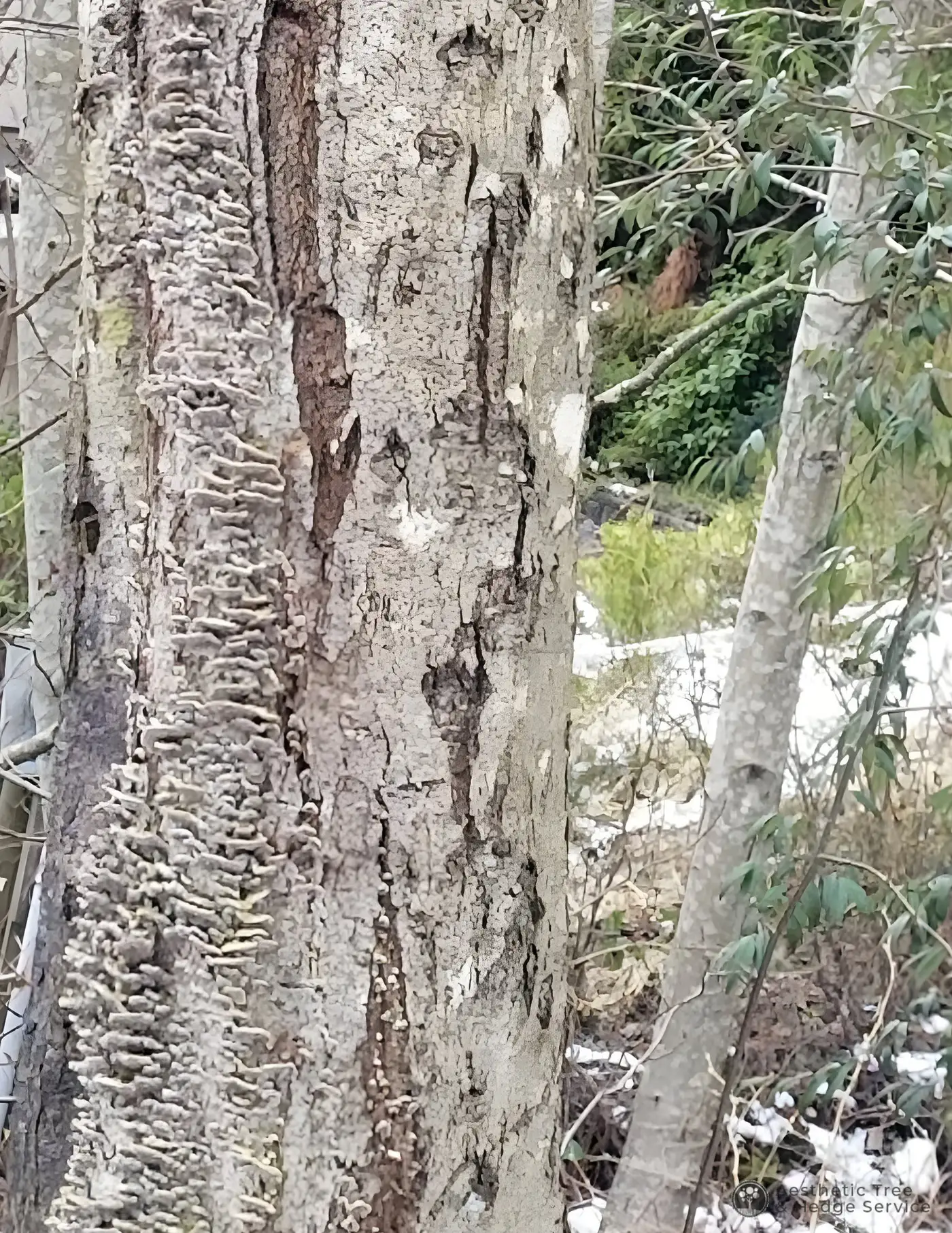
- If a limb flags early or bark texture shifts on one side of the trunk, don't wait a season — conditions like Verticillium wilt narrow your options quickly
- Our TRAQ certification means we assess trees as whole systems, not isolated symptoms

What Makes Acer Trees More Demanding to Service Than Other Species?
Maple trees develop branch architecture that genuinely slows the work down — and doing it right requires it. Mature bigleaf maples and ornamental Japanese maples tend to form codominant stems and tight, included-bark unions that require careful, deliberate cuts to avoid introducing large wounds or destabilizing the canopy. Each cut carries more consequence than it might on a conifer, and you cannot rush the assessment any more than you can rush the cuts.
Sap flow timing adds another layer of complexity. In late winter and very early spring, sap pressure in maples is building toward the spring flush. Heavy pruning during that window produces pronounced bleeding at wound faces, which creates extended moist conditions that invite fungal pathogens — particularly Nectria, which causes canker on maples and is widespread throughout the Pacific Northwest. Our team schedules accordingly: late fall after full leaf-drop, or mid-summer when active growth supports faster wound closure.
For removal work specifically, wood density is a real cost factor. Bigleaf maple is significantly denser than western red cedar of similar diameter, which affects how we section and lower it. Add to that the root systems on established maples — which often intertwine with adjacent plantings or run close to structures on the tighter lots common in Vancouver — and any removal plan carries more staging time than a comparable conifer would require.

Why Do So Many Maple Conditions Go Undiagnosed Until They're Advanced?
The most common pattern we see on acer diagnosis calls is a condition that was misread — or simply not read — during a previous assessment. The visible symptoms of Verticillium wilt, Nectria canker, root dysfunction, drought stress, and pest damage can look nearly identical from street level. Marginal leaf scorch in July or a flagging limb in early September gets written off as summer drought stress. An owner gives it another season. By the time a repeating pattern is unmistakable, the condition has often advanced significantly and the range of options has narrowed.
Two issues come up on acer calls more than any others in this region:
Verticillium wilt is a soilborne fungal disease that moves through the vascular tissue progressively. Early signs — marginal leaf scorch, premature fall colour on isolated branches, a wilting or flagging limb — look enough like drought stress that owners and some crews miss it for a full season or more. By the time the pattern repeats across two or three growing seasons, the fungus has often moved through a substantial portion of the vascular system and the range of responses has narrowed considerably.
Girdling roots are the other condition we see overlooked frequently, particularly on older Vancouver-area residential lots. A maple planted even a decade ago can develop circling roots that begin to compress the vascular tissue at the root collar while the canopy overhead still looks vigorous. Most symptom guides online don't prompt homeowners to check below grade, and visible crown health masks the problem until the compression is significant.
Our team does a full visual assessment before giving any scope of work — checking the root collar, looking for bark texture and colour changes, assessing branch unions for included bark — before we even discuss what the owner called us for. Starting with the crown and working down misses too much on maple calls. Maple work, more than most species we handle, rewards a ground-up read of the tree first.
What Does Common Online Maple Advice Get Wrong?
The most consistently repeated piece of wrong advice homeowners act on is pruning maples hard during dormancy in late winter or very early spring. This gets recommended widely. In our Pacific Northwest climate, that timing coincides with building sap pressure — cutting during that window produces heavy bleeding at wounds and leaves the tree more exposed to Nectria canker entry at wound faces.
Better timing: late fall after the tree has fully entered dormancy, or mid-summer when active growth supports faster wound closure.
The second piece of advice worth correcting is the idea that tar spot requires fungicide treatment. The black blotches on maple leaves caused by *Rhytisma acerinum* are a cosmetic issue — the tree isn't sick, and spraying for it is unnecessary. The right response is to rake and dispose of fallen leaves in autumn to reduce the spore load going into the next season, then leave the tree alone. Owners who apply fungicide for tar spot are addressing the wrong problem while potentially missing the one that actually matters.
When Is a Diseased Maple Past the Point of No Return?
This is the hardest conversation in acer work. It comes up most often with mature Japanese maples that carry significant sentimental value, where an owner has been managing what they believed was a recoverable situation across one or two seasons.
When Verticillium wilt has advanced to the point where it has moved through the vascular system extensively, there is no functional salvage path. Removing dead wood addresses the symptom, not the disease — the fungus persists in the soil and in the sapwood. It isn't something that can be pruned out, and no responsible treatment changes the biological outcome at that stage. The visible dieback is a symptom, not the disease itself.
Our team gives a clear, honest picture in those situations: what's happening biologically, why no intervention would change the trajectory, and what replanting in that spot requires — including whether soil conditions need to be addressed before anything new goes back in the ground. People who have grown a twenty-year-old Japanese maple in a garden their family shaped take that news hard. Clarity is the only thing we can offer that's actually useful.
When Verticillium is caught early — a single flagging limb while the rest of the canopy is still healthy — the range of responses is genuinely different. That's the case for calling us in the first season you notice something, not the second.
What Should You Do Right Now If Your Maple Is Showing Early Signs of Trouble?
Stop waiting to see if it comes back on its own. That's the honest answer. When a maple shows marginal leaf scorch in July, or a single limb flags early in September, or the bark texture changes on one side of the trunk, the instinct is to give it another season and see how it looks next spring. By the time that second spring comes and the problem is unmistakably worse, the condition has often progressed significantly and the options available have narrowed.
An ISA-certified arborist can differentiate drought stress from a pathogen from a structural problem in a way that a homeowner assessing from the sidewalk cannot — and catching Verticillium wilt, Nectria canker, or a failing root system in year one versus year three changes what's available to you.
In the Vancouver area specifically, consider whether anything significant has changed in the tree's immediate environment in recent years — grade changes, hard paving over root zones, or construction activity on adjacent lots. These changes accumulate silently. If surrounding conditions have shifted and you're now seeing crown symptoms, those two things are likely connected. Get a qualified set of eyes on it this season rather than next.
Book an Acer Assessment with Our Team
If a maple on your property is showing leaf scorch, early dieback, bark changes, or anything else that's giving you pause — don't wait a season to see how it looks next spring. By the time a pattern repeats, conditions like Verticillium wilt have often advanced beyond the point where the same responses are still available.
Our ISA-certified, TRAQ-credentialed team serves residential and commercial properties across Vancouver and the surrounding area. We approach every acer call with a full ground-up assessment before any scope of work is set — because maple work, more than most species we handle, rewards reading the whole tree before doing anything else.
Contact Aesthetic Tree to schedule your maple assessment.