Burnaby Tree Bylaw: 5 Mistakes Homeowners Make Before Trimming
TL;DR — Quick Summary
Hiring for tree trimming in Burnaby? Know the bylaw rules, nesting season windows, and why ISA-certified arborists matter. Free estimates: (604) 721-7370.
- Burnaby's Tree Bylaw protects conifers 30.5 cm or more in diameter and broadleaf trees 45.7 cm or more (measured 1.3 m above the ground) on lots without a development application. Pruning to accepted arboricultural practice needs no permit, but topping a protected tree counts as damage, and fines run $2,000 to $10,000 per violation.
- The City of Burnaby's bird nesting season runs March 15 to August 15. Check for active nests before pruning: injuring, molesting or destroying an occupied nest is an offence under section 34 of BC's Wildlife Act.
- ISA Certified Arborist credentials can be checked through the ISA credential directory linked from treesaregood.org.
- Ask any contractor for a WorkSafeBC clearance letter. If the business isn't registered and paying premiums, WorkSafeBC says you as the customer could be held responsible for its unpaid premiums.
Most Burnaby homeowners book tree trimming the same way they'd book a gutter clean. They search online, pick someone with decent reviews, and schedule a time. It feels straightforward. But trees in Burnaby aren't just a landscaping concern, they're subject to bylaws, wildlife protections, and safety regulations that most homeowners don't know about until something goes wrong.
A few things can go wrong. A crew starts cutting in April and finds an active nest in the canopy, so the job has to stop. A neighbour reports work on a protected tree. Or poor cuts leave a tree in structural decline a few years later.
Tree trimming in Burnaby is more complicated than it looks. Here are five things homeowners routinely get wrong, and what to do instead.
Does Burnaby's Tree Bylaw Apply to Trimming, or Just Removal?
The short answer: the bylaw covers damage as well as removal, but ordinary pruning done to accepted arboricultural practice does not need a permit.
Under the Burnaby Tree Bylaw (Bylaw No. 10482), a protected tree on a property with no current development application is any conifer 30.5 cm (12 in.) or more in diameter, or any broadleaf tree 45.7 cm (18 in.) or more. If a development application is in progress, the threshold drops to 20.3 cm (8 in.) for any tree. Diameter is measured 1.3 metres above the ground; for a multi-stemmed tree, it is the sum of the three largest stems. Covenanted trees, replacement trees and trees in streamside protection areas are protected too (source: City of Burnaby, Burnaby Tree Bylaw, consolidated 2022).
In practice, a mature Douglas fir or bigleaf maple in a Burnaby backyard may well pass those thresholds. Before your trimmer touches it, confirm whether the tree is protected and whether the planned work goes beyond normal pruning.
The bylaw is specific about what needs a permit. Pruning "in accordance with accepted arboricultural practices" is exempt. So is the emergency removal of a protected tree that severe weather has left in imminent danger of falling, as long as the City is told right away. Topping a tree, or removing branches other than in accordance with accepted practice, counts as damage, and damaging a protected tree is not allowed (source: City of Burnaby, Burnaby Tree Bylaw, sections 2 to 4).
What happens if the rules are ignored? The bylaw sets fines of $2,000 to $10,000 for each violation. If a protected tree is cut down, or damaged so badly that it has to come down, the City can also require replacement trees to be planted (source: City of Burnaby, Burnaby Tree Bylaw, sections 15 and 19).
The practical fix is simple: before you book any significant trimming work, have a certified arborist assess the tree. They can tell you upfront whether the work needs a permit and can manage the application process on your behalf. Trying to sort that out after you've already committed to a date is where things get complicated.
Explore our tree care services to see how an arborist assessment works before any trimming begins.
Why Does Nesting Season Actually Matter for Burnaby Tree Trimming?
Nesting season is easy to overlook, and it has legal consequences.
The City of Burnaby sets bird nesting season as March 15 to August 15. During that window, the City asks anyone pruning or removing a tree or other vegetation to confirm there are no active nests first, and to wait until the birds leave if there are (source: City of Burnaby, Tree Removal & Replacement). Section 34 of BC's Wildlife Act makes it an offence to injure, molest or destroy a bird or its egg, or the nest of a bird while it is occupied by a bird or its egg (source: Wildlife Act, RSBC 1996, c. 488).
The difficulty is that nests are often hard to see from the ground. A dense cedar hedge or a leafy ornamental cherry can hide a nest until cutting starts.
A pre-work nest check means a careful look through the whole canopy before any cutting, watching for nest structures, birds flushing, or territorial behaviour. Ask whoever you hire whether they do one between March 15 and August 15, and whether they record what they find.
If you need trimming done during nesting season, you have two sensible options. The first is to schedule the work between August 16 and March 14, outside the City's nesting window. The second is to have the tree checked for active nests before work starts. If none are found, the work can go ahead. If there is an active nest, the City's guidance is to wait until the birds have left.
Don't assume a crew will check for nests unless you ask.
How Do You Actually Verify a Tree Trimmer's Credentials in Burnaby?
Not everyone who calls themselves an arborist is one. This is worth understanding before you hire anyone.
Anyone can describe themselves as an arborist on a website or business card, so look for a credential you can check. One is the ISA Certified Arborist credential, issued by the International Society of Arboriculture.
ISA describes its Certified Arborists as people trained and knowledgeable in all aspects of arboriculture who agree to adhere to its Code of Ethics (source: International Society of Arboriculture, ISA Certified Arborist).
To verify an ISA Certified Arborist, go to treesaregood.org and follow the link to the ISA credential directory. If a company says it has certified arborists on staff, ask for their names and certification numbers so you can check them yourself.
The second check is WorkSafeBC. WorkSafeBC recommends that before you hire an independent business, you make sure it is registered and making its payments. If it isn't, you as the customer could be held responsible for its premiums (source: WorkSafeBC, Homeowners).
To verify WorkSafeBC registration, visit worksafebc.com and request a clearance letter for the company. A clearance letter shows whether a business is registered with WorkSafeBC and in good standing, and it's free to request online. Any legitimate Burnaby tree service company should be comfortable with you checking.
Both checks are free, and both tell you more than a star rating.
A few other red flags worth watching for: no physical business address listed, no proof of liability insurance on request, pressure to pay cash to "save you the tax," and crew members who can't answer basic questions about tree biology or the bylaw. These are signs that what you're getting isn't a certified arborist, it's someone with a chainsaw and a truck.
Contact our team if you'd like to confirm our credentials before booking. Our arborists are ISA-certified, and every crew member is covered by WorkSafeBC.
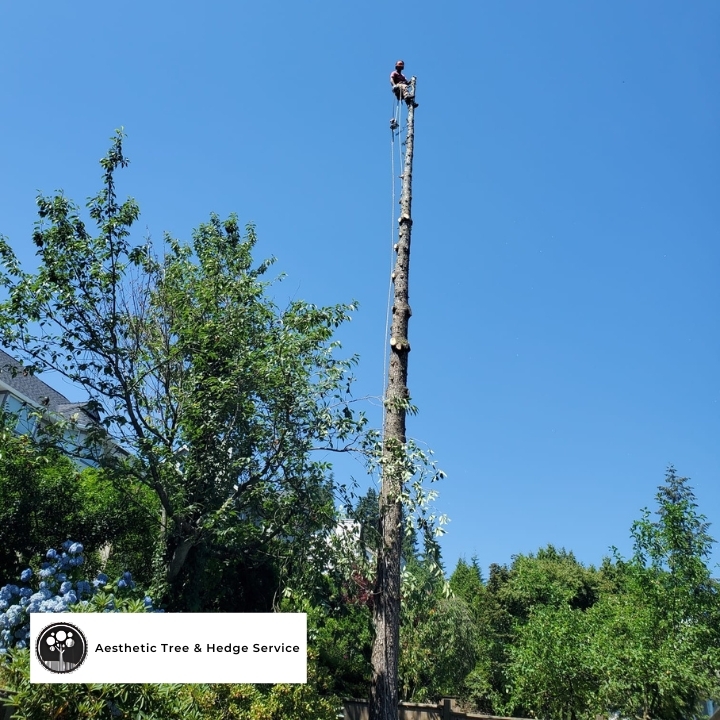

What Happens When a Tree Is Topped?
ISA describes topping as the indiscriminate cutting of tree branches to stubs, or to lateral branches that are not large enough to take over as the leader. It is often done to shrink a tree that seems too big for its yard (source: International Society of Arboriculture, Why Topping Hurts Trees).
The damage follows a predictable pattern. Topping can remove 50 to 100 percent of a tree's leaf-bearing crown, which can starve the tree. Dormant buds then push out multiple fast-growing shoots below each cut, and those shoots are anchored only in the outer layers of the branch, so they break easily in wind or ice. Stubs the tree can't close begin to decay, and bark suddenly exposed to sun can burn (source: ISA, Why Topping Hurts Trees).
A topped tree can never fully regain its natural form, and if it survives it will likely need corrective pruning within a few years (source: ISA, Why Topping Hurts Trees).
Local rules reflect this. Burnaby's bylaw treats topping a protected tree as damage, and Vancouver's Protection of Trees By-law No. 9958 lists topping a tree among prohibited activities. An arborist assessment before any height reduction is the way to avoid it.
What's the Real Difference Between Tree Trimming and Pruning, and Why Does It Matter?
In everyday conversation, trimming and pruning are the same word. In arboriculture, they're not, and the difference matters for your trees.
Tree trimming, in the professional sense, usually refers to cutting back branches to maintain shape, clear space, or manage growth. It's often aesthetic. It's the job you book when the apple tree in your Edmonds backyard is getting into the eaves, or when branches from the street-side maple are hanging over your driveway.
Pruning is more targeted. It means selectively removing specific branches for defined purposes, improving structure, removing deadwood, reducing disease exposure, managing weight distribution in the crown, or preparing a tree ahead of a storm season.
The practical issue with over-cutting is documented and real. Removing too much live growth at once, and in the worst cases topping, strips a tree of the leaves it needs to feed itself. Topped trees show it over time: sunburned bark, fast-growing, weakly attached shoots below each cut, and decay in wounds the tree can't close. ISA calls topping perhaps the most harmful tree pruning practice known (source: ISA, Why Topping Hurts Trees).
Many homeowners book "trimming" without realizing what they actually need is a structural pruning job. And some ask for heavy pruning thinking it'll rejuvenate a struggling tree, when what they've described would cause significant stress. Getting this right starts with someone who can assess the tree before quoting, not after.
In Burnaby, the stakes are higher with older trees. Large, mature bigleaf maples, Douglas firs and western red cedars need pruning informed by their species and current structural condition, not a standard trim.
Our ISA-certified arborists serve Burnaby neighbourhoods from Metrotown to Edmonds and can assess what your trees actually need before any cutting begins.
What Does Tree Trimming Actually Cost in Burnaby, and What's Driving the Price?
The pricing range for residential tree trimming in Metro Vancouver is wide enough that a single quote without context doesn't tell you much.
For an accurate price, get at least two quotes from qualified arborists and make sure each one covers the same scope of work.
Five factors drive pricing more than anything else:
Access. A tree in the open middle of a lawn is significantly faster to work on than one growing against a fence, over a deck, between structures, or near utility lines. Restricted access means more time and more careful rigging, both cost more.
Size and species. A mature Douglas fir requires different equipment, more hands, and more time than a young ornamental cherry. Dense wood and large branch diameter matter, as does height.
Condition. A structurally compromised tree, one with visible decay, multiple competing leaders, significant storm damage, or evidence of past poor pruning, requires a higher level of skill and more deliberate work. A general crew isn't the right fit for a compromised tree.
Debris disposal. Most professional crews include chip and debris removal in their quote. Confirm this. Low-cost operators sometimes quote for the cutting only and leave debris for you to deal with.
Permit requirements. If the work means removing a protected tree, factor in the permit application and the City's replacement-tree requirements. An arborist who handles this on your behalf adds value that shows up in the quote.
A price that's significantly below everything else you're seeing is worth questioning. It can reflect the absence of WorkSafeBC coverage, missing liability insurance, or an undertrained crew doing work that looks like pruning but isn't.
Which Burnaby Neighbourhoods Have the Most Complex Tree Situations?
Burnaby isn't a uniform place when it comes to trees. Different neighbourhoods have distinct challenges shaped by their age, terrain, density, and development history.
Burnaby Heights is one of the city's older residential areas. The properties here have mature street trees and large backyard specimens, including bigleaf and Norway maples. Trees this old and this large need structural pruning, not standard trimming. Their root systems often conflict with driveways and foundations. Their crowns are massive. Permit requirements are common, and the work requires someone who knows what they're looking at.
Capitol Hill sits on higher ground, and wind exposure is a significant factor. Trees here experience more mechanical stress than those in sheltered lower neighbourhoods. Storm damage trimming is a recurring need, and the topography can make access difficult. Trees growing on slopes also have asymmetric weight distribution in their crowns, something that matters when deciding how much to remove and from which side.
Highgate and similar areas can have medium-sized ornamental trees such as cherries, Japanese maples and magnolias. The work is often more predictable in scale, but proximity to fences and adjoining properties is a constant consideration. A medium ornamental cherry growing directly along a property line requires careful rigging to keep everything on the right side of the fence.
Metrotown and the surrounding area is a mix of older single-family properties and newer condo developments. Older lots sometimes have trees that predate the surrounding development significantly. These weren't planted as urban trees, they were growing in relatively open conditions before density arrived around them. They didn't adapt to constrained space, and they often show the stress of it.
Edmonds and other older areas can include lots with long-established fruit trees such as apple and pear. Old fruit trees are often neglected for years before a homeowner decides something has to happen. Fruit tree management is its own discipline: the timing of cuts, the approach to renewal pruning, and the goal of preserving productive structure all differ from standard shade tree work.
Knowing which neighbourhood you're in and what kind of trees you have shapes every decision about how and when to trim.
About Aesthetic Tree & Hedge Services
Aesthetic Tree & Hedge Services is a locally owned tree care company that has served the Lower Mainland since 2004. Founder Yaniv Biton is an ISA Certified Arborist, our arborists hold ISA certification and the Tree Risk Assessment Qualification (TRAQ), and every crew member is covered by WorkSafeBC. We carry $3 million in liability insurance, prune to ANSI A300 standards (never topping), and handle Burnaby Tree Bylaw 10482 permit applications for our clients.
FAQ
What size of tree is protected under Burnaby's bylaw?
On lots without a development application, Burnaby's Tree Bylaw protects conifers 30.5 cm or more in diameter and broadleaf trees 45.7 cm or more, measured 1.3 metres above the ground. Pruning done to accepted arboricultural practice doesn't need a permit. Cutting down a protected tree does, and topping or otherwise damaging a protected tree is not allowed.
Can I book tree trimming in Burnaby during spring or summer?
Yes, with a nest check. The City of Burnaby's nesting season runs March 15 to August 15, and the City asks that you confirm there are no active nests before pruning. Disturbing an occupied nest is an offence under BC's Wildlife Act. If an active nest is found, the work waits until the birds have left.
How do I verify that a Burnaby tree company has ISA-certified arborists?
Go to treesaregood.org and follow the link to the ISA credential directory to check an arborist's certification. For WorkSafeBC, request a clearance letter, which shows whether the company is registered and in good standing. Both checks are free.
What's the safest time of year for tree trimming in Burnaby?
Work scheduled between August 16 and March 14 falls outside Burnaby's bird nesting season, so it avoids the nest check the City asks for during that window. In late winter, deciduous trees are also leafless, which makes branch structure easier to see before cutting. The right timing for a specific tree still depends on its species and condition.
Is topping a tree ever the right choice?
No. ISA calls topping perhaps the most harmful tree pruning practice known. It leaves stubs the tree may not be able to close, which lets decay in, and it triggers weakly attached shoots that break easily. Burnaby's bylaw treats topping a protected tree as damage. When a tree needs to be smaller, cutting larger limbs back to a lateral branch at least one-third their diameter, selective thinning, or removal and replacement are better options.
What happens if a tree company damages my tree and doesn't have WorkSafeBC coverage?
WorkSafeBC coverage is workplace insurance for workers, not insurance for your property. If you hire a business that isn't registered or isn't paying its premiums, WorkSafeBC says you could be held responsible for those premiums, so ask for a clearance letter before work starts. For damage to your tree or property, ask the company for proof of liability insurance.
How much does it typically cost to trim a large tree in Burnaby?
It depends on access, species, condition, debris removal, and whether permits are involved, so a single figure isn't meaningful. An on-site assessment from a certified arborist is the reliable way to get an accurate number for your specific tree.
The difference between a good tree trimming job and a damaging one usually comes down to one thing: whether the person holding the saw has the training to know what they're doing and the credentials to prove it. In Burnaby, where the bylaw is real, nesting season is real, and the trees in older neighbourhoods are genuinely large and complex, that difference matters.
Call Aesthetic Tree & Hedge Services for a free estimate: (604) 721-7370. ISA-certified arborists. WorkSafeBC registered. Serving Burnaby and the Lower Mainland.
Found this helpful? Follow our tree care insights directly on Google.
Make us your preferred source on GoogleOur Tree Care Services
ISA-certified arborists serving Greater Vancouver
Explore Our Tree Care Services
From expert pruning to safe tree removal, our ISA-certified arborists are ready to help across Greater Vancouver.
View Services