
City of Richmond Tree Trimming | ISA-Certified Arborists
In Richmond you need a permit to trim or remove any tree 20 cm or more in diameter at breast height, measured 1.4 m above ground, and unauthorised removal can be pursued to a fine of up to $50,000 per tree ([City of Richmond](https://www.richmond.ca/services/climate/environment/treeremoval.htm)). Richmond's high water table also makes shallow-rooted mature trees unusually sensitive to heavy canopy reduction.
Richmond's flat delta landscape hides a specific set of tree trimming challenges. The city's high water table produces mature trees with shallow, laterally extended root systems; its clay soils affect how load is distributed when canopy weight is removed; and its municipal tree protection bylaw adds a permit step most homeowners don't factor into their timelines. At Aesthetic Tree, our team treats a Richmond property assessment as its own site-specific process, not a minor regional variation on a Vancouver approach.
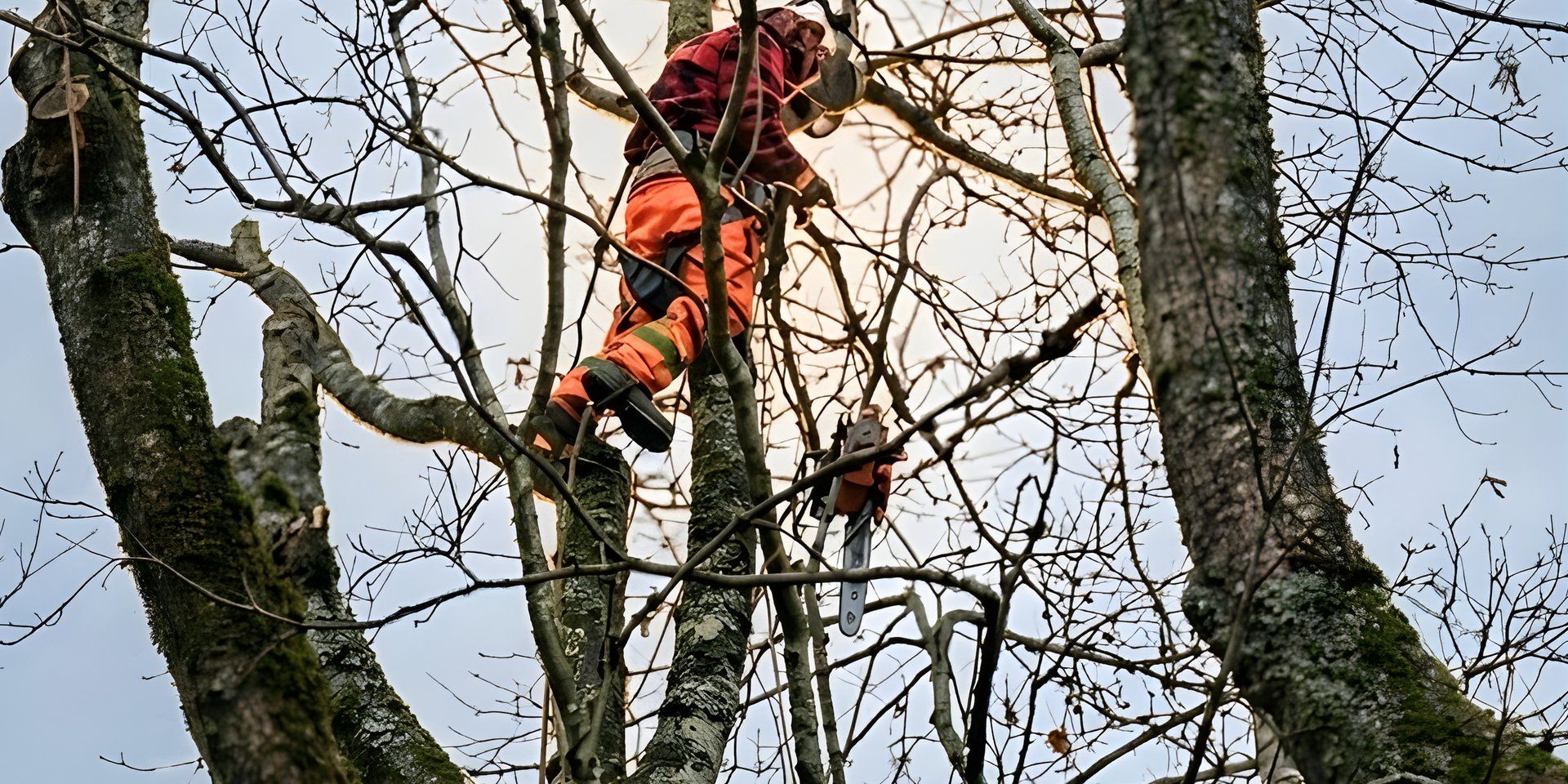
What Makes Tree Trimming in Richmond Different from Other Metro Vancouver Cities?
Richmond sits on the Fraser River delta, and that geography directly affects how trees grow and how they need to be managed.
The high water table means even large, mature trees tend to develop root systems that spread laterally rather than deeply. When our team at Aesthetic Tree plans a canopy reduction on a Richmond tree, a large ornamental cherry near the Dyke Road corridor or a spreading maple in Steveston, the risk assessment shifts in ways not obvious from street level. Removing significant canopy weight asymmetrically on a tree with a shallow root plate, in Richmond's heavier clay soils, can alter how load is distributed across that root system. That assessment step is non-negotiable regardless of how routine the work appears.
Properties near the agricultural land reserve boundary also present utility infrastructure in configurations less common in denser urban areas. What looks like a standard clearance trim from the road can require a more deliberate rigging plan once an arborist is actually in the canopy.
Why Are Ornamental Cherry Trees a Recurring Problem for Richmond Property Owners?
Richmond has a high density of ornamental cherry trees, boulevard and residential, and they're one of the most consistent sources of avoidable, expensive problems our team sees.
The core issue is deferred maintenance. When pruning is skipped for five or six growing seasons, the corrective cuts needed to restore structure become large. Large pruning wounds on cherry trees are entry points for silver leaf disease and bacterial canker, both active in the Lower Mainland through wet winters.
The fix: commit to a three-year pruning cycle while the tree is young enough to keep corrective cuts small. Late fall or late winter, just before bud break, is the right window. Cuts heal faster during dormancy and disease pressure is lower. Homeowners who maintain that rhythm end up with trees that hold form through wind events and rarely need emergency response, which costs significantly more than the routine maintenance that would have prevented it.
The Richmond rules, in numbers
Richmond's Tree Protection Bylaw No. 8057 is stricter than most homeowners expect, and the thresholds are specific enough to check before you call anyone.
The permit trigger is size. In the City of Richmond's own words, you may not remove "any tree larger than 20 cm (7-7/8 inches) in diameter at breast height (dbh - measured at 1.4m or 4'7" above the ground) without a permit". For a multi-stem tree the measurement is weighted: the full diameter of the largest trunk plus 60% of each additional one ([City of Richmond](https://www.richmond.ca/services/climate/environment/treeremoval.htm)).
Three figures worth carrying into the decision:
- $50,000 per tree: the maximum fine the [City of Richmond](https://www.richmond.ca/services/climate/environment/treeremoval.htm) can pursue for unauthorised removal.
- 72 hours: the permit must be displayed before work begins.
- 12%: Richmond's city-wide canopy cover as measured by 2017 LiDAR, against a public-realm target the Public Tree Management Strategy states as: "Increase canopy cover over the public realm from 20% to 30% by 2045."
That last number explains the enforcement posture. A city working to add canopy treats a removed mature tree as a setback it has to buy back, which is why replacement planting is attached to most permits rather than offered as an option.
Permit fees are small next to the work itself. Published figures put a single-tree application in the region of $60 to $80, with each additional tree in a similar band, though the schedule is updated periodically and the figure below is indicative rather than quoted ([City of Richmond](https://www.richmond.ca/services/climate/environment/treeremoval.htm)), Richmond's permit desk at 604-276-4118 gives the current schedule in one call. For comparison, [Vancouver](https://vancouver.ca/your-government/protection-of-trees-bylaw.aspx) sets the same 20 cm threshold but a much lower penalty range: a minimum of $500 and a maximum of $10,000 per offence under its Protection of Trees By-law ([City of Vancouver](https://vancouver.ca/your-government/protection-of-trees-bylaw.aspx)).
Two comparisons put Richmond's regime in context. The [City of Vancouver](https://vancouver.ca/your-government/protection-of-trees-bylaw.aspx) uses the same 20 cm threshold but caps penalties at $10,000 per offence against Richmond's $50,000. And if a dispute over a trimmed tree ends up as a claim, the [Limitation Act, SBC 2012](https://www.bclaws.gov.bc.ca/civix/document/id/complete/statreg/12013_01) gives you 2 years from discovering the damage, with a 15-year outer limit.
Frequently Asked Questions
Does the City of Richmond require a permit to trim or remove a tree on my property? Yes. Richmond's tree protection bylaw sets caliper and height thresholds that trigger a permit requirement before any work can begin. The permit process runs on the city's timeline, build several weeks into your planning, particularly before fall wind season.
Why is my ornamental cherry tree producing so many vertical shoots after being trimmed by a previous company? Those vertical shoots, epicormic growth, are a common response to topping. When the main leader and scaffold branches are cut to stubs, the tree pushes weakly attached, fast-growing shoots from just below each cut. This growth rebuilds toward original height within a few seasons on structurally inferior wood. Remedial pruning is possible but more complex and expensive than the directional crown reduction that should have been done originally.
Why does my Richmond tree lean more than similar trees I've seen in other cities? Trees near the dyke system or in wind-exposed Richmond locations develop pronounced directional lean and reaction wood as a structural adaptation to prevailing winds. Trimming a wind-adapted tree to appear symmetrical can increase mechanical failure risk by removing the wood the tree built specifically to handle its wind environment.
My neighbour is extending a driveway close to a tree on our shared property line. Should I be concerned? Root zone impact from construction is an underrecognized stress contributor for Richmond trees. Root severance and soil compaction on trees already under summer drought stress creates a compounded risk that can take one to three growing seasons to manifest visibly. An assessment before the construction begins gives far more options than one after.
How can I tell if a tree trimming quote is for genuine pruning versus topping? A legitimate directional crown reduction proposal describes which branches will be removed and where cuts land relative to lateral branching. A topping quote typically emphasizes height reduction without specifying cut placement. If the quote is based entirely on height and reach without a site visit, ask more specific questions before agreeing to the work.
Contact Aesthetic Tree for a Richmond Tree Assessment
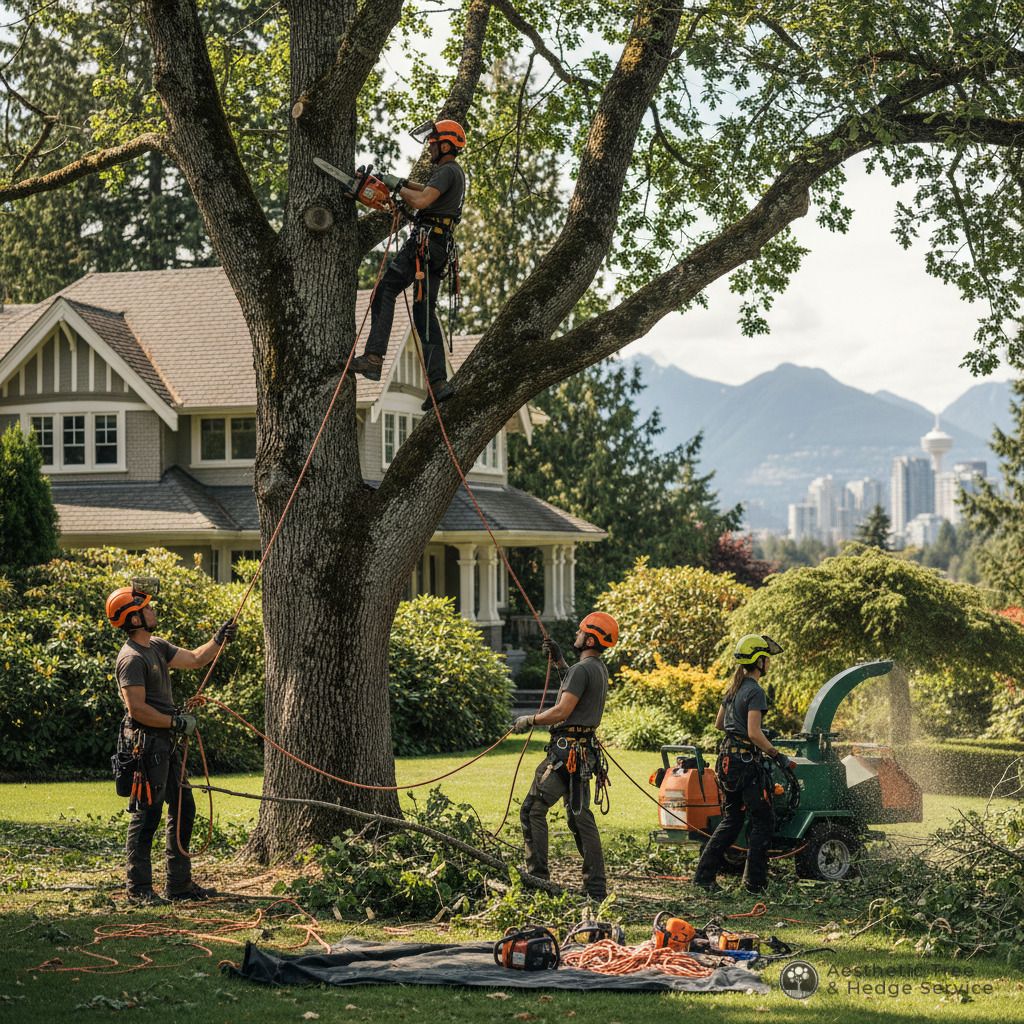
If a tree on your Richmond property needs trimming, structural assessment, or a removal review, our team at Aesthetic Tree brings ISA-certified arborist expertise to every site visit. Every assessment covers root zone condition, structural lean, branch attachment angles, and what's below the canopy, not a quote based on height alone.
Tree trimming costs in Richmond vary based on species, size, site access, permit requirements, and tree condition. For accurate pricing, contact Aesthetic Tree for a personalised on-site assessment.