
Fiber Company Caused Spruce Removal — Is It Worth Pursuing?
If a contractor removed your trees without consent or a permit, you may have a claim, but document it before you talk to them. Get an independent arborist's assessment, keep every exchange in writing, and check the limitation period: in BC a property damage claim runs two years from the date you discovered it.
When a fiber company causes the removal of two mature 50-foot Norway Spruce trees from your property, especially without advance notice or a permit, the question of whether to pursue the claim usually comes down to one decision made in the first 72 hours. At Aesthetic Tree, our team sees this pattern regularly across Metro Vancouver: a crew arrives to install or upgrade conduit, work proceeds without the property owner's knowledge, and the owner discovers the loss only when they notice the stump. Whether you recover what you're actually owed depends far more on what you do before you speak to the company than on whether you decide to file at all.
What Actually Happens When a Fiber Company Removes Your Trees Without Notice?
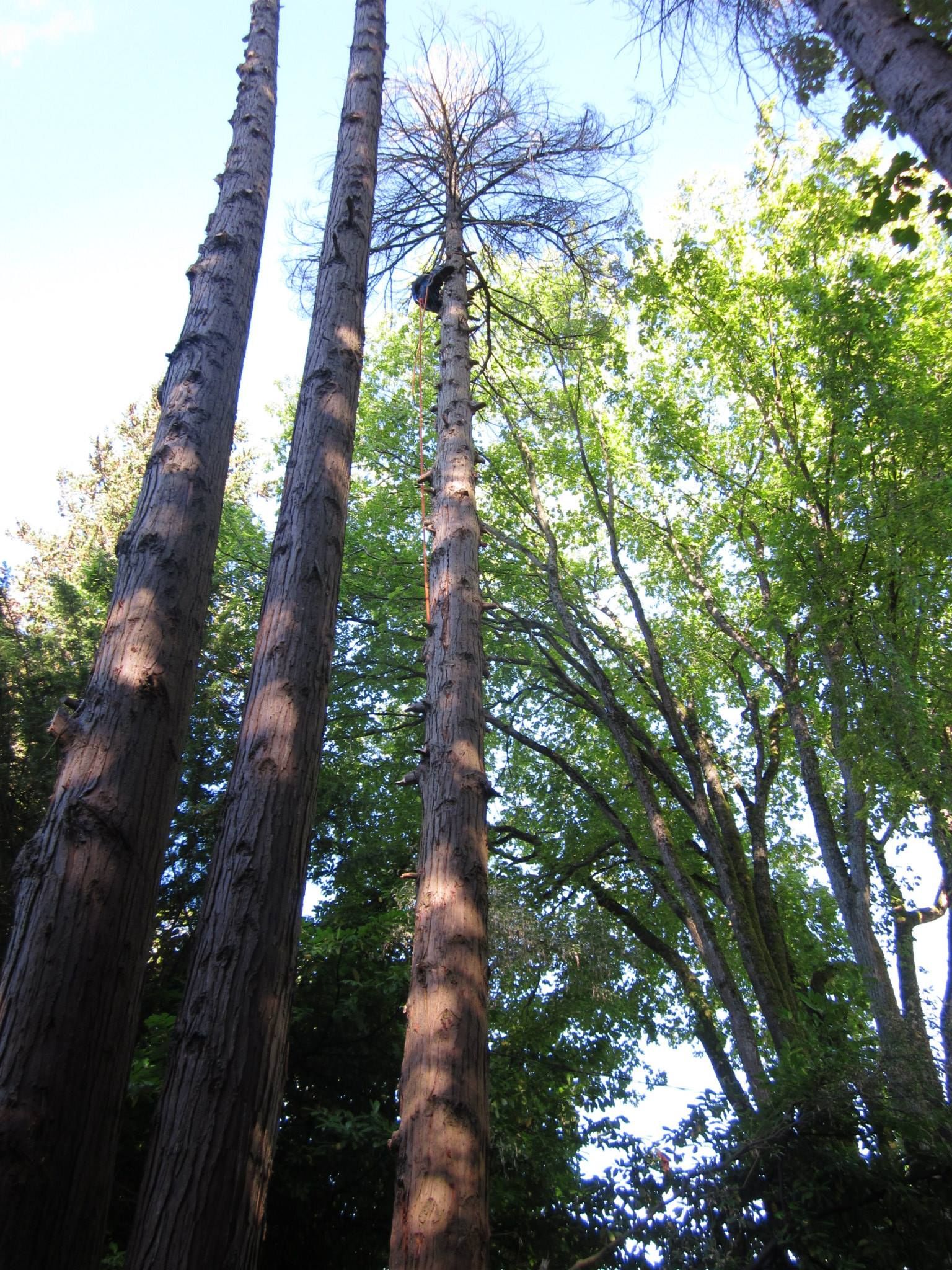
The pattern our team at Aesthetic Tree sees most often follows a recognizable sequence. A fiber crew arrives to run conduit through a boulevard or utility corridor. No one notifies the property owner in advance. By the following morning, there are roots severed at the drip zone, bark stripped by equipment, or, in the worst cases, the crew has decided on their own that a tree is "in the way" and removed it without a permit. The owner finds out after the fact, sometimes only when they notice the stump.
What happens next is what matters most. The crew returns to clean up debris. The site looks tidy. Someone from the company's office reaches out and indicates they want to make things right. This interaction feels cooperative, and many owners read it as a sign the process will be straightforward. What's actually happening is that the company is establishing their version of events before any independent assessment exists. By the time the owner calls us, the site has sometimes been partially cleared, root damage from excavation may be covered over, and evidence of how the work was conducted is gone.
Property owners who come away reasonably whole are almost always the ones who called an arborist first, before they had their first real conversation with the company's claims department.
What Do You Do First, Call the Fiber Company or Call an Arborist?
Call the arborist first. Every time.
An independent arborist assessment costs a consultation fee and preserves your options. You can always choose not to file a claim after you have the report in hand. You cannot go back and document damage that has been cleaned up and the evidence is gone.
At Aesthetic Tree, our team provides independent assessments using the TRAQ (Tree Risk Assessment Qualification) methodology recognized by the International Society of Arboriculture. A signed TRAQ report carries formal weight in property damage disputes and with municipal authorities. Before you return the fiber company's call, before you accept any offer, before you allow their crew back on the site, get that report.
What the law actually gives you here
A fibre or hydro contractor cutting a tree on private land sits in an awkward gap, and it is worth knowing where the edges are before you spend money chasing it.
BC Hydro may enter land and remove vegetation it considers a threat to its infrastructure under the [Hydro and Power Authority Act](https://www.bclaws.gov.bc.ca/civix/document/id/complete/statreg/96212_01), and the Community Charter exempts it from municipal tree bylaws. A telecom contractor is not BC Hydro. We found no BC statute requiring either to give a homeowner notice before cutting. BC Hydro's own position, given to Global News, puts it plainly: "It's not an obligation, it's just the right thing to do."
Three numbers shape whether pursuing it is worth your time:
- $5,000: the ceiling for the [Civil Resolution Tribunal](https://decisions.civilresolutionbc.ca/), and claims at or under it must start there rather than in court.
- $35,000: the BC Provincial Court small claims limit, in force since 1 June 2017 ([BC Provincial Court](https://www2.gov.bc.ca/gov/content/justice/courthouse-services/small-claims)).
- 2 years: the basic limitation period under the *Limitation Act*, SBC 2012, running from when you discovered the damage, with a 15-year hard outer limit.
On value, BC courts have not treated a mature tree as firewood. In Prowal v. Court (BC Supreme Court, May 2024), as [reported by CTV News](https://www.ctvnews.ca/vancouver/article/bc-court-awards-22k-in-damages-in-neighbour-dispute-over-trees/), an owner was awarded $22,925 over five felled Douglas firs, though the judge cut the arborist's $25,900 replacement figure by 25% because the owner showed no intention of actually replanting ([CTV News](https://www.ctvnews.ca/vancouver/article/bc-court-awards-22k-in-damages-in-neighbour-dispute-over-trees/)). That detail matters more than the headline: the award tracks what you will really do, not what the loss feels like.
This is general information, not legal advice, and your municipality's bylaw may change the picture. If a contractor has cut your tree, photograph everything and get advice while the limitation clock is early.
Frequently Asked Questions
Is it worth pursuing a claim against a fiber company that removed my 50ft Norway Spruce trees without permission? In most cases, yes, particularly for trees of this size. The key factor is whether you secure independent documentation before the site is disturbed. Replacement value under the CTLA methodology is typically far higher than removal cost alone, and that gap represents real, recoverable loss. An arborist assessment before you engage with the company's claims department is the single most important step.
What is the CTLA trunk formula and why does it matter for my claim? The CTLA trunk formula is the published methodology from the Council of Tree and Landscape Appraisers for calculating appraised tree value. It accounts for species, size, condition, and location, not just what it costs to cut the tree down. For mature specimens like two 50-foot Norway Spruce, the appraised value can be substantially higher than removal cost alone. That difference is what you're entitled to claim, and what a company's initial offer frequently omits.
Does a fiber company need a permit to remove trees in Metro Vancouver? Yes. The City of Vancouver requires a permit before removing protected trees, generally those 20 cm DBH or larger. Two 50-foot Norway Spruce almost certainly exceed that threshold. If the company removed those trees without a permit, that is a bylaw violation, separate legal exposure that supports your claim and gives you grounds for a formal municipal complaint.
What evidence should I gather after a fiber company removes my trees without notice? Photograph the site immediately, stumps, root zones, any excavation or equipment damage to surrounding soil. Do not allow the company's crew back on the site to clean up before an independent arborist has assessed the damage. Keep all written communications, note any verbal statements with names and dates, and request written confirmation of anything the company tells you verbally.
How do I find a TRAQ-certified arborist to assess fiber company tree damage? TRAQ (Tree Risk Assessment Qualification) is a credential issued through the International Society of Arboriculture. A signed report from a TRAQ-certified arborist carries formal weight in property damage disputes and with municipal authorities. Our team at Aesthetic Tree holds ISA certification and can provide the independent assessment and CTLA replacement valuation you need before entering any claim conversation.

Talk to Our Team at Aesthetic Tree Before You Talk to the Fiber Company
If a fiber or utility company has caused the removal of trees on your property, the time to act is before you respond to their first offer. Our team at Aesthetic Tree provides independent arborist assessments, CTLA replacement valuations, and the written documentation property owners need to pursue what they're actually owed, not just what's convenient for the company's claims department.
[Contact Aesthetic Tree to book an independent assessment](https://aesthetictree.ca/contact)