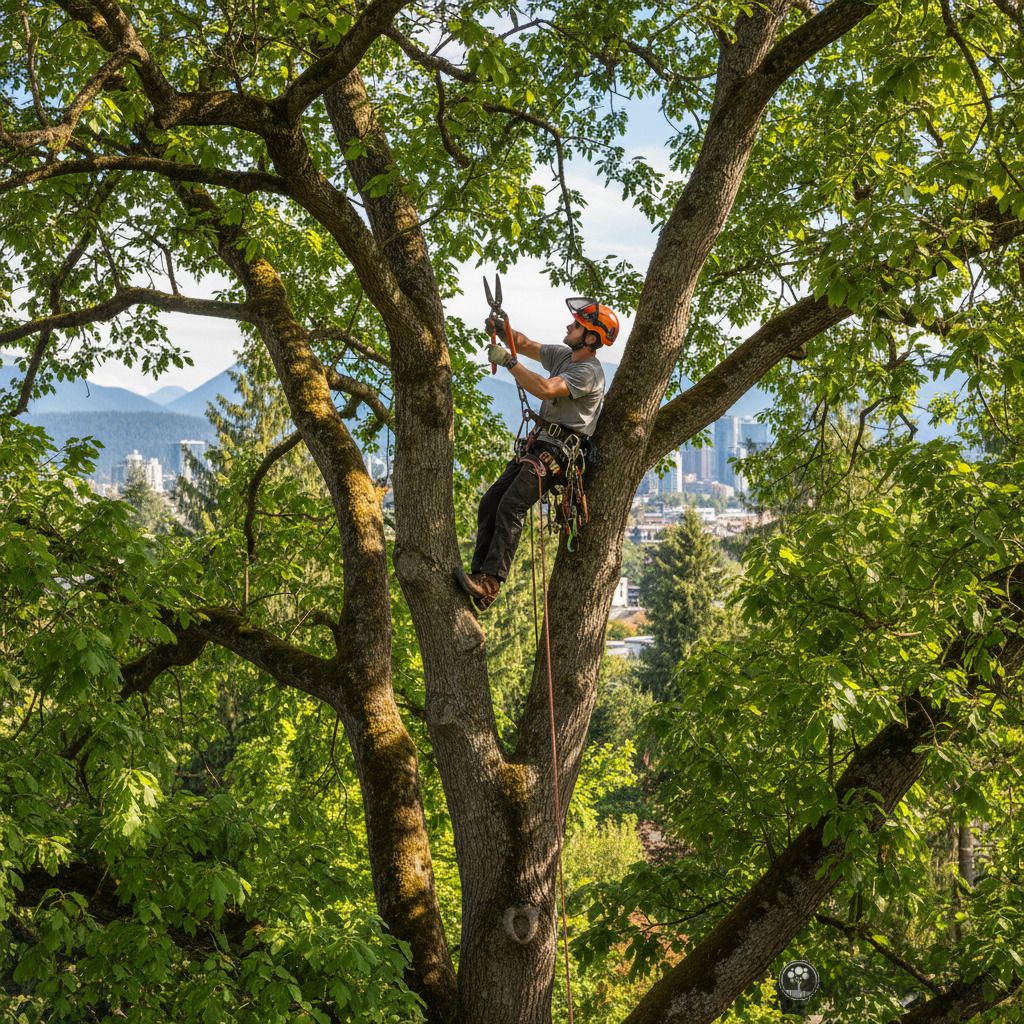
Neighbor Offering to Remove Your Tree? Read This First
Before you accept a neighbour's offer to remove your tree, get three things in writing: proof of WorkSafeBC coverage and liability insurance, the exact scope of work, and who is pulling the permit. A tree 20 cm or more in diameter needs one in most Metro Vancouver municipalities, and the liability for an uninsured job lands on the property owner.
A neighbor offering to take down a tree that's bothering them, or you, sounds like a friendly solution. No cost, no hassle, done. Our team at Aesthetic Tree hears this scenario regularly across Vancouver and the surrounding municipalities, and the honest answer is: yes, there is quite a bit to consider. Good intentions are real, but they don't transfer liability, satisfy permit requirements, or cover the unexpected costs that can surface months after the tree is gone. Before you agree, or before work starts, here is what our TRAQ-certified arborists think you should know.
What Should You Get in Writing Before Work Starts Near Your Property Line?
Our team at Aesthetic Tree recommends getting written confirmation of three things before work begins anywhere near your property line.
First, a certificate of insurance. General liability and WorkSafeBC coverage from whoever is doing the physical work, whether that's the neighbor themselves or a crew they've hired.
Second, a written description of the exact scope. Which tree, how much of it, and where the work stops. Verbal agreements about "just the branches over my side" routinely expand in scope once the equipment is on site.
Third, written confirmation that permit requirements have been checked. If the tree is of any significant size, ask the neighbor to confirm in writing that they've verified requirements with the City of Vancouver, or whichever municipality applies. In Vancouver, the Protected Trees Bylaw sets clear thresholds, and "we didn't know we needed a permit" is not a defense.
A short written exchange, even email, covering those three points gives you something to stand on if anything goes sideways.
Where the property line actually falls
Most of the trouble we are called into starts with a reasonable-sounding offer and an unexamined assumption about who owns what.
Under Anderson v. Skender (BC Court of Appeal, 1993), still the governing BC authority, a neighbour may cut branches and roots back to the property line and no further. The [People's Law School](https://www.peopleslawschool.ca/trees-and-neighbours/) states the limit directly: "A neighbour may have a remedy in nuisance with a right to 'self help', but it will not generally include a right to enter the other's property, nor to cut any part of the tree which is on the other's side of the property line."
Two things that surprise homeowners:
- A boundary tree is jointly owned. Where the trunk or the visible root flare crosses the line, neither owner may remove or top it alone. BC has no province-wide statute defining this, it is settled municipality by municipality, so your bylaw governs.
- The self-help right is not immunity. Pruning that kills the tree can still attract damages. In one 2022 BC Supreme Court case [reported by CTV News](https://bc.ctvnews.ca/b-c-woman-who-deliberately-damaged-neighbour-s-hedge-ordered-to-pay-150k-in-damages-1.6545096), a neighbour who topped a cedar hedge was ordered to pay roughly $150,000, $59,915.73 in remediation plus damages for the years the replacements will take to mature ([CTV News](https://bc.ctvnews.ca/b-c-woman-who-deliberately-damaged-neighbour-s-hedge-ordered-to-pay-150k-in-damages-1.6545096)).
If the tree is 20 cm or more in diameter at breast height, a permit question arrives before any of this: both Richmond and Vancouver set that threshold, measured 1.4 m above ground. Get the line surveyed and the bylaw checked before anyone agrees to anything. General information only, a real dispute deserves real legal advice.
Permits are the part an informal arrangement usually misses. Both the [City of Richmond](https://www.richmond.ca/services/climate/environment/treeremoval.htm) and the [City of Vancouver](https://vancouver.ca/your-government/protection-of-trees-bylaw.aspx) require one for any tree 20 cm or more in diameter at breast height. Richmond can pursue up to $50,000 per tree for removal without it ([City of Richmond](https://www.richmond.ca/services/climate/environment/treeremoval.htm)); Vancouver's range runs from a $500 minimum to $10,000 per offence ([City of Vancouver](https://vancouver.ca/your-government/protection-of-trees-bylaw.aspx)). The liability follows the land, not the neighbour who offered to help.
Frequently Asked Questions
Is my neighbor allowed to remove a tree sitting on the property line? Trees on a shared property line are typically co-owned, meaning both parties need to agree before removal proceeds. Neither neighbor has unilateral authority to remove a jointly-owned tree without the other's consent. If work proceeds without agreement, the other party may have legal recourse. Permit requirements still apply regardless of who initiates the work.
Can my neighbor trim branches that overhang their yard without asking me? In BC, there is a general common-law right to trim branches that overhang your property, but only back to the property line, not further. This right doesn't override municipal permit requirements for significant pruning of regulated trees. The trimmed material typically belongs to the tree's owner, and work that damages the tree beyond what is reasonable may expose the person doing the trimming to liability.
Should I be present when the neighbor's crew does the removal? Being present is strongly advisable. It allows you to confirm the scope stays within what was agreed, document conditions before and after, and identify any immediate damage to fences, structures, or surrounding vegetation. If you cannot be there, photograph the area thoroughly beforehand and ensure your written scope agreement is specific about exactly where the work begins and ends.
What happens if the removal turns out to have been unpermitted? The property owner, not the neighbor who ordered the work, is typically the party who receives a notice of violation from the city. Remediation can include mandatory replacement planting, sometimes multiple trees at nursery-grade sizing, at the property owner's expense. An open bylaw file can complicate a future sale. Resolution requires working directly with the municipality, often with the support of a TRAQ-certified arborist to assess the impact and recommend a remediation path.
How do I find out if my tree is protected under Vancouver's tree bylaws? The City of Vancouver's Protected Trees Bylaw sets a diameter threshold, trees at or above that threshold on private property require a permit before removal or significant alteration. Thresholds and species protections vary by municipality across the Lower Mainland. The most direct step is to contact the city's urban forestry department or speak with a City of Vancouver approved arborist before work begins. Our team at Aesthetic Tree can help you understand where a specific tree stands relative to local regulations.