
Tree Trimming Without a Bucket Truck in Vancouver
When a Vancouver property owner pictures a tree crew arriving on-site, the mental image usually includes a large lift truck rolling up to the curb. In most of the city's established residential neighbourhoods, that expectation meets a harder reality. Vancouver's urban forest—dense mature canopies of red oak, big-leaf maple, western red cedar, and towering Douglas fir—grows on lots with narrow lane access, wood-frame houses close on all sides, and fences or utility lines directly beneath the crown. A bucket truck simply cannot reach a large percentage of the trees our team at Aesthetic Tree works on across the city. What actually makes urban tree trimming safe here differs from what most homeowners assume, and understanding the equipment, permits, and credentials involved is the first step to hiring correctly.
TL;DR
- Bucket trucks can't access the majority of trees in Vancouver's older residential neighbourhoods—tight lanes, dense lots, and structures below the canopy put lift equipment out of reach.
- The real operational investment for safe urban tree trimming is precision rigging hardware: friction-control devices, redirects, and sectional rigging blocks that let climbing crews lower large limb sections under full control.
- The City of Vancouver's Tree Bylaw protects trees above certain trunk diameter thresholds—many mature residential trees require a permit and a Certified Arborist Report before trimming can legally begin.
- Always ask for ISA certification numbers, TRAQ qualification, WorkSafeBC clearance, and proof of liability coverage before any crew starts work.
Why Can't a Bucket Truck Just Drive Up to My Tree?
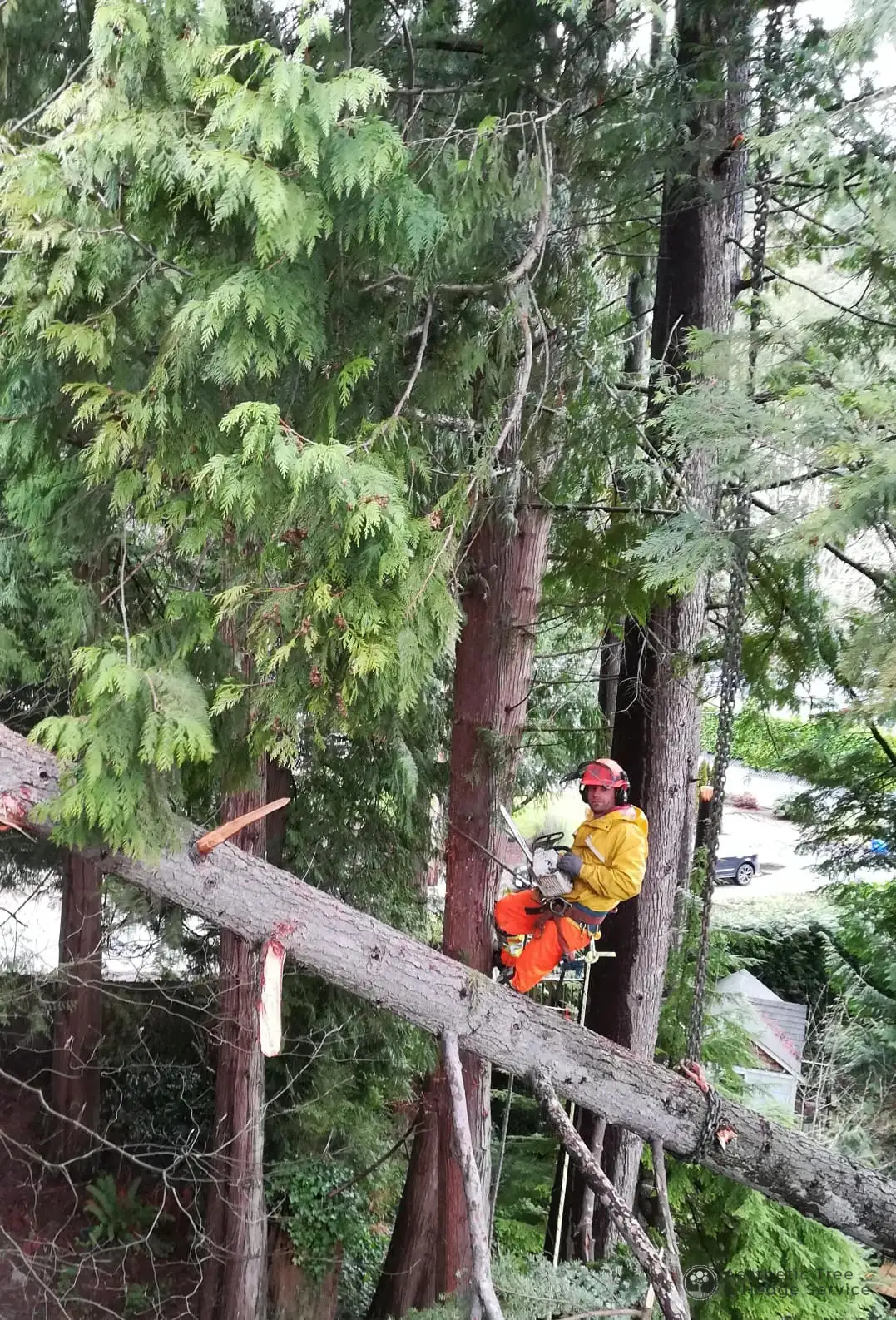
Bucket trucks need clear access to position, level ground to stabilize, and a usable aerial angle to the canopy. Many Vancouver properties can't offer any of those conditions. Our team at Aesthetic Tree regularly assesses trees at the end of a single-width lane, overhung by a neighbouring canopy, or bounded on all sides by fencing and structures that place the entire area below the crown inside a potential drop zone.
The city's residential grid predates aerial lift equipment, and the urban forest has grown into every available gap. Across Vancouver, West Vancouver, North Vancouver, Burnaby, Coquitlam, and Richmond, a meaningful share of large-canopy tree trimming must be done from inside the tree—by a skilled climber who establishes anchor points in the canopy and works outward from there, removing limbs in sections that can be rigged and lowered under control rather than dropped.
The absence of a truck on-site is not a corner cut. It reflects the actual access conditions of urban Vancouver, and the alternative—a climbing-and-rigging approach executed by a properly equipped crew—is the correct method for the majority of residential jobs in this city.
What Equipment Actually Makes Tight-Access Tree Trimming Safe?
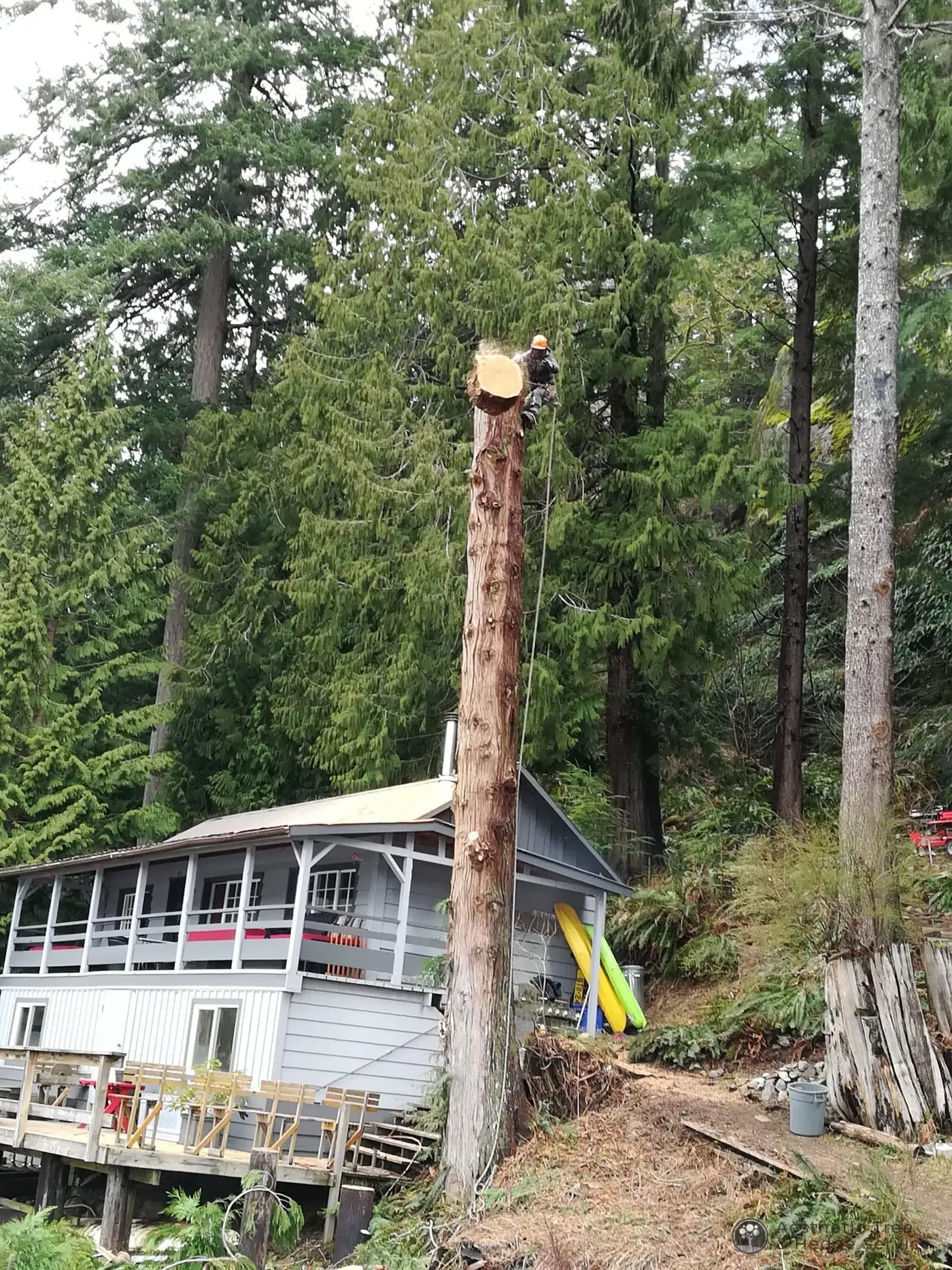
The single most consequential investment in our operation for urban residential work is rigging equipment. Specifically: friction-control devices, redirects, and sectional rigging blocks that allow a climber to lower large sections of crown in precise, controlled increments. This is not improvised—it is engineered and load-rated.
Proper rigging hardware is what allows a crew to trim a large-canopy tree directly over a garden, a fence, or a structure without causing damage to what sits below. It also directly addresses WorkSafeBC requirements. British Columbia's regulatory framework does not accommodate improvised rigging on tree work sites. Any crew that skips this investment transfers the resulting risk to the property owner.
Our team at Aesthetic Tree also carries TRAQ (Tree Risk Assessment Qualification) certification. That qualification is the difference between assessing a tree by eye from the ground and conducting a structured, defensible risk evaluation—one that covers load vectors, anchor-point integrity, and structural defects like co-dominant stems with included bark or internal decay that isn't visible until a climber is working inside the canopy. TRAQ and ISA Certified Arborist credentials aren't badges on a wall. They are what lets a crew properly assess what a tree will do under load before a single cut is made.
When Does the City of Vancouver Require a Permit for Tree Trimming?
More frequently than most homeowners expect. The City of Vancouver's Tree Bylaw protects trees based on trunk diameter at breast height, and the thresholds vary by tree. Confirm the current thresholds with the City before planning work. Many of the mature trees in Vancouver's residential neighbourhoods that homeowners most want trimmed meet or exceed those thresholds.
Work that alters the structure or health of a protected tree typically requires a City permit, and the permit application must include a Certified Arborist Report prepared by a qualified professional. Our team prepares those reports. The City's approval timeline is entirely the municipality's process, not something any arborist can guarantee. What we can control is submitting a technically complete application on the first attempt, which reduces back-and-forth and minimises delays before work can begin.
One point property owners often overlook: the City expects that report from a qualified arborist, so an unqualified crew cannot produce one. If an uncertified contractor trims a protected tree without a valid permit, the bylaw liability falls on the property owner—not the contractor. Verifying credentials before work begins is not just about safety. It is legal protection.
Which Vancouver Neighbourhoods Have the Most Complex Tree Work?
Much of the challenging, permit-heavy residential tree work in the city is in Vancouver's older established areas: Kitsilano, Point Grey, Dunbar, Shaughnessy, and much of East Vancouver. These neighbourhoods share conditions that compound the difficulty on nearly every job.
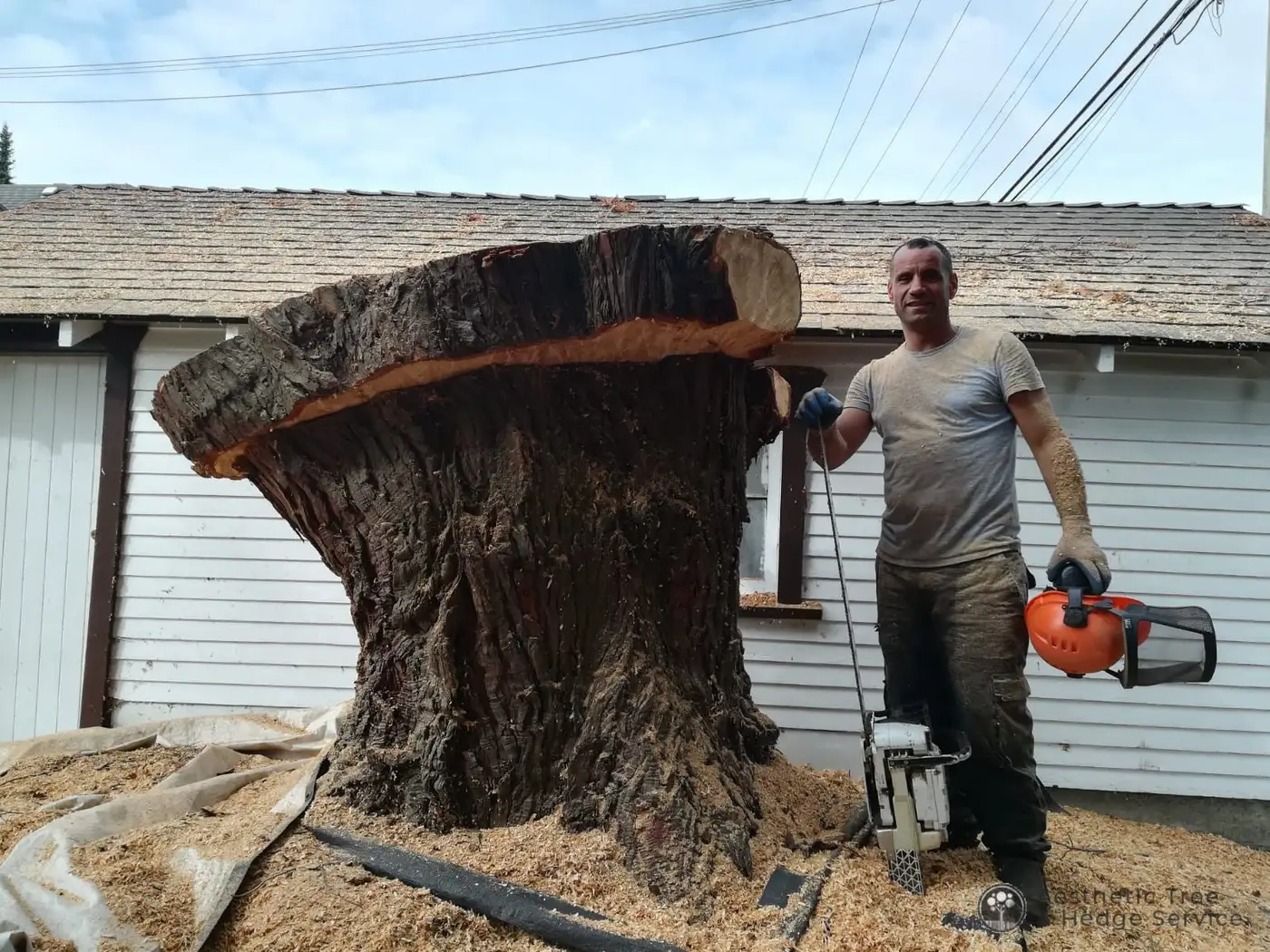
The urban forest here is dense with mature specimens—big-leaf maple, western red cedar, horse chestnut, ornamental elm—many of which predate the lots they now overhang. Properties sit close together, canopies interlock across property lines, and equipment access is frequently limited to a single-width lane or narrow driveway. Many of these trees qualify for protection under the City Bylaw, so the permit load is correspondingly high.
Wind exposure adds a further layer. Events off Burrard Inlet and English Bay place real lateral loads on these canopies every fall and winter. That is when emergency calls come in for broken scaffold limbs and compromised root plates. Responding effectively in these neighbourhoods requires both the technical skill to manage complex rigging in constrained spaces and the regulatory literacy to move efficiently through permit requirements when conditions demand speed.
How Do You Verify a Tree Service Is Qualified Before You Hire?
The most common and costly mistake Vancouver property owners make is hiring on price alone without checking credentials. Tree work involves chainsaw operation at height on structures that can fail unpredictably. If an uninsured or uncertified crew causes damage or injury on your property, the liability exposure is yours—not theirs.
Before any crew starts work, ask for:
- ISA certification numbers—verifiable directly on the ISA website
- TRAQ qualification for any job involving structural risk assessment
- WorkSafeBC clearance—confirming the crew is fully covered and compliant
- Proof of liability coverage, including the coverage limits
If a company hesitates to produce any of these, that hesitation is your answer. The City's permit process adds a second verification layer: the City expects a report from a qualified arborist. Work carried out without a valid permit leaves the property owner exposed.