
TL;DR — Quick Summary
Master safe cutting a tree limb with our guide. Learn the 3-cut method, essential tools, & avoid mistakes for healthy trees.
Safe tree limb removal requires the 3-cut method: an undercut on the branch underside 1-2 feet from the trunk, a relief cut a few inches further out to drop the limb's weight, then a final cut just outside the branch collar. Use the right tool for the branch diameter, wear full PPE, and never prune near power lines without a certified professional.
Understanding When, Why, and What to Prune
Timing your cuts correctly is as important as making them cleanly. For most species in BC, the dormant season — late winter through early spring — is the preferred window. Trees are not actively growing, so wounds close faster and the risk of fungal or insect entry is lower. The bare canopy also makes structural problems easier to see. Flowering trees are a meaningful exception: early bloomers like cherry and plum set buds on old wood, so prune them immediately after flowering ends. Late-blooming species, which flower on new growth, can go back to the early-spring schedule.
When deciding what to remove, ISA (International Society of Arboriculture) guidelines identify three priority targets: dead, diseased, or mechanically damaged limbs; crossing or rubbing branches that create open wounds; and weak V-shaped unions with included bark, which are prone to splitting under snow or wind load. According to the ISA's *Best Management Practices: Pruning* (2011), removing no more than 25% of a tree's live crown in a single season minimises physiological stress and limits the production of weakly attached water sprouts. Removing more than that in one year can trigger stress responses that compromise the tree's long-term structure.
Before touching a saw, assess the work area. Identify unstable overhead branches, ground obstacles, and — critically — overhead power lines. BC Hydro's public safety guidance is unambiguous: any branch within 3 metres of a distribution line is utility-company territory; do not prune it yourself. Clear the drop zone at the tree's base and position your ladder so you can maintain three points of contact throughout the cut without overreaching.
Match the tool to the branch. Pruning shears handle stems up to 3/4 inch (20 mm) in diameter. Loppers extend your reach and leverage for branches between 3/4 inch and 1-1/2 inches. A pruning saw is the right choice for anything larger up to about 3 inches (75 mm). A chainsaw, which requires significant skill and full PPE including a chainsaw-rated helmet and chaps, should be reserved for limbs above that threshold; for most homeowners, that threshold is the point to call a professional. Disinfect blades between trees — a 1:9 bleach-to-water solution applied to the blade prevents spreading fungal or bacterial pathogens between cuts, a practice supported by the BC Ministry of Forests in its forest health guidelines.
The 3-Cut Method: Anatomy, Execution, and Healing
A clean cut that respects tree anatomy is the difference between a wound that closes in a season and one that decays for a decade. Before you start, locate two anatomical landmarks at the base of the branch: the branch collar (the slightly swollen ring of tissue encircling the branch base, which contains the tree's healing cells) and the branch bark ridge (the raised strip of bark on the upper side of the union). Your final cut must preserve both.
Cut 1 — the undercut. On the branch's underside, roughly 10-15 inches from the trunk, make a cut upward through one-third of the branch's diameter. This cut's only job is to create a controlled stopping point. Without it, the branch's weight will tear bark down the trunk as it falls, creating a long strip wound that far exceeds the branch diameter and resists closure.
Cut 2 — the relief cut. Move a few inches further from the trunk than the undercut and cut straight through from the top. The limb will fall; the undercut prevents bark from tearing past that point. You are left with a manageable stub, not the full weight of the original limb.
Cut 3 — the final cut. With the weight gone, remove the stub cleanly. Cut just outside the branch collar and branch bark ridge, angling slightly away from the trunk so water runs off. Do not cut flush with the trunk — a flush cut removes the collar tissue and creates a wound the tree cannot close, leading to internal decay. Do not leave a long stub — stubs die back, provide entry points for insects and wood-decay fungi, and interfere with the formation of the callus ring (woundwood) that seals the wound.
CODIT — Compartmentalization of Decay in Trees, the model developed by Dr. Alex Shigo — explains why cut placement matters so much. Trees do not heal wounds the way animals do; they wall off the decayed zone and grow new tissue around it. A proper collar cut maximises the width of the woundwood ring and minimises the volume of wood exposed to pathogens. According to ISA research, wound closure rates correlate directly with cut placement relative to the collar; flush cuts can double the wound area a tree must close.
One common myth worth addressing: wound sealants. Research published in the Journal of Arboriculture has consistently shown that wound dressings do not accelerate closure and can trap moisture in ways that promote fungal decay beneath the seal. The correct finishing step after a proper 3-cut sequence is nothing — let the tree air-dry and respond through its own CODIT mechanism.
Worked Example: Removing a Hanging Limb Step by Step
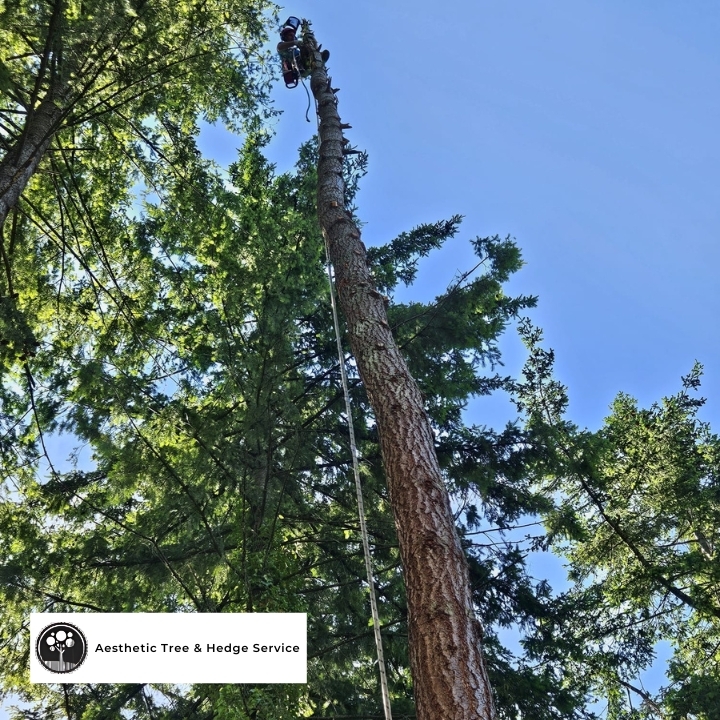
The following example walks through a realistic residential limb removal so you can see how the technical steps, tool choices, and any associated costs connect in practice.
Worked example (illustrative):
Assumptions:
- Dead maple limb, 4-inch (100 mm) diameter, 12 feet long, hanging over a garden shed in the Lower Mainland
- Homeowner handles ground-level work; hires Aesthetic Tree for the elevated cut
- Limb will be cut into manageable sections and disposed of via municipal green-waste bin (Metro Vancouver allows branches up to 2 inches diameter loose in the bin; larger pieces require bundling or a private haul)
Tool hire or purchase:
- Pruning saw (quality hand saw, approximately $40-$60 at a hardware store) — homeowner already owns
- Arborist labour (1 hour at a typical Metro Vancouver rate) — see calculation below
At 4 inches, this limb is above the chainsaw-proficiency threshold; a professional handles the three cuts from a ladder. Assume a 1-hour minimum service call.
Cost breakdown (illustrative market assumptions — verify current rates with your arborist):
- Arborist minimum call-out (1 hour): $150.00
- Debris haul-away, oversized bundle (assume 3 bundles at $15 each): $45.00
- Subtotal before tax: $150.00 + $45.00 = $195.00
- GST (5%, according to the Canada Revenue Agency): $195.00 x 0.05 = $9.75
- PST in BC (7%, according to the BC Ministry of Finance, on taxable labour services where applicable): $195.00 x 0.07 = $13.65
- Total with tax: $195.00 + $9.75 + $13.65 = $218.40
Undercut placement:
- Limb is 12 feet long; undercut is made 12 inches from the trunk (at the 10-15 inch guideline midpoint)
- Depth of undercut: 4 inches x 0.33 = 1.33 inches (one-third through)
Relief cut: positioned 14 inches from the trunk (2 inches outboard of the undercut), cut through from the top; limb drops free
Final cut: stub measures approximately 12 inches; cut just outside the collar, following the branch bark ridge angle — stub removed cleanly, collar intact
Result: circular wound face approximately 4 inches in diameter; woundwood ring expected to close over 3-5 growing seasons under normal conditions, consistent with ISA CODIT research on maple species.
Note: the debris in this example fits Metro Vancouver's green waste guidelines for bundled branches (bundles up to 4 feet long, tied with natural twine). Confirm current guidelines at metrovancouver.org before disposal; rules vary by municipality.
When to Call a Professional and What to Expect
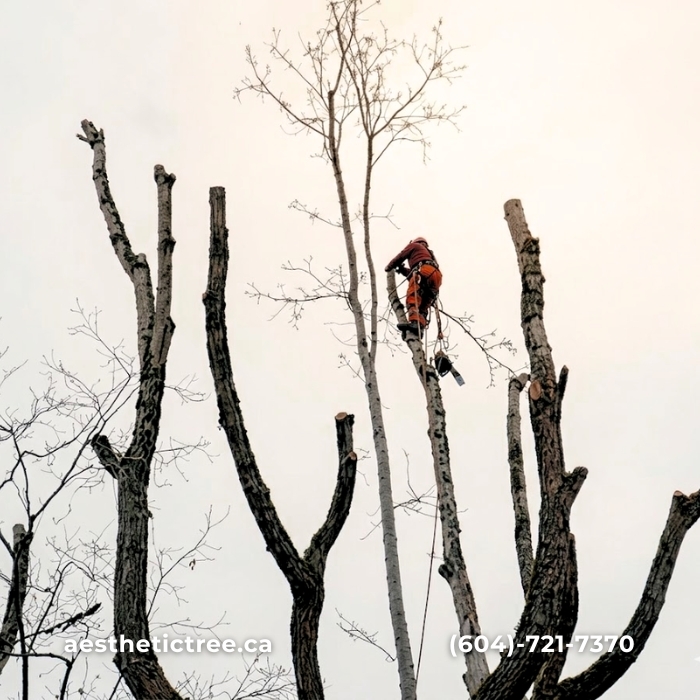
There is no single diameter that automatically requires a professional, but ISA's risk-assessment framework and WorkSafeBC's arborist safety regulations combine to make the decision clear in most cases. Any limb over 3 inches (75 mm) in diameter is in chainsaw territory and carries structural and gravity risks that require training, rigging equipment, and WorkSafeBC-compliant fall protection for elevated work. Any limb within 3 metres of a power line is, per BC Hydro's published safety standards, the utility's jurisdiction — call BC Hydro's line-clearance service before engaging any arborist, as tree workers must follow specific proximity rules under WorkSafeBC Occupational Health and Safety Regulation section 13.
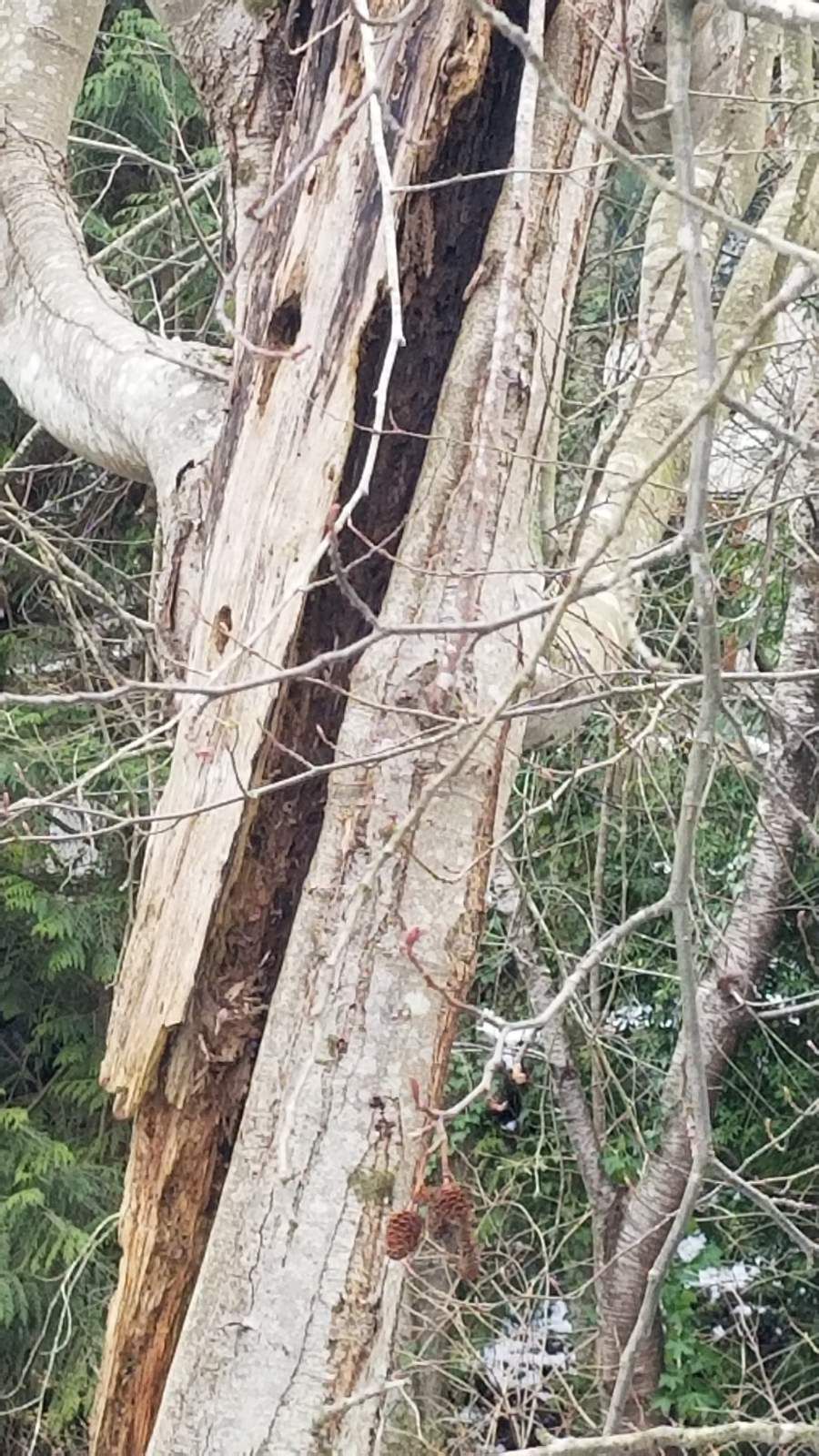
Signs of structural compromise — significant bark loss over more than 30% of the circumference, large conk-type fungal growths (bracket fungi), or visible crack lines in the union — indicate the branch may fail unpredictably during cutting. These situations warrant a hazard tree assessment by an ISA Certified Arborist with a TRAQ (Tree Risk Assessment Qualification) credential before any cutting begins. A TRAQ assessment produces a written risk rating and a recommended treatment that can support an insurance claim if the tree has already caused property damage.
When you call a professional arborist, ask for their ISA Certification number (verifiable on isahq.org), confirmation of WCB/WorkSafeBC coverage, and their liability insurance certificate. A reputable arborist will conduct a site walk before quoting, explain the cut plan, and discuss debris removal options. They will not recommend topping — the practice of cutting large scaffold branches back to stubs — which ISA's position statement classifies as harmful, producing large wounds, weak epicormic regrowth, and long-term structural decline.
Frequently Asked Questions
Related: tree cutting services near you
Found this helpful? Follow our tree care insights directly on Google.
Make us your preferred source on GoogleOur Tree Care Services
ISA-certified arborists serving Greater Vancouver

Explore Our Tree Care Services
From expert pruning to safe tree removal, our ISA-certified arborists are ready to help across Greater Vancouver.
View Services