
TL;DR — Quick Summary
tree diseases vancouver arborist frequently treat, plus symptoms, risks, and when to call an ISA-certified Vancouver arborist.
# Tree Diseases Vancouver Arborists Frequently Treat: What Homeowners Should Watch For
Tree diseases Vancouver arborists frequently treat often start quietly. A few brown needles. One dead limb. A cedar hedge with a strange gap. Then one wet winter or hot, dry summer pushes the tree over the edge.
That is what many homeowners miss.
Tree disease is rarely one single problem. Around Vancouver, it is usually a chain: wet soil, compacted roots, poor pruning, a fungal pathogen, then summer drought. Decay or decline can begin before the tree looks obviously unsafe.
A good arborist does not just name the disease. They ask why the tree became weak enough for the disease to take hold.
At Aesthetic Tree & Hedge Services, our ISA-certified, WCB registered team inspects trees across Vancouver, Burnaby, North Vancouver, Richmond, Coquitlam, and the Lower Mainland. We look at the canopy, trunk, root flare, soil, drainage, past pruning cuts, nearby construction, and risk to people and property.
This guide explains the tree diseases Vancouver homeowners should know, when treatment may work, when removal is safer, and when an arborist report may be required.
TL;DR
- Vancouver’s wet climate makes fungal leaf diseases, root rot, cankers, wood decay, and cedar hedge decline common.
- Root disease can make a tree unstable before the crown looks fully dead.
- Emerald ash borer was confirmed in Vancouver in spring 2024, so ash decline now needs faster inspection.
- A diseased tree does not always need removal. Many trees can recover with pruning, soil care, drainage correction, and monitoring.
- Call Aesthetic Tree & Hedge Services for a free estimate at (604) 721-7370. Our ISA-certified arborists are WCB registered.
Suggested image: close-up photo of brown cedar foliage beside healthy green cedar growth.
What tree diseases do Vancouver arborists treat most often?
Vancouver arborists most often treat fungal leaf diseases, cedar hedge decline, Phytophthora root rot, Armillaria root disease, canker diseases, wood decay, and insect-linked decline that looks like disease.
The big local pattern is moisture.
Long wet periods keep leaves damp and soils saturated. That helps fungal spores spread. When roots sit in wet, compacted soil, they lose oxygen. When roots are stressed, the tree loses stored energy. Disease then has an easier path in.
The City of Vancouver’s 2025 Urban Forest Strategy reports that canopy cover reached 25% city-wide in 2022, up from 21% in 2013. That is a major urban forest. It also means disease monitoring matters at the property level. One declining tree can affect shade, safety, habitat, and nearby trees.
The problems we inspect most often fall into six practical groups:
- Anthracnose on maple, dogwood, sycamore, ash, and oak
- Cedar leaf blight and cedar hedge decline
- Phytophthora root rot in wet, poorly drained soil
- Armillaria root disease and other root decay fungi
- Canker diseases on stressed branches and trunks
- Wood decay fungi inside stems, trunks, and large limbs
Homeowners usually call after seeing one of these signs:
- Leaves curling, blotching, or dropping early
- Brown cedar tips that keep spreading
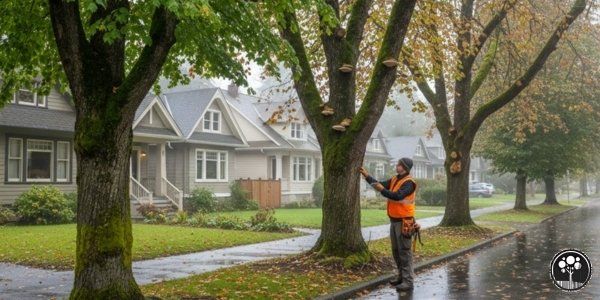
- Mushrooms near the base of a tree
- Dead limbs high in the canopy
- Cracks, cavities, or soft wood in the trunk
- A tree leaning more than before
- Sawdust, bark splitting, or exit holes
- Sudden decline after trenching, paving, or grade changes
The disease name matters. The risk matters more.
A maple with anthracnose can look rough in spring and still be structurally safe. A Douglas fir with root decay can look green and still be dangerous. That is why an ISA-certified arborist starts with a tree health and risk assessment, not just a leaf diagnosis.
If the tree is dead, unstable, or structurally compromised, our team may recommend tree removal in Vancouver. If the tree is salvageable, we focus on pruning, soil care, root zone protection, cabling, or monitoring.
Why are Vancouver trees so prone to fungal disease?
Vancouver trees are prone to fungal disease because the city combines rain, shade, dense planting, compacted soil, and older urban trees. Fungi thrive in that mix.
Think of a tree disease triangle. Disease needs three things:
- A host tree that can be infected
- A pathogen that can infect it
- Conditions that help the pathogen spread
Vancouver often supplies all three.
Rain keeps leaves wet. Dense hedges hold moisture. Shaded yards dry slowly. Clay or compacted soils trap water near roots. Construction damages fine roots. Summer drought then stresses the same tree a few months later.
That stress cycle is hard on urban trees.
A cedar hedge in Kitsilano may sit in wet soil all winter, then face reflected heat from a fence in August. A maple in East Vancouver may have roots under sidewalk, driveway, and lawn. A Douglas fir in North Vancouver may have new wind exposure after nearby trees are removed.
Disease does not need perfect conditions. It needs a weak opening.
The City of Vancouver also notes a major canopy gap between neighbourhoods. Strathcona has less than 10% canopy cover, while the city-wide figure is 25%. Less canopy can mean hotter streets, drier soils, and more summer stress.
That is why disease care is not just spraying. In many cases, spray is the least important tool.
Good arboriculture starts with site correction:
- Clear the root flare of buried soil or mulch
- Reduce soil compaction around the tree
- Keep lawn equipment away from bark
- Improve drainage where roots sit wet
- Prune to ANSI A300 standards
- Remove infected deadwood at the right time
- Avoid topping, flush cuts, and lion-tailing
We see many disease cases where the first problem was poor tree work, not disease.
Bad cuts create entry points. Topping forces weak sprouts. Over-thinning exposes bark to sunscald. Root pruning by a non-arborist can destabilize a tree.
Vancouver’s Protection of Trees By-law also treats roots seriously. The bylaw states that a person must not prune tree roots unless that person is an arborist. Roots are not just plumbing. They are structure.
If you are unsure whether the work is pruning, cutting, or removal, start with an inspection. Proper tree cutting in Vancouver should include correct cuts, safety controls, and arborist judgment.
How can you tell if a tree has anthracnose?
You can often spot anthracnose by irregular brown leaf blotches, curled leaves, dead leaf edges, and early leaf drop in spring or early summer.
Anthracnose is a fungal disease group, not one single fungus. Different fungi affect different trees. The symptoms often look similar: scorched leaves, dark blotches, ragged edges, dead shoot tips, or early leaf drop.
Portland Parks & Recreation notes that anthracnose can affect dogwood, London plane, sycamore, ash, oak, maple, and walnut. Those trees are common across the Pacific Northwest and in many Vancouver yards and streets.
In Vancouver, anthracnose often shows up after cool, wet spring weather. The tree leafs out, spores spread, tender leaves become infected, and the homeowner notices a thin or blotchy canopy by May or June.
Key symptoms include:
- Brown or black blotches along leaf veins
- Twisted or curled young leaves
- Premature leaf drop
- Dead tips on small twigs
- Sparse canopy after a wet spring
- Repeated spring decline on the same tree
Anthracnose often looks worse than it is. A healthy mature maple can lose some spring foliage and still produce a second flush. The tree still needs monitoring, but removal is not the default answer.
Treatment usually focuses on stress reduction and deadwood pruning. We also look at airflow. Dense canopies stay wet longer, so selective pruning can help leaves dry faster and reduce disease pressure.
Do not rake heavily infected leaves into garden beds and call it mulch. Remove infected leaf litter where practical. Spores can survive on fallen material and infect new growth next season.
Also avoid fertilizing by guesswork. A stressed tree does not always need fertilizer. It may need water management, mulch, and root protection. Too much nitrogen can push soft new growth that gets infected again.
An arborist will also check whether anthracnose is truly the issue. Leaf scorch from drought, salt, herbicide drift, root damage, or heat can look similar.
Why do cedar hedges turn brown in Vancouver?
Cedar hedges turn brown in Vancouver because of drought stress, poor drainage, root rot, cedar leaf blight, spider mites, salt, overcrowding, or hard pruning into old wood.
Cedar problems are one of the most common calls we get.
A hedge can look fine for years. Then one panel turns orange. The bottom thins out. A gap opens. The homeowner waters more, but the hedge gets worse. That is when diagnosis matters.
Western red cedar, Thuja plicata, is a local species. But many hedges are planted in tight rows, close to fences, with poor airflow and limited soil. That is not a forest condition. It is a stress condition.
Cedar leaf blight is one disease we watch for. The Maine Forest Service says cedar leaf blight, caused by Didymascella thujina, is known on western red cedar in western North America and Canada. Damage is most severe where dense shade and high foliage moisture are present.
That matches many Lower Mainland hedges.
Watch for:
- Brown scale-like foliage on tips and small twigs
- Thinning from the inside out
- Patchy browning in shaded areas
- Black fruiting bodies on infected foliage
- Dead sections that do not green back up
- Roots sitting in wet, sour-smelling soil
But not every brown cedar has leaf blight.
OSU Extension has pointed to poor drainage, overwatering, root rot, and overcrowding as common causes of arborvitae decline. That fits what we often see in Vancouver. Many hedges are watered heavily in summer, then sit wet through winter.
Cedar roots need oxygen. Saturated soil removes it.
For hedges, the first job is to read the pattern. One dead plant in a row may point to root damage, drainage, planting depth, or localized disease. Browning across the sunny side often points to heat or drought. Browning inside the hedge can be normal needle shed unless it spreads outward.
Good cedar hedge care includes:
- Light, regular trimming instead of hard cuts
- Keeping the hedge wider at the base than the top
- Avoiding cuts into bare old wood
- Checking irrigation for overwatering and dry gaps
- Mulching the root zone without burying trunks
- Improving airflow where the hedge stays wet
If your hedge is salvageable, hedge trimming services in Vancouver can keep growth dense without overstressing the plants. If sections are dead, replacement and soil correction come first. Trimming dead cedar will not bring it back.
What is Phytophthora root rot, and why is it serious?
Phytophthora root rot is a soil-borne disease that damages roots and root crowns, especially in wet or poorly drained sites.
It is serious because the damage starts underground.
By the time the top of the tree looks thin, the fine roots may already be failing. Those roots absorb water and nutrients. They also help the tree respond to drought and heat.
Oregon State University’s Phytophthora root rot guide lists reduced growth, poor colour, root decay, bleeding basal cankers, and dead lower branches as symptoms. It also points to low-lying, poorly drained areas as places to inspect.
That matters in Vancouver.
Many properties have heavy soil, drainage changes, raised beds, patios, irrigation, or compacted lawns near trees. When roots lose air, Phytophthora has the wet conditions it needs.
Common signs include:
- Thinning canopy
- Small, pale, or sparse leaves
- Dead branches starting lower in the crown
- Dark, rotten roots
- Bleeding or dark cankers near the root crown
- Decline after drainage changes
- Decline in one wet corner of the yard
You cannot prune your way out of rotten roots. The site has to be corrected. That may include drainage work, root zone mulching, irrigation changes, soil testing, and removing competing material near the trunk.
We also inspect the root flare. A buried root flare traps moisture against bark. The root flare should be visible. If the trunk looks like a telephone pole going straight into the ground, something is wrong.
For small ornamental trees, early intervention can work. For large trees near homes, the safety question comes first. Root loss can affect stability. A green canopy does not prove a tree is safe.
If a tree has to come down, do not leave the stump as a disease reservoir. Stump grinding in Vancouver can help remove the remaining stump so the site can be replanted or restored with better soil conditions.
How dangerous is Armillaria root disease in Vancouver trees?
Armillaria root disease is dangerous because it decays roots and lower stems. It can weaken a tree’s anchoring system before the crown fully dies.
Armillaria is often called honey fungus. It can produce honey-coloured mushrooms near the base of infected trees. It can also spread through root contact and cord-like fungal structures in soil.
The BC government’s root disease guidance says root disease inoculum, mainly in stumps, can remain infectious for up to 35 years depending on fungal species and inoculum size. That is important for homeowners. A diseased stump can be more than an eyesore.
The BC Ministry of Forests identifies Armillaria root disease as present throughout southern and coastal BC. It also lists laminated root disease throughout southern and coastal BC. Those ranges include the broader Lower Mainland region.
In urban yards, Armillaria often appears after stress:
- Grade changes
- Drought
- Construction damage
- Soil compaction
- Poor drainage
- Tree topping
- Root cutting
- Old infected stumps nearby
Look for:
- Honey-coloured mushrooms near the trunk or roots
- White fungal mats under bark
- Black shoestring-like growth in soil or under bark
- Crown thinning
- Dead upper branches
- Resin or bleeding near the base on conifers
- Sudden windthrow in advanced cases
Armillaria is not a DIY diagnosis. Mushrooms can mislead. Some are harmless decay fungi. Others signal serious root failure. An arborist checks the whole tree, not just the mushroom.
Treatment depends on the stage.
Early cases focus on stress reduction: mulch, irrigation correction, no further root damage, and removal of infected deadwood. Advanced cases near homes, driveways, roads, or play areas often need removal.
If you are replanting after root disease, choose species carefully. Do not plant the same susceptible tree into the same infected spot without a plan. Tree planting services can help with species selection, spacing, and soil preparation.
When is a canker disease a serious tree risk?
A canker disease becomes a serious risk when it girdles branches, reaches the trunk, kills bark around structural wood, or combines with decay.
A canker is a dead area of bark and cambium. It may be sunken, cracked, swollen, discoloured, or oozing sap. Some look like wounds that never close.
Cankers often follow stress. Drought, frost cracks, poor pruning cuts, mower wounds, and construction damage all give pathogens a way in.
On fruit trees, cherries, maples, birches, and ornamentals, cankers can kill branches. On large shade trees, trunk cankers can create structural risk.
Watch for:
- Sunken patches on bark
- Cracked bark around dead tissue
- Dead branches beyond the canker
- Sap or resin flow
- Wounds that expand each year
- Fungal fruiting bodies near the wound
- A canker on a main stem or branch union
Small branch cankers can often be pruned out. Timing and cut placement matter. Cutting too close to the trunk harms the branch collar. Leaving a long stub creates more dead tissue.
ANSI A300 standards guide proper pruning. That means the cut supports tree health and structure. It does not just make the tree look tidy.
Large cankers need a risk lens. If a canker affects a main stem, included bark union, or weight-bearing limb over a roof, walkway, or driveway, call an arborist.
We also check for hidden decay behind the canker. A tree can seal off some wounds. It cannot heal wood the way skin heals. It grows new wood around injury. If decay outruns that response, structure weakens.
If pruning can reduce risk, we will say so. If cabling can support a weak union, tree cabling may be recommended. If the defect is too advanced, removal is the responsible answer.
What does wood decay look like before a tree fails?
Wood decay often looks like mushrooms, cavities, soft wood, cracks, dead limbs, swelling, or old wounds that never closed.
But decay is tricky.
The worst decay can be hidden inside the trunk. The outer shell may still look normal. That is why large old wounds, cavities, and fungal bodies deserve attention.
Common warning signs include:
- Conks or bracket fungi on the trunk
- Mushrooms at the base
- Cavities or hollow areas
- Soft, punky, or crumbly wood
- Cracks running along the stem
- Dead branches in the upper crown
- Carpenter ant activity
- Bark falling off in sheets
- Bulges around old wounds
Decay fungi break down wood. Some attack deadwood only. Others attack living structural wood. An arborist identifies the location and consequence of decay.
A small cavity on a low-risk tree in an open yard is one thing. Decay at the base of a tall tree beside a house is another.
Targets matter. A target is anything a tree can hit: house, car, fence, sidewalk, neighbour’s yard, hydro line, or person. Tree risk is a mix of defect, likelihood of failure, and consequence.
Homeowners often ask, “Can’t we just cut off the dead part?”
Sometimes yes. Sometimes no.
Removing deadwood reduces falling limb risk. It does not repair trunk decay. Crown reduction can reduce load. It does not restore rotten roots. Cabling can support some weak unions. It does not fix decay at the base.
If the tree is cracked, leaning, uprooting, or dropping large limbs, treat it as urgent. Emergency tree service is appropriate for dangerous trees, storm damage, and immediate hazards.
How does emerald ash borer change tree disease inspections in Vancouver?
Emerald ash borer changes inspections because ash decline now needs faster action in Vancouver.
Emerald ash borer is an insect, not a disease. But homeowners often describe the damage as a sick tree. The canopy thins. Branches die. Bark splits. Woodpeckers attack the trunk. The tree declines.
The City of Vancouver says emerald ash borer was confirmed in Vancouver in spring 2024. It also notes that the beetle infests and kills ash trees. The Canadian Food Inspection Agency regulates movement of ash material, branches, logs, woodchips, and firewood from affected areas.
For Vancouver homeowners, the practical rule is simple: if you have an ash tree, get it identified and inspected. Do not wait for severe dieback.
Signs of emerald ash borer include:
- Thinning upper canopy
- Dead branches high in the tree
- D-shaped exit holes
- S-shaped galleries under bark
- Bark splitting
- Heavy woodpecker feeding
- Sprouts from the trunk or base
EAB spreads through flight and movement of infested wood. Disposal matters. A tree crew must handle ash debris according to current CFIA and municipal rules.
Dead ash can become brittle. Once structural decline advances, removal becomes more dangerous and more technical. Delayed action can mean a more complex job.
If an ash tree is dead, hazardous, or too far gone, removal is often the right call. If it is valuable and still healthy enough, treatment and monitoring may be considered by a qualified professional.
When do you need an arborist report for a diseased tree in Vancouver?
You need an arborist report when a protected tree is proposed for removal, when a permit requires it, when development affects trees, or when a diseased tree needs formal risk documentation.
In Vancouver, the tree bylaw matters. You cannot treat private trees like disposable yard waste.
The City of Vancouver’s Protection of Trees By-law says trees 20 centimetres in diameter or larger require an arborist report for a development permit application. Diameter is measured at standard height, not guessed from the stump.
A proper arborist report should document:
- Tree species
- Diameter and location
- Condition and defects
- Disease or pest symptoms
- Risk level and targets
- Photos and observations
- Retention or removal recommendation
- Replacement or protection notes where required
- Arborist credentials
For homeowners, the report is useful even when the city does not require it. It creates a clear record for insurance, neighbours, strata councils, construction planning, and permit review.
We also prepare reports when a tree affects building work. Roots, grade changes, excavation, and access routes can all affect tree health. A tree protection plan can prevent damage before it starts.
If you are planning renovation, drainage work, driveway replacement, or a new build near trees, get advice early. Once roots are cut, they cannot be put back.
Can a diseased tree be saved, or does it need removal?
A diseased tree can often be saved when the infection is limited, the structure is sound, and the site stress can be corrected.
Removal is needed when disease has caused severe decline, root failure, trunk decay, major limb risk, or an unacceptable hazard near targets.
The decision is technical.
We look at four questions:
- Is the tree alive enough to recover?
- Is the structure safe enough to retain?
- Can we correct the stress that caused decline?
- Is the tree worth the risk and care required?
A young dogwood with anthracnose may recover with pruning and better airflow. A cedar hedge with mild blight may improve with trimming, irrigation correction, and cleanup. A maple with one cankered branch can often be pruned.
A large tree with root rot beside a house is different. So is a dead ash. So is a fir with mushrooms at the base and a lean toward a neighbour’s roof.
Treatment options include:
- Deadwood pruning
- Structural pruning
- Crown thinning for airflow
- Mulching over the root zone
- Irrigation changes
- Drainage correction
- Removing infected debris
- Cabling weak unions
- Root zone protection
- Monitoring on a set schedule
Removal options depend on access and risk. Some trees can be climbed and dismantled. Some require rigging. Some require crane support. Some need traffic or utility coordination.
After removal, plan the site. Grind the stump when appropriate. Correct drainage. Replace with a better species. Give the new tree enough soil, space, and water.
Vancouver needs trees. It also needs safe, healthy trees in the right places.
What should homeowners do when they spot tree disease symptoms?
When you spot tree disease symptoms, document the signs, reduce stress, avoid heavy pruning, and call an ISA-certified arborist before the problem spreads.
Start with photos. Take a wide shot of the whole tree. Then take close shots of leaves, bark, root flare, mushrooms, cracks, and dead branches. Note when symptoms started.
Then check the site:
- Is the soil soggy?
- Did irrigation change?
- Was nearby digging done?
- Was the tree pruned recently?
- Is mulch piled against the trunk?
- Are roots covered by new soil or paving?
- Did symptoms start after heat, drought, or storms?
Do not top the tree. Do not remove major limbs without a plan. Do not trench near roots. Do not apply fungicide because a garden centre label sounds close.
Tree disease work needs diagnosis first.
In field inspections, the visible symptom is often not the root cause. Brown cedar may be drought stress. Leaf spots may be anthracnose. Dieback may be root damage from construction. A mushroom may mean structural decay, or it may only be feeding on buried wood.
The correct first move is assessment.
An ISA-certified arborist checks tree health and risk together. That matters because a tree can be treatable but still unsafe in its current location. The reverse is also true. A tree can look ugly after a disease year and still be safe.
Call sooner if you see:
- A new lean
- Soil lifting around roots
- Large cracks
- Hanging limbs
- Mushrooms at the base
- Sudden canopy collapse
- Dead ash branches
- Branches over roofs, driveways, or sidewalks
A fast inspection can save a tree. It can also prevent a failure.
FAQ
What is the most common tree disease in Vancouver?
Fungal leaf disease and root disease are the most common categories we see in Vancouver. Anthracnose shows up often after wet spring weather. Phytophthora and Armillaria become serious when roots sit in wet or stressed soil. Cedar hedge decline is also common across the Lower Mainland.
Does a diseased tree always need to be removed?
No. A diseased tree only needs removal when it is dead, structurally unsafe, severely declining, or a hazard to people or property. Many trees recover with pruning, mulch, better drainage, irrigation changes, and monitoring. An arborist should inspect the tree before any major decision.
Can I prune disease out of my tree myself?
Small dead twigs on low ornamental trees can be pruned by a careful homeowner. Large limbs, protected trees, trunk defects, root issues, and any work near wires or structures need an arborist. Poor cuts can spread disease, create decay, or make the tree unsafe.
Are cedar hedges dying because of disease or drought?
Cedar hedges can decline from both. In Vancouver, drought stress, poor drainage, root rot, cedar leaf blight, overcrowding, and hard pruning all cause browning. The pattern tells the story. One dead section points to roots or localized damage. Widespread browning after heat points to water stress.
When should I call an emergency tree service?
Call emergency tree service when a tree is leaning suddenly, uprooting, cracked, hanging over a structure, blocking access, or dropping large limbs. Also call when a diseased tree has mushrooms at the base and sits near a home, driveway, sidewalk, or neighbour’s property.
Tree disease is not something to guess at from the sidewalk. The safest answer comes from an on-site inspection by trained arborists who understand local species, municipal bylaws, and hazard assessment.
Call Aesthetic Tree & Hedge Services for a free estimate at (604) 721-7370. Our ISA-certified arborists are WCB registered, and we serve Vancouver, Burnaby, North Vancouver, Richmond, Coquitlam, and the Lower Mainland.
Related: For more on this, see Service Berry Tree: The 4 Mistakes Vancouver Homeowners Make Before Calling an Arborist.
Found this helpful? Follow our tree care insights directly on Google.
Make us your preferred source on GoogleBefore You Go
Where are you in your tree care journey?
Our Tree Care Services
ISA-certified arborists serving Greater Vancouver


Explore Our Tree Care Services
From expert pruning to safe tree removal, our ISA-certified arborists are ready to help across Greater Vancouver.
View Services