
TL;DR — Quick Summary
Aesthetic tree services seasonal pruning keeps healthy trees strong all year. ISA-certified arborists in Vancouver explain when and why to prune by season.
TL;DR
- Seasonal pruning is the single most effective intervention for keeping trees structurally sound and disease-resistant in Metro Vancouver's climate.
- The best pruning window for most deciduous trees in Vancouver is late winter (February–March), just before bud break.
- ANSI A300 standards prohibit removing more than 25% of a tree's live crown in one season — exceeding this causes stress injury, crown dieback, and accelerated decline.
- ISA-certified arborists assess root flare health, branch architecture, and decay indicators before making a single cut. A landscaper does not.
- Deferring seasonal pruning for 3–5 years produces predictable outcomes: codominant stems, deadwood accumulation, disease entry, and structural failure risk.
---
Aesthetic tree services seasonal pruning is how healthy trees stay that way — and how at-risk trees get caught before they become emergencies.
Most homeowners skip it. Or they wait too long. Or they hire someone with a chainsaw and call it arboriculture.
The results are predictable. Codominant stems that split in the first real windstorm. Root zone disease spreading unchecked for three seasons before anyone notices. Structural failure during a November atmospheric river.
This guide explains exactly what seasonal pruning involves, when it needs to happen in Metro Vancouver's specific climate, and why ISA-certified work follows a fundamentally different standard than general landscape maintenance.
According to Tree Canada's ongoing urban forest research, mature trees increase adjacent residential property values by an average of 10 to 15 percent. A healthy tree is not just aesthetics. It is an asset.
What Exactly Is 'Seasonal Pruning' — And Why Does Timing Change Everything?
Most people think of pruning as maintenance. Take off the overgrown parts. Clean up the edges. Done.
That is not pruning. That is guessing.
Seasonal pruning is a timed biological intervention. The goal is to remove wood at the moment when the tree can close wounds fastest, fight infection most effectively, and direct new growth where it actually helps the structure.
Trees are not passive. They respond to cuts.
Prune in late winter — just before bud break — and the tree uses its spring energy surge to seal wounds rapidly. This mechanism is explained by the CODIT model (Compartmentalization of Decay in Trees), developed by Dr. Alex Shigo of the USDA Forest Service in the 1970s. Trees do not heal wounds like animals do. They wall them off. Fast walling means smaller decay columns. Smaller decay columns mean longer-lived trees.
Prune at the wrong time and you slow that walling response. Prune in fall, for instance, and a fresh wound sits open through winter. Pathogens move in. The tree walls off a larger decay zone in spring — if it recovers at all.
The City of Vancouver's Urban Forest Strategy (2018–2037) identifies improper pruning timing as one of the top three preventable causes of urban tree failure. Vancouver manages more than 150,000 public street trees. The ones that reach a hundred years receive properly timed care. The ones that fail get reactive removal.
Timing is not a preference. It is biology.
When Is the Best Time to Prune Trees in Metro Vancouver?
Vancouver's climate is coastal temperate: mild, wet winters and dry summers. That creates a specific pruning calendar that most generic guides get wrong.
**Deciduous trees (maple, oak, birch, cherry):** Best window: late winter (mid-February to late March), just before bud break. The tree is dormant but primed to direct energy into wound closure. Visibility is ideal — no leaf canopy conceals branch architecture.
Avoid September through November. Fall pruning stimulates late-season growth that will not harden before frost. It also coincides with peak spore release for fungal pathogens common in BC's rainy season.
**Conifers (Douglas fir, cedar, spruce):** Best window: late spring (May–June), after candles have elongated but before midsummer heat stress. For Douglas fir specifically, late winter works well too — sap flow is low and bark beetle pressure is minimal.
Avoid midsummer heat spikes (July–August). Fir bark beetles are most active then. Fresh cuts become infestation entry points.
**Flowering trees (cherry, magnolia, dogwood):** Best window: immediately after bloom. Pruning in late winter removes flower buds. Waiting until after bloom preserves the display and sets up strong summer growth.
**Fruit trees (apple, pear, plum):** Best window: late winter, while fully dormant. This maximizes fruit bud development and keeps the canopy open for air circulation — directly reducing fire blight and brown rot, both common in the Lower Mainland's wet springs.
The rule that overrides all others: prune dead, diseased, or structurally dangerous branches any time of year. A failing branch does not follow a calendar.
Which Trees in Vancouver Benefit Most From Seasonal Pruning?
Not every species needs the same frequency. Here is how the most common Lower Mainland trees break down.
**Big-leaf maple (Acer macrophyllum):** Annual crown thinning is recommended for mature specimens. They grow aggressively. Codominant stems are common and dangerous. A codominant stem — two leaders of roughly equal diameter — creates a weak V-union that splits under snow load or wind. ISA-certified arborists address these early, when structural cabling is still viable. Left untreated, the tree eventually becomes a crane removal job.
**Douglas fir (Pseudotsuga menziesii):** Lower limb removal every 3–5 years for clearance and storm resistance. The goal is a clean crown lift — never topping. Topping a Douglas fir destroys its apical dominance structure and creates epicormic clusters that are structurally weak for decades.
**Western red cedar (Thuja plicata):** Annual deadwood removal. Cedar holds moisture. Dead branches become decay entry points quickly. Seasonal cleaning prevents fungal spread to live tissue.
**Japanese cherry and ornamental varieties:** Post-bloom pruning, annually. These trees respond well to selective thinning but poorly to heavy cuts — they are susceptible to silver leaf disease through large wounds, especially in autumn.
**Garry oak (Quercus garryana) and English oak (Quercus robur):** Conservative pruning every 3–5 years. Oaks are slow to close wounds. The ANSI A300 limit of 25% live crown removal per season is especially critical here.
Knowing the species matters. A Big-leaf maple needs fundamentally different care than a Douglas fir. Treating them the same is how trees fail.
What Damage Does Skipping Seasonal Pruning Actually Cause?
Skipping one season rarely produces visible damage. Skip three seasons, and you start to see it.
Here is what accumulates when seasonal pruning is deferred:
**Deadwood loading.** Dead branches do not fall immediately. They hang, held by residual wood fibers, for months or years. Wind, rain, or ice load eventually releases them — unpredictably and at high velocity. The International Society of Arboriculture's risk assessment guidelines identify accumulated deadwood as the leading cause of preventable branch failure in residential settings.
**Increased wind sail.** Unchecked canopy growth increases the tree's wind sail — the surface area catching wind force. A dense, unpruned crown in a Lower Mainland winter storm carries dramatically higher failure risk than a properly thinned one. A formal hazard assessment quantifies that risk before it becomes a property damage event.
**Codominant stem progression.** Identified early, a codominant stem can be managed with structural cabling or corrective pruning. Ignored for years, the options narrow to tree removal or accepted ongoing hazard. Neither outcome is inexpensive.
**Disease entry through dense canopy.** Unpruned trees develop thick internal canopies that trap moisture. Wet, still air inside the crown is the ideal environment for Cytospora canker, Phytophthora root rot, and Armillaria species — all common in BC's Lower Mainland. Once established, these pathogens spread faster than pruning alone can contain.
**Root zone stress from crown imbalance.** A heavily loaded crown on a compromised root system is a structural failure waiting for the right conditions. WorkSafeBC's tree safety guidelines consistently identify deferred maintenance as a primary risk factor in tree-related structural failures across BC.
The preventive cost of seasonal pruning is a fraction of remediating any of these outcomes.
What Do ANSI A300 Standards Actually Say — And Do You Need to Know Them?
You hired a professional. Why do standards matter to you?
Because they protect you.
The ANSI A300 standards are the North American benchmark for tree care. They are written by ANSI (American National Standards Institute) with ISA input and are not optional guidelines. They are the professional and legal standard against which arborist work is measured in insurance claims, bylaw disputes, and civil liability proceedings.
Here is what matters when you book seasonal pruning:
**The 25% live crown rule.** No more than 25% of a tree's live foliage should be removed in one growing season. Exceed this threshold and the tree lacks the photosynthetic capacity to support root function. Lower branches die first. The tree is technically alive but actively declining.
**No flush cuts.** Branch collar tissue is the tree's primary wound-sealing mechanism. Cutting through it destroys the tree's ability to wall off that wound. The result is slow-spreading internal decay. ANSI A300 mandates cuts just outside the branch bark ridge and collar — preserving response tissue every time.
**Thinning, not topping.** ANSI A300 explicitly prohibits topping for any species. Topping creates massive wounds, stimulates fast-growing but structurally weak epicormic sprouts, and accelerates the very structural problems it was supposed to solve. If a company quotes you a 'topping' service, that is not arboriculture. It is the opposite.
When you book with ISA-certified arborists, ANSI A300 compliance is the baseline — not an added value, not a premium option. The job description.
Can You Legally Prune or Remove Trees in Vancouver Without a Permit?
Yes — with limits. And this is where many Lower Mainland homeowners get into serious trouble.
Pruning a few branches on your own property feels simple. The regulations do not.
**City of Vancouver:** The City's Street Tree Bylaw prohibits pruning or removing any street tree without authorization from Vancouver's Urban Forestry team. Street trees adjacent to your property belong to the City. Unauthorized pruning carries fines.
Vancouver's Private Tree Bylaw requires a permit to remove any tree with a trunk diameter of 20 cm (roughly 8 inches) or greater, measured at breast height (1.4 m above grade). General pruning of private trees does not typically require a permit. Removal does.
**Burnaby:** Similar private tree protection rules. Permit required for removal of trees 20 cm DBH or greater.
**District of North Vancouver:** Among the most protective jurisdictions in Metro Vancouver. Extra protections apply to trees on slopes over 15% or near watercourses — regardless of diameter.
**Coquitlam, Richmond, Surrey:** All have tree protection bylaws. None are identical.
An arborist report from a certified professional typically accompanies permit applications across all Lower Mainland municipalities — in many cases, it is required.
The bottom line: before removing any substantial tree in the Lower Mainland, get professional advice on permit requirements first. Fines for unpermitted removal are real. In some jurisdictions, the owner is required to replace the removed tree at their own expense.
How Is ISA-Certified Pruning Different From What a Landscaper Does?
This is the most important distinction most homeowners do not know to make.
A landscaper mows. A landscaper trims hedges. A landscaper cuts branches to make things look tidy.
An ISA-certified arborist does something fundamentally different. They assess first. They cut second.
The assessment involves:
**Root flare examination.** The root flare — where the trunk transitions to the root system — tells an arborist about soil compaction, grade change, root girdling, and fungal pressure. A buried root flare can cause a tree to fail in a windstorm even when the visible crown looks completely healthy. You cannot know this without examining ground level.
**Branch architecture analysis.** Where is structural weight distributed? Are there included bark pockets? Included bark forms when two stems grow together without proper collar development — creating a thin, compromised union that fails under stress.
**Pathogen indicators.** Conks (shelf fungi), weeping from wounds, discoloration at branch unions — all are visible signals of decay organisms that change the pruning prescription.
**Crown density mapping.** Where is the tree directing growth energy? Is there dieback in specific zones? Internal deadwood? Asymmetric structural loading?
An arborist builds a pruning prescription from this assessment. Cuts happen in a specific order. The 25% live crown rule is tracked in real time across the whole tree. Everything is executed to ANSI A300.
A landscaper looks at branches that are too long. And cuts them.
Both will use a chainsaw. Only one of them is doing arboriculture.
For mature trees on your property — especially species like Big-leaf maple, Douglas fir, or cedar — seasonal pruning by ISA-certified professionals is the only pruning that actually extends tree life. Hedge trimming is a separate service category, suited to formal hedges and small ornamental plants that do not carry structural risk.
What Does a Professional Seasonal Pruning Visit Actually Look Like?
Here is exactly what to expect from a professional seasonal pruning visit in Metro Vancouver.
**Step 1: Site assessment.** Before any equipment moves, the ISA-certified arborist walks the tree. Root flare check. Trunk inspection. Crown architecture review. Signs of decay, included bark, codominant stems, or active disease are documented. This takes 5–20 minutes per tree depending on size and history.
**Step 2: Pruning prescription.** The arborist determines what comes out and in what order. Priorities: dead or diseased wood first, structural defects second, clearance and aesthetic objectives last. The 25% live crown rule is tracked throughout.
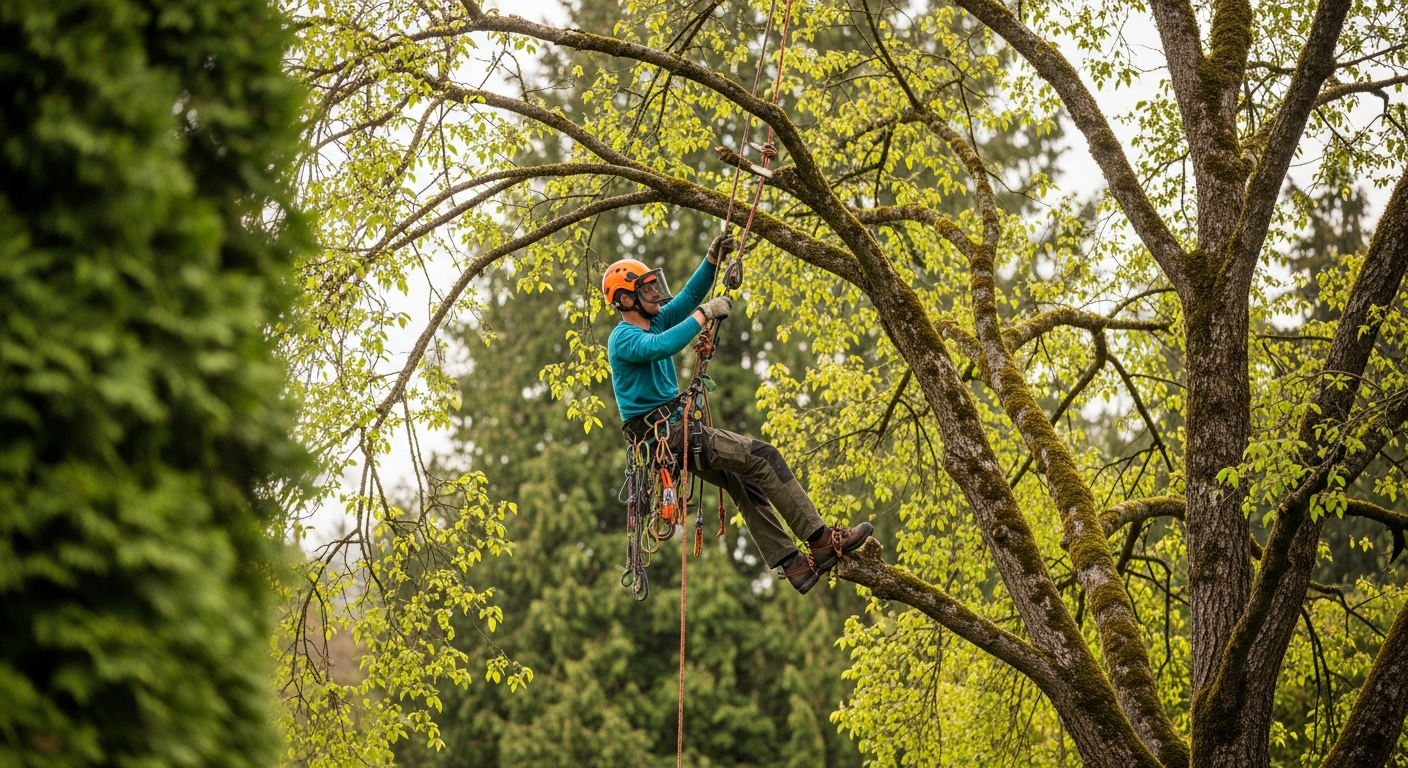
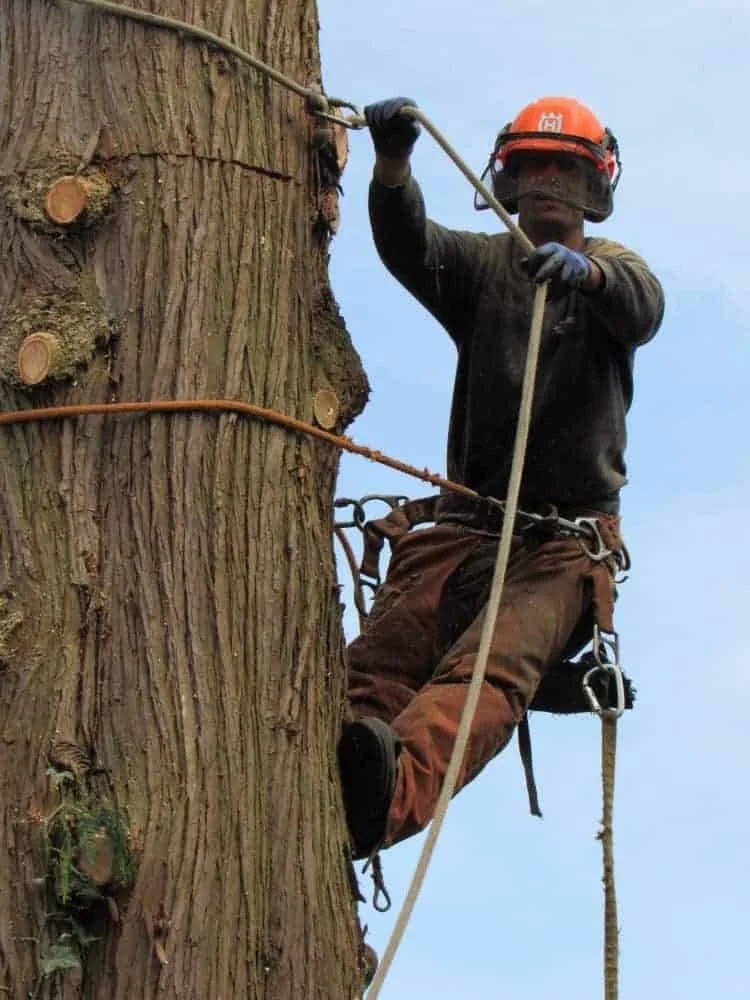
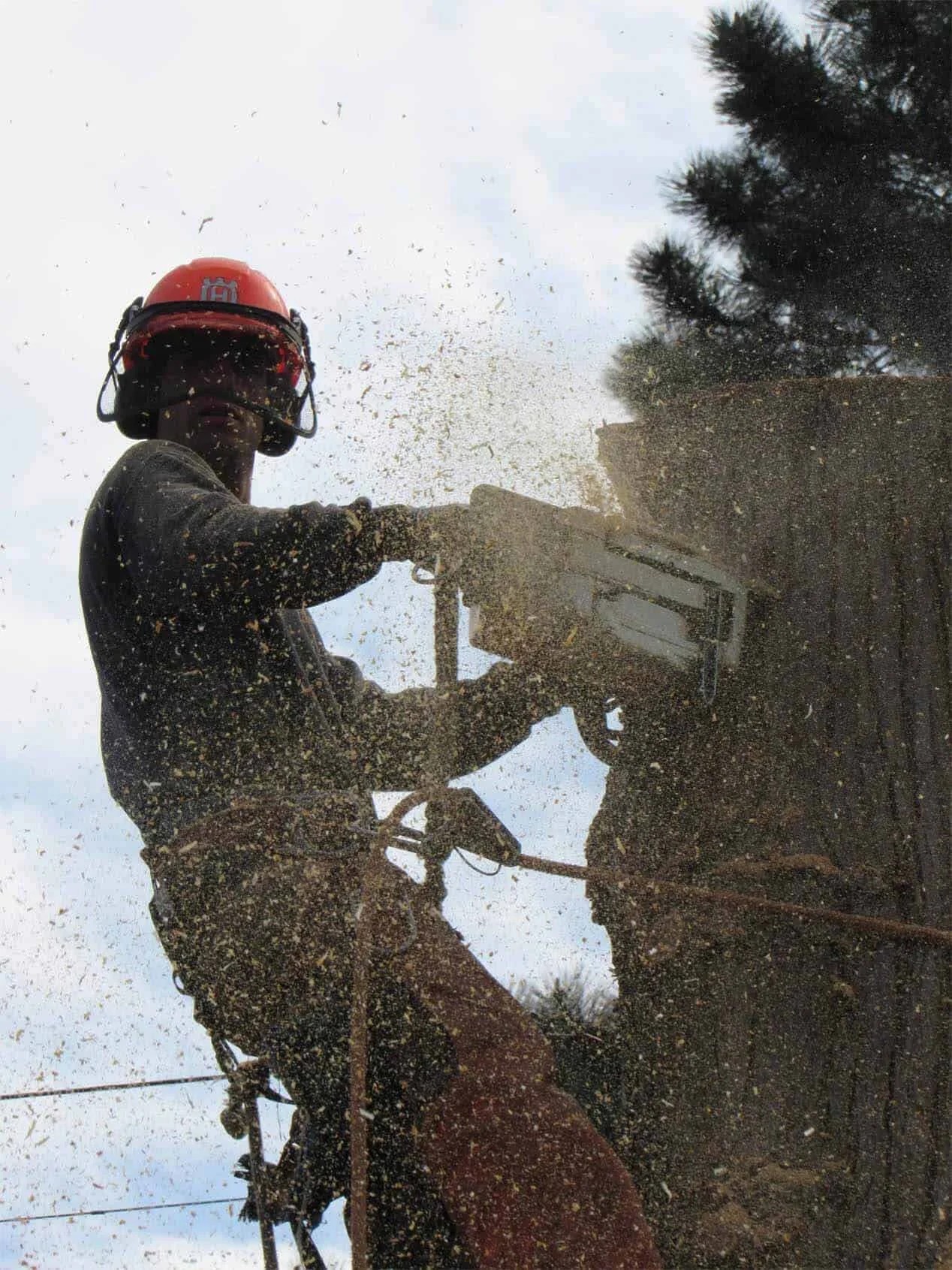
**Step 3: Rigging and access.** For large or mature trees, climbing gear and rigging systems control exactly how removed material is lowered. No branches dropped freefall onto lawn, gardens, or structures. For very large specimen trees, crane-assisted work is sometimes the safest approach — crane removal is not reserved only for dying trees.
**Step 4: Pruning execution.** Every cut is made just outside the branch bark ridge and collar. No stubs. No flush cuts. Each removed branch is evaluated against the live crown limit in real time.
**Step 5: Cleanup.** All brush and removed material is chipped or hauled away. Some clients request the chips as mulch — arborist wood chip mulch applied to the root zone of the pruned tree is beneficial for soil moisture, temperature regulation, and microbial activity.
**Step 6: Documentation.** For trees with ongoing monitoring requirements or pending permit applications, post-pruning documentation is prepared. This integrates into a formal arborist report where needed.
For a medium-sized residential tree in good condition, a seasonal pruning visit typically takes 2–4 hours. For large mature trees, plan for a full day.
Are There Trees That Need More Than Annual Seasonal Pruning?
Yes. Three categories warrant year-round attention in Metro Vancouver.
**Trees with active structural defects.** A codominant stem or included bark identified in February does not resolve by August — it worsens. Trees in this category need scheduled follow-up assessments, not just a single annual visit. Tree cabling provides physical support for structurally compromised unions — buying years of additional safe life from a tree that might otherwise require removal.
**Trees directly over structures.** Overhang above a roof, garage, or deck is active risk accumulation. For these trees, annual seasonal pruning is the baseline — not the ceiling. Proactive monitoring between visits matters. Sudden lean, new weeping wounds, or new fungal growth between scheduled visits should trigger an immediate call, not a wait for the next appointment.
**Previously topped trees.** A tree that was topped at any point is permanently compromised. The epicormic growth that follows topping — fast-growing, weakly attached sprouts — looks vigorous but is structurally immature. These trees need more frequent assessment (annually at minimum) and careful selective pruning to develop the best possible crown structure from a compromised start.
And one more category: any tree that shows sudden, unexpected change between scheduled visits. Sudden lean after heavy rain. New bark splitting. A branch that drops without wind. For these, emergency tree service exists specifically for this reason — acute structural changes that require immediate professional evaluation.
Do not wait for the next seasonal window.
FAQ
**How often should trees be pruned in Metro Vancouver's climate?**
Most deciduous trees benefit from pruning every 2–3 years. Conifers vary — healthy Douglas firs can go 5 years between formal pruning visits, while cedar typically needs annual deadwood removal. Fruit trees and ornamental cherries benefit from yearly attention. The honest answer is that frequency depends on species, age, site conditions, and prior care history. An initial assessment by an ISA-certified arborist gives you a specific schedule for your actual trees — not a generic formula.
**What is the difference between pruning and topping?**
Pruning removes specific branches following ANSI A300 standards — cuts outside the branch collar, no more than 25% of live crown removed per season, preserving structural integrity. Topping removes large sections of trunk or primary branches to bare stubs, without regard to the tree's wound-response tissue. The ISA and the broader arboricultural science community widely condemn topping. It creates large wounds, stimulates structurally weak epicormic growth, and consistently shortens tree lifespan. Topping is not a pruning technique. It is harmful.
**Can I prune my own trees in Vancouver?**
Small ornamental shrubs and low branches on small trees — yes, with proper hand pruners and knowledge of correct cut placement outside the branch collar. Any work requiring a ladder, a chainsaw, or involving branches over two inches in diameter should be done by a professional. The risks — falling branches, improper cuts creating long-term decay, falls from height — are not proportionate to the savings. For trees near structures, power lines, or over public areas, professional work is the only appropriate approach.
**My tree has mushrooms growing at the base. Does it still need seasonal pruning?**
Shelf fungi or mushrooms at the base of a tree are a strong indicator of root or butt rot — typically Armillaria or Ganoderma species. This changes the tree's risk profile significantly. The structural integrity of the root system and lower trunk may be compromised. Before any pruning, you need a full hazard assessment. This is no longer a seasonal maintenance question — it is a structural safety question. A formal arborist report documenting the condition and risk level is the right first step, especially if the tree is near a structure or over a public area.
**What is the difference between seasonal pruning and emergency tree service?**
Seasonal pruning is scheduled, preventive work performed on a stable tree at the biologically optimal moment for that species. It follows a full assessment and ANSI A300 protocol. Emergency tree service addresses acute hazards — a branch that has failed in a storm, a tree leaning suddenly after ground saturation, a split trunk under snow load. Emergency work prioritizes immediate risk reduction; it does not follow the same deliberate assessment protocol as planned seasonal pruning. If a tree on your property suffers storm damage or shows sudden structural change, emergency tree service is the right call. Do not wait for the next scheduled visit.
---
Schedule Your Seasonal Pruning — Free Estimate
The seasonal pruning window in Metro Vancouver opens in February. It does not stay open long.
Trees that receive properly timed care now enter summer structurally sound, disease-free, and positioned to grow the right way. Trees that do not accumulate risk — season by season — until the risk becomes a removal.
Aesthetic Tree & Hedge Services is ISA-certified and WCB registered. We serve Vancouver, Burnaby, North Vancouver, Coquitlam, Richmond, and the surrounding Lower Mainland. Every seasonal pruning visit follows ANSI A300 standards — because that is what professional tree care actually means.
Call us for a free estimate: **(604) 721-7370**
Related: For more on this, see 10 Reasons Why We Should Cut Down Trees — What ISA Arborists Check First.
Related: For more on this, see What Does ISA Certified Mean — And What Uncertified Crews Miss.
Found this helpful? Follow our tree care insights directly on Google.
Make us your preferred source on GoogleBefore You Go
Where are you in your tree care journey?
Our Tree Care Services
ISA-certified arborists serving Greater Vancouver


Explore Our Tree Care Services
From expert pruning to safe tree removal, our ISA-certified arborists are ready to help across Greater Vancouver.
View Services