
TL;DR — Quick Summary
Alternatives to tree topping in Vancouver: ISA-certified arborists explain crown reduction, directional pruning & ANSI A300 standards. Free estimate: (604) 721-7370.
Alternatives to tree topping in Vancouver exist — and they produce safer, healthier trees. But the request comes in almost every week.
A homeowner looks at a large Douglas fir or Big-leaf maple. They worry about the roof in a windstorm. They think removing the top will solve the problem. It won't. It creates a worse one.
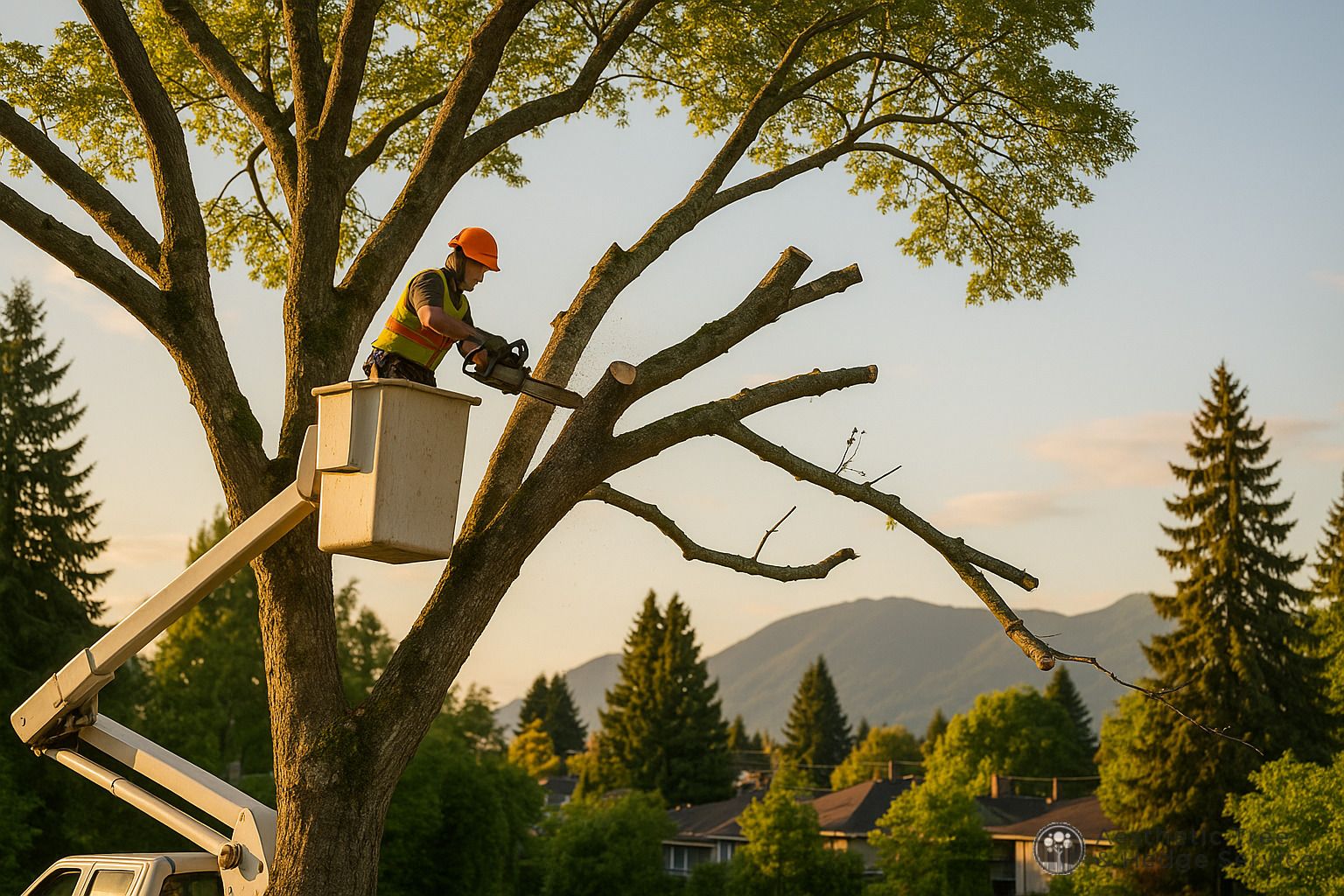
This guide covers what the science says, what Vancouver's bylaws require, and which pruning practices actually work.
TL;DR
- Tree topping violates ANSI A300 pruning standards and is formally condemned in the ISA's 2021 Position Statement on Topping
- Crown reduction, crown thinning, and directional pruning are the three evidence-based alternatives
- Vancouver's Private Tree Bylaw (No. 9958) protects trees with a trunk diameter of 20cm or more — permits are required before major work
- Topped trees develop weakly attached epicormic shoots that break in storms; properly pruned trees do not
- ISA-certified arborists assess each tree's structure before recommending any approach
What Is Tree Topping and Why Do ISA Arborists Oppose It?
Tree topping is the removal of large branches or the entire upper canopy, leaving stubs or lateral branches too small to take over as a terminal leader. It's also called hat-racking, rounding over, or heading back.
The International Society of Arboriculture (ISA) has formally opposed this practice for decades. Its 2021 Position Statement on Topping is direct: topping is "an unacceptable pruning practice that disfigures, weakens, and ultimately shortens the life of trees."
Here is why.
**The wound problem.** Trees close wounds by forming callus tissue at the branch collar — the swollen zone where defence compounds concentrate. Topping cuts through the middle of a branch. No collar exists there. The tree cannot close the wound properly. Fungal pathogens and bacteria move in. Decay spreads inward.
**The regrowth problem.** A tree responds to sudden canopy loss by sending out epicormic shoots — water sprouts that emerge from dormant buds near the cut. These sprouts grow six to eight feet in a single season. They attach weakly at the wood surface. In high winds, they break. The ISA's research documents this pattern consistently across species and climate zones.
**The safety paradox.** Topping makes trees more dangerous, not less. The water sprouts that replace the removed canopy are structurally weaker than properly developed branches. A tree topped in year one is a genuine hazard by year three or four. The homeowner has traded a large, sound tree for a cluster of poorly attached vertical shoots.
**The longevity problem.** Without adequate leaf area, a tree cannot photosynthesize enough energy to sustain itself. Many topped trees show clear decline within five years. Death follows within ten.
What Does the ANSI A300 Standard Say About Proper Pruning in Vancouver?
ANSI A300 is the American National Standard for Tree Care Operations. It is the benchmark ISA-certified arborists follow across North America — including every municipality in the Lower Mainland.
Section 5 (Pruning) sets these requirements:
- **The 25% rule.** No more than 25% of a tree's living crown should be removed in a single growing season. For mature or stressed trees, that limit drops to 10–15%.
- **Cut placement.** All cuts must be made at branch collars or branch unions. Stub cuts — the defining feature of topping — are prohibited.
- **Crown structure.** The resulting tree must retain a form appropriate to its species: a dominant leader for columnar conifers like Douglas fir and Western red cedar, or a spreading crown for deciduous trees like Big-leaf maple.
ISA-certified arborists are obligated to follow ANSI A300. It is not optional guidance. If a tree service offers to top your tree, they are either unaware of this standard or ignoring it. Neither is acceptable.
What Are the Real Alternatives to Tree Topping in Vancouver?
Four evidence-based pruning techniques address the concerns that lead homeowners to request topping. Each serves a different purpose. A qualified arborist assesses the tree first and recommends the right approach.
1. Crown Reduction
Crown reduction lowers the overall height and spread of a tree while maintaining its natural structure. The critical distinction from topping: cuts are made at lateral branches that are at least one-third the diameter of the removed section. These laterals can take over as the new terminal growth point.
The result is a smaller tree that still looks like a tree. Structural integrity is maintained. Wound closure proceeds normally. There are no weakly attached water sprouts.
Crown reduction is appropriate when a tree has outgrown its space and the needed size reduction stays within the 25% live crown removal limit. It is not appropriate for all species. Douglas fir and Western red cedar are excurrent — they grow with a single dominant leader. Remove that leader and the tree's structure is permanently compromised. On these species, removal is usually the correct answer.
2. Crown Thinning
Crown thinning removes selected branches from throughout the canopy to reduce density. Overall height and spread stay approximately the same. Density decreases.
This is the right approach when:
- The crown is so dense that wind resistance is a storm hazard
- Shading is affecting a garden, deck, or solar panel below
- The homeowner wants to see through the canopy without reducing tree height
Thinning prioritizes dead, crossing, and weakly attached branches first. It then selectively removes interior growth to achieve the desired density. It never removes more than 25% of foliage from any branch.
3. Directional Pruning (Clearance Pruning)
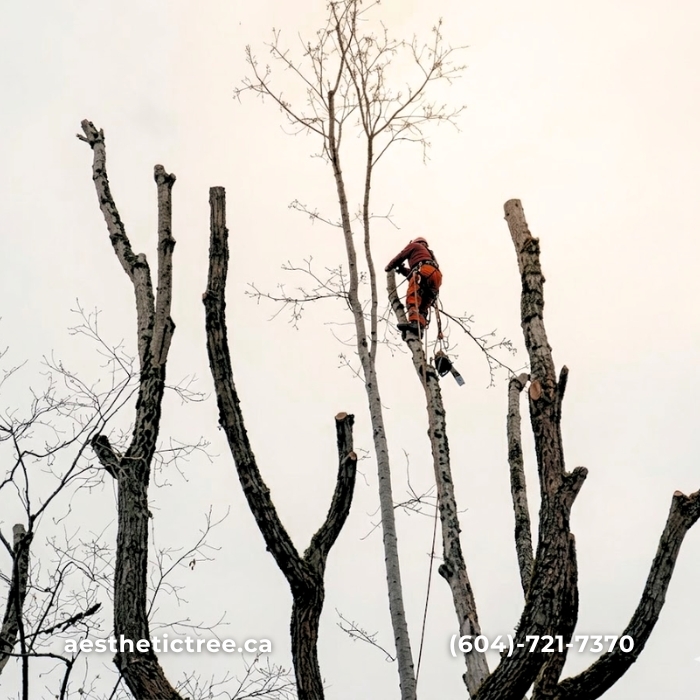
Directional pruning uses the tree's natural branch structure to redirect its growth away from a specific target. The tree is not shortened. It is guided over time.
This technique is used near structures, rooflines, fences, and sidewalks. BC Hydro and FortisBC require clearance pruning near utility lines under their Electric Tariff — with minimum clearances specified from distribution conductors. Line-clearance work near energized conductors requires specialized certification beyond general ISA credentials.
Directional pruning is a multi-year strategy. It does not solve a clearance problem in one visit. After three to five years of consistent work, the tree grows in the right direction without recurring annual intervention.
4. Crown Lifting (Crown Raising)
Crown lifting removes the lower branches of a tree to provide clearance beneath the canopy. It is used for pedestrian clearance, vehicle clearance, sight lines, or to allow more light to reach the ground.
ISA guidelines limit crown lifting to the lower one-third of the tree's total height. Removing branches higher than that shifts the crown too far up. It compromises structural balance and wind stability.
Why Is Tree Topping Still So Common in Vancouver?
Because in year one, it appears to work.
The tree is smaller. The homeowner feels the risk has been addressed. The job is done.
By year three, the water sprouts have returned to original height — sometimes taller. They are weakly attached. The decay in the stub wounds has progressed into the main wood. The tree is more dangerous than before the work was done.
The ISA's position on this cycle is clear. The sprouts that regrow after topping are structurally inferior to properly developed branches. The interval between interventions shortens. The cost accumulates. The tree continues to decline.
Unqualified tree services offer topping because it is fast and cheap to perform. It also guarantees repeat business. The sprouts always come back.
In our experience serving Vancouver, Burnaby, North Vancouver, and Coquitlam, we see the aftermath of topping jobs done by non-certified operators regularly. The pattern is consistent: a tree that was large and structurally sound three years ago is now a cluster of vertical shoots rising from decaying stubs.
Does Vancouver Regulate Tree Topping?
Not by name — but the regulatory context is significant.
Vancouver's Private Tree Bylaw (Bylaw No. 9958) protects trees with a trunk diameter of 20 centimetres or more at breast height (1.4 metres above grade). Any removal or significant pruning of these trees requires a Tree Cutting Permit from the City of Vancouver, administered through the Vancouver Board of Parks and Recreation.
The City of Vancouver Urban Forest Strategy (2018–2037) sets a target of 30% tree canopy coverage across the city. This strategy reinforces permit requirements and guides enforcement priorities.
Violation fines under Bylaw No. 9958 can reach $500 per tree removed without a permit, with elevated penalties for significant or heritage trees. If a topped tree subsequently dies — a common outcome — the property owner may be held responsible for the unauthorized removal of a protected tree.
Burnaby's Tree Protection Bylaw protects trees with a trunk diameter of 30cm or more. North Vancouver, Richmond, and Coquitlam each maintain parallel bylaws with varying diameter thresholds. Before any major pruning work on a mature tree in any Lower Mainland municipality, confirm the permit requirements with the relevant parks or bylaw department.
An arborist report from a qualified ISA arborist is typically required before the city will issue a Tree Cutting Permit. The report documents the tree's condition, the proposed work, and the justification. ISA-certified arborists prepare these reports to municipal specifications.
What Happens When Proper Pruning Isn't Enough?
Sometimes it isn't.
A tree with advanced internal decay, major included bark at primary branch unions, or significant root damage is not a candidate for crown reduction. Pruning it smaller does not make it safer. The structural failure risk is internal. A smaller crown on a failing trunk is still a failing tree.
In those situations, tree removal is the correct recommendation. It is the responsible response to a tree that cannot be made safe through any pruning method.
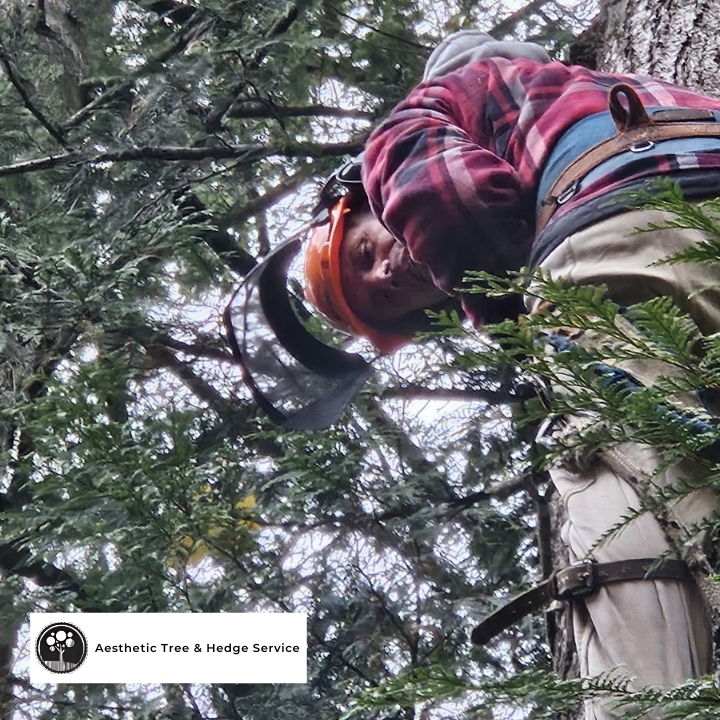
For trees in confined spaces — beside structures, over rooflines, entangled in fences — where standard felling is not safe, crane tree removal allows controlled, section-by-section lowering. This protects adjacent structures and neighbouring trees from damage during removal.
After removal, stump grinding eliminates the root crown flush with the ground. This prevents regrowth from the stump and removes the trip hazard.
How Do You Choose Between Crown Reduction and Tree Removal in Vancouver?
This is the central question. The answer depends on four factors.
**The tree's structural condition.** A tree with no major defects — no advanced decay, no included bark at primary unions, no significant root damage — is a pruning candidate. A tree with serious structural defects is not, unless a targeted pruning cut (removing a cracked co-dominant stem, for example) directly addresses the defect.
**The species' pruning tolerance.** Big-leaf maple, cherry, ornamental plum, and most deciduous species tolerate moderate crown reduction. Douglas fir and Western red cedar are excurrent conifers with a central leader architecture. They do not tolerate crown reduction. Know the species before committing to a method.
**The size reduction needed.** If the homeowner wants a 50% height reduction and ANSI A300 limits removal to 25% of live crown per year, the math doesn't work. Removal is the honest answer.
**The tree's amenity value versus its risk.** The Council of Tree and Landscape Appraisers (CTLA) Guide for Plant Appraisal documents that healthy, established shade trees in residential settings contribute significant appraised property value. The BC Assessment Authority accounts for mature canopy in residential property values — particularly in established Vancouver neighbourhoods like Dunbar, Kitsilano, and Shaughnessy. That value should factor into the decision, in both directions.
What Should You Expect from a Professional Pruning Consultation in Vancouver?
A qualified ISA arborist follows a specific process before any pruning work begins.
**1. Species identification.** Pruning timing varies by species. Cherry and plum trees are pruned in summer to reduce fungal disease risk. Many evergreens are best pruned in late winter before new growth begins. The species determines the calendar.
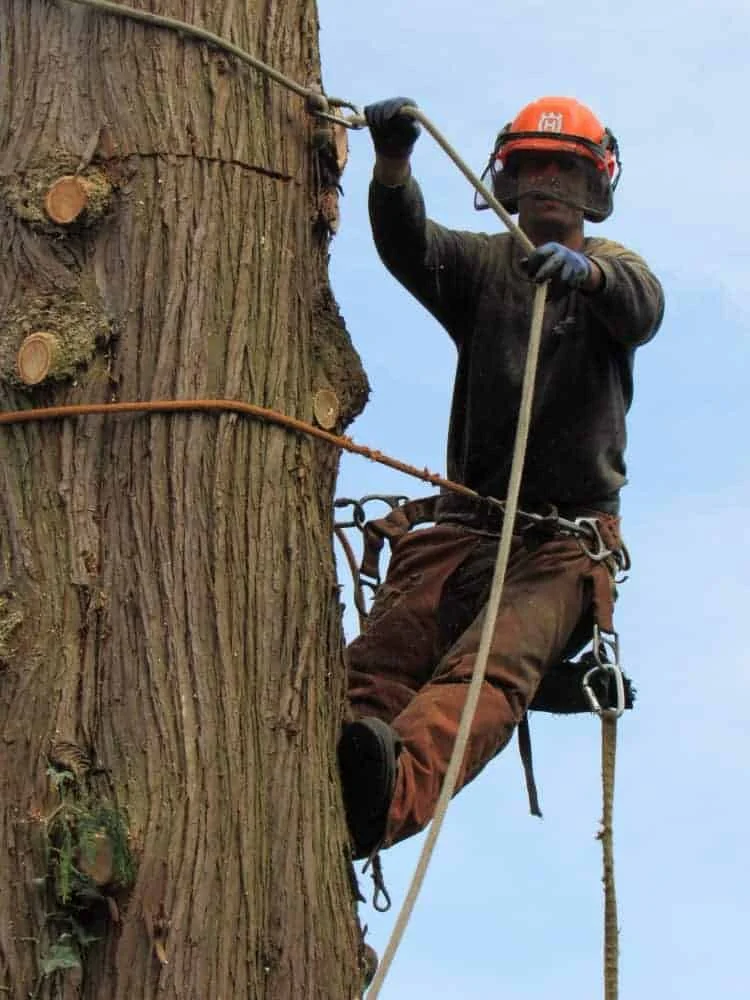
**2. Structural hazard assessment.** The arborist evaluates the tree from ground level and, where necessary, from a rope climb. They're identifying decay indicators, structural weaknesses, and branch attachment quality.
**3. Bylaw review.** The arborist confirms whether the tree is protected under the applicable municipal bylaw and whether a permit is required before work starts.
**4. Written scope of work.** The proposal specifies what will be removed, to what ANSI A300 standard, and the target outcome. Vague proposals — "we'll clean it up" — are not acceptable from a certified arborist.
**5. Post-work documentation.** For significant trees requiring a permit, some municipalities require a completion report confirming the work was performed as specified.
If a contractor shows up, looks at your tree for thirty seconds, and quotes a topping job — that is not a certified arborist. ISA certification requires passing a comprehensive examination and maintaining continuing education. WCB (WorkSafeBC) registration is a separate legal requirement for any tree service operating in British Columbia. It covers mandatory worker injury insurance and is non-negotiable.
Is Hedge Trimming the Same as Tree Topping?
No. The distinction matters.
Formal hedges — Western red cedar, cherry laurel, boxwood, privet — are designed for repeated shearing. These species have dense, multi-stemmed growth habits and tolerate heavy cutting that would destroy a tree. Regular shearing of a formal hedge is correct maintenance, not a harmful practice.
What matters for hedges: shape, timing, and frequency. A properly maintained hedge is wider at the base than at the top. This keeps the lower growth in adequate light. A hedge that is narrower at the base loses its lower foliage within two to three years as the bottom branches are shaded out.
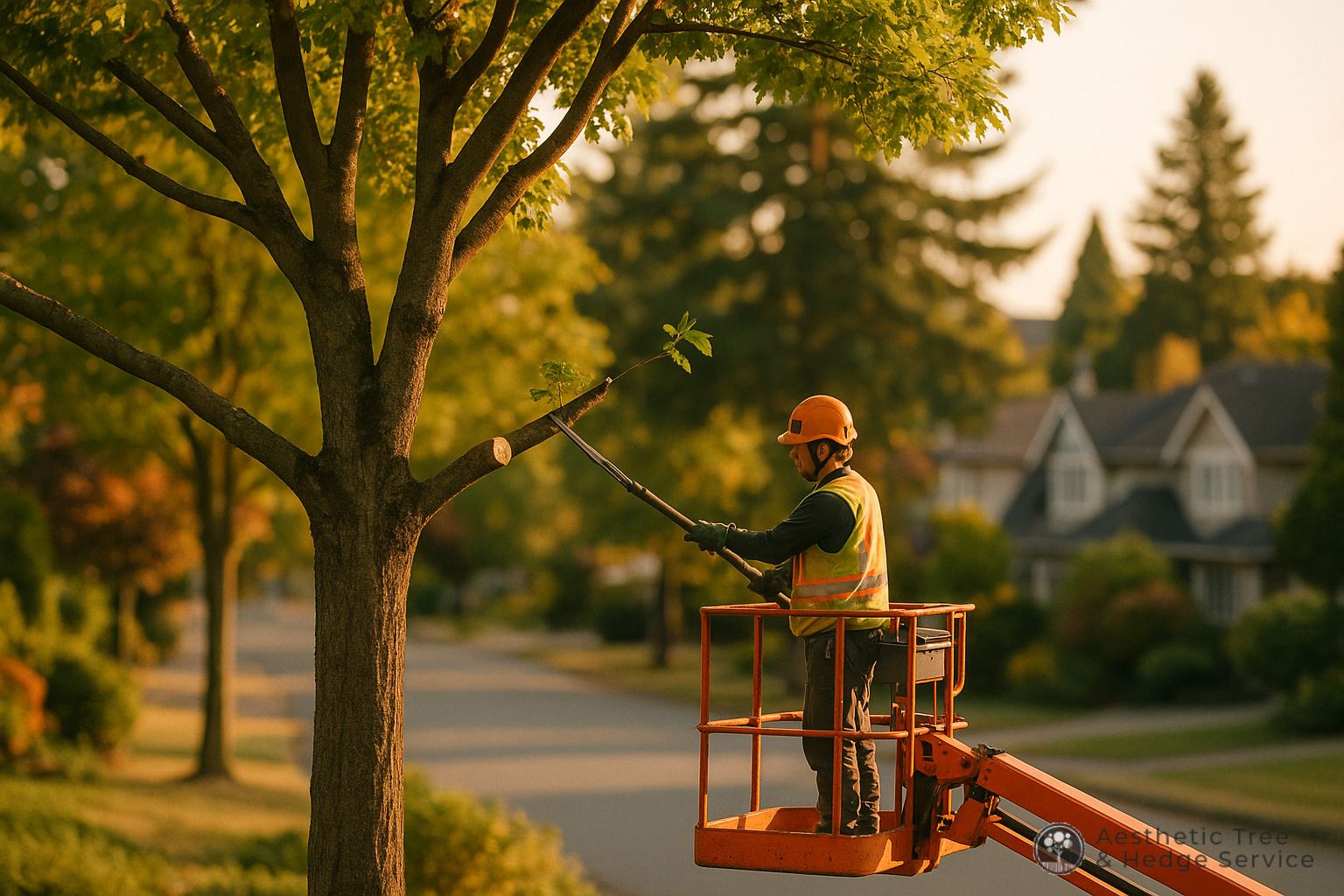
In Vancouver's climate — particularly on the North Shore and in wetter Coquitlam neighbourhoods — dense hedges accumulate interior moisture that drives fungal growth. Regular cutting keeps the canopy open enough for airflow. Our hedge trimming services include two to three visits per year for most formal hedges, timed to the species and the season.
What Are the Long-Term Economics of Proper Pruning vs. Tree Topping?
Topping appears cheaper upfront. The economics reverse quickly.
A topped tree requires re-topping every two to four years as the water sprouts return. Each cycle costs money. Each cycle advances the tree's structural decline. After three or four topping cycles, you're managing a hazard tree on an accelerating maintenance schedule. Eventually you're paying for removal as well — after spending thousands on topping cycles that made the problem worse.
Proper crown reduction costs more per visit. But the treatment cycle is three to seven years, not two to four. The tree doesn't decline. You don't accumulate permit risk, liability exposure, or emergency removal bills.
The CTLA Guide for Plant Appraisal documents that healthy established trees contribute measurable appraised value to residential properties. The ISA's published position on the economics of topping is direct: the practice devalues the tree asset, increases liability, and generates recurring costs that exceed the price of doing it correctly in the first place.
In our work across Vancouver and the Lower Mainland, we've yet to see a topping cycle that saved money over a ten-year horizon. The numbers don't support it. The science doesn't support it. The bylaws don't protect it.
Do it right the first time.
FAQ
**Is tree topping legal in Vancouver?**
Tree topping is not explicitly named in Vancouver bylaws, but it conflicts with ANSI A300 standards. On protected trees — those with a trunk diameter of 20cm or more at breast height — any significant pruning requires a Tree Cutting Permit under Vancouver's Private Tree Bylaw (No. 9958). If a topped tree subsequently dies, the property owner may face consequences for the unauthorized removal of a protected tree. The legal exposure is real.
**How do I know if my tree needs pruning or removal?**
A structural hazard assessment by a qualified ISA arborist is the only reliable answer. General indicators for pruning: the tree is structurally sound but too large or too dense. General indicators for removal: advanced internal decay, structural failure at major branch unions, significant root damage, or a species that cannot tolerate the pruning depth needed. For urgent situations, our emergency tree service is available across the Lower Mainland.
**What is the difference between crown reduction and topping?**
Crown reduction makes cuts at lateral branches that are at least one-third the diameter of the removed section. Those laterals take over as the new terminal growth. The tree retains its form and structural integrity. Topping makes cuts through the middle of branches, leaving stubs with no lateral to assume the terminal role. Crown reduction follows ANSI A300. Topping does not.
**Can a tree recover after being topped?**
If the tree is structurally sound and the stub wounds have not yet developed advanced decay, restorative pruning can improve its condition over time. An ISA arborist selectively removes water sprouts over three to seven years, identifying the strongest as a replacement leader and removing the rest. This process is called restorative or corrective pruning. It does not fully reverse the structural damage from the original cuts, but it can reduce hazard risk and extend the tree's life.
**How do I find an ISA-certified arborist in Vancouver?**
The ISA maintains a searchable directory of certified arborists at treesaregood.org. The BC Society of Certified Arborists (BCSCA) maintains a provincial registry as well. Always verify current certification before hiring — ISA credentials expire if continuing education requirements are not met. Confirm WorkSafeBC registration separately. It is a legal requirement in BC, not a credential some companies have and others don't.
---
**Call Aesthetic Tree & Hedge Services for a free estimate — (604) 721-7370.** ISA-certified arborists. WCB registered. Serving Vancouver, Burnaby, North Vancouver, Richmond, and Coquitlam. We follow ANSI A300 on every job. We don't top trees.
Found this helpful? Follow our tree care insights directly on Google.
Make us your preferred source on GoogleBefore You Go
Where are you in your tree care journey?
Our Tree Care Services
ISA-certified arborists serving Greater Vancouver


Explore Our Tree Care Services
From expert pruning to safe tree removal, our ISA-certified arborists are ready to help across Greater Vancouver.
View Services