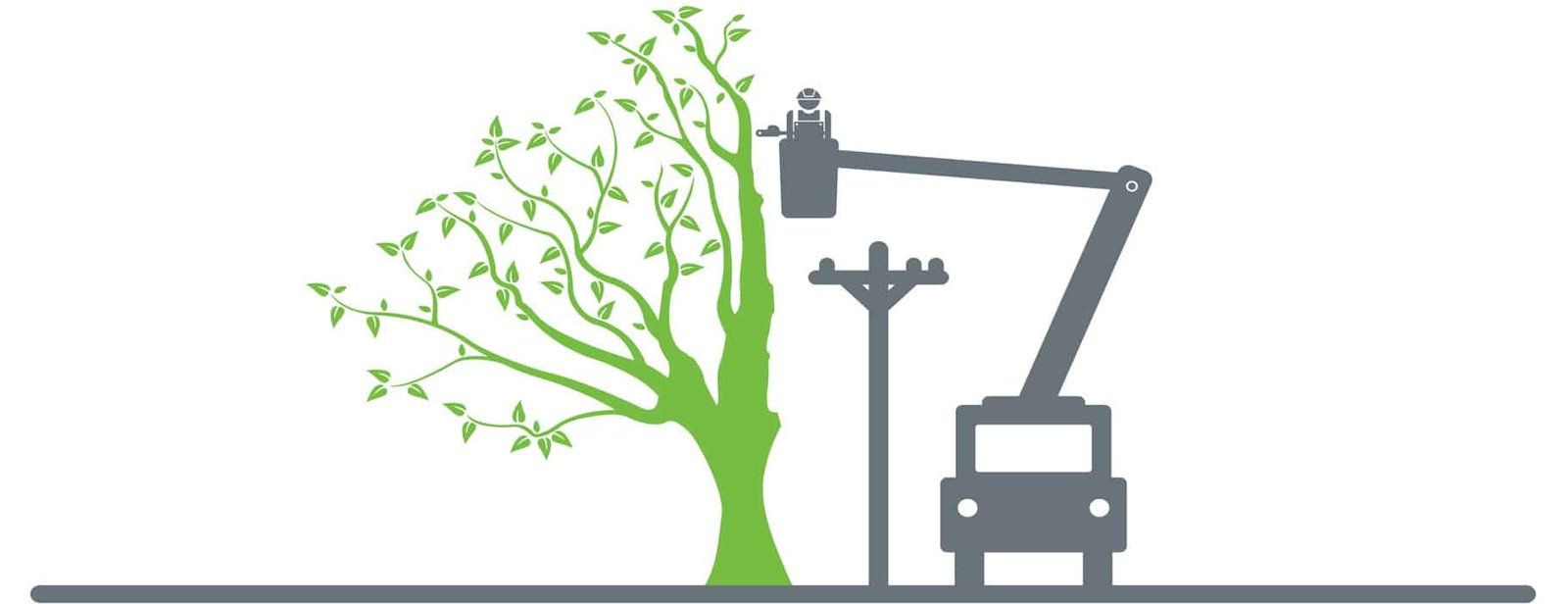

TL;DR — Quick Summary
Trees near power lines in Vancouver are a serious hazard. ISA-certified arborists explain BC Hydro clearance rules, legal responsibility, and when to call a pro.
Trees near power lines are not ordinary landscaping problems. They are safety issues involving electrical hazards, utility clearance rules, municipal tree bylaws, and work practices that most homeowners never have to think about until a branch is already too close.
If you have a tree growing toward a hydro line on your property, do not guess. The safe next step is to identify the type of line, check whether the tree is within a utility clearance zone, and have the work assessed by a qualified arborist before anyone cuts a branch.
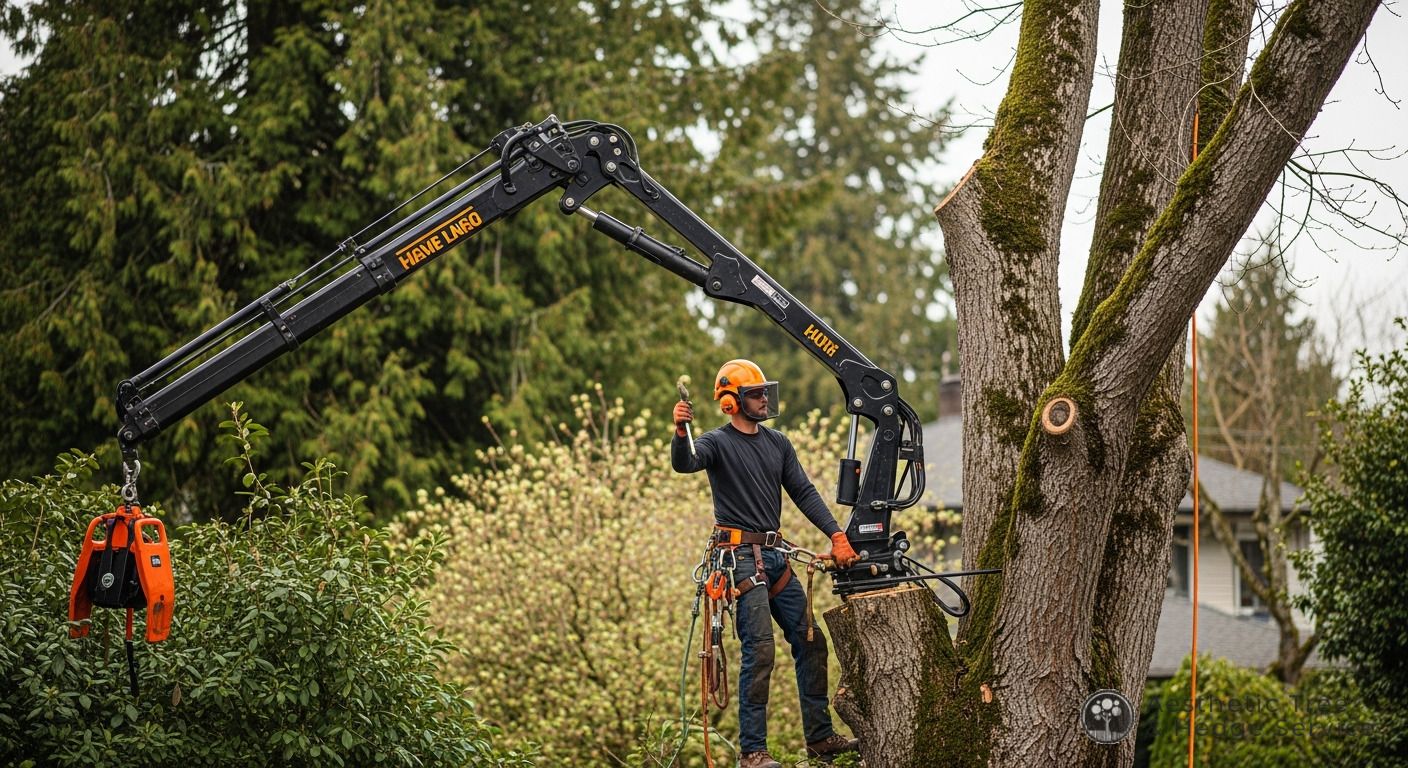
This guide explains what Vancouver and Lower Mainland homeowners need to know: when a tree becomes dangerous, who to call, why this is not DIY work, and how an ISA-certified arborist can help protect both the tree and the people around it.
TL;DR
- Trees growing into or touching power lines can create a serious electrical hazard. Never prune, pull, or remove them yourself.
- BC Hydro and WorkSafeBC rules set strict safety requirements around energized conductors.
- Clearance requirements vary by conductor type and voltage, so the line must be identified before any work is planned.
- Trees on private property may still require municipal permits before removal, even when power lines are involved.
- If a tree is touching a line, call BC Hydro emergency first. Tree work can only happen after the electrical hazard is controlled.
- Aesthetic Tree & Hedge Services provides ISA-certified, WCB-registered tree assessment, pruning, removal, and emergency tree service across Vancouver, Burnaby, North Vancouver, Richmond, Coquitlam, and the Lower Mainland.
---
What Are BC Hydro's Rules for Trees Near Power Lines?
BC Hydro manages vegetation around its electrical system to reduce outages, fire risk, and public safety hazards. The required clearance depends on the type of line, the voltage, the species of tree, and the expected growth before the next maintenance cycle.
For a homeowner, the most important distinction is usually between distribution lines and transmission lines.
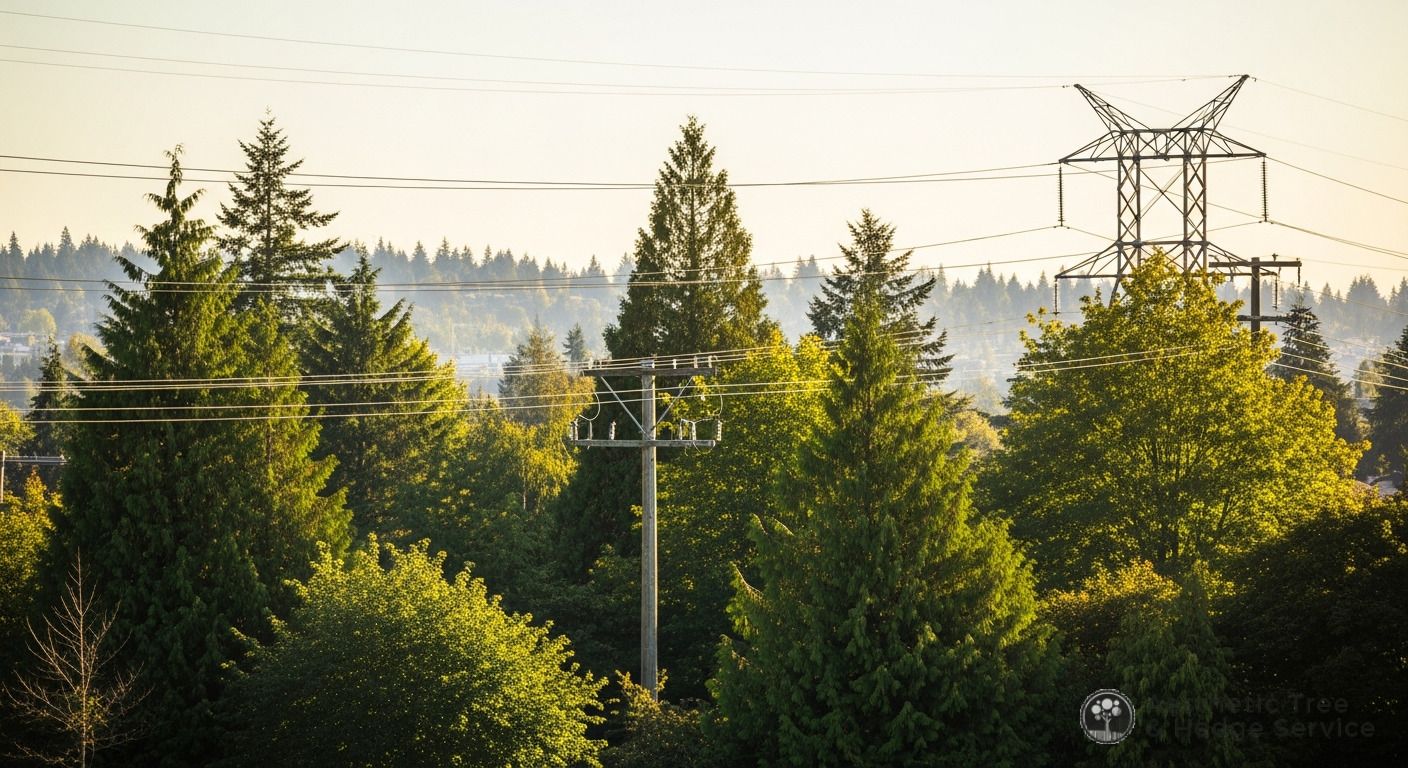
Distribution lines are the lines most people see on residential streets. They are often carried on wooden poles and may include both primary conductors and secondary service lines. Transmission lines are larger, higher-voltage lines usually carried on steel towers or major utility corridors.
The closer the tree is to energized equipment, the more carefully the work must be planned. A branch that looks only slightly too close from the ground may already be inside a restricted approach zone for anyone who is not qualified to work near energized conductors.
BC Hydro vegetation crews also do not prune only to the exact minimum distance visible on the day of work. They usually account for regrowth. A fast-growing Big-Leaf Maple or cottonwood can put on enough annual growth that a cut made too conservatively today becomes a clearance problem again within a short period.
That is why utility pruning can look aggressive. The goal is electrical clearance and service reliability. The goal of an arborist-led plan is to restore clearance while also preserving as much sound tree structure as possible.
Recommended image: close-up ground-level photo showing a tree crown approaching overhead residential distribution lines, with no person or ladder near the tree.
---
Who Is Responsible for Trees Near Power Lines in BC?
Responsibility depends on where the tree is growing, what infrastructure is nearby, and whether the situation is routine maintenance or an immediate hazard.
In general, BC Hydro manages vegetation that threatens its electrical infrastructure and may have authority to access property when work is required for safety or service reliability. Homeowners, meanwhile, are usually responsible for trees growing on private property and for arranging proper care before those trees become hazards.
For residential properties, the practical rule is simple: if a tree on your property is growing toward a power line, do not wait for someone else to solve it. Get the tree assessed while there is still time to prune selectively, apply for permits if needed, and coordinate with BC Hydro if the work requires utility involvement.
BC Hydro crews and contractors prune for electrical safety. They are not there to shape the tree for appearance, long-term canopy balance, or landscape value. When a tree has already grown too close, the cuts required for clearance may be much more severe than what a homeowner would have chosen earlier.
A proactive arborist assessment gives you better options. An arborist can document the tree's condition, identify the likely clearance issue, recommend pruning or removal, and help determine whether municipal approval is required.
If the tree is already touching a line, the situation changes. Do not call a regular tree crew first. Call BC Hydro emergency and keep people away from the area until the line status has been confirmed.
---
Which Trees Are Risky Near Power Lines?
Most line-clearance problems begin years earlier with the wrong tree in the wrong location.
A small tree may look harmless when planted, but many common Lower Mainland species mature far above residential utility lines. Once they reach conductor height, every storm and every growth season increases the likelihood of conflict.
High-risk species near overhead lines include:
- Big-Leaf Maple: a large native tree that can become very wide and tall at maturity.
- Western Red Cedar: slower than some deciduous trees, but capable of becoming massive over time.
- Douglas Fir: tall, fast-growing, and poorly suited to tight residential utility corridors.
- Black Cottonwood: fast-growing, brittle in storms, and common near drainage areas, creeks, and property edges.
- Norway Maple: widely planted historically and often too large for confined urban spaces.
None of these species are bad trees. They are simply the wrong choice directly under or beside overhead utility corridors.
Better planting choices near utility areas are usually smaller ornamental trees, compact native species, or shrubs that stay well below conductor height. BC Hydro publishes planting guidance for utility corridors, and municipalities may also have preferred species lists.
Before planting, check the mature height and spread, not the nursery size. A tree that matures at 15 to 30 metres should not be treated like a shrub because it fits in a five-gallon pot today.
Aesthetic Tree's tree planting service includes site assessment, species selection, and spacing recommendations so today's planting decision does not become a power-line problem in 10 or 20 years.
---
How Close Is Too Close?
There is no single safe distance that applies to every line. The right clearance depends on voltage, conductor type, tree species, site conditions, and who is doing the work.
From the ground, homeowners can make a basic observation, but they should not try to measure clearance by leaning ladders, using poles, climbing, or moving branches. If a branch appears close enough that you are wondering whether it is safe, that is enough reason to call for an assessment.
Common visual clues:
- Branches are growing through or over the wires.
- The tree crown is within a few metres of the upper conductors.
- A limb moves toward the line during wind.
- Previous utility cuts have left large stubs facing the wires.
- The tree has a heavy lean toward the street or service line.
- Storm-damaged branches are hanging above or near the conductors.
Residential overhead lines are not all the same. The lower service line running to a house is different from the primary conductor on the pole. Both deserve caution, but they are not managed the same way.
An ISA-certified arborist can assess the tree from the ground, identify whether utility coordination is likely required, and recommend the safest path forward.
---
Warning Signs a Tree Near Power Lines Needs Attention Now
Do not wait for a windstorm to confirm that the tree is a problem.
Call for professional help if you notice:
- Branches touching or resting on a wire.
- Broken limbs caught in or hanging over the line.
- Burn marks, bark wounds, or dead sections facing the conductor.
- Sudden lean after a storm.
- Root lifting or soil cracking near the base of the tree.
- Dead limbs above a service drop, sidewalk, driveway, or street.
- Repeated flickering lights during wind events that appear to correspond with tree movement.
If the tree is touching a line, treat it as an emergency. Keep people and pets away. Do not touch the tree, the branch, a fence connected to the area, or anything that may be energized.
Call BC Hydro emergency at 1-800-BCHYDRO. Once the utility has addressed the electrical hazard or confirmed the line status, an emergency tree service crew can assess what tree work is required.
Wet weather increases concern. In Vancouver's fall and winter conditions, wet bark, wet soil, and saturated branches can make an already dangerous situation worse.
---
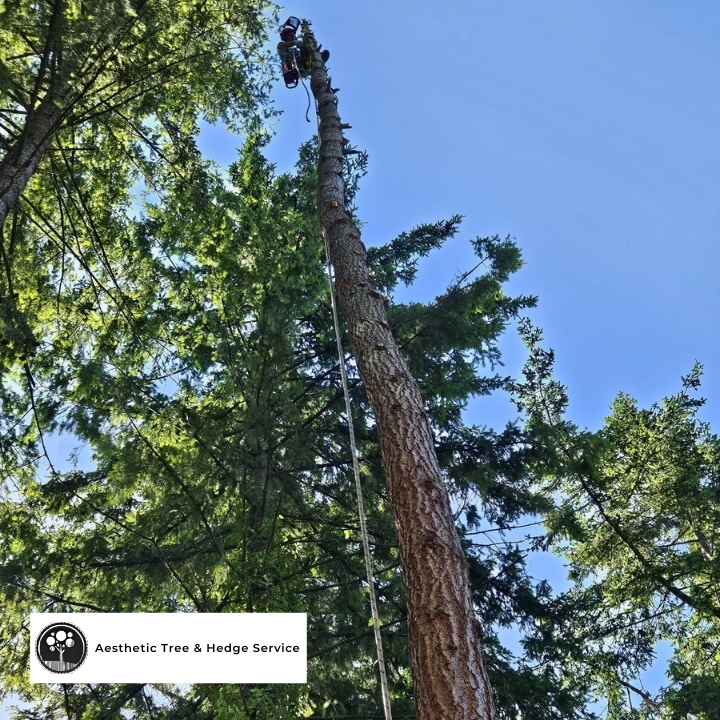
Can You Remove a Tree Touching Power Lines Yourself?
No.
A tree touching or growing into an energized conductor is not a homeowner pruning job. It is not a handyman job. It is not a job for a general landscaping crew.
WorkSafeBC rules set minimum approach distances around energized electrical equipment. People who are not qualified and equipped for this work must stay away from the hazard zone.
The danger is not limited to touching the wire directly. Electricity can travel through a wet branch, the trunk, a ladder, a saw, a rope, or the ground near the contact point. A person may be injured before they understand what has happened.
Do not:
- Cut the branch.
- Pull the branch with a rope.
- Use a pole saw.
- Climb the tree.
- Place a ladder against the tree.
- Touch a fence, gate, or wet surface that may be connected to the energized area.
What to do instead:
1. Call BC Hydro emergency at 1-800-BCHYDRO. 2. Keep people and pets well away from the tree and surrounding ground. 3. Wait for the utility to confirm the line status. 4. Call an emergency tree service once the electrical hazard has been controlled.
If the tree is close to the line but not touching, schedule a hazard assessment before it becomes an emergency.
---
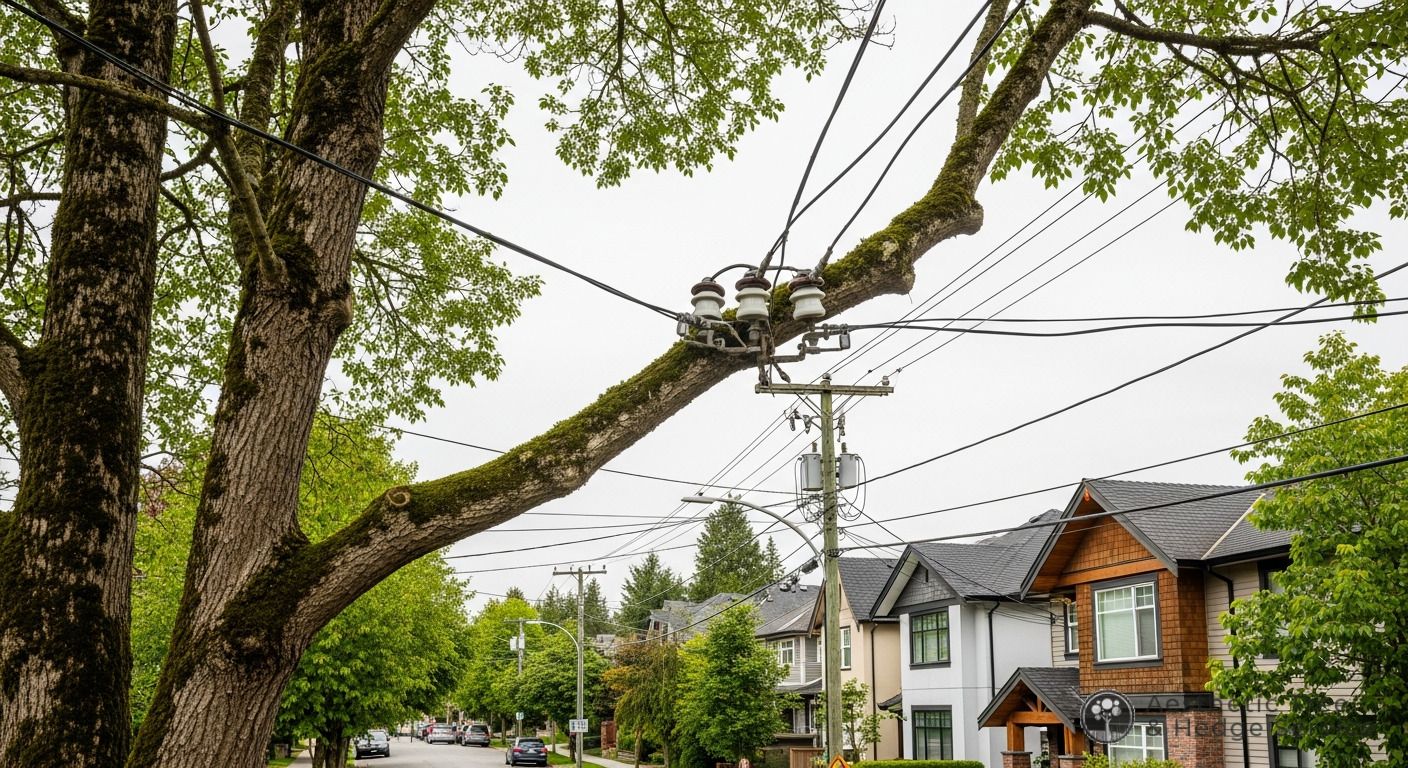
How Do ISA-Certified Arborists Prune Trees Near Power Lines?
Tree pruning near utility lines is different from ordinary crown thinning or hedge work. The crew must consider electrical approach distances, tree structure, species response, equipment access, and the amount of live crown that can be safely removed.
Where safe clearance still exists, an arborist may be able to prune branches back to suitable laterals or branch unions while preserving the tree's natural structure. The goal is to redirect growth away from the conductor, not simply shear a flat wall into the canopy.
A proper plan considers:
- Current clearance from the line.
- Expected regrowth rate.
- Branch attachment strength.
- Decay or defects from previous cuts.
- Wind exposure.
- Whether the work can be completed without entering a restricted approach zone.
- Whether BC Hydro coordination or a line hold is needed.
If the tree is too close to work safely, the arborist may need to coordinate with BC Hydro. In some cases, the utility may need to de-energize or otherwise control the line before tree work can proceed.
This is one reason early action matters. A tree with adequate clearance can often be pruned thoughtfully. A tree already in contact may require emergency response, utility scheduling, and more severe cuts or removal.
---
Real Example: When Early Assessment Prevents Emergency Removal
In 2024, we assessed a North Vancouver home where a 40-year-old Big-Leaf Maple was overhanging a residential distribution line. The homeowner had been watching the tree for "a couple of years" but assumed it was the utility's responsibility to handle.
When we evaluated the tree, branches were already within the BC Hydro clearance zone, and two recent summer storms had left a lean in the crown toward the line. The tree was not yet touching, but the regrowth trajectory meant contact was likely within 12 to 18 months—or sooner if a major storm bent the crown again.
We documented the tree's structure, the clearance deficit, and the growth rate in a formal arborist report. Because the tree still had adequate clearance, we recommended a selective, structure-preserving pruning that redirected 5 major limbs away from the conductor while removing 12 percent of the canopy. We coordinated with BC Hydro for a courtesy line visit—not because the tree was in contact, but to confirm the branch paths after work.
The pruning was completed in one day. BC Hydro verified clearance the following week. The homeowner never needed emergency removal, never faced an outage incident, and kept a tree that will continue to provide shade and wildlife value for another 20+ years.
If the homeowner had waited for BC Hydro to act unilaterally, the tree would have eventually touched the line. At that point, a crew would have removed large limbs with no concern for tree structure—or removed the tree entirely. Early assessment cost far less and preserved an asset.
---
What Does a Tree Risk Assessment Near Power Lines Include?
A tree risk assessment is more than a quick opinion from the driveway.
For trees near power lines, an arborist looks at both the electrical target and the biological condition of the tree. The question is not only whether the tree is close to a wire today. The question is how likely it is to contact the line, fail toward the line, or require more severe intervention if left unmanaged.
A strong assessment includes:
- Tree species and approximate size.
- Distance and growth direction relative to the conductor.
- Whether the line appears to be service, distribution, sub-transmission, or transmission infrastructure.
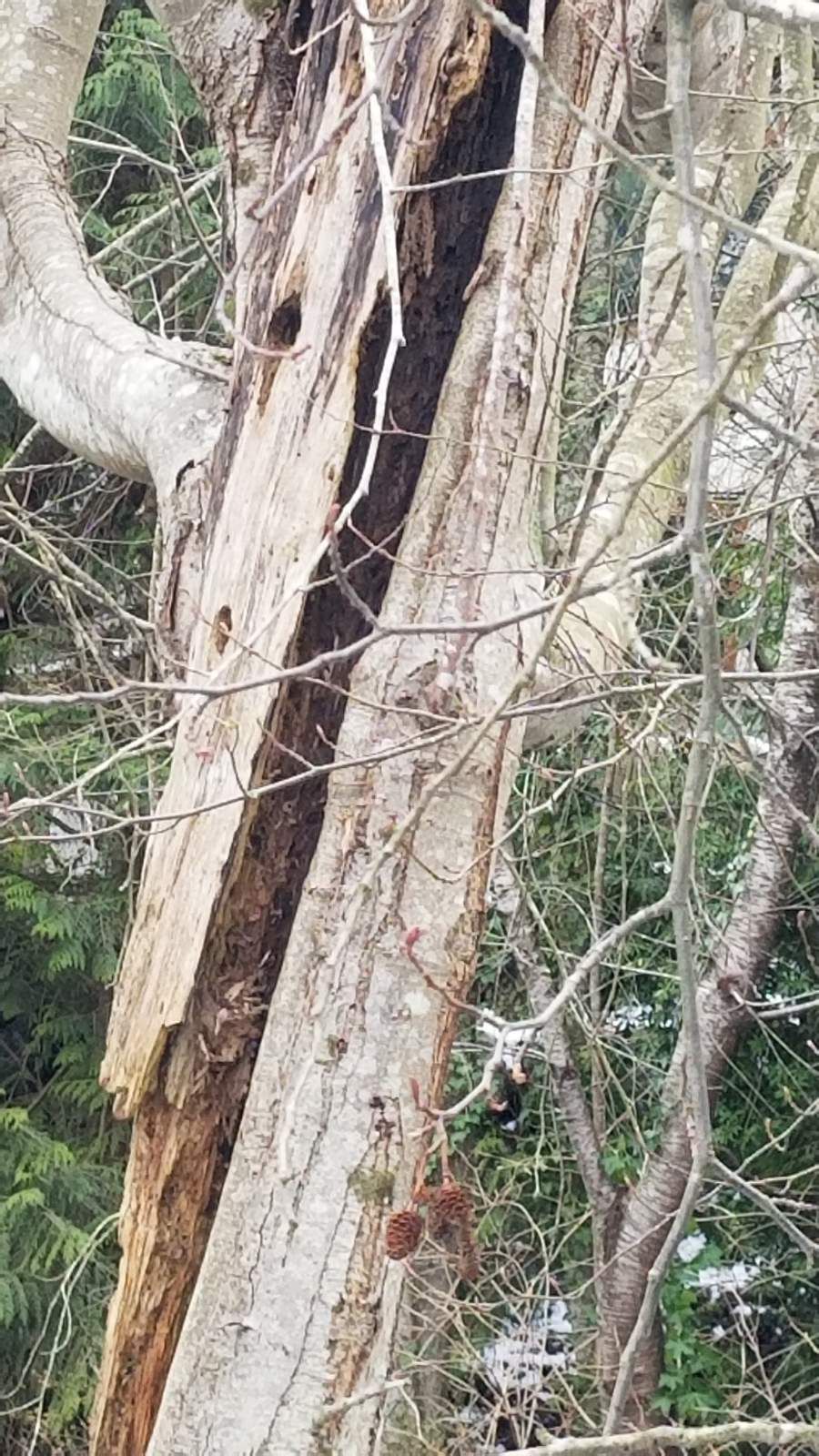
- Defects such as cracks, cavities, included bark, decay, weak unions, or root disturbance.
- Evidence of previous topping or utility pruning.
- Likely failure mode: branch failure, stem failure, or whole-tree failure.
- Targets: power line, house, garage, vehicle, sidewalk, road, or neighbouring property.
- Recommended action: pruning, monitoring, cabling, removal, or utility coordination.
For permit applications, written documentation matters. Municipal staff and insurers are more likely to rely on a clear arborist report than on a homeowner's description of a dangerous tree.
Aesthetic Tree's arborist reports can support tree removal permits, pruning plans, insurance documentation, and practical decision-making before the situation becomes urgent.
---
Do You Need a Permit to Remove a Tree Near Power Lines?
Often, yes.
Power-line proximity does not automatically cancel municipal tree bylaws. Many Lower Mainland municipalities regulate private tree removal based on trunk diameter, species, location, hazard status, or environmental sensitivity.
Examples homeowners should verify before removal:
- City of Vancouver: private-property tree removal is regulated, and trees above the bylaw threshold generally require a permit unless an emergency exemption applies.
- District of North Vancouver: many private trees require application and approval before removal.
- Burnaby: protected trees are regulated by the city's tree bylaw, with significant penalties for unauthorized removal.
- Coquitlam: permit requirements may apply depending on tree size, location, and site conditions.
Emergency hazards may be handled differently, but documentation is still important. If a tree must be removed immediately because it presents an imminent safety risk, photograph the condition, keep utility or arborist records, and report the removal according to the municipality's requirements.
The safest path is to confirm the local bylaw before work begins. A qualified arborist can help identify whether a permit is needed and prepare the supporting report.
---
What Happens If You Ignore a Tree Growing Into Power Lines?
The problem usually becomes more expensive and less controllable, and we have seen this pattern repeatedly in our service area.
**Early stage:** The tree is growing toward the line but still has workable clearance. Selective pruning may redirect growth and preserve structure. Professional assessment at this point costs $300–500 and often prevents future conflict entirely.
**Middle stage:** Branches enter the clearance zone. Utility pruning may be required, and cuts are likely to prioritize electrical clearance over appearance. The tree's form is compromised, and regrowth becomes unpredictable.
**Contact stage:** A branch touches the conductor. The situation may become an electrical emergency. BC Hydro may need to respond before any arborist can work. Emergency response, utility coordination, and urgent removal all escalate cost and limit options.
**Failure stage:** A storm breaks a limb or pushes the tree into the line. This can cause outages, property damage, downed wires, emergency callouts, and a much narrower set of options. Liability questions may arise if the hazard was known and ignored.
**Removal stage:** If pruning can no longer restore safe clearance without destroying the tree's structure, removal may be the only practical recommendation. That may also mean permit work, stump grinding, replacement planting, and total costs $2,500–6,000+.
Early assessment is almost always better than waiting for a forced decision.
---
How Much Does It Cost to Prune or Remove a Tree Near Power Lines?
There is no responsible fixed price without seeing the tree.
Cost depends on:
- Tree size and species.
- Distance from the conductor.
- Whether the line is service, distribution, or transmission infrastructure.
- Access for bucket trucks or climbing crews.
- Whether utility coordination is required.
- Whether the tree is being pruned or removed.
- Whether a municipal permit and arborist report are needed.
- Cleanup, hauling, and stump grinding.
A simple clearance-pruning job with good access is very different from removing a storm-damaged cedar beside overhead lines, a fence, a garage, and a neighbour's driveway.
The most accurate next step is an on-site estimate. Aesthetic Tree can assess the line proximity, explain whether BC Hydro coordination may be needed, and provide a written scope before work begins.
The hidden cost of waiting is risk. If a known tree hazard later causes damage, outage, or injury, the documentation trail may matter. An arborist assessment shows that you took the issue seriously and acted with due care.
---
What Should You Expect When You Call an ISA-Certified Arborist?
The process should be clear and documented.
Step 1: Site assessment. The arborist inspects the tree, line proximity, access, species, structural condition, and likely work constraints.
Step 2: Recommendation. You receive a practical explanation of whether the tree should be pruned, monitored, cabled, removed, or escalated for utility coordination.
Step 3: Permit review. If removal is being considered, the arborist checks whether municipal approval is likely required and what documentation will support the application.
Step 4: Utility coordination. If the tree cannot be worked on safely because of line proximity, BC Hydro coordination may be required before the tree crew proceeds.
Step 5: Tree work. WCB-registered, insured crews complete the approved scope using appropriate equipment and pruning standards.
Step 6: Cleanup and documentation. Debris is removed, the site is left clean, and any required documentation is provided for the homeowner, municipality, or insurer.
---
FAQ
**Can BC Hydro cut my tree without asking me first?**
BC Hydro may have authority to manage vegetation that threatens its electrical infrastructure, including situations where safety or service reliability is at risk. Notice requirements and access rights depend on the circumstances. If you are concerned about a tree near a line, it is better to act proactively than wait for utility intervention.
**My tree is already touching the power line. What do I do right now?**
Do not touch the tree. Do not try to move the branch. Keep people and pets away from the area and call BC Hydro emergency at 1-800-BCHYDRO. After the utility confirms the electrical hazard has been controlled, call Aesthetic Tree for emergency tree service.
**Does my home insurance cover damage caused by a tree that hit a power line?**
Coverage depends on your policy, the cause of the damage, and whether the hazard was known before the incident. If you already knew the tree was dangerous and did nothing, your insurer may review the claim more closely. A written arborist assessment and completed corrective work can help show responsible maintenance.
**Do I need a permit to prune a tree near power lines in Vancouver?**
Routine pruning may not require the same approval as removal, but pruning must still be done safely and within accepted arboricultural standards. Tree removal is more likely to require a permit, especially when the tree exceeds the city's protected size threshold. Always confirm current municipal requirements before work begins.
**How far from power lines should I plant a new tree?**
Choose a planting location based on the tree's mature height and spread, not its current nursery size. Large native trees and conifers should be kept well away from overhead utility corridors. Near lines, choose smaller species that will remain below conductor height and check BC Hydro and municipal planting guidance before planting.
---
Trees near power lines are a safety issue first, a tree health issue second, and a permit issue third. The best outcomes happen before a branch touches the wire.
Call Aesthetic Tree & Hedge Services for a free estimate: (604) 721-7370.
ISA-certified arborists. WCB registered. Serving Vancouver, Burnaby, North Vancouver, Richmond, Coquitlam, and the Lower Mainland.
Found this helpful? Follow our tree care insights directly on Google.
Make us your preferred source on GoogleBefore You Go
Where are you in your tree care journey?
Our Tree Care Services
ISA-certified arborists serving Greater Vancouver


Explore Our Tree Care Services
From expert pruning to safe tree removal, our ISA-certified arborists are ready to help across Greater Vancouver.
View Services