
TL;DR — Quick Summary
complying vancouvers tree replacement rules laneway house? Learn permits, arborist reports, replacement trees, and site risks.
complying vancouvers tree replacement rules laneway house starts before design drawings feel final.
Because in Vancouver, the tree can decide the project.
Not the garage. Not the fence. Not the deck you plan to remove.
The tree.
If you’re building a laneway house in Kitsilano, Riley Park, Mount Pleasant, Dunbar, Renfrew-Collingwood, or anywhere else in Vancouver, tree replacement rules need early attention. Not after demolition. Not after excavation. Not when your contractor is ready to start.
Vancouver’s Protection of Trees By-law No. 9958 ties tree removal, replacement planting, arborist reporting, and construction protection into the building permit process.
That matters.
A protected tree near the lane can change your footprint. A neighbour’s cedar within two metres of your property line can trigger protection requirements. A street tree can affect access. A replacement tree may need a legal planting spot before occupancy.
In our experience, laneway projects run smoother when the arborist is involved early. Before the design locks in. Before the survey gets stale. Before a machine gets near the root flare.
Aesthetic Tree & Hedge Services works with homeowners, builders, and designers across Vancouver and the Lower Mainland. We prepare permit-support reports, assess tree risk, plan removals, protect retained trees, and help owners meet City requirements without guessing.
TL;DR
- Vancouver usually requires a tree permit for private trees with a trunk diameter of 20 cm or more, measured 1.4 m above grade.
- For laneway houses, tree rules apply to trees on your site, trees on adjacent property within two metres, and street or boulevard trees near the work.
- If a tree is removed for a laneway house, the City can require replacement planting under Protection of Trees By-law No. 9958.
- Replacement trees need the right size, species, spacing, location, and survival care. Planting anywhere convenient is not enough.
- The cleanest path is simple: survey, arborist report, tree plan, permit review, protection barriers, supervised work, replacement planting, inspection.
Do you need a tree permit before building a laneway house in Vancouver?
Yes, if the tree meets Vancouver’s protected-tree threshold or was required under a previous permit.
The City of Vancouver says a tree removal permit is required on private property when the tree is at least 20 cm in diameter, or 64 cm in circumference, measured 1.4 m above the base of the tree. Multi-stem trees can also count if the combined diameter of the largest two or three stems reaches 20 cm.
That’s the first number to know.
But don’t stop there.
A smaller tree can still matter if it was planted as a replacement tree or required by a previous development approval. Hedges also deserve care. Vancouver’s by-law applies to individual trees within a hedge unless a specific section says otherwise.
For laneway projects, the permit question often comes up because the tree sits where the new structure, services, or construction access needs to go.
The City’s current tree removal permit page says removal can be considered when a tree is located within the building envelope defined in an issued development or building permit. The by-law itself is tighter. Section 4.5 says the Director of Planning may issue a permit when the tree is within the building envelope and changing the siting of the accessory building to retain the tree is not possible.
That last part matters.
The City does not treat replacement planting as a free pass to remove a healthy tree. You still need a valid reason under the by-law. You still need documents. You still need approval.
That’s why an ISA-certified arborist report in Vancouver is often the first real step. It gives the City the tree data it needs. It also gives your designer facts, not guesswork.
A proper report identifies:
- Species, such as Douglas fir, Big-leaf maple, western red cedar, cherry, birch, or spruce
- Diameter at 1.4 m above grade
- Condition and structure
- Root zone limits
- Drip line
- Tree protection requirements
- Construction impact
- Removal or retention rationale
- Replacement planting recommendations
A homeowner sees a backyard.
The City sees a regulated site.
The arborist connects the two.
What tree documents does Vancouver ask for on a laneway house project?
For development work, Vancouver asks for more than a simple note saying the tree is in the way.
Protection of Trees By-law No. 9958 requires a tree plan with a permit application. For development or building permit applications, Section 7.1 requires a survey certified by a BC land surveyor. It must show trees on the site, trees on adjacent property within two metres of the boundary, and trees on streets next to the site.
That is broader than many homeowners expect.
Your neighbour’s cedar can matter. A boulevard maple can matter. A stump can matter.
Section 7.2 also requires an arborist report with the development or building permit application. The report must cover tree condition, size, species, development impact, hazards during and after construction, construction limits, and recommended practices to protect trees.
That report is not just paperwork.
It can shape the job.
A lane-facing garage demolition may look simple. But if a mature cedar root zone sits beside the slab, the demolition method matters. If excavation cuts roots near the root flare, the retained tree can decline years later. If a trench crosses a protection zone, the City can require boring or hand excavation.
The by-law also requires the arborist and owner to make commitments. Those can include pre-construction treatment, root and branch pruning, on-site inspections during construction, soil work, replacement tree selection, replacement planting, and post-construction reporting.
That is why we like to review the site before design choices harden.
A good arborist can help the project team answer questions like:
- Can the laneway house shift slightly to retain a valuable tree?
- Does the proposed footing hit major roots?
- Will utility trenching damage the root system?
- Can a tree protection barrier fit while keeping access open?
- Is removal defensible under the by-law?
- Where can the replacement tree actually survive?
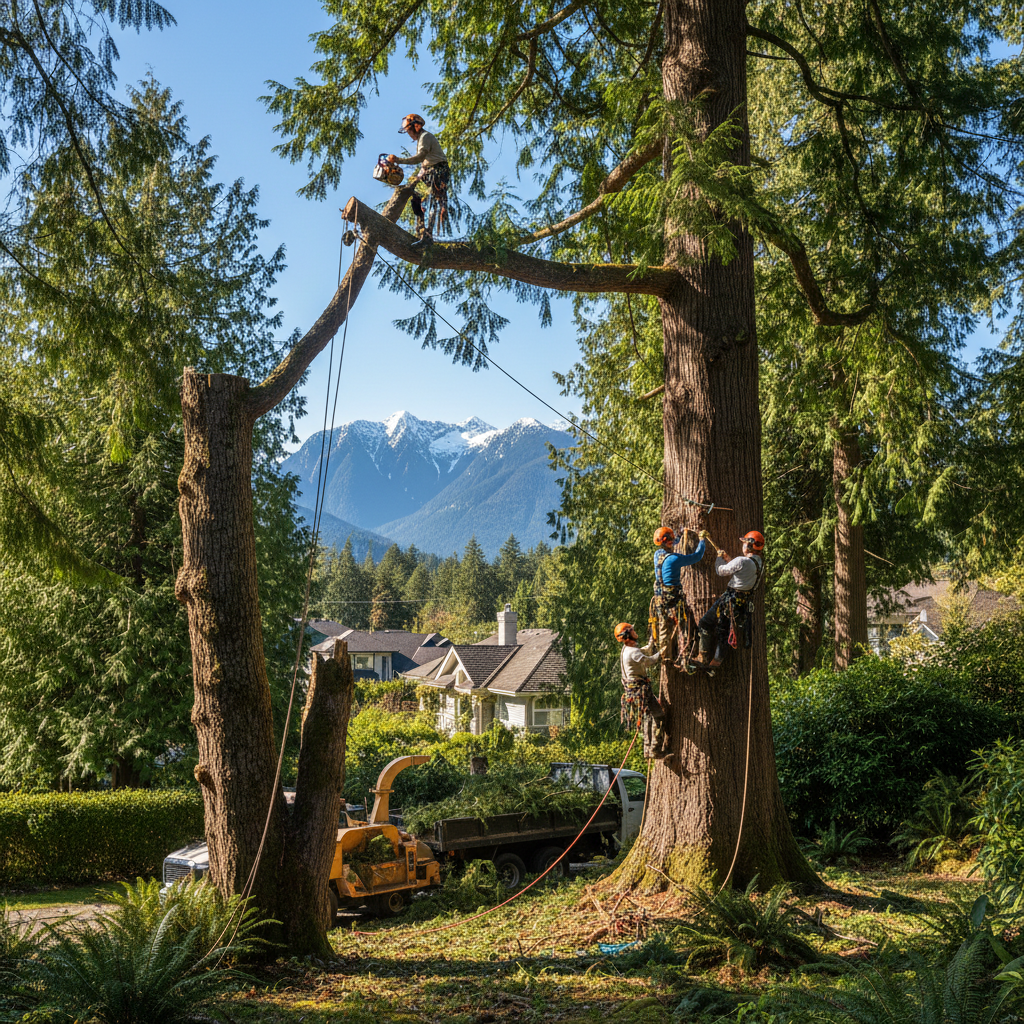
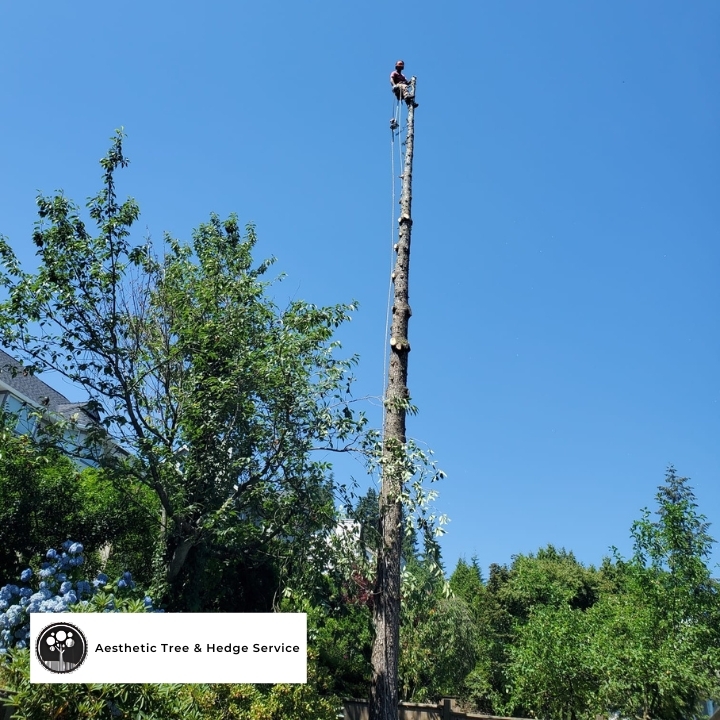
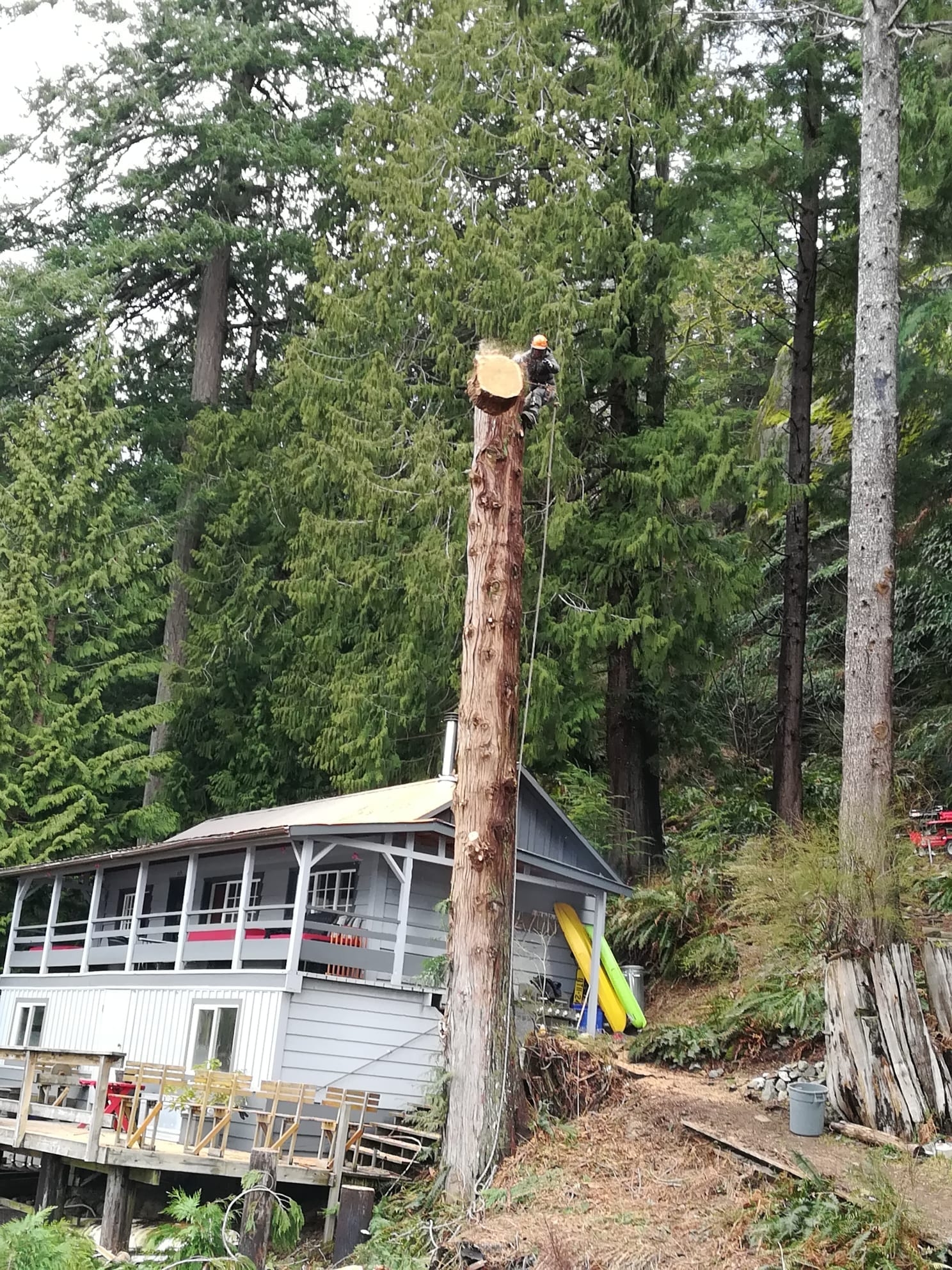
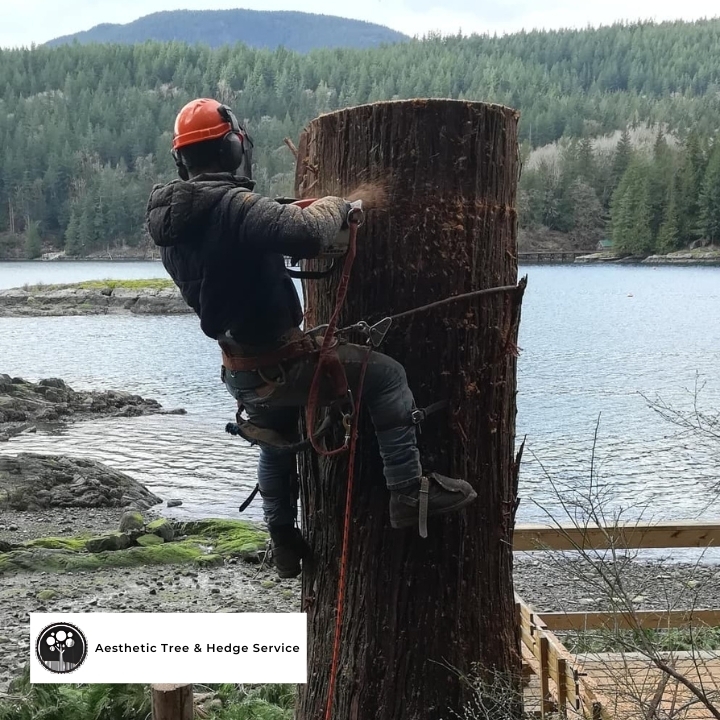
If removal is approved, the work still has to be done safely. Tight Vancouver lanes, overhead utility lines, fences, garages, sheds, and neighbouring structures all raise the stakes. For approved removals near construction, our tree removal Vancouver team plans the sequence around site access, rigging, and public safety.
When does Vancouver require replacement trees for a laneway house?
Vancouver can require a replacement tree when a tree is removed under a tree permit.
The City’s tree removal permit page states that a replacement tree will be required for any removed tree larger than 20 cm in diameter. The by-law also says the owner must plant a replacement tree for every tree removed in breach of the by-law, or as required by the tree permit.
For laneway houses, that replacement requirement often shows up as a permit condition.
The basic rule is not complicated.
Remove a protected tree. Replace it if the City requires it. Plant it where the approved tree plan says. Keep it alive. Pass inspection.
The details are where people get stuck.
Under Section 6.3 of the by-law, for each tree removed, the owner must plant one replacement tree from Part 1 of Schedule D, two replacement trees from Part 2 of Schedule D, or another tree or trees acceptable to the Director of Planning.
The City’s replacement tree instructions state that replacement trees must be at least 6 cm caliper, measured 15 cm above the ground, or 3.5 m tall at planting, excluding the root ball.
Spacing matters too.
The replacement tree must be on the same site. It must sit at least one metre from a side boundary, accessory building, or other affected structure. It must sit at least 1.5 m from a principal building. It must sit at least 2.5 m from any other tree on or beside the site. It must also match the approved tree plan.
That sounds easy until you draw a real Vancouver lot.
A laneway house takes the rear yard. The main house takes the front. Services run through the side yard. Patios, stairs, fences, bike storage, parking pads, and drainage all compete for the same space.
Now add mature roots.
This is where replacement planning needs arborist input. A replacement tree squeezed into poor soil beside a foundation is not a real solution. It may fail inspection. Or worse, it may survive just long enough to create future conflict.
We look for a planting location with enough soil volume, light, clearance, and long-term room. We also consider species. A small ornamental tree may fit better near a compact laneway yard. A larger canopy tree may work on a deeper lot with clean setbacks.
If the City requires a replacement, treat it as part of the build. Not an afterthought.
Our tree planting service can help select and install a replacement tree that matches City conditions and the site’s future use.
What happens if the tree is inside the laneway house footprint?
A tree inside the buildable footprint is not automatically approved for removal.
That surprises people.
The City’s Low Density Housing Options guide says that for laneway houses, if a tree is located within the buildable footprint, you may be able to remove the tree. It also says replacement trees are required for removed trees under the Protection of Trees By-law. The guide recommends preparing an arborist report and consulting with a Landscape Specialist at the Development and Building Services Centre.
Notice the phrase: may be able.
Not will be able.
The City can also consider variances to laneway house rules to support tree retention. That means your project team may need to test options before asking to remove a healthy tree.
Options can include:
- Shifting the laneway house within the allowed envelope
- Changing the entry or stair layout
- Adjusting service routes
- Using pier or grade-beam approaches where appropriate
- Moving storage or parking
- Protecting part of the root zone with barriers
- Keeping excavation outside the critical root area
The arborist’s role is not to block the build. It is to identify what the tree can tolerate and what the by-law will likely require.
Some trees are poor candidates for retention. A declining cherry with decay and included bark is different from a healthy Douglas fir with stable structure. A cracked stem over a future rental suite is different from a young ornamental tree near a fence.
We assess risk, health, species, root conditions, structure, and site constraints.
That gives the designer something useful: a tree constraint that can be drawn, discussed, and submitted.
It also helps the homeowner avoid a bad sequence.
Bad sequence:
- Design the laneway house.
- Submit the permit.
- Learn the tree blocks the project.
- Redesign late.
- Lose time.
Better sequence:
- Survey the site.
- Assess trees early.
- Design with tree constraints shown.
- Submit a clear arborist report.
- Plan removal, retention, and replacement before construction starts.
That one change can save weeks of confusion.
How close can construction get to a protected tree?
It depends on trunk diameter, species, condition, soil, and the work being done.
Vancouver’s by-law includes a protection barrier schedule. A 20 cm trunk needs a minimum protection distance of 1.2 m from the trunk. A 50 cm trunk needs 3.0 m. A 100 cm trunk needs 6.0 m.
Those are by-law distances.
They are not a promise that the tree will tolerate every impact outside the fence.
Roots do not read drawings. They grow where oxygen, moisture, and soil allow. On older Vancouver lots, roots often run under garages, cracked slabs, fence lines, and compacted lane edges.
That is why the arborist report matters.
Section 7.5 says protection barriers must be installed before demolition, excavation, or construction begins. Section 7.6 says no demolition, excavation, or construction can proceed unless required protection barriers are in place. Section 7.9 says a person is not entitled to a demolition, excavation, or construction permit unless required barriers have been inspected and approved.
In plain English:
No barrier. No work.
The by-law also says people must not enter the tree protection area with vehicles. They must not store materials there. They must not alter or remove the barrier until construction is complete.
That includes common mistakes like:
- Stacking lumber inside the fenced area
- Parking a mini-excavator over roots
- Cutting roots for a trench without arborist review
- Raising grade around the trunk
- Pouring wash water near the root zone
- Removing bark from a retained tree
- Topping a tree to clear equipment
- Pruning roots without an arborist
These details matter on laneway sites because access is tight. Crews want staging space. Materials arrive from the lane. Bins, fencing, porta-potties, and machines all need room.
The retained tree often ends up under pressure.
A good plan gives crews a clear layout. It shows the protection zone. It shows access. It shows what cannot move.
If pruning is needed for clearance, it should meet ANSI A300 standards. Cuts should protect the branch collar. Roots should be pruned only by an arborist. Large roots near the root flare need special care.
For approved clearance work, our tree cutting Vancouver service focuses on controlled cuts, safety, and tree health. It is not topping. It is not random cutting. It is arboriculture.
What replacement tree species work best on tight Vancouver laneway lots?
The best replacement tree is the one that fits the by-law and the site.
Not the one that looks good in a nursery pot.
The City’s Schedule D lists acceptable replacement tree types. The right choice depends on space, soil, light, overhead wires, future maintenance, and building clearance.
On tight laneway lots, we often look at these factors first:
- Mature canopy spread
- Root behaviour near foundations and paving
- Drought tolerance
- Soil volume
- Clearance from stairs, patios, and fences
- Light levels between the main house and laneway house
- Long-term pruning needs
- Wildlife value
- City acceptance
A western red cedar may be a strong native tree, but it needs room. A Douglas fir is not right for every compact rear yard. Big-leaf maple gives canopy value, but its mature size can overwhelm a narrow site. Some ornamental species fit better where soil volume is limited.
This is where homeowners need direct advice.
A replacement tree should not become a future removal application.
We want a tree that can reach a healthy form without fighting the laneway house. That means checking future clearance from gutters, windows, heat pumps, fences, and service lines. It also means planting at the correct depth, with the root flare visible and the root ball prepared properly.
A common failure is planting too deep.
The root flare gets buried. Mulch gets piled against the trunk. The tree starts stressed. Girdling roots form. Decline follows.
Another failure is choosing the wrong species for the soil.
Many rear yards have compacted fill, old garage base material, construction debris, or poor drainage. A replacement tree planted into that without soil work has a weak start.
Vancouver’s Urban Forest Strategy explains why this matters. The City’s 2025 strategy says Vancouver’s canopy covered about 25% of the city in summer 2022, up from 23% in 2018 and 21% in 2013. The City’s target is 30% canopy coverage by 2050. The same City page says Vancouver has about 150,000 street trees, 36,000 specimen trees in golf courses and urban parks, and more than 1 million trees across 444 hectares of public forests and woodlands.
That is the big picture.
Your replacement tree is one small part of it.
But the City still checks.
And on your site, that one tree can decide whether the permit condition is satisfied.
What if a neighbour’s tree or street tree is near the laneway build?
Do not ignore it.
Vancouver’s development rules do not stop at your fence.
The by-law requires the survey to show trees on adjacent property within two metres of your boundary. It also requires street trees next to the site to be shown. If your work affects those trees, the arborist report must deal with the risk.
This is common on laneway builds.
Rear yards are close. Fences hide trunks. Cedars straddle boundaries. Tree crowns hang over garages. Roots cross lot lines. Street and lane trees sit near access routes.
If a neighbour’s tree is within the impact zone, your project may need:
- A tree protection barrier inside your site
- Arborist notes on excavation limits
- Hand digging near roots
- Root pruning by an arborist
- Clearance pruning with consent where needed
- No storage or traffic in the protection area
- Monitoring during demolition or excavation
If a tree straddles the property line, removal is more sensitive. The City’s tree removal permit page says written consent from the other owner is needed when the tree is co-owned. For strata property, written consent from the strata council president or vice-president is needed.
For street trees, the City’s rules are strict. Section 7.8 says owners must meet City requirements for boulevard or lane trees next to the site. It also says they must not prune, move, or disturb those trees unless the Park Board has given prior written permission.
That means your contractor should not trim a street tree for equipment access on a Friday morning because the truck is coming.
Get direction first.
A damaged street tree can delay the job and trigger enforcement. A damaged neighbour tree can create a dispute that lasts longer than the build.
If a tree becomes hazardous during construction or after storm damage, emergency work has a separate path. Section 9.1 allows emergency removal when a tree becomes hazardous due to natural damage. But Section 9.2 requires a tree permit application within 24 hours, or the next business day after a weekend or holiday.
If a tree is cracked, leaning, uprooted, or hung up after wind, call a qualified crew. Our emergency tree service is built for those situations.
What are the biggest mistakes homeowners make with laneway house tree rules?
Most mistakes start with timing.
The tree gets treated like a landscaping issue. But on a laneway house, it is a permit issue, a design issue, and a construction safety issue.
Here are the mistakes we see most often.
Waiting until after design is finished
By then, the footprint feels fixed. The drawings feel paid for. The owner is attached to the layout.
Then the arborist finds a protected tree in the wrong place.
Early review is faster. It gives the designer better constraints. It also helps avoid late changes.
Measuring the tree wrong
Vancouver measures diameter at 1.4 m above grade. Not at knee height. Not at the widest root flare. Not by eyeballing from the deck.
Multi-stem trees need special care. The combined diameter of the largest two or three stems can trigger the by-law.
Forgetting adjacent trees
A tree across the fence can still affect your permit. If it is within two metres of the property line, it belongs on the survey and in the arborist review.
Assuming replacement means approval
Replacement planting does not erase the need for a valid removal reason. The City can ask whether the laneway house can shift or whether a variance supports retention.
Damaging roots during demolition
Old garages often sit close to trees. Pulling slabs, breaking footings, and trenching can damage roots fast. Once major roots are torn, the tree may decline or become unstable.
Moving protection fencing
Protection barriers are not site furniture. They exist to keep people, machines, and materials out of the root zone. Moving them without approval creates risk.
Planting the replacement tree in a poor spot
A replacement tree needs setbacks, soil, water, light, and room. A cramped corner beside concrete is not good enough.
Leaving the stump unmanaged
If a removal is approved, the stump can interfere with grading, planting, drainage, or future landscape work. Our stump grinding Vancouver service clears the stump while respecting nearby roots, utilities, and site plans.
How do Vancouver’s tree rules affect your construction timeline?
They affect it early, during work, and near occupancy.
The City’s tree process is tied to development and building permits. If the arborist report is missing, weak, or inconsistent with the survey, review can slow down. If the tree plan does not show adjacent trees, it can come back. If replacement planting has no legal location, the issue can land late.
Here is the better order.
Step 1: Get a site survey
Make sure it shows trees on the site, adjacent trees within two metres, street trees, grades, stumps, and relevant structures.
Step 2: Book the arborist assessment
The arborist measures, identifies, and assesses the trees. They review likely impacts from demolition, excavation, utility work, and construction access.
Step 3: Share findings with the designer
Do this before the laneway house layout is fixed. A small layout change can save a tree or support a stronger removal case.
Step 4: Prepare the arborist report and tree plan
The report should match the survey and drawings. It should be specific. Vague reports cause questions.
Step 5: Submit with the permit package
The arborist report supports the City’s review. If removal is proposed, the rationale must match the by-law.
Step 6: Install protection barriers
Barriers need to be in place before demolition, excavation, or construction. The City may inspect them.
Step 7: Use arborist supervision when needed
Root pruning, work near protection zones, and clearance pruning need qualified oversight.
Step 8: Remove approved trees safely
Approved removal should be sequenced around access, structures, overhead lines, and neighbouring property. Tight lanes often need rigging.
Step 9: Plant replacement trees on time
For development under the Zoning and Development By-law, Section 6.6 says replacement trees must be planted before occupancy permit issuance or before occupancy if no occupancy permit is required, unless the Director of Planning sets another deadline.
Step 10: Pass inspection and maintain the tree
The City can inspect replacement trees after planting. The by-law also provides for another inspection one year after satisfactory inspection to confirm that replacement trees have been maintained and remain in satisfactory condition.
That last point is easy to miss.
Replacement does not end on planting day.
Watering, mulch, staking, soil care, and pruning all matter. A dead replacement tree can become another compliance problem.
What fines or enforcement risks apply if you remove or damage a tree without approval?
The risk is real.
Protection of Trees By-law No. 9958 says a person must not cut down, kill, remove, relocate, or plant a replacement tree except in compliance with the by-law and the tree permit.
It also says no person may damage a tree in a way that causes it to become hazardous, lose its characteristic appearance, become diseased, die prematurely, or be removed.
That covers more than chainsaw removal.
Damage can include root cuts, grade changes, bark injury, topping, heavy pruning, soil compaction, or construction traffic inside the protection area.
The by-law allows the City to revoke a tree permit if it was issued based on false, misleading, or incorrect information, or if the owner fails to follow the permit.
It also allows the City to order replacement after unlawful damage or removal. The person may need to apply for a tree permit within 14 days, take required steps to obtain it, and plant replacement trees as directed.
The fine range is serious. Section 11.8 says offences are punishable on conviction by a fine of not less than $500 and not more than $10,000 for each offence. Section 11.9 says continuing offences are punishable by a fine of not less than $250 and not more than $10,000 for each day the offence continues.
Each tree can count separately.
That means one bad decision can become more than one issue.
The practical risk is bigger than the fine.
An unlawful removal can pause a build. A damaged neighbour tree can create a legal dispute. A failed replacement inspection can hold up final closeout. A contractor who cuts roots without approval can leave the homeowner responsible.
Do not rely on verbal advice from a crew that is not qualified to assess trees.
Use an ISA-certified arborist.
Get the report.
Follow the permit.
Keep the tree protection barrier in place.
How can an ISA-certified arborist help before you submit your laneway plans?
An ISA-certified arborist turns a risky unknown into a clear plan.
Before submission, we can identify protected trees, measure them properly, assess condition, and map constraints. We can also flag likely City concerns before they become comments on your application.
For a laneway house, the arborist should review:
- The survey
- The proposed footprint
- Demolition scope
- Excavation depth
- Service routes
- Lane access
- Street and boulevard trees
- Neighbouring trees within two metres
- Replacement planting locations
- Construction staging areas
The goal is simple.
Protect what can be protected. Remove only what is approved. Replace what the permit requires. Keep the project moving.
Aesthetic Tree & Hedge Services is ISA-certified and WCB registered. We work with Vancouver tree permits, arborist reports, tree removal, pruning, stump grinding, planting, hedge work, and emergency response.
We also understand the difference between a tree that is inconvenient and a tree that is unsafe or not compatible with approved construction.
That distinction matters to the City.
It also matters to your home.
A healthy retained tree can add shade, privacy, habitat, and property value. A hazardous tree can threaten the future laneway suite. A poor replacement choice can create maintenance problems. An undocumented removal can create enforcement risk.
For compact sites, we may also recommend root barrier installation where roots and hardscape need separation. This is not for every tree. But in the right place, it can reduce future conflicts with paving, drainage, or structures.
If the laneway project includes hedge removal or pruning near access routes, our hedge trimming services in Vancouver can help keep clearance work clean and controlled.
What should you do before calling a builder or designer?
Start with the trees.
That does not mean you need every answer before you speak with a designer. It means you should know whether trees are likely to control the site.
Here is a simple homeowner checklist.
- Walk the property from the lane to the front street.
- Note every trunk near the proposed laneway area.
- Check for trees on or near the property line.
- Look for street trees near access, parking, or service routes.
- Do not cut, top, or prune anything to make measuring easier.
- Book a site visit with an ISA-certified arborist.
- Get tree measurements before design is fixed.
- Ask whether an arborist report is needed for the permit package.
- Ask where replacement trees can fit.
- Share the arborist findings with your designer.
A laneway house is a major project. The trees are not decoration around it. They are part of the approval path.
If you are already in design, it is not too late. But move now.
The later tree issues are found, the more expensive they feel in time, stress, and redesign.
Call Aesthetic Tree & Hedge Services for a free estimate at (604) 721-7370. Our ISA-certified, WCB registered team can assess your trees, prepare permit-support arborist reports, plan approved removals, protect retained trees, and help you comply with Vancouver’s replacement tree rules before your laneway build gets stuck.
FAQ
Do I need an arborist report for a Vancouver laneway house?
Usually, yes, if trees may be affected. Vancouver’s Protection of Trees By-law requires an arborist report with development or building permit applications when the project affects trees on the site, adjacent property within two metres, or street trees next to the site. The report covers species, size, condition, construction impact, protection methods, and replacement planting where required.
Can I remove a healthy tree if I plant a replacement tree?
Not automatically. Vancouver still needs a valid removal reason under the by-law. A tree inside the approved building envelope may be considered for removal, but the City can ask whether the laneway house can be shifted or whether retention is possible. Replacement planting is a condition. It is not a blank cheque.
How big does a Vancouver replacement tree need to be?
The City’s replacement tree instructions state that replacement trees must be at least 6 cm caliper, measured 15 cm above the ground, or 3.5 m tall at planting, excluding the root ball. The tree must also be an accepted type and planted in an approved location with required setbacks.
Can construction happen inside a tree protection area?
Only under approved conditions. The by-law says demolition, excavation, or construction cannot start unless required protection barriers are in place. It also prohibits vehicle access and material storage inside tree protection areas. Root pruning must be done by an arborist.
Who should I call before removing a tree for a laneway house?
Call an ISA-certified arborist before removing, pruning, or damaging the tree. Aesthetic Tree & Hedge Services can assess the site, prepare an arborist report, support the permit process, and complete approved tree work safely. Call (604) 721-7370 for a free estimate.
Related: For more on this, see Tree Removal Richmond: What to Know.
Found this helpful? Follow our tree care insights directly on Google.
Make us your preferred source on GoogleBefore You Go
Where are you in your tree care journey?
Our Tree Care Services
ISA-certified arborists serving Greater Vancouver


Explore Our Tree Care Services
From expert pruning to safe tree removal, our ISA-certified arborists are ready to help across Greater Vancouver.
View Services