
TL;DR — Quick Summary
Diseases insects trees West Vancouver — spot warning signs early. ISA-certified arborists reveal what's attacking your trees right now and how to stop it.
Diseases and insects are damaging trees across West Vancouver right now. The hard part is that most homeowners do not notice the problem until the tree is already in decline.
The first signs are usually small. A few dead branch tips. Needles turning bronze before the rest of the crown. Bark that looks wet, cracked, sunken, or resin-soaked. Fine boring dust caught in bark crevices. Mushrooms at the root flare after rain.
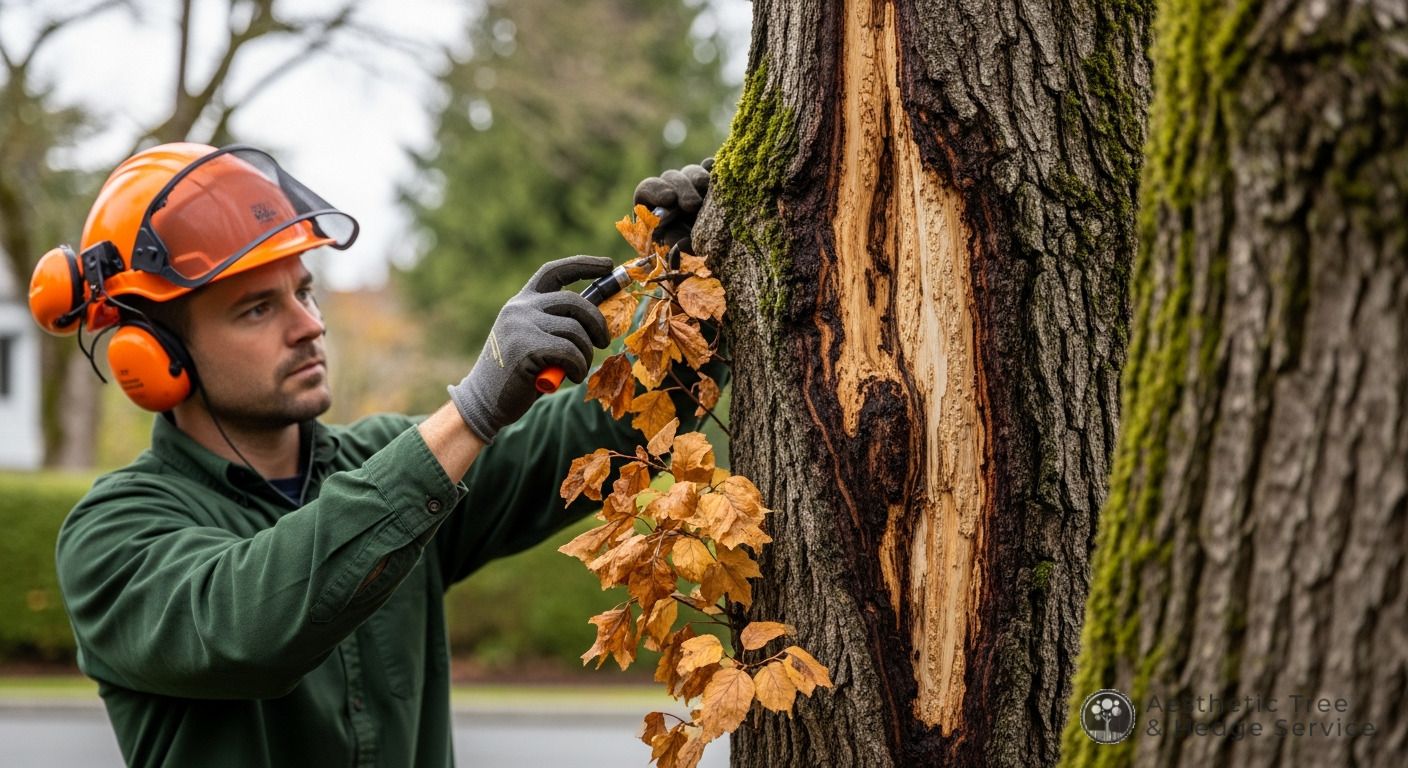
By the time those symptoms are easy to see from the driveway, the disease or insect may have been active for a year or more.
West Vancouver sits in coastal temperate rainforest, but many residential trees are also dealing with drought stress, construction pressure, compacted soils, slope exposure, and tighter urban growing spaces. Douglas fir, western red cedar, big-leaf maple, paper birch, ornamental cherry, plum, spruce, and pine all face different risks.
Our ISA-certified arborists work across West Vancouver, North Vancouver, and the Lower Mainland every week. These are the diseases and insects we pay closest attention to during local tree assessments.
[Image suggestion: close-up of resin, boring dust, or fungal conk at the base of a West Vancouver conifer, with alt text: signs of diseases insects trees West Vancouver arborist inspection]
TL;DR
- West Vancouver trees face real pressure from laminated root rot, Armillaria root disease, Dothistroma needle blight, bronze birch borer, western tent caterpillar, spongy moth, and mountain pine beetle.
- The mountain pine beetle outbreak affected more than 18 million hectares of pine forest in British Columbia, according to the Province of BC.
- Root disease and wood-boring insects can be active long before the crown looks thin or dead.
- West Vancouver Tree Bylaw No. 4892 does not protect every 20 cm tree in every situation. Protected status depends on DBH, species, development status, location, replacement or retained status, and wildlife or nesting use.
- Before removing a diseased or hazardous tree, get an ISA-certified arborist assessment and confirm District permit requirements.
What Are the Most Dangerous Tree Diseases in West Vancouver Right Now?
Several fungal diseases are active in West Vancouver's urban forest. Some are manageable when caught early. Others are terminal once the root system or main stem is compromised.
The difficult part is diagnosis. A tree can look acceptable from the street while decay, root loss, or insect galleries are already weakening the structure.
Laminated Root Rot, Phellinus sulphurascens
Laminated root rot is one of the most serious root diseases affecting Douglas fir in coastal British Columbia.
That matters in West Vancouver because Douglas fir is one of the defining native trees on local slopes and residential lots. A large Douglas fir can look green in the crown while its root system is losing structural strength underground.
Common warning signs include sudden crown thinning, reduced shoot growth, resin near the base, windthrow of nearby Douglas firs, and fungal fruiting bodies close to the root flare. In advanced cases, the tree may become a hazard even before the crown fully dies back.
Infected Douglas firs do not simply recover with fertilizer or surface treatment. The key question is usually risk: where is the tree, what could it hit, and how much root support remains?
If a Douglas fir near a home, driveway, fence, public path, or neighbouring property shows sudden decline, book an arborist inspection. An arborist report can document condition, risk level, and whether removal, monitoring, or nearby tree protection is appropriate.
Armillaria Root Disease, Armillaria ostoyae
Armillaria is common in coastal BC soils. It can live on dead roots and stumps, but it can also attack stressed trees.
Trees under drought stress, construction damage, grade changes, root pruning, or soil compaction are more vulnerable. In West Vancouver, we often pay close attention to trees growing close to driveways, retaining walls, new builds, drainage changes, and steep slopes.
Signs include crown dieback, early fall colour, resin-soaked bark at the base, mushrooms around the root zone, and white mycelial fans under loose bark near the root collar.
Once Armillaria has compromised the root flare or major structural roots, treatment options are limited. The priority becomes risk assessment and preventing spread where practical.
Dothistroma Needle Blight, Dothistroma septosporum
Dothistroma needle blight affects pine species. The classic field sign is reddish-brown banding on needles that are still attached to the tree. Older needles usually show symptoms first, then drop early.
Wet spring conditions increase disease pressure. That is relevant for the North Shore, where spring moisture can be persistent.
Early cases may be managed with pruning, sanitation, improved air flow, and, where appropriate, professionally applied treatment. But repeated heavy needle loss weakens the tree and can make it more vulnerable to other stressors.
For homeowners, the key is pattern recognition. If a pine is losing older needles every year, or the lower and inner crown is thinning faster than normal, have it assessed before the upper crown is affected.
Cytospora Canker
Cytospora canker affects stressed spruce and other conifers. It often enters through wounds, pruning cuts, frost cracks, or insect damage.
Look for resin-soaked bark patches, sunken cankers, orange-brown discolouration, and branch death that often begins in the lower crown.
Cytospora rarely kills a healthy tree quickly. It is more often part of a decline pattern. A stressed spruce gets wounded, canker develops, branches die, the crown thins, and secondary insects or decay organisms move in.
Localized infections can sometimes be managed by pruning affected branches correctly. Advanced trunk infection is a different situation and may require removal if structural risk is present.
Black Knot, Apiosporina morbosa
Black knot affects cherry and plum trees, including ornamental varieties common in West Vancouver yards.
The sign is distinctive: hard, black, swollen galls on branches or stems. Early infections can be pruned out. The usual standard is to cut well below visible infection and disinfect tools between cuts.
If black knot reaches the main trunk or multiple scaffold limbs, management becomes much harder. Waiting one or two seasons can turn a manageable pruning job into a removal discussion.
[Image suggestion: black knot gall on ornamental cherry branch, with alt text: black knot tree disease on cherry branch in West Vancouver]
Which Insects Are Killing Trees in West Vancouver?
Tree insects rarely act alone. Drought, poor planting location, root damage, construction stress, or past pruning wounds usually come first. Then insects exploit the weakened tree.
That is why a proper arborist assessment looks beyond the insect. It asks why the tree became vulnerable in the first place.
Bronze Birch Borer
Bronze birch borer is a serious threat to birch trees. Paper birch, silver birch, and river birch are all vulnerable when stressed.
The larvae feed under the bark, cutting through the tissues that move water and nutrients. Early signs include thinning in the upper crown, small dead branches, and reduced leaf size. Later signs include D-shaped exit holes, raised serpentine ridges under bark, and dead upper limbs.
By the time exit holes are obvious, the tree may already be in advanced decline.
Birch trees planted in hot, dry, reflected-heat locations are especially vulnerable. South-facing lots, pavement edges, and compacted urban soil can all increase stress.
Early assessment matters. A lightly affected birch may have options. A birch with extensive upper-crown dieback often does not.
Western Tent Caterpillar
Western tent caterpillar is native to the region and can cause dramatic defoliation during outbreak years.
It forms silken tents in branch forks, especially on alder, ornamental cherry, and fruit trees. One defoliation event rarely kills a healthy mature tree, but repeated defoliation can weaken it and invite secondary pests.
The most useful homeowner action happens before the outbreak is visible. Egg masses overwinter on twigs as small grey-brown bands. Removing them in late winter can reduce spring feeding pressure.
If tents are already present, do not burn them out of the tree. That creates more damage than the insects. Mechanical removal or targeted treatment is safer.
Mountain Pine Beetle
Mountain pine beetle is best known for its impact on BC's interior forests, where the outbreak affected more than 18 million hectares of pine forest.
In West Vancouver, the risk is more property-specific. Lodgepole pine, shore pine, and ponderosa pine on exposed or stressed sites deserve attention.
Look for pitch tubes, reddish boring dust, fading crown colour, and blue-stain fungus in freshly cut wood. Once a pine is successfully mass-attacked, survival is unlikely.
The management priority is early identification and preventing infested material from becoming a source for nearby susceptible pines.
Spongy Moth
Spongy moth is an invasive defoliator monitored by the Canadian Food Inspection Agency and provincial programs.
It feeds on many broadleaf trees and some conifers. Preferred hosts include oak, birch, alder, apple, and other landscape trees.
Egg masses look like tan, felt-textured patches on bark, outdoor furniture, vehicles, firewood, and other surfaces. If you suspect spongy moth, report it to the appropriate authority and avoid moving potentially infested material.
Because this pest is subject to monitoring and control programs, homeowners should not treat suspected spongy moth as an ordinary backyard caterpillar problem.
Cooley Spruce Gall Adelgid
Cooley spruce gall adelgid creates pineapple-shaped galls on spruce tips. It can also involve Douglas fir in its life cycle.
It usually does not kill mature trees outright, but heavy infestations can distort growth, reduce photosynthetic area, and stress already weakened trees.
Pruning affected tips can help in smaller trees. Larger or repeated infestations should be assessed by an arborist, especially where spruce decline is already present.
How Do You Know If Your Tree Has a Disease or Insect Problem?
Most homeowners notice the crown first. Arborists look lower.
The trunk, root flare, soil line, bark texture, pruning wounds, branch unions, and nearby trees often tell the story before the top of the tree does.
Spring Signs
- Branches that leafed out last year do not produce new growth.
- Needles emerge, then turn brown or red.
- Silken tents appear in branch forks.
- New shoots look swollen, distorted, or stunted.
- Conifers shed more older needles than expected.
Summer Signs
- Crown thinning, especially in the upper third.
- Premature yellowing before normal fall colour.
- Boring dust on bark or at the base of the tree.
- Pitch tubes on pine or spruce bark.
- D-shaped or round exit holes.
- Mushrooms, conks, or soft tissue near the base.
Fall Signs
- Leaves change colour much earlier than nearby trees of the same species.
- White fungal growth appears under loose bark near the soil line.
- Egg masses are visible on twigs, trunks, fences, or outdoor furniture.
- Dead branches become more obvious after leaf drop.
Year-Round Signs
- A new lean.
- Cracked soil or lifting root plate.
- Wet staining below a wound.
- Vertical bark cracks.
- Dead branch tips throughout the crown.
- Large deadwood over a target such as a driveway, roof, path, or neighbour's yard.
A homeowner can catch obvious symptoms. An ISA-certified arborist can identify early signals, assess structural risk, and separate cosmetic decline from a genuine hazard.
What Happens If You Ignore Tree Disease or Pest Infestation?
Ignoring a tree problem usually narrows your options.
First, the tree declines. Root disease spreads, borers continue feeding, cankers expand, and deadwood increases.
Second, risk rises. A tree with compromised roots, decay, or major dead limbs can fail in wind, snow, saturated soil, or sometimes calm weather.
Third, neighbouring trees may become part of the problem. Root diseases can move through root contact. Airborne fungal diseases can spread during wet conditions. Insect populations can build from one stressed host to the next.
Fourth, documentation becomes more important. If a visibly declining tree fails and damages property, the question may become whether the hazard was foreseeable. A professional assessment creates a record of condition and recommended action.
Early inspection gives you more choices: pruning, monitoring, treatment, cabling, site correction, or planned removal. Late inspection often leaves only emergency removal.
Does West Vancouver Have Bylaws About Diseased or Hazard Trees?
Yes. West Vancouver regulates tree cutting through Tree Bylaw No. 4892, and homeowners should check the current District requirements before removing a tree.
The important correction is this: West Vancouver does not define every private-property tree over 20 cm DBH as protected in every situation.
Under the current consolidated bylaw, protected trees include categories such as:
- Any tree 75 cm DBH or greater.
- Any tree 20 cm DBH or greater on a parcel being developed with a new residential or commercial building, or subdivided for a new residential parcel.
- Replacement trees, retained trees, and heritage trees.
- Trees in Watercourse Protection Areas or Foreshore Protection Areas.
- Certain species over 20 cm DBH, including Arbutus, Garry oak, Pacific yew, Pacific dogwood, Yellow cedar, and Shore pine in the protected shoreline area.
- Trees with active nests or protected wildlife habitat.
- Trees on District land, including boulevards and highways.
The bylaw also addresses imminent danger. A tree that presents imminent danger to people or property may be cut without a permit if certified by an arborist, but the cutting must still be reported to the District and documentation may be required.
For homeowners, the practical rule is simple: before removing a diseased or hazardous tree in West Vancouver, confirm whether it is protected and get the right arborist documentation. This protects you from permit problems, insurance confusion, and disputes after the work is done.
Can a Diseased Tree Be Saved, or Does It Need to Be Removed?
Not every diseased tree needs to come down. The decision depends on three things.
First, what is the pest or disease? Some problems are manageable. Others are terminal once the root flare, main stem, or vascular system is compromised.
Second, how advanced is the damage? Early foliar disease and localized cankers may have treatment options. Advanced root rot or major borer galleries usually do not.
Third, what is the target? A declining tree in the middle of a forested area is different from a declining tree above a house, driveway, playground, road, or neighbour's roof.
Trees that can sometimes be managed include early Dothistroma, localized Cytospora canker, black knot on smaller branches, western tent caterpillar defoliation, and light adelgid activity.
Trees that often require removal include trees with advanced laminated root rot, advanced Armillaria at the root flare, birch trees with extensive bronze birch borer damage, pines under confirmed successful mountain pine beetle attack, and trees with main-stem decay or major structural compromise.
Timing is the single biggest variable. A tree assessed in the first stage of decline may have options. A tree assessed after several seasons of decline may only have risk-management options.
When Should You Call an ISA-Certified Arborist in West Vancouver?
Call promptly if you see any of these signs:
- A new lean near a structure, road, path, power line, or neighbouring property.
- Large dead branches in the upper crown.
- Mushrooms or conks at the base or on the trunk.
- Branch failure during calm weather.
- Pitch tubes, boring dust, or exit holes.
- White fungal growth at the root flare.
- Sudden crown thinning in Douglas fir, pine, birch, or cedar.
- A tree damaged by wind, lightning, vehicle impact, excavation, or another falling tree.
Do not wait for the perfect season if the tree may be hazardous. Risk assessment is not seasonal.
For slower decline, schedule a formal inspection before the condition advances. An arborist report can document species, DBH, condition, risk factors, permit relevance, and recommended action.
What Does Treating or Removing a Diseased Tree Involve?
After inspection, the path usually falls into one of several categories.
Pruning and Sanitation
For localized disease, pruning infected tissue can reduce pathogen load and slow spread. This is common for black knot, some cankers, and selected foliar diseases.
Correct cuts matter. Poor cuts create new entry points for decay. Professional tree cutting and pruning follows arboricultural standards and avoids unnecessary wounding.
Site Correction
Some tree problems start with the site, not the pest. Soil compaction, poor drainage, drought stress, grade changes, construction damage, and heat exposure can all push trees into decline.
Improving mulch, irrigation, drainage, root-zone protection, and soil conditions may help trees resist future attack.
Systemic or Targeted Treatment
Some insects and diseases may be treated with professional products, but timing and diagnosis matter. Bronze birch borer, for example, is much more manageable before severe upper-crown dieback appears.
Some treatments require a licensed pesticide applicator under BC rules. Homeowner products are not appropriate for root disease, advanced borer damage, or major systemic decline.
Cabling and Bracing
If a tree has a structural defect but is otherwise worth retaining, tree cabling may reduce risk. Cabling does not cure disease. It provides supplemental support where the tree's structure allows it.
Full Removal
When a tree is dead, structurally compromised, or an unacceptable hazard, removal is the right decision.
In West Vancouver, removals can be complex because of slopes, tight access, retaining walls, homes, fences, and neighbouring properties. Professional tree removal in West Vancouver may involve climbing, rigging, sectional removal, or crane support.
Stump Grinding
After removal, stump grinding may be recommended for access, replanting, aesthetics, or disease management. In some root disease cases, the remaining stump and roots can still matter. See our stump grinding service for details.
What Trees Should West Vancouver Homeowners Watch Most Closely?
Douglas Fir
Douglas fir is one of West Vancouver's most important native trees and one of the trees we assess carefully near homes and slopes. Watch for crown thinning, resin near the base, conks, root disturbance, and windthrow of nearby firs.
Paper Birch and Silver Birch
Birch trees are vulnerable to bronze birch borer when stressed. Hot, dry, compacted, or paved sites increase risk. Upper-crown dieback is a warning sign.
Western Red Cedar
Western red cedar is under increasing drought stress in parts of coastal BC. Browning inside the crown can be normal seasonal shedding, but widespread dieback, thinning, and top decline deserve assessment.
Big-Leaf Maple
Big-leaf maple can develop branch dieback, cankers, decay pockets, and weak unions. Large maples near targets should be checked if dieback appears in major limbs.
Ornamental Cherry and Plum
Black knot is common throughout the Lower Mainland. Annual inspection and prompt pruning are the best controls.
FAQ
Does homeowner insurance cover diseased tree removal in West Vancouver?
Most policies are more likely to cover damage caused by a tree failure than proactive removal of a declining tree. Some insurers may consider removal or related costs if there is a written arborist report documenting hazard status. Ask your insurer directly and keep the report on file.
Can I treat tree disease myself with garden-centre products?
For minor surface pests, homeowner products may help. For root disease, trunk-boring insects, systemic decline, or hazard trees, start with diagnosis. The wrong product wastes time and can harm beneficial insects, soil biology, and nearby plants.
How fast can disease spread to neighbouring trees?
It depends on the pest or pathogen. Root diseases can move through root contact over time. Foliar diseases can spread during wet seasons. Insects can build population pressure over multiple years. Early detection and sanitation are the best ways to reduce spread.
Does the District of West Vancouver handle diseased trees on public land?
Trees on District land, boulevards, parks, and public property are the District's responsibility. Trees on private property are the owner's responsibility. If you are unsure whether a tree is public or private, confirm ownership before arranging work.
How long does an arborist inspection take?
A ground-level inspection of a typical residential property often takes 30 to 60 minutes, depending on the number, size, and condition of the trees. A formal written arborist report takes additional time because it documents species, DBH, condition, risk, and recommended action.
Call Aesthetic Tree & Hedge Services for a Free Estimate
Do not wait for a branch to fail before looking closely at a declining tree.
The earlier a disease or insect problem is identified, the more options you usually have. A tree in early decline may be pruned, treated, monitored, or protected. A tree in advanced decline may only be removable.
Aesthetic Tree & Hedge Services provides ISA-certified arborist assessments, pruning, hedge trimming, stump grinding, cabling, emergency service, and tree removal across West Vancouver, North Vancouver, Burnaby, and the Lower Mainland.
Call Aesthetic Tree & Hedge Services for a free estimate: (604) 721-7370
ISA-certified arborists. WCB registered. Fully insured. Serving West Vancouver and the Lower Mainland.
Found this helpful? Follow our tree care insights directly on Google.
Make us your preferred source on GoogleBefore You Go
Where are you in your tree care journey?
Our Tree Care Services
ISA-certified arborists serving Greater Vancouver


Explore Our Tree Care Services
From expert pruning to safe tree removal, our ISA-certified arborists are ready to help across Greater Vancouver.
View Services