
TL;DR — Quick Summary
Complete tree care service Vancouver homeowners trust. ISA-certified arborists, WCB registered. Pruning, removal, hazard assessment, emergency response. Call (604) 721-7370.
It started with one phone call.
A homeowner in Kitsilano noticed a crack running up the trunk of her backyard Big-leaf maple. She'd seen it for months. She kept hoping it would seal itself. It didn't.
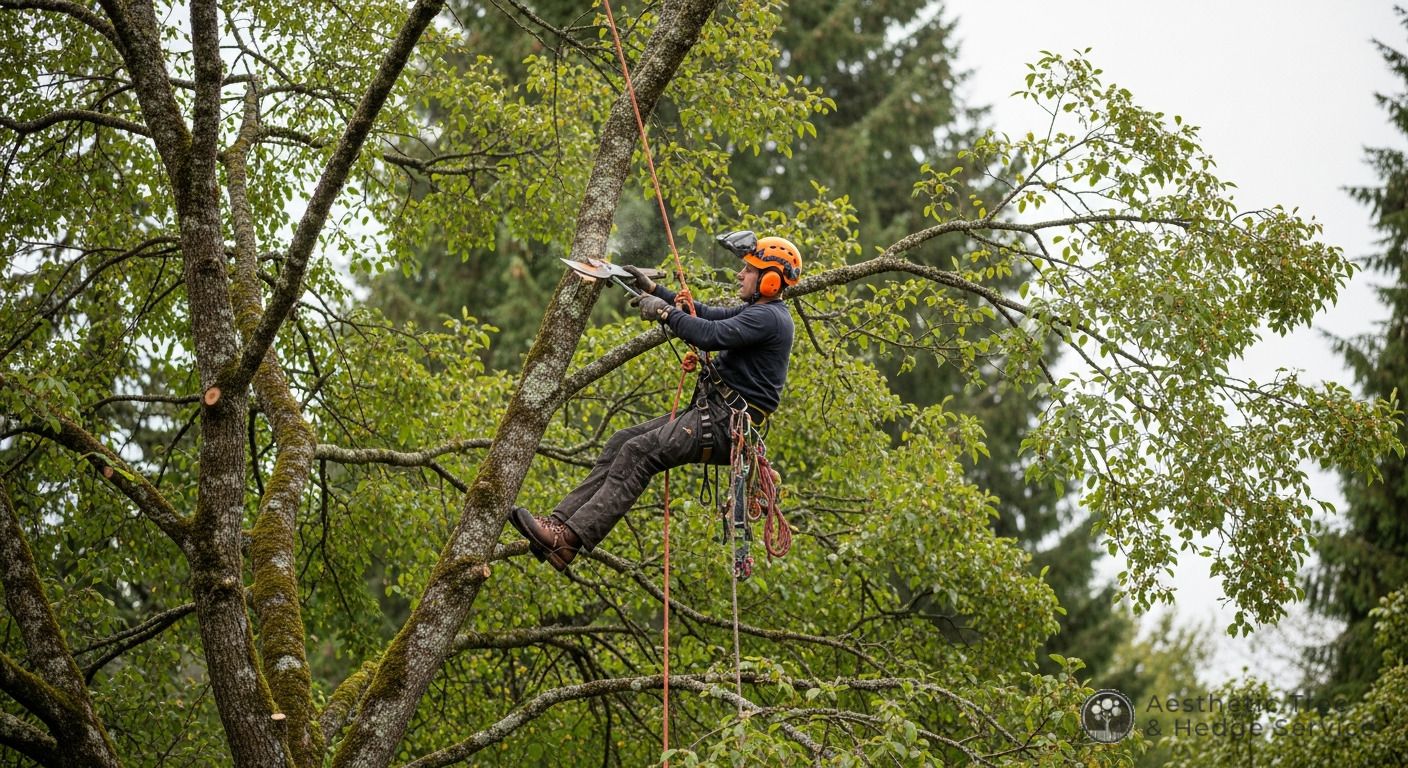
The day a heavy limb dropped three feet from where her daughter was playing, she stopped waiting.
She called for a complete tree care service in Vancouver. Not a landscaper. An ISA-certified arborist.
That visit changed everything. The hazard limb came down safely. A cabling system went in to support the co-dominant stem. The maple is still standing in that Kitsilano yard today.
This is what real tree care looks like.
TL;DR
- A complete tree care service covers pruning, removal, stump grinding, hazard assessment, cabling, emergency response, and more — one certified team handles it all
- Vancouver's **Private Tree Bylaw No. 9958** requires a permit before removing any tree 20 cm DBH or larger on private property — ISA-certified arborists handle this paperwork for you
- ISA-certified + WCB-registered credentials are not optional extras — they protect you from personal liability if anything goes wrong on your property
- A formal hazard assessment catches the problems a visual glance will miss: root decay, vascular disease, structural failure under the bark
- Aesthetic Tree & Hedge Services serves Vancouver, Burnaby, North Vancouver, Richmond, and Coquitlam — call **(604) 721-7370** for a free estimate
---
What Does a Complete Tree Care Service in Vancouver Actually Include?
Most homeowners think tree care means one thing: cutting down the tree.
That's like thinking car service means buying a new car every time something goes wrong.
A complete tree care service covers the full life cycle of every tree on your property. It starts before you have a problem. It ends long after the job is done.
Here's what's included when you hire certified arborists — not contractors with chainsaws:
**Pruning and crown management.** The most common service. Done right, it removes dead wood, improves structure, and extends tree life by decades. Done wrong, it invites disease and structural failure. Our tree cutting and pruning service follows ANSI A300 pruning standards — the industry benchmark developed by the American National Standards Institute for professional arboricultural work.
**Tree removal.** Sometimes a tree must come down. A compromised root system. A disease that's spread too far. A location that makes the tree a hazard. Our tree removal service covers everything from a small ornamental cherry to a 100-foot Douglas fir. Crane removal handles tight access sites where standard rigging won't work safely.
**Stump grinding.** The stump stays in the ground after removal. Leave it, and you get pest habitat, tripping hazards, and regrowth. Stump grinding takes it below grade — clean, usable space.
**Hedge trimming.** A shapeless hedge isn't just an eyesore. It blocks sightlines, harbours pests, and puts pressure on fences. Our hedge trimming service keeps hedges structured and healthy year-round.
**Arborist reports.** Before major work on a protected tree, Vancouver requires a formal report from a certified arborist. An arborist report is also required by most insurance companies and mortgage lenders when trees are in dispute.
**Emergency tree service.** A storm drops a limb on your roof at 11 PM. That's not a Monday morning problem. Our emergency tree service operates when you need it — not when it's convenient for us.
**Cabling, root barriers, mulching, and tree planting.** These are the preventive and long-term services most homeowners don't think about until it's too late.
A complete service means you never call five different companies for one property.
---
Why Does ISA Certification Matter When Hiring a Vancouver Tree Service?
You can hire anyone to cut down a tree.
A certification separates a trained professional from a gamble.
The International Society of Arboriculture (ISA) is the gold standard for arboricultural credentials worldwide. An ISA Certified Arborist has passed a comprehensive exam covering tree biology, risk assessment, pruning theory, soil science, and disease identification. They're required to maintain continuing education credits to keep that certification active.
This matters for three reasons in Vancouver specifically.
**First, ISA certification signals real diagnostic skill.** Anyone can look at a tree and say "that looks bad." An ISA-certified arborist reads the bark, the root flare, the canopy structure, and the soil profile — and tells you *why* it looks bad, what's causing it, and what happens if you don't act. The difference between "that tree looks dead" and "that tree has *Armillaria* root disease that's already spread to the adjacent cedar" is the difference between a certified arborist and a guess.
**Second, it protects you legally.** If a tree on your property falls on a neighbour's fence, your insurance company will ask two questions: Did you know the tree was a hazard? Did you take reasonable steps? An ISA-certified arborist's written assessment on file answers both questions in your favour. Without documentation, you're exposed.
**Third, Vancouver's bylaws increasingly expect certified professionals.** For permit applications under the City of Vancouver's Private Tree Bylaw, an arborist report carries weight only when it comes from a certified professional. An unlicensed opinion is not a qualifying assessment.
The ISA maintains a public, searchable credential database at treesaregood.org. You can verify any arborist's certification status before they set foot on your property. Always check. A legitimate crew will give you their ISA number without hesitation.
---
What Vancouver Tree Bylaws Do You Need to Know Before Any Work Begins?
Here's where homeowners get burned.
They hire a crew. Work gets done. Then a City notice arrives — with a fine attached.
Vancouver's **Private Tree Bylaw No. 9958** governs trees on private property within city limits. The key thresholds:
- Trees with a trunk diameter of **20 cm or more** at 1.4 metres above ground (diameter at breast height, or DBH) are protected under the bylaw
- Removal of any protected tree requires a **permit from the City of Vancouver**
- Permit applications require either a City arborist site visit or a written report from an ISA Certified Arborist or Registered Professional Biologist
- Violations can trigger replacement requirements at a **ratio of up to 3:1** — remove one tree without a permit, and you may be required to plant three replacements
For boulevard trees — those between the sidewalk and the street curb — Vancouver's **Street Tree Bylaw** applies. These are City-owned trees. You cannot prune, remove, or alter them without City approval, regardless of whether branches hang over your property.
Burnaby, North Vancouver, Richmond, and Coquitlam each maintain their own municipal bylaws with different diameter thresholds and permit processes. What's allowed in one municipality may be prohibited in the next.
In our years working across Vancouver and the Lower Mainland, roughly one in three homeowners who contact us has already done unpermitted work — often without any idea they needed a permit. The consequences are real, not theoretical.
Knowing the bylaws before the chainsaw starts isn't a technicality. It's how you protect your property and your wallet.
---
How Do You Know If a Tree Is a Hazard That Needs Immediate Attention?
Most tree failures don't announce themselves.
That's the problem.
Research from the **Tree Care Industry Association (TCIA)** indicates that a significant proportion of storm-related tree failures involve trees that showed visible structural defects before the failure event — defects that were visible, and ignored. The International Society of Arboriculture's Tree Risk Assessment Qualification (TRAQ) framework was developed precisely because hazard identification requires systematic training, not a casual glance.
Here are the warning signs that require a professional assessment now, not later:
**Cracks in the trunk.** A vertical crack can indicate internal decay. A horizontal shear crack is often a sign of imminent structural failure. Don't attempt to assess it yourself. Call.
**Recent lean.** A tree that has always had a slight lean is usually fine. A tree that *recently started* leaning — especially after heavy rain or wind — is often signalling root failure. This is urgent.
**Crown dieback.** Dead branches in the upper canopy, sparse foliage, or a stag-headed appearance (dead crown, live lower limbs) signals root problems, vascular disease, or insect damage. In the Lower Mainland, watch for these patterns on Big-leaf maples, red alders, and older ornamental cherries.
**Fungal conks.** Mushrooms or conks growing from the base of the trunk, the root zone, or major branches indicate internal wood decay. The fruiting body you see on the outside represents decay that is already extensive inside.
**Root zone disturbance.** Construction, landscaping changes, soil compaction, and altered drainage around the root zone can compromise a tree long before the damage shows in the canopy. This is one of the most underdiagnosed tree problems in urban Vancouver — and one of the most common causes of failure on properties where recent work has been done.
**Hanging limbs.** A dead branch caught in the canopy — what arborists call a "widow maker" — can drop without warning. One confirmed widow maker is reason enough to call.
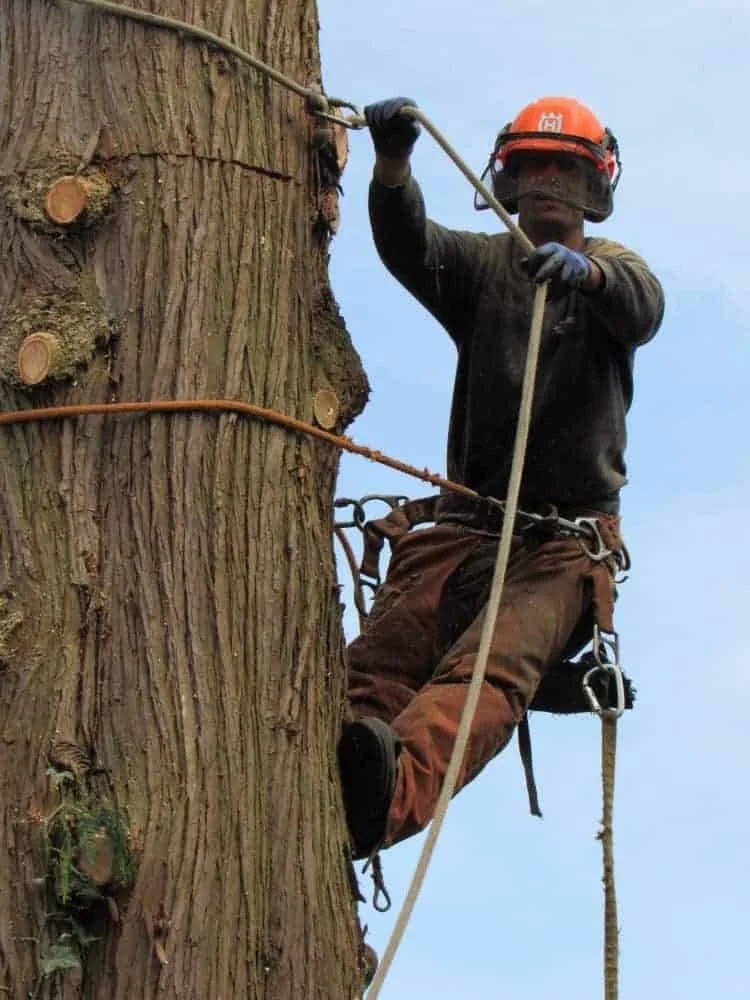
WorkSafeBC's **OHS Regulation Part 26** — which governs tree felling and arboricultural work in BC — requires a formal hazard assessment before any work begins on a tree that could affect workers or the public. That regulatory standard exists because tree hazards kill people. Take them seriously.
---
What's the Difference Between Tree Pruning and Tree Cutting in Vancouver?
These terms get mixed up constantly. The difference matters.
**Tree pruning** is the selective removal of specific branches for a defined purpose: removing dead or diseased wood, improving canopy structure, raising the crown for clearance, or reducing weight on a co-dominant stem. Proper pruning follows ANSI A300 Part 1 standards — it preserves the branch collar, avoids flush cuts that destroy the tree's natural wound-closure response, and never removes more than 25% of the live crown in a single season.
Bad pruning is worse than no pruning. **Lion-tailing** (stripping inner branches) destroys the canopy weight distribution. **Topping** (removing the crown leader) creates massive wounds, triggers stress growth called epicormic shoots, and shortens the tree's life significantly. We see these mistakes on residential properties throughout Vancouver — often left by contractors who charged less and had no idea what they were doing.
**Tree cutting** refers to felling — removing a tree entirely, or dismantling major structural sections. This requires rigging, proper notch-and-back-cut technique, defined drop zones, and often crane access in urban lots with limited clearance.
A crew that doesn't know what ANSI A300 means probably isn't following it. Before any work starts on your property, ask: "What pruning standard do you follow?" The answer tells you everything.
---
When Is Emergency Tree Service the Right Call?
Not every tree situation is an emergency.
But when it is, waiting costs more than a phone call.
An emergency service call is justified when:
- A tree or major limb has fallen on a structure, vehicle, or is blocking access to the property
- A tree is visibly leaning in a new direction after wind or rain — especially if the lean is recent
- A large dead branch is hanging in the canopy over areas where people walk or children play
- A storm-damaged tree is in contact with power lines — **do not approach this yourself**. Contact BC Hydro first. No arborist should work near live conductors without utility coordination.
- A tree has cracked at a major branch union and is at risk of further splitting under its own weight
Our emergency tree service responds with ISA-certified crew, proper equipment, and the documentation your insurance claim will require.
According to WorkSafeBC incident data, many serious injuries in tree work occur during unplanned responses — when homeowners or unqualified contractors try to manage a dangerous situation before calling for professional help. Don't be that statistic. Secure the area. Keep people back. Then call.
---
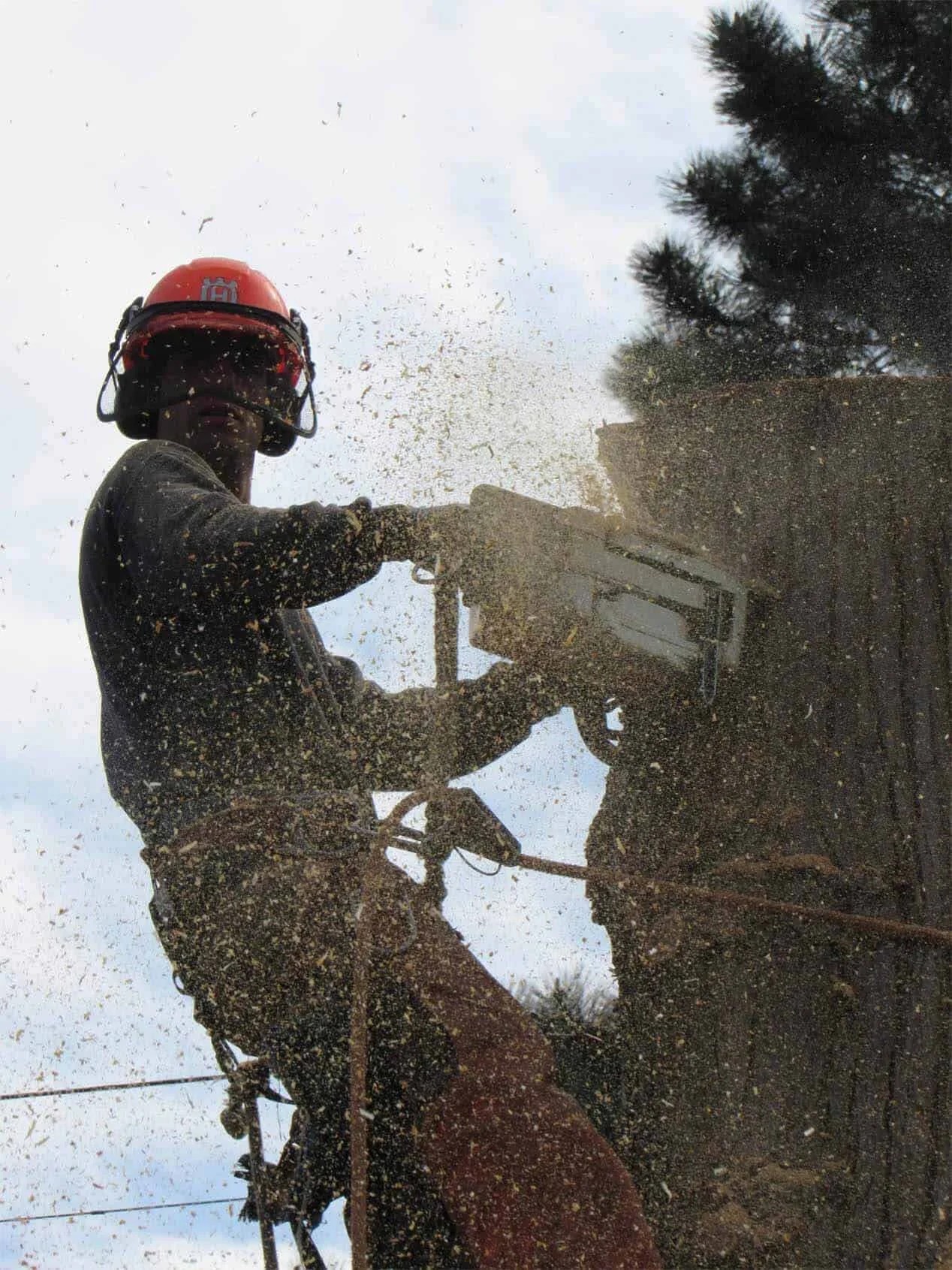
What Services Does a Complete Tree Care Team Handle Beyond Removal?
Most people think about tree services only when a tree has to come down.
That's the smallest part of what a certified arborist team actually does.
**Tree cabling and bracing.** Some trees don't need removal. They need structural support. Co-dominant stems — two equally-sized leaders growing from the same union point — are among the most common failure points on mature urban trees. Steel cables installed between the stems distribute load and reduce split risk. Tree cabling is often the difference between keeping a 60-year-old heritage tree and losing it.
**Root barriers.** Tree roots follow water. In urban Vancouver, that water runs under driveways, foundations, and municipal sidewalks. When roots hit those structures, both suffer. Root barriers redirect root growth away from infrastructure before damage occurs — a fraction of the cost of repairing a cracked foundation later.
**Mulching.** A 2–4 inch layer of wood chip mulch around the base of a tree insulates roots, retains moisture, suppresses competing grass, and reduces compaction. According to the ISA's urban forestry guidance, proper mulching applied correctly is one of the highest-return interventions for stressed urban trees. Our mulching service uses chipped material from our own jobs where appropriate — keeping the carbon local.
**Crane tree removal.** Some sites in Vancouver and the North Shore have access constraints that make conventional rigging impossible — steep lots, tight fence lines, adjacent structures with no safe drop zone. Crane tree removal removes the tree in sections, lifted clear of all obstacles. It costs more. It's the only safe option in the right situation.
**Land clearing.** Development projects, overgrown lots, and properties with multiple hazard trees need a coordinated approach. Land clearing handles full-site removal efficiently, with proper waste disposal and municipal permit compliance.
**Tree planting.** After removal, many homeowners want to replant. Species selection matters more than most people realize. A tree planted too close to structures, under power lines, or in unsuitable soil becomes the next problem. Tree planting done right means selecting species suited to Vancouver's coastal climate, the specific soil conditions of your property, and the mature size the tree will eventually reach.
The City of Vancouver's Urban Forest Strategy set a target of expanding canopy cover across the city to 22% by 2050 — up from approximately 18% today. That goal means new trees, well-chosen and well-placed, are a civic priority. Not just a landscaping preference.
---
How Do You Choose the Right Complete Tree Care Service in Vancouver?
There are hundreds of companies offering tree services in Metro Vancouver.
Here's how to separate the ones who protect you from the ones who don't.
**Ask for the ISA Certification number.** ISA Certified Arborists have a verifiable credential number listed publicly at treesaregood.org. If they can't provide it, they're not certified. End of conversation.
**Ask for WCB (WorkSafeBC) registration.** WCB registration means the company has active WorkSafeBC coverage for their crew. If a worker is injured on your property and the company isn't WCB-registered, you can be held liable for their medical costs and lost wages. This is not a technicality. It's a serious financial exposure.
**Ask for a written scope of work.** A legitimate tree service provides written documentation of what will be done, what standards will be followed, and what debris will be removed versus left on site. Verbal agreements are not enough.
**Ask who handles the permit.** If the company tells you a permit isn't needed for a protected tree in Vancouver — walk away. Permit responsibility is part of what you're paying for. They should identify the need, guide the application, and ensure compliance before touching anything.
**Ask about local species knowledge.** A crew that knows the difference between a Garry oak — protected under BC's *Wildlife Act* as critical habitat for over 100 species — and a Japanese maple won't make a costly identification error on your property. A crew that doesn't won't know what they've cut until after it's gone.
**Check for a physical address and verifiable history.** Fly-by-night operations appear in spring and disappear by November. A company that has been operating in Metro Vancouver for years has a track record you can verify.
In our years of service across the Lower Mainland, the most expensive tree problems we've seen were created by unqualified contractors who made a bad call on a job that looked simple.
Simple doesn't mean easy. Cheap doesn't mean safe.
---
FAQ
**Do I need a permit to prune a tree on my Vancouver property?**
Pruning a tree on your private property generally does not require a permit in Vancouver, as long as you're not removing it and the work follows proper arboricultural standards. However, if the tree is on a City boulevard — the strip between your sidewalk and the curb — it's City property, and you cannot touch it without City authorization. If the tree is protected under Private Tree Bylaw No. 9958 and you want to remove it, you need a permit regardless of the work type. When in doubt, contact us before touching anything. Getting this wrong is expensive.
**How do I know if my tree needs to come down or can be saved?**
You don't know until a certified arborist runs a proper assessment. Visible decay, a new lean, and crown dieback can indicate serious problems — or manageable ones. The only reliable answer comes from a formal hazard assessment that evaluates structural integrity, root zone health, and site-specific risk. We don't recommend removal if preservation is a safe option. We've saved trees other companies said were gone. We've also told homeowners hard truths when the risk wasn't worth carrying.
**What is an arborist report, and when do I need one in Vancouver?**
An arborist report is a formal written assessment from an ISA Certified Arborist that documents a tree's condition, risk level, and recommended course of action. In Vancouver, you'll need one to support a permit application for removing a protected tree. You'll also need one if your insurance company or a neighbouring property owner is involved in a dispute about a tree. Mortgage lenders and real estate lawyers sometimes request them during property transactions. Our arborist report service covers all of these requirements with documentation that meets City of Vancouver standards.
**Are you insured for work on my property?**
Yes. Aesthetic Tree & Hedge Services is WCB registered with WorkSafeBC, which means our crew carries active workers' compensation coverage. We also maintain general liability insurance for property damage. Ask us for proof of both before any work starts — a legitimate arborist company provides this without hesitation. If a company won't show you their certificates, that's your answer.
**What's the difference between an ISA Certified Arborist and someone who calls themselves an arborist?**
Anyone can put the word "arborist" on a truck. Only someone who has passed the ISA's comprehensive certification examination — covering tree biology, risk assessment, pruning science, soil management, and more — and who maintains active continuing education can legally use the title "ISA Certified Arborist." The credential is publicly verifiable at treesaregood.org. It's the single clearest signal that the person assessing your trees knows what they're doing. Always verify before you let anyone near your property.
---
Ready for a Complete Tree Care Assessment?
Your trees don't wait. Problems compound. A manageable hazard in spring becomes an emergency service call after the first November storm.
Aesthetic Tree & Hedge Services is Vancouver's ISA-certified, WCB-registered complete tree care team. We handle everything from routine crown pruning in Kitsilano to crane removals on tight North Shore lots. We know Lower Mainland tree bylaws cold. We carry the credentials. We show up when we say we will.
Call for a free estimate: **(604) 721-7370**
Serving Vancouver, Burnaby, North Vancouver, West Vancouver, Richmond, Coquitlam, and the surrounding Lower Mainland.
Found this helpful? Follow our tree care insights directly on Google.
Make us your preferred source on GoogleBefore You Go
Where are you in your tree care journey?
Our Tree Care Services
ISA-certified arborists serving Greater Vancouver


Explore Our Tree Care Services
From expert pruning to safe tree removal, our ISA-certified arborists are ready to help across Greater Vancouver.
View Services