
TL;DR — Quick Summary
Essentials complete tree care service Vancouver: ISA-certified arborists for removal, pruning & hazard assessment. Free estimate — (604) 721-7370.
The essentials of complete tree care service in Vancouver aren't obvious until a branch falls on your car. Let's fix that.
Vancouver sits in one of the most tree-rich urban environments in Canada. The City of Vancouver manages over 150,000 street trees, according to its Urban Forest Strategy. That doesn't count the hundreds of thousands of trees on private residential and commercial properties across the Lower Mainland. With Douglas firs, Big-leaf maples, Western red cedars, and ornamental cherry trees on nearly every block, tree care isn't optional. It's ongoing infrastructure maintenance.
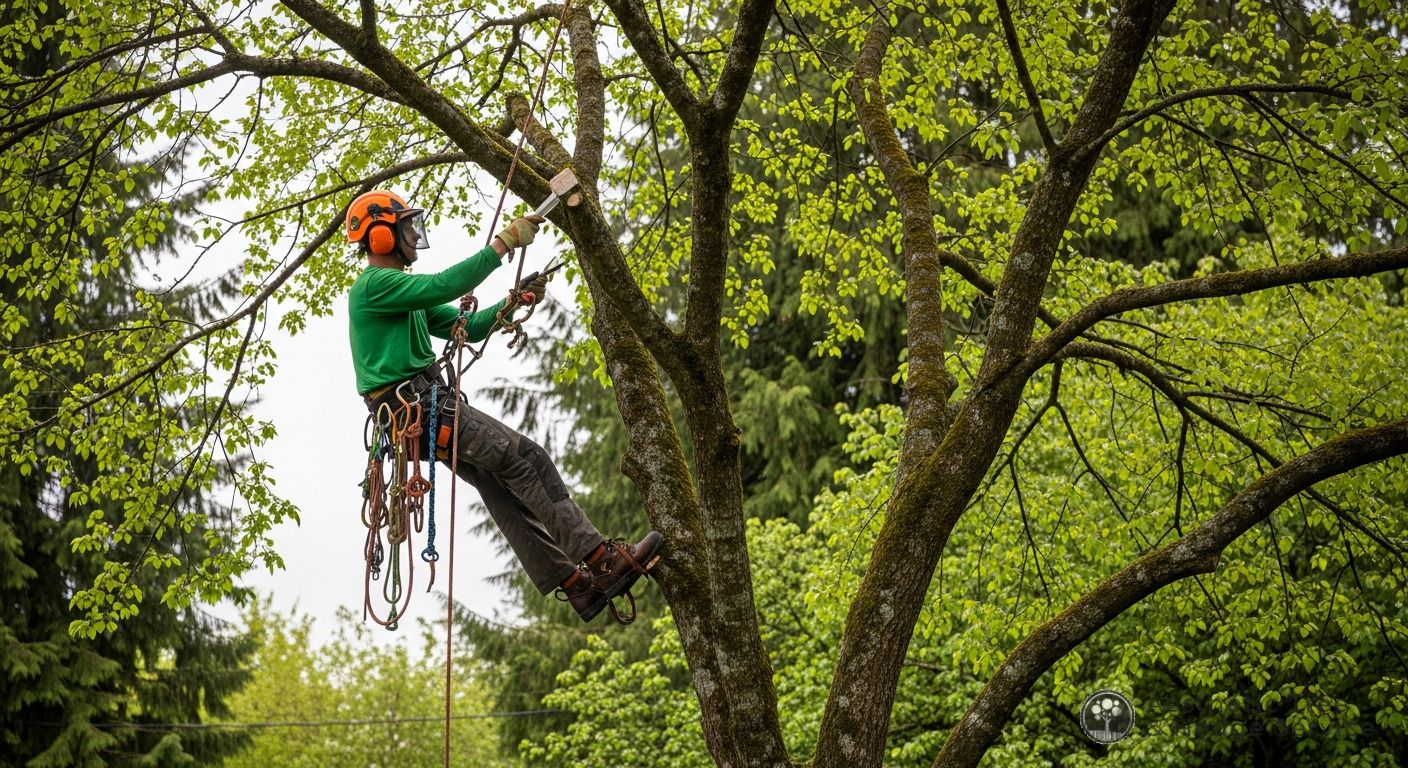
What complete tree care means — the real essentials — breaks into six categories: assessment, pruning, removal, stump work, emergency response, and preventive systems. A tree company that only does one or two of these isn't a full-service arborist. It's a landscaper with a chainsaw.
TL;DR
- Complete tree care in Vancouver goes far beyond cutting — it includes hazard assessment, ISA-certified pruning, permit navigation, stump grinding, and 24-hour emergency response.
- The City of Vancouver's Trees By-law No. 9958 requires a permit for removing any tree with a trunk diameter of 20 cm or more at breast height (DBH) on private property.
- ISA-certified arborists follow ANSI A300 pruning standards. That's not the same as hiring a landscaper — the difference shows up years later, in your tree's structure.
- Vancouver's Pacific storm season (October through March) creates urgent hazard windows. Pre-storm assessment is the cheapest insurance you'll buy.
- All tree work in BC must be performed by WCB/WorkSafeBC-registered crews. Unregistered contractors leave homeowners legally exposed.
What Does a "Complete Tree Care Service" Actually Include in Vancouver?
Most homeowners think of tree care as one thing: cutting. That's like saying a mechanic just changes oil.
A proper complete tree care service covers six core disciplines.
**Hazard Assessment**
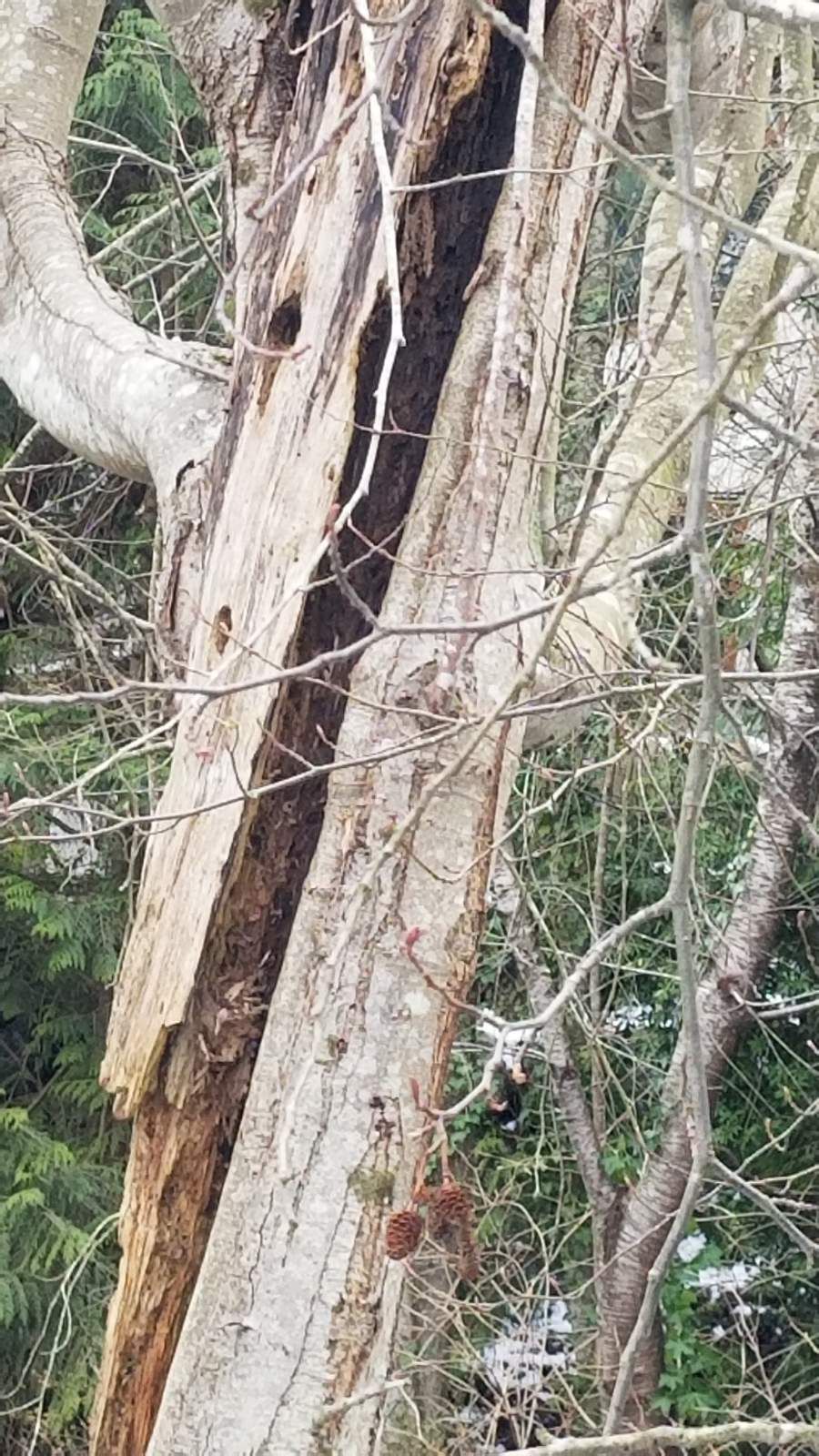
A hazard assessment is where everything starts. An ISA-certified arborist evaluates crown density, root flare condition, trunk decay, branch attachment angles, and soil stability. In the Lower Mainland, we pay particular attention to *included bark* — a V-shaped branch union where bark is trapped between two co-dominant stems. It's structurally weak. It's common in Big-leaf maples. And it fails without warning.
**Pruning to ANSI A300 Standards**
ANSI A300 is the American National Standards Institute's standard for tree care. It specifies exactly where cuts should be made (at the branch collar, preserving the tree's natural wound response) and how much live wood can be removed in a single session — no more than 25% of the live crown.
Any arborist who doesn't reference ANSI A300 isn't an arborist. They're a tree cutter.
Proper tree cutting in Vancouver means crown cleaning (removing dead, dying, and diseased branches), crown thinning (improving light penetration and air circulation), and structural pruning (building strong branch architecture in young trees before defects become permanent).
**Tree Removal**
Some trees can't be saved. Structural decay, advanced disease, storm damage, root system failure — any of these can make tree removal in Vancouver the right call. Full removal requires proper rigging, an experienced ground crew, and — for large trees near structures — often a crane.
**Stump Grinding**
A stump left in the ground is more than an eyesore. It becomes a vector for Armillaria root rot — a fungal pathogen that spreads through root contact to neighboring healthy trees. Stump grinding eliminates the stump below grade and removes the infection risk before it spreads through your yard.
**Emergency Response**
Storms don't call ahead. A 24-hour emergency tree service is part of any complete offering. That means arborists who can respond to fallen limbs, uprooted trees, and compromised branches threatening your home — at 3 a.m. on a Tuesday in November.
**Hedge and Boundary Management**
Hedges are living structures, not just green walls. Hedge trimming services in Vancouver include proper timing (avoiding bird nesting season from April 15 to August 15), correct species-specific technique, and long-term shaping plans that keep hedges healthy rather than just short.
Why Do Vancouver Trees Need Professional Care Year-Round?
Vancouver's climate is why trees thrive here — and why they require constant management.
The Lower Mainland receives an average of 1,153 mm of precipitation annually, according to Environment and Climate Change Canada's 30-year climate normals. That consistent moisture drives fast growth. Fast-growing trees develop weaker wood structure than the same species would in drier climates. Growth rate and wood density are inversely related.
Then add the atmospheric river events that hit the BC coast each fall and winter. These storms bring sustained winds that test every structural weakness in your trees. BC Hydro's annual reliability reports consistently show tree-related failures as the leading cause of power disruptions in Metro Vancouver during major storm events.
Spring growth flushes create a second vulnerability window. Trees with included bark unions lay down new wood every year, widening the structural split. A union that looked stable in December looks dangerous by June.
The four professional care windows for Vancouver trees:
- **Late winter (February–March):** Structural pruning before new growth. Best window for most deciduous species.
- **Spring (April–May):** Post-bloom pruning for flowering trees. Avoid hedge and shrub work during nesting season (April 15–August 15).
- **Summer (June–August):** Crown assessments when full canopy is visible. Spot failing structure you can't see in winter.
- **Fall (September–October):** Pre-storm hazard review. Address anything dangerous before the rainy season starts.
When Do You Need an ISA-Certified Arborist vs. a General Tree Company?
The difference matters legally, practically, and for your trees' long-term health.
ISA certification — issued by the International Society of Arboriculture — requires passing a comprehensive written examination covering tree biology, soil science, disease diagnosis, pruning standards, and safety protocols. As of 2023, the ISA had credentialed arborists in more than 40 countries, with the designation recognized by municipalities, insurance companies, and courts as the professional standard for tree care.
Certified arborists carry continuing education requirements. They stay current on ANSI A300 revisions, new pest threats — the Emerald Ash Borer is now established in BC — and changes to municipal bylaws.
**When a certified arborist is mandatory:**
*Arborist report requirements.* The City of Vancouver's Trees By-law requires an arborist report from an ISA-certified professional for any development permit or subdivision application involving trees. No certified arborist, no permit.
*Protected tree removal.* Any tree measuring 20 cm or more in trunk diameter at breast height on private property in Vancouver requires a permit and arborist documentation.
*Insurance claims.* Insurers require certified professional documentation when a tree failure is the basis of a property claim.
*Disease and pest diagnosis.* Root rot, fireblight, borer damage — these need correct identification before treatment. Misidentification means the wrong treatment, which means the tree dies anyway and the problem spreads.
General landscapers who offer tree work on the side are fine for minor cleanup on small ornamentals. For any tree over five metres, structural work, hazard assessment, or permit applications: ISA-certified is not optional.
What Are the Permit Requirements for Tree Removal in the Lower Mainland?
This is the question most homeowners ask after they've already cut the tree. Don't be that homeowner.
**City of Vancouver**
Under City of Vancouver Trees By-law No. 9958 and subsequent amendments, a permit is required to remove any tree measuring 20 cm or more in trunk diameter at breast height on private property. Applications require a completed form, a site plan showing tree location, and typically an arborist assessment.
Penalties for removing a protected tree without a permit reach up to $10,000 per tree. Heritage trees or trees in environmentally sensitive areas carry even higher consequences.
**City of Burnaby**
Burnaby's Tree By-law No. 11831 applies the same 20 cm DBH threshold for permits on private land. Replacement planting requirements apply — typically a 2:1 ratio for large tree removals.
**City of North Vancouver**
The City of North Vancouver requires permits for private trees at or above 20 cm DBH under its Tree Protection Policy. Their Urban Forestry team conducts site inspections before approvals are granted.
**Coquitlam**
Coquitlam's Tree Protection By-law requires permits for protected trees, with thresholds as low as 10 cm DBH in certain zones and development-triggered requirements in others.
The pattern across every Lower Mainland municipality is consistent: size thresholds, permit requirements, professional documentation. The specific numbers vary. When in doubt, arrange an arborist assessment before cutting anything significant — the permit fee is substantially less than the fine.
How Do You Know If Your Tree Is Actually a Hazard Before It Becomes an Emergency?
A hazard tree isn't simply a dead tree. A structurally sound dead snag in an open field poses no hazard. A leaning live tree over your living room does. Hazard assessment combines two variables: **defect rating** and **target value**.
**Visual defect indicators to inspect right now:**
- *Included bark in co-dominant stems.* Two main trunks growing together with bark trapped at the union. The union looks like a V, not a U. V-shaped unions fail under load.
- *Vertical cracks along the trunk.* Shear cracks mean failure has already started.
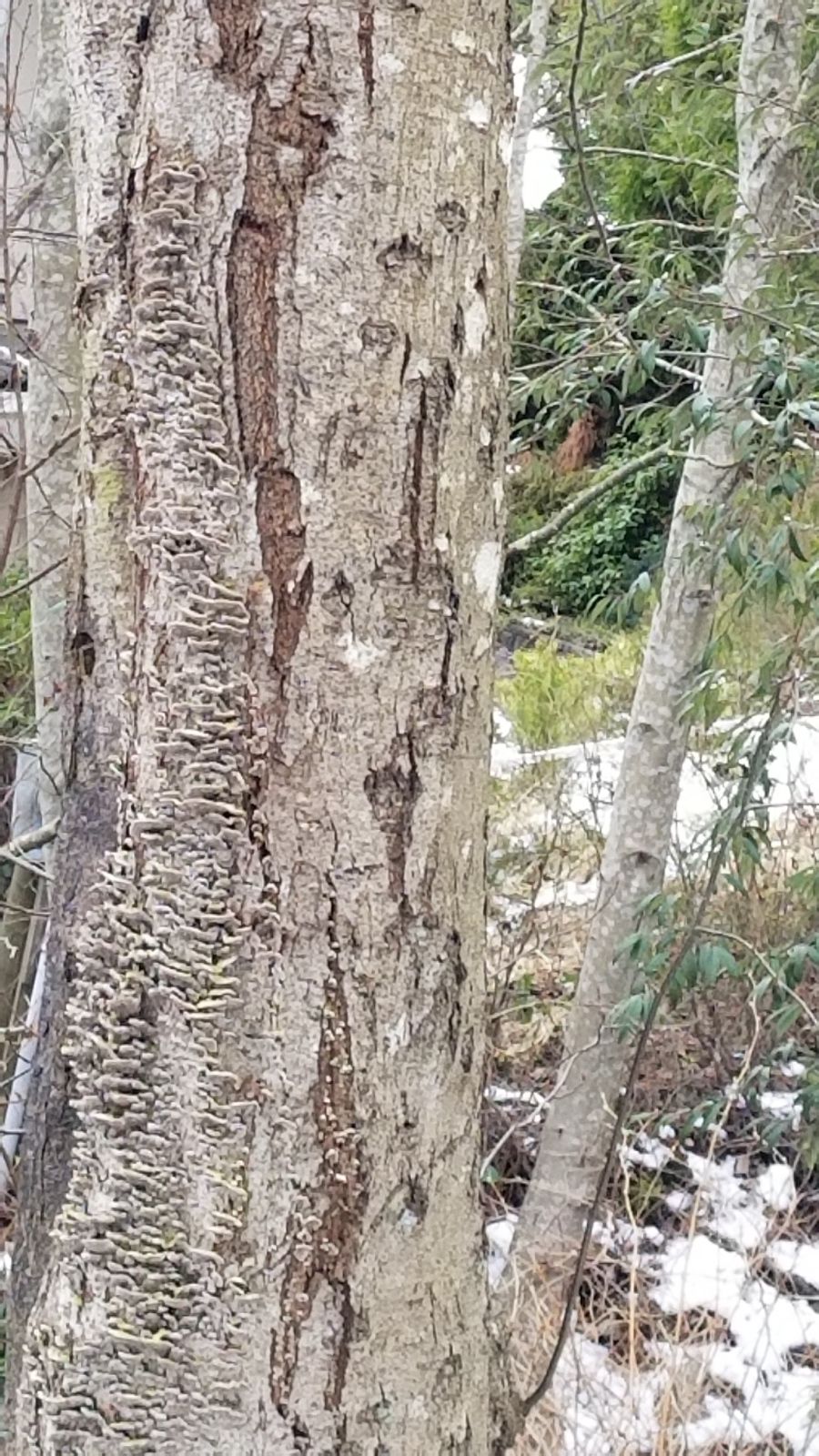
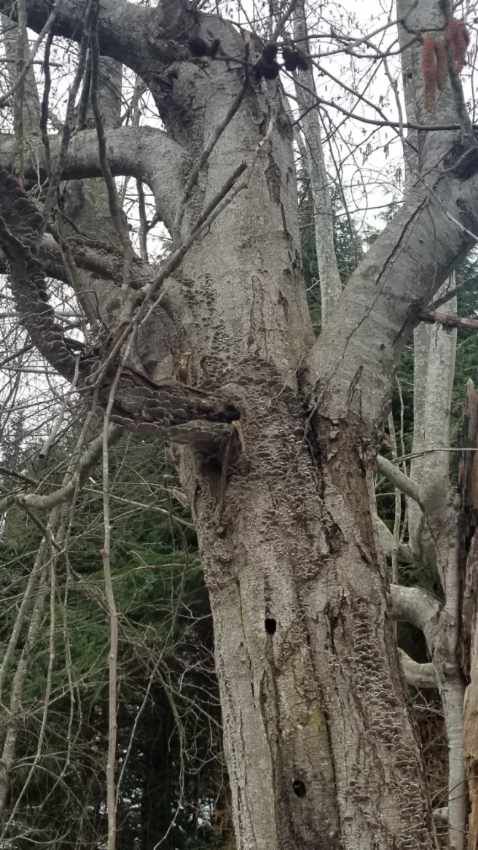
- *Mushrooms or conk growth at the base or on major limbs.* Fungal fruiting bodies signal internal decay. By the time you see them on the outside, the decay has been progressing inside for years.
- *Recent change in lean combined with lifted soil at the base.* A tree that has shifted its lean since last season and shows soil uplift on the tension side is losing its root anchor.
- *Crown dieback.* Dead wood at the top of the crown signals root stress, vascular disease, or structural decline — even when lower branches look healthy.
**Target value:**
A severely defective tree falling into an open lawn isn't a high-hazard situation. A moderately defective tree directly over your roof or a sidewalk is. Target value — what's in the fall zone — determines urgency just as much as the defect itself.
In our experience conducting hazard assessments across Vancouver, Burnaby, and North Vancouver, the most commonly missed hazard is the large Douglas fir with dead interior crown wood. Homeowners see green foliage from the street. Arborists see the dead branches hidden inside the lower canopy — the ones that become projectiles at 70 km/h.
If you spot any of the defect indicators above, don't wait for your next scheduled service visit. Call immediately.
What Should You Expect During a Professional Tree Care Assessment in Vancouver?
A site visit from a certified arborist takes 20 to 45 minutes per tree, depending on complexity. Here's what happens:
**Ground-level inspection**
The arborist walks the base of each tree and examines the root flare (the visible transition between trunk and roots), soil condition, and signs of compaction, grade change, or construction damage that affects root function.
**Trunk and basal zone**
Visual inspection for cavities, bark anomalies, and fungal growth. A mallet test helps locate hollow sections — hollow wood returns a dull thud, solid wood returns a clean ring. Experienced arborists use this extensively on large-diameter conifers and hardwoods.
**Scaffold branches and crown**
Using binoculars when necessary, the arborist examines branch attachment angles, dead wood distribution, and the presence of epicormic growth — water sprouts at the trunk or branch bases that signal vascular stress or root decline.
**Species-specific risk factors**
Different species fail differently. Big-leaf maples are prone to sudden limb drop in summer — a phenomenon called sudden limb failure, where large healthy-looking branches detach without warning during warm, calm weather. Douglas firs under root stress show elevated windthrow risk. Western red cedars in drought conditions exhibit foliage bronzing that precedes significant root decline. Knowing your species is not a nice-to-have. It changes the assessment.
**Written documentation**
For permit or insurance purposes, the arborist produces a formal written report with species identification, DBH measurements, structural findings, risk rating, and specific recommendations. This is the formal arborist report required by municipal planning departments across the Lower Mainland.
What Does WCB Registration Actually Mean for Tree Work on Your Property?
WorkSafeBC (WCB) registration is mandatory for all tree service companies operating in British Columbia. It means the company has registered their workers with the provincial occupational health and safety system and pays applicable premiums. Workers are covered for workplace injuries.
Why does this matter to you as a property owner?
Under BC's Workers Compensation Act, if an unregistered crew member is injured on your property, you can be found liable as the effective owner of the workplace. That liability can extend to covering the worker's lost wages, medical costs, and long-term rehabilitation — out of your pocket.
WorkSafeBC's High-Risk Tree Felling operational procedures, updated in 2020, specifically govern tree felling near power lines, structures, and road rights-of-way. These procedures require formal hazard identification, communication protocols, and designated escape routes before any felling begins. They aren't optional for professional operators.
Ask any tree service you're considering to provide their WCB registration number and certificate of liability insurance before work begins. A legitimate company provides both immediately. Hesitation is a red flag.
How Does Professional Hedge Care Differ From Standard Shape-Trimming?
Hedges aren't self-maintaining. They're living structures that require knowledge of growth habits, species biology, and timing — not just a string line and a gas trimmer.
The elements that separate professional hedge care from basic trimming:
**Timing.** Cedar, laurel, and boxwood hedges have specific windows for hard cuts. Trim a cedar hedge too late in the season and new growth won't harden before frost. Trim a California lilac at the wrong time and you remove the following season's flowers entirely.
**Nesting season compliance.** From April 15 through August 15, birds actively nest in dense hedges across the Lower Mainland. Work that disturbs active nests can create violations under BC's Wildlife Act. Professional crews account for this in scheduling.
**Species-appropriate technique.** Formal hedges — yew, cedar, boxwood — tolerate hard annual shearing. Informal flowering hedges — camellia, rhododendron, forsythia — require different approaches to maintain flowering. Applying formal technique to an informal species removes the blooms for a full year.
**Long-term architecture.** A hedge kept at the same height year after year gradually develops a dense outer shell of old wood with a dying interior. Correct ongoing management — including selective thinning — keeps interior growth alive. A hedge that's lost its interior is difficult to recover and sometimes can't be saved.
FAQ
**Q: Do I need a permit to remove a tree on my own property in Vancouver?**
Yes, in most cases. City of Vancouver Trees By-law No. 9958 requires a permit for any tree measuring 20 cm or more in trunk diameter at breast height on private property. The application includes an arborist assessment. Removing a protected tree without a permit carries fines up to $10,000 per tree. Contact the City's Permits and Licences department or arrange an arborist assessment before cutting anything significant.
**Q: How do I know if my tree situation is a genuine emergency?**
Call immediately if you see any of these: a fresh crack running through a major limb or trunk; a significant change in lean since last week; soil uplift at the base of the tree; large hanging broken branches that haven't fallen yet (widow-makers); or new fungal growth at the base following a storm. Any of these signals an active structural failure in progress — not a situation to monitor and revisit.
**Q: What's the difference between a general tree assessment and a formal arborist report?**
A tree assessment is a visual inspection that produces verbal or informal written recommendations. A formal arborist report is a signed written document from an ISA-certified arborist. It includes species identification, DBH measurement, structural findings, risk rating, and specific recommendations. The formal report is required for City of Vancouver permit applications, development permits, insurance claims, and legal proceedings involving trees. Ask specifically for the written report if you need it for a formal purpose.
**Q: How often should mature trees in Vancouver be professionally assessed?**
The ISA recommends a formal hazard assessment every three years for mature trees in urban settings. For Vancouver specifically — given storm exposure, fast growth rates, and high target values — we recommend annual pre-storm assessments for any large Douglas fir, any tree with a known structural defect, and any tree over 15 metres within falling distance of a structure or road.
**Q: What happens legally if a tree on my property falls onto a neighbour's property in BC?**
BC courts apply a negligence standard. If you knew or reasonably should have known the tree was hazardous and failed to act, you're liable for the resulting damage. This is why documented hazard assessments and written arborist reports matter — they create a record of due diligence. If no professional assessment has ever been done and a tree falls, "I didn't know it was dangerous" is not a legal defense.
---
Get a Complete Tree Care Assessment in Vancouver
Your trees aren't static. They grow, they age, they accumulate structural defects — and Vancouver's rainfall and storm season accelerates every stage of that process.
Complete tree care isn't a single service call. It's an ongoing relationship between your property and ISA-certified arborists who know your specific trees, understand your specific risk profile, and can tell you — based on direct professional assessment, not guesswork — what needs attention now versus what can wait.
Aesthetic Tree & Hedge Services provides the full range of essential tree care across Vancouver, Burnaby, North Vancouver, Richmond, and Coquitlam: hazard assessment, ANSI A300-standard pruning, tree removal, stump grinding, formal arborist reports, and 24-hour emergency response. Every crew member is WCB registered. All assessments are conducted by ISA-certified arborists.
Call for a free estimate: **(604) 721-7370**
Found this helpful? Follow our tree care insights directly on Google.
Make us your preferred source on GoogleBefore You Go
Where are you in your tree care journey?
Our Tree Care Services
ISA-certified arborists serving Greater Vancouver


Explore Our Tree Care Services
From expert pruning to safe tree removal, our ISA-certified arborists are ready to help across Greater Vancouver.
View Services