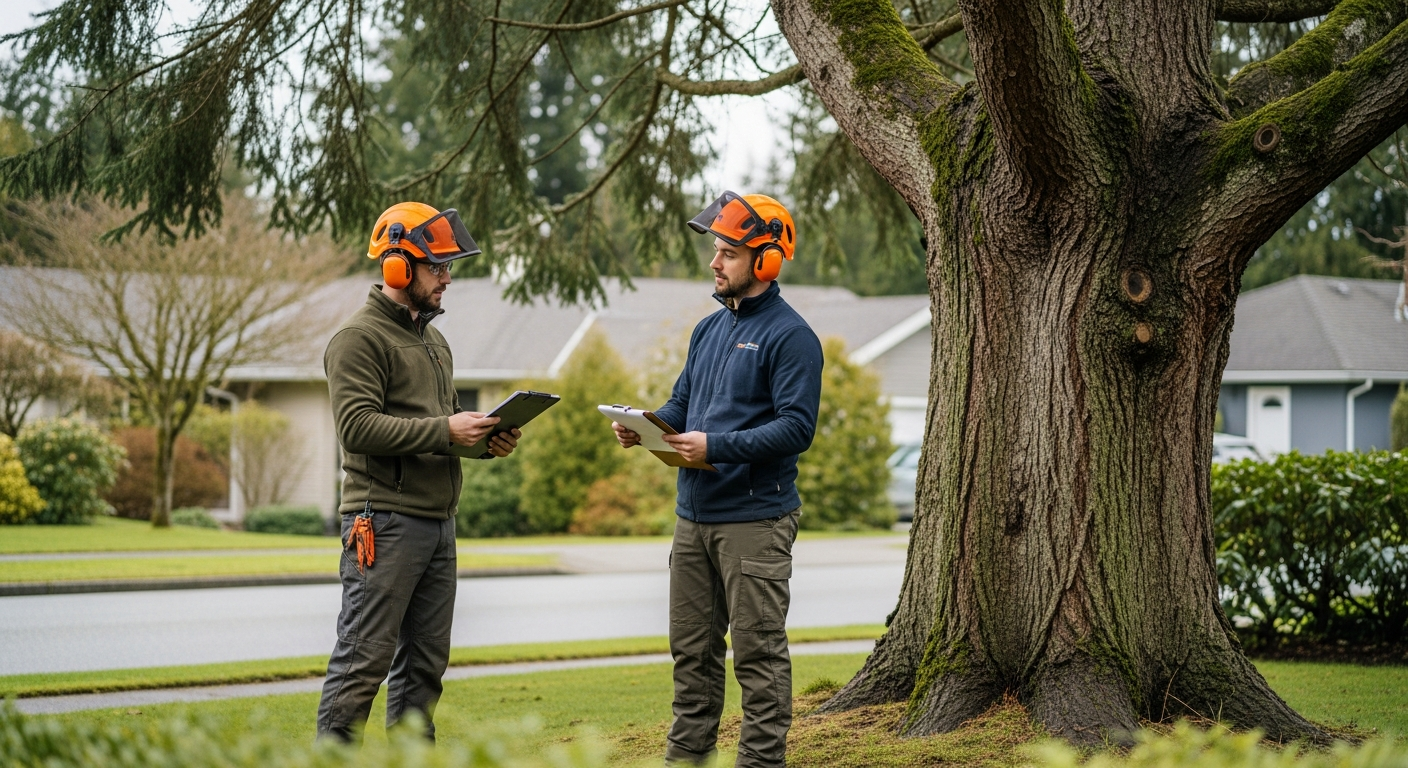

TL;DR — Quick Summary
Latest tree cutting techniques Vancouver arborists use in 2026. ISA methods, crane removal, sectional felling explained. Free estimate: (604) 721-7370.
TL;DR
- Vancouver arborists rely on sectional dismantling, precision rigging, aerial work platforms and crane-assisted removal for most urban residential jobs — because tight Lower Mainland lots rarely allow full-tree felling.
- The City of Vancouver Private Tree Bylaw (No. 9958) requires a removal permit for any private-property tree with a trunk diameter of 20 cm or greater, measured 1.4 m above grade.
- WorkSafeBC classifies tree falling and arboriculture as a high-hazard occupation in BC. Ask every contractor for their WorkSafeBC registration number and liability insurance certificate before work starts.
- ANSI A300 standards define the professional baseline for pruning cuts, crown reduction and tree risk assessment across North America, including Vancouver.
- ISA certification and Tree Risk Assessment Qualification (TRAQ) are the two most important credentials to verify before hiring any Vancouver arborist.
---
The tree work that looks routine from the sidewalk is rarely routine once you're up in the canopy.
In Vancouver, mature trees grow beside houses, over laneway homes, above carports, close to power lines and right along tight property boundaries. That geography is the first problem a qualified arborist has to solve before any cutting begins.
This guide covers the methods ISA-certified arborists actually use in the Lower Mainland in 2026 — the decisions that happen before the chainsaw starts and the techniques that determine whether a job ends cleanly or with a claim call.
---
What Tree Cutting Techniques Do Vancouver Arborists Actually Use?
There's no single answer. The technique follows the site, the tree and the targets.
A professional arborist assesses structure, lean, decay, height, root condition and surrounding targets before deciding how to cut. The methods below are the most common in Vancouver residential work.
Sectional Dismantling
Sectional dismantling means removing a tree from the top down in manageable pieces. The arborist or climbing crew takes each piece off with controlled cuts, then either lowers the piece by rope or drops it into a clear zone.
In our work across Kitsilano, East Vancouver, Dunbar, Grandview-Woodland and Mount Pleasant, sectional dismantling is the standard approach for any tree with structures nearby. The lots are simply too tight for anything else. In a typical Vancouver backyard, you might have the house on one side, a garage or laneway home on another, a fence on the third and a neighbour's structure on the fourth. There's no clean fall zone. Sectional work with proper rigging is how you protect all of it.
This is also the technique most directly shaped by skill level. Anyone can make rough cuts. Getting sections to land exactly where you planned — that's the difference between a qualified arborist and a liability risk.
Directional Felling
When space allows, directional felling removes the whole tree in one controlled drop. The arborist cuts a face notch on the intended fall side, then a back cut on the opposite side, leaving a hinge of wood that guides the fall.
It's fast when conditions are right. But "conditions are right" rarely describes a Vancouver residential lot. You need room, a clean escape route, predictable lean and sound wood. Most urban trees in Vancouver lack at least one of those.
Bore Cutting
Bore cutting is an advanced felling technique where the arborist inserts the saw bar directly into the trunk to establish the hinge before making the release cut. This gives the cutter more control on trees with internal tension or off-axis lean and it reduces the risk of barber chairing — the dangerous upward split that can happen when a loaded tree is cut in the wrong sequence.
It's not a beginner technique. We use it selectively, usually on larger trees with obvious lean or tension in the wood where a standard back cut would release the trunk too unpredictably.
Controlled Rigging Systems
Modern tree work is as much rigging as it is chainsaw technique.
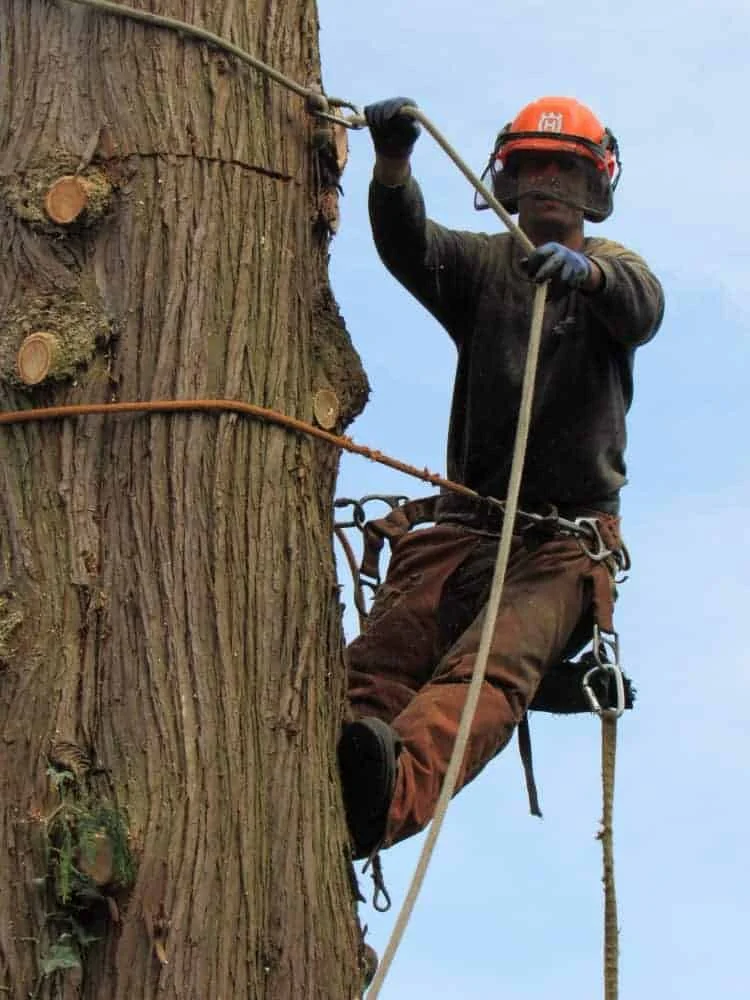
Professional arborists use rope blocks, lowering devices, redirect anchors, pulley systems and friction management to control how each section descends. The goal is to transfer the weight of a cut piece onto the rope system before the cut is complete, then lower it in a controlled arc to the ground crew.
Good rigging absorbs shock load. Poor rigging transfers that shock to the tree, the rope system and whatever is below. On a Vancouver property with structures on three sides, controlled rigging isn't optional — it's the job.
---
Why Does Vancouver's Urban Density Change How Arborists Cut Trees?
Vancouver's urban layout compresses the standard arborist's risk calculation. What might be a straightforward removal on a rural acreage becomes a multi-stage rigging problem on a 33-foot-wide Vancouver lot.
According to the City of Vancouver's Urban Forest Strategy, the city has set a target of 22% canopy cover across all neighbourhoods. That means tens of thousands of mature trees growing in tight residential settings — and that number is the backdrop for every removal job we take on.
Consider what a typical East Vancouver removal actually looks like. The tree is a 60-year-old big-leaf maple, 15 to 18 metres tall, growing three metres from the back wall of the house. There's a fence on the left, a detached garage on the right, a concrete patio below and the neighbour's fence two metres past the canopy edge.
We've worked dozens of jobs fitting that description. In every one of them, the rigging plan was determined before any chainsaw was in the tree. Equipment was staged before anyone climbed. The ground crew was briefed on every section before the first cut.
That's how it should be done. The technique is only as effective as the planning behind it.
---
What Is the Site Assessment Process Before Any Tree Is Cut?
A qualified arborist doesn't show up and start cutting. The site assessment is where the safe approach gets determined.
Tree Risk Assessment
Tree risk assessment follows a structured process. ISA's Tree Risk Assessment Qualification (TRAQ) training covers a defined method for evaluating failure likelihood, impact likelihood and consequence of failure.
A dead birch leaning over a back deck carries a different risk profile than a healthy red maple in an open corner of the yard. Visible indicators like included bark, fungal fruiting bodies at the base, soil heaving, trunk cracks, major deadwood, or split unions all change the approach. For higher-risk trees, the crew may recommend crane assistance, aerial lift access, or additional rigging anchors before cutting begins.
According to the International Society of Arboriculture, improper risk assessment is one of the leading contributors to preventable tree failures in urban settings. The TRAQ framework was developed specifically to standardize how arborists evaluate and communicate tree risk to property owners.
Target Zone Mapping
Before any cutting starts, the crew identifies every target in the work zone. In Vancouver, a single backyard removal might have eight or nine distinct targets: the house, a detached garage, a laneway home, a parked vehicle, a fence, a neighbour's garden, overhead service lines, a retaining wall and a concrete patio.
In our experience, the time spent mapping targets before climbing is never wasted. One overlooked target can mean a section lands somewhere it shouldn't.
Confirming Insurance and WorkSafeBC Coverage
WorkSafeBC classifies tree falling and arboriculture as a high-hazard occupation under BC's Occupational Health and Safety Regulation. WorkSafeBC's industry injury rate data consistently places forestry, logging and arboriculture among the highest-risk occupations in BC for serious injuries and fatalities.
Before hiring any tree service in Vancouver, ask for the company's WorkSafeBC registration number and their liability insurance certificate. A legitimate company provides both without being asked twice.
---
When Is Crane-Assisted Tree Removal the Right Choice?
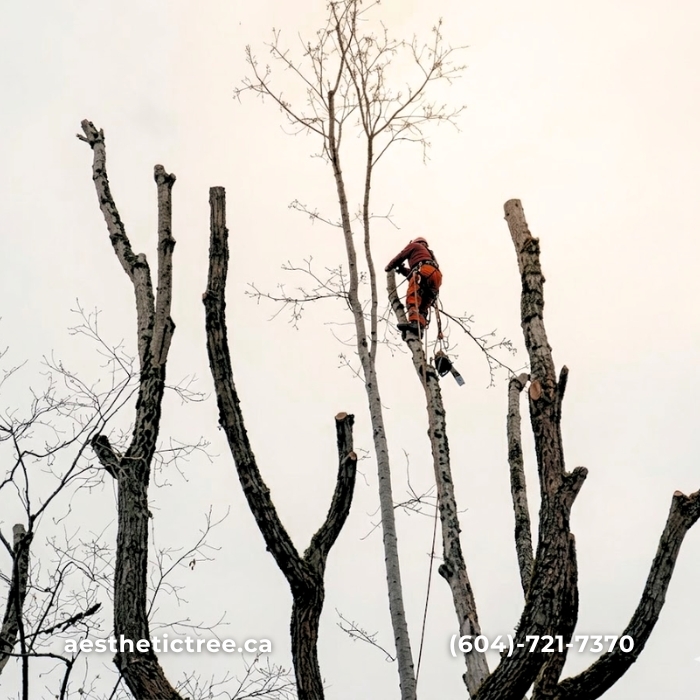
Crane removal costs more per hour than standard crew work. But it's the right choice in several common Vancouver scenarios.
The Tree Can't Be Safely Climbed
Severe decay, root plate failure, a major split union, or storm damage can make a tree unsafe for a climber. A crane can lift sections from above while the arborist makes cuts at a stable, ground-based position or from a work platform below the failure zone.
Access Is Physically Blocked
Some Vancouver properties have no practical route to get a fallen piece safely to the street. A narrow side yard, a steep grade, retaining walls, or a fully enclosed laneway home can block every conventional exit path for a cut section. A crane positioned on the street can reach over obstacles and lift sections directly — no dragging through tight clearances.
Speed Matters in Emergency Situations
In storm response, speed is part of the safety calculation. A crane can clear a major fallen or partially fallen tree faster than conventional dismantling, which matters when a roof is exposed to weather or a driveway is blocked.
Any crane job needs a proper lift plan, confirmed rigging gear, clear communication between the arborist and crane operator and — in Vancouver — any required temporary lane-use permits from the City if the crane occupies the street.
For removals with multiple constraints,professional tree removal in Vancouverrequires both the rigging knowledge and the permit coordination to do the job legally and safely.
Image suggestion: Wide shot showing a crane-assisted section lift on a Vancouver residential street, with the rigging visible and the crew in position.
---
What Do Vancouver's Tree Bylaws Mean Before You Cut Anything?
This is the question most homeowners don't think to ask until after they've already made a plan. Knowing the rules before you pick up a saw can save a significant fine.
City of Vancouver Private Tree Bylaw
The City of Vancouver's Private Tree Bylaw (Bylaw No. 9958) requires a removal permit for any private-property tree with a trunk diameter of 20 cm or greater, measured 1.4 m above grade. The City also extends protection to certain significant trees by species, regardless of size in some cases.
Penalties for removing a protected tree without a permit can reach into the thousands of dollars. The City of Vancouver has publicly documented cases of significant fines for unpermitted removals and remediation requirements can add further costs.
Before anytree cutting in Vancouver, measure the trunk diameter at the required height and confirm the current rules with the City or a qualified arborist. Bylaws are updated periodically and what applied two years ago may not apply today.
Street Trees and Boulevard Trees
Street trees and boulevard trees are owned by the City of Vancouver. Homeowners can't remove, prune, or structurally alter a city-owned street tree without City approval — even if the tree is physically adjacent to your property.
If a tree sits near the sidewalk, lane, or road allowance, confirm ownership before making any assumptions. We've seen homeowners damage or remove what turned out to be a city-owned tree. The resulting liability and remediation costs far exceeded what a proper permit process would have cost.
Rules Differ Across Lower Mainland Municipalities
Burnaby, Richmond, North Vancouver, West Vancouver, Coquitlam, each have their own tree protection bylaws. The threshold for permit requirements, protected species lists and fine structures all differ by municipality.
A local arborist should know how to look up the applicable bylaw for the specific address on the job. If they can't tell you the correct bylaw for your municipality without checking, that's worth noting.
For any situation requiring documentation to support a permit application or a legal tree assessment, anarborist report in Vancouverprovides the formal written assessment that municipalities and insurance companies expect.
---
How Do ANSI A300 Standards Apply to Vancouver Tree Work?
ANSI A300 standards are North American professional standards for tree care practices. They cover pruning, risk assessment, support systems, fertilization, root management and other arboricultural work. They're developed through a collaborative process involving the Tree Care Industry Association (TCIA) and the American National Standards Institute.
For a Vancouver homeowner, the important point is simple: professional arborists work to a defined standard, not just to whatever the customer wants done quickly.
What ANSI A300 Says About Pruning Cuts
Proper pruning cuts are made just outside the branch collar — the slightly swollen area where the branch meets the trunk or parent stem. Cutting too close damages trunk tissue and removes the callus-generating zone. Cutting too far away leaves a dead stub that decays and invites secondary infection.
The ANSI A300 standard also addresses how much live crown can be removed in a single season. Removing more than roughly 25-30% of a tree's live canopy at once creates serious stress responses, particularly in mature trees. A company that offers to strip a crown because it's "safer" isn't following professional pruning standards — it's topping under a different name.
Why Topping Is Still a Problem in 2026
Despite being widely condemned by arboricultural organizations for decades, topping is still offered as an option in the Vancouver market. Topping removes large portions of the crown, triggering weak epicormic regrowth, accelerated decay in large pruning wounds and structural instability over time.
We've assessed properties where topped trees from five to ten years ago are now showing signs of serious structural failure from the regrowth. Topping doesn't make a tree safer — it creates a different, often worse, structural problem on a longer timeline.
If an arborist recommends topping without citing specific structural reasoning, that's a signal to ask more questions or get a second opinion.
---
What Should You Actually Verify When Hiring a Vancouver Tree Service?
The quote is easy to compare. The credentials take more work to check, but they're worth checking.
ISA Certification
The International Society of Arboriculture certifies arborists through written examination and documented field experience. ISA credentials can be verified through the ISA's public lookup tool by name or certification number.
Ask for the certifying arborist's full name and credential number. In some cases, the person doing the assessment and quoting the job is certified, but the crew doing the actual cutting isn't. Ask who will be on-site supervising the work.
Beyond standard ISA certification, the Tree Risk Assessment Qualification (TRAQ) is a specialized credential for arborists performing formal risk assessments. If you're getting an arborist report for insurance, municipal requirements, or a significant tree decision, confirm that the assessing arborist holds TRAQ.
Insurance and Business Documentation
A professional Vancouver tree service should carry:
- WorkSafeBC registration (verifiable by their registration number)
- General liability insurance (ask for the certificate, not just a verbal confirmation)
- A written estimate with a defined scope of work
- Business licensing where required by the municipality
The estimate should spell out what's included: cutting, rigging, cleanup, wood chipping, stump grinding, debris removal, traffic control if needed and permit support. Verbal agreements leave too much room for "that wasn't included."
Red Flags Worth Knowing
Watch out for these signals before signing anything: a company that can't produce a WorkSafeBC number on request, a quote based purely on time with no explanation of method, a recommendation to top the tree without a structural rationale, or an arborist who can't explain where each major section will go before it's cut.
---
What Happens to the Property After the Tree Comes Down?
A clean removal doesn't end when the last trunk section hits the ground.
Stump Grinding
The stump stays unless grinding is included in the scope.Stump grinding in Vancouverremoves the stump below grade — typically to a depth that allows replanting, levelling, or landscape restoration.
Chemical stump removal is slower and less predictable and it's not suitable near other tree roots or planting beds. For most Vancouver residential properties, grinding is the practical and faster option.
Site Cleanup and Wood Disposal
Professional crews chip smaller branches and cut larger wood into manageable sections. Some homeowners want chips left for mulch — wood chips are excellent as mulch, especially around other tree root zones. Others want the site fully cleared. Confirm this in writing before work begins.
Large trunk sections from removed trees are sometimes available to keep for firewood if the species is suitable. Ask before the crew hauls everything away.
Post-Removal Tree Assessment
Removing one tree changes the conditions for every tree nearby. Light exposure, wind loading and soil moisture all shift. Trees that were sheltered by the removed tree may experience new stress responses in the first growing season.
A post-removal inspection of adjacent trees is worth requesting, especially if the removed tree was large or showed signs of site-wide issues — soil saturation, root damage, or fungal disease present in multiple trees on the property.
Replanting
Vancouver's urban forest goals encourage replacement planting and some permit approvals require it. Species selection for replacement should account for mature canopy size, root spread, soil conditions, light availability after removal and municipal guidelines for the specific neighbourhood.
---
How Does Emergency Tree Service in Vancouver Work?
Emergency tree work operates on a compressed timeline, but the same safety principles apply.
Call foremergency tree serviceif a tree or large limb has fallen on a structure, is leaning after storm damage, is visibly cracked at the trunk or a major union, has lifted roots, or is in contact with utility lines.
Don't attempt to cut or move a storm-damaged tree yourself. Partially fallen trees store tremendous mechanical energy in bent or compressed wood. What looks stable may be balanced on a single tension point that shifts the moment a cut releases it.
What a Professional Emergency Crew Does Differently
A professional emergency arborist arrives and assesses load paths before touching anything. Where is the tension? Where is the compression? What holds the piece in place right now and what happens if that contact point is disrupted?
The crew then secures the work area, identifies targets and removes the damaged tree in controlled sections — working from the safest accessible position outward, not from the most convenient one.
Depending on the situation, that might mean rigging from a secondary anchor, bringing in an aerial lift, or using crane assistance to clear a section wedged against a structure.
After emergency removal, ask for a written assessment of nearby trees. One storm failure can indicate broader site conditions — saturated soil, root plate movement in adjacent trees, or canopy attachment issues that weren't visible until the failed tree was gone.
Image suggestion: Emergency storm cleanup photo showing controlled rigging on a property, with the crew in proper PPE and a tidy work zone rather than loose debris piles.
---
What's the Real Difference Between Professional Tree Cutting and a Cheap Quote?
The cheap quote usually isn't accounting for everything.
A low-cost operator may skip the site assessment, work without WorkSafeBC coverage, use drop cuts instead of controlled lowering, or misjudge section weight. If something hits a roof, a fence, or a neighbouring structure, the savings disappear — and the liability lands on the homeowner.
Professional tree cutting isn't a premium option on top of the base job. It's the base job done correctly.
The Tree Care Industry Association notes that tree care has one of the highest injury and fatality rates of any outdoor occupation in North America. That fact reflects the genuine hazard of the work and is exactly why professional standards exist. A qualified crew arrives with a work plan, proper rigging equipment, signed documentation and the ability to explain exactly how each major section will be controlled before it's cut.
The same principle applies to everything else on the property.Hedge trimming services in Vancouverfrom a trained crew follow proper cutting technique for species health — not just a visual result that looks tidy for a few weeks and damages the hedge structure long-term.
---
FAQ
What is the most common tree cutting technique used in Vancouver?
Sectional dismantling is the most common approach for Vancouver residential properties. Because most urban lots have structures on multiple sides, arborists remove trees from the top down in controlled sections rather than felling the whole tree at once. Each section is rigged and lowered under control — it's not dropped.
Do I need a permit to cut down a tree on my private property in Vancouver?
In most cases, yes. The City of Vancouver Private Tree Bylaw (No. 9958) requires a permit to remove any private-property tree with a trunk diameter of 20 cm or greater, measured 1.4 m above grade. Penalties for unpermitted removal can be substantial. Confirm current requirements before making any cuts, because the bylaw is updated periodically and exemptions apply in specific situations.
How do I verify that a Vancouver arborist is ISA certified?
Ask for the arborist's full name and ISA certification number, then check through the ISA's public credential lookup tool. Credentials can be confirmed by name, city, or certification number. If the person quoting the work is different from the person who will supervise the crew on-site, verify both.
What is the difference between tree cutting and tree pruning?
Tree cutting usually refers to removal of the whole tree or major structural sections. Tree pruning selectively removes branches to improve structure, health, clearance, or safety while keeping the tree alive. Both require proper technique — pruning cuts that don't respect the branch collar, or crown reduction that removes too much live material in one season, can cause lasting structural and health damage.
When should I call for emergency tree service in Vancouver?
Call immediately if a tree or limb has fallen on a structure, is in contact with utility lines, is leaning noticeably after a storm, has visible trunk cracks or a split union, or has visible root plate lifting. Storm-damaged trees are mechanically unpredictable. Don't attempt to cut or reposition them without a trained crew using proper rigging equipment.
What does an arborist report include and when do I need one?
An arborist report is a written assessment prepared by a qualified ISA-certified arborist, typically one holding TRAQ credentials. It covers tree species, size, condition, risk factors, recommendations and supporting documentation. Municipal permit applications in Vancouver often require an arborist report for removal or significant pruning of protected trees. Insurance claims related to tree damage or failure may also require one.
Can any tree in Vancouver be removed without a permit?
Some trees fall below the protected size threshold — under 20 cm diameter at 1.4 m above grade — and some species are exempt under certain conditions. Street trees are never the homeowner's call; they're city property regardless of where they're physically located. If you're unsure, measure the trunk and confirm with the City of Vancouver's Planning, Urban Design and Sustainability department, or ask a qualified arborist before touching the tree. The cost of confirming is far lower than the cost of an unpermitted removal.
---
*Aesthetic Tree & Hedge Services providestree cutting, tree removal, pruning, stump grinding, hedge trimming, arborist reports, emergency tree service and tree planting across Vancouver, Burnaby, North Vancouver, West Vancouver, Richmond, Coquitlam and the Lower Mainland. Free estimates: (604) 721-7370. ISA-certified arborists. WCB registered.*
Found this helpful? Follow our tree care insights directly on Google.
Make us your preferred source on GoogleBefore You Go
Where are you in your tree care journey?
Our Tree Care Services
ISA-certified arborists serving Greater Vancouver


Explore Our Tree Care Services
From expert pruning to safe tree removal, our ISA-certified arborists are ready to help across Greater Vancouver.
View Services