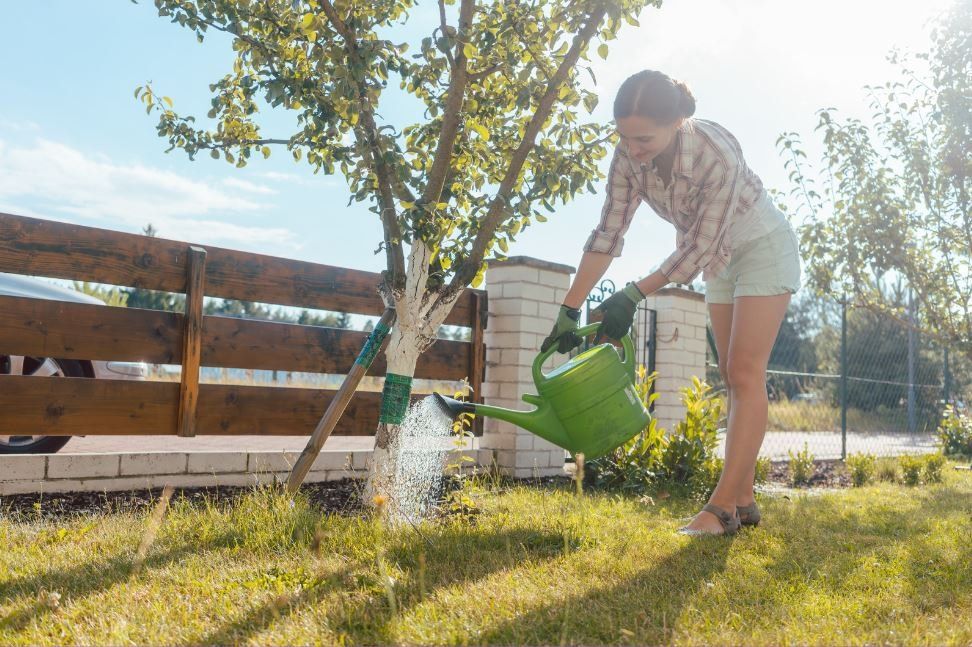

TL;DR — Quick Summary
Does regular watering mulching benefit trees during summer? Here's the science, the right technique, and the one mistake Vancouver homeowners make.
Does regular watering mulching benefit trees during Vancouver's dry season? The answer is yes — and by a margin that surprises most homeowners.
Here's the short version: water keeps trees alive. Mulch keeps water in the soil. Together, they're the two highest-return care practices you can do between professional visits. Most Vancouver homeowners either skip them entirely or do them wrong.
This guide covers both. The science behind why they work. The technique that gets results. And the most common mistake — one that actively harms trees instead of helping them.
TL;DR
- Regular watering and mulching are the two most effective DIY tree care practices in Metro Vancouver
- A proper mulch layer reduces soil moisture evaporation by up to 35%, per ISA research
- Vancouver's dry season (June–September) stresses even established trees
- Volcano mulching — piling mulch against the trunk — causes more harm than doing nothing at all
- Newly planted trees need 25–30 litres of water per week during their first two to three years (BC Ministry of Forests)
---
Does Mulching Actually Help Trees? What the Research Shows
Short answer: yes. Dramatically.
The International Society of Arboriculture (ISA) has studied this for decades. A proper 3–4 inch mulch layer reduces soil moisture evaporation by up to 35%. That's water that stays in the root zone — not lost to the atmosphere on a hot July afternoon.
But evaporation is only part of the story.
Mulch also:
- Moderates soil temperature swings by up to 10°F versus bare soil (ISA data)
- Suppresses weeds that compete directly with tree roots for water and nutrients
- Reduces soil compaction from foot traffic and rain impact
- Builds organic matter as it breaks down, feeding beneficial soil microbes
- Regulates soil pH gradually as organic material decomposes
A 2019 study published in *Arboriculture & Urban Forestry* found that trees with organic mulch rings established 30% faster than trees planted without mulch. That's not a minor difference. That's the difference between a tree that thrives in year two and one that barely holds on.
For Vancouver homeowners, this matters more than most people realize.
Urban trees face stressors that forest trees never encounter. Compacted soil. Reflected heat from driveways and sidewalks. Restricted root zones. Low organic matter in disturbed fill soil. Mulch addresses all of them — at once, with a single application.
When it's done right, that is.
---
How Much Water Does a Tree Actually Need During Vancouver's Dry Season?
Vancouver's rainy reputation is accurate — for about nine months of the year. But June through September? Metro Vancouver regularly goes two to four weeks without significant rainfall. That dry stretch stresses trees far more than most homeowners expect.
The BC Ministry of Forests recommends 25–30 litres of water per week for newly planted trees during their first two to three years of establishment. Most homeowners underwater significantly. They soak the root ball at planting, then forget about it until leaves start browning.
Here's what adequate watering looks like by tree age:
**Newly planted trees (Years 1–3):**
- 25–30 litres per week, delivered slowly over 30–45 minutes
- Slow delivery matters — a quick spray sheet runs off compacted soil; slow watering soaks in
- Water in the early morning to reduce surface evaporation
- Once per week in mild weather, twice per week during heat waves
**Established trees (Years 4+):**
- Most established trees in Vancouver's climate manage without supplemental watering
- Exceptions: trees in heavily compacted soil, trees near impervious pavement, trees showing visible drought stress
- Deep, infrequent watering beats shallow, frequent watering every time — it trains roots downward
- Aim for 30–60 litres every two weeks during prolonged dry spells
**Drought stress warning signs to watch for:**
- Wilting leaves that don't recover overnight
- Leaf scorch — brown crispy edges on otherwise green leaves
- Premature fall colour appearing in July or August
- Noticeably smaller leaf size compared to prior years
- Dieback at branch tips — small dead twigs throughout the canopy
Drought stress weakens a tree's immune system. A stressed tree is far more vulnerable to secondary pest and disease pressure. In Metro Vancouver, that means increased risk of armillaria root rot, bronze birch borer, and other opportunistic problems that can turn a manageable situation into an emergency tree service call.
Don't wait for dramatic symptoms. By the time you see leaf scorch, the tree has already been stressed for weeks.
---
What's the Right Way to Apply Mulch? (Most People Get This Wrong)
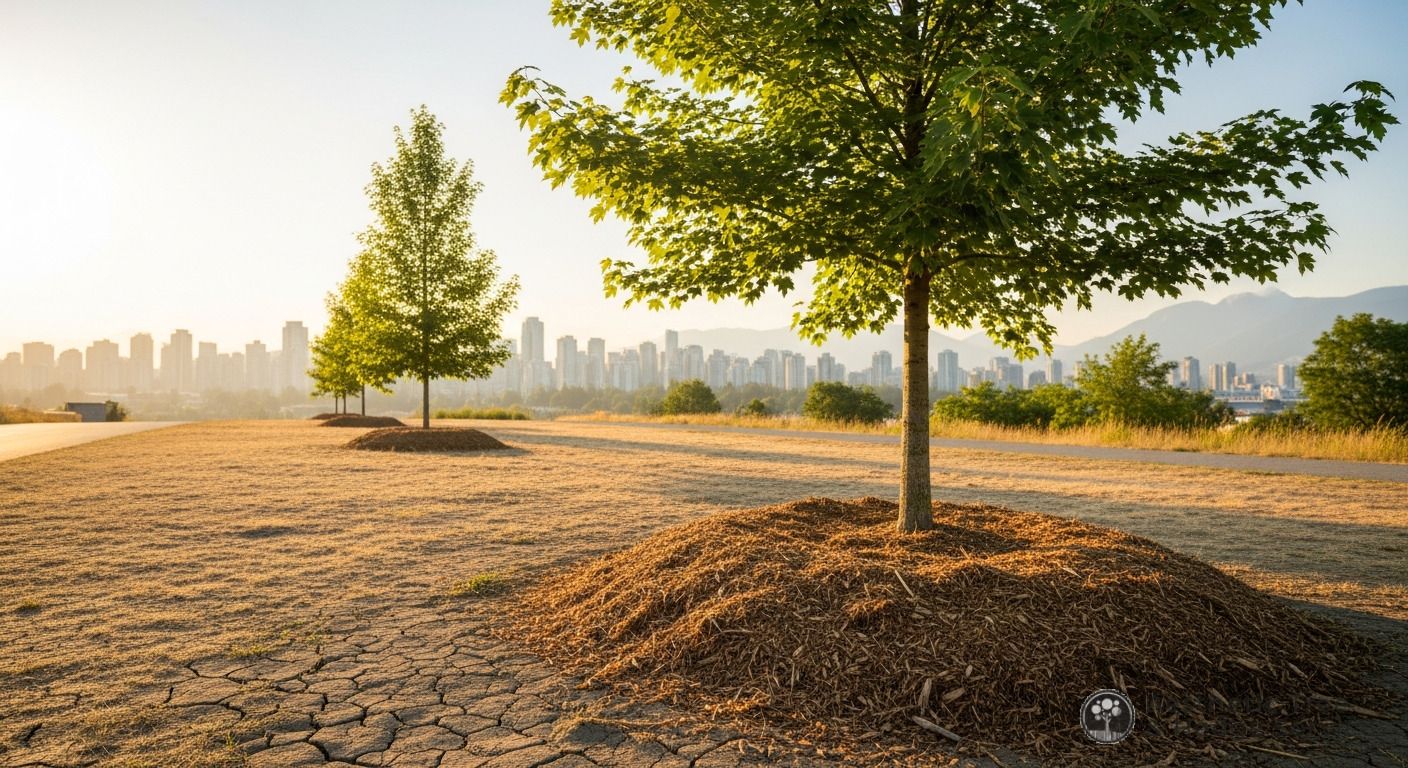
Here's the mistake that drives ISA-certified arborists crazy across Metro Vancouver: volcano mulching.
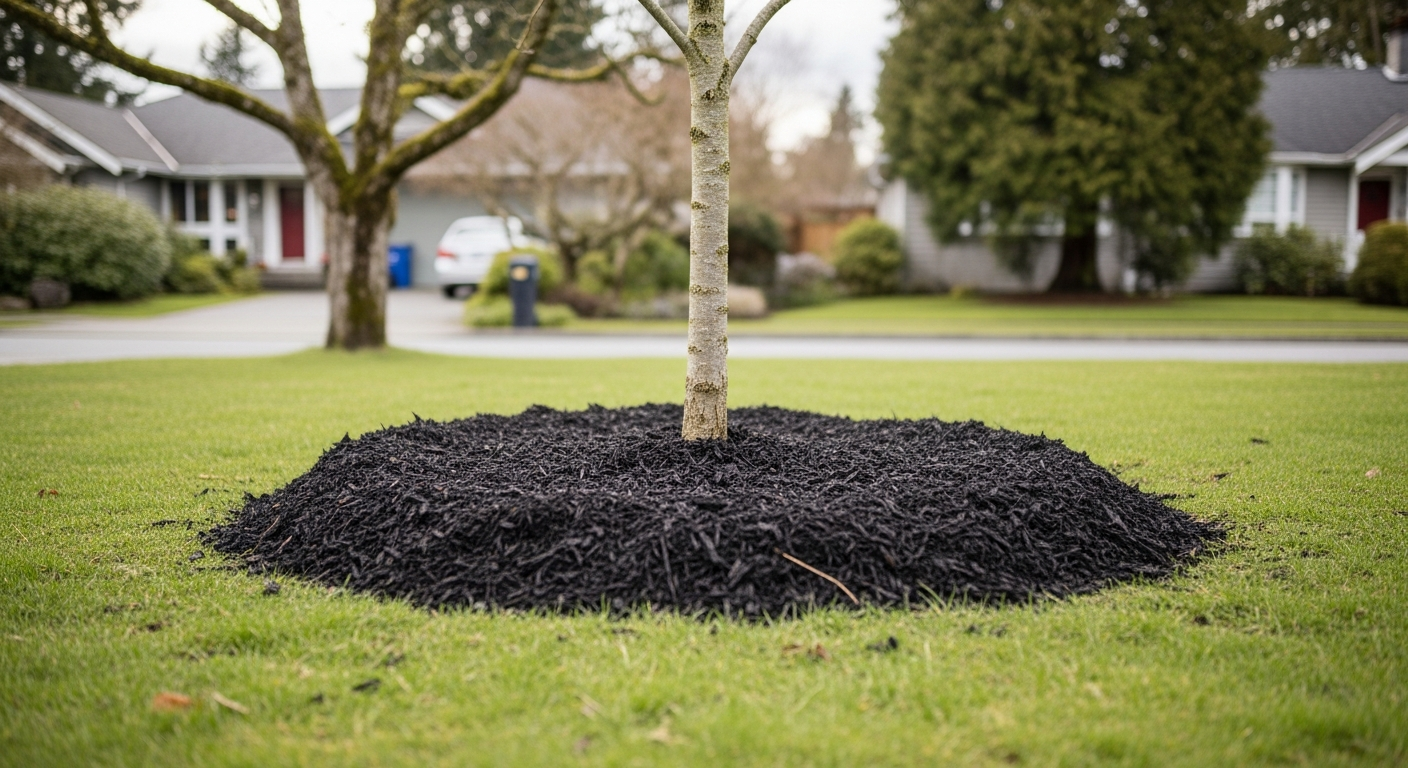
Volcano mulching is exactly what it sounds like. Mulch piled up against the trunk in a cone shape. It looks tidy. It looks generous. It's one of the most harmful things you can routinely do to a tree.
Here's the problem.
When mulch contacts the trunk, it holds moisture against bark that isn't designed for constant, prolonged contact. The result:
- Bark decay and cambium layer damage
- Root collar rot progressing upward into the stem
- Fungal pathogens gaining entry through softened bark
- Girdling roots that choke the tree as they mature around the buried flare
Oregon State University Extension found that volcano mulching increases pest and disease incidence by approximately 30% compared to trees mulched correctly. That risk is entirely preventable. You just need to pull the mulch back.
**The correct mulching technique — step by step:**
1. **Depth:** 3–4 inches of organic mulch. Fresh wood chips from ISA arborist operations are ideal — untreated, locally sourced, and biologically active. Avoid rubber mulch and dyed wood chips. They don't improve soil biology and can introduce unwanted chemicals. 2. **Width:** Extend the mulch ring as far as possible — ideally out to the drip line, which is the outer edge of the canopy. Wider is always better. A 6-foot ring is far better than a 2-foot ring. 3. **Keep mulch off the trunk:** Pull it back 6 inches from the root flare. The root flare is where the trunk visibly widens at ground level. It should be visible, not buried. If you can't see the flare, the mulch is too close. 4. **Don't pile it deep:** More than 4 inches of mulch reduces soil oxygen exchange and can suffocate surface roots. 5. **Refresh every spring:** Organic mulch breaks down over the winter season. Top it up each April before the dry season begins.
In our experience working across Vancouver, Burnaby, North Vancouver, and Richmond, the most common mulching error isn't volcano mulching — it's no mulching at all. Trees surrounded by lawn suffer the most. Mowers compact the soil around the root zone, and turf grass competes intensely for moisture and nutrients in exactly the zone where tree feeder roots live.
The second most common mistake: using the wrong material. Gravel and decorative stone look permanent but do nothing for soil biology. The best mulch is fresh wood chips — the kind produced during crown pruning or removal operations. If you're scheduling tree cutting in Vancouver or any crown work, ask the crew to leave the chips on site. Most homeowners don't realize those chips are worth more than the job itself, ecologically speaking.
---
Which Vancouver Tree Species Benefit Most From Regular Watering and Mulching?
All trees benefit from proper care. But some species need it urgently in Metro Vancouver's climate, especially in their first years in the ground.
**Douglas fir (Pseudotsuga menziesii)** BC's iconic native conifer is largely drought-tolerant once established. But newly planted specimens are vulnerable. Root systems take three to five years to fully establish in urban soil with its compaction, drainage interruptions, and low organic matter. Mulching during this critical window is one of the highest-impact interventions available.
**Big-leaf maple (Acer macrophyllum)** Vancouver's most recognizable native deciduous tree. Big-leaf maples have shallow, wide-spreading root systems that respond strongly to mulch rings. During drought, they drop leaves early as a survival response — not death, but a clear stress signal. A proper mulch ring and deep watering can prevent that early drop entirely.
**Western red cedar (Thuja plicata)** Cedar is a moisture-loving species. In natural forest habitats, they grow near streams and in moist understories. In urban settings, they're routinely planted in full sun with restricted root zones and poor irrigation. Regular watering is essential for urban cedars. Brown interior foliage in summer almost always signals drought stress — not disease, not normal shedding.
**Japanese maple (Acer palmatum)** Widely planted across Lower Mainland gardens. Japanese maples have delicate fine root systems that dry quickly in shallow, well-drained soil. A 4-inch mulch ring combined with weekly deep watering during summer isn't optional for a healthy Japanese maple — it's baseline care.
**Ornamental cherry (Prunus spp.)** Cherry trees line streets across Vancouver, Burnaby, and Coquitlam. They're shallow-rooted and compete poorly with surrounding turf for moisture. Add a proper mulch ring and the visible improvement within a single growing season is striking — denser canopy, fuller leaf set, reduced dieback.
**Native species in new plantings:** The City of Vancouver's Urban Forest Strategy 2021–2030 prioritizes climate-resilient native species for new street and boulevard tree plantings across the city. For any new tree planting project, establishing a proper mulch ring on day one is standard professional practice — and significantly improves five-year survival rates for every species.
---
Can Mulching Save a Stressed or Declining Tree?
Sometimes. It depends on how far the decline has progressed and what's causing it.
A tree showing early drought stress — minor leaf scorch, slightly reduced canopy density, some premature leaf drop — can absolutely recover with corrective watering and mulching. We've seen trees that homeowners were ready to cut down come back strongly within a single growing season after receiving proper care and a professional assessment.
Speed matters enormously here. The longer a tree goes without adequate moisture and root zone protection, the more secondary problems accumulate on top of the primary stress. Bark beetles don't attack healthy trees. They attack weakened ones. A drought-stressed Douglas fir becomes a target. Acting before that window opens is far better than responding after.
**Steps to rehabilitate a drought-stressed tree:**
1. **Identify the actual cause first.** Is it drought? Soil compaction? Root damage from nearby excavation or construction? The wrong species for the site's drainage conditions? Your response should match the diagnosis. 2. **Remove competing vegetation from the root zone.** Turf grass is highly competitive. Strip it back to the drip line if possible and replace it with mulch. 3. **Apply a proper mulch ring immediately.** 3–4 inches deep, pulled back 6 inches from the root flare. Do this the same day you diagnose the problem. 4. **Start a deep watering program.** Slow, sustained soaking twice a week during dry periods. Use a soaker hose or a slow-running garden hose at the drip line, not against the trunk. 5. **Get a professional assessment.** If you're not sure whether the tree is salvageable, an ISA-certified arborist can assess its structural integrity, root health, and long-term prognosis. Sometimes a tree has crossed a threshold where decline is irreversible — and knowing that early prevents wasted effort and helps you plan properly for tree removal in Vancouver under the city's Tree Protection Bylaw.
One critical Vancouver note: the City of Vancouver's Tree Protection Bylaw covers trees with a trunk diameter of 20 cm or more measured at 1.4 m height. If removal is the right call, you need a permit — and often a written arborist report to support the application. An ISA-certified arborist tells you which path is appropriate and what documentation each option requires.
---
Does Watering Near a Stump Affect Surrounding Healthy Trees?
After tree removal, homeowners often ask whether continuing to water the surrounding garden affects remaining root material or nearby healthy trees.
Short answer: it depends on what you're dealing with.
For recently removed trees, watering near the base can accelerate stump and root decomposition. That's sometimes desirable — but decomposing root material can attract armillaria (honey fungus), which spreads along root contact points to neighbouring trees. If you have a stump near healthy trees, stump grinding in Vancouver removes the potential fungal host before it becomes a problem.
For new plantings near a removed tree's location, consult your arborist about a root barrier installation if there's any risk of competing root growth from neighbouring trees or aggressive shrubs encroaching on the new planting's root zone.
The interaction between water, root systems, soil biology, and adjacent trees is more complex than it looks from the surface. When in doubt, get an assessment before planting.
---
What Does an Arborist Report Have to Do With Tree Watering and Mulching?
More than most homeowners expect.
When an ISA-certified arborist writes an arborist report in Vancouver, the assessment includes the tree's current health status and documented condition history. A tree that has been consistently watered and mulched shows measurably better tissue health, structural integrity, and vascular function than a chronically stressed specimen of the same species and age.
That matters in several real situations:
- Applying for a tree removal permit where the city requires a health and risk assessment
- Disputes with neighbours over whether a tree is structurally hazardous
- Pre-construction tree inventory for development projects requiring documented baseline condition
- Property transactions involving significant mature trees
A tree with a history of proper care is more likely to be assessed as healthy and structurally sound — which is valuable both to the report outcome and to your property. The USDA Forest Service estimates that a single mature urban tree provides up to $270 in documented annual benefits through stormwater interception, energy cost reduction, and air quality improvement. Protecting that investment with consistent watering and mulching is straightforward and inexpensive. Replacing it is not.
---
When Watering and Mulching Aren't Enough: Time to Call a Professional
Regular watering and mulching reduce the frequency of serious tree problems. They don't eliminate every risk.
Some conditions require professional assessment regardless of how well you've maintained a tree.
Call an ISA-certified arborist if you notice:
- Cracks or vertical splits in the main trunk
- Hollow or soft areas when you knock on the wood
- A lean that has changed noticeably over one season
- Mushroom growth at the base of the trunk or on major roots
- Dead limbs throughout the canopy that weren't present last year
- Root upheaval, soil mounding, or cracking near the trunk base
These are hazard signals. They're structural issues, not hydration problems. Watering and mulching can't address them. What they need is a trained eye, a written risk assessment, and often a clear action plan.
Pruning, cabling, or removal decisions need to meet ANSI A300 standards — the professional benchmark for arboricultural care in North America. Work done outside those standards can create liability, and in Vancouver's regulated tree environment, it can create permit complications as well.
Our ISA-certified, WCB-registered team works across all of Metro Vancouver. We assess before we act. We give you a clear picture of what you're dealing with and what your real options are — whether that's a care plan, structural support via tree cabling, or a removal permit application.
---
FAQ
**Does regular watering and mulching benefit trees during Vancouver's dry summers?** Yes, significantly. Vancouver's dry season from June through September creates drought stress even in well-established trees. Regular deep watering combined with a 3–4 inch mulch ring reduces soil moisture evaporation, moderates soil temperature, and maintains root zone health through the driest months. The two practices work together — mulch makes your watering more effective by reducing how quickly water is lost from the soil surface.
**How far from the trunk should mulch be applied?** Pull mulch back at least 6 inches from the root flare — the point where the trunk widens at ground level. The root flare should be visible at all times, never buried. Mulch in contact with the trunk holds moisture against bark and creates decay entry points for disease. This error, called volcano mulching, is one of the most common preventable causes of urban tree decline in Metro Vancouver — and it usually looks like good care to the untrained eye.
**How much water does a newly planted tree need in Vancouver?** The BC Ministry of Forests recommends 25–30 litres per week for newly planted trees during their first two to three years of establishment. Deliver water slowly over 30–45 minutes rather than quickly, so it penetrates deeply instead of running off. Water in the early morning. During heat waves and extended dry stretches, increase frequency to twice per week. Trees planted in compacted urban soils with poor drainage may need more — watch the tree, not just the calendar.
**Can the wrong mulch type damage a tree?** Yes. Dyed wood chips can leach chemical compounds into the soil. Rubber mulch provides no soil biology benefit. Any mulch applied deeper than 4 inches can reduce soil oxygen exchange and suffocate surface roots. The best mulch is fresh, untreated wood chips from ISA arborist operations — organic, free of disease, broken down by beneficial fungi, and genuinely beneficial to soil structure. Ask your arborist to leave chips on site after any pruning or removal work.
**When should I call a certified arborist about a tree that isn't recovering?** If drought stress symptoms don't improve after four to six weeks of corrective watering and mulching, call an ISA-certified arborist. Call immediately — don't wait for the four-to-six-week window — if you notice any structural symptoms: cracks in the trunk, hollow areas, an unexplained new lean, or mushroom growth at the base. Some trees decline past the point where rehabilitation is realistic. A professional assessment tells you which situation you're in, what your options are under Vancouver's Tree Protection Bylaw, and whether you need a permit before taking any action.
---
*Aesthetic Tree & Hedge Services are ISA-certified arborists and WCB-registered tree care professionals serving Vancouver, Burnaby, North Vancouver, Richmond, Coquitlam, and the surrounding Lower Mainland.*
**Ready to protect your trees this summer? Call Aesthetic Tree & Hedge Services for a free estimate — [(604) 721-7370](tel:6047217370). ISA-certified arborists. WCB registered. Serving Metro Vancouver.**
Found this helpful? Follow our tree care insights directly on Google.
Make us your preferred source on GoogleBefore You Go
Where are you in your tree care journey?
Our Tree Care Services
ISA-certified arborists serving Greater Vancouver


Explore Our Tree Care Services
From expert pruning to safe tree removal, our ISA-certified arborists are ready to help across Greater Vancouver.
View Services