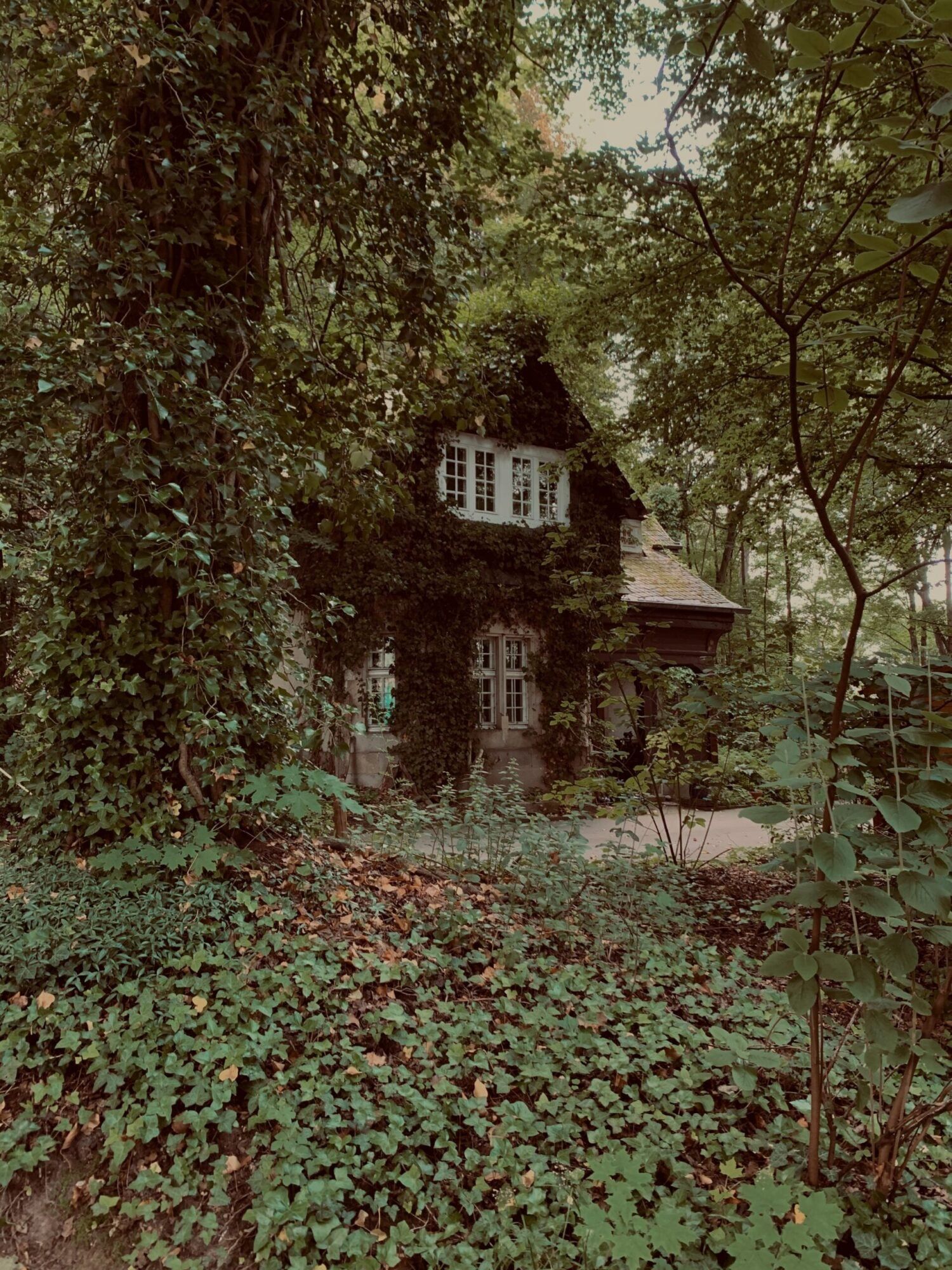

TL;DR — Quick Summary
How to prevent ivy from threatening trees before damage becomes irreversible. ISA-certified tips from Vancouver arborists. Call (604) 721-7370 for a free estimate.
TL;DR
- English ivy, Hedera helix, is listed as an invasive plant of concern in British Columbia and is a common tree-health issue in the wet Lower Mainland climate.
- Ivy can threaten trees by adding storm weight, trapping bark moisture, hiding decay, competing in the root zone, and shading the canopy.
- The safest homeowner method is the ivy ring technique: cut every stem around the trunk, clear the base, and let upper vines die before removing loose sections.
- Do not pull live ivy from high branches. It can strip bark, drop debris, and disturb nesting birds during the spring and summer nesting period.
- If ivy has reached the canopy, or you see deadwood, fungal growth, bark wounds, root movement, or a lean toward a target, book an ISA-certified arborist assessment before removing it yourself.
---
Knowing how to prevent ivy from threatening trees is one of the most useful things a Vancouver homeowner can learn before a small garden problem turns into a tree-risk problem.
Ivy often looks harmless at first.
It stays green through winter. It fills bare ground. It covers fences and retaining walls. In older Vancouver, Burnaby, North Vancouver, Richmond, and Coquitlam yards, English ivy is often inherited from a previous owner and left alone because it seems established.
The issue is that English ivy does not stay politely in the garden bed.
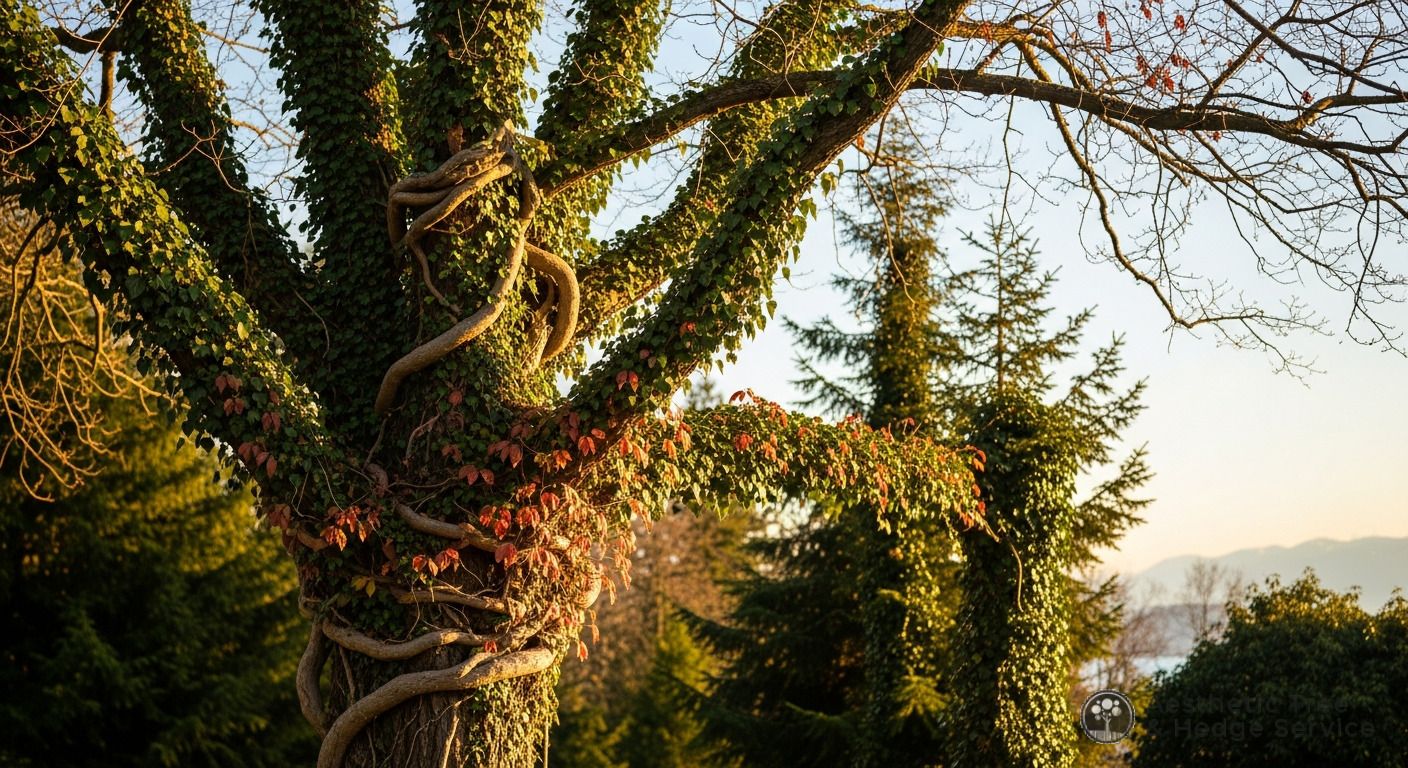
Once it reaches a tree trunk, it can climb into the canopy, hide bark defects, add rain and wind load during storms, and compete with the tree in the root zone. The decline is usually gradual. Many homeowners only notice the problem after deadwood, sparse foliage, bark wounds, or structural weakness has already appeared.
This guide explains how ivy threatens trees, how to remove it without causing more damage, and when the job should move from DIY cleanup to an ISA-certified arborist assessment.
---
Why English Ivy Is a Problem for Trees in Vancouver
English ivy is not native to British Columbia. Provincial invasive-plant resources, including the Invasive Species Council of BC and regional invasive species programs, identify English ivy as a problem species because it spreads aggressively, suppresses native plants, and climbs trees in mild coastal conditions.
The Lower Mainland is especially vulnerable because ivy can grow for much of the year. Vancouver's mild winters and wet shoulder seasons mean ivy does not get the same hard winter die-back that might slow it in colder regions.
Ivy affects trees in two places at once.
**On the trunk and canopy:** Ivy climbs bark, attaches with aerial rootlets, adds weight, traps moisture, and can eventually shade the tree's own leaves.
**At the root zone:** Ivy spreads across the soil surface, competes with tree roots, and crowds out native or climate-suitable groundcovers that would otherwise support healthier soil conditions.
The City of Vancouver has identified invasive species pressure as one of the challenges facing urban forest health. That matters because every mature private-property tree contributes to canopy coverage, cooling, stormwater control, wildlife habitat, and neighbourhood character. When ivy weakens a mature cedar, Douglas fir, maple, birch, cherry, or ornamental tree, the eventual cost is often much higher than early vine removal would have been.
In our field work across Vancouver-area residential properties, ivy problems are most common on older lots, shaded fence lines, unmanaged side yards, retaining-wall edges, and properties where ivy has grown from a neighbouring yard into the tree's root zone.
A useful inspection photo for this section would show the lower trunk before cutting, with the root flare hidden by ivy and the main woody ivy stems visible.
---
How Ivy Threatens a Tree Step by Step
Ivy usually harms trees through a combination of stress factors rather than one single event. The more established the vine becomes, the more these stresses compound.
**Step 1: Stem compression and bark pressure.** Mature ivy stems become woody and thick. As they expand against bark, they can press into the trunk and branch unions. This can interfere with normal bark development and make it much harder to inspect the tree for cracks, wounds, decay, cavities, included bark, or old pruning damage.
**Step 2: Added storm load.** Ivy-covered trees carry extra weight. During Lower Mainland rain and wind events, wet vine mass can increase branch loading and make the crown catch more wind. This is especially concerning when the tree already has deadwood, weak branch attachments, decay, or a lean toward a house, fence, driveway, sidewalk, vehicle, or neighbouring property.
**Step 3: Trapped moisture against bark.** Ivy holds moisture close to the trunk. Persistent bark moisture can create better conditions for decay organisms and can hide fungal conks, cavities, cankers, and old wounds until the problem is advanced.
**Step 4: Root-zone competition.** Ivy mats compete with tree roots for water, oxygen, and nutrients. In compacted urban soils, this competition matters. Many Vancouver-area trees already deal with restricted rooting space, construction disturbance, lawn compaction, drainage issues, and grade changes.
**Step 5: Canopy shading.** Once ivy reaches the crown, it can shade the tree's own foliage. Less sunlight means less photosynthesis. Over time, that can contribute to thinning canopy, deadwood, and reduced vitality.
A mature tree rarely fails because of ivy alone. More often, ivy hides or worsens existing weaknesses until the tree becomes harder and more expensive to manage.
---
How to Remove Ivy From a Tree Without Damaging It
The most important rule is simple: do not pull live ivy down from the upper trunk or canopy.
Live ivy grips tightly. Pulling it can strip bark, tear small branches, drop debris, and make hidden decay harder to manage safely. If birds are nesting, careless removal can also create wildlife concerns during the spring and summer nesting period. In British Columbia, active nests are protected, so tree and hedge work should be approached carefully whenever nesting activity may be present.
For ground-level ivy, the safest approach is the ivy ring technique.
**1. Cut every stem around the trunk.** Use bypass pruners, loppers, or a pruning saw to cut all ivy stems around the tree at about waist height. Then make a second cut lower down near the base. Remove the cut section so there is a clear gap between the rooted ivy and the upper vine.
**2. Clear the base of the tree.** Remove ivy from the soil around the trunk. Aim for at least a 1-metre clear ring where space allows. Keep the root flare visible and avoid piling soil or mulch against the bark.
**3. Let upper vines die in place.** Once cut, the upper ivy will usually brown and dry over the following weeks. Dead ivy releases more easily than live ivy and is less likely to tear bark when removed.
**4. Return for follow-up removal.** After the upper vine has dried, remove loose sections carefully from reachable areas. If the ivy extends above safe ground reach or into the canopy, leave that work for a trained arborist with proper climbing or aerial equipment.
On residential jobs, the most common homeowner mistake we see is trying to clear the whole tree in one afternoon by pulling live vines from overhead. That often causes more bark damage than the original ivy.
A simple diagram here would help: cut line at waist height, second cut near the base, removed gap, and cleared root flare.
---
How Much Ivy Should You Clear From the Trunk?
Start by clearing the bottom 1 to 2 metres of the trunk and the root flare.
That lower section is the priority because it is where ivy reattaches, thickens, hides bark defects, and moves upward into the crown. A clean base ring also makes future inspections much easier.
If ivy is still limited to the lower trunk and the tree appears otherwise healthy, a careful homeowner can often manage the first removal pass from the ground.
If ivy has reached the canopy, the situation changes. At that point, an ISA-certified arborist should assess:
- Whether the tree has deadwood, decay, cracks, cavities, or weak branch attachments
- Whether bark damage is visible once lower vines are cut away
- Whether upper vine removal can be done safely without stripping bark
- Whether the tree needs pruning, monitoring, cabling, or removal
- Whether municipal permit rules apply if the tree is likely to come down
This is especially important for mature Douglas fir, Western red cedar, Big-leaf maple, birch, cherry, and other high-value trees common on Vancouver-area properties.
---
Does English Ivy Kill Mature Trees?
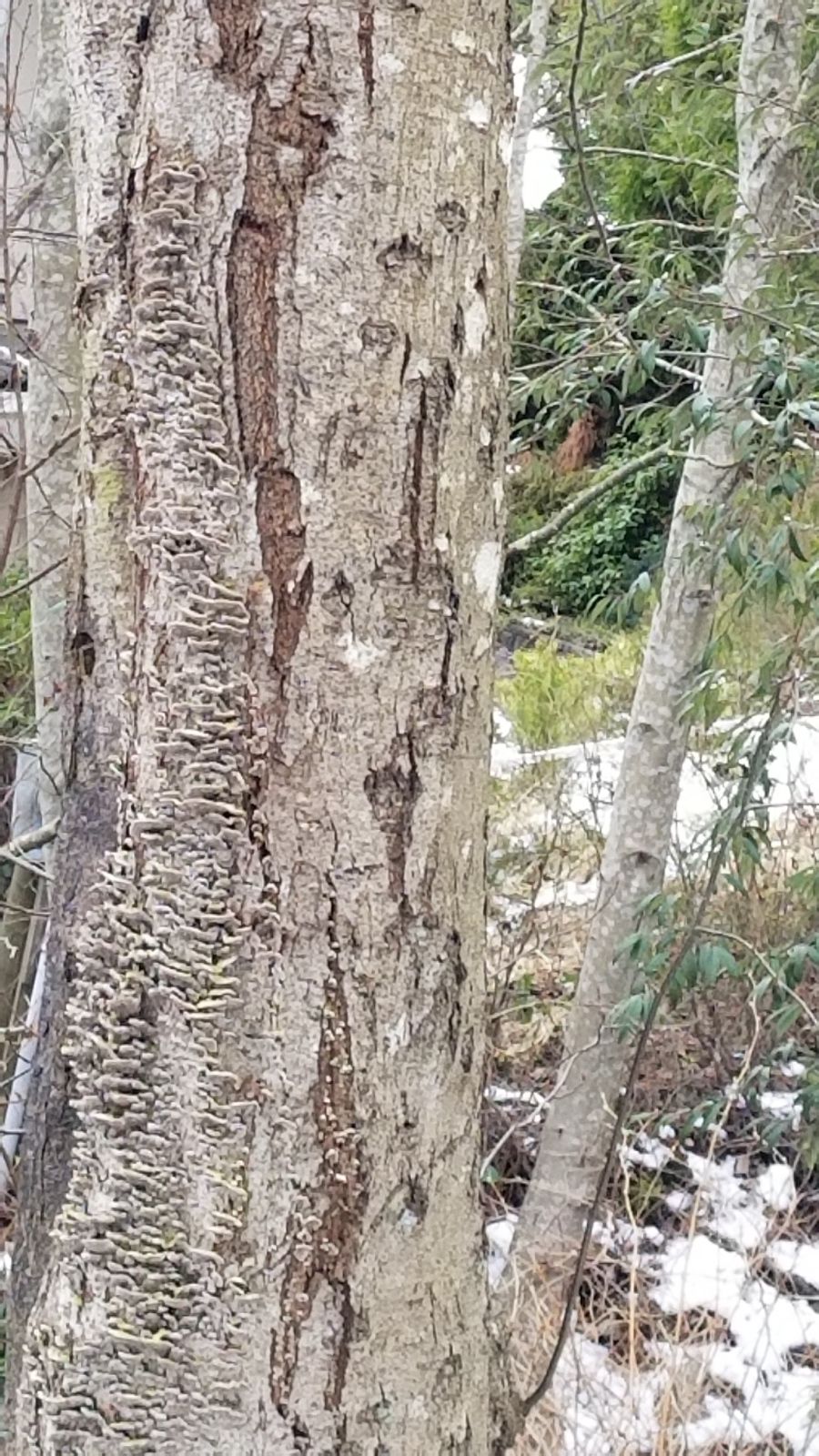
English ivy can contribute to the decline and failure of mature trees, especially when it is allowed to climb into the canopy and remain there for years.
It is more accurate to say that ivy weakens trees and increases risk rather than claiming every ivy-covered tree will die on the same timeline. Tree species, age, soil conditions, previous pruning, construction damage, drainage, exposure, and existing decay all affect the outcome.
That said, heavy ivy coverage is a real warning sign.
A tree covered in ivy is harder to inspect. It may carry more wind and rain load. Bark defects may be hidden. Root-zone competition may be ongoing. If the tree is already stressed, ivy can push it further into decline.
In the Lower Mainland, winter storms make this more urgent. A tree that looks green in August can become a hazard in November if it has hidden decay, a heavy vine-covered crown, and a target such as a roof, driveway, fence, sidewalk, or parked vehicle.
Prevention is usually far less expensive than emergency tree work.
---
Signs Ivy Has Already Damaged Your Tree
Ivy hides the trunk, so damage is not always obvious from a distance. Walk around the tree and look for these warning signs.
- **Deadwood in the canopy:** Dead branches while the rest of the tree remains green can signal stress, disease, or structural decline.
- **Sparse or thinning canopy:** If the crown looks thinner than it used to, the tree may be losing vitality.
- **Bark compression or wounds:** Thick ivy stems can hide bark damage, cracks, old pruning wounds, cavities, or decay pockets.
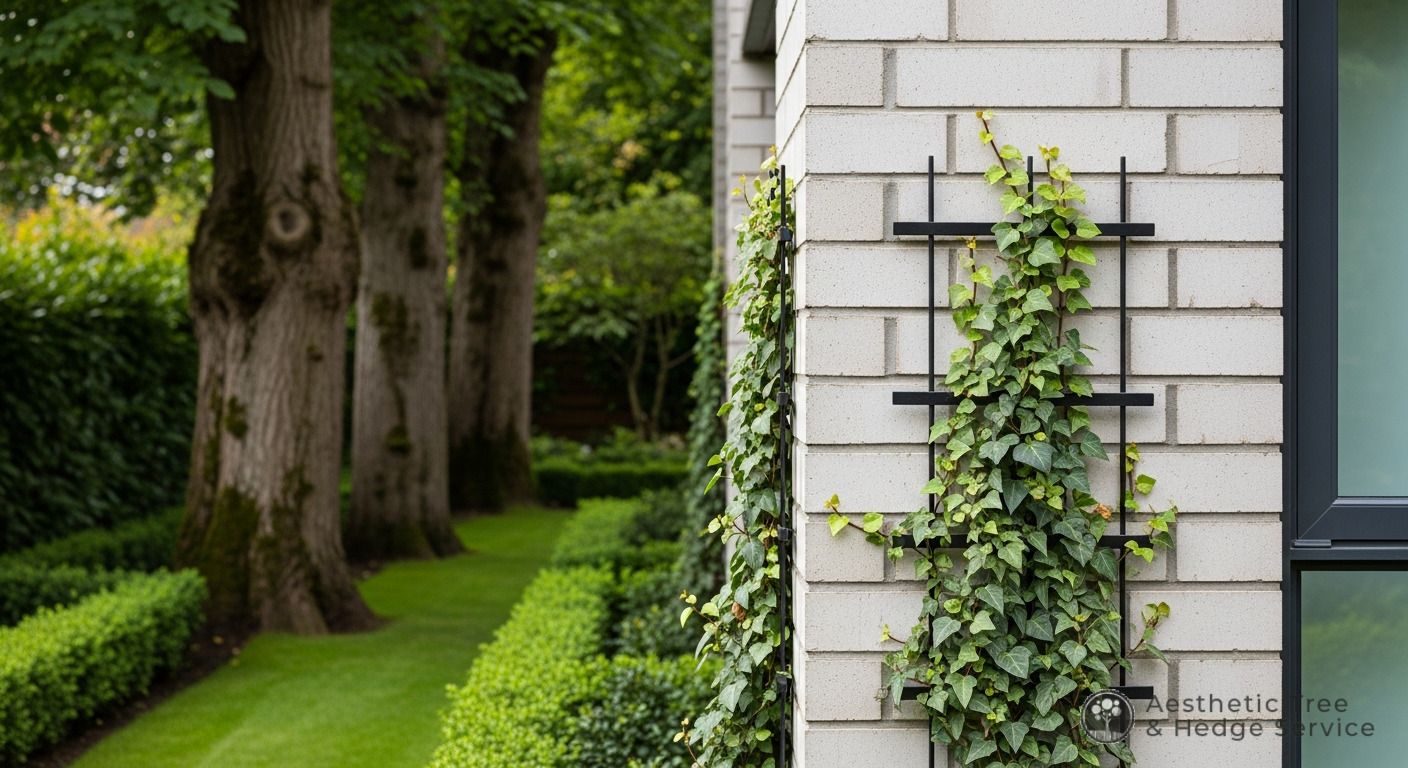
- **Fungal conks:** Shelf-like fungal growth on the trunk or near the base can indicate internal decay.
- **Soil heaving or root plate movement:** Raised soil, cracking ground, or movement around the base can indicate instability.
- **Lean toward a structure:** Ivy plus a lean toward a home, fence, vehicle, or walkway should be assessed promptly.
If you see any of these signs, do not start pulling vines from the canopy. Book a tree assessment first. Aesthetic Tree & Hedge Services provides ISA-certified assessments and WCB-registered tree work across Vancouver, Burnaby, North Vancouver, Richmond, and Coquitlam.
If you need documentation for a property sale, strata council, insurance question, or municipal permit, an arborist report is the right deliverable. It records tree condition, risk factors, and recommended next steps.
---
Tools for Safe Ground-Level Ivy Removal
For lower-trunk ivy removal, most homeowners only need basic tools.
- **Bypass hand pruners** for small green stems
- **Loppers** for thicker woody stems
- **Folding pruning saw** for large established stems
- **Heavy gloves** because ivy can irritate skin
- **Eye protection** for cutting and pulling ground vines
- **Long sleeves** to reduce skin contact
- **Yard bags or disposal bins** for removed plant material
Do not compost ivy at home unless your municipal guidance specifically says the material can be handled that way. Ivy can reroot from fragments. Bagging or municipal green-waste handling is usually safer than leaving cut pieces in a garden bed.
Do not use a ladder to pull ivy from the crown. Ladder work around trees is unstable, and falling vines or branches can shift suddenly. If the work cannot be done from the ground, it is no longer a simple homeowner cleanup.
After the first cut, schedule a follow-up pass. Ivy roots often resprout. Check again after 4 to 6 weeks, then again the following spring.
---
How to Stop Ivy From Growing Back
Removing ivy once is not enough. Regrowth prevention is the difference between a real fix and a temporary cleanup.
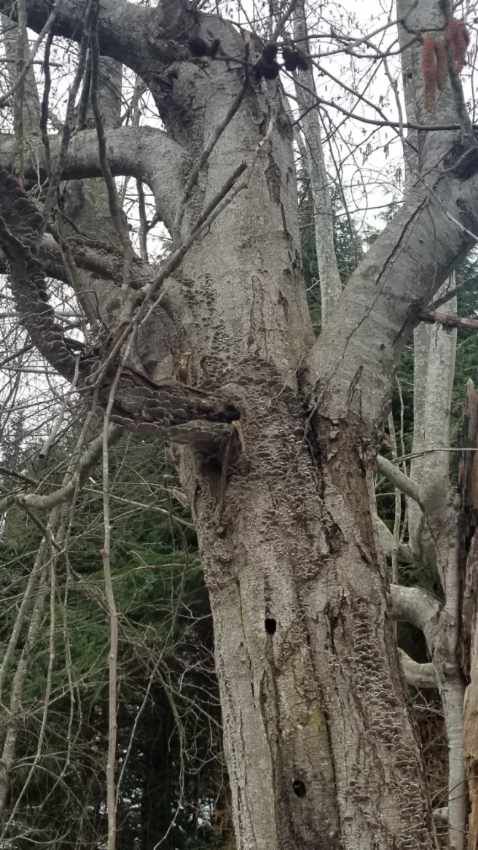
**Keep the root flare clear.** The base of the trunk should stay visible. Do not let ivy, mulch, or soil pile against the bark.
**Use arborist wood-chip mulch.** A 100 to 150 mm layer of wood-chip mulch can suppress ivy regrowth and improve soil conditions. Keep mulch pulled back from the trunk in a wide donut shape.
**Remove new sprouts early.** Young ivy is easy to pull. Established ivy is not. A spring and fall inspection is usually enough to catch new growth before it climbs.
**Replant with appropriate groundcovers.** Bare soil invites ivy back. In many Lower Mainland gardens, native or climate-suitable replacements such as salal, sword fern, sedges, and other shade-tolerant plantings can help occupy the space.
**Address the source.** If ivy is coming from a neighbouring property, fence line, or unmanaged slope, cutting only the trunk growth will not solve the problem. You may need a maintenance strip, root barrier, or neighbour discussion supported by photos and an arborist note.
---
Is It Legal to Remove Ivy in Vancouver Without a Permit?
Removing ivy from your own private-property tree usually does not require a permit.
Tree removal is different.
In Vancouver, protected tree rules can apply when a tree reaches the City's regulated size threshold. If ivy damage means the tree may need to be removed, check the current City of Vancouver tree bylaw requirements before any removal work begins.
Also consider these situations:
**Street trees and park trees:** Do not remove ivy from City-owned trees without authorization. Contact the municipality.
**Neighbouring ivy:** You can generally cut plant growth that crosses onto your property, but you should not enter a neighbour's property or damage their plants without permission.
**Nesting birds:** Tree and hedge work during spring and summer should be approached carefully. If active nests are present, removal may need to wait or be handled under professional guidance.
Burnaby, North Vancouver, Richmond, Coquitlam, and other Lower Mainland municipalities have their own tree protection rules. When in doubt, call the local urban forestry or parks department before cutting.
---
When to Call a Professional Arborist
DIY ivy removal is reasonable when:
1. Ivy is limited to the lower trunk 2. You can work from the ground 3. The tree has no obvious deadwood, fungal growth, lean, cracks, bark wounds, or root movement
Call an ISA-certified arborist when:
- **Ivy has reached the canopy** and removal would require climbing, ladders, or aerial equipment
- **The tree has deadwood or fungal conks** that may indicate decay or structural risk
- **The tree leans toward a house, fence, driveway, walkway, or neighbouring property**
- **You need written documentation** for a strata, real estate file, insurance matter, or municipal permit
- **Tree removal may be required** and local bylaw rules need to be followed
Aesthetic Tree & Hedge Services handles ivy-related tree assessments, pruning, vine removal, hazard review, tree cabling, arborist reports, and tree removal across Vancouver and the surrounding Lower Mainland.
---
FAQ
**Q: Will ivy kill my tree if I leave it alone?**
It can. Heavy ivy coverage can contribute to decline by adding weight, trapping moisture, hiding defects, competing at the root zone, and shading the canopy. The risk is higher when ivy reaches the crown or the tree already has stress or decay.
**Q: Can I pull ivy off the trunk?**
Only from reachable lower areas, and only if it releases easily. Do not pull live ivy from upper trunks or branches. Cut the vine first, let it die, then remove loose sections later.
**Q: How long does cut ivy take to die?**
Most cut ivy begins browning within a few weeks. In cool, wet weather, it may take longer. Wait until it dries and loosens before trying to remove upper sections.
**Q: Can I use herbicide on ivy near a tree?**
Cut-stump herbicide treatment can work, but it should be used carefully and according to the product label. Avoid broadcast spraying around tree roots. If the tree is valuable or close to sensitive planting, ask an arborist or licensed applicator first.
**Q: Is English ivy invasive in BC?**
Yes. English ivy is widely recognized as an invasive plant in British Columbia and is a known problem in coastal urban forests and natural areas.
**Q: What is the difference between DIY ivy removal and arborist ivy removal?**
Ground-level cutting is similar. The difference is risk assessment and work at height. Arborists can identify structural defects, remove canopy vines safely, protect bark, and advise whether pruning, cabling, monitoring, or removal is needed.
---
Get a Free Assessment From Aesthetic Tree
Ivy problems do not fix themselves. A tree that looks manageable now can become a much more expensive problem after a wet winter or windstorm.
Aesthetic Tree & Hedge Services provides ISA-certified arborist assessments across Vancouver, Burnaby, North Vancouver, Richmond, and Coquitlam. We assess ivy damage, document tree risk, and provide vine removal, pruning, tree management, arborist reports, and tree removal where required.
Call for a free estimate: **(604) 721-7370**
ISA-certified arborists. WCB registered.
Related: For more on this, see arborist vancouver dispute: 2026 Tree Guide.
Found this helpful? Follow our tree care insights directly on Google.
Make us your preferred source on GoogleBefore You Go
Where are you in your tree care journey?
Our Tree Care Services
ISA-certified arborists serving Greater Vancouver


Explore Our Tree Care Services
From expert pruning to safe tree removal, our ISA-certified arborists are ready to help across Greater Vancouver.
View Services