
TL;DR — Quick Summary
Vancouver arborists assess and treat tree stress during every season. Learn ISA-certified diagnosis, treatment options, and what happens when stress goes unchecked. Free estimate: (604) 721-7370.
# How Vancouver Arborists Assess and Treat Tree Stress During Every Season
TL;DR
- Vancouver tree stress usually starts before a homeowner sees dead tips, cedar browning, early leaf drop, mushrooms, or a new lean.
- Local stress patterns often follow the seasons: wet winter soils, spring disease pressure, dry summer weather, fall decline signs, and winter wind loading.
- A proper assessment checks the crown, trunk, root flare, soil, drainage, site history, pests, disease signs, and what the tree could hit if it failed.
- Early care may include pruning, soil aeration, mulch correction, irrigation, pest care, cabling review, root-zone protection, or a written arborist report.
- Call right away for sudden lean, lifting roots, fresh trunk cracks, large hanging limbs, or decay near a tree that could strike a home, road, sidewalk, vehicle, or power line.
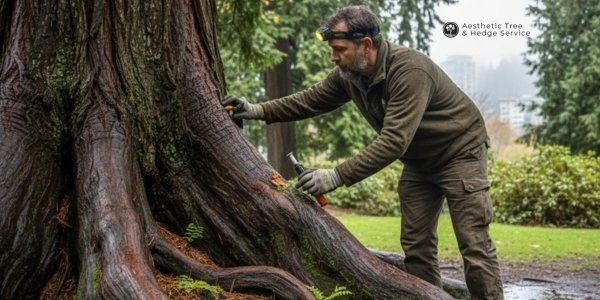
Image suggestion: ISA-certified arborist inspecting the root flare and lower trunk of a mature Vancouver yard tree.
What does tree stress mean for Vancouver trees?
Tree stress is not one bad week. It is a decline process.
In Vancouver, we often see the same pattern. A tree is first weakened by dry summer weather, saturated winter soil, hardscape work, soil compaction, poor pruning, root loss, grade changes, or a damaged root flare. Then a second problem shows up. That may be canker, root decay, boring insects, bark beetle activity, branch dieback, or a limb failure after wind.
By the time a homeowner notices thinning leaves or cedar tips turning brown, the root system may have been under strain for months. In our experience at Aesthetic Tree & Hedge Services, this is common in older Vancouver and Burnaby yards where trees were planted before patios, driveways, fences, sheds, turf, and retaining walls were added around them.
A stressed tree is not always a dying tree. Some trees recover when the cause is found early. Others have already lost too much root function or sound wood. A good arborist assessment separates those two cases.
Local context matters. The City of Vancouver's 2025 Urban Forest Strategy reports about 150,000 street trees, 36,000 specimen trees in golf courses and urban parks, more than 1 million trees across 444 hectares of public forests and woodlands, and a 30% canopy-cover target by 2050. Private trees, street trees, park trees, and shoreline trees all face different forms of stress.
Vancouver is also dense. Statistics Canada's 2021 Census counted 662,248 people in the City of Vancouver and 2,642,825 people in the Vancouver census metropolitan area. More homes, lanes, utilities, driveways, sidewalk work, drainage changes, and root-zone conflicts mean urban trees often grow with less air and water in the root zone than they need.
When Vancouver arborists assess and treat tree stress during each season, they are asking three practical questions:
1. What started the stress? 2. Is the tree still able to recover? 3. Does the tree create a risk that needs prompt action?
How do Vancouver arborists assess tree stress on site?
A real tree assessment is not a quick glance from the driveway. It is a step-by-step inspection of the tree and the site around it.
When our ISA-certified arborists inspect a stressed tree in Vancouver, North Vancouver, Richmond, Coquitlam, Burnaby, or nearby areas, we start with the whole setting. We ask what changed. Was there a new driveway? A trench for drainage? A hedge cut hard in summer? A deck built over roots? A dry year with no slow watering? Did the owner notice mushrooms after fall rain? Did the tree start leaning after a windstorm?
The site history often explains the symptoms.
A full assessment may include species, age class, crown density, branch growth, deadwood amount and location, leaf size and colour, scorch, drop timing, trunk wounds, cracks, seams, cavities, decay signs, root flare depth, root collar health, soil compaction, drainage, mulch depth, turf competition, pest signs, fungal conks, nearby targets, and municipal permit rules if removal may be needed.
We often find that the visible symptom is not the root cause. A cedar hedge may brown after a dry August, but the real issue may be a narrow soil strip between a fence and concrete path. A maple may drop leaves early, but the trigger may be grade changes around the trunk. A birch may show upper-crown dieback, but the underlying stress may be heat and drought that made it more vulnerable to Bronze Birch Borer.
That is why diagnosis comes before treatment. A stressed tree can be harmed by the wrong fix. Heavy live-branch removal can make a low-energy tree worse. Fertilizer can be a poor use of time if the main issue is root decay. Watering helps some trees, but it can worsen problems in a poorly drained site.
For permit, insurance, strata, or development questions, a written arborist report in Vancouver can document the condition, likely stress causes, risk level, and recommended work.
Image suggestion: Close-up of a buried root flare being inspected beside a Vancouver patio or driveway.
What seasonal signs show that a Vancouver tree is under stress?
Tree stress looks different in January than it does in July. Vancouver's seasonal pattern is one reason assessments need local knowledge.
Environment and Climate Change Canada's 1991-2020 climate normals for Vancouver International Airport show a strong wet-dry split. July is typically one of the driest months, with about 35.6 mm of precipitation, while late fall and winter are far wetter. That matters for roots. Many local trees move from saturated soils to summer moisture stress in the same year.
In winter, stress may show as storm damage, cracks, hanging limbs, saturated soil, root plate movement, or fungal growth near the base. We pay close attention to trees that lean over homes, lanes, fences, or sidewalks after heavy rain and wind. A root system already weakened by decay or cutting may move when soil is wet and wind loads the crown.
In spring, we look for delayed bud break, uneven leaf-out, small leaves, dead tips, cankers, and poor shoot growth. A tree can look worse in spring because it is spending stored energy to leaf out. If the roots cannot support that growth, the crown may thin.
In summer, drought stress becomes easier to see. We often see leaf scorch on maples, early drop on cherries, flagging on western red cedar, and dieback on birch. The BC Coroners Service 2022 death review of the 2021 heat dome reported 619 heat-related deaths in British Columbia during June 25 to July 1, 2021, with temperatures above 40 C in parts of the province. That report is about human health, not tree health, but it is a clear record of how severe regional heat can become. Trees in paved yards and narrow planting strips feel that heat too.
In fall, decline may become clearer after the growing season. Some trees colour early because they are shutting down under stress. Mushrooms may appear near the base after rain. Dead branches may stand out once leaves drop. This is a good time to inspect root zones, drainage, deadwood, and structural defects before winter storms.
In our field work, fall and late winter are often the best times to plan non-urgent pruning, soil care, and follow-up inspections. Safety work can happen any time if the tree is a hazard.
What crown symptoms do arborists look for first?
The crown is often where homeowners first notice trouble. It is also where we can read the pattern of decline.
Common crown stress signs include thin canopy compared with nearby trees of the same species, dead tips at branch ends, deadwood in the upper crown, smaller leaves than expected, yellowing, browning, scorched leaf edges, early fall colour, premature leaf drop, sparse growth on one side, short annual shoot growth, and broken, hanging, or rubbing branches.
The pattern matters. Top-down dieback on birch can point toward Bronze Birch Borer or drought stress. One-sided thinning may suggest root loss on that side, past excavation, or a change in drainage. Scorch on exposed maple leaves after a dry spell may be moisture stress. Deadwood over a driveway or sidewalk may need safety pruning even if the rest of the tree is stable.
We also look at the tree's history. A tree may have a thin crown in early spring because of normal timing. Or it may be thin because it has lost roots. A single visit can help, but repeat photos across seasons are often useful. We ask clients to show us older yard photos when they have them. A photo from two or three summers ago can show whether the decline is new or long-running.
Pruning decisions depend on the tree's energy. For stressed trees, we avoid removing too much live canopy. Leaves feed the tree. Heavy live pruning on a weak tree can reduce its ability to recover. When pruning is needed, the goal is to remove dead, broken, diseased, or poorly attached branches while preserving enough live crown.
If branches are dead, storm-broken, or growing into structures, professional tree cutting in Vancouver may be part of the care plan. The key is that cutting should match the diagnosis, not just the symptom.
What root-zone problems cause tree stress in Vancouver yards?
Many tree problems start below ground. Roots need oxygen, water, space, and decent soil structure. In urban yards, those basics are often missing.
In Vancouver, we often see root stress caused by compacted soil from foot traffic, parking, or equipment; patios, pavers, decks, and driveways built over roots; drainage changes that leave soil too wet; new soil piled against the trunk; mulch mounded against bark; turf and irrigation competition; roots cut during trenching; retaining walls built too close to the trunk; fence posts or utility work inside the root zone; and grade cuts that remove fine roots.
The root flare tells us a lot. The flare is where the trunk widens into the major roots. It should be visible. If it is buried by soil or mulch, bark can stay wet and root collar problems can develop. Buried flares can also hide girdling roots, decay, or past grade changes.
In our experience, compacted soil is one of the most missed stress factors in Vancouver yards. A lawn may look tidy, but the soil below may be hard and airless. Fine absorbing roots are often in the upper soil layers. If that layer is compacted or cut, the tree may not take up enough water during dry weather.
Air excavation can help in some cases. It lets an arborist expose the root flare and loosen soil with less root damage than digging with a shovel. Mulch can also help when placed correctly. We usually want a broad mulch ring, not a pile against the trunk. A depth around 7 to 10 cm is often enough. The mulch should be pulled back from the bark.
Root care is not dramatic, but it works when the tree is still viable. Good soil, careful watering, and less compaction can give a stressed tree a chance to rebuild energy.
How does summer drought affect cedars, maples, birches, and cherries?
Dry summer weather is one of the biggest stress triggers for Lower Mainland trees.
Metro Vancouver's Urban Forest Climate Adaptation Framework points to drought tolerance as a key factor in tree species selection for the region's future climate. That matches what we see in the field. Trees that handled past summers may now struggle when their roots are boxed in by hardscape or when they miss deep watering during long dry spells.
Western red cedar often shows stress as flagging. Some inner browning is normal seasonal shedding. Tip browning across large sections of a hedge is different. We see this in cedar hedges along fences, alleys, and south-facing property lines where soil volume is low. A hedge may look fine in May, then turn brown after a hot, dry stretch in August.
Bigleaf maple may show scorched leaf edges, early colour, or leaf drop. Mature maples can also have decay in old wounds. If drought stress and decay are both present, the treatment plan must address both health and structure.
Birch is a classic stress-sensitive tree in urban sites. Drought and heat can make birch more open to Bronze Birch Borer. The Washington State University Urban Forest Health Lab notes that hotter and drier summers have increased Bronze Birch Borer impact on birch decline in the Pacific Northwest. In Vancouver-area yards, we watch for upper-crown thinning, branch dieback, D-shaped exit holes, and poor vigour.
Ornamental cherry trees are common in Vancouver, but they can be sensitive in compacted or dry sites. We look for cankers, dieback, poor wound closure, and stress after hard pruning.
Hedges need their own care plan. A cedar or laurel hedge may need pruning, irrigation changes, and root-zone care, not just a cosmetic trim. For hedges with browning, gaps, or repeated dieback, a professional hedge trimming service in Vancouver can pair shape work with a health check.
Image suggestion: Split image showing normal cedar inner shedding versus drought-related tip browning.
Can construction damage make a tree decline years later?
Yes. This is one of the most common patterns we see.
A tree can be injured during construction and still leaf out for several years. That does not mean it is fine. Trees store energy. They can live on reserves while root function drops. Later, the crown thins, deadwood appears, decay expands, or the tree becomes less stable.
Construction-related stress can come from trenching through roots, cutting roots for a driveway or sidewalk, soil grade changes, heavy equipment on the root zone, concrete washout or chemical spills, new drainage patterns, soil piled against the trunk, storage of materials under the crown, and retaining wall work near structural roots.
Tree roots often extend beyond the dripline. The most important roots are not only the large visible roots. Fine roots in the upper soil absorb much of the water and nutrients. These roots can be lost during shallow scraping, trenching, or soil compaction.
We once assessed a mature maple near a replaced driveway in East Vancouver. The tree still leafed out, so the owner assumed the work had not hurt it. Two summers later, the crown on the driveway side had thinned badly. The root flare also had buried soil from the project. That kind of delayed decline is normal after root loss.
Before digging near a mature tree, it is worth getting a tree protection plan. If work already happened, an arborist can still assess root loss, crown response, and risk. Some trees can be managed with soil care, irrigation, and reduced stress. Others need risk reduction or removal if too many structural roots were cut.
Which pests and diseases are linked to stressed trees in the Lower Mainland?
Pests and diseases often move in after a tree is already weak. That is why treatment must start with the stress cause.
Common concerns include Bronze Birch Borer, Armillaria root disease, canker diseases, bark beetle activity, leaf diseases, and decay fungi. Not every fungus means the tree must come down. Not every insect means treatment is needed. Identification matters.
Bronze Birch Borer attacks stressed birch. Signs may include top-down dieback, thinning leaves, raised ridges in bark, and D-shaped adult exit holes. Water stress is often part of the picture. Treatment is time-sensitive and depends on the tree's condition.
Armillaria root disease can affect many tree species. Honey-coloured mushrooms near the base may be a clue, but a site inspection is needed. Once root decay is advanced, there is no simple spray fix. Care focuses on stress reduction, monitoring, and removal when risk is too high.
Canker diseases affect cherries, maples, and other ornamentals. Cankers may show as sunken bark, dead branches, oozing, or poor wound closure. Pruning can help when timed well and done correctly, but repeated stress often keeps the disease active.
Decay fungi are different from surface mushrooms in a lawn. Fungal conks on the trunk or buttress roots can point to internal decay. We treat that as a structural concern, not just a health concern. The question becomes: how much sound wood remains, where is the decay, and what could the tree hit?
For suspected regulated pests or unusual symptoms, an arborist may advise checking provincial or federal guidance before moving wood or plant material. This is especially important when a pest could spread through firewood, chips, or nursery stock.
How do arborists treat stressed trees without making the damage worse?
The best treatment depends on diagnosis. There is no single fix for tree stress.
A treatment plan may include deadwood removal, conservative structural pruning, soil aeration, root flare excavation, mulch correction, deep watering, soil amendment where suitable, pest or disease treatment, cabling or bracing for select structural defects, tree protection during construction, follow-up inspection, or removal if the tree is beyond recovery or unsafe.
Pruning is one of the most common treatments, but it must be careful. The ANSI A300 tree care standards, published through the Tree Care Industry Association, set accepted practices for pruning and other tree work. In simple terms, topping, flush cuts, and heavy interior stripping can harm trees. Good pruning respects branch collars, tree structure, and species response.
Soil care is often the quiet fix. We may recommend opening compacted soil, exposing a buried flare, adding a wider mulch area, or changing irrigation. These steps do not look as dramatic as cutting, but they address root stress.
Watering is also species- and site-specific. Many trees do not need daily watering. They need slow, deep watering during dry periods. A shallow spray on turf may not reach enough roots. Young trees, birches, cedars, cherries, and trees with recent root disturbance often need closer summer attention.
Cabling can help some trees with weak unions or heavy limbs. It does not make a tree risk-free. It reduces movement or load at a known defect and must be inspected over time.
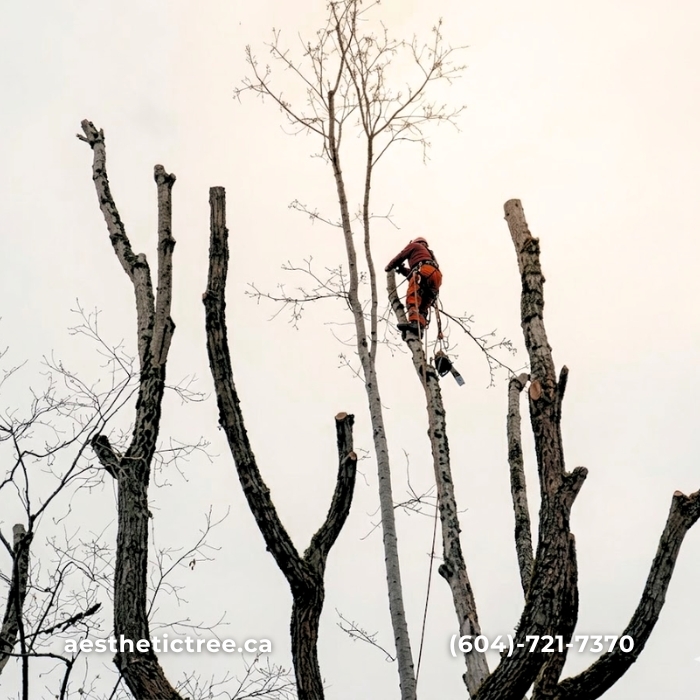
Removal is the right call when the tree cannot be made reasonably safe or has no realistic path to recovery. If the tree is near a building, lane, road, or power line, planned tree removal in Vancouver is usually safer than waiting for a failure. If a stump remains after removal, stump grinding in Vancouver can help clear the site for replanting, turf, or a safer walking area.
When is tree stress an emergency in Vancouver?
Not every stressed tree is an emergency. Some trees need monitoring or scheduled care. Others need same-day action.
Call for urgent help if you see a sudden lean, roots lifting on one side, fresh cracks in the trunk or major limbs, a large broken limb hanging in the crown, splitting sounds during wind, a tree pressing into a home or service line, a large cavity with new cracking, mushrooms near the base plus lean or crown imbalance, or a tree partly failed after snow, rain, or wind.
These are risk signs. The concern is not only whether the tree is stressed. The concern is what happens if part or all of it fails.
The City of Vancouver's Protection of Trees By-law says a permit is needed to remove a private-property tree with a diameter of 20 cm or greater, measured 1.4 m above ground. Emergency work and permit rules can vary by situation and municipality, so it is best to confirm before non-urgent removal. Burnaby, Richmond, North Vancouver, Coquitlam, West Vancouver, and other cities have their own rules.
If a tree or large limb has failed and there is a risk to people or property, contact a qualified crew. Aesthetic Tree & Hedge Services provides emergency tree service for dangerous limbs, storm damage, and urgent tree hazards in the Vancouver area.
Do not stand under a hung limb. Do not try to pull a large limb down with a rope. Do not cut a storm-damaged tree under tension unless you are trained for that work. Wind-thrown and split trees can move suddenly when cut.
Image suggestion: Storm-damaged limb suspended over a driveway, with a caption explaining why homeowners should not cut it themselves.
When should a stressed tree be removed instead of treated?
Removal is not the first choice when a tree can recover and risk is low. It is the right choice when the defect, decay, root loss, or decline has passed a practical limit.
An arborist may recommend removal when root decay is advanced, the root plate is moving, the trunk has major decay with high target risk, large structural roots were cut, the crown is mostly dead, a severe lean has developed, a major union is splitting, the tree is too close to a high-use target, treatment would not restore health or reduce risk enough, or the tree is protected but meets municipal removal criteria.
We explain this with plain language on site. A tree with dead tips over a lawn is different from a decayed tree leaning over a bedroom. Risk depends on the defect, the tree size, the chance of failure, and the likely consequence.
A written report can help when strata councils, neighbours, insurers, or municipalities are involved. It creates a record of the observed condition and the reason for the recommendation. This is useful when a tree looks green but has root or trunk defects that are not obvious from the street.
If removal is needed, it should be planned around access, targets, rigging, disposal, permits, and replacement planting where required. For regulated trees, do not assume you can remove first and explain later. Confirm the rule for your municipality.
How can homeowners reduce tree stress before the next season?
The best time to reduce stress is before the tree shows major decline.
Homeowners can help by protecting the root zone and watching seasonal patterns. Keep heavy materials, parked vehicles, and equipment off the soil under mature trees. Avoid trenching near trunks. Do not pile soil or mulch against bark. Water deeply during dry spells when the species and site need it. Prune at the right time and avoid topping.
In late winter, look for broken limbs, cracks, hanging branches, and lean after storms. Schedule pruning before spring growth if the tree needs structural work and the timing suits the species.
In spring, watch leaf-out. Delayed bud break, small leaves, or dead tips can signal stress from the prior year. This is a good time to plan soil care and pest monitoring.
In summer, water young trees and drought-sensitive species during long dry periods. Check cedars, birches, cherries, and maples for scorch, flagging, and early leaf drop.
In fall, look for mushrooms near the base, early colour, and deadwood. This is a strong season for assessment because symptoms are visible and winter storms are ahead.
In any season, document changes. Take photos from the same angle every few months. Tell your arborist what changed on the property. Site history often saves time and leads to a better recommendation.
What should a Vancouver arborist report include for a stressed tree?
A useful arborist report should be clear enough for a homeowner, strata, municipality, or insurer to understand.
It should identify the tree, species, approximate size, location, condition, visible defects, likely stress factors, risk concerns, and recommended work. It should also state whether more investigation is needed.
For stressed trees, a report may include tree species and size, diameter at breast height where needed, crown condition, trunk and root flare findings, soil and site conditions, pest or disease signs, photos, risk notes, treatment options, removal rationale if needed, permit notes, and a reinspection timeline.
The International Society of Arboriculture's tree risk process looks at likelihood of failure, likelihood of impact, and consequences. In plain terms, a tree with a defect over a busy sidewalk is treated differently from a similar tree over a low-use garden bed.
Reports are not only for removals. They can support preservation. We often prepare reports that recommend root-zone protection, pruning, watering, and monitoring so a tree can remain safely on site.
Which sources and standards support this tree stress guide?
This guide is based on field experience from Aesthetic Tree & Hedge Services and current public sources that relate to Vancouver tree care, climate, bylaws, and arboricultural practice.
Key sources include the City of Vancouver 2025 Urban Forest Strategy, the City of Vancouver 2022 Tree Canopy Assessment and Urban Forest Strategy material, Statistics Canada's 2021 Census, Environment and Climate Change Canada's 1991-2020 Canadian Climate Normals for Vancouver International Airport, the BC Coroners Service 2022 Extreme Heat Death Review Panel Report, the City of Vancouver Protection of Trees By-law 9958, Tree Care Industry Association ANSI A300 Tree Care Standards, Metro Vancouver's Urban Forest Climate Adaptation Framework, and Washington State University Urban Forest Health Lab information on Bronze Birch Borer and heat-related birch decline in the Pacific Northwest.
FAQ
How often should Vancouver homeowners have stressed trees assessed?
For mature trees near homes, driveways, roads, sidewalks, play areas, or service lines, an annual inspection is a good baseline. Also book an assessment after major wind, heavy snow, nearby construction, sudden lean, root cutting, new cracks, or fast crown decline.
Can a stressed Vancouver tree recover?
Yes, some can. Recovery depends on the cause, species, root condition, crown loss, decay level, and site conditions. A tree stressed by compaction or dry soil may improve with root-zone care and watering. A tree with advanced root decay or a failing trunk may not be a good treatment candidate.
What is the fastest warning sign that a stressed tree may be unsafe?
Sudden lean, lifting roots, fresh trunk cracks, and large hanging limbs are urgent signs. Mushrooms near the base can also be serious when paired with lean, canopy imbalance, or dieback. If people, homes, cars, or sidewalks are within the fall zone, treat it as urgent.
Do cedar hedges turn brown from normal shedding or stress?
Both are possible. Some inner browning is normal as cedars shed older foliage. Browning at branch tips, large dead patches, thinning tops, or repeated summer decline may point to drought stress, root restriction, poor pruning, disease, or soil problems. A hedge health assessment can separate normal seasonal change from decline.
Do I need a permit to remove a stressed tree in Vancouver?
Often, yes. The City of Vancouver requires a permit to remove a private-property tree with a diameter of 20 cm or greater measured 1.4 m above ground. Other Lower Mainland cities have their own rules. Always confirm local requirements before removal unless there is an immediate safety issue that requires emergency action.
Is fertilizer enough to fix tree stress?
Not always. Fertilizer only helps when nutrient limits or low vigour are part of the problem. It will not fix root decay, severe compaction, poor drainage, major root cutting, or structural failure. Diagnosis should come first.
What is the best season to treat tree stress in Vancouver?
It depends on the issue. Soil care and planting work often fit spring or fall. Pruning timing depends on species, condition, and risk. Pest treatments depend on the pest's life cycle. Emergency work should happen when the hazard is found, no matter the season.
How is a tree health assessment different from a tree risk assessment?
A health assessment asks why the tree is declining and whether it can recover. A risk assessment asks how likely the tree or a part of it is to fail, what it could hit, and how severe the result could be. Many stressed trees need both questions answered.
How can Aesthetic Tree & Hedge Services help with stressed trees in Vancouver?
Aesthetic Tree & Hedge Services assesses stressed and declining trees across Vancouver, Burnaby, North Vancouver, Richmond, Coquitlam, and nearby Lower Mainland communities.
Our arborists inspect crowns, trunks, root flares, soil conditions, pests, disease signs, construction damage, storm damage, and safety concerns. We can recommend pruning, hedge care, soil improvement, watering changes, cabling review, written reports, removal, stump grinding, or emergency work when needed.
For a tree that is thinning, leaning, dropping leaves early, showing mushrooms at the base, or turning brown after summer heat, book an assessment before the next season makes the problem worse.
Found this helpful? Follow our tree care insights directly on Google.
Make us your preferred source on GoogleBefore You Go
Where are you in your tree care journey?
Our Tree Care Services
ISA-certified arborists serving Greater Vancouver


Explore Our Tree Care Services
From expert pruning to safe tree removal, our ISA-certified arborists are ready to help across Greater Vancouver.
View Services