
TL;DR — Quick Summary
wildfire recovery new city policies changing tree rules in Vancouver. Learn permits, FireSmart pruning, risk work, and arborist steps.
Wildfire recovery and new city tree policies are changing how Vancouver homeowners need to think about tree care.
For years, the question felt simple: is the tree dead, dangerous, or in the way?
Today, the decision is more layered. Does the tree support canopy cover? Is it creating fuel near the house? Is it protected by a local bylaw? Will the city require replacement planting? Does pruning follow ANSI A300 standards? Is an arborist report needed before removal?
That is the practical reality for homeowners in Vancouver and the Lower Mainland.
Wildfire risk is no longer only an Interior BC issue. Smoke, drought, heat, wind, and dense urban growth now affect how cities talk about trees. Vancouver wants more canopy. FireSmart BC asks homeowners to reduce combustible material near structures. On many properties, those two goals meet in the same yard.
At Aesthetic Tree & Hedge Services, we see this tension during real site visits. A cedar may shade the house but hold dead limbs over the roof. A Douglas fir may give privacy while shrubs underneath create ladder fuel. A Big-leaf maple may cool the street while decay at the root flare changes its risk profile.
The answer is not to cut every tree. It is not to save every tree either. The right answer is inspection, documentation, proper pruning, permits where required, and sound arborist judgment.
TL;DR
- BC’s 2023 wildfire season burned more than 2.84 million hectares, according to BC Wildfire Service data.
- Vancouver’s 2025 Urban Forest Strategy reports about 25% canopy cover and sets a 30% canopy target for 2050.
- Vancouver generally requires a permit to remove private trees 20 cm or greater in diameter, measured 1.4 metres above grade, under Protection of Trees By-law 9958.
- FireSmart BC divides the Home Ignition Zone into 0 to 1.5 metres, 1.5 to 10 metres, and 10 to 30 metres.
- If a protected tree may need removal, start with an arborist report in Vancouver before cutting.
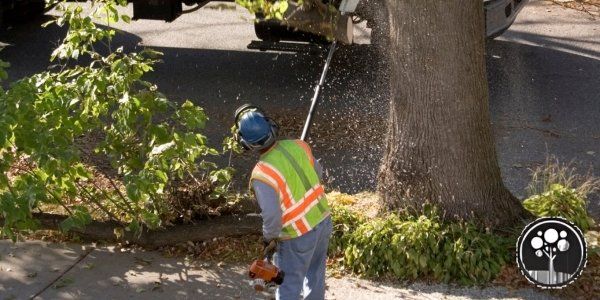
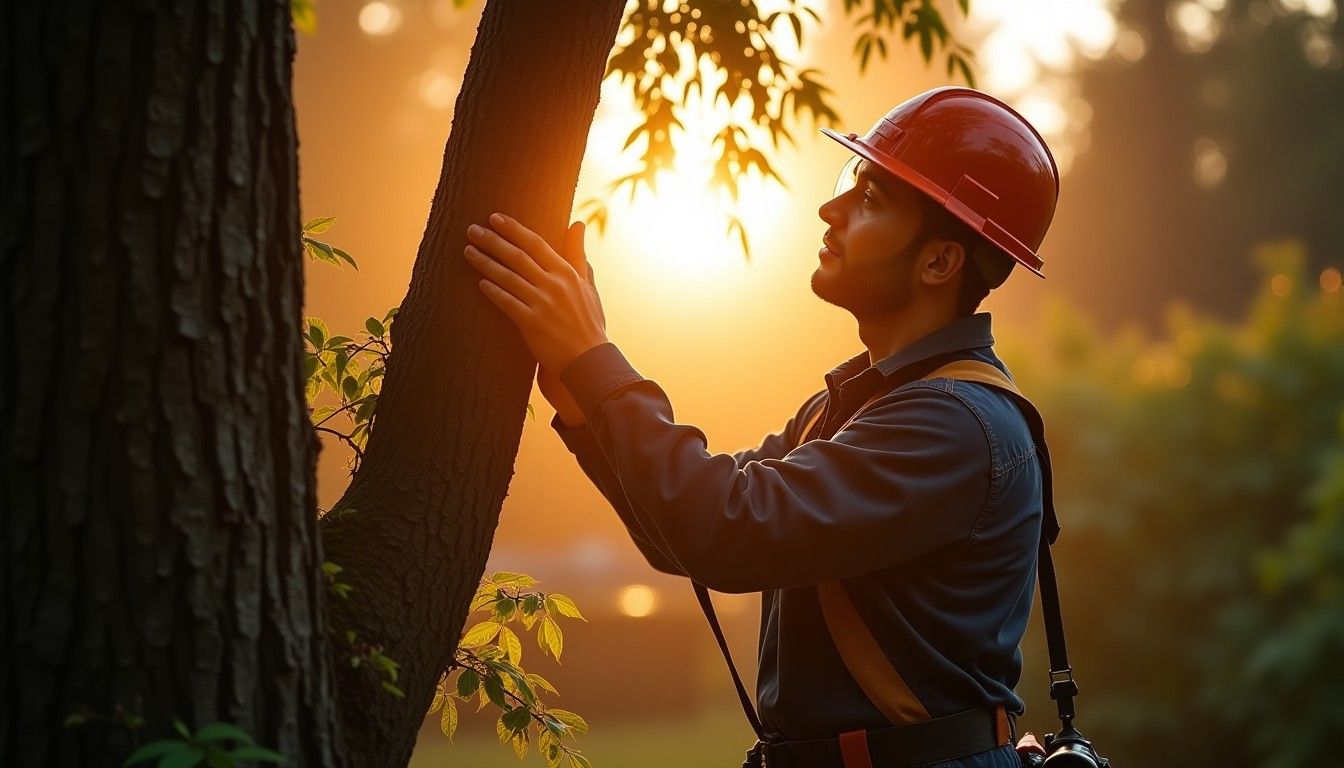
- Suggested image: ISA-certified arborist inspecting a cedar or fir near a Vancouver home, with caption explaining permit and FireSmart assessment.
Why Wildfire Recovery Is Changing Tree Care in Vancouver
Wildfire recovery is changing tree care because fire, heat, and drought are now part of urban tree risk planning.
According to the BC Wildfire Service, 2,245 wildfires burned more than 2.84 million hectares in British Columbia during the 2023 season. At the national level, Canada’s 2023 wildfire season burned about 18.5 million hectares, making it the largest recorded wildfire season in modern Canadian records.
Those numbers changed the conversation. Municipal tree rules are still local bylaws, but homeowners now have to think about three connected issues:
- protecting healthy urban canopy
- reducing fuel near homes
- documenting tree risk before removal or major pruning
Vancouver’s 2025 Urban Forest Strategy says the city has about 25% canopy cover and a 30% canopy target for 2050. The city also reports roughly 150,000 street trees, 36,000 specimen trees in parks and golf courses, and more than 1 million trees in public forests and woodlands.
That is a major public asset. It also needs professional care when trees become drought-stressed, damaged, overcrowded, topped, or poorly pruned.
In the field, high-risk trees are not always obvious from the sidewalk. A cedar can look green on the outside and have dead interior growth. A maple can leaf out while decay is active near the base. A fir can stand straight while old storm damage or root movement changes the risk.
That is why documentation matters. Cities want permit records. Insurers may ask for proof. Homeowners need clear advice before they approve cutting.
What New City Tree Policies Mean for Homeowners
New city tree policies mean homeowners should treat tree work as regulated risk work, not ordinary yard cleanup.
In Vancouver, Protection of Trees By-law 9958 requires a permit to remove most private trees with a diameter of 20 cm or greater, measured 1.4 metres above the ground. That measurement is DBH, or diameter at breast height.
Many municipalities also require replacement planting after an approved removal. Replacement tree species, size, and location can matter. In some cases, a replacement tree becomes protected later.
The reason for removal also matters. “I do not like the needles” is different from an ISA-certified arborist documenting root decay, stem defects, severe dieback, or target risk.
Rules vary across the Lower Mainland. Burnaby, North Vancouver, West Vancouver, Richmond, Coquitlam, and Surrey do not all use the same thresholds or permit process. Strata rules, development permits, covenants, and replacement-tree conditions can add more layers.
The practical lesson is simple: do not copy a rule from one city to another.
Aesthetic Tree & Hedge Services checks the local bylaw before recommending major work. If removal may be needed, start with tree removal in Vancouver only after the tree, site, and permit path are clear.
Good arboriculture now leaves a paper trail.
How FireSmart BC Changes Tree Care Near Homes
FireSmart BC changes tree care by focusing attention on distance from the home.
The Home Ignition Zone has three main areas:
- Immediate Zone: 0 to 1.5 metres from the home and attached structures
- Intermediate Zone: 1.5 to 10 metres from the home
- Extended Zone: 10 to 30 metres from the home
The first 1.5 metres is the most important zone. FireSmart BC recommends a non-combustible area next to the house. That means no dry needles, woody shrubs, bark mulch, leaves, or stored debris against siding, decks, or attachments.
The 1.5 to 10 metre zone is where many Vancouver yards need careful work. Trees often stand close to homes. Cedars may overhang roofs. Hedges may run tight against fences. Shrubs can connect ground fuel to tree crowns.
The 10 to 30 metre zone is about spacing, surface debris, crown condition, and access. It matters most on larger lots in areas such as West Vancouver, North Vancouver, Coquitlam, Port Moody, and the edge of Burnaby Mountain.
FireSmart work is not clear-cutting. It often means pruning deadwood, lifting low branches where appropriate, separating shrubs from tree crowns, removing cedar debris from roofs and gutters, thinning congested hedges, and moving firewood away from structures.
The arborist’s job is to reduce fuel without damaging tree health. Topping, over-thinning, and poor cuts can create decay, weak regrowth, and future failure points.
ANSI A300 standards matter because they give pruning work a professional framework. The goal is controlled risk reduction, not random branch removal.
Can You Remove a Tree for Wildfire Risk in Vancouver?
You can remove a tree for wildfire risk only when the facts support removal and the bylaw allows it.
Wildfire concern does not automatically override tree protection rules. If the tree is protected, the city will usually expect an application unless there is an immediate emergency hazard.
A proper assessment looks at species, DBH, crown condition, stem defects, root flare, lean, target area, soil conditions, and nearby structures. The arborist should also ask whether pruning or fuel reduction can lower the risk enough without removal.
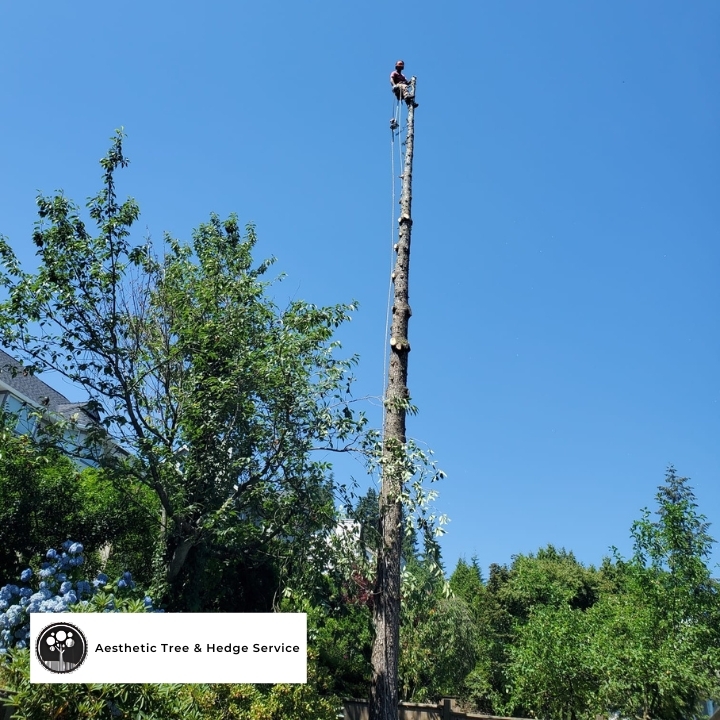
Removal becomes more likely when a tree has serious defects such as advanced root rot, major stem decay, dead tops, cracked unions, failed scaffold limbs, root plate movement, fire damage at the base, or repeated limb failures over a target.
A tall Douglas fir is not automatically unsafe. A cedar is not unsafe simply because it sheds. A Big-leaf maple is not unsafe because leaves clog gutters.
Risk depends on condition and target.
If removal is justified, the permit package should include measurements, photos, and a clear arborist recommendation. Cities respond better to evidence than fear.
If a tree is removed, the stump may also need planning. Old stumps can interfere with replacement planting and yard recovery. Ask about stump grinding in Vancouver during the same planning stage.
Why Arborist Reports Matter More Now
Arborist reports matter more because tree decisions increasingly need evidence.
A useful arborist report can include species, DBH, location, health rating, structural condition, visible defects, target risk, bylaw context, photos, recommendations, and replacement notes.
In Vancouver and North Vancouver, reports often support permit applications. In Burnaby and Coquitlam, they can help clarify protected-tree status, development conflicts, and hazard claims. In strata settings, they help councils make decisions owners can understand.
Reports are also useful after drought, heat, smoke, fire exposure, or storms. A tree can survive one stressful season and decline the next. Cedar flagging, maple scorch, crown thinning, and root problems often appear later.
Aesthetic Tree & Hedge Services uses assessment to separate trees into three practical groups:
- trees to retain and monitor
- trees to prune, cable, or otherwise manage
- trees to remove with permit support
Tree cabling can help in select cases, especially weak unions with enough sound wood and a clear target. It is not a cure for decay, but it can be part of a retention plan when removal is not the best first answer.
The report turns opinion into a record.
Species That Raise the Biggest Questions
The biggest wildfire and recovery questions in Metro Vancouver often involve cedar, Douglas fir, spruce, pine, maple, and laurel hedges.
Western red cedar is common and drought-sensitive. Browning, thinning, and dry interior material can raise concern, especially near homes. That does not mean every cedar hedge should be removed. It means the hedge needs inspection, cleaning, spacing, and correct pruning.
Douglas fir is strong when healthy, but it can carry large limbs over homes, lanes, and driveways. After drought, root disturbance, or grade changes, firs deserve careful assessment.
Big-leaf maple grows fast and can form heavy limbs. Included bark, decay pockets, and poor unions can increase failure risk.
Spruce and pine vary by site. Dead lower branches, resin, dry needles, and tight spacing can add fuel near structures.
Laurel hedges are not trees, but they matter in Vancouver yards. Dense hedges can hold dry leaves, block access, and crowd fences or structures. Proper hedge trimming in Vancouver keeps growth controlled without stripping the plant bare.
Species is only the starting point. Site conditions decide the real risk.
How Heat, Drought, and Smoke Affect Urban Trees
Heat, drought, and smoke affect urban trees by adding stress before damage is obvious.
Vancouver’s Urban Forest Strategy connects canopy to heat protection and notes that lower-canopy areas face higher heat stress. Trees help cool streets, but stressed trees can also become more vulnerable to pests, decay, dieback, and limb failure.
Drought affects fine absorbing roots first. A crown may stay green for a while, then begin to thin. Cedars may brown. Maples may scorch. Young replacement trees often fail if watering stops too soon.
Homeowners should watch for early leaf drop, dead branch tips, thinning upper crowns, cracked soil, sudden browning on one side, mushrooms near the trunk, bark splitting, fungal brackets, and repeated limb drop in calm weather.
Do not wait until a tree is obviously dead. Dead trees can be more brittle and more dangerous to remove, especially in tight Vancouver lots.
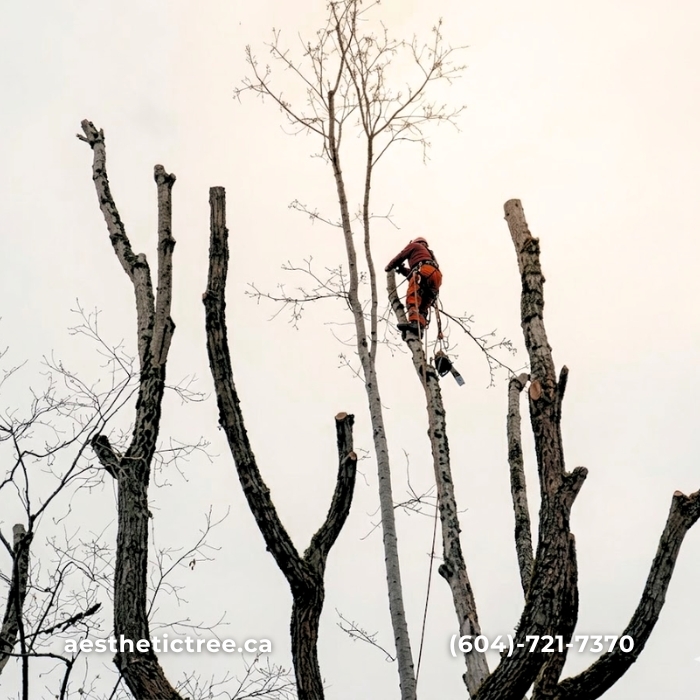
After a hot summer, schedule inspection before winter wind. If a tree fails during a storm, emergency tree service should focus on safety, access, and damage control first.
What To Do Before Cutting a Tree
Before cutting, identify the city and bylaw. Vancouver, Burnaby, Richmond, North Vancouver, West Vancouver, Coquitlam, and Surrey do not share one rulebook.
Next, measure DBH at 1.4 metres above grade. If the tree has multiple stems, the rule may be more complicated.
Then check whether the tree is protected for another reason. Replacement trees, development permit trees, covenant trees, heritage trees, and strata-controlled trees may have extra restrictions.
After that, assess the target. A tree over a house, garage, lane, sidewalk, service line, neighbour’s property, or parked car carries different risk than a tree in an open yard.
Finally, call an ISA-certified arborist before major cuts.
Poor pruning can make a tree less stable. Large limb removal creates decay entry points. Over-lifting changes wind load. Topping creates weak sprouts.
A good tree plan answers four questions:
- Can the tree be retained?
- Does it need pruning?
- Does it need removal?
- Does the city require a permit or replacement tree?
Cleanup matters too. Dry limbs, hedge waste, cedar debris, and stump grindings should be handled as part of the recovery plan.
Reducing Wildfire Risk Without Losing Canopy
You reduce wildfire risk without losing healthy canopy by working from the house outward.
Start at the structure. Clear needles from roofs and gutters. Remove dry leaves beside siding. Keep the first 1.5 metres around the home free of woody fuel. Check under decks. Move firewood away from walls. Avoid combustible mulch against the house.
Then move through the yard. Remove deadwood. Prune low branches where appropriate. Separate shrub layers from tree crowns. Thin crowded hedge interiors. Remove dead shrubs. Keep grass and weeds controlled.
Then assess the canopy. Healthy trees cool the property, shade pavement, slow runoff, and support Vancouver’s canopy goals. The goal is not bare ground. The goal is a yard where fire has fewer paths to the structure.
Mulching can still support tree health when used correctly. It helps protect roots and hold moisture, but combustible mulch should not sit in the immediate zone against the home.
Canopy and fire safety are not enemies. Poor planning makes them enemies.
What Cities Are Trying to Protect
Cities are trying to protect canopy, shade, safety, stormwater function, biodiversity, and public trust.
That is why tree bylaws can feel stricter than homeowners expect.
A mature tree removed without cause is a public loss. A dangerous tree retained without inspection is a private risk. A topped tree can become both.
The best result is selective work. Keep trees that can be kept. Prune trees that need pruning. Remove trees that are unsafe, dead, or unsuitable. Replant species that fit the site. Water young trees through establishment. Keep records.
That is practical tree care.
When To Call an Arborist
Call an arborist when a tree has both a target and a defect.
A target is anything the tree can hit. A defect is anything that changes strength, structure, or health.
Call before waiting if you see dead limbs over a roof or driveway, cracks in the trunk, mushrooms at the base, fresh lean after wind, lifted soil near roots, sudden crown thinning, bark loss after heat or fire exposure, hanging broken limbs, hedge sections browning near the house, or roots cut during construction.
Also call before renovations. Decks, fences, driveways, additions, and drain work can injure roots. The tree may not decline until months later.
Call before listing a home if major trees sit close to the house. Buyers, inspectors, and insurers may ask about risk.
Aesthetic Tree & Hedge Services is ISA-certified and WCB registered. For large removals near homes, lanes, or tight access, crane tree removal may reduce impact when the site calls for it.
Replanting After Removing a High-Risk Tree
Replanting should match the site, the bylaw, and the future climate.
Many cities require replacement trees after approved removal. Even when they do not, replanting often makes sense. A removed tree leaves a shade gap, changes privacy, increases heat, and affects stormwater.
Good replacement starts with space. Do not plant a large tree under service wires. Do not plant a water-hungry tree in a dry compacted strip. Do not plant too close to foundations, drains, or retaining walls.
Species choice matters. Depending on the site, Vancouver yards may suit maples, dogwoods, oaks, magnolias, serviceberries, or other climate-appropriate trees. Native species can be excellent, but they are not automatically the right choice for every tight urban lot.
Planting detail matters too. The root flare should sit at grade. The hole should be wide, not deep. Mulch should stay off the trunk. Staking should not strangle the tree. Watering must continue through establishment.
Tree planting should be treated as arboricultural work, not decoration.
The best replacement tree is the one that survives year five.
FAQ
Do I need a permit to remove a tree in Vancouver?
Yes, in many cases. Under Vancouver’s Protection of Trees By-law 9958, a permit is generally required to remove a private tree with a diameter of 20 cm or greater, measured 1.4 metres above ground. Some smaller trees may also be protected if they are replacement trees or tied to development approvals.
Does wildfire risk let me remove a protected tree without approval?
No. Wildfire risk does not automatically remove permit duties. If a tree is protected, the city usually expects an application unless there is an immediate emergency hazard. An ISA-certified arborist can document defects, target risk, and FireSmart concerns.
What is the most important FireSmart tree step near a house?
Start with the first 1.5 metres around the home. FireSmart BC identifies this as the Immediate Zone. Keep it non-combustible by removing dry needles, woody shrubs, bark mulch, leaves, and debris beside walls, decks, and attachments.
Should I remove cedar hedges because of wildfire risk?
Not always. Cedar hedges need inspection. Dense, dry, neglected hedges beside homes can raise fuel risk. Healthy, maintained hedges set away from structures are different. Correct pruning, debris removal, spacing, or partial replacement may solve the issue.
Who should I call for tree policy, wildfire recovery, and hazard work?
Call Aesthetic Tree & Hedge Services for a free estimate at (604) 721-7370. Our ISA-certified arborists are WCB registered and assess tree risk, permit needs, pruning options, removals, stumps, hedges, and recovery planting across Vancouver and the Lower Mainland.
Related: For more on this, see Arborist Report Cost Vancouver.
Related: For more on this, see Tree Removal Coquitlam Bylaw Facts.
Found this helpful? Follow our tree care insights directly on Google.
Make us your preferred source on GoogleBefore You Go
Where are you in your tree care journey?
Our Tree Care Services
ISA-certified arborists serving Greater Vancouver


Explore Our Tree Care Services
From expert pruning to safe tree removal, our ISA-certified arborists are ready to help across Greater Vancouver.
View Services