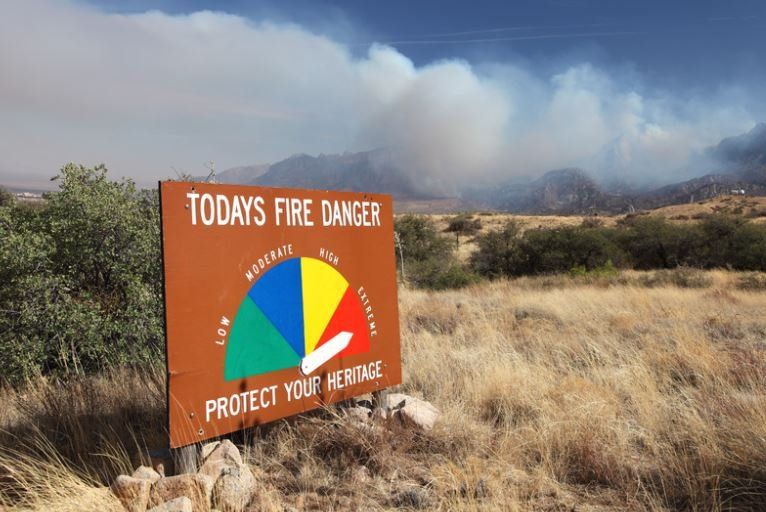

TL;DR — Quick Summary
keeping trees property safe wildfire threats vancouver starts with smart pruning, removals, and FireSmart yard work. Call for a free estimate.
keeping trees property safe wildfire threats vancouver starts with one blunt truth: your trees don’t have to be removed to reduce wildfire risk.
They do have to be managed.
That means deadwood out. Cedar hedges checked. Lower branches lifted where appropriate. Tree crowns separated from roofs. Stumps and woody debris removed. Permits handled before any protected tree comes down.
In Vancouver, Burnaby, North Vancouver, Richmond, Coquitlam, and the Lower Mainland, wildfire risk is no longer a far-away Interior problem. Smoke reaches the coast. Dry summers stress trees. Wind moves embers fast. Dense urban lots give fire more places to catch.
Aesthetic Tree & Hedge Services helps homeowners reduce tree hazards without panic cutting. Our ISA-certified arborists assess the tree, the structure, the bylaw, and the real risk.
TL;DR
- Wildfire risk around homes often starts with embers, not a wall of flame. FireSmart BC says embers alone can account for up to 90% of home and building ignitions in wildfire events.
- FireSmart BC’s Home Ignition Zone focuses on 0 to 1.5 metres, 1.5 to 10 metres, and 10 to 30 metres from the home. Tree work should follow those zones.
- Vancouver requires a permit to remove private trees 20 cm or greater in diameter, measured 1.4 metres above grade. Replacement trees are usually required when a removed tree is larger than 20 cm.
- Cedar hedges, ladder fuels, dead branches, bark mulch, stumps, and dry woody debris raise risk near structures.
- Call Aesthetic Tree & Hedge Services for a free estimate at (604) 721-7370. We’re ISA-certified and WCB registered.
Why should Vancouver homeowners care about wildfire risk around trees?
Because wildfire risk has moved into normal homeowner planning.
Not fear. Not drama. Planning.
According to the BC Wildfire Service’s 2024 wildfire season summary for 2023, British Columbia recorded 2,245 wildfires between April 1 and October 31, 2023. Those fires burned more than 2.84 million hectares of forest and land. BC Wildfire Service called it the most destructive wildfire season in the province’s recorded history.
That number matters in Vancouver even when the fire isn’t on your block.
Smoke moves. Drought stress builds. Trees weaken. Branches die back. Cedar hedges dry out. Deadwood sits in crowns until wind, heat, or snow brings it down.
Metro Vancouver is not the Cariboo. But it is full of homes pressed against trees, slopes, ravines, lanes, fences, sheds, decks, and older hedges. That mix matters.
The City of Vancouver reported in its 2025 Urban Forest Strategy that Vancouver has 25% canopy cover and a target of 30% by 2050. The goal is not fewer trees. The goal is healthier, safer trees.
Metro Vancouver’s 2020 regional tree canopy reporting also found that canopy cover decreased by 1% between 2014 and 2020 across the region, within the Urban Containment Boundary, and in the Regional Core.
So the job is not to strip properties bare.
The job is to manage fuel, defects, clearance, and tree health.
That’s arborist work.
What makes trees a wildfire threat on a Vancouver property?
A tree becomes a wildfire threat when it gives fire an easy path.
That path can be vertical. Grass to shrub. Shrub to hedge. Hedge to low branches. Low branches to crown. Crown to roof.
Arborists call that ladder fuel.
A tree can also create horizontal fuel. Branches touching the roof. A cedar hedge tight against siding. A dead limb over a deck. A dry stump beside a fence. Bark mulch running right to the house.
The risk is highest when tree material is dry, dead, dense, or too close to the structure.
Watch for these signs:
- Dead branches in Douglas fir, cedar, spruce, pine, or Big-leaf maple
- Branches touching shingles, gutters, siding, decks, or chimney areas
- Cedar hedges tight to fences, sheds, garages, or houses
- Old stumps and exposed roots collecting dry debris
- Ivy climbing trees or fences near structures
- Thick lower limbs that connect shrubs to the tree crown
- Conifer needles packed in gutters or roof valleys
- Cracked trunks, included bark, fungal growth, or root flare damage
- Dense trees with no airflow through the crown
In our field work, the most common issue is not one giant tree leaning at the house.
It’s the chain.
Dry hedge. Dead branch. Full gutter. Bark mulch. Wood pile. Shed. Fence. Roofline.
Break the chain and you reduce risk.
That often starts with professional tree cutting in Vancouver to clear problem limbs, raise crowns, and remove deadwood under proper pruning standards.
How do FireSmart zones apply to tree care near your house?
FireSmart BC divides the Home Ignition Zone into three areas.
The Immediate Zone is 0 to 1.5 metres from the home. The Intermediate Zone is 1.5 to 10 metres. The Extended Zone is 10 to 30 metres.
That zone system gives homeowners a simple order of work.
Start closest to the house. Then move out.
What should happen in the 0 to 1.5 metre Immediate Zone?
This is the no-excuses zone.
FireSmart BC’s Begins At Home guidance says homeowners should maintain a 1.5-metre non-combustible zone around the home and attachments.
That means no cedar branches brushing siding. No bark mulch packed against the foundation. No woody debris under decks. No dry hedge pressed against the wall.
For tree care, the Immediate Zone usually means clearance pruning and debris removal. It can also mean removing volunteer trees or shrubs that grew too close to the house.
If a tree trunk sits inside this zone, don’t just cut first. Check the bylaw. Check the species. Check diameter. Check condition.
What should happen in the 1.5 to 10 metre Intermediate Zone?
This is where many Vancouver yards need the most work.
FireSmart BC says work within 10 metres can have a significant impact. That includes plant choice, spacing, pruning, and removing combustible material.
For trees, that means:
- Remove dead, broken, diseased, and hanging branches
- Prune lower branches where appropriate
- Keep crowns from touching the roof or chimney area
- Thin dense conifer growth without topping the tree
- Remove ladder fuels below tree crowns
- Keep shrubs and hedges separated from trees where possible
- Clean up needles, dead leaves, and woody debris
ANSI A300 pruning standards, maintained by the Tree Care Industry Association, identify risk management, plant health, structure, and clearance as valid pruning objectives. That matters because wildfire pruning still needs to protect the tree.
Topping a tree is not risk reduction.
It’s damage.
What should happen in the 10 to 30 metre Extended Zone?
This zone is about slowing spread.
On larger properties in West Vancouver, North Vancouver, Coquitlam, Anmore, Port Moody, and the edges of Burnaby, the 10 to 30 metre area can include mature conifers, ravine edges, forested slopes, or shared boundaries.
Here, arborists look for canopy spacing, dead standing trees, storm-damaged stems, and heavy fuel buildup.
You don’t need a bare yard.
You need managed trees.
Are cedar hedges a wildfire concern in Vancouver?
Yes, cedar hedges deserve a serious look.
Not every cedar hedge is a crisis. But old, dense, dry cedar hedges can hold dead interior material. They can also run like a fuse along fences, driveways, sheds, and side yards.
FireSmart BC’s plant guidance identifies cedar and juniper as plants that need care in fire-risk planning. FireSmart BC’s Begins At Home Guide also flags cedar and juniper in its yard guidance and recommends non-combustible material close to the home.
Here’s the practical test.
Stand beside the hedge. Pull back the outside green layer. Look inside.
Do you see brown, dry, twiggy material? Does the hedge touch the fence? Does it touch the garage? Is it under eaves? Does bark mulch run beneath it? Are dead needles sitting at the base?
That hedge needs attention.
Good hedge work can reduce risk without destroying privacy. The goal is clean, controlled growth with less dead interior fuel and more clearance from structures.
For cedar, laurel, yew, and mixed hedges near homes, Aesthetic Tree & Hedge Services provides hedge trimming services in Vancouver that focus on shape, health, clearance, and site safety.
If the hedge is too far gone, removal and replanting with better spacing can be the safer plan. That decision should come after an arborist assessment, not a guess.
Should you remove trees to protect your property from wildfire?
Remove the wrong tree and you lose shade, privacy, slope stability, habitat, and value.
Keep the wrong tree and you keep risk.
The answer is not “remove trees.”
The answer is “remove hazards.”
Tree removal makes sense when a tree is dead, dying, structurally unsound, too close to a structure, badly storm-damaged, or creating a serious fire path that pruning can’t fix.
Common removal candidates include:
- Dead cedars beside fences or garages
- Declining conifers with heavy deadwood near the house
- Trees with root plate movement or severe lean toward a structure
- Trees with fungal decay at the root flare or trunk
- Multi-stem trees with splitting unions
- Trees damaged by construction, trenching, drought, or topping
- Volunteer conifers growing too close to siding or decks
But removal must be legal.
In Vancouver, the Protection of Trees By-law 9958 requires a permit to remove any private-property tree with a diameter of 20 cm or greater, measured 1.4 metres above ground. The City of Vancouver also notes that replacement planting can be required when a removed tree is larger than 20 cm in diameter.
Richmond’s Tree Protection Bylaw No. 8057 also generally requires a permit to remove trees larger than 20 cm diameter at breast height.
Burnaby uses different protected-tree thresholds. The City of Burnaby states that, on properties not subject to a development application, protected trees include conifers 30 cm or greater and deciduous trees 45 cm or greater, along with other protected categories.
Coquitlam’s Tree Management Bylaw protects private-property trees and lists protected size at 20 cm or more in its bylaw guide.
Same region. Different rules.
That’s why permit-aware tree removal in Vancouver matters. An ISA-certified arborist can assess the tree, document the hazard, and help you avoid an expensive bylaw mistake.
Can pruning reduce wildfire risk without hurting the tree?
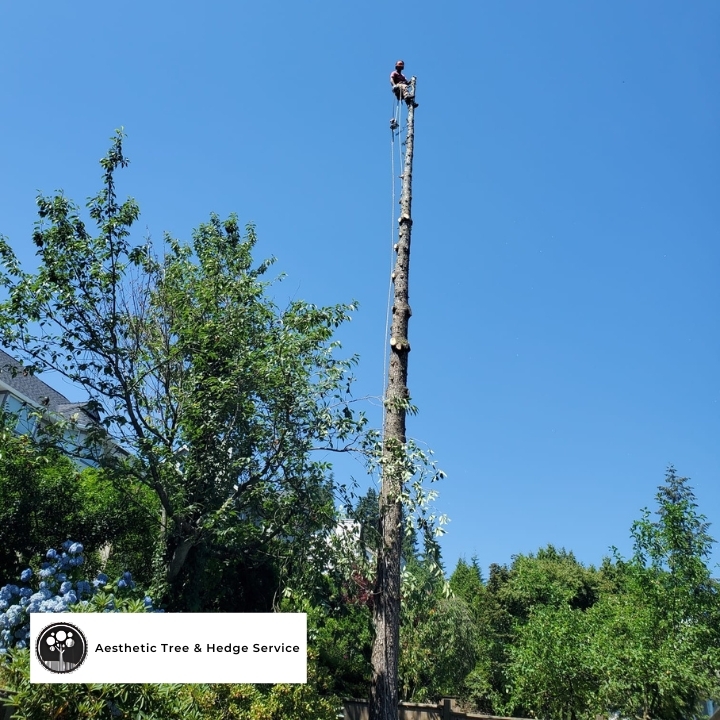
Yes, when pruning has a clear objective.
Bad pruning creates weak growth. Good pruning reduces risk and supports tree health.
For wildfire risk, pruning usually focuses on five goals:
- Remove deadwood before it falls or burns
- Create clearance from roofs, chimneys, decks, and service lines
- Raise low branches that act as ladder fuel
- Reduce crowded branches where density traps debris
- Improve structure so the tree handles wind and weather better
This is not the same as shaving a tree into a shape.
It is not topping.
It is not gutting the inner crown.
TCIA’s ANSI A300 pruning standards warn against topping, lion’s tailing, and other practices that injure trees. For homeowners, the takeaway is simple: if a contractor says they’ll just “take the top off,” stop.
Topping makes trees uglier and weaker.
It also often creates fast, poorly attached regrowth. That’s not safer.
A proper arborist looks at species, age, structure, wound response, branch collars, and the pruning dose. A mature Douglas fir does not respond like a young ornamental cherry. A Big-leaf maple does not respond like a cedar hedge.
In our experience, the safest pruning plan is specific.
Not “trim tree.”
A real plan says what branches are removed, why they’re removed, and what standard guides the cuts.
What role do stumps, mulch, and woody debris play in wildfire safety?
They matter more than most homeowners think.
Old stumps collect needles, leaves, bark, and dry grass. Rot pockets hold debris. Roots can create trip hazards around evacuation paths or work areas. Wood chips and shredded cedar mulch can hold fine, dry material close to fences and buildings.
FireSmart BC’s mulch guidance rates shredded cedar as a higher-risk mulch material in fire planning. Its Begins At Home Guide recommends gravel or crushed rock mulch in safer zones near structures.
This does not mean every wood chip on a property is dangerous.
Location matters.
Wood chips in a garden bed far from the house are different from dry cedar mulch touching siding under a deck.
For wildfire safety, look at:
- Stumps within 10 metres of the home
- Woody debris under hedges
- Old grindings piled against fences
- Dry leaves around root flares
- Bark mulch against foundations
- Dead branches stored beside sheds
- Firewood stacked close to the house
If you’ve removed a tree, finish the job. Grinding the stump and cleaning the area reduce hiding places for dry fuel.
Aesthetic Tree & Hedge Services offers stump grinding in Vancouver for homeowners who want the site cleaned up after removal, not left with a dry stump beside the house.
When do you need an arborist report for wildfire-related tree work?
You need an arborist report when the tree is protected, disputed, risky, or tied to a permit.
That includes many wildfire-related removals.
A report gives the city and the homeowner a written record. It documents species, diameter, condition, defects, risk factors, and recommendations.
For Vancouver, Burnaby, Richmond, Coquitlam, and North Vancouver, this can be the difference between a clean permit process and a stalled one.
An arborist report is often useful when:
- A tree is 20 cm or greater in Vancouver or Richmond
- A tree is protected under Burnaby’s bylaw thresholds
- A tree sits near a ravine, streamside area, or slope
- The tree is shared by neighbours or close to a property line
- The tree is dead, declining, or structurally defective
- A homeowner needs proof for a permit or insurance file
- A contractor needs tree protection zones for nearby work
A strong report does not just say “remove tree.”
It explains why.
It references observable defects. It may include photos. It may recommend pruning, cabling, monitoring, or removal. It should be written by someone qualified to assess risk, not someone guessing from the driveway.
For permit support, hazard documentation, and tree condition review, book an arborist report in Vancouver before you cut.
What should you do after wind, heat, or smoke events?
Check your trees after stress events.
Not once a decade. After real stress.
Vancouver trees face more than wildfire smoke. They deal with drought, heat, atmospheric rivers, snow loads, wind, construction damage, compacted soil, and root disturbance.
A hot dry summer can push already stressed cedars into decline. A fall windstorm can expose cracked unions. Heavy snow can split hedges and maples. Construction can damage roots long before the crown shows symptoms.
After a major weather event, walk the property and look for:
- New lean
- Cracked soil around the root plate
- Fresh splits in stems or unions
- Hanging branches
- Dead tops in conifers
- Sudden browning in cedar or hemlock
- Mushrooms near the root flare
- Branches now touching the roof or service lines
- New debris buildup in gutters or roof valleys
Do not stand under a damaged tree and inspect it from below.
Do not climb it.
Do not cut loaded branches.
Loaded wood can move fast. Storm-damaged trees can shift without warning.
If a tree has failed, split, or is threatening a structure, use an emergency tree service. That is not a weekend pruning job.
How do neighbourhoods like North Vancouver, Burnaby, Richmond, and Coquitlam change the tree risk picture?
Local conditions change the work.
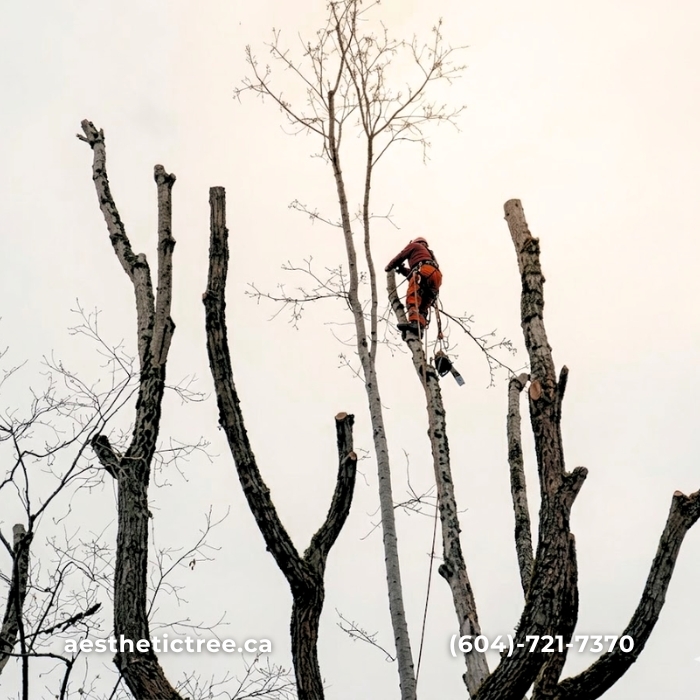
In North Vancouver and West Vancouver, slopes, ravines, forest edges, and tall conifers can create complex access and higher consequence if a tree fails. Crane work or technical rigging may be needed near homes, lanes, or retaining walls.
In Burnaby, older lots often have mature conifers and large deciduous trees close to houses. The bylaw thresholds also differ from Vancouver’s.
In Richmond, flat lots and dense hedges create different issues. Tree roots, drainage, wind exposure, and property-line disputes show up often. Richmond’s 20 cm permit threshold is important.
In Coquitlam and Port Moody, ravines, greenbelts, and larger lots can put homes close to heavier vegetation. Homeowners often need a mix of pruning, removals, debris cleanup, and permit support.
In Vancouver neighbourhoods such as Shaughnessy, Kerrisdale, Kitsilano, Dunbar, Mount Pleasant, Strathcona, and East Van, the key issue is usually tight spacing.
Trees, homes, garages, fences, lanes, and hedges are packed close.
That means small defects matter.
A dead limb over a narrow side yard. A cedar hedge touching a garage. A maple limb over a roof valley. A stump beside a fence line.
These are not dramatic.
They are exactly where risk builds.
What can you safely do yourself before calling an arborist?
You can do a lot.
Start on the ground.
Do not use a ladder with a chainsaw. Do not cut branches touching service lines. Do not remove protected trees without checking the bylaw. Do not top trees.
Safe homeowner work includes:
- Clear leaves and needles from gutters
- Remove dry debris from under decks and stairs
- Move firewood away from the house
- Pull dead branches from the ground
- Keep grass cut near fences and sheds
- Replace bark mulch near the house with gravel or rock
- Rake needles from under cedar hedges
- Check that branches are not touching the roof
- Photograph tree defects before they change
- Measure trunk diameter at 1.4 metres above grade before calling
Then call an arborist when work involves height, chainsaws, rigging, bylaws, tree health, or risk assessment.
A good call starts with better information.
Tell us the city, species if you know it, distance from the house, trunk diameter, visible defects, and what you’re worried about. Photos help.
We’ll still inspect the tree.
But a clear starting point saves time.
How should a proper wildfire-focused tree assessment work?
A proper assessment should look beyond one tree.
The arborist should review the tree, the house, the yard, and the route fire can take.
That includes:
- Species and condition
- Diameter and permit status
- Root flare and soil grade
- Deadwood and crown density
- Branch clearance from roof and structures
- Ladder fuels below the crown
- Hedges, shrubs, mulch, and debris
- Stumps and downed wood
- Access for crews and equipment
- Neighbouring targets and property lines
- Bylaw requirements
- Whether pruning, cabling, monitoring, or removal fits best
Some trees need pruning.
Some need removal.
Some need nothing today and monitoring next season.
Some need a report before the city will act.
That is why the first job is diagnosis.
If a company quotes removal without assessing the tree, structure, and bylaw, you’re not getting arborist judgment. You’re getting a saw plan.
What are the biggest mistakes homeowners make with wildfire tree safety?
The biggest mistake is waiting until the tree looks dead.
By then, options shrink.
Other common mistakes include:
- Topping mature trees to reduce height
- Removing healthy shade trees while ignoring dead hedges
- Leaving stumps and debris after removal
- Planting cedar or juniper tight to the house
- Letting branches grow into rooflines and gutters
- Assuming every tree is legal to remove
- Hiring uninsured crews for high-risk work
- Ignoring root flare burial and construction damage
- Treating wildfire risk as only a rural issue
- Waiting until a windstorm turns pruning into emergency work
The most expensive mistake is unpermitted removal.
The most dangerous mistake is DIY cutting on a loaded or defective tree.
The most common mistake is thinking a green tree is a safe tree.
Green leaves do not prove sound structure.
A tree can be alive and still fail. A hedge can be green outside and dry inside. A cedar can look full and still hold years of dead material near the fence.
Get eyes on it before the season gets hot and dry.
What should you ask before hiring a tree service for wildfire risk reduction?
Ask direct questions.
You’re hiring someone to work near your home. The work involves heavy limbs, heights, saws, rigging, permits, and risk.
Ask:
- Are you ISA-certified?
- Are you WCB registered?
- Do you carry insurance?
- Will you follow ANSI A300 pruning standards?
- Do you know the local tree bylaw for my city?
- Will this tree need a permit?
- Can pruning solve the issue, or is removal required?
- What happens to the stump and debris?
- How will you protect fences, roofs, lawns, and nearby trees?
- Will I receive written recommendations if needed?
The answers should be clear.
No dodging. No scare tactics. No “we’ll just take it down.”
Aesthetic Tree & Hedge Services is ISA-certified and WCB registered. We work across Vancouver, Burnaby, North Vancouver, Richmond, Coquitlam, and the Lower Mainland. We assess hazards, check bylaw requirements, and recommend the least invasive safe option.
FAQ
What is the best way to protect my Vancouver property from wildfire threats caused by trees?
Start within 1.5 metres of the home. Remove combustible debris, keep branches off the structure, clear gutters, and replace high-risk mulch near siding. Then assess the 1.5 to 10 metre zone for cedar hedges, deadwood, ladder fuels, and branches touching roofs or sheds. Hire an ISA-certified arborist for pruning, removals, and permit advice.
Do I need a permit to remove a tree for wildfire safety in Vancouver?
Yes, if the tree is 20 cm or greater in diameter, measured 1.4 metres above ground. The City of Vancouver’s Protection of Trees By-law 9958 requires a permit for those private-property removals. A replacement tree is usually required when a removed tree is larger than 20 cm. Get an arborist assessment before cutting.
Are cedar hedges dangerous during wildfire season?
Cedar hedges can raise fire risk when they are dry, dense, full of dead interior material, or touching structures. FireSmart BC flags cedar and juniper in fire-risk planting guidance. A healthy, maintained cedar hedge with clearance is different from an old hedge packed with dry debris beside a garage.
Should I remove all conifers near my house?
No. Remove hazards, not whole categories of trees. Some conifers need pruning, spacing, deadwood removal, or monitoring. Others need removal because of condition, location, or structure. An ISA-certified arborist can tell the difference and help you avoid unnecessary loss of healthy canopy.
When should I call emergency tree service?
Call emergency tree service when a tree has failed, split, shifted, or is threatening a home, driveway, lane, service line, deck, or fence. Also call after major wind or snow if large limbs are hanging or the root plate has moved. Do not cut storm-loaded branches yourself.
Call Aesthetic Tree & Hedge Services for a free estimate at (604) 721-7370. Our ISA-certified arborists are WCB registered and ready to help you keep trees, property, and people safer across Vancouver and the Lower Mainland.
Found this helpful? Follow our tree care insights directly on Google.
Make us your preferred source on GoogleBefore You Go
Where are you in your tree care journey?
Our Tree Care Services
ISA-certified arborists serving Greater Vancouver


Explore Our Tree Care Services
From expert pruning to safe tree removal, our ISA-certified arborists are ready to help across Greater Vancouver.
View Services