
TL;DR — Quick Summary
lesser known benefits hiring local arborist vancouver: permits, safer pruning, storm risk checks, and better tree value. Call for a free estimate.
lesser known benefits hiring local arborist vancouver is not a soft topic. It is about permits, risk, tree health, storm damage, and property protection.
Most homeowners call an arborist after a branch cracks. Or after a neighbour complains. Or after a cedar blocks a driveway.
That is late.
A good local arborist sees the problem before it costs more. The signs are there. Included bark. A weak union. A buried root flare. Soil piled against cedar bark. A maple crown thinned so hard it grows weak water sprouts.
A Vancouver tree is not just a tree. It sits under city bylaws. It grows in wet coastal soil. It faces wind, rain, drought stress, and tight lot lines. It may stand beside a lane, hydro line, garage, suite entrance, or shared fence.
That is why local knowledge pays.
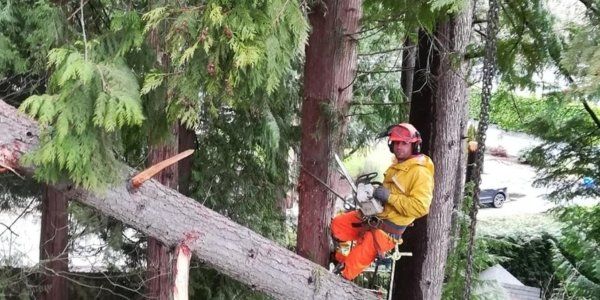
Aesthetic Tree & Hedge Services works across Vancouver, Burnaby, North Vancouver, Richmond, Coquitlam, and the Lower Mainland. We are ISA-certified and WCB registered. We read the tree, the site, and the bylaw before we cut.
TL;DR
- A local arborist protects you from permit mistakes. Vancouver requires permits for many private trees at 20 cm diameter or more, measured 1.4 metres above the base.
- Local arborists know coastal species. Douglas fir, Western red cedar, Big-leaf maple, birch, and cypress fail in different ways.
- Proper pruning follows ANSI A300 standards. That protects structure, not just appearance.
- Storm risk is rising. BC Hydro reported more than 1.8 million storm-related outages in 2024.
- A written arborist report helps with permits, insurance, development, neighbour disputes, and hazard records.
Why Does A Local Vancouver Arborist Know More Than A General Tree Crew?
A local Vancouver arborist brings three kinds of knowledge to the site.
First, they know local trees. A mature Big-leaf maple in Kitsilano does not behave like a cedar hedge in Richmond. A Douglas fir on a North Vancouver slope does not fail like a birch beside a paved driveway in Burnaby.
Second, they know local rules. Vancouver, Burnaby, Richmond, and North Vancouver do not treat tree removal the same way. The wrong answer creates delay. It also creates fines.
Third, they know local site risks. Vancouver lots are tight. Many trees grow near garages, lane homes, fences, hydro lines, and neighbour structures. A cut that works on an open acreage does not work beside a Dunbar lane.
This is where cheaper work becomes expensive.
A saw can remove wood. It cannot judge load, decay, root damage, or permit risk. An ISA-certified arborist is trained to assess the whole tree. That includes roots, trunk, crown, site exposure, species, defects, and targets.
A target is anything a tree can hit. A house is a target. So is a car, sidewalk, daycare yard, fence, or service mast.
The local part matters. We know how coastal rain affects soil. We know which hedges suffer from poor timing. We know which trees are commonly protected. We know why a root flare buried under mulch is not harmless.
That is one lesser-known benefit. You are not just buying labour. You are buying judgment.
How Can A Local Arborist Help You Avoid Tree Permit Problems?
Permit mistakes are one of the clearest reasons to hire local.
The City of Vancouver says a private-property tree removal permit is required when a tree is at least 20 cm in diameter, or 64 cm in circumference, measured 1.4 metres above the base. Vancouver also states that a replacement tree is required for any removed tree larger than 20 cm diameter.
That is not a small detail.
A homeowner can look at a tree and see a nuisance. The City may see a protected tree. Those are different facts.
Richmond has its own rule. Under Richmond Tree Protection Bylaw No. 8057, the City says cutting or removing a tree larger than 20 cm diameter at breast height generally requires a permit. Richmond also states that topping trees is prohibited and can lead to fines up to $50,000 per tree.
North Vancouver has another local rule. The City of North Vancouver says a permit is required to remove a protected tree with a diameter of 20 cm or greater, measured 1.4 metres above ground.
Burnaby differs again. Burnaby says you do not need a permit to remove trees smaller than 30 cm diameter unless the tree is protected. But development properties and covenant trees can change the answer.
A local arborist checks these details before work starts.
That protects the homeowner in four ways:
- You know if a permit is needed before a crew arrives.
- You know if an arborist report is required.
- You know if replacement planting applies.
- You reduce the risk of a stop-work order or bylaw complaint.
When a removal is justified, the paperwork matters. A damaged, dead, or hazardous tree still needs the right process. Our arborist report Vancouver service documents tree condition, defects, and recommendations for permit files.
That report is not filler. It is proof.
Why Is A Hazard Assessment Different From Looking At A Tree From The Ground?
Most dangerous defects are not dramatic at first.
A crack can hide under bark. Decay can sit behind a small wound. A tree can have a full green crown and still carry a weak stem union. A root plate can be unstable even when the trunk looks straight.
A local arborist reads these signs in order.
We start at the site. We look at lean, slope, drainage, exposure, and targets. Then we inspect the root flare. A buried root flare often points to grade change, girdling roots, or poor planting depth. Then we inspect the trunk. We look for cracks, cavities, fungal fruiting bodies, old topping cuts, seams, and included bark. Then we read the crown. Deadwood, dieback, thinning, overextended limbs, and heavy end weight all tell a story.
The ISA Basic Tree Risk Assessment process uses likelihood and consequence. That matters. A failing branch over a shed is one risk. The same branch over a bedroom is another.
This is why a quick photo is not enough for serious trees.
A Vancouver homeowner often calls after a storm. We prefer earlier. A hazard assessment before storm season gives you options. You can prune, cable, monitor, or remove. After failure, the choices shrink.
BC Hydro reported that 2024 brought more than 1.8 million storm-related outages in British Columbia. BC Hydro also said drought-stressed trees added to the outage problem and that it tripled its vegetation management budget for fiscal year 2025.
That is real evidence. Trees are under stress before they fail.
If a tree has already split, shifted, or fallen, call for emergency tree service. Keep people away from the area. Do not approach downed lines. Let BC Hydro handle electrical hazards.
How Does Proper Pruning Save Money Without Talking About Price?
Bad pruning creates future defects.
That is the part many homeowners miss.
A hard topping cut does not make a tree safer. It forces weak new shoots. Those shoots attach poorly. They grow fast. They become the next failure point.
Lion-tailing is another problem. That is when interior branches are stripped out and foliage remains only at the ends. It looks tidy for a short time. It also increases end weight and wind movement.
Proper pruning has an objective. It removes deadwood. It reduces end weight. It improves clearance. It improves structure. It keeps the living crown strong.
The Tree Care Industry Association states that ANSI A300 standards provide standard practices and specification writing guidelines for arborists, urban foresters, landscape architects, and contractors. The 2023 ANSI A300 Tree Care Standards include pruning and other tree care practices.
That matters because pruning is not just cutting.
A good arborist will tell you what should not be removed. That advice often saves the tree. In our field work, we see mature cedars and maples damaged by over-thinning. The homeowner wanted light. The tree lost structure.
A measured pruning plan protects both.
If your tree needs crown reduction, clearance, or selective cutting, use a trained crew. Our tree cutting Vancouver service is built around controlled cuts, safe rigging, and tree health.
The lesser-known benefit is simple. The right cut today prevents weak regrowth tomorrow.
Why Do Vancouver Tree Species Need Local Diagnosis?
Species matters.
Douglas fir can carry large dead limbs high in the crown. Western red cedar can decline after root disturbance, grade change, or drought stress. Big-leaf maple often develops large, heavy limbs with decay at old wounds. Birch trees can decline fast when stressed. Cypress hedges fail when cut past green growth.
A general crew may treat them the same. A local arborist does not.
Here is what we watch in the Lower Mainland:
- Douglas fir: dead tops, root disturbance, bark beetle signs, long lever arms, wind exposure.
- Western red cedar: thinning foliage, drought stress, root compaction, poor drainage, buried root flare.
- Big-leaf maple: included bark, decay pockets, heavy lateral limbs, fungal fruiting bodies.
- Birch: crown dieback, bronze birch borer signs, drought stress, shallow roots.
- Laurel and cedar hedges: timing, depth of cut, old wood exposure, sightline clearance.
Local diagnosis also helps with planting decisions. Vancouver’s Urban Forest Strategy says the city has 25% canopy cover and a target of 30% by 2050. It also reports about 150,000 street trees, 36,000 specimen trees in golf courses and urban parks, and more than 1 million trees across 444 hectares of public forests and woodlands.
That is not trivia. It shows why local tree choices matter.
A homeowner who removes a declining tree still has to think about replacement. The wrong species can outgrow the space. The wrong location can damage hardscape. The wrong planting depth can shorten the tree’s life.
A local arborist helps choose the right tree for the right site. That is one of the quiet benefits. It prevents the next problem before it starts.
How Can A Local Arborist Protect Your Property During Tree Removal?
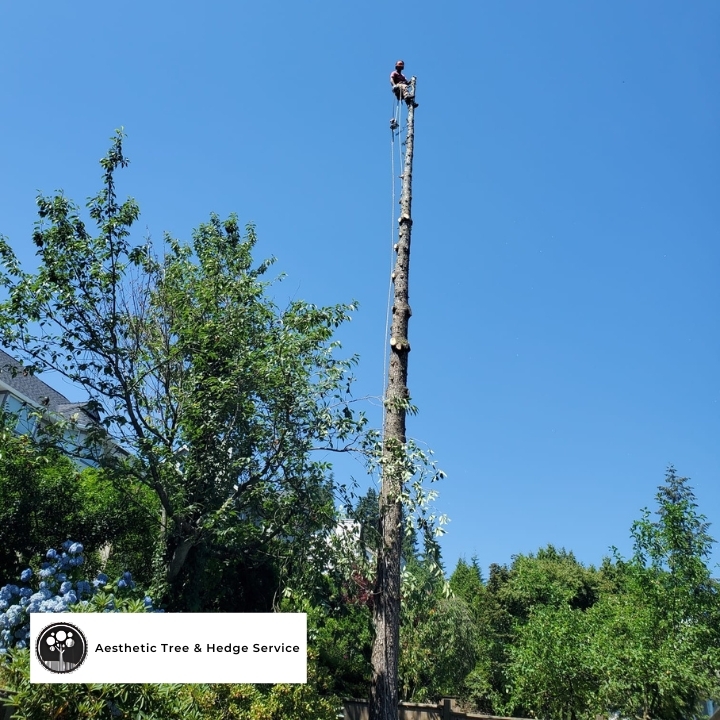
Tree removal is controlled dismantling.
That is especially true in Vancouver. Many removals happen near fences, rooflines, glass railings, garages, lane houses, and service lines. A tree does not have to be huge to cause damage. It only has to fall the wrong way.
A professional removal plan accounts for weight, lean, wind, rigging points, drop zone, access, and cleanup. A local arborist also checks the bylaw before work starts.
Some removals need climbing. Some need rigging. Some need sectional lowering. Some need crane support. Some should wait because wind or site conditions are wrong that day.
That last point matters. A trained crew knows when not to cut.
If a tree is dead, hazardous, storm-damaged, or approved for removal, our tree removal Vancouver service covers assessment, safe dismantling, and cleanup. For complex access or large trees, crane-assisted removal can reduce ground impact and improve control.
The lesser-known benefit is not only safety. It is planning.
A local arborist knows Vancouver lanes. We know tight access in Kitsilano. We know sloped lots in North Vancouver. We know Richmond soils. We know Burnaby redevelopment sites. That site knowledge affects the work plan.
Why Does WCB Registration Matter When Hiring A Tree Company?
Tree work is high-risk work.
That is not opinion. WorkSafeBC reported 175 work-related deaths in British Columbia in 2023. It also reported 60 traumatic injury deaths that year, including deaths from falls, struck-by incidents, and equipment-related events.
Tree crews work with chainsaws, chippers, ropes, ladders, aerial lifts, cranes, and heavy wood under tension. Those hazards belong to the job.
WCB registration matters because it shows the company is registered for workplace coverage in BC. It also shows the company is not treating hazardous work like casual labour.
Homeowners should ask two questions before hiring:
- Are you ISA-certified?
- Are you WCB registered?
Aesthetic Tree & Hedge Services is both.
This protects more than the worker. It protects the homeowner from hiring an uninsured or unqualified crew for hazardous work. A low bid means little if the company is not set up to manage the risk.
A qualified arborist also communicates clearly. They explain what will be cut, why it will be cut, and how the site will be protected. They do not hide behind vague wording.
That is the Hopkins test. Specific proof beats broad claims.
How Does A Local Arborist Help With Neighbours, Property Lines, And Shared Trees?
Tree disputes often start small.
A hedge crosses a line. A cedar shades a garden. A branch hangs over a roof. A neighbour fears a tree will fall. Someone wants it cut now.
Local arborist documentation can lower the temperature.
A written opinion gives both sides facts. It identifies species, condition, defects, and recommended work. It separates fear from risk. It also helps show whether pruning or removal is justified.
Property lines still matter. An arborist is not a surveyor. But an arborist can tell you what work is healthy for the tree and what work is not. That is important when branches cross a fence.
Heavy one-sided pruning can destabilize a tree. It can also damage long-term health. A proper plan reduces the branch issue while keeping structure intact.
Hedges need the same care. A cedar hedge cut too hard into brown wood will not fill back in like a lawn. Laurel and cedar respond differently. Timing matters. Depth matters. Height matters. So does sightline clearance near sidewalks and driveways.
For formal hedges, our hedge trimming services Vancouver focus on clean lines, plant health, and realistic regrowth.
The hidden benefit is peace. Good arborist advice gives neighbours a neutral record.
What Does A Local Arborist Notice About Roots That Homeowners Miss?
Roots are usually the first thing damaged and the last thing blamed.
A homeowner sees crown decline. The arborist looks down.
Common root problems include compaction, grade changes, trenching, paving, poor drainage, and buried root flares. Construction is a major cause. So is repeated parking over soil. So is adding too much mulch against the trunk.
A root flare should be visible. When it is buried, moisture sits against bark. Roots can circle. Decay can start near the base. The tree can decline for years before the crown shows it.
Local arborists also understand site drainage. Vancouver rain is not gentle on compacted soil. Water moves differently on a North Vancouver slope than on a flat Richmond lot. Clay, fill, and hardscape all change root health.
UBC stormwater education material cites North Vancouver experiments showing some urban trees, including red cedar and Douglas fir, can intercept and evapotranspire more than 40% to 60% of rainfall.
That is a strong reason to protect roots. Healthy roots support stormwater benefits. Damaged roots reduce them.
If roots are pushing into hardscape or near a foundation, removal is not always the first answer. A root barrier may solve a specific conflict. Our root barrier service helps manage root direction where site conditions support it.
The point is clear. The root system is part of the job, not an afterthought.
How Can Arborist Reports Help With Insurance, Development, And Records?
A written arborist report turns a tree opinion into a record.
That record matters when a permit is required. It matters when a tree is near construction. It matters when a neighbour disputes the risk. It matters when an insurer asks what you knew and when you knew it.
A useful report includes the species, size, condition, defects, site context, risk factors, and recommendation. It may also include photos, measurements, and protection notes.
For development, reports often support tree retention or removal decisions. They can define tree protection zones. They can recommend fencing, root protection, and work limits.
This is one place where local knowledge protects timelines.
Vancouver’s tree rules are not the same as Burnaby’s. Richmond’s 20 cm rule and topping penalties are not the same as North Vancouver’s process. A report written without local context can miss the point.
A proper report also avoids vague claims. It should not say “tree seems unsafe” and stop there. It should name the defect and explain the risk.
Examples include:
- Co-dominant stems with included bark.
- Decay cavity at the main union.
- Dead scaffold limb over a target.
- Root plate movement after wind.
- Crown dieback linked to root stress.
This is proof-first arboriculture.
Why Does Local Tree Care Improve Heat, Shade, And Stormwater Benefits?
Trees are living infrastructure.
That sounds broad. The data makes it concrete.
Vancouver’s 2025 Urban Forest Strategy says city canopy cover is 25%, with a 30% target by 2050. The City also notes that lower-canopy areas, including Strathcona, Sunset, Downtown, and Marpole, feel extreme heat more intensely.
A 2024 study in Scientific Reports looked at street trees and heat exposure in Tacoma, Washington. It found air temperature varied by 2.57 C across the study area. It also found locations with no canopy within 10 metres were up to five times more likely to exceed regulated high-temperature thresholds than locations with full canopy.
That is why tree care is not only about appearance.
Healthy trees shade homes, sidewalks, vehicles, patios, and soil. They slow rainfall. They support birds and insects. They reduce heat stress at ground level.
But benefits depend on condition. A topped tree gives less shade. A declining tree gives less stormwater benefit. A poorly planted tree fails before maturity. A compacted root zone reduces growth.
Local arborists protect the tree’s value by protecting structure and health.
This is also where removal decisions need care. Sometimes removal is correct. A dead or hazardous tree beside a house should not be romanticized. But removal should be based on assessment, not guesswork.
When removal is needed, stump planning matters too. A remaining stump can create trip hazards, pest habitat, and replanting problems. Our stump grinding Vancouver service clears the site for safer use and future planting.
What Should You Ask Before Hiring A Local Arborist In Vancouver?
Ask direct questions. Good companies answer directly.
Start with credentials:
- Are you ISA-certified?
- Are you WCB registered?
- Do you carry insurance?
- Do you follow ANSI A300 pruning standards?
- Do you know the tree bylaw in my city?
Then ask about the work plan:
- What is the objective of this pruning?
- Is this tree protected by a bylaw?
- Do I need a permit?
- What defects did you find?
- What targets are at risk?
- Will you remove live foliage? If yes, how much and why?
- How will you protect fences, roofs, lawns, and hardscape?
Then ask about cleanup and site condition:
- Will wood be removed or left on site?
- Will the stump stay or be ground?
- Will the crew protect nearby plantings?
- Will traffic, lane access, or neighbour access be affected?
The answers should be specific.
Avoid anyone who says every tree should be topped. Avoid anyone who skips permits. Avoid anyone who gives only a verbal opinion for a risky tree. Avoid anyone who treats a protected tree like a private nuisance.
Good arboriculture is measured. It is not dramatic.
When Is Tree Removal Better Than Pruning?
Removal is better than pruning when the tree can no longer be made acceptably safe or healthy.
That decision should come after assessment.
Removal is often the right recommendation when:
- The tree is dead.
- The main stem has severe decay.
- The root plate is moving.
- A major crack runs through a load-bearing union.
- The tree has failed before and still threatens a target.
- Construction has destroyed the critical root zone.
- Disease or decline is advanced and irreversible.
- The tree conflicts with approved work and the permit allows removal.
Pruning is often better when the tree is structurally sound and the problem is limited. Deadwood can be removed. End weight can be reduced. Clearance can be improved. A young tree can be trained before defects become large.
Cabling is sometimes an option. It does not make a weak tree strong. It adds support for specific structural defects. The tree still needs inspection and maintenance. Our tree cabling service is used only when the tree and defect make sense for support.
This is where local arborist judgment counts. The goal is not to save every tree. The goal is to make the right call with evidence.
How Does Hiring Local Help In A Storm Emergency?
Storm calls are different from routine work.
The site is unstable. Wood is under tension. Branches can shift after the first cut. A cracked stem can fail without warning. Power lines may be involved.
A local crew can respond with knowledge of streets, access, weather patterns, and municipal expectations. That saves time when a tree blocks a driveway, hits a roof, or leans over a lane.
The first rule is safety. Keep people away. Do not cut a loaded limb yourself. Do not touch trees near wires. Do not assume a fallen tree is done moving.
A storm response should follow a sequence:
- Secure the area.
- Identify electrical hazards.
- Assess tension and compression in wood.
- Remove immediate hazards first.
- Protect the structure from more damage.
- Remove debris in a controlled order.
- Document the condition with photos when needed.
A local arborist also helps after the emergency. The remaining tree may still be unstable. Adjacent trees may have new cracks. Root plates may have shifted. A follow-up assessment is often the difference between one incident and two.
BC Hydro’s 2024 storm outage data shows why this matters. Storms and drought-stressed trees are now a routine part of Lower Mainland risk planning.
Why Is A Free Estimate More Useful When The Arborist Is Local?
A free estimate is only useful when the person on site understands the local facts.
A Vancouver estimate should account for permits, access, species, targets, disposal, rigging, traffic, slope, and site protection. A Richmond estimate should account for the local tree bylaw. A North Vancouver estimate should account for steep lots and large conifers. A Burnaby estimate should account for protected trees, development sites, and access.
That is why phone guesses are weak.
An on-site assessment gives better information. The arborist can see the root flare. They can measure diameter. They can check for defects. They can inspect access. They can tell you if an arborist report or permit is part of the path.
This is the practical benefit behind hiring local. You get fewer surprises.
Aesthetic Tree & Hedge Services serves Vancouver, Burnaby, North Vancouver, Richmond, Coquitlam, and the Lower Mainland. We are ISA-certified and WCB registered. We handle pruning, removals, hedges, stumps, reports, emergency work, root barriers, planting, and cabling.
Call Aesthetic Tree & Hedge Services for a free estimate at (604) 721-7370.
FAQ
Do I need a permit to remove a tree in Vancouver?
Yes, in many cases. The City of Vancouver requires a tree removal permit for a private-property tree that is at least 20 cm in diameter, or 64 cm in circumference, measured 1.4 metres above the base. Vancouver also requires a replacement tree for any removed tree larger than 20 cm diameter. A local arborist can measure the tree and advise on the permit path.
Is an ISA-certified arborist different from a tree cutter?
Yes. A tree cutter may only cut and remove wood. An ISA-certified arborist is trained in tree biology, pruning, diagnosis, risk assessment, soil, species needs, and safe work practices. For protected trees, hazard concerns, major pruning, and removals near structures, hire an ISA-certified arborist.
What is the biggest hidden benefit of hiring a local arborist?
The biggest hidden benefit is judgment before the cut. A local arborist understands Vancouver-area bylaws, coastal soil, common tree species, storm exposure, and tight urban lots. That helps prevent permit errors, poor pruning, property damage, and avoidable removals.
Can pruning make a dangerous tree safe?
Pruning can reduce risk when the defect is limited. It can remove deadwood, reduce end weight, or improve clearance. Pruning cannot fix severe trunk decay, major root failure, or a splitting main union. A hazard assessment determines whether pruning, cabling, monitoring, or removal is the right choice.
Why should I choose a WCB registered tree service?
Tree work involves chainsaws, rigging, climbing, aerial lifts, chippers, heavy limbs, and fall hazards. WCB registration shows the company is registered for workplace coverage in British Columbia. Homeowners should ask for ISA certification, WCB registration, and insurance before hiring any tree service.
When should I call for emergency tree service?
Call for emergency tree service when a tree has fallen, split, shifted, or is leaning toward a structure, driveway, sidewalk, or service line. Keep people away from the area. Do not touch trees near power lines. Call BC Hydro for electrical hazards, then call a qualified arborist for safe removal and assessment.
Does Aesthetic Tree & Hedge Services provide free estimates?
Yes. Call Aesthetic Tree & Hedge Services at (604) 721-7370 for a free estimate. The team is ISA-certified and WCB registered, serving Vancouver, Burnaby, North Vancouver, Richmond, Coquitlam, and the Lower Mainland.
Related: For more on this, see Service Berry Tree: The 4 Mistakes Vancouver Homeowners Make Before Calling an Arborist.
Related: For more on this, see 5 Questions to Ask Before Hiring an Arborist in Vancouver.
Found this helpful? Follow our tree care insights directly on Google.
Make us your preferred source on GoogleBefore You Go
Where are you in your tree care journey?
Our Tree Care Services
ISA-certified arborists serving Greater Vancouver


Explore Our Tree Care Services
From expert pruning to safe tree removal, our ISA-certified arborists are ready to help across Greater Vancouver.
View Services