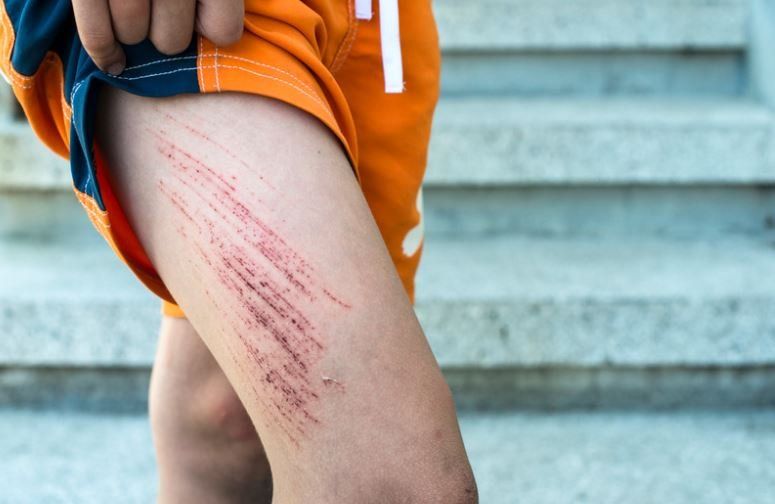

TL;DR — Quick Summary
Safety first: dangers of DIY tree cutting in Vancouver explained. Know the real hazards, local bylaws & why ISA-certified arborists protect lives and properties.
Safety first — that phrase matters because the dangers of DIY tree cutting in Vancouver are more serious than most homeowners expect.
You may have a tree leaning toward a fence, a heavy limb over the roof, or a storm-damaged cedar dropping branches in the yard. You may own a chainsaw. You may have watched a few videos and thought the job looked manageable.
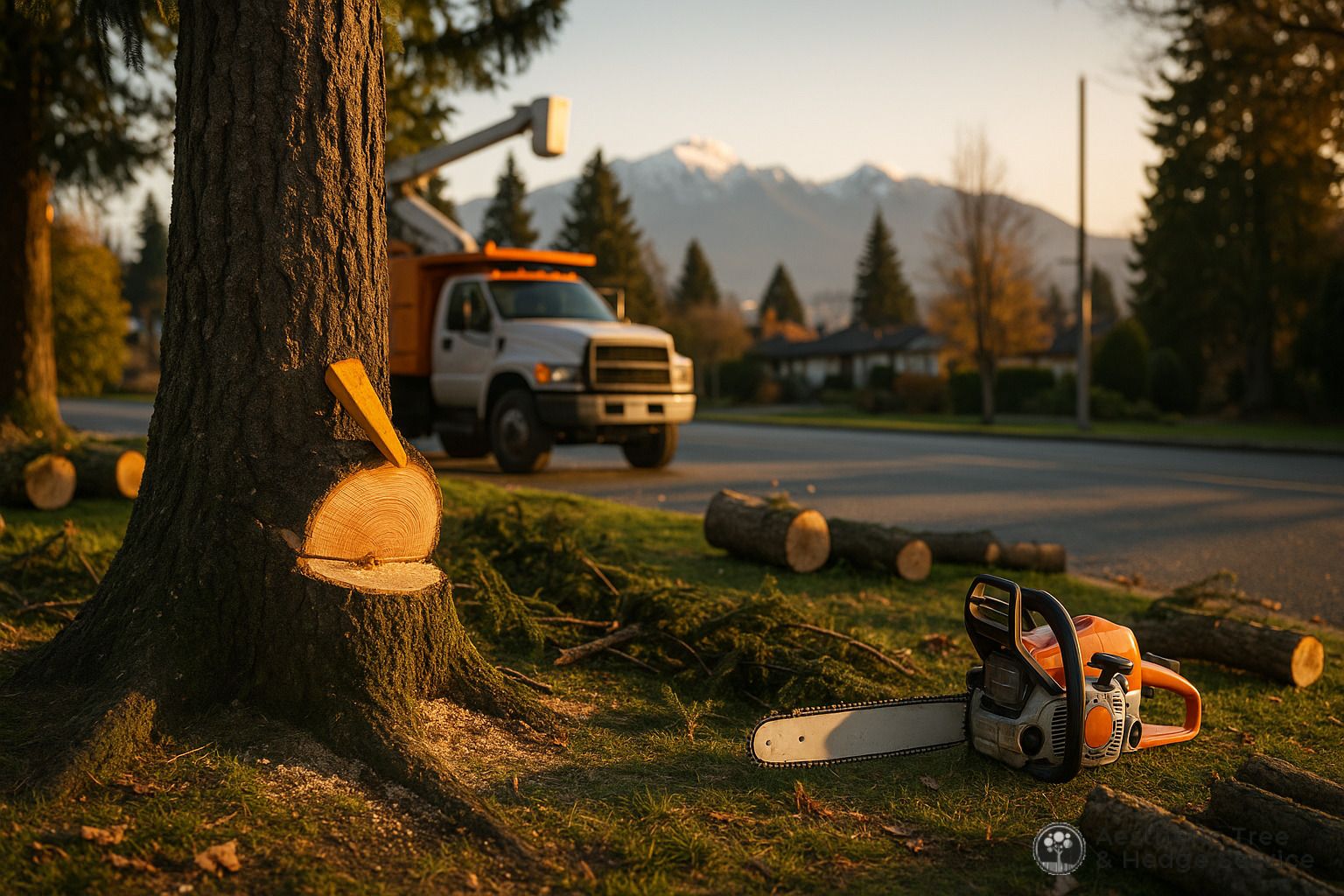
Tree work is different. Wood shifts under tension. Branches twist as they fall. Wet soil changes root stability. Power lines are often closer than they appear. In Vancouver and the Lower Mainland, the safety risk is also tied to permits, liability, WorkSafeBC coverage, and local tree bylaws.
This guide gives you the practical answer: when small DIY pruning is reasonable, when it is not, and why professional arborists treat tree cutting as high-risk work from the first site assessment.
Key Takeaways
- Tree trimming and pruning is one of the highest-risk occupations tracked by the U.S. Bureau of Labor Statistics, with a 2022 fatal injury rate of 47.0 per 100,000 full-time equivalent workers.
- In Vancouver, a permit is generally required to remove a private property tree with a trunk diameter of 20 cm or greater, measured 1.4 metres above ground.
- The three biggest DIY hazards are chainsaw kickback, falling wood, and power line contact. Any one of them can be fatal.
- WorkSafeBC registration matters. If an unregistered worker is injured on your property, liability can become a serious issue.
- Professional arborists use formal risk assessment, rigging systems, protective equipment, trained ground crews, and recognized tree-care safety practices that homeowners usually do not have.
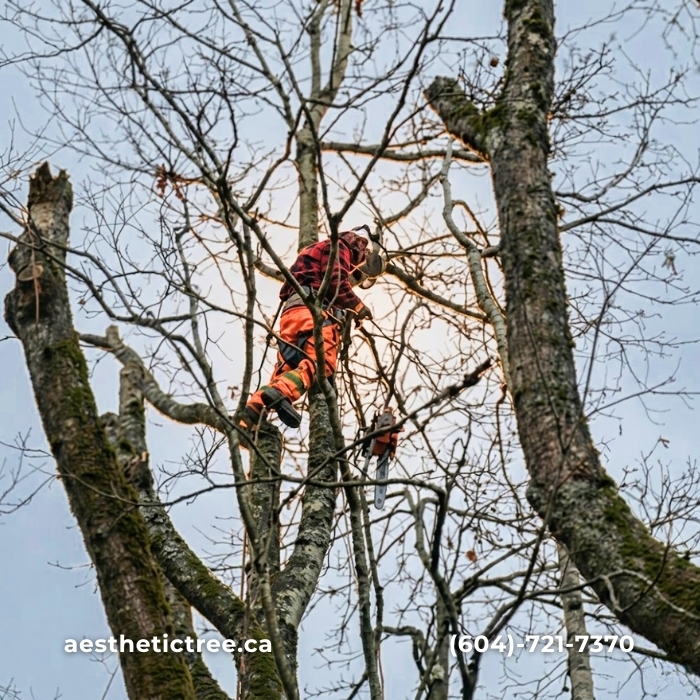
[Suggested image: Certified arborist crew lowering a large branch with ropes in a Vancouver backyard. Alt text: Professional arborists controlling a tree limb during safe tree removal in Vancouver.]
---
Why Is DIY Tree Cutting So Dangerous?
Tree cutting looks simple from the ground. The risk appears only after the cut begins.
A branch that seems balanced can be loaded with tension. A trunk can split vertically before it falls. A tree that looks solid from the outside can be hollow inside. A leaning tree can shift direction when weight moves through the canopy. These are not rare edge cases. They are normal tree-work hazards.
According to the U.S. Bureau of Labor Statistics 2022 Census of Fatal Occupational Injuries, tree trimmers and pruners had a fatal injury rate of 47.0 per 100,000 full-time equivalent workers. That is many times higher than the average across all occupations.
Those numbers involve workers who do tree care for a living. They use protective gear, job-site communication, rigging systems, and formal safety procedures. Most homeowners attempting DIY tree cutting have none of that training.
The hardest part is that many injuries happen because the person cutting did not know what they could not see. They did not know the limb was under compression. They did not know the spar could barber chair. They did not know decay had weakened the union. They did not notice the service line behind the foliage.
That gap is exactly what professional assessment is designed to catch.
---
What Are the Most Common DIY Tree Cutting Injuries in BC?
Most serious DIY incidents fall into three categories: chainsaw injuries, struck-by injuries, and electrical contact.
Chainsaw Kickback
Chainsaw kickback happens fast. The upper tip of the guide bar contacts wood, gets pinched, or hits an object. The saw can rotate back toward the operator’s face, neck, shoulder, or arm before there is time to react.
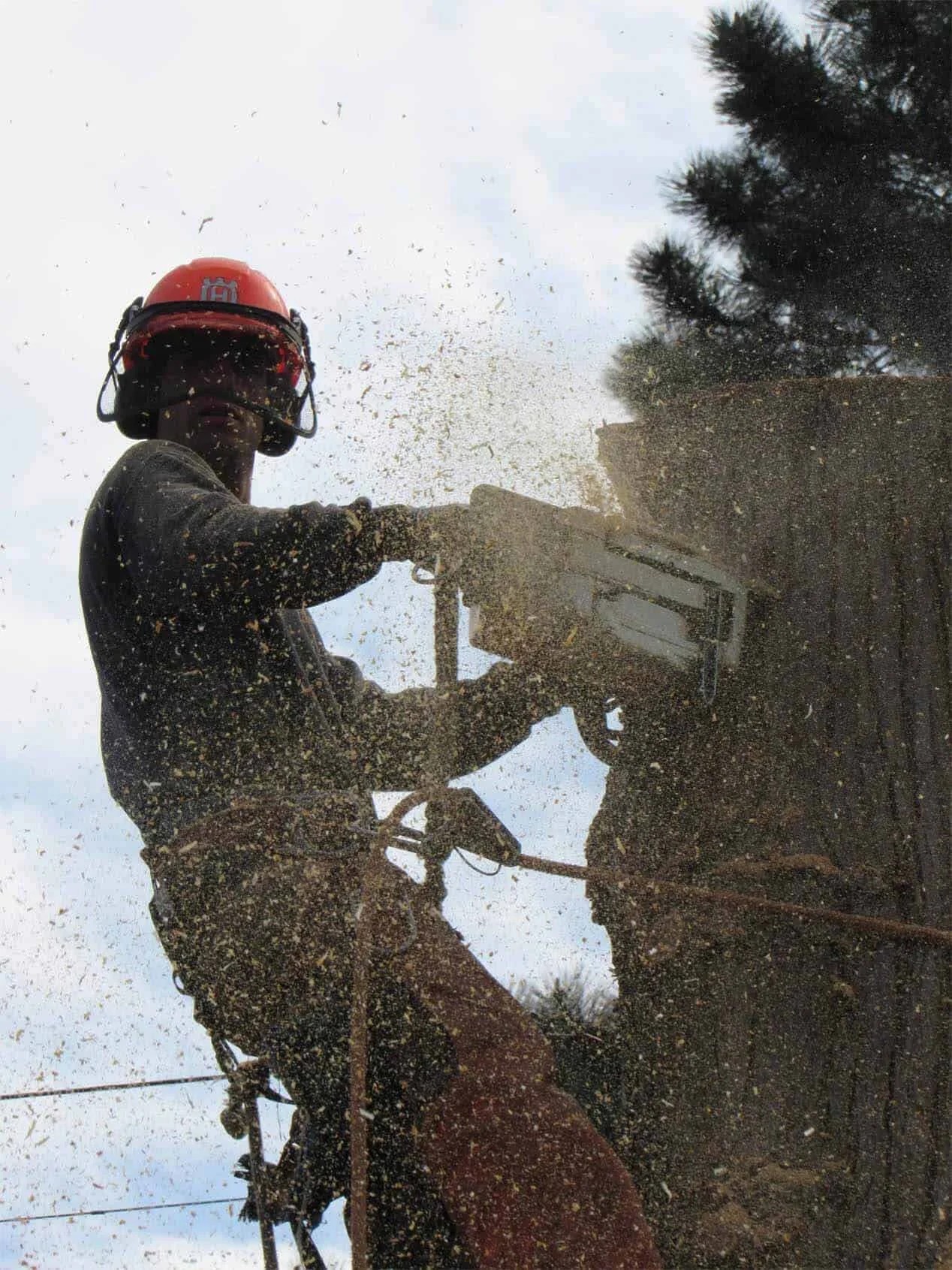
Professional arborists reduce that risk with training, saw control, body positioning, chain selection, maintenance, cut planning, and protective equipment such as chainsaw chaps, helmets, eye protection, and hearing protection.
A homeowner using a chainsaw above waist height, from a ladder, or while reaching into a canopy is in a very different risk category. If the saw kicks, there may be no stable footing and no second chance.
Struck-By Incidents From Falling Wood
Branches do not always fall straight down. They twist, swing, catch other limbs, bounce off trunks, and shift when fibres release.
One of the most dangerous failures is a barber chair split. This happens when a trunk or large limb splits upward under pressure while being cut. The wood can snap violently before the tree or branch falls. It is especially dangerous in leaning, stressed, cracked, or decayed wood.
Vancouver yards often contain large Douglas fir, bigleaf maple, western red cedar, birch, cherry, and ornamental trees growing close to fences, garages, decks, and neighbouring properties. A limb that looks manageable from the ground can weigh hundreds of pounds.
If you are standing in the landing zone, there is no practical way to outrun falling wood.
Power Line Contact
Power lines are one of the clearest reasons not to attempt DIY tree cutting.
BC Hydro warns homeowners to stay away from trees and branches touching or near electrical lines. A wet branch, metal pole saw, ladder, rope, or falling limb can create a path for electricity. Residential distribution lines may not look dramatic, but contact can still be lethal.
If a tree or branch is near a line, the first call should be to BC Hydro or a qualified tree service experienced with utility-clearance safety. Do not try to clear it yourself.
[Suggested image: Tree branches growing near overhead service lines in a residential lane. Alt text: Tree branches close to power lines showing a common DIY tree cutting danger in Vancouver.]
---
Does Vancouver Require a Permit to Cut Down a Tree?
Yes, in many cases.
Under the City of Vancouver Protection of Trees By-law, a permit is generally required to remove a tree on private property if the trunk is 20 cm or greater in diameter, measured 1.4 metres above ground. A 20 cm diameter trunk is roughly 64 cm in circumference.
That means many ordinary backyard trees are regulated. Homeowners should not assume that private property means unrestricted removal.
Vancouver may also require replacement planting, tree protection measures during construction, and documentation from an arborist depending on the situation. Fines and enforcement costs can be significant when trees are removed illegally.
Other Lower Mainland municipalities have their own tree bylaws:
- District of North Vancouver and City of North Vancouver have their own protected-tree rules and permit processes.
- Burnaby regulates tree removal based on property type, tree size, and development context.
- Richmond has private tree permit requirements based on trunk size and site conditions.
- Coquitlam has rules for significant trees, development sites, and protected trees.
If you are planning tree removal anywhere in Metro Vancouver, check your municipality before cutting. An arborist report from an ISA-certified professional can help confirm whether the tree is hazardous, protected, removable, or subject to replacement requirements.
---
What Equipment Do Professional Arborists Use That Homeowners Usually Do Not Have?
The gap between watching a tree-cutting video and doing the work safely is mostly equipment, training, and judgment.
A professional arborist crew may use:
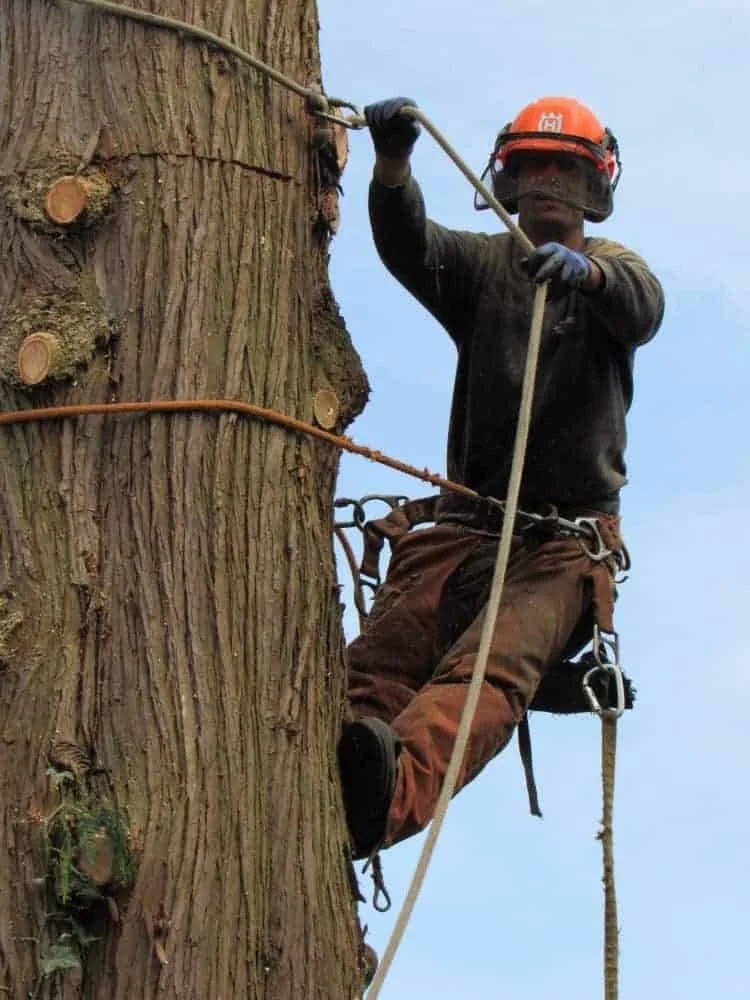
- Climbing harnesses, saddles, and approved life-support ropes
- Rigging ropes, pulleys, blocks, slings, friction devices, and lowering systems
- Chainsaw chaps, helmets, face shields, eye protection, and hearing protection
- Top-handle saws used only by trained climbers in appropriate situations
- Ground crew communication systems and established escape routes
- Aerial lifts, cranes, or bucket equipment for trees that cannot be climbed safely
- Traffic, pedestrian, and property protection where the work affects public or shared spaces
The important detail is control. A homeowner usually cuts and hopes the branch falls safely. An arborist plans how the wood will move before the saw starts.
For large removals in tight urban lots, crane-assisted tree removal may be the safest option. A crane can lift sections away from homes, fences, garages, greenhouses, and power lines instead of letting heavy wood fall through the yard.
---
How Does a Professional Arborist Assess Risk Before Any Cut?
A proper tree-risk assessment is not a quick look from the patio. Arborists inspect the tree, the site, the targets, and the likely failure pattern.
The assessment includes:
- Structural integrity: decay, cracks, cavities, fungal fruiting bodies, included bark, weak unions, deadwood, and root damage
- Lean and load: the direction of lean, canopy weight, wind exposure, and compression or tension in the wood
- Target zone: houses, garages, fences, vehicles, neighbours’ yards, sidewalks, pedestrians, and overhead utilities
- Species behaviour: Douglas fir, bigleaf maple, western red cedar, birch, cherry, and other local species fail in different ways
- Soil and weather: saturated Lower Mainland soil can reduce anchorage, especially after heavy rain or wind
- Access: whether the tree can be climbed, lowered, lifted, or removed in sections without damaging property
This is where local experience matters. A tree that looks easy from the ground can be dangerous because of internal decay, canopy imbalance, or a hidden obstacle in the drop zone.
In our experience, the trees homeowners describe as just one quick cut are often the ones that need the most careful planning.
---
When Is DIY Tree Work Actually Acceptable?
Some light tree and shrub work can be reasonable for homeowners with the right tools and caution.
Lower-risk DIY work may include:
- Pruning shrubs and hedges under 2 metres tall with hand tools
- Removing small dead twigs or branches that can be reached from the ground
- Cutting small saplings at ground level with a hand saw
- Light cleanup after branches have already fallen and there are no power lines nearby
Even then, wear eye protection, gloves, sturdy footwear, and avoid ladders when cutting.
Call a professional if the job involves:
- Any chainsaw use above waist height
- Any ladder-and-saw combination
- Any tree or branch within falling distance of a power line
- A tree leaning toward a house, fence, vehicle, sidewalk, or neighbouring property
- Visible decay, fungal growth, cracks, cavities, or root disturbance
- Climbing the tree
- Pruning or removing a tree taller than roughly 4.5 metres
- A tree that may require a municipal permit
- Storm damage where branches are hung up, split, or under tension
For complex tree removal in Vancouver, there is no low-risk DIY version. The safer decision is to bring in an ISA-certified arborist before the cut is made.
---
What Happens If Someone Gets Hurt on Your Property?
This is one of the most overlooked parts of DIY or cash-only tree work.
If you do the work yourself, you carry the personal safety risk. If you hire a casual worker, neighbour, or unregistered crew, you may also inherit liability risk if something goes wrong.
In British Columbia, WorkSafeBC coverage and registration matter. Before hiring any tree service, homeowners should confirm that the company is registered and in good standing. If a contractor is not properly covered and a worker is injured on your property, the consequences can become expensive and complicated.
Aesthetic Tree & Hedge Services is WCB registered in British Columbia. Our crews carry WorkSafeBC coverage for the work they perform. That is one of the reasons hiring a legitimate tree service matters: safety is not just about the cut; it is also about who is responsible if an incident happens.
---
What Should You Ask Before Hiring a Tree Service in Vancouver?
Metro Vancouver has many people with chainsaws. Not all of them are arborists. Not all of them are insured. Not all of them understand local bylaws.
Ask these questions before approving work.
1. Are you ISA-certified?
ISA certification shows that the arborist has passed an industry-recognized exam covering tree biology, pruning, diagnosis, risk, safety, and professional practice. Ask for the certification number and verify it through the ISA directory.
2. Are you registered with WorkSafeBC?
Ask for the company’s WorkSafeBC registration details and confirm coverage before work begins. This is especially important for climbing, chainsaw work, removals, and storm response.
3. Do you carry liability insurance?
Professional tree services should be able to provide proof of liability insurance. If a company hesitates, gives vague answers, or offers a lower cash price because they are not properly covered, treat that as a warning sign.
4. Do you understand the local tree bylaw?
A qualified arborist should know when permits are required in Vancouver, Burnaby, Richmond, Coquitlam, North Vancouver, and surrounding municipalities. If a company recommends removing a mature tree without discussing permits, pause before proceeding.
For urgent situations, such as a storm-damaged tree on a roof or a hanging limb over a driveway, emergency tree service in Vancouver is available. If a power line may be involved, contact BC Hydro first and stay well away from the area.
---
What Does Tree Removal Cost in Vancouver?
Tree removal costs vary widely because the work depends on size, species, access, hazards, disposal, equipment, permits, and whether crane or lift support is needed.
Small ornamental trees are usually far less expensive than mature cedars, firs, maples, or trees in tight urban lots. A straightforward removal with good access may be relatively simple. A large tree beside a house, lane, fence, or power line may require rigging, multiple crew members, traffic control, or crane support.
The best way to compare quotes is not just by price. Ask what is included:
- Permit guidance, if required
- WorkSafeBC coverage
- Liability insurance
- Cleanup and wood disposal
- Stump grinding, if needed
- Replacement-tree guidance, if required by the municipality
- Arborist report or hazard documentation, if needed
A low quote from an uninsured or unregistered crew can become the most expensive option if someone is hurt, property is damaged, or the City determines the removal was not permitted.
Hiring a professional arborist is not only about the cost of cutting the tree. It is about reducing the full risk around the job.
---
Why Work With Aesthetic Tree & Hedge Services
Aesthetic Tree & Hedge Services provides professional tree care across Vancouver and the Lower Mainland. Our team includes ISA-certified arborists, and we are WCB registered in British Columbia.
We help homeowners assess whether a tree can be pruned, preserved, supported, or safely removed. We also help identify when a permit, arborist report, emergency response, crane-assisted removal, or stump grinding plan is needed.
Our services include:
- Tree cutting and pruning in Vancouver
- Tree removal in Vancouver
- Crane-assisted tree removal
- Stump grinding
- Professional hedge trimming
- Certified arborist reports and hazard assessments
- 24/7 emergency tree service
If you are looking at a tree and wondering whether it is safe to cut yourself, that is usually the right moment to ask an arborist. A short assessment can prevent injury, property damage, bylaw trouble, and unnecessary removal.
Call Aesthetic Tree & Hedge Services for a free estimate: (604) 721-7370. ISA-certified arborists. WCB registered. Serving Vancouver, Burnaby, North Vancouver, Richmond, Coquitlam, and the Lower Mainland.
---
FAQ
Is it legal to cut down a tree in my Vancouver backyard without a permit?
It depends on the tree. In Vancouver, a permit is generally required to remove a private property tree with a trunk diameter of 20 cm or greater, measured 1.4 metres above ground. Other municipalities have their own thresholds and rules. Check with your city or ask an ISA-certified arborist before cutting.
What is the most dangerous part of DIY tree cutting?
The highest-risk situations are chainsaw kickback, falling wood, and power line contact. Power line contact is especially dangerous because electricity can travel through branches, tools, ropes, or ladders before the person realizes what has happened.
Do I need a permit just to trim branches?
Sometimes. Heavy pruning can damage or injure a protected tree, and some municipalities restrict how much canopy can be removed. If the tree is large, protected, near a property line, or part of a development site, get advice before pruning.
Can I hire any tree service, or does it need to be ISA-certified?
You can choose who to hire, but ISA certification, WorkSafeBC registration, and liability insurance are important trust signals. Tree work is high-risk. A cheaper crew without credentials can create safety, liability, and bylaw problems.
What should I do if a tree comes down during a storm?
Stay away from the tree until you know whether power lines are involved. If there is any chance of electrical contact, call BC Hydro and keep people clear. For non-utility tree emergencies, call Aesthetic Tree & Hedge Services for emergency tree removal in Vancouver.
---
Call Aesthetic Tree & Hedge Services for a free estimate: (604) 721-7370. ISA-certified arborists. WCB registered. Serving Vancouver, Burnaby, North Vancouver, Richmond, Coquitlam, and the Lower Mainland.
Found this helpful? Follow our tree care insights directly on Google.
Make us your preferred source on GoogleBefore You Go
Where are you in your tree care journey?
Our Tree Care Services
ISA-certified arborists serving Greater Vancouver


Explore Our Tree Care Services
From expert pruning to safe tree removal, our ISA-certified arborists are ready to help across Greater Vancouver.
View Services