
TL;DR — Quick Summary
Secrets improving over-saturated soil Vancouver homeowners need: drainage fixes, aeration, mulching dos and don'ts, and ISA arborist advice to save your trees. Free estimate (604) 721-7370.
The secrets to improving over-saturated soil in Vancouver are usually learned the hard way. After a tree dies. After a root system collapses silently underground for two seasons while the homeowner waits for spring to fix whatever's wrong.
Don't be that homeowner.
Here's a scene every Lower Mainland resident knows.
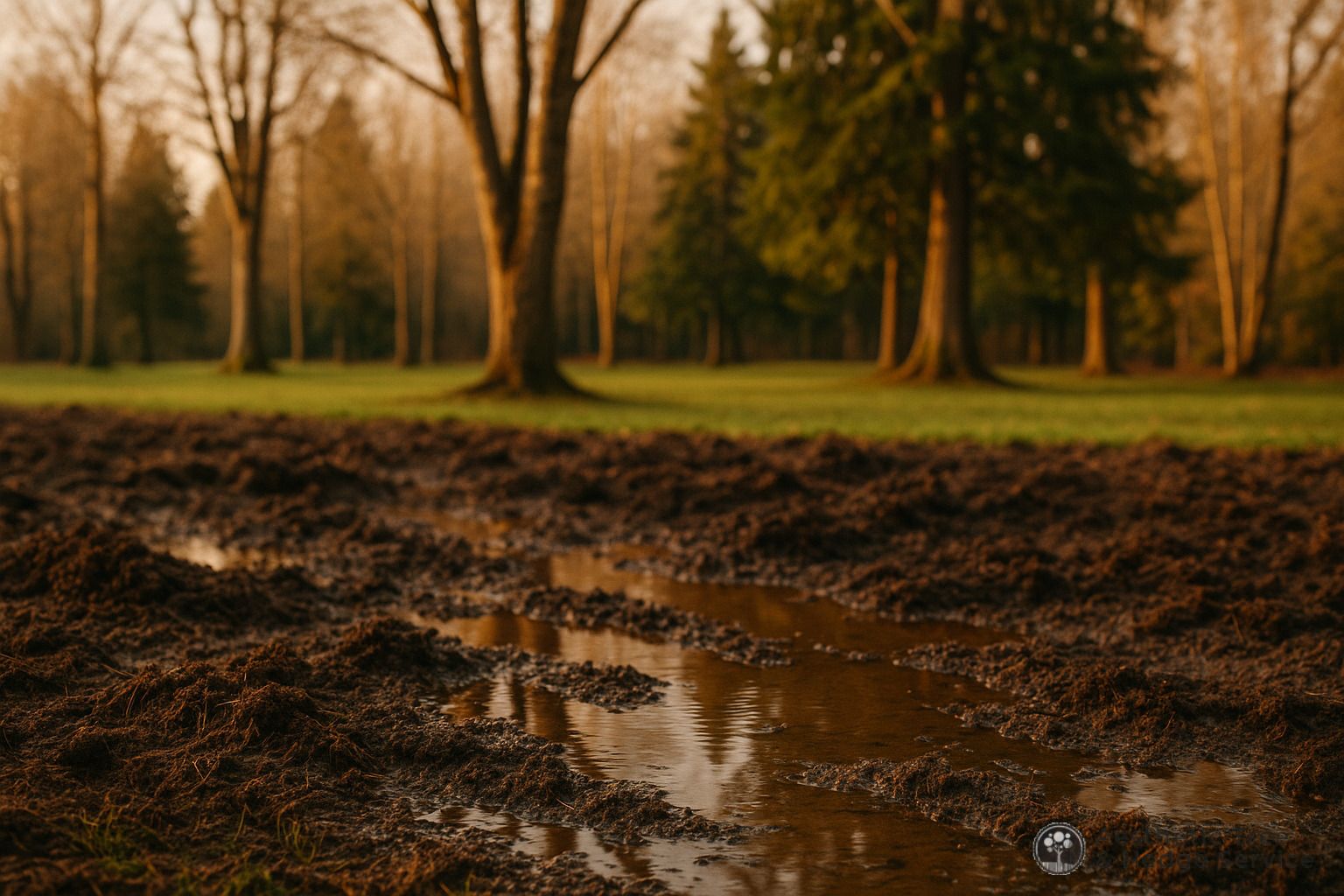
It's November. The rain has been falling for three straight weeks. Not Pacific storms — just the steady grey drizzle that soaks everything and never quite stops. You look out the kitchen window at the big Douglas fir in the corner of your yard. Something looks wrong. The branches droop lower than usual. The soil around the base gleams dark and wet. You walk out and your boot sinks two inches into the ground.
You think: *It's just the rain. Trees survive rain.*
But here's what you don't see. That soil stopped breathing weeks ago. The roots are already suffocating.
---
TL;DR
- Vancouver averages over 1,153 mm of precipitation annually (Environment Canada, 1981–2010 climate normals), and the Lower Mainland's clay-heavy glacial soils make chronic over-saturation nearly inevitable without active management.
- Waterlogged, oxygen-free soil begins damaging tree roots within 24–48 hours. By the time you see canopy decline, root damage has usually been progressing for one to three years.
- Warning signs include standing water 24+ hours after rain stops, spongy soil at the root zone, early leaf drop, and mushrooms at the base of the trunk.
- Solutions range from French drains and soil aeration to proper mulching technique and species-appropriate replanting — but the right fix depends on your specific site.
- An ISA-certified arborist assessment is the only reliable way to know whether your tree can recover or needs to come down before it becomes a hazard.
---
Why Is Vancouver Soil So Prone to Over-Saturation?
Vancouver sits at the edge of the Pacific and gets hammered with moisture from October through April. The city averages over 1,153 mm of precipitation per year, according to Environment Canada's 1981–2010 climate normals. That's more than double Toronto's annual rainfall.
But the rainfall alone isn't the whole problem.
The real trouble is underground. Much of Metro Vancouver — especially Burnaby, Coquitlam, and the North Shore — sits on clay-heavy glacial till left behind by retreating ice sheets thousands of years ago. Clay soil is dense. It compacts under foot traffic, vehicle weight, and years of surface pressure. And it drains slowly.
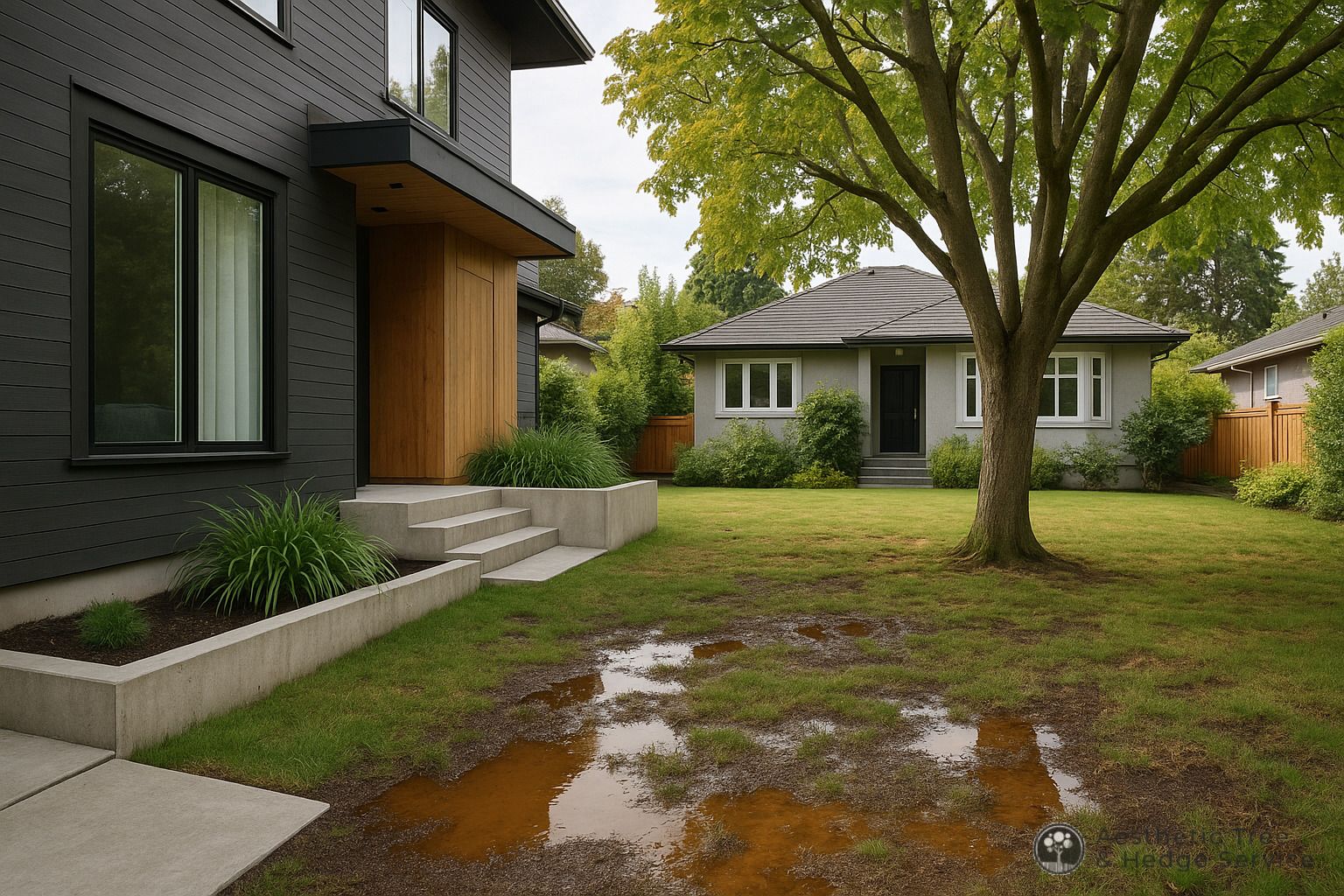
In Richmond and Delta, the problem gets worse. These areas sit on Fraser River delta sediments, with water tables often sitting less than two metres below the surface. During wet seasons, some residential lots see groundwater within one metre of grade.
So when Vancouver's rain falls for three weeks straight, the soil reaches complete saturation. The tiny pore spaces between soil particles — the channels that carry water downward and let oxygen in — fill completely. What's left is essentially wet concrete. Dense, airless, hostile to everything alive in the root zone.
Your tree isn't growing in soil. It's growing in a sponge.
---
What Does Over-Saturated Soil Actually Do to Tree Roots?
Most people think roots just need water. They do. But they also need oxygen.
Tree roots breathe. They absorb oxygen from air pockets in healthy, well-draining soil. When those pockets fill with water, roots begin to suffocate. The International Society of Arboriculture (ISA) notes that truly anaerobic — oxygen-free — soil conditions can begin causing root damage within 24 to 48 hours of complete saturation.
That's one heavy rain event.
Three things happen in sequence when roots suffocate.
**Root cell death begins.** Without oxygen, root cells can't generate energy. They die at the tips first — the fine roots responsible for water and nutrient uptake. These are the roots your tree depends on most.
**Pathogen invasion follows.** Waterlogged, oxygen-depleted soil is the preferred habitat for *Phytophthora ramorum* and related water mould pathogens. These aren't true fungi — they're oomycetes, highly adapted to wet, anaerobic conditions. Once fine root tissue begins dying, these organisms move in fast. The BC Ministry of Forests has identified Phytophthora root rot as one of the leading causes of tree decline and death across coastal BC's urban and residential areas.
**The whole tree weakens.** Dead roots can't pull nutrients or water up into the canopy. Paradoxically, a tree standing in saturated soil can simultaneously be dying of water stress at the crown. The leaves don't know why they're not getting water. They go yellow. They drop early. New growth comes in sparse and weak.
Here's the cruel part. This happens underground, invisibly. By the time you see canopy decline, root damage has often been progressing for one to three years.
---
How Do You Know If Your Soil Is Too Wet?
You don't need a soil meter. The warning signs are visible if you know what to look for.
**Standing water that won't drain.** If water pools in your yard and stays standing for more than 24 hours after rainfall stops, drainage is inadequate. Healthy, well-structured soil should drain most surface water within 6–12 hours.
**Spongy, soft ground near the root zone.** Push a wooden stake or a pencil into the soil at the drip line — the outer edge of the canopy overhead. In healthy soil, it should meet resistance within 15–20 cm. In saturated soil, it slides straight in.
**Surface algae and persistent moss.** Green-black algae on garden beds and moss growing where it doesn't belong are signs of chronically wet, low-oxygen surface conditions. These aren't cosmetic problems. They're indicators.
**Canopy decline.** Yellowing leaves in July or August. Early drop. Sparse spring growth. Crown dieback starting from the branch tips and working inward. These are the tree's distress signals — and Vancouver homeowners misread them constantly. They chase aphids and scale insects while the real problem is six inches underground.
**Mushrooms or bracket fungi at the base.** Fungal fruiting bodies near the root flare or trunk base are often late-stage signs of internal wood decay, frequently accelerated by root death in waterlogged conditions.
**Bark cracks or weeping near the root flare.** Particularly common in cherry, birch, and western red cedar. Saturated soil stresses bark cambium directly, especially at the transition zone between trunk and root system.
If you're seeing two or more of these signs together, your tree needs a professional hazard assessment — not just drainage fixes.
---
What Are the Best Ways to Fix Waterlogged Soil in Vancouver?
The right solution depends on the severity and the cause. Here are the practical approaches, starting with the most impactful.
Can You Fix It With a French Drain?
For serious drainage problems, yes. A French drain is a gravel-filled trench with a perforated pipe at the bottom that intercepts and redirects groundwater away from a problem zone.
Properly installed, a French drain placed at the perimeter of the root zone — at or beyond the drip line — can prevent water from accumulating where it damages roots. The critical word is *perimeter*. Don't run trenches through the root mass itself. Cutting through established root systems to install drainage creates a different kind of damage. Before any excavation near a mature tree, an arborist assessment is essential.
For lower-slope situations, dry creek beds and bioswales are less invasive alternatives that manage surface water without subsurface disruption.
Does Soil Aeration Actually Do Anything for Tree Roots?
Yes. Aeration breaks up compaction and restores the pore structure that allows drainage and oxygen exchange.
For trees specifically, the professional tool is pneumatic air excavation — the AirSpade. This tool uses compressed air to fracture compacted soil without cutting roots. An ISA arborist can work throughout the root zone using an AirSpade, remove compacted material, incorporate coarse organic amendments, and restore drainage structure — without the root damage that comes from mechanical digging.
This isn't a DIY project. But for trees showing early-stage stress in compacted, saturated soil, soil aeration via air excavation is genuinely restorative. It's one of the most effective interventions available before root damage becomes irreversible.
What About Raised Beds and Soil Amendments?
For new plantings, raised beds are excellent. Lifting the root zone above the water table and using well-draining amended soil dramatically reduces saturation risk.
But you can't raise a mature tree's root zone after the fact. Mounding soil against an existing trunk creates its own serious problem — bark rot at the root flare. This is as damaging as waterlogged roots. Never pile soil against a trunk as a drainage workaround.
If you're planning new tree planting in a known problem area, raise the planting site 30–45 cm using well-draining amended soil. And choose species matched to the site. Sitka alder (*Alnus sinuata*), Pacific willow (*Salix lucida*), and red-osier dogwood (*Cornus sericea*) thrive where drainage-sensitive ornamentals fail.
For existing trees with compacted root zones, radial trenching — narrow trenches cut outward from the root zone toward the drip line — allows soil amendment and drainage channel installation without severing major lateral roots. This is specialist work, but it's effective when the damage is caught early.
---
Does Mulching Help or Hurt With Over-Saturated Soil?
Multhing is one of the most misunderstood tools in urban arboriculture. Done right, it helps. Done wrong, it accelerates exactly the problem you're trying to fix.
Here's how it helps.
Organic mulch — wood chips, arborist chips, composted bark — improves soil structure over time as it breaks down. It feeds soil microbes that create natural pore structure and drainage channels. A good mulch layer also reduces compaction from rain impact, which matters more than most people realize. The BC Ministry of Agriculture recommends organic mulch applications of 5–10 cm depth as standard practice for improving urban soil health and water infiltration.
Here's how it hurts.
Mulch piled against the trunk — the "mulch volcano" pattern you see everywhere — traps moisture against bark and root flare. It creates exactly the anaerobic conditions you're trying to prevent, right at the most critical point of the tree. In a city that gets 1,100 mm of rain a year, mulch volcanoes accelerate crown and root rot faster than almost any other single management error.
The rule is simple. Mulch like a donut, not a volcano. Keep mulch 15–20 cm clear of the trunk in all directions. Spread it wide under the canopy — out to the drip line if possible — at 7–10 cm depth. Our mulching services follow ANSI A300 standards precisely because this detail matters. Applied correctly, mulch is one of the best things you can do for a tree in Vancouver's wet climate. Applied incorrectly, it's a slow-motion killer.
---
What Role Do Root Barriers Play in Water Management?
Root barriers are primarily designed to redirect root growth away from structures, sidewalks, and utility pipes. But they serve a secondary function in saturated soil situations: they can prevent roots from spreading into chronically wet zones.
If your drainage problem is localized — a corner of the yard that holds water, or a low area near a property line — a root barrier can prevent your tree's roots from being drawn into that wet zone as they naturally grow toward available moisture.
This is a proactive management strategy. Install barriers during healthy periods, before roots have colonized the problem zone. They won't rescue a tree whose roots are already waterlogged. But as part of a broader drainage and soil management plan, they're a useful tool.
---
When Is Over-Saturated Soil Dangerous Enough to Call an ISA Arborist?
Earlier than you think.
The signs that warrant immediate professional assessment:
- Any visible canopy decline — yellowing, early leaf drop, sparse spring growth, crown dieback
- Mushrooms or bracket fungi at the trunk base or root flare
- Bark discolouration, cracks, or weeping near the base of the tree
- Surface roots heaving or lifting
- The tree has been showing stress symptoms for more than one growing season
- Any tree within fall distance of your house, a fence, or a neighbouring structure
What an ISA-certified arborist brings is diagnostic precision. Not every stressed tree in wet soil needs to come down. Some need drainage work plus targeted soil management. Some need monitoring over one season. Others have progressed to structural compromise — and those trees need to come down safely and on a schedule, not unexpectedly during a windstorm.
An arborist report documents the tree's current condition, quantifies the risk level, and outlines the recommended course of action. In Metro Vancouver, this report is often required anyway. The City of Vancouver's Street Tree Bylaw (Chapter 96) governs trees on boulevards and adjacent private property. The City of Burnaby's Tree Bylaw (2015) requires permits for removal of any tree with a trunk diameter exceeding 20 cm at 1.4 m height. North Vancouver District and City both treat significant root work as potential tree removal under their respective protection bylaws — triggering the same permit and assessment requirements.
For trees in immediate danger — unusual lean, base cracks, roots lifting — don't wait for a standard consultation. Call for emergency tree service immediately. A failing tree doesn't wait for a convenient appointment window.
---
Which Tree Species Handle Vancouver's Wet Soil Best?
If you're replanting after removing a tree that failed in saturated conditions, species selection matters more than any soil amendment. The right tree on the right site outlasts a wrong-species tree no matter how much drainage work you do.
These species handle Vancouver's wet winters and seasonally saturated soils well:
- **Red alder (*Alnus rubra*)** — BC native. Colonizes disturbed wet sites naturally. Fixes nitrogen, improves soil biology. Fast-growing with wildlife value.
- **Pacific willow (*Salix lucida* ssp. *lasiandra*)** — Extremely tolerant of wet and flood conditions. Best for larger residential or commercial sites with space.
- **Sitka spruce (*Picea sitchensis*)** — Coastal BC native adapted to heavy, moist soils. Slower-growing but structurally excellent for long-term urban canopy.
- **Western red cedar (*Thuja plicata*)** — Thrives in moist to moderately wet conditions. BC's iconic forest tree tolerates seasonal saturation well when not permanently inundated.
- **Cascara (*Rhamnus purshiana*)** — Underused urban species with good moisture tolerance, early spring pollinator value, and a clean growth habit.
Avoid planting ornamental cherry, Japanese maple, birch, and ornamental pear in sites with known drainage problems. These species dominate the hazard-tree assessments we conduct in wet Lower Mainland years. They're beautiful in the right conditions. Saturated Lower Mainland clay is not the right condition.
---
How Can You Tell If Root Rot Has Already Set In?
Root rot doesn't announce itself. By the time above-ground symptoms appear, underground damage is often extensive. Here's how to check.
Start at the root flare — the point where the trunk widens and transitions to the root system. Pull back any mulch and look for:
- Dark, mushy bark at or below soil level
- White or pale tan mycelial mats visible under loose bark near the base
- Roots that are black or brown instead of the healthy cream-white colour when you scratch the surface with a fingernail
- A strong musty or fermented smell from the soil immediately surrounding the root flare
Above ground, look for:
- Stunted growth across two or more consecutive seasons
- Premature leaf drop in late summer — August or September instead of October
- Sparse, yellowing foliage concentrated in the upper crown
- Dieback progressing from branch tips inward
- New lean that wasn't present in previous years
None of these signs alone confirms root rot. But two or more together — especially combined with a history of waterlogged soil — warrants an assessment before the next storm season.
For any tree showing these signs in combination with structural concerns — proximity to a structure, crown weight, existing lean — a formal hazard assessment from an ISA-certified arborist is not optional. It's the responsible choice. When removal is the correct outcome, our team handles tree removal in Vancouver in full compliance with municipal permit requirements. We assess, document, remove, and leave your site ready for whatever comes next.
---
FAQ
**Q: How long can a tree survive in completely waterlogged soil?**
A: It depends on the species and the tree's existing health. Stress-tolerant species like alder and willow can handle weeks of saturation. Most common urban ornamental trees — maple, birch, cherry, ornamental pear — begin sustaining root damage within 24–72 hours of complete anaerobic saturation. Chronic waterlogging over multiple seasons is almost always fatal without active intervention.
**Q: Does adding sand to Vancouver clay soil actually improve drainage?**
A: Not reliably — and done incorrectly, it makes drainage worse. Adding small amounts of coarse sand to clay creates a mixture with worse drainage than either material alone. Effective amendment requires incorporating enough coarse sand and organic matter to fundamentally change the soil texture — typically 30–40% by volume. That's impractical for in-place tree root zones without major excavation. Organic compost amendments and biological approaches are typically more effective for existing trees.
**Q: Can a tree recover from root rot caused by waterlogged soil?**
A: Sometimes, if caught early. Early-stage Phytophthora infections with less than 30–40% root system involvement can respond to improved drainage, soil aeration, and in some cases, targeted phosphonate-based treatments registered in BC. Trees with significant structural root damage rarely recover fully. An ISA arborist assessment is the only reliable way to determine what's salvageable and what isn't.
**Q: Are Vancouver's drainage problems getting worse over time?**
A: According to Environment and Climate Change Canada's 2022 updated Intensity-Duration-Frequency data for Metro Vancouver, extreme rainfall events — the 24-hour heavy downpours that truly saturate soil — have been increasing in intensity. More intense short-duration rainfall creates saturation faster than chronic drizzle, because the soil can't drain between events. Soil drainage management is increasingly relevant across the Lower Mainland's urban tree canopy.
**Q: What's the difference between over-saturated soil and a high water table?**
A: Over-saturated soil typically refers to topsoil and subsoil holding water due to poor drainage — clay content, compaction, or impermeable surfaces. A high water table means groundwater is naturally close to the surface regardless of topsoil drainage quality. Both are damaging to tree roots, but the solutions differ. High water table problems in areas like Richmond and Delta require raised planting, species selection for wet sites, and sometimes accepting that certain species simply don't belong on that property. Drainage improvements alone cannot lower a water table.
---
Call Vancouver's ISA-Certified Arborists — Free Estimate
You've read the warning signs. You know what waterlogged soil does to roots over time. But knowing the theory and diagnosing your specific trees in your specific yard are two different things.
Every property is different. Every tree is different. What looks like simple waterlogging might be early Phytophthora infection already three years in. What looks like a dying tree might be a recoverable situation with the right drainage work and timing.
Don't guess. Get a professional set of eyes on it.
**Call Aesthetic Tree & Hedge Services for a free estimate: (604) 721-7370.**
We're ISA-certified arborists, WCB registered, serving Vancouver, Burnaby, North Vancouver, Richmond, Coquitlam, and the broader Lower Mainland. We know BC's municipal tree bylaws cold. We know what Phytophthora looks like at the root flare. We know which trees can be saved with soil work and which ones are already a hazard.
We'll tell you exactly what your trees need — drainage intervention, soil management, monitoring, or removal. No pressure. Just accurate, expert assessment from arborists who understand Vancouver soil, Vancouver weather, and Vancouver trees.
Your trees have been standing in the rain. Time to give them a fighting chance.
*Author: Aesthetic Tree & Hedge Services, ISA-Certified Arborists. Serving Metro Vancouver.*
Found this helpful? Follow our tree care insights directly on Google.
Make us your preferred source on GoogleBefore You Go
Where are you in your tree care journey?
Our Tree Care Services
ISA-certified arborists serving Greater Vancouver


Explore Our Tree Care Services
From expert pruning to safe tree removal, our ISA-certified arborists are ready to help across Greater Vancouver.
View Services