

TL;DR — Quick Summary
how to storm proof your trees before wind season hits. Learn pruning, risk signs, permits, and when to call an ISA-certified arborist.
how to storm proof your trees starts with one hard truth: a storm does not create every tree failure.
It exposes the weak points already there.
A split union. A buried root flare. A dead top. A cedar that has been lion-tailed. A Big-leaf maple with heavy limbs over a roof. A Douglas fir with roots cut during a driveway job.
The wind only finishes the argument.
In Vancouver, Burnaby, North Vancouver, Richmond, Coquitlam, and the wider Lower Mainland, that argument gets loud. We get saturated soils. We get coastal gusts. We get atmospheric rivers. We get tall conifers beside homes, lanes, garages, wires, and fences.
Storm proofing does not mean making a tree storm-proof in the absolute sense. No arborist can promise that. It means reducing the chance of failure before the next wind warning.
That work is not guesswork. It is inspection, pruning, weight reduction, root care, cabling where suitable, and removal when the risk is no longer acceptable.
TL;DR
- Start before storm season. Once the wind is up, it is too late to prune safely.
- Look for dead limbs, cracks, fungus, leaning, soil heaving, weak V-shaped unions, and buried root flares.
- Do not top trees. Topping creates weak regrowth and more future storm risk.
- Use ISA-certified arborists who follow ANSI A300 standards for pruning and risk work.
- In many Lower Mainland cities, removing a protected tree needs a permit. Vancouver, Richmond, and the City of North Vancouver all use a 20 cm diameter threshold for many private-property trees.
What Does It Mean To Storm Proof Your Trees?
Storm proofing means preparing trees so they shed wind, carry load, and keep sound structure.
It is not a one-day trick.
It is a tree care plan built around risk.
A good storm plan asks five questions:
- What part of the tree is most likely to fail?
- What target would it hit?
- Can pruning lower the load?
- Are the roots stable and healthy?
- Is removal the safer choice?
That last question matters. Some trees can be retained with proper care. Some cannot. A cracked trunk over a child’s bedroom is not a sentimental decision. It is a hazard assessment.
The International Society of Arboriculture teaches that landscape trees need more care than forest trees because homes, roads, and people sit below them. TreesAreGood, ISA’s public education site, states in its 2026 pruning guidance that improper pruning can create lasting damage or shorten a tree’s life.
That is why storm preparation must be selective.
We do not strip the inner canopy. We do not leave long branch stubs. We do not cut large limbs without a reason. We do not remove lower limbs just to make a tree look taller.
We inspect first. Then we cut with purpose.
For homeowners, the main goal is simple. Keep the tree strong enough to live, and light enough to survive weather.
If your tree already has large dead limbs, storm cracks, or a recent lean, book a tree risk and arborist report before the next major system arrives.
Why Do Vancouver Trees Fail During Windstorms?
Vancouver trees fail in storms because wind, rain, roots, structure, and site history collide.
Wind is only one part.
Heavy rain softens soil. Saturated soil gives roots less grip. Wind then pushes the crown back and forth. If the roots are damaged, decayed, shallow, or restricted, the whole tree can plate over.
Environment and Climate Change Canada’s 2025 warm-season weather guidance says inland wind warnings involve steady winds of 60 to 65 km/h or gusts up to 90 km/h or more. The same guidance notes that 60 to 70 km/h winds make walking against the wind difficult and can break small branches.
That is enough to matter.
Environment Canada’s hurricane hazards guide also lists 70 to 90 km/h winds as a range where small branches break, loose objects blow around, and power outages become possible.
Now add Vancouver conditions.
Many yards have:
- Tall Douglas firs close to houses.
- Western red cedars with sparse lower crowns.
- Big-leaf maples with heavy horizontal limbs.
- Hedges acting like sails.
- Tree roots cut for patios, drains, fences, and laneways.
- Compacted soil from parking and construction.
- Waterlogged ground during fall storms.
BC Hydro’s 2025 storm outage release reported that more than 1.4 million customers had weather-related outages in 2024, the highest total in its history. BC Hydro also said three storms on the South Coast and Vancouver Island in November and December caused about one million customer outages combined.
BC Hydro tied much of that damage to drought-stressed trees and vegetation that became more likely to fall into infrastructure.
That is the Lower Mainland pattern now.
Dry summers weaken trees. Wet falls load the soil. Wind does the rest.
In our field work across Vancouver and nearby cities, the trees that worry us are often not the ugliest trees. They are the ones with hidden structure problems. A green crown can still sit on weak roots. A full maple can still have included bark. A cedar can look alive but have a dead top.
Storm prep starts by seeing what the wind sees.
How Can You Tell If A Tree Is Dangerous Before A Storm?
You can spot many warning signs from the ground.
Do not climb the tree. Do not put a ladder against a suspect stem. Do not pull on hanging limbs. Look from a safe distance.
Start at the base.
The root flare should be visible where the trunk widens into the soil. If the trunk drops into the ground like a telephone pole, soil or mulch may be buried against the stem. That traps moisture. It can hide decay. It can also hide girdling roots.
Then look for soil movement.
Fresh cracks in the soil, raised turf, or a lifted root plate are serious signs. If the tree leaned after a storm and the soil moved, treat it as urgent.
Next, scan the trunk.
Look for:
- Vertical cracks.
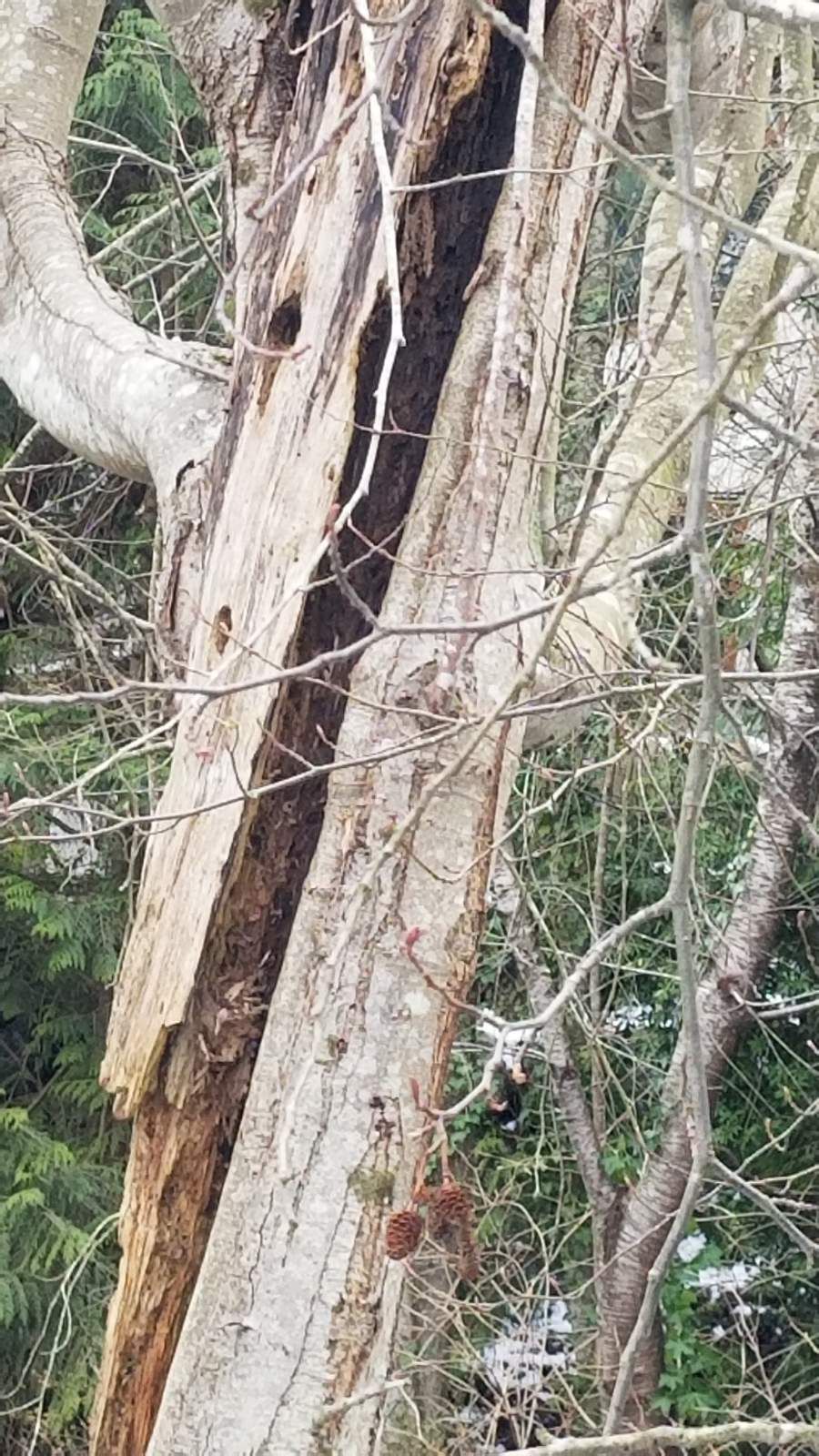
- Open cavities.
- Mushrooms or conks.
- Missing bark.
- Wet staining.
- Old topping cuts.
- Fresh splits below large limbs.
Then look at the crown.
Dead limbs are common failure points. So are long branches with most of their weight at the tips. Crossed limbs rub through bark. Tight V-shaped unions often trap included bark, which means the two stems do not connect with strong wood.
A 2021 systematic review in Arboriculture and Urban Forestry found that tree failure is linked to biological causes such as decay and low vigor, weather causes such as wind and drought, mechanical issues such as cracks and weak unions, and site issues such as compacted soils.
That list matches what we see on real properties.
The target matters too.
A dead limb over a garden bed is one level of risk. The same limb over a driveway, sidewalk, service wire, bedroom, or neighbour’s roof is another.
Call an arborist fast if you see:
- A new lean after wind or rain.
- Soil heaving near the trunk.
- A split trunk or major branch union.
- A large hanging limb.
- Fungus at the base.
- A dead top in a conifer.
- Roots cut within the dripline.
- Branches touching or near power lines.
If a tree or limb has already failed, use an emergency tree service. Keep people out of the drop zone until the site is controlled.
When Should You Prune Trees For Storm Protection?
Prune before the storm season, not during it.
In the Lower Mainland, the best timing depends on species, condition, and the pruning goal. Many structural and clearance cuts can be planned during dormancy. Some deadwood can be removed any time when safe access exists.
The key is timing the work before weather forces a rushed decision.
Storm pruning is not about making the tree smaller everywhere. It is about reducing specific loads.
For mature trees, that can include:
- Removing dead, broken, or hanging limbs.
- Reducing end weight on long limbs.
- Pruning weakly attached branches.
- Improving clearance from roofs and structures.
- Reducing wind sail where the crown is too dense.
- Correcting rubbing or crossing limbs.
- Managing codominant stems when possible.
For young trees, structural pruning is even more powerful.
A young tree can be guided toward one dominant leader. Bad unions can be corrected while cuts are small. Branch spacing can be improved. Future storm risk drops because the tree grows better architecture.
That is the part many homeowners miss.
The cheapest failure is the one you prevent ten years early.
For older trees, heavy cuts are not always safer. Removing too much live crown stresses the tree. It can trigger weak shoots. It can expose bark to sunscald. It can reduce the tree’s ability to feed itself.
That is why Aesthetic Tree & Hedge Services works to ANSI A300 pruning standards. Those standards guide cut type, dose, purpose, and tree response.
If a tree has grown too close to a structure, use professional tree cutting in Vancouver rather than hard topping. Proper reduction cuts lower risk while protecting long-term structure.
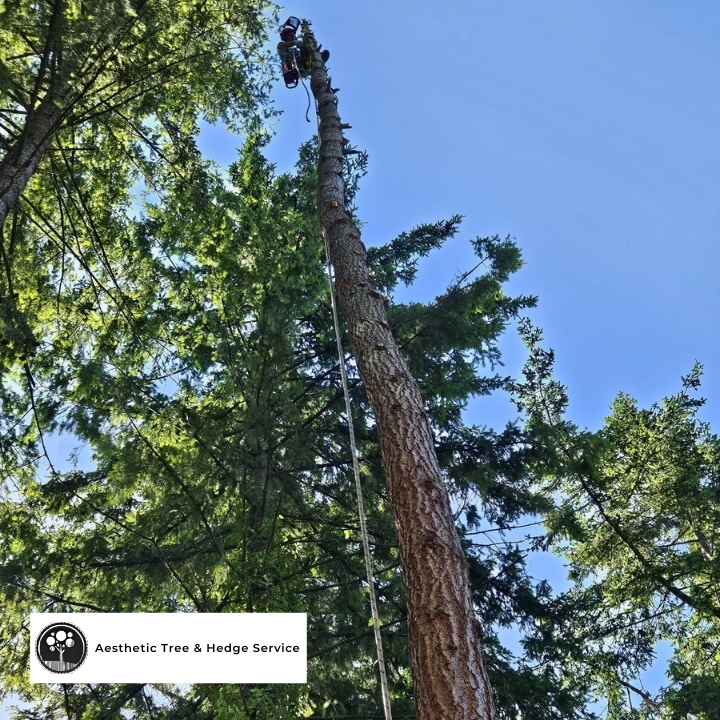
Why Is Tree Topping A Bad Way To Prepare For Storms?
Tree topping is one of the fastest ways to make future storm risk worse.
It looks decisive. It feels like control. It is usually bad arboriculture.
Topping removes the upper crown with large heading cuts. The tree responds by pushing fast shoots near the cuts. Those shoots are often weakly attached. They grow quickly. In a few years, they become tall levers with poor unions.
Now the tree has more failure points than before.
Topping also opens large wounds. Large wounds close slowly. Decay can enter. The crown loses food-producing leaf area. The tree becomes stressed. Stressed trees attract pests and disease.
A topped tree can also become ugly in a way that never fully recovers.
There is a better way.
Reduction pruning uses cuts back to suitable laterals. Crown cleaning removes dead or broken limbs. Structural pruning improves branch spacing and leader selection. Crown thinning is used carefully and only where the tree needs it.
The difference is intent.
Topping says, make it short.
Arboriculture says, make it safer while keeping the tree alive.
The USDA Climate Hubs guidance on wind and ice damage states that storm resistance is affected by tree form, size, condition, species, wind speed, pruning, and wood properties. That means pruning can help, but only when it respects how trees carry load.
Bad cuts solve today’s fear and create tomorrow’s failure.
If a tree has already been topped, do not keep repeating the damage. Have an ISA-certified arborist inspect the regrowth. Some trees can be retrained over time. Others become candidates for removal if decay and weak sprouts create too much risk.
For unsafe trees that cannot be retained, Aesthetic Tree provides professional tree removal in Vancouver with permit awareness and site protection.
Which Tree Species In The Lower Mainland Need Extra Storm Attention?
Some local species deserve closer attention because of size, growth habit, or common site stress.
Douglas fir is one of them.
A sound Douglas fir can be a strong tree. But it is tall. It carries huge sail area. It often sits near homes built long after the tree was established. Root damage from excavation, trenching, grade changes, or driveway work can turn a stable fir into a serious hazard.
Western red cedar is another.
Cedars often decline from drought stress, root restriction, and poor soil conditions. A thinning top, heavy cone load, dead upper crown, or sudden browning needs attention. Cedars can also fail when hedged or stripped in ways that leave poor live growth distribution.
Big-leaf maple needs structural review.
These maples can develop large spreading limbs. They also form codominant stems and heavy branch unions. A mature maple over a roof or lane should be checked for included bark, decay pockets, and end-heavy limbs.
Cherry and plum trees need care too.
They are common in Vancouver yards. They can develop decay after poor pruning. Large old cuts, cavities, and fungal signs deserve a closer look.
Hedges can create storm problems as well.
A tall cedar hedge can act like a wall in wind. If it is overgrown, uneven, or root-stressed, sections can split or lean. A hedge beside a sidewalk or driveway should be kept dense, balanced, and within a manageable height.
For that work, professional hedge trimming in Vancouver helps reduce sail while keeping the hedge healthy and presentable.
Species is only the start.
A healthy tree of a weaker species can be safer than a damaged tree of a stronger species. Site history matters. Soil matters. Past cuts matter. Construction matters.
When we assess a tree, we look at the whole setting. A tree is not just a trunk. It is a structure connected to soil, water, wind, buildings, and targets.
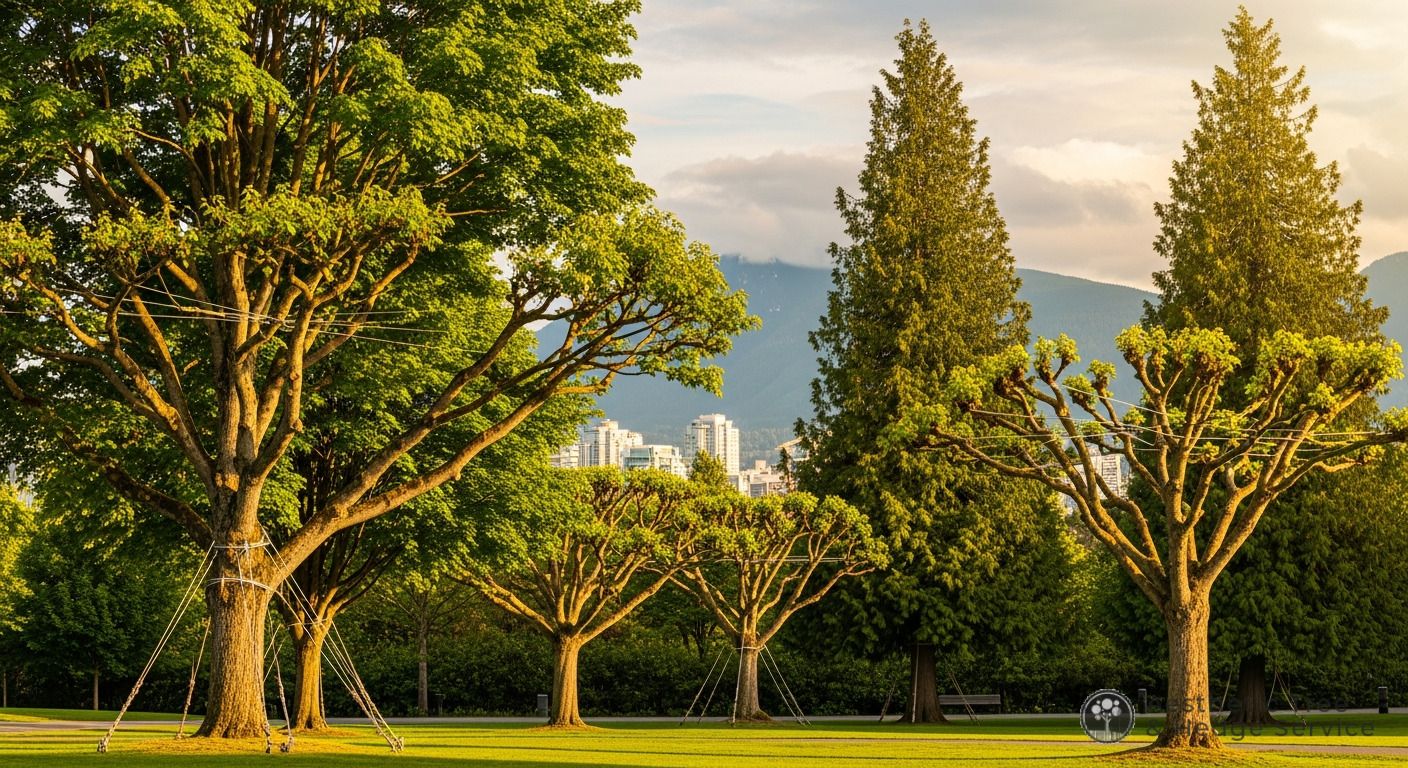
How Do Roots And Soil Affect Storm Safety?
Roots decide whether a tree stays upright.
The crown gets the attention. The roots carry the verdict.
Most absorbing roots grow in the upper soil. They need oxygen. They need space. They need stable moisture. They do not respond well to compaction, trenching, grade changes, or heavy equipment.
Common root risks include:
- Soil piled against the trunk.
- Mulch volcanoes around the stem.
- Driveway cuts through major roots.
- Drainage trenches inside the dripline.
- Compacted parking areas.
- Construction fill over roots.
- Retaining wall work near the tree.
- Repeated drought stress.
A buried root flare is a warning sign. It means the base is hidden. Decay and girdling roots can develop out of sight.
Girdling roots wrap around the trunk or major roots. Over time, they can choke vascular flow and weaken stability. They are common on poorly planted trees and trees installed too deep.
Saturated soil adds stress.
When rain soaks the ground, roots lose some holding power. Then wind loads the crown. Trees with shallow, damaged, or decayed root systems are more likely to uproot.
Root care is storm care.
Good steps include:
- Keep the root flare visible.
- Use mulch in a wide, thin ring.
- Keep mulch away from the trunk.
- Avoid trenching inside the dripline.
- Do not park on root zones.
- Water drought-stressed trees during dry periods.
- Ask before cutting roots near structures.
Mulch is simple, but it is powerful when done right. It protects soil moisture, buffers temperature, and reduces mower damage. Aesthetic Tree offers mulching services when trees need better root-zone conditions.
If roots are lifting hardscape or pushing toward foundations, do not cut first and ask later. Root cutting can change stability. In some cases, a root barrier is part of the plan. In other cases, removal or redesign is safer.
Can Cabling Help A Storm-Damaged Or Weak Tree?
Cabling can help some trees. It is not a cure.
Tree cabling adds support between stems or limbs. It is often considered when a tree has a weak union, codominant stems, or a valuable structure worth retaining.
The purpose is to reduce movement and lower the chance of failure at a known weak point.
But cabling has limits.
It does not fix decay. It does not make a dead tree safe. It does not replace pruning. It does not remove the need for inspection. A cable is a support system, not a guarantee.
Good cabling starts with a risk assessment.
An arborist checks:
- Species.
- Union shape.
- Included bark.
- Crack depth.
- Decay signs.
- Target below the tree.
- Crown weight.
- Root condition.
- The value of retaining the tree.
Then the arborist decides if cabling, pruning, or removal is the right move.
Some trees need both pruning and cabling. End weight reduction lowers force on the weak union. Cabling then adds support. Other trees are too compromised and should not be retained over high-value targets.
This is where experience matters.
A cable installed in the wrong place gives false confidence. A cable on a decayed stem can hide the real risk. A cable without follow-up inspection becomes an old piece of hardware in a growing tree.
Aesthetic Tree provides tree cabling for suitable trees after inspection. We use it when it makes arboricultural sense, not as a sales add-on.
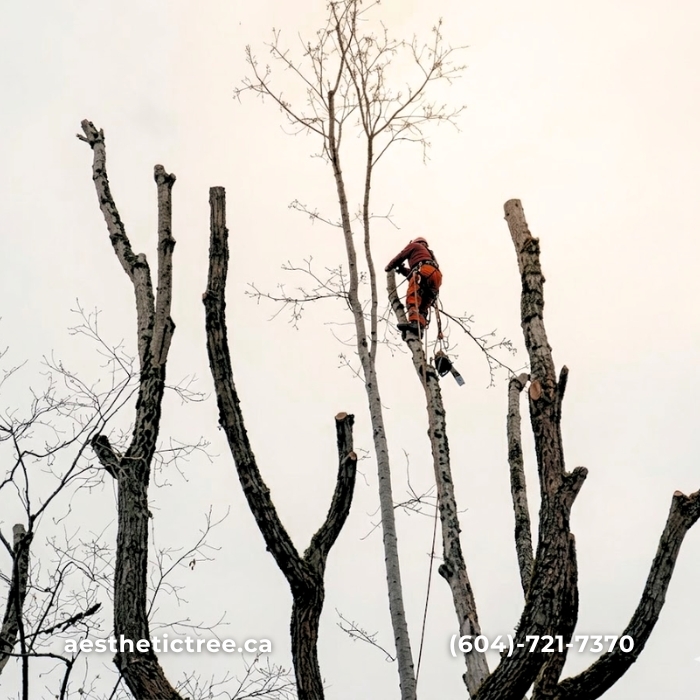
Do You Need A Permit To Remove A Storm-Risk Tree In Vancouver?
Often, yes.
Tree bylaws matter across the Lower Mainland. They change by city. They also change by tree size, species, property status, development context, and hazard status.
In Vancouver, the City of Vancouver’s Protection of Trees By-law 9958 states that a permit is needed to remove any private-property tree with a diameter of 20 cm or greater, measured 1.4 metres above the ground.
In Richmond, Tree Protection Bylaw No. 8057 generally restricts cutting or removing a tree larger than 20 cm diameter at breast height without a permit.
In the City of North Vancouver, the city’s private tree guidance says a permit is required to remove protected trees with a diameter of 20 cm or greater, measured 1.4 metres above the ground.
Burnaby also regulates protected trees through its Tree Bylaw, and replacement rules can apply when removal is approved.
Do not assume storm concern gives automatic permission.
Emergency conditions can change the process, but documentation matters. Photos, an arborist assessment, and clear records help show why work was needed.
This is where an ISA-certified arborist protects the homeowner.
We know how to assess the tree and speak the language cities expect: DBH, protected tree, hazard assessment, target, likelihood of failure, consequence of failure, and mitigation options.
If the tree is dangerous but permit rules apply, an arborist report in Vancouver can support the next step.
Permits are not paperwork for paperwork’s sake. They are part of urban forest management. Vancouver’s 2025 Urban Forest Strategy reports that the city has about 150,000 street trees, 36,000 specimen trees in golf courses and urban parks, and more than 1 million trees across 444 hectares of public forests and woodlands managed by City and Park Board staff.
The same 2025 city update states that Vancouver’s canopy has grown from 21 percent in 2013 to 25 percent city-wide, with a goal of 30 percent by 2050.
Those numbers explain the pressure. Cities want canopy. Homeowners need safety. Good arboriculture balances both.
What Should You Do After A Storm Damages A Tree?
First, control the danger zone.
Keep people away from hanging limbs, split trunks, and downed trees. Do not stand under broken branches. Do not touch trees on wires. Treat all downed lines as live. Call BC Hydro or emergency services where wires are involved.
Then document the damage.
Take photos from a safe distance. Capture the whole tree, the failed limb, the base, targets hit, and any visible cracks or soil lifting.
Next, call a qualified tree service.
Storm-damaged trees can shift under load. A limb on a roof can roll. A split trunk can release suddenly. A hung-up branch can fall without warning.
Professional crews bring rigging, saws, climbing systems, aerial lift access, and job-site controls. For large or difficult removals, crane work may be needed. Aesthetic Tree provides crane tree removal for complex sites where controlled lifting is safer than cutting pieces free by hand.
After the immediate hazard is handled, ask whether the tree can recover.
Some storm-damaged trees can be retained with proper pruning. Others lose too much structure. A tree with a split main stem, root plate movement, or severe trunk damage may need removal.
The stump also matters.
After removal, a stump can block replanting, attract decay organisms, or create a trip hazard. When the site is ready, stump grinding in Vancouver clears the remaining wood below grade so the area can be restored.
Do not rush replanting without checking soil and space. A replacement tree should fit the site at maturity. Planting the wrong species under wires or too close to a house creates the next storm problem.
How Can You Prepare Trees Before The Next Wind Warning?
A storm checklist should be simple enough to act on.
Use this before fall weather sets in.
Walk The Property
Check every tree that can hit a target. Targets include the house, garage, parked cars, fences, sheds, sidewalks, lanes, service lines, and neighbour structures.
Look from several angles. A lean is easier to see from a distance.
Check The Base
Find the root flare. Look for mushrooms, cavities, cracks, soft soil, heaving roots, or fresh movement.
If the base looks wrong, do not ignore it.
Scan The Trunk
Look for cracks, seams, dead bark, holes, and old large cuts. Pay close attention below major branch unions.
Read The Crown
Deadwood, broken limbs, hanging branches, long end-heavy limbs, and tight V unions need review.
Look At Clearance
Branches rubbing roofs can damage shingles and siding. Branches near service lines require care. Utility clearance is not homeowner pruning work.
Review Recent Site Work
New fences, drains, driveways, patios, retaining walls, and excavations can damage roots. If work happened inside the dripline, book an assessment.
Book Work Early
Storm season fills calendars fast. The best time to reduce risk is before everyone is calling about the same wind warning.
Keep Records
Save arborist reports, permits, photos, and invoices. They help with city files, insurance conversations, and future care.
The most useful step is the one homeowners delay: a pre-storm hazard assessment.
It tells you which trees need work now, which can wait, and which are not a concern. That keeps money and effort focused on real risk.
How Often Should An Arborist Inspect Your Trees?
Most homeowners should have high-target trees inspected every one to three years.
High-target means failure would hit something important. A large fir beside a house needs more attention than a small ornamental tree in the middle of a lawn.
Book sooner after:
- Major wind events.
- Heavy snow or ice loading.
- Construction near roots.
- Drainage changes.
- Drought stress.
- New cracks or leans.
- Large limb failure.
- Pest or disease signs.
Annual checks make sense for mature trees over homes, driveways, and public areas.
A qualified arborist does more than look for dead branches. They assess likelihood of failure, likely failure part, target, and consequence. That is the heart of tree risk work.
The U.S. Forest Service’s 2024 study on managing urban trees through storms found that urban forestry professionals see risk as tied to species, size, age, health, maintenance history, infrastructure, and community setting. That fits real work in dense Lower Mainland neighbourhoods.
A tree in Shaughnessy, Kitsilano, Burnaby Heights, Lynn Valley, or Steveston does not stand in isolation. It stands beside homes, roads, fences, utilities, and people.
Inspection turns vague worry into a work plan.
That plan may say prune. It may say cable. It may say monitor. It may say remove. It may say the tree is sound and needs no action now.
That last answer has value too.
Good arborists do not sell fear. They identify risk.
What Should You Ask Before Hiring A Storm Tree Service?
Ask direct questions.
Storm work is dangerous. Poor pruning can make the tree worse. Permit mistakes can create trouble with the city.
Use this list:
- Are you ISA-certified?
- Are you WCB registered?
- Do you carry liability insurance?
- Will pruning follow ANSI A300 standards?
- Do I need a municipal permit?
- Will you provide photos or an arborist report if needed?
- How will you protect roofs, fences, lawns, and neighbouring property?
- What is the plan for debris and stump work?
- Are you recommending pruning, cabling, removal, or monitoring?
- Why is that the right option?
Be cautious with anyone who recommends topping as the first answer.
Be cautious with vague claims. Be cautious with door-knockers after a storm. Be cautious with crews that cannot explain the cut plan.
A good arborist can explain the tree in plain language. They can point to the defect. They can name the target. They can explain why a cut reduces load. They can also tell you when not to cut.
That restraint matters.
Tree work is not just saw work. It is judgment under risk.
FAQ
Can you fully storm proof a tree?
No. You can reduce risk, not remove it. Trees are living structures. Wind speed, soil moisture, decay, roots, and targets all matter. A proper plan lowers the chance of failure through inspection, pruning, root care, cabling where suitable, or removal when needed.
Is it better to prune trees before or after storm season?
Before. Pre-storm pruning removes deadwood, reduces end weight, and corrects weak structure before wind loads the crown. After-storm pruning is still needed when damage happens, but it is reactive. Preventive pruning is safer and more controlled.
Should I remove a tree that leans toward my house?
Not always. Some trees have grown with a stable lean for decades. A new lean is different. Soil cracking, root lifting, or a lean that appeared after rain or wind needs urgent assessment. An ISA-certified arborist can decide if pruning, cabling, monitoring, or removal is the right step.
Do I need a permit to remove a dangerous tree in Vancouver?
Often, yes. Vancouver requires a permit to remove many private-property trees with a diameter of 20 cm or greater measured 1.4 metres above ground. Emergency situations need documentation. An arborist report can support the permit process and show why action is needed.
Who should I call if a tree falls during a storm?
If wires are involved, stay away and call BC Hydro or emergency services. If the tree hit a structure, blocks access, or has hanging limbs, call a professional emergency tree crew. Aesthetic Tree & Hedge Services provides emergency tree work, removals, pruning, stump grinding, and arborist reports across Vancouver and the Lower Mainland.
Call Aesthetic Tree & Hedge Services for a free estimate at (604) 721-7370. Our ISA-certified arborists are WCB registered, safety-first, and experienced with Vancouver, Burnaby, North Vancouver, Richmond, Coquitlam, and Lower Mainland tree bylaws.
Found this helpful? Follow our tree care insights directly on Google.
Make us your preferred source on GoogleBefore You Go
Where are you in your tree care journey?
Our Tree Care Services
ISA-certified arborists serving Greater Vancouver


Explore Our Tree Care Services
From expert pruning to safe tree removal, our ISA-certified arborists are ready to help across Greater Vancouver.
View Services