
TL;DR — Quick Summary
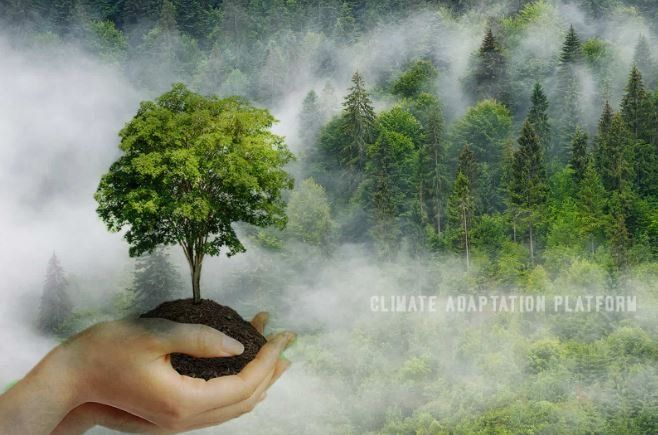
Role trees play in climate change mitigation in Vancouver is measurable, documented, and underestimated. ISA-certified arborists break it down.
The role trees play in climate change mitigation in Vancouver goes far beyond street appeal.
Trees are infrastructure. They sequester carbon, cool neighborhoods, filter air, and intercept stormwater — every hour of every day.

Right now, Vancouver's urban forest is under pressure.
Development is intensifying. The Invasive Shot Hole Borer beetle is spreading through the Lower Mainland. Heat events are becoming more extreme. Trees are dying faster than they're being replaced in some neighborhoods.
That's a climate problem. Not just a property problem.
Here's what every Vancouver homeowner needs to know about urban trees, climate change, and what you can do about it.
TL;DR
- A single mature tree absorbs an average of 21.77 kg of CO₂ per year, according to the US Forest Service's urban forestry research
- The City of Vancouver Urban Forest Strategy targets 30% canopy cover citywide — current coverage sits at approximately 22%
- Properly maintained trees live longer and sequester far more carbon over their lifetimes
- Douglas fir, Western red cedar, and Big-leaf maple are the Lower Mainland's top climate-performing species
- Removing a mature tree without replacement eliminates decades of accumulated carbon work
Why Does Vancouver Need Trees for Climate Change Mitigation?
Vancouver's Climate Emergency Action Plan targets net-zero community emissions by 2050. Trees are a central tool — not a side note.
They sequester carbon directly. They cool the urban heat island. They intercept stormwater that would otherwise overwhelm drainage systems. They filter particulate matter from the air.
No other infrastructure does all four for free.
But the urban forest isn't static. It's under continuous pressure from development, invasive pests, climate-driven stress, and improper care.
Trees don't protect themselves. They need ongoing stewardship from people who know what they're doing.
How Much Carbon Do Vancouver's Trees Actually Sequester?
The numbers are real.
The US Forest Service's urban forestry research estimates a single mature tree absorbs an average of 21.77 kg of CO₂ per year. That's over 48 pounds of carbon — every year, for the life of the tree.
Vancouver's urban forest stores approximately 1.4 million tonnes of carbon in total. That figure comes from the City of Vancouver Urban Forest Strategy (2014). It's equivalent to removing 300,000 cars from the road for a full year.
But those numbers assume healthy trees.
A diseased tree sequesters less. A dying tree releases stored carbon as it decomposes. A tree that was improperly pruned five years ago is weaker, shorter-lived, and doing less climate work than it should.
This is why professional arborist care is a climate issue — not just a property one.
What Tree Species Are Best for Climate Mitigation in Vancouver?
Species selection matters. Some trees store far more carbon than others.
**Douglas fir (Pseudotsuga menziesii)** BC's signature timber species. Large canopy. Long-lived. High carbon density. Mature Douglas firs store tens of thousands of kilograms of carbon in their biomass. Plant one and you're making a 100-year climate investment.
**Western red cedar (Thuja plicata)** BC's provincial tree. Dense wood means high carbon density. Extremely long-lived. Even a 50-year urban cedar is a serious carbon store and critical habitat for lichens, birds, and invertebrates.
**Big-leaf maple (Acer macrophyllum)** Canada's largest maple. Fast early growth means rapid carbon uptake. Also essential habitat for mosses, lichens, and birds. Currently under serious threat from the Invasive Shot Hole Borer beetle across Metro Vancouver.
**Coast redwood (Sequoia sempervirens)** Not native to BC, but widely recommended for Lower Mainland planting. Climate-resilient and capable of extraordinary carbon storage. Grows well in Metro Vancouver's mild, wet climate.
**Garry oak (Quercus garryana)** BC's only native oak. Slower growing, but long-lived and drought-resistant. Climate projections suggest Vancouver's warming summers will suit Garry oak increasingly well over the next 30 years.
How Does Vancouver's Urban Forest Strategy Protect Climate Benefits?
The City of Vancouver Urban Forest Strategy (2014–2035) is the governing framework for the city's trees. Its core goals:
- 30% canopy cover citywide by 2050
- No net loss of tree canopy — every removed tree must be replaced
- Targeted planting in undercanopied neighborhoods
- Protection for Vancouver's oldest and largest trees
Vancouver currently sits at approximately 22% canopy cover. That gap — 22% to 30% — represents thousands of trees that need to be planted, maintained, and protected across the city.
The Vancouver Park Board manages roughly 50,000 street trees alone. That doesn't count trees on private property. Private trees make up a substantial portion of Vancouver's total urban canopy.
Every tree on your property is part of the city's canopy count. Every tree that dies from preventable disease or improper pruning is a setback to the city's stated climate targets.
Does Removing a Tree Hurt Vancouver's Climate Goals?
The math is unforgiving.
A 30-year-old Douglas fir stores approximately 300–800 kg of carbon in its trunk, branches, and roots — depending on size and condition. Remove that tree, and that carbon eventually returns to the atmosphere as the wood decomposes.
Planting a replacement is not the same as keeping an existing tree. A new tree won't match the carbon storage of a 30-year tree for another 20–30 years. The gap in climate work during that time is real.
The City of Vancouver's Protection of Trees By-law No. 9958 requires a permit before removing most trees on private property. Fines for unauthorized removal are significant. Other Metro Vancouver municipalities have their own bylaws with different size thresholds.
But beyond permits — there's the ecological debt.
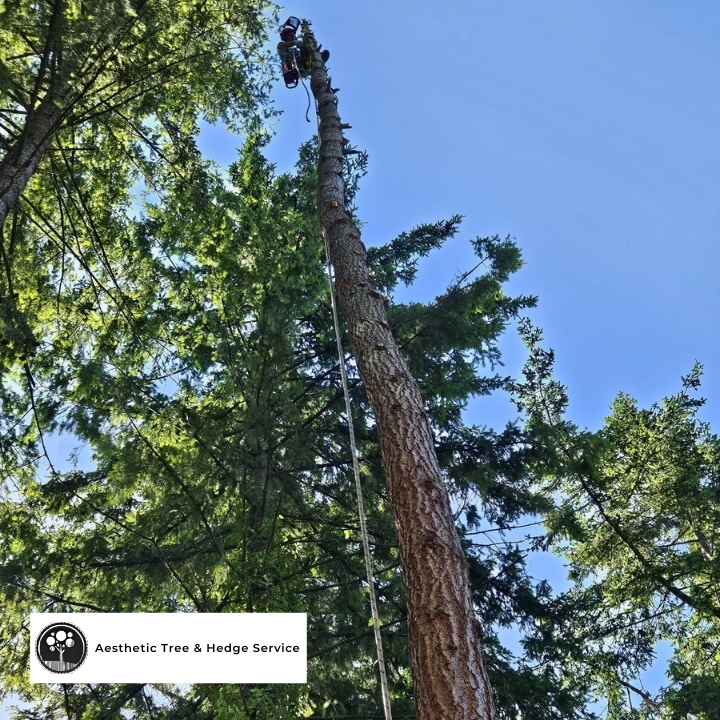
When you need a tree removed, it should be done by ISA-certified arborists who assess whether removal is truly the only option. Professional tree removal in Vancouver should always start with a conversation about alternatives. Sometimes structural cabling, crown reduction, or targeted treatment extends a tree's life by decades.

How Does Proper Pruning Maximize a Tree's Climate Contribution?
Pruning sounds simple. It isn't.
Bad pruning causes lasting damage. Topped trees, flush-cut branches, improper wound closure — these stress a tree's vascular system. A stressed tree devotes resources to survival, not growth. Less growth means less carbon uptake.
ANSI A300 pruning standards exist to protect tree health and structural integrity. ISA-certified arborists follow them. Untrained operators often don't.
Proper pruning extends a tree's climate contribution in specific ways:
- **Extends lifespan** — a well-pruned tree lives longer, sequestering more total carbon over its lifetime
- **Reduces disease entry points** — clean cuts close properly; bad cuts invite fungi and pests
- **Maintains structural integrity** — a structurally sound tree survives windstorms that would otherwise end its carbon work abruptly
- **Manages canopy shape** — maximizing leaf area increases photosynthesis and CO₂ absorption year-round
In our experience working across Vancouver, Burnaby, and the North Shore, trees that receive regular ISA-certified care consistently outlast their neglected neighbors by decades. The gap in lifetime carbon sequestration over that span is enormous.
Regular tree pruning and cutting services aren't just about aesthetics or safety clearance. They're a direct investment in long-term climate productivity.
How Do Trees Cool Vancouver Neighborhoods — and Why Does It Matter?
Carbon sequestration is one piece of the story. Cooling is another.
Urban heat island effect is documented across Metro Vancouver. Concrete, asphalt, and glass store heat. Densely built neighborhoods can run 2–8°C hotter than surrounding areas on hot days. Research from the BC Centre for Disease Control confirms this temperature differential across Vancouver's densest residential zones.
Trees cool through two mechanisms:
**Shade:** A mature tree's canopy blocks 50–90% of solar radiation reaching the surface beneath it, per US Forest Service data. That shading dramatically reduces surface and air temperatures on summer afternoons.
**Evapotranspiration:** Trees release water vapor through their leaves. That evaporative effect lowers ambient air temperature by 1–3°C in the immediate vicinity, according to Environment and Climate Change Canada research.
During the 2021 BC heat dome, temperatures hit 49.6°C in Lytton. Over 619 people died across BC from heat-related causes — a figure documented by the BC Coroners Service. Neighborhoods with higher tree canopy coverage experienced measurably lower ambient temperatures during the event.
Trees kept people alive. That's not metaphor. That's documented public health data.
What Threats Are Damaging Vancouver's Urban Forest Right Now?
If you own trees in the Lower Mainland, know these threats:
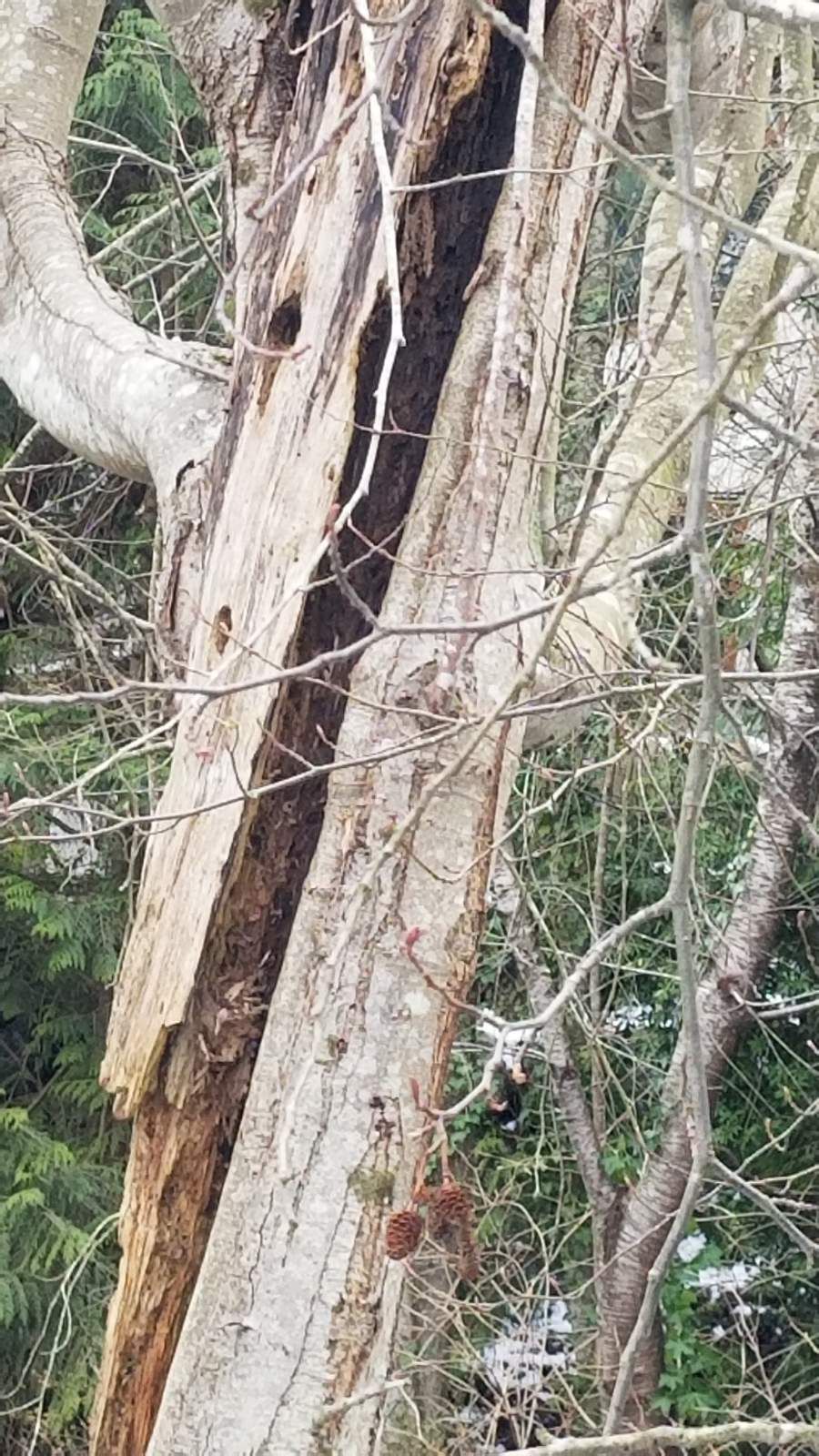
**Invasive Shot Hole Borer (Euwallacea fornicatus)** First detected in Metro Vancouver in 2022. This beetle bores into a tree's cambium layer, introducing a fungus that disrupts water and nutrient flow. Big-leaf maple is a primary host. Look for tiny entry holes with white powdery frass around them. No fully effective chemical treatment exists — early detection is everything.
**Phytophthora Root Rot** A water mold that thrives in Vancouver's wet winters. Kills feeder roots first. Trees show dieback from the top down and are frequently misdiagnosed as drought-stressed. Improved soil drainage is the primary prevention strategy.
**Bronze Birch Borer (Agrilus anxius)** Targets birch trees stressed by drought or poor soil conditions. As Vancouver summers get longer and drier, birches across the Lower Mainland face increasing vulnerability.
**Wind and Storm Damage** Atmospheric rivers are more intense now. Trees with structural defects — often a result of past bad pruning or root damage — fail in windstorms. When a large tree fails, decades of carbon work end in a single event. Emergency tree service after a storm can address damage before it cascades further.
**Construction Root Damage** Vancouver's development pace is relentless. Trenching, soil compaction, and grade changes within a tree's root zone cause invisible damage. Trees die years after construction ends — long after the cause is obvious. Get an arborist report before any ground-breaking work near significant trees. That report can also protect your project from stop-work orders under the Protection of Trees By-law.
How Can Homeowners Support Climate Mitigation Through Tree Care?
You don't need to be a climate scientist. You need to take care of the trees you have.
Here's what that looks like in practice:
**Schedule regular arborist inspections.** An ISA-certified arborist catches disease, structural problems, and pest infestations before they become fatal. A tree saved from preventable death continues decades of carbon work it would otherwise lose.
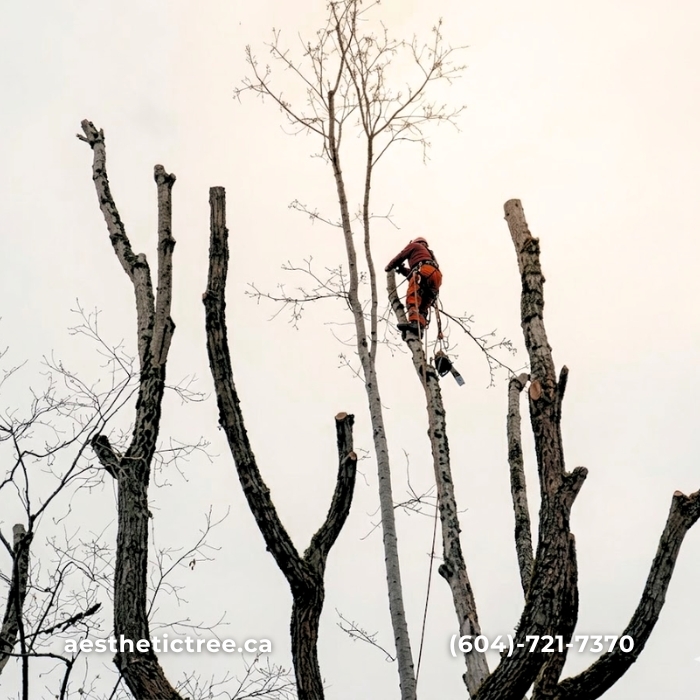
**Never top your trees.** Topping is the single most damaging thing you can do to a mature tree. It triggers weak, explosive regrowth. It creates large wounds that don't close properly. It shortens the tree's life significantly. If your tree is too tall, ask about crown reduction — not topping.
**Water during dry summers.** Young trees need supplemental irrigation in their first 3–5 years. Established trees benefit from deep, infrequent watering during August and September heat events. This is more important now than it was ten years ago.
**Protect root zones during construction.** Keep equipment and foot traffic outside the area extending from the trunk to the drip line. Roots often extend 1.5–3× the canopy radius — much farther than most people realize.
**Apply mulch properly.** A 3–4 inch layer of wood chip mulch retains soil moisture, moderates root zone temperature, and feeds soil biology. Professional mulching services make a measurable difference in urban tree survival, especially through summer drought.
**Choose climate-resilient species when planting.** Douglas fir, Garry oak, Coast redwood, Tulip tree (Liriodendron tulipifera). These species are projected to thrive in Vancouver's evolving climate. Pair your choice with professional tree planting to ensure proper establishment and long-term success.
What Happens to Carbon When a Tree Is Removed? What About Stumps?
When a tree is removed, what happens to its stored carbon depends entirely on what happens next.
- **Wood used in long-term construction** — dimensional lumber, timber framing — continues storing carbon for the life of the building. Decades, potentially centuries.
- **Wood chipped for mulch** returns carbon to soil within a few years, but that organic matter feeds soil biology and supports surrounding vegetation and root systems.
- **Wood left to decompose on-site** releases carbon steadily — faster in warm, wet conditions like a Vancouver winter.
- **Stumps left in the ground** decompose slowly over years. Some species — Western red cedar, red alder — regenerate aggressively from stumps.
Stump grinding removes the above-ground stump. Combined with using the chips as mulch, it returns organic matter to the soil and prepares the site for replanting. If you're planting a replacement tree — which you should be — grinding the old stump eliminates competition for the new root system and manages the decomposition cycle predictably.
The most carbon-responsible approach when removal is genuinely necessary: ISA-certified removal, local wood repurposing where possible, and prompt replacement planting.
Does Metro Vancouver Have Regional Programs Supporting Urban Tree Canopy?
Yes — and the rules vary significantly by municipality.
Metro Vancouver's Regional Biodiversity Strategy identifies urban forest connectivity as a regional priority. Each city enforces its own tree protection bylaws.
- **City of Burnaby** — Tree Protection Bylaw requires permits for trees above a specified diameter on private property. Unauthorized removal carries fines.
- **City of North Vancouver** — Maintains one of Metro Vancouver's highest canopy cover rates, with ongoing street tree planting programs.
- **City of Richmond** — Unique challenges: low-lying terrain and high water tables limit species options and increase sensitivity to root disturbance and compaction.
- **City of Coquitlam** — Tree protection bylaws apply to trees over specified sizes on both private and public land.
If your property sits near a municipal boundary — common along the Burnaby-Vancouver border — verify which bylaw applies before any tree work begins. Working with arborists who cover Metro Vancouver means working with people who know the permit requirements for each jurisdiction cold. That knowledge keeps your project compliant and on schedule.
FAQ
**Does removing a tree from my Vancouver property require a permit?**
In most cases, yes. The City of Vancouver's Protection of Trees By-law No. 9958 requires a permit for removing trees over 20 cm DBH on private property. Each Metro Vancouver municipality — Burnaby, North Vancouver, Coquitlam, Richmond — has its own threshold. Always verify before any removal work begins. An ISA-certified arborist can advise on permit requirements as part of an initial assessment, and can prepare documentation to support your application.
**How much carbon does a large tree in my yard actually store?**
It depends on species, trunk diameter, and age. A mature Douglas fir stores hundreds to thousands of kilograms of carbon in its woody biomass. A mature Big-leaf maple stores comparable amounts. The US Forest Service's i-Tree Eco tool allows you to estimate carbon storage values for individual trees by species and trunk diameter — it's free and publicly accessible.
**Can proper pruning really extend a tree's life significantly?**
Yes. Trees pruned to ANSI A300 standards by ISA-certified arborists develop stronger structural form, resist disease and pest infiltration more effectively, and live longer. A tree that lives 20 additional years because of consistent proper care sequesters 20 additional years of CO₂. At the scale of an urban forest with thousands of trees receiving that care, the climate difference is significant.
**What's the best tree to plant in Vancouver for long-term climate benefits?**
For large properties: Douglas fir or Western red cedar — long-lived, high carbon density, native to BC. For smaller lots: Coast redwood or Tulip tree — fast early growth, large eventual size, excellent climate resilience. For biodiversity value: Garry oak — BC's only native oak, critical habitat for insects and birds, and increasingly well-suited to Vancouver's warming climate trajectory. A tree planting consultation matches species to your specific soil type, sun exposure, and space constraints.
**Is stump removal better for the environment than leaving a stump?**
It depends on context. Stumps decompose slowly, releasing stored carbon over years. Grinding them and using the chips as mulch returns organic matter to soil in a more controlled way. If you're replanting — which you should be, wherever possible — grinding the stump gives the new tree the best start by eliminating root competition. Left in place, stumps can also harbour pests and create tripping hazards. In most urban residential settings, grinding is the cleaner and more responsible choice.
---
Ready to protect the trees that are protecting your city?
Call Aesthetic Tree & Hedge Services at **(604) 721-7370** for a free estimate. Our ISA-certified arborists are WCB registered and serve Vancouver, Burnaby, North Vancouver, Richmond, Coquitlam, and the wider Lower Mainland. We assess, care for, and — when genuinely necessary — responsibly remove the trees that form your neighborhood's climate defense.
Found this helpful? Follow our tree care insights directly on Google.
Make us your preferred source on GoogleBefore You Go
Where are you in your tree care journey?
Our Tree Care Services
ISA-certified arborists serving Greater Vancouver


Explore Our Tree Care Services
From expert pruning to safe tree removal, our ISA-certified arborists are ready to help across Greater Vancouver.
View Services