
TL;DR — Quick Summary
vancouver arborist tree canopy goal join green: permit rules, pruning, planting, and hazard checks from ISA-certified arborists.
vancouver arborist tree canopy goal join green is a strange search phrase, but the job behind it is clear.
Vancouver wants more tree canopy. Homeowners want safe yards. Those two goals should work together.
A tree is not just shade. It is structure. It is risk. It is stormwater control. It is a living asset tied to bylaws, permits, roots, soil, pruning cuts, and long-term care.
At Aesthetic Tree & Hedge Services, we see the same problem often. A tree is planted with good intent. Then it is topped, buried, crowded, or ignored. Ten years later, the owner has a hazard instead of canopy.
That is the waste this guide is meant to prevent.
We will show what Vancouver's canopy goal means at yard level. We will explain when permits apply. We will show how ISA-certified arborists make decisions under real site limits. We will also show when removal is the correct choice.
TL;DR
- Vancouver has a public urban forest target. The City of Vancouver's Urban Forest Strategy sets a goal of 30% canopy cover by 2050.
- The City reported about 25% canopy cover in its 2022 update. That leaves a real gap.
- Homeowners help most by keeping healthy trees, planting the right species, and pruning to ANSI A300 standards.
- Removal still has a place. Dead, unstable, diseased, or structurally failed trees can threaten people and buildings.
- Before you cut, check the bylaw. In Vancouver, many trees need a permit before removal.
For a site-specific answer, call Aesthetic Tree & Hedge Services for a free estimate at (604) 721-7370. Our team is ISA-certified and WCB registered.
What Does Vancouver's 30% Tree Canopy Goal Mean For Homeowners?
Vancouver's canopy goal is not abstract. It reaches into front yards, backyards, lanes, boulevards, strata sites, and development lots.
The City of Vancouver's Urban Forest Strategy sets a target of 30% canopy cover by 2050. In its 2022 update, the City reported canopy cover at about 25%. That means the city needs both new planting and better retention.
Canopy cover means the layer of leaves, branches, and stems seen from above. A mature Big-leaf maple counts more than a new sapling. A healthy cedar hedge counts in a different way. A topped tree counts less each year, because it loses form and life span.
This is where arboriculture matters.
A homeowner can plant three trees and still lose canopy value. That happens when the species is wrong for the site. It also happens when roots dry out, trunks get buried, or branches are cut poorly.
Good tree care protects future canopy. Poor tree work spends it.
Vancouver has specific site pressures:
- Small lots with service lines.
- Older houses with tight access.
- Clay and compacted urban soils.
- Drought stress in late summer.
- View pressure on slopes.
- High-value targets near trees, such as roofs and power lines.
- Permit rules that vary by municipality.
A Vancouver arborist has to balance all of this.
The right answer is rarely, "save every tree." The right answer is evidence. Is the tree alive? Is the structure sound? Are the roots stable? Is there decay? Is the species suited to that location? Is the work permit required under bylaw?
For trees that are unsafe or no longer viable, professional tree removal in Vancouver protects people, buildings, and nearby trees. For trees that can be retained, pruning and soil care are usually the better investment.
That is how homeowners join the green goal without taking bad risks.
Why Should A Vancouver Homeowner Care About Tree Canopy?
Tree canopy gives measurable benefits. The proof is not sentimental.
First, heat.
The BC Coroners Service's 2022 report on the 2021 heat dome found 619 heat-related deaths in British Columbia. The report found most deaths happened indoors, and many victims lived in areas with less cooling relief. Heat is now a real safety issue in the Lower Mainland.
Trees reduce heat in two ways. They shade hard surfaces. They also cool air through transpiration. The result is lower surface temperature around shaded yards, sidewalks, walls, and roofs.
The U.S. Environmental Protection Agency's heat island guidance states that shaded surfaces can be 20 to 45 degrees Fahrenheit cooler than unshaded peak-temperature surfaces. That is a large physical difference. It matters beside patios, asphalt lanes, and south-facing walls.
Second, stormwater.
Metro Vancouver's urban forest guidance explains that trees intercept rainfall, slow runoff, and reduce load on storm systems. This matters in older neighbourhoods where heavy rain arrives fast. It also matters on sloped lots in North Vancouver and West Vancouver.
Third, air.
Trees capture particulate matter on leaf surfaces. They also store carbon in wood and roots. The numbers vary by species, age, soil, and health. That is why mature trees need careful decisions. A mature Douglas fir cannot be replaced by one small ornamental tree in any practical time frame.
Fourth, property function.
Shade changes how a yard works. It affects lawn health, hedge density, drainage, moss, roof debris, gutters, and plant choice. A cedar that blocks too much light can damage a hedge below it. A maple that is pruned correctly can give shade without rubbing the roof.
This is why arborist advice must be site-specific. A rule that works in Kitsilano may fail in Coquitlam. A pruning plan for a Big-leaf maple is not the same as one for a Western red cedar.
The goal is not to keep trees at any cost. The goal is to keep the right trees in the right condition.
How Can An Arborist Help You Keep A Tree Instead Of Removing It?
An ISA-certified arborist starts with diagnosis. Not opinion. Diagnosis.
That means looking at the tree from roots to crown.
The root flare comes first. It should be visible where the trunk widens into roots. If mulch, soil, or landscape fabric covers the flare, the tree can decline. Buried flares hold moisture against bark. They also hide girdling roots.
Next comes trunk structure. The arborist checks cavities, cracks, included bark, fungal fruiting bodies, old topping cuts, and seams in the wood. A tree can look green and still be weak. Leaves do not prove structure.
Then comes the crown. The arborist checks deadwood, branch attachment, end weight, crossing limbs, storm damage, and clearance. The inspection also looks for pests and disease.
For many trees, the best action is pruning. Not topping. Not random cutting. Proper pruning follows ANSI A300 standards, the main tree care standards used by professional arborists in North America.
ANSI A300 pruning focuses on clear objectives. That includes risk reduction, clearance, structure, restoration, and health. Each cut has a reason.
A good pruning plan can:
- Remove dead, broken, or hanging limbs.
- Reduce end weight on overextended branches.
- Improve clearance from roofs and buildings.
- Improve young tree structure.
- Reduce failure risk in wind.
- Keep more live canopy than harsh cutting.
Topping does the opposite. It removes major live tissue. It forces weak regrowth. It creates decay points. It often makes the tree more dangerous later.
This matters for Vancouver's canopy goal. A topped tree is a delayed removal. A well-pruned tree has a better chance of staying useful.
If a tree is near a building, service line, or public path, professional tree cutting in Vancouver should be based on a clear work objective. The question is simple: what risk are we reducing, and how much live canopy can we keep?
That question saves trees.
When Does Vancouver Require A Tree Removal Permit?
In Vancouver, many private trees are protected by bylaw. Do not assume you can remove a tree because it is on your property.
The City of Vancouver's Protection of Trees By-law No. 9958 regulates tree removal. The City states that a permit is required for many trees based on size, condition, and site context. The common threshold homeowners hear is diameter at breast height. That means trunk diameter measured around 1.4 metres above grade.
This is where mistakes happen.
A homeowner sees a tree as "small." The bylaw sees a measured trunk. A homeowner sees a nuisance. The bylaw may see protected canopy. A contractor sees a quick cut. The City may see an unpermitted removal.
Permit rules also change across the Lower Mainland. Vancouver, Burnaby, Richmond, North Vancouver, Coquitlam, and other municipalities each have their own tree bylaws. They differ in diameter thresholds, replacement rules, application steps, and documentation.
An arborist report can help when the City needs proof. It records species, size, condition, defects, risk factors, and recommendations. It may include photos, measurements, site notes, and a clear opinion from a qualified arborist.
A report is useful when:
- A tree is dead or dying.
- A tree has decay or structural defects.
- A tree conflicts with construction.
- A neighbour dispute needs evidence.
- A permit application needs support.
- A strata needs a written record.
Aesthetic Tree & Hedge Services provides arborist reports in Vancouver for homeowners, builders, property managers, and strata councils.
The key is timing. Get the report before removal. Do not create the problem first and seek proof later.
A permit decision should rest on facts. Species. Diameter. condition. risk. Location. Bylaw. That is the Hopkins way to look at it: measure first, act second.
Which Trees Help Vancouver's Canopy Goal The Most?
The best canopy tree is not the biggest tree on a nursery tag. It is the tree that fits the site and lives long enough to matter.
In Vancouver and the Lower Mainland, common canopy species include Douglas fir, Western red cedar, Big-leaf maple, red alder, Pacific dogwood, shore pine, Garry oak, and various ornamental maples. Each has a different job.
Douglas fir can provide major canopy. It also needs room. It is not a casual choice near a small house, retaining wall, or overhead line.
Western red cedar does well in many coastal sites. But cedar can suffer during hot, dry summers. Shallow roots and poor irrigation make it worse.
Big-leaf maple gives strong shade and habitat value. It also drops leaves, seeds, and branches. It needs space and correct pruning.
Garry oak is drought tolerant once established. It grows slower, but has strong long-term value in the right site.
Ornamental cherries and smaller maples give beauty and moderate shade. They suit tight yards. But they do not replace the canopy value of a large conifer or broadleaf tree.
The City of Vancouver's urban forest work also points to equity. Canopy is not spread evenly. Some neighbourhoods have more shade, while others have more hard surface and heat. That means private planting has public value.
A homeowner can ask five practical questions before planting:
- How wide will the crown be in 20 years?
- How close is the house, fence, lane, drain, or service line?
- How much summer water does the species need?
- Does the tree suit the soil and sun exposure?
- Will the tree need regular clearance pruning?
A small yard can still help. The answer may be a smaller native tree, a hedge, or a replacement tree after permitted removal. A large yard can carry bigger canopy, but only with space for roots.
Planting is not a gesture. It is a long contract with the site.
For homeowners replacing a removed tree, professional tree planting services help match species, placement, and planting depth to the property. That choice affects survival more than most people think.
How Should You Plant A Tree So It Survives Vancouver Summers?
Most tree planting failures are simple. The tree is too deep. The hole is wrong. The roots are bound. Watering stops too soon.
Planting depth is the first test. The root flare should sit at grade. Not under soil. Not under bark mulch. Not hidden by a raised bed.
The planting hole should be wide, not deep. Roots need oxygen. In compacted urban soil, a narrow deep hole can act like a pot. Water collects. Roots circle. Growth slows.
Container trees need root inspection. If roots circle the pot, they need correction before planting. If girdling roots stay in place, they can strangle the trunk later.
Mulch helps when it is done correctly. A wide mulch ring protects roots, holds moisture, and reduces mower damage. But mulch against the trunk is a fault. Keep it away from the bark.
Watering is the second test. Vancouver has wet winters, but young trees die in dry summers. New trees need deep, regular watering through the first few growing seasons. A quick spray on topsoil does not reach roots.
The International Society of Arboriculture teaches that proper planting and early care are central to tree survival. That matches what we see in the field. A well-planted tree with basic aftercare often beats a larger tree planted badly.
Use this simple field checklist:
- Root flare visible.
- Tree straight, but not rigidly tied.
- Hole wider than the root ball.
- Circling roots corrected.
- Mulch wide, shallow, and off the trunk.
- Deep watering plan set before summer.
- No landscape fabric choking the root zone.
This is how one yard joins the green goal in a real way. Not by planting for a photo. By planting for year five, year ten, and year thirty.
How Does Pruning Protect Canopy Without Creating Hazards?
Pruning is a surgical act. Bad pruning creates the next hazard.
A proper pruning cut protects the branch collar. The collar is the swollen area where a branch joins the trunk or parent limb. Cutting flush against the trunk removes tissue the tree uses to close the wound. Leaving a long stub also causes problems.
ANSI A300 standards require pruning objectives. That is important. A crew should not arrive and "thin it out" with no reason. The objective should be clear.
Common objectives include:
- Remove deadwood over targets.
- Raise canopy for clearance.
- Reduce branch length where failure risk is high.
- Restore structure after storm damage.
- Train young trees for better form.
- Reduce conflict with roofs and gutters.
Different species respond differently.
Big-leaf maple can handle structural pruning when cuts are well placed. Western red cedar should not be stripped inside. Douglas fir needs caution with crown reduction. Cherry trees need disease-aware pruning and timing.
Hedges need a different method. Cedar hedges can brown out when cut too far into old wood. Laurel hedges respond differently. Yew, boxwood, beech, and privet each have their own limits.
For hedge work, professional hedge trimming services in Vancouver help keep shape, density, and clearance without scalping the plant.
The proof is in regrowth.
Good pruning keeps a natural form. It leaves enough live foliage. It reduces specific risk. It does not shock the tree into weak shoots.
Poor pruning leaves stubs, tears, lion-tailed limbs, flat tops, and heavy end growth. Those signs are easy to see later. They are also hard to fix.
If Vancouver wants lasting canopy, pruning quality matters as much as planting numbers.
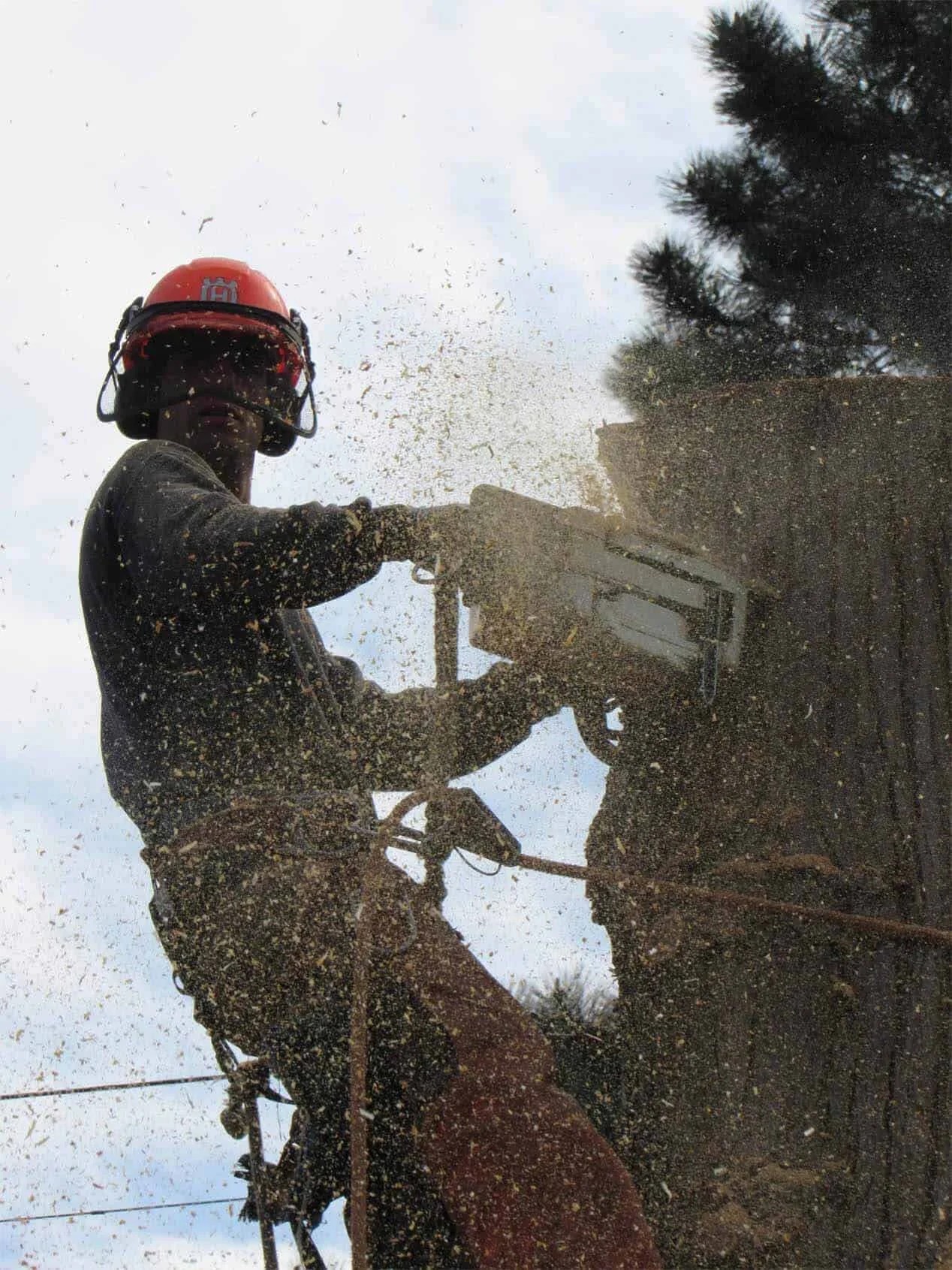
What Should You Do When A Tree Is Dead, Diseased, Or Dangerous?
A dead tree does not help the canopy goal. It adds risk.
The same is true for a tree with severe decay, root failure, major cracks, or a failed trunk union. Some trees can be managed. Some need removal.
A hazard assessment looks at three things:
- The likelihood of failure.
- The part likely to fail.
- The target below or beside it.
A dead branch over a shed is one level of risk. A cracked stem over a bedroom is another. A leaning tree in an open ravine differs from a leaning tree over a sidewalk.
Evidence matters.
Signs that need quick attention include:
- Fresh cracks in the trunk or major limbs.
- Soil lifting around the root plate.
- Fungal conks on the trunk or root flare.
- Large dead limbs over a target.
- Sudden lean after wind or rain.
- Hanging limbs after a storm.
- Cavities with active decay.
- Bark loss around the trunk.
The Lower Mainland gets wind, heavy rain, and saturated soils. That combination exposes weak roots and poor branch attachments. Storm calls often involve defects that were visible before the storm.
When a tree has failed or poses immediate risk, call for emergency tree service. Do not stand under hanging limbs. Do not cut a loaded branch without training. Stored tension can injure people fast.
For large or hard-access removals, rigging and equipment matter. A crane, lift, ropes, blocks, and lowering devices can protect buildings, fences, and neighbouring trees. The method should fit the site.
Removal is not anti-canopy when it is justified. It is part of responsible canopy management. A failed tree can damage healthy trees around it. It can also force rushed decisions after damage has already happened.
The better sequence is simple: inspect, document, permit when required, remove when needed, replant where practical.
How Do Hedges, Stumps, And Roots Fit Into The Canopy Plan?
Canopy is not only tall trees. Urban green cover includes hedges, shrubs, root zones, soil, and open growing space.
Hedges matter in Vancouver yards. Cedar, laurel, yew, beech, boxwood, and privet can provide privacy, habitat, shade, and wind reduction. But hedges decline when they are cut too hard, planted too close, or starved for water.
A hedge is a living wall. It needs light on the sides. It needs room at the base. It needs a top that does not shade out the lower growth.
The best hedge form is often slightly narrower at the top than the bottom. That lets light reach the lower foliage. A square hedge can look tidy for a season, then thin out at the base.
Roots matter too.
Roots need oxygen and soil volume. They suffer under compacted driveways, raised beds, excavation, trenching, and grade changes. A tree can lose major roots long before the crown shows stress.
Root barriers help in specific cases. They are not a cure for every conflict. They need proper placement and depth. Used badly, they can redirect roots in ways that hurt tree stability or fail to solve the real issue.
Stumps also play a role. A stump left after removal can block replanting. It can attract pests or keep sending shoots. It can also interfere with grading, fencing, and new landscape work.
After permitted removal, stump grinding in Vancouver clears the site for safer use and better replanting options.
Mulch is another simple tool. Correct mulching improves soil moisture and protects roots from mower and trimmer damage. Bad mulching buries the trunk and causes decay.
Think of the yard as a system. Tree, hedge, stump, soil, root zone, drainage, sun, and access all affect the outcome.
A yard with one healthy tree and one well-kept hedge often contributes more than a yard with several stressed plantings.
How Can Your Yard Join The Green Goal This Year?
Start with a measured plan. Do not start with a saw.
Walk your property and list each tree. Note species if you know it. Measure trunk diameter. Look for deadwood, cracks, lean, root flare burial, fungus, and clearance conflicts.
Then sort each tree into one of four groups:
- Keep and monitor.
- Prune for health or clearance.
- Assess for risk or permit.
- Remove and replace when justified.
That simple list changes the conversation. It turns worry into evidence.
For homeowners in Vancouver, Burnaby, North Vancouver, Richmond, Coquitlam, and across the Lower Mainland, this is the practical path:
1. Keep healthy mature trees when the site allows it. 2. Prune to ANSI A300 standards, not guesswork. 3. Check municipal bylaw rules before removal. 4. Get an arborist report when proof is needed. 5. Replace lost canopy with suitable species. 6. Water young trees through dry summers. 7. Protect the root flare and root zone. 8. Remove true hazards before they fail.
The canopy goal is city-wide. The work is property by property.
A single homeowner cannot create Vancouver's urban forest. But one homeowner can keep one mature cedar alive. One strata can replace a poor hedge with a better one. One builder can protect roots during work. One family can plant the right tree in the right place.
Those choices add up.
The City of Vancouver's goal gives the direction. Arboriculture supplies the method. Homeowners provide the sites.
That is how you join green without slogans. You make each tree decision by evidence.
FAQ
Do I need an arborist to remove a tree in Vancouver?
You need to check the bylaw before removal. Many Vancouver trees require a permit. An arborist helps measure the tree, assess condition, document defects, and support the permit process when removal is justified. If the tree is dead, hazardous, or tied to construction, written evidence matters.
What is the best tree to plant for Vancouver's canopy goal?
The best tree depends on space, soil, sun, drainage, and nearby structures. Douglas fir, Western red cedar, Big-leaf maple, Garry oak, shore pine, and smaller ornamental trees all have uses. A large tree in the wrong place becomes a future removal. A suitable tree in the right place can serve for decades.
Is topping a tree a good way to control height?
No. Topping is poor arboriculture. It removes major live tissue, creates decay points, and often triggers weak regrowth. The tree may become more hazardous later. Proper pruning uses clear objectives and follows ANSI A300 standards.
Can a sick tree be saved?
Sometimes. It depends on species, site, pest or disease, root condition, and structure. A tree with minor stress may recover with pruning, mulch, watering, and root care. A tree with severe decay, root failure, or major cracks may need removal. Inspection comes before advice.
How fast can a new tree replace lost canopy?
Not fast. A small replacement tree takes years to provide meaningful shade. That is why mature tree retention matters when safe and practical. Replacement planting is still important, but it does not equal the canopy value of a healthy mature tree right away.
Call Aesthetic Tree & Hedge Services for a free estimate at (604) 721-7370. Our ISA-certified arborists are WCB registered, and we handle pruning, removals, arborist reports, hedge care, stump grinding, and emergency tree work across Vancouver and the Lower Mainland.
Found this helpful? Follow our tree care insights directly on Google.
Make us your preferred source on GoogleBefore You Go
Where are you in your tree care journey?
Our Tree Care Services
ISA-certified arborists serving Greater Vancouver


Explore Our Tree Care Services
From expert pruning to safe tree removal, our ISA-certified arborists are ready to help across Greater Vancouver.
View Services