
TL;DR — Quick Summary
vancouvers ambitious tree canopy goal creates unprecedented permit pressure. Learn what homeowners must check before pruning or removal.
vancouvers ambitious tree canopy goal creates unprecedented pressure on homeowners, builders, and arborists.
That pressure is measurable. Vancouver wants 30% tree canopy cover by 2050. The city reported 25% canopy cover in 2025. That five-point gap sounds small. It isn't.
Trees take decades to mature. A 6-foot replacement cedar doesn't replace a 70-foot Douglas fir. A young Big-leaf maple doesn't shade a roof like a mature street tree. This is why the rules matter.
At Aesthetic Tree & Hedge Services, we see the same pattern on Lower Mainland properties. A homeowner wants a tree removed. A builder wants a clean building envelope. A neighbour worries about a leaning cedar. The real question is not just whether the tree can come down. The question is whether the removal fits the bylaw, the site, and the long-term canopy plan.
That is where ISA-certified arborist work starts.
TL;DR
- Vancouver's 2025 Urban Forest Strategy sets a 30% canopy target by 2050. The city reports 25% canopy cover today.
- The City of Vancouver's Protection of Trees By-law No. 9958 requires a permit for most private trees 20 cm or wider at 1.4 m above grade.
- Metro Vancouver's 2020 regional report found 31% canopy cover inside the Urban Containment Boundary, down 1% from 2014.
- Heat, stormwater, development, and permit rules now meet on the same residential lot.
- Before tree removal, pruning, construction, or root work, get an ISA-certified arborist assessment. A proper report protects the tree, the permit, and the property.
Why does Vancouver's 30% tree canopy goal matter to homeowners?
Vancouver's canopy target matters because private yards carry part of the public goal.
The City of Vancouver says its urban forest includes 150,000 street trees, 36,000 specimen trees in golf courses and parks, and more than 1 million trees across 444 hectares of public forests and woodlands. That is public inventory. Yet many important trees stand on private land.
A cedar in Kitsilano. A cherry in Mount Pleasant. A Douglas fir in Dunbar. A Big-leaf maple in East Vancouver. These trees count toward the canopy that cools streets and holds rain. They also sit near homes, driveways, power lines, drains, fences, and future additions.
That creates a new reality. Tree work is no longer a simple yard decision. It is now a regulated property decision.
According to the City of Vancouver's 2025 Urban Forest Strategy update, Vancouver aims to raise canopy cover from 25% to 30% by 2050. The city also states that canopy has grown by four percentage points since 2013. That is progress. It also shows how slow canopy gain is.
A five-point gain over 25 years takes discipline. It takes planting. It takes retention. It takes better pruning. It takes removal only when removal is justified.
This is why homeowners now need proof before action. The city doesn't judge a tree by opinion. It looks at diameter, location, condition, risk, species, and reason for removal.
In our work across Vancouver, Burnaby, North Vancouver, Richmond, and Coquitlam, we see the same mistake. People wait until a project is urgent. Then they learn that a permit, arborist report, or replacement plan is required. That delay costs time. It also adds stress.
The better method is simple. Assess the tree first. Confirm the bylaw trigger. Then choose the work.
If the tree is dead, dying, or hazardous, the arborist documents the facts. If the tree can be retained with pruning, cabling, mulch, or root protection, the arborist documents that too. If removal is required, the permit file needs clear evidence.
For homeowners facing a serious removal decision, our tree removal Vancouver service starts with that evidence. It is not guesswork. It is inspection, measurement, risk review, and bylaw fit.
What does the City of Vancouver tree bylaw require before removal?
The rule starts with one measurement.
The City of Vancouver's Protection of Trees By-law No. 9958 applies to trees on private property. The city states that a permit is required to remove any private tree with a diameter of 20 cm or greater, measured at 1.4 m above the ground. A 20 cm diameter equals about 64 cm in circumference.
That number matters. It is easy to misread a trunk by eye. It is also common to measure at the wrong height. We measure diameter at breast height, known as DBH. On slopes, grade changes make the measurement less obvious. Multi-stem trees also need care.
The city lists removal conditions. A permit can be granted when the tree is inside a development building envelope. It can also be granted when an arborist certifies the tree is dead, dying, or hazardous. Other reasons include direct utility conflict, or root conflict with sewer or drainage systems certified by an accredited plumber.
The permit must be posted in a visible location during removal. That detail gets missed. It shouldn't.
Development adds another rule. The city says that, unless a tree qualifies for removal, renovation and new building work require existing trees to be retained. Trees on adjacent properties and boulevard trees also need protection when they are at risk from construction.
The city also states that if trees 20 cm or larger exist on a site, an arborist report is required for a development permit application.
This is where a casual chainsaw job becomes a legal problem. A protected tree near a laneway house, garage, or addition has to be assessed before work starts. Root zones matter. Soil compaction matters. Excavation matters. So does scaffold placement.
A proper arborist report in Vancouver documents species, DBH, height, condition, defects, risk, retention value, and the reason for any recommended work. It also gives the city a clear record.
That report is not paperwork for its own sake. It is the proof system.
A weak report invites delay. A strong report gives the planner, homeowner, builder, and arborist the same facts. It also reduces the chance of a stop-work problem once crews are on site.
How does canopy policy change tree removal decisions in Vancouver?
Canopy policy changes the question from can we cut it to should this tree be removed under the rules?
That difference is large.
A tree can be inconvenient without being hazardous. It can drop needles without being defective. It can shade solar panels without being a removal candidate. It can lean naturally without being unstable.
An ISA-certified arborist separates nuisance from risk.
We look for structural defects. Included bark. Cracks. Root plate movement. Fungal fruiting bodies. Dead scaffold limbs. Recent grade changes. Soil heave. Wound response. Crown dieback. The findings decide the work.
If the issue is clearance, pruning often solves it. If the issue is low limbs over a roof, selective reduction often beats topping. If the issue is weak union risk, tree cabling can reduce failure risk in the right tree. If the issue is root conflict near hardscape, a root barrier can protect infrastructure when used correctly.
ANSI A300 standards guide modern tree care. They reject topping as a routine practice. Topping removes too much live crown. It creates weak sprouts. It opens decay paths. It also ruins form.
Vancouver's canopy goal makes poor pruning a canopy problem. A topped tree often becomes a future removal. A properly pruned tree keeps structure, leaves, and long-term value.
That is why we recommend a care-first sequence.
1. Identify species and DBH. 2. Check the municipal bylaw. 3. Inspect defects and site forces. 4. Review targets, such as homes, driveways, sidewalks, and utility lines. 5. Decide between pruning, cabling, root care, removal, or monitoring. 6. Document the decision.
This method is slower than guessing. It is also safer.
For dangerous, dead, or storm-damaged trees, removal remains the right answer. A canopy goal does not require keeping a hazard. It requires proof that the work is justified.
When removal is justified, skilled rigging protects the site. Tight Vancouver lots leave little margin. Fences, glass railings, garden walls, sheds, and neighbouring roofs sit close to the drop zone. In those cases, controlled sectioning, lowering lines, and sometimes crane tree removal are the safer tools.
The goal is not to save every tree. The goal is to make the right call for each tree.
Why are mature trees worth more than replacement trees?
A mature tree carries value that a sapling hasn't earned yet.
This is the point homeowners miss. Replacement planting matters. But canopy is a function of crown spread, height, leaf area, and health. A mature cedar shades a yard now. A young cedar needs years.
Metro Vancouver's 2020 Regional Tree Canopy Cover and Impervious Surface report gives the regional scale. It found 53% canopy cover across the Metro Vancouver region. Inside the Urban Containment Boundary, canopy cover was 31%. The same report found that canopy inside the region, Regional Core, and Urban Containment Boundary decreased by 1% from 2014 to 2020.
That is the hard evidence. Even a tree-rich region loses canopy when development and hard surfaces outpace mature tree growth.
The same Metro Vancouver report found that 54% of land inside the Urban Containment Boundary was impervious in 2020. It also found impervious surfaces rose by 4% from 2014 to 2020. Impervious surfaces include pavement, roofs, and other hard cover.
Trees fight that trend in three measurable ways.
They shade hard surfaces. They intercept rain. They cool air through transpiration.
A 2022 Metro Vancouver study in the journal Atmosphere found large temperature differences by land cover. The mean surface temperature across the study area was 31.8 C. Buildings measured about 37.24 to 37.29 C. Coniferous tree areas measured about 25.07 to 25.13 C. The authors reported conifer areas were 12.2 C cooler than building-dominated areas.
That does not mean every yard needs a conifer. It means species choice matters. Douglas fir, western red cedar, and other conifers perform differently from ornamental broadleaf trees. Site space, soil volume, overhead clearance, wind exposure, and future size decide what belongs.
In small Vancouver yards, the wrong tree becomes tomorrow's conflict. A large species planted under wires, beside a drain line, or against a foundation creates future removal pressure. The right tree in the right space grows into an asset.
That is why tree planting is arborist work, not decoration. Species choice has consequences for 30 years.
How does urban heat make Vancouver tree care more urgent?
Heat makes tree care urgent because trees are now climate infrastructure.
The City of Vancouver states that wildfire smoke is a top climate risk. It also reports about 60 cumulative days with air quality advisories due largely to fine particulate matter since 2015. Before 2015, the city says wildfire smoke advisories were almost non-existent.
Trees don't solve wildfire smoke. But healthy urban trees clean air, store carbon, absorb rainwater, support habitat, and reduce heat stress.
The same city page says Vancouver faces hotter, drier summers, stronger rainfall events, and sea level rise. This turns tree maintenance into risk management.
Drought stress weakens trees. Heat dries shallow roots. Compacted soil limits oxygen. Construction damage cuts absorbing roots. Then winter rain and wind arrive. A stressed tree has less margin.
In our inspections, we pay close attention to root flare. The root flare is where the trunk widens at the base. It should be visible. When soil, mulch, or fill covers it, decay risk rises. Girdling roots also form near buried flares.
Mulch helps when it is done right. A wide mulch ring protects soil moisture and reduces mower damage. A mulch volcano against the trunk does harm. Keep mulch off bark. Let the flare breathe.
Our mulching service focuses on root health, not appearance alone. The best mulch job is boring. It protects the soil, keeps moisture steady, and stays away from the trunk.
Watering also matters. Young trees need regular deep watering in dry periods. Mature trees need soil protection more than frequent shallow watering. Deep roots follow oxygen, space, and moisture.
Heat also changes pruning timing. Heavy pruning during stress removes leaf area when the tree needs energy. Deadwood removal is different. Hazard limbs should be addressed. But major canopy reduction during drought stress needs caution.
A good arborist doesn't just ask what branch bothers you. We ask what season, what species, what stress signs, and what target sits below.
What should homeowners do before pruning a protected tree?
Homeowners should confirm the bylaw, then choose pruning that preserves tree health.
Not all pruning needs a removal permit. But bad pruning still creates liability. It also creates future hazard.
The first step is to identify the objective. Clearance over a roof is one objective. Weight reduction on an overextended limb is another. Sightline clearance near a driveway is another. Hedge shaping is different again.
Tree pruning should follow a written purpose. Never prune because a tree looks too big. That phrase leads to topping.
Good pruning removes specific branches for a specific reason. It respects branch collars. It keeps enough live crown. It avoids flush cuts. It avoids stub cuts. It keeps the tree's natural form.
For cedars, over-thinning is a common error. Interior cedar foliage does not replace itself like grass. Cut too deep into brown interior wood, and the hole often stays. For Big-leaf maple, large cuts can decay if placed poorly. For Douglas fir, removing too many lower limbs can change wind load and trunk exposure.
Hedges need a different plan. Cedar hedges, laurel hedges, and yew hedges respond differently to trimming. A cedar hedge cut past green growth will not fill in fast. Laurel tolerates harder reduction, but it still needs clean cuts and timing.
For formal hedges, regular light trimming beats hard correction. Our hedge trimming services in Vancouver keep hedges dense, even, and clear of walkways without stripping them bare.
For trees near buildings, a certified arborist should inspect before heavy pruning. Roof clearance, chimney clearance, and utility clearance each carry different risks. If utility lines are involved, homeowners must not improvise. Contact the proper utility or a qualified professional.
Pruning is not just branch removal. It is a growth decision. Every cut changes how the tree responds.
When is tree cutting different from tree removal?
Tree cutting is a broad term. Tree removal is the complete removal of a tree.
Homeowners often use the terms as if they mean the same thing. Municipal bylaws do not.
Tree cutting can include pruning, sectioning, clearance work, or removing part of a tree. Tree removal means the tree is taken down. The stump may remain unless stump grinding is included.
This distinction matters for permits, scope, safety, and site cleanup.
A protected tree cannot be removed just because someone calls it cutting. If the work kills the tree, it is treated as removal in substance. Severe topping, root cutting, bark stripping, or soil damage can destroy a tree even when the trunk stands.
That is why we define scope before work starts.
For homeowners comparing options, tree cutting in Vancouver should be tied to a clear arborist objective. Are we reducing risk? Clearing a structure? Removing deadwood? Preparing for permitted removal? Each answer changes the method.
Stumps add another decision. A stump left behind can obstruct planting, patios, paths, and fence work. It can also attract decay organisms. Stump grinding removes the stump below grade and prepares the area for restoration.
If a tree comes down and the site needs to be usable again, stump grinding in Vancouver should be planned with the removal. Access matters. Slope matters. Nearby irrigation, gas lines, and electrical lines matter.
The best tree job is not just safe in the air. It is clean on the ground.
How do development projects create tree conflicts in Vancouver?
Development creates tree conflicts because buildings need space and trees need roots.
Most conflict happens below grade. Roots are not a mirror of the crown. They grow where oxygen, water, and soil conditions allow. On urban lots, roots often run under lawns, driveways, patios, and neighbouring areas.
Excavation can cut structural roots. Soil compaction can suffocate absorbing roots. Grade changes can bury root flare. Trenching can sever roots that feed one side of a crown.
Vancouver's bylaw addresses this. The city says retained trees on a development site need protection. Adjacent trees and boulevard trees in danger of damage need protection too.
That means a builder cannot look only at trees inside the property line. A neighbour's cedar can have roots inside the work zone. A boulevard maple can be affected by driveway work. A lane tree can be harmed by machinery access.
A tree protection plan sets the working boundary. It identifies protection barriers. It marks root protection zones. It sets rules for storage, excavation, access, and pruning.
The earlier this happens, the better. If the arborist is called after the design is finished, choices are limited. If the arborist is involved before final layout, tree retention and buildability can both improve.
This is not theory. We see projects delayed because the tree review came too late. A garage corner, service trench, or crane access path conflicts with a retained tree. Then everyone has to redesign under pressure.
A better sequence is simple.
- Survey trees early.
- Measure DBH correctly.
- Identify protected trees.
- Check neighbouring and boulevard trees.
- Set root protection zones.
- Match design to retention rules.
- Submit the arborist report with clear recommendations.
This protects the homeowner. It also protects the contractor.
What should you do after storm damage or emergency tree failure?
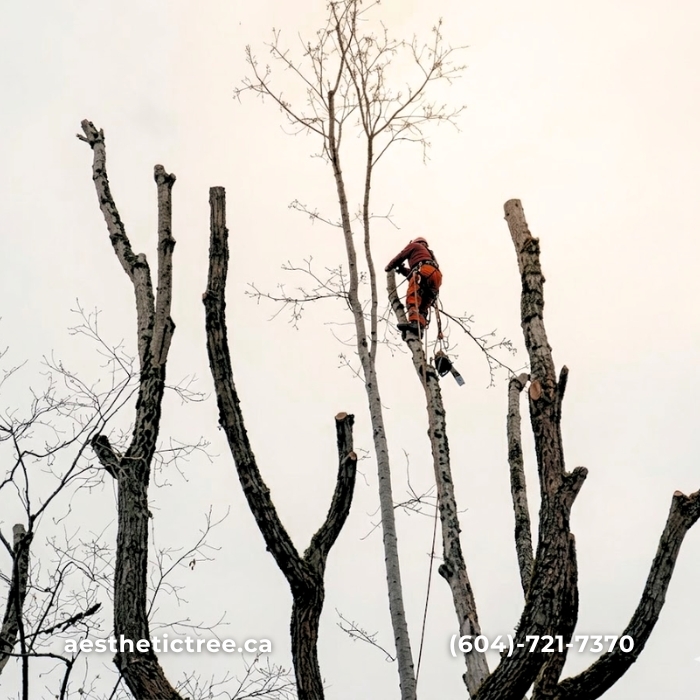
Storm damage needs fast triage and clear documentation.
A split cedar over a roof is not a routine pruning job. A failed maple limb on a driveway is not a wait-and-see issue. A leaning tree after soil saturation needs inspection.
The first rule is safety. Stay away from hung limbs, cracked stems, and trees touching wires. Don't stand under a broken crown. Don't cut tensioned wood unless you are trained. Storm wood moves fast when released.
The second rule is documentation. Take photos from a safe distance. Note the time. Note what changed. If the tree is protected, emergency action still needs a proper record.
The third rule is assessment. An ISA-certified arborist checks whether the tree can be made safe or requires removal. Some storm-damaged trees can be retained with reduction pruning, cabling, or monitoring. Others have lost structural integrity.
Our emergency tree service focuses on immediate hazard reduction first. Then we address permit records, cleanup, and next steps.
Storm work is also where insurance, neighbours, and municipal rules meet. A limb over a fence can involve two properties. A city tree is not handled like a private tree. A boulevard tree has its own process.
Don't guess under stress. Secure the area. Call a qualified arborist. Keep records.
How should Vancouver homeowners choose the right replacement tree?
Replacement planting should start with mature size, not nursery size.
A young tree looks harmless in a pot. The mature tree decides whether the planting succeeds.
Ask six questions before planting.
1. How wide will the crown be at maturity? 2. How tall will the tree be at maturity? 3. How much soil volume is available? 4. Are there overhead wires? 5. Are there drains, foundations, or retaining walls nearby? 6. Will the species handle heat, drought, and local pests?
For larger lots, native conifers such as Douglas fir and western red cedar have strong climate value when space allows. For tighter lots, smaller species or carefully selected cultivars can reduce future conflict. For wet areas, species choice changes again.
The 2022 Atmosphere study matters here. It found coniferous tree areas in Metro Vancouver had much lower surface temperatures than building areas. That supports careful use of conifers where site conditions fit.
But no species is good in the wrong spot. A cedar hedge planted too close to a fence becomes a maintenance problem. A large maple planted near a drain line becomes a future dispute. A tree planted too deep starts life with stress.
Planting depth is critical. The root flare should sit at or slightly above finished grade. The hole should be wide, not deep. Burlap, wire baskets, and circling roots need proper handling. Mulch should cover the soil, not the trunk.
This is where arborist planting differs from landscaping. The goal is not only a good first week. The goal is a healthy tree ten years later.
What does this canopy goal mean for Burnaby, North Vancouver, Richmond, and Coquitlam?
Vancouver's goal does not stop at the city line.
Tree rules vary across the Lower Mainland. That is why homeowners should not copy advice from another municipality.
Richmond's Tree Protection Bylaw No. 8057 generally requires a permit to remove a tree larger than 20 cm DBH. The City of North Vancouver states that a permit is required to remove protected trees 20 cm or larger, measured at 1.4 m. Coquitlam's Tree Management Bylaw protects living woody plants greater than 20 cm diameter, but in many cases allows up to two protected-size trees per 12-month period without a permit unless other site conditions apply. Burnaby uses different thresholds and rules, including protected trees and development-related triggers.
The pattern is clear. Diameter, location, zoning, development status, and environmental conditions decide the rule.
This is why one phone answer rarely covers the job. The address matters. The species matters. The tree size matters. The proposed work matters.
For Lower Mainland homeowners, the safest first step is to ask for an arborist site review before cutting. That review prevents wrong assumptions.
In our experience, most bylaw problems start with one sentence: I thought it was allowed.
That sentence does not help after the tree is gone.
How can homeowners support canopy goals without taking on unsafe trees?
Homeowners can support canopy goals by caring for good trees and removing true hazards with proof.
This is the balanced view. A dangerous tree does not become safe because the city has a canopy target. A healthy tree does not become disposable because it drops leaves.
Start with inspection. Mature trees should be assessed after major storms, nearby excavation, grade changes, or visible decline. Watch for dead tops, fungal conks, cracks, sudden lean, root plate movement, and large dead limbs.
Use pruning as medicine, not punishment. Remove deadwood. Reduce end weight where needed. Improve clearance. Keep cuts small when possible.
Protect roots. Keep heavy equipment off root zones. Avoid trenching near trunks. Do not pile soil over roots. Keep the root flare visible.
Plant with intent. Choose species that match space, light, soil, and future size. Water young trees deeply. Mulch correctly.
Remove when the evidence supports removal. Dead, dying, hazardous, structurally unsound, or construction-conflict trees can qualify under bylaw conditions. The key is documentation.
This is the practical path. It protects people and property. It also protects the urban forest.
FAQ
Do I need a permit to remove a tree in Vancouver?
Yes, if the private tree is 20 cm or greater in diameter measured at 1.4 m above the ground, Vancouver's Protection of Trees By-law No. 9958 requires a tree removal permit. Smaller trees can still be regulated if they are replacement trees or tied to a development landscape plan.
What is DBH in an arborist report?
DBH means diameter at breast height. In Vancouver, the key measurement height is 1.4 m above grade. Arborists use DBH to decide whether a tree meets permit size and to document the tree for reports, risk review, and development applications.
Can I remove a dead or hazardous tree in Vancouver?
Yes, but the condition needs evidence. Vancouver lists dead, dying, and hazardous trees as a condition where removal permission can be granted when certified by an arborist. Take photos, keep records, and get an ISA-certified arborist assessment before work starts unless there is immediate danger.
Does Vancouver's canopy goal mean no trees can be removed?
No. The 30% canopy goal does not ban necessary removals. It raises the importance of retention, replacement, and proper proof. Hazard trees, dead trees, and trees that meet bylaw removal conditions can still be removed through the proper process.
Is topping a tree a good way to keep it smaller?
No. Topping is poor arboriculture. It removes too much live crown, creates weak sprouts, and increases decay risk. ANSI A300 standards support selective pruning, reduction cuts, and species-aware care instead of topping.
What tree species work well in Vancouver yards?
Good species depend on space, soil, light, and future size. Douglas fir and western red cedar can perform well where there is enough room. Smaller ornamental or native species suit tighter lots. The right tree is the one that can mature without hitting wires, drains, roofs, or foundations.
Who should I call before tree removal, pruning, or storm cleanup?
Call Aesthetic Tree & Hedge Services for a free estimate at (604) 721-7370. Our ISA-certified arborists are WCB registered. We handle hazard assessment, pruning, tree removal, arborist reports, stump grinding, hedge trimming, and emergency tree work across Vancouver and the Lower Mainland.
Found this helpful? Follow our tree care insights directly on Google.
Make us your preferred source on GoogleBefore You Go
Where are you in your tree care journey?
Our Tree Care Services
ISA-certified arborists serving Greater Vancouver


Explore Our Tree Care Services
From expert pruning to safe tree removal, our ISA-certified arborists are ready to help across Greater Vancouver.
View Services