
TL;DR — Quick Summary
Discover what causes tree trunks to turn black, whether you should worry, and simple steps to protect your trees. ISA-certified arborists explain.
Tree trunks turn black across Vancouver every year — and uncovering the real cause is the difference between a simple treatment and a $5,000 emergency removal.
Picture this. You're standing in your East Vancouver backyard on a wet February morning. You've walked past your old cherry tree a hundred times without a second glance.
But today something stops you cold.
The trunk is turning black.
Not a patch. Not a shadow. The entire lower section — from the root flare up past your shoulder — is coated in something dark, slick, and spreading.
Your stomach drops.
You don't know if it's dying. You don't know if it's dangerous. And you don't know if it's about to fall on your fence, your kid's bedroom window, or your neighbour's car.
This guide is for that moment.
We're ISA-certified arborists at Aesthetic Tree & Hedge Services. We've diagnosed this exact situation hundreds of times across Vancouver, Burnaby, North Vancouver, and the Lower Mainland. We know every cause. We know when it's cosmetic. We know when it's a structural emergency.
Here's the full picture.
TL;DR
- Black tree trunks in Vancouver most often signal **sooty mold**, **black knot disease**, or **Phytophthora crown rot** — each requiring a completely different response
- Vancouver receives an average of 1,153 mm of rainfall per year (Environment and Climate Change Canada, 2023), creating year-round conditions for bark fungus and water molds
- Soft or mushy bark at the base of the trunk is never cosmetic — it signals potential structural failure
- ISA-certified arborists use the TRAQ risk assessment framework to separate cosmetic discolouration from hazard-grade decay
- The window between "treatable" and "emergency removal" can close in a single rainy season — early diagnosis saves trees and protects your property
What Does It Actually Mean When a Tree Trunk Turns Black?
Let's start here, because this single misconception causes most mistakes.
"Black trunk" is not one diagnosis. It's a symptom. Six completely different conditions produce it. Some are benign. Some are urgent.
Getting this wrong costs you. Panic-remove a healthy tree and you've lost a mature specimen worth thousands. Ignore a decay problem for a season and you're booking emergency removal — after the tree fails.
Here are the six main causes we see in Metro Vancouver, in rough order of frequency:
1. **Sooty mold** — a fungal film growing on insect honeydew 2. **Black knot disease** — a fungal infection specific to cherry and plum trees 3. **Phytophthora crown and root rot** — a water mold attacking the root flare 4. **Bacterial canker** — a bacterial infection creating dark, sunken bark areas 5. **Algae and lichen growth** — cosmetic, driven by moisture and shade 6. **Fire blight** — a bacterial disease in apple and pear trees
Each one looks different up close. Each one demands a completely different response.
Is Sooty Mold the Reason Your Tree Trunk Is Black?
In Vancouver? Often, yes. But here's what you need to understand.
The mold itself doesn't attack your tree. It's a secondary problem — a passenger, not the pilot.
The real culprits are insects. Specifically aphids, soft scale insects, and psyllids. These insects suck sap from your tree. They secrete a sticky substance called honeydew. Sooty mold spores — primarily from the genus *Capnodium* — land on that honeydew and grow fast in Vancouver's cool, wet conditions.
The result: a black, powdery or crusty coating on bark surfaces, often following the vertical channels where honeydew dripped.
According to the BC Ministry of Forests' 2022 Forest Health Conditions Report, aphid populations across Metro Vancouver's urban forest expanded significantly following consecutive warm summers in 2020 and 2021. More aphids means more honeydew. More honeydew means more sooty mold.
**How do you identify sooty mold versus something more serious?**
- It wipes off partially with a damp cloth — real disease doesn't
- It follows vertical streaks where honeydew dripped, not random patches
- The bark underneath feels hard and normal — no soft spots
- Inspect the canopy closely in summer — you'll likely spot insects at branch junctions
The fix is not spraying the bark. The fix is controlling the insect population in the canopy. ISA arborists apply dormant oil in late winter — before bud break, typically February in Metro Vancouver — to smother overwintering aphid and scale populations. One preventive treatment prevents most sooty mold cases entirely.
What Is Black Knot Disease and Should You Be Worried?
If you have a cherry tree, a plum, or any species in the *Prunus* genus — this section is for you.
Black knot disease (*Apiosporina morbosa*) is one of the most destructive fungal diseases hitting ornamental and fruit trees in British Columbia. And Vancouver's cherry tree population is ground zero for it.
Here's how it develops. The fungus infects new shoots in spring during wet weather. You won't see anything at first. By late summer, you'll notice olive-green, elongated swellings on branches. Over the next growing season, those swellings turn hard and jet black. They look like irregular tar deposits fused directly to the wood.
When black knot reaches the main trunk, the stakes change completely.
A large trunk gall means the infection has been spreading, undetected, for years. At that stage, the disease has likely compromised the tree's structural integrity. In a windstorm — and Vancouver gets its share between October and March — a structurally compromised cherry tree can fail without warning.
The City of Vancouver's Urban Forestry Division has identified black knot as one of the primary reasons for cherry tree removal in street tree maintenance programs. Cherry trees define Vancouver's spring streetscape along Oak Street, Commercial Drive, and the Cherry Blossom Walk in Queen Elizabeth Park. The disease spares none of them.
**What are your treatment options?**
- **Early infection (branches only):** Prune infected branches at least 10 cm below the visible gall, following ANSI A300 pruning standards. Remove all prunings from the site — do not leave them on the ground or put them in compost.
- **Advanced infection (trunk galls):** In most cases, tree removal is the only safe option. Trunk galls affecting more than 30% of the circumference compromise structural integrity beyond repair.
Don't attempt to cut out black knot galls yourself. Incorrect cutting spreads spores to nearby Prunus species throughout your yard and your neighbours'.
How Does Vancouver's Rain Turn Tree Bark Black?
This is the environmental context underneath almost every case of black bark in Metro Vancouver.
Vancouver receives an average of 1,153 mm of rainfall annually, according to Environment and Climate Change Canada's 2023 climate normals. Parts of the North Shore receive considerably more — areas above 200 metres in North Vancouver and West Vancouver can see over 2,400 mm per year in wet micro-climates.
That persistent moisture keeps bark surfaces wet for weeks at a time through autumn and winter. That's ideal territory for:
- **Algae** (*Trentepohlia* and related genera) — produces orange-to-black staining on bark
- **Lichen** — grey, green, or black crusty growths that colonize shaded bark faces
- **Moss** — holds moisture against the bark, compounding the problem over time
Here's what most Vancouver homeowners get wrong. They see black, slimy bark after a week of rain. They assume the tree is diseased. Often, it's algae.
Algae and lichen don't harm your tree directly. They grow on the bark surface, not through it. However:
- Thick moss accumulation traps moisture against the bark and promotes rot over time
- Heavy lichen on a mature tree can signal chronic stress — the bark isn't renewing fast enough to shed the colonizers naturally
- Algae on young trees can interfere with gas exchange through the bark
**The simple diagnostic test:** Press firmly on the blackened area with your thumb. Healthy bark feels hard and slightly rough. Soft, spongy, or crumbling bark means something is happening beneath the surface — and that's when you call an arborist, not Google.
What Is Phytophthora Root and Crown Rot — and Why Does It Target Vancouver Trees?
This is the diagnosis that keeps ISA arborists up at night. In Vancouver's climate, it's far more common than most homeowners know.
*Phytophthora* species are water molds — not true fungi — that thrive in wet, poorly draining soil. They attack the root system and the crown of the tree: the critical zone where trunk meets roots, called the root flare.
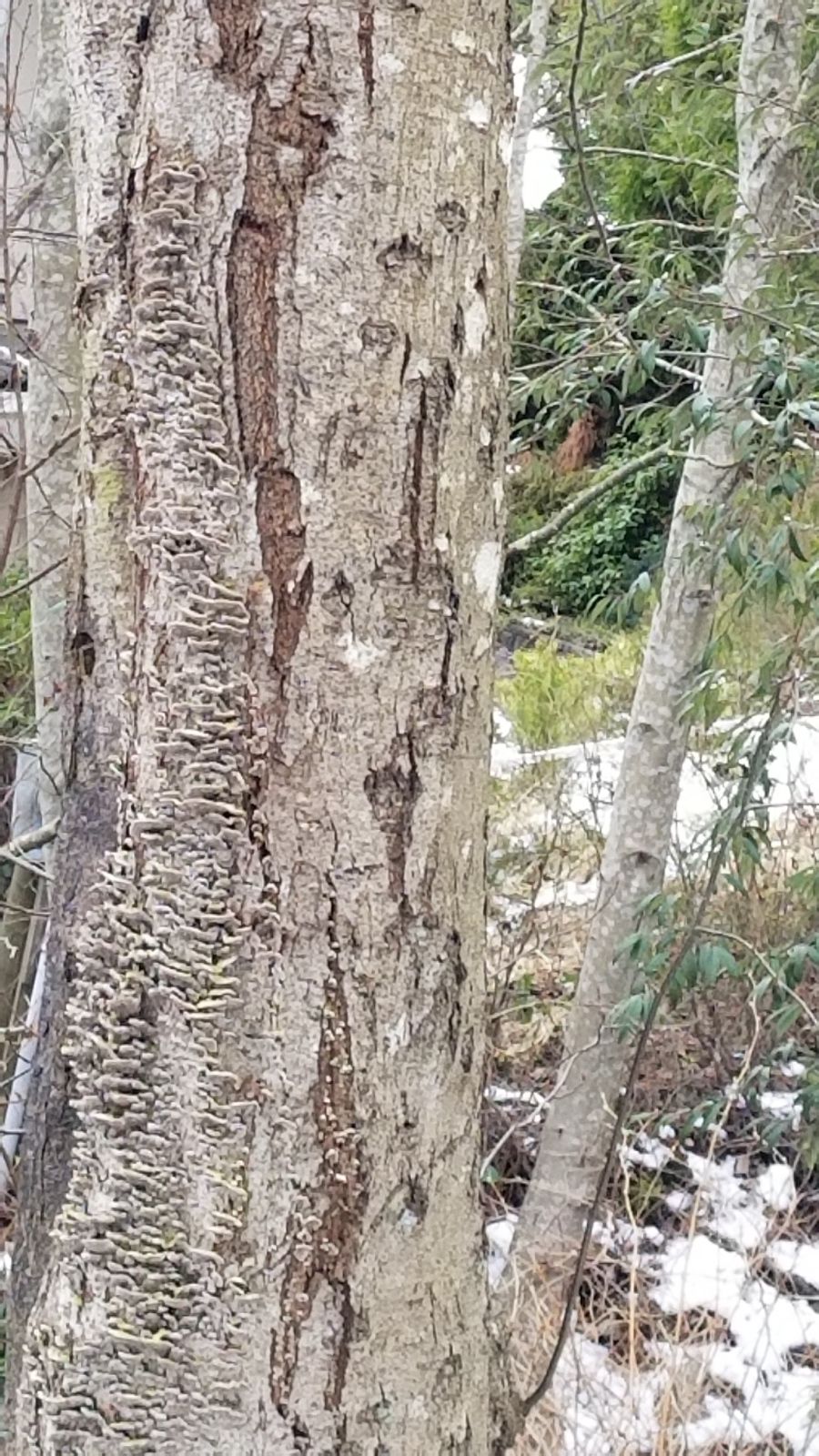
The first visible sign on the trunk is a dark, water-soaked staining at the base. Press the bark at the root flare and it may feel soft — even mushy. Peel back a small piece of outer bark and you'll find reddish-brown to near-black tissue underneath. Not the healthy cream-white you'd expect.
This disease destroys trees from underground first. By the time you see trunk discolouration, the root system may already be severely compromised. The tree looks healthy from the street. But it can fail structurally with very little warning.
Research from the University of British Columbia's Faculty of Land and Food Systems has documented *Phytophthora cinnamomi* and related species causing losses in ornamental plantings throughout Metro Vancouver, particularly in clay-heavy soil areas in Burnaby, Coquitlam, and South Vancouver — where drainage is chronically poor.
**Risk factors specific to Metro Vancouver:**
- Clay-heavy soils across South Vancouver, Burnaby, and Delta
- Chronic root zone compaction from driveways and foot traffic
- Automatic irrigation systems keeping soil saturated into autumn
- Trees planted too deep — the most common installation mistake in residential landscaping
If *Phytophthora* rot is confirmed, removal is often unavoidable. The infected tree becomes a structural hazard, and the soil needs treatment before replanting — the water mold persists in soil for years.
An arborist report documents the condition formally, which matters if the tree falls under Vancouver's Private Tree By-law (By-law No. 12875) and requires a permit to remove.
When Does a Black Trunk Signal an Immediate Emergency?
Not every black trunk is an emergency. But some are. And the ones that are can come down in a single afternoon.
Here's the honest breakdown.
**The bark is telling you it's urgent if you see:**
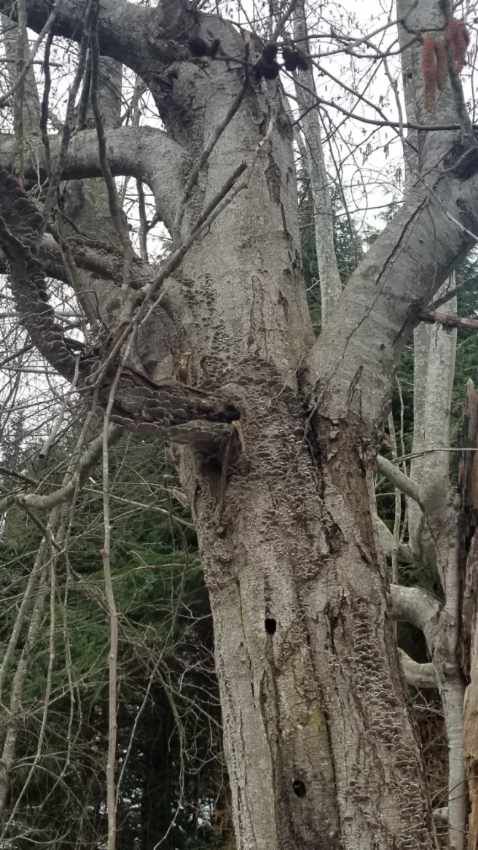
- Soft, mushy, or crumbling sections when pressed
- Visible vertical cracks or splits running up the trunk
- Bark peeling away in large sheets
- Dark, sticky liquid oozing from dark patches
- A fermented or sour smell near the base
**The structure is telling you it's urgent if you notice:**
- Leaning that has developed or worsened over recent weeks
- Cracking or groaning sounds during wind
- Dead branches appearing rapidly in the upper canopy (called flagging)
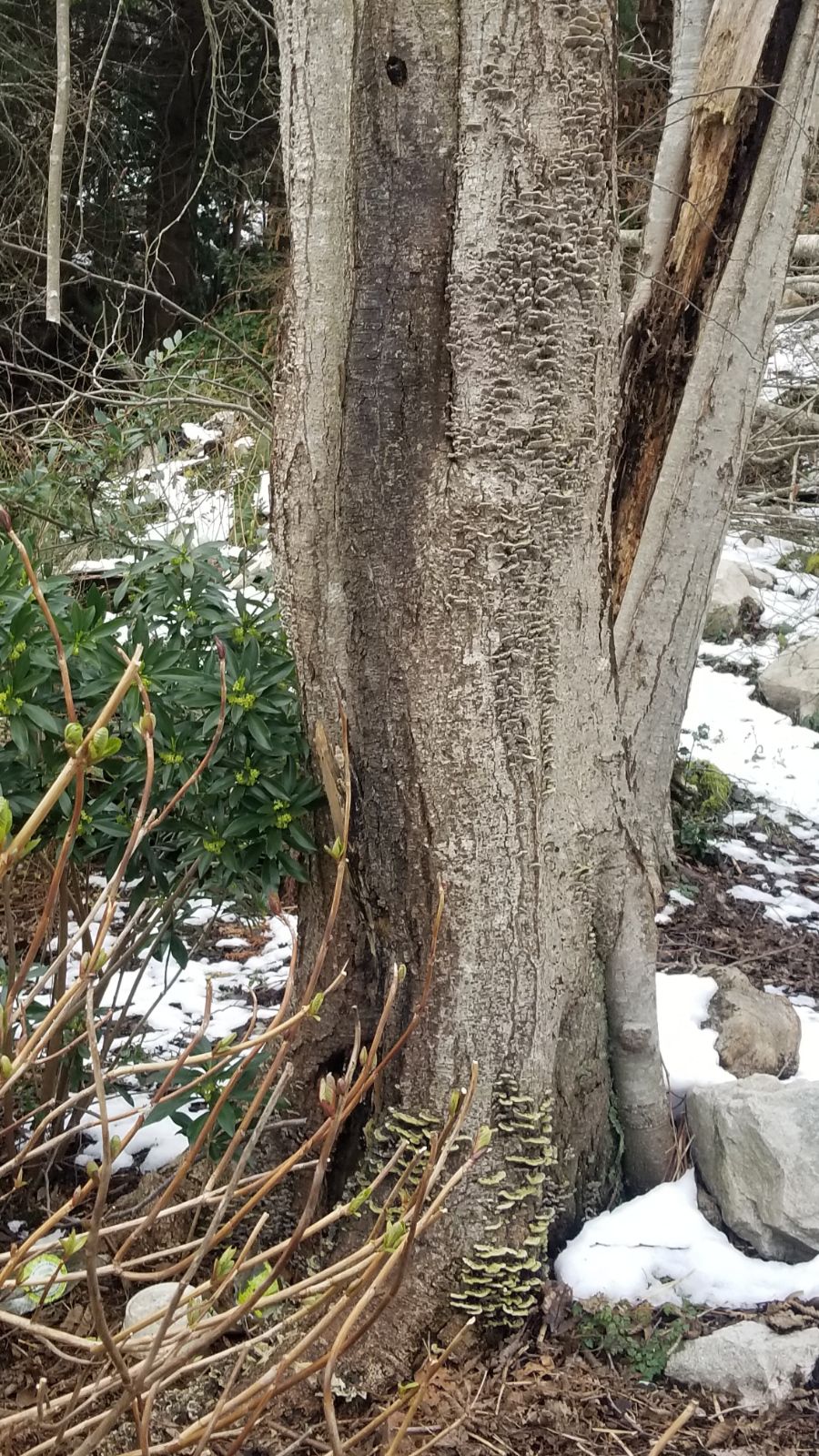
- Fungal conks or mushrooms at the base — these indicate serious internal decay that may have been progressing for years
**Location factors that raise the stakes significantly:**
- The tree overhangs your home, garage, or a parked vehicle
- It's within falling distance of a power line
- It stands on a slope above any structure
If any of these signs are present together, don't wait for a scheduled appointment. Call for emergency tree service the same day. A tree showing multiple failure indicators can come down in a single windstorm.
The Insurance Bureau of Canada reports that weather-related property damage claims in British Columbia — which include tree fall events — are among the fastest-growing categories of homeowner insurance losses in the province, with significant year-over-year increases recorded between 2019 and 2023. A single tree failure over a primary structure can mean $15,000 to $50,000 in damage, and coverage can be denied when pre-existing decay was visible before the event.
How Do ISA-Certified Arborists Actually Diagnose a Black Tree Trunk?
Here's what separates a trained arborist's assessment from an educated guess.
ISA (International Society of Arboriculture) certification requires demonstrated knowledge in tree biology, pathology, risk assessment, and ANSI A300 standards. When we examine a black trunk at Aesthetic Tree & Hedge Services, we follow a structured diagnostic sequence.
**Step 1 — Crown assessment.** The canopy tells the story before we touch the bark. Sparse foliage, dead branch tips, premature leaf drop, or epicormic sprouting from the trunk all signal systemic stress.
**Step 2 — Bark examination.** We assess the texture, firmness, and pattern of discolouration. Random patches versus linear vertical streaks versus basal staining each suggest different causes.
**Step 3 — Root flare inspection.** We examine the zone where trunk meets soil. Is the root flare visible, or buried? Is mulch piled against the trunk? Is the base bark soft?
**Step 4 — Probe and mallet test.** For suspected internal decay, we tap the trunk with a mallet. Hollow sections produce a dull, resonant sound. Dense, healthy wood sounds solid. For advanced cases, we use a Resistograph drill — a specialized tool that measures wood density as it penetrates the trunk, mapping internal decay without cutting through the tree.
**Step 5 — Pest evidence review.** We check under bark scales, at branch junctions, and at the soil line for insect populations, bore holes, or egg masses.
**Step 6 — TRAQ risk rating.** Per the ISA's Tree Risk Assessment Qualification framework, we assign a formal risk rating based on the likelihood of failure and the consequence if failure occurs — low, moderate, high, or extreme.
This process takes 30–60 minutes per tree. It's documented, evidence-based, and defensible. The alternative — deciding from across the yard based on what you can see — is how people end up with surprise emergency failures.
Can You Save a Tree with a Black Trunk, or Does It Need to Be Removed?
The straight answer: it depends entirely on the cause and how far it's progressed.
Here's how we categorize diagnostic outcomes in the Vancouver area.
**Often fully treatable:**
- Sooty mold — resolve the insect problem, bark recovers over one or two seasons
- Algae and lichen — improve air circulation, treat with approved copper-based formulations if needed
- Early-stage bacterial canker limited to a single branch or scaffold
- Early-stage black knot confined to secondary branches — aggressive ANSI A300 pruning removes it completely
**Borderline — case-by-case:**
- Black knot that has reached the main trunk but affects less than 30% of circumference
- Bacterial canker spread to multiple scaffold branches but sparing the main trunk
- Fire blight in apple and pear trees — treatable if caught at the blossom or new shoot stage
**Typically requires removal:**
- Phytophthora crown rot with soft, advanced basal decay
- Internal decay affecting more than 30% of the trunk cross-section
- Black knot galls girdling the main trunk
- Any of the above in a tree within falling distance of a structure
When removal is the right call, stump grinding completes the job correctly. A stump left behind harbors ongoing fungal disease, creates a tripping hazard, and — for pathogens like *Phytophthora* — acts as a reservoir that can infect whatever you plant in the same spot next season.
After removal, have the soil assessed before replanting. Your arborist can recommend species matched to the actual drainage conditions on your site.
How Do You Prevent Tree Trunks from Turning Black in Vancouver?
Prevention in Vancouver's climate is specific work. It's not generic "water your trees" advice. Here's what actually moves the needle.
**Control insect populations before spring.**
Aphid outbreaks escalate fast in warm springs. A dormant oil spray applied in late winter — before bud break, typically February in Metro Vancouver — smothers overwintering aphid and scale populations before they hatch. This single preventive step eliminates most sooty mold cases before they start.
**Don't volcano mulch.**
Heaping mulch against the tree trunk is one of the most common landscaping mistakes we see in Vancouver yards. It traps moisture against the bark, creates ideal conditions for fungal pathogens, and leads directly to collar rot. Apply mulch in a doughnut shape, keeping it 15–20 cm away from the root flare.
**Ensure the root flare is visible.**
Trees planted too deep in clay-heavy Vancouver soils are dramatically more vulnerable to *Phytophthora* and bacterial canker. You should see the point where the trunk starts to widen and flare outward at the soil surface. If the trunk goes straight into the ground like a post, the tree may be planted too deep — a condition that causes chronic root stress and eventual bark decay.
**Prune Prunus species every year.**
Cherry, plum, and ornamental Prunus trees in Vancouver need an annual inspection for black knot. The best pruning window is late winter, before spores become active in warm, wet spring weather. An annual pruning cycle catches black knot at the branch stage — before it ever reaches the trunk.
**Improve root zone drainage.**
*Phytophthora* water molds need standing water to spread. In clay-heavy urban soils, a French drain installation or root zone aeration can dramatically reduce infection risk. Our root barrier and soil management services address drainage conditions that standard landscaping doesn't touch.
**Schedule annual arborist inspections.**
The USDA Forest Service's urban forestry research estimates that a single properly maintained urban tree provides $25 to $30 in annual ecosystem services — stormwater absorption, cooling effect, air quality improvement, and wildlife habitat. Urban trees without regular professional inspection fail at a significantly higher rate. An annual check by an ISA-certified arborist catches problems at the early, treatable stage — before a cosmetic bark issue becomes a structural crisis.
FAQ
**Q: My tree trunk is black and slimy after heavy rain. Is that normal in Vancouver?**
A: A slimy dark film after rain is very often algae. Vancouver's persistent autumn and winter rainfall creates ideal conditions for algae growth on bark surfaces, and it's typically not harmful to the tree itself. However, if the bark underneath the sliminess feels soft when pressed — or if the sliminess persists long after the tree dries out — have an arborist assess it. Slimy plus soft bark at the base is a warning sign for Phytophthora crown rot, not a cosmetic issue.
**Q: The black discolouration is only on one side of the trunk. What does that usually mean?**
A: One-sided discolouration most often indicates a localized wound, a fungal canker developing on the shaded face of the tree, or moisture patterns from a nearby drainage issue. Compare the firmness of the dark side against the normal side. If the dark side is noticeably softer, call an arborist. One-sided discolouration that is hard and follows the grain may be an old wound callusing over — often no cause for concern, but worth monitoring annually.
**Q: I have a protected tree in Vancouver with a black trunk. Can I still get permission to remove it?**
A: Yes. Protected trees on private property in Vancouver fall under the Private Tree By-law. Permits for removal are issued when a certified arborist documents hazard conditions that make retention unsafe. An arborist report is the required first step — it establishes the condition formally and provides the City with the documentation needed to approve a removal permit.
**Q: Is black knot disease contagious to other trees in my yard?**
A: Yes. Black knot spreads via airborne spores released during wet spring weather. An infected Prunus tree will spread the disease to nearby cherry, plum, and related ornamental trees. Remove all infected prunings from the site immediately — don't leave them on the ground or put them in a compost bin. If one Prunus tree in your yard shows trunk galls, have every other Prunus species on the property inspected at the same time.
**Q: How quickly can bark disease spread once a trunk starts turning black?**
A: Speed depends entirely on the cause. Sooty mold is slow and cosmetic — it won't structurally affect your tree. Black knot advances on an annual cycle, adding new galls each growing season. Phytophthora crown rot is the fastest mover: a tree showing early basal staining in October can have significant structural compromise by March after a wet winter. Don't wait a season to see what happens. If you see dark, soft bark at the root flare heading into fall, get an assessment before the rainy season accelerates the problem.
---
Call Aesthetic Tree & Hedge Services Before It Becomes an Emergency
Your tree is telling you something.
Whether it's a cosmetic algae film or the early stages of structural failure, the difference between a simple treatment and a costly emergency removal often comes down to one thing: how quickly you act.
Aesthetic Tree & Hedge Services are ISA-certified arborists serving Vancouver, Burnaby, North Vancouver, Richmond, Coquitlam, and the Lower Mainland. We're WCB registered. We assess, diagnose, treat, and — when removal is the right answer — we handle it safely and completely, including tree cutting and full stump removal.
If the situation is urgent, we're available for emergency tree service across the Lower Mainland.
Call us for a free estimate: **(604) 721-7370**
Don't let uncertainty become an emergency.
Related: For more on this, see Tree Removal Richmond: What to Know.
Found this helpful? Follow our tree care insights directly on Google.
Make us your preferred source on GoogleBefore You Go
Where are you in your tree care journey?
Our Tree Care Services
ISA-certified arborists serving Greater Vancouver


Explore Our Tree Care Services
From expert pruning to safe tree removal, our ISA-certified arborists are ready to help across Greater Vancouver.
View Services