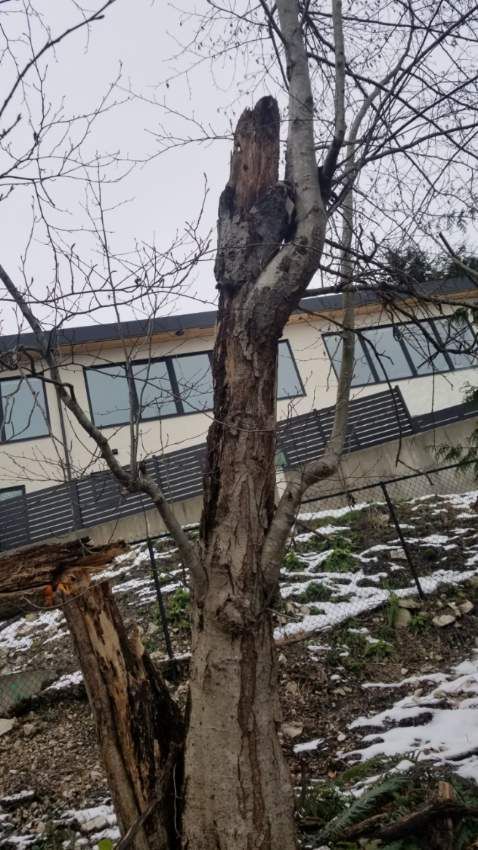
Tree Hollow Assessment & Treatment Vancouver
A hollow is not a verdict. What matters is how much sound wood remains: arborists screen against a t/R ratio of 0.3, meaning residual wall thickness against stem radius, and plenty of hollow trees pass. Cavity filling is no longer recommended practice, because it traps moisture and accelerates the decay it was meant to stop.
A hollow in your tree is alarming to look at, but it is not a death sentence for the tree, and it does not automatically mean removal. Our team at Aesthetic Tree approaches every hollow assessment the same way: separate the cosmetic concern from the structural one, then give you an honest answer about which you're actually dealing with. That distinction matters enormously, and most homeowners don't hear it clearly enough until they call us.
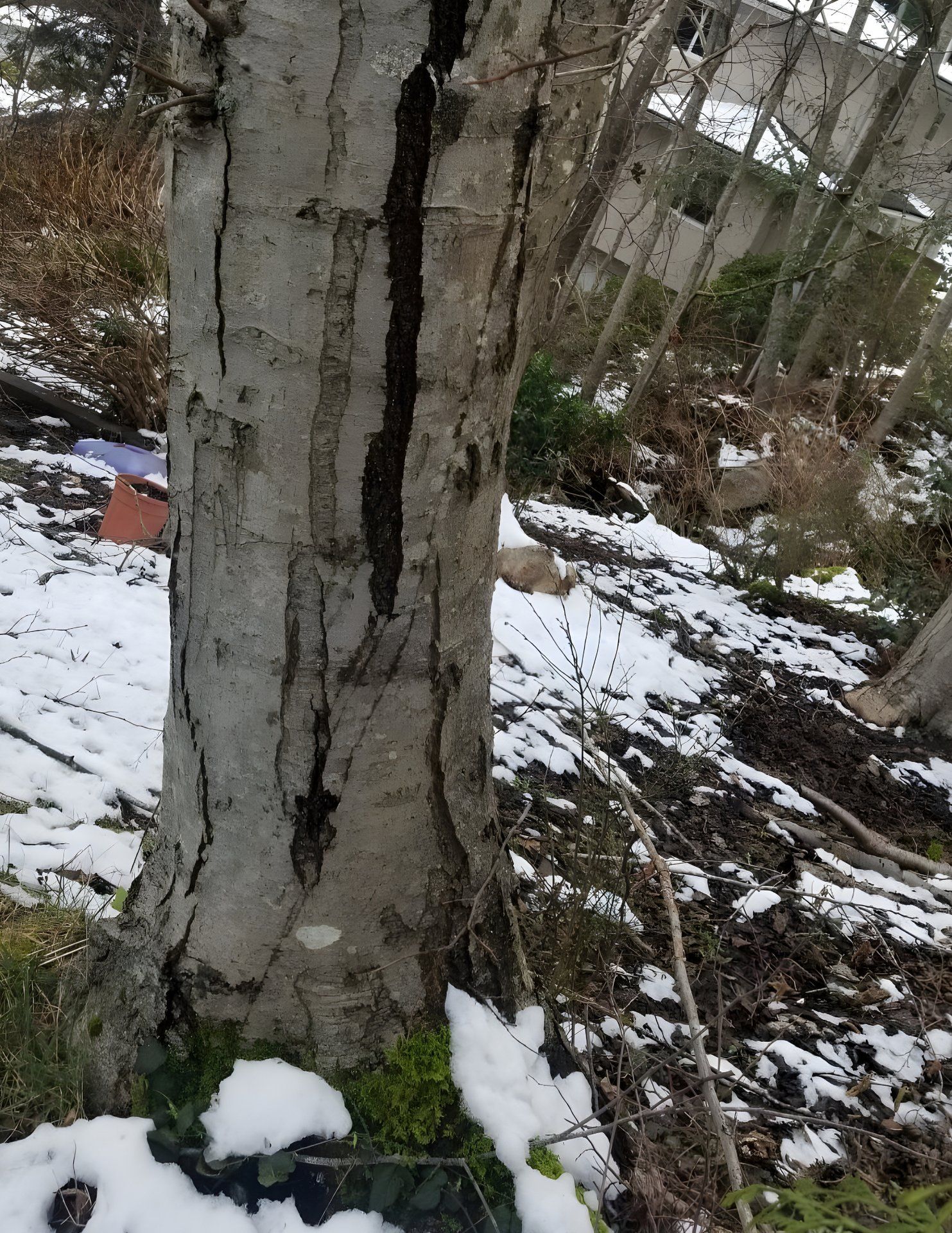
How Does Your Team Actually Assess a Tree Hollow?
The key discipline is treating apparent size as a floor, not a ceiling.
What you can see from the ground, the opening, the visible cavity wall, understates what's actually happening inside. Decay follows moisture and grain in ways that are not obvious from the outside. Our team probes the wood around the entire circumference at multiple heights, not just at the visible opening. That approach catches situations that would otherwise surprise even experienced crews: a hollow that looks contained from the street but has progressed much further up the cambium than any visual inspection suggested.
This is also why we apply TRAQ methodology, Tree Risk Assessment Qualification, to structural evaluations. TRAQ gives us a consistent framework for weighing hollow geometry, wood condition, species characteristics, site exposure, and what's in the target zone. A hollow in a tree overhanging a patio is assessed differently from the same hollow in a tree on a back fence line with no targets.
The takeaway for homeowners: if you are going to err on anything, err on a more thorough assessment upfront. The cost of a second visit to address missed decay is always higher, in time, in equipment, and in the risk profile for everyone on-site.
Should I Fill the Hollow or Treat It?
In most cases, no. This surprises people.
Modern arboriculture moved away from cavity filling decades ago, and for good reason: filling a hollow does not restore structural integrity. Concrete, foam, and other fill materials were once standard practice, but the evidence showed they can trap moisture at the fill boundary and accelerate the decay they were intended to stop. Our team recommends against filling regularly, it is a routine part of honest arboricultural advice, not an exception.
The clearest case for leaving a hollow alone is a mature tree where the decay column is stable, the surrounding wood shows good compartmentalization, the tree is not positioned over a high-value target zone, and the species has a known tolerance for internal cavities. In that scenario, monitoring is a legitimate and responsible recommendation, not a placeholder until we think of something else to sell you.
When homeowners hear this, the reaction is usually a mix of relief and mild skepticism. People expect to be sold something. We explain what we are watching for, what observable changes would prompt a callback, and when to get us back on-site. That transparency is the service.
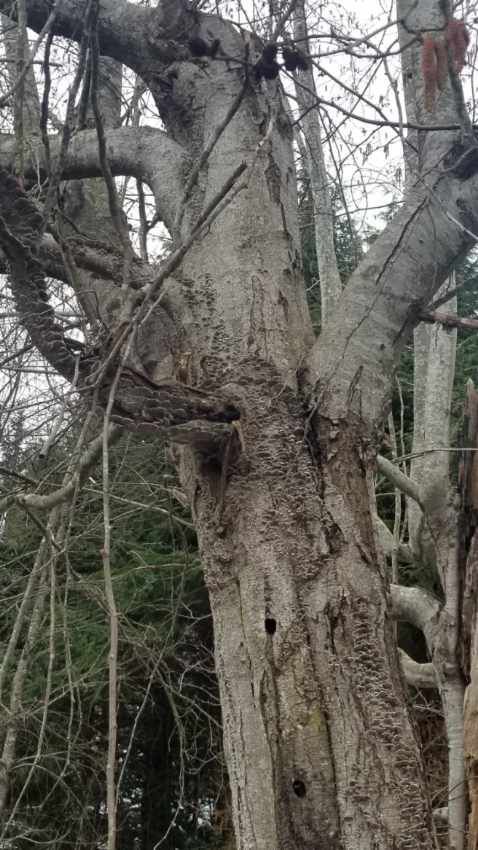
The thresholds we actually measure against
A hollow is not a diagnosis. The question is how much sound wood is left and where the load goes.
The long-standing screening figure is the t/R ratio, residual wall thickness divided by stem radius, published by Mattheck and Breloer in The Body Language of Trees (1995). Below 0.3, a hollow stem is treated as at risk of shell buckling. An older approach from Wagener (1963) flags a stem once the hollow exceeds 0.33 of the cross-section by the d³/D³ formula, though that one was developed only for conifers without other defects, a limit worth stating whenever the number is quoted. Both are screening triggers. A 2017 analysis in [Royal Society Open Science](https://royalsocietypublishing.org/rsos/article/4/4/160972) calls the 0.3 threshold "an oversimplification that cannot be generalised."
Where the stem is ambiguous, instruments help: sonic tomography has shown a 0.91 correlation with actual decay extent, and Picus tomograms deviated by about 5% of cross-sectional area across 27 sections ([Arboriculture & Urban Forestry](https://auf.isa-arbor.com/content/30/5/277), 2004).
Then the part that gets skipped: a hollow is habitat. U.S. Forest Service research ([GTR PSW-181](https://www.fs.usda.gov/psw/publications/documents/gtr-181/016_Bull.pdf)) records that more than a quarter of Pacific Northwest wildlife species use tree cavities, and a cavity large enough for denning takes over 100 years to form naturally, small usable ones take 8 to 30 years after a limb dies. You cannot replant that.
So the rating matters more than the hole. We assess the way the ISA Tree Risk Assessment Qualification framework does, Low, Moderate, High, Extreme, weighing likelihood of failure against what sits beneath it. Plenty of hollow trees keep standing on that assessment.
Two numbers to hold alongside the ratios. Wagener's older screening test treats a stem as compromised once the hollow passes 33% of the cross-section, a figure developed only for conifers carrying no other defect. And on habitat, more than 25% of Pacific Northwest wildlife species use cavities, which is why retention is the default wherever the structure supports it.
Frequently Asked Questions
Does a tree hollow always mean the tree needs to be removed? No. A hollow indicates internal decay, but the structural question, whether the remaining sound wood can safely carry the tree's load, is separate. Many hollows, particularly in otherwise healthy trees with good structure and root systems, are stable and do not require removal. Our team assesses each situation individually using TRAQ methodology.
Should I fill a tree hollow with concrete or foam? Modern arboriculture no longer recommends cavity filling. Filling does not restore structural integrity and can trap moisture at the fill boundary, accelerating the decay it was meant to stop. In most cases, monitoring or structural support measures are more appropriate than filling.
How do you know how far the decay has progressed inside the tree? Our team probes the wood around the entire circumference at multiple heights, not just the visible opening. Decay follows moisture and grain in non-obvious ways, so visible size understates actual progression. We treat apparent size as a floor, never a ceiling, and assess accordingly.
What would make you recommend removal rather than monitoring? Removal becomes the responsible recommendation when structural analysis under TRAQ methodology indicates that residual risk for the site and target zone exceeds the acceptable threshold, and the deficit cannot be addressed through cabling, bracing, or crown reduction. This is most common when decay has been left unassessed over multiple seasons and has compromised a significant portion of the trunk's cross-section.
What do I get after an assessment? Documentation of findings and recommendations in writing. For situations requiring a formal arborist report, that report becomes the baseline for future comparison. We also advise you on the specific observable changes, new cracking, fungal fruiting bodies, sudden lean, significant storm loading, that should prompt you to call us back.