
TL;DR — Quick Summary
Benefits of tree removal include safer homes, healthier yards, and fewer storm risks. Learn when removal makes sense in Vancouver.
The benefits of tree removal are easiest to see when a tree has crossed the line from asset to risk.
A healthy Douglas fir can shade a house for decades. A strong cedar can frame a backyard beautifully. A Big-leaf maple can cool a patio in August and hold a whole small world of birds, moss, and insects.
But a failing tree is different.
It leans after a storm. It drops large limbs. It has fungal conks at the root flare. It presses against the roofline. Its roots lift paving, block drains, or crowd a foundation. It may still look alive from the kitchen window. Yet the structure inside the trunk tells another story.
That is where tree removal becomes responsible tree care.
At Aesthetic Tree & Hedge Services, we do not treat removal as the first answer. We inspect. We assess risk. We check the species, defects, site, targets, and municipal rules. Then we recommend the safest option. Sometimes that is pruning. Sometimes it is cabling. Sometimes it is a permit-backed removal done by an ISA-certified arborist crew.
This guide explains when removal helps, what problems it solves, and how Vancouver-area homeowners can make the decision with less stress.
TL;DR
- Tree removal is useful when a tree is dead, dying, hazardous, structurally weak, or in the wrong place.
- In Vancouver, many private trees need a permit before removal. The City of Vancouver requires a permit for private trees 20 cm or larger in diameter, measured 1.4 metres above grade.
- Removal can protect roofs, vehicles, fences, drains, power lines, and nearby healthy trees.
- A good arborist looks for defects at the root flare, trunk, scaffold limbs, and canopy before recommending removal.
- After removal, stump grinding and replanting often finish the job properly.
If you already know the tree needs to come down, start with professional tree removal in Vancouver. If you are not sure, an arborist report in Vancouver gives you written evidence for permits, insurance, and peace of mind.
Why Would Removing a Tree Ever Be the Best Choice?
Removing a tree is the best choice when keeping it creates more risk than benefit.
That sounds simple. In real yards, it takes judgment.
A tree is not unsafe just because it is tall. Tall trees are normal in the Lower Mainland. Western red cedar, Douglas fir, spruce, and Big-leaf maple all grow large here. Height alone does not decide the issue.
Structure does.
A tree becomes a removal candidate when we see clear signs of failure. These include:
- Dead or dying upper canopy
- Large cracks in the trunk
- Included bark between co-dominant stems
- Root plate movement after wind
- Fungal fruiting bodies near the base
- Major decay at old pruning wounds
- Large dead limbs over a roof, driveway, sidewalk, or play area
- Severe lean with fresh soil heaving
- Storm damage that leaves the tree unbalanced
The key word is target. A dead tree deep in a forest is habitat. A dead tree over a Vancouver garage is a liability.
In our field work, we often meet homeowners who feel guilty about removal. That is understandable. Mature trees matter. Vancouver’s 2025 Urban Forest Strategy reports that citywide canopy cover reached 25% in 2022, up from 23% in 2018 and 21% in 2013. The city also has a 30% canopy target for 2050.
So yes, we protect good trees.
But protecting the urban forest also means removing the trees that are beyond recovery. A hazardous tree can injure people, damage property, and spread pests or decay into nearby trees. Responsible removal keeps the rest of the landscape safer.
Think of it less as giving up on a tree. Think of it as making room for the right next tree.
What Are the Main Safety Benefits of Tree Removal?
The biggest safety benefit is simple: controlled removal prevents uncontrolled failure.
Trees fail on their own schedule. They do not wait for a sunny Saturday. They fail during wind, wet snow, heavy rain, heat stress, or after years of decay. In the Lower Mainland, that often means the worst moment is a stormy night.
A professional removal changes the conditions.
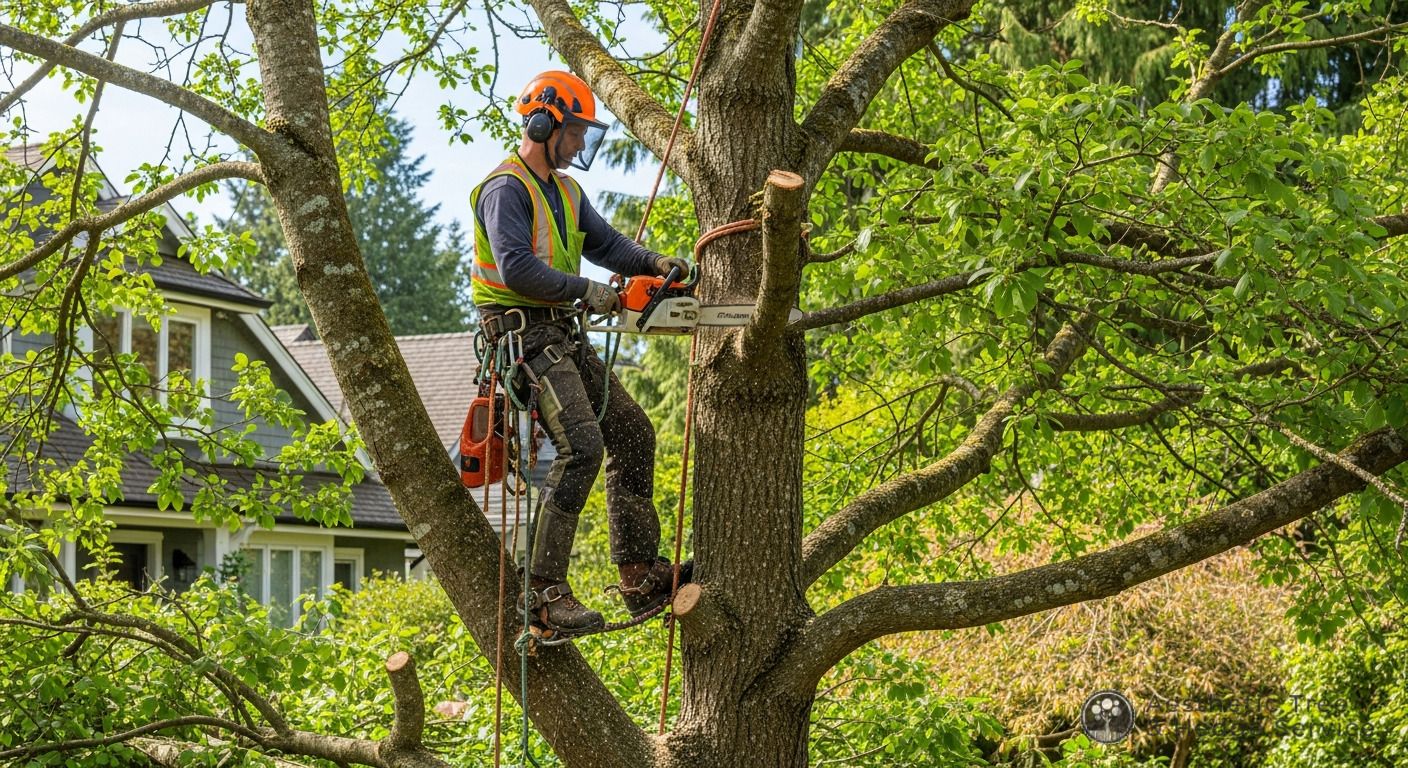
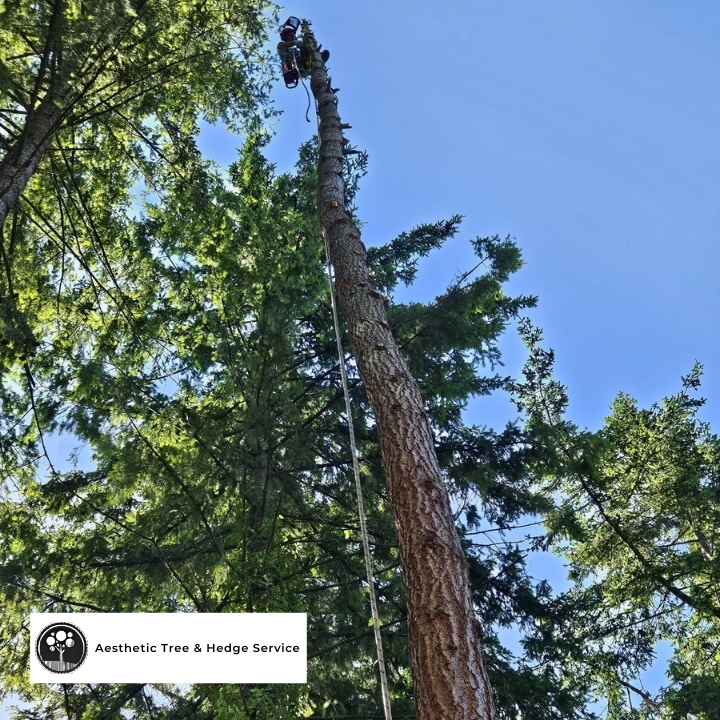
Instead of waiting for gravity and wind, an arborist crew plans the fall path, rigging, cuts, drop zones, traffic control, and cleanup. In tight Vancouver yards, sections are often lowered by rope. That protects fences, decks, sheds, garden beds, and neighbouring property.
This matters because tree work is not casual labour.
WorkSafeBC reported that the injury rate for manual tree falling in British Columbia was 20.1 in 2020. The provincial average was 2.15. That makes hand falling close to ten times more dangerous than the average job in B.C.
That statistic should make any homeowner pause before renting a saw.
Tree removal involves weight, tension, compression, hinge wood, fall angles, escape routes, electrical hazards, and overhead work. A limb can barber-chair. A trunk can split. A hung-up top can roll. A cut that looks small from the ground can release hundreds of pounds.
A trained crew manages those forces. They also bring the right equipment: climbing systems, rigging lines, blocks, lowering devices, chainsaws, pole saws, wedges, helmets, eye protection, hearing protection, and chipper safety procedures.
The safety gains are practical:
- Fewer falling limbs over people and pets
- Lower risk to roofs and gutters
- Less chance of damage to parked cars
- Safer driveways and walkways
- Less storm anxiety in winter
- Safer work near overhead service lines
If a tree has already failed, or a large limb is hanging, do not stand under it for photos. Call for emergency tree service and keep people away from the drop zone.
How Does Tree Removal Protect Your House and Property?
A risky tree does not need to fall completely to cause damage.
One large limb can puncture a roof. A rubbing branch can strip shingles. A trunk pressing into a fence can crack posts. Roots can lift pavers, push retaining walls, and create trip hazards. Dense branches can hold moisture against siding and speed up rot.
Tree removal protects property by removing the source of pressure.
The most common property risks we see include:
- Limbs over roofs, skylights, and chimneys
- Trunks too close to garages or additions
- Roots disrupting hardscape
- Trees growing into service lines
- Large branches over parked vehicles
- Storm-damaged trees leaning toward homes
- Decayed stems near fences or sheds
Not every conflict requires removal. A skilled pruning plan can solve many clearance issues. That is where proper tree cutting in Vancouver helps. The goal is not to hack the tree back. The goal is to reduce risk while preserving structure and health.
Still, some trees are planted in the wrong place from day one.
A cedar may have been cute at planting. Thirty years later, it blocks light, crowds the house, and drops heavy debris into gutters. A maple may have grown too large for a narrow side yard. A spruce may now lean over a neighbour’s driveway.
Good tree care has to respect the site.
The right tree in the right place is a long-term asset. The wrong tree in the wrong place becomes a recurring problem. At that point, removal and replacement can be the better plan.
This is especially true before construction.
If you are planning a renovation, laneway house, drainage repair, or new hardscape, tree protection rules matter. In Vancouver, the Protection of Trees By-law No. 9958 applies to private trees. The City says a permit is needed to remove any private tree with a diameter of 20 cm or more, measured 1.4 metres above ground.
For development work, an arborist report is often required when protected trees are present. That report identifies retention trees, protection zones, removal requests, and replacement requirements.
The benefit here is not just physical protection. It is process protection. You avoid permit trouble, stop-work delays, and expensive redesigns.
Can Removing One Tree Help the Rest of the Yard?
Yes. Removing one poor tree can improve the health and usability of the whole yard.
Trees compete for light, water, soil space, and nutrients. In a forest, that competition is natural. In a small Burnaby, Richmond, or East Vancouver yard, it can become a problem.
A declining tree can shade out better plants. It can crowd a hedge. It can trap moisture and reduce airflow. It can spread fungal issues. It can also leave the homeowner constantly cleaning needles, cones, leaves, or broken branches from one small area.
Removal can create space for:
- A healthier replacement tree
- More light for lawn or garden beds
- Better airflow around the house
- Safer access along walkways
- Healthier hedges and shrubs
- A clearer view from windows
- Better use of patios and play areas
We often see this with overgrown hedge lines. A tree seeded itself into the hedge years ago. Now it has outgrown everything around it. The hedge is thin on one side, shaded on the other, and hard to trim properly.
In that case, tree removal plus good hedge trimming services in Vancouver can restore shape and light. The yard looks cleaner. The plants left behind get a better chance.
There is also a soil story here.
Old stumps and decayed root systems can become fungal reservoirs. Not every fungus is a threat. Many are part of normal decomposition. But certain decay patterns near living trees deserve attention. An arborist can assess whether removal, stump grinding, or monitoring is the right path.
The best yard is not the yard with the most trees. It is the yard with the right trees, placed well, maintained well, and suited to the space.
What Are the Storm-Season Benefits of Removing a Hazard Tree?
Storm season changes the risk equation.
The Lower Mainland gets wet soil, strong wind, and heavy rain. Add saturated ground to a tree with poor roots, and the chance of failure rises. Add a dense evergreen canopy, and the sail effect can increase in wind.
Removal before storm season reduces the odds of an emergency call later.
This is not fear-based. It is practical.
The Insurance Bureau of Canada reported that severe weather caused $8.5 billion in insured damage across Canada in 2024. That was the highest annual total on record. The report included severe storms in southern British Columbia among the notable events.
A single yard tree is not the whole climate story. But homeowners can control the risks on their own property.
Before winter, look for these warning signs:
- New lean after wind
- Soil lifting on one side of the trunk
- Cracks running down the trunk
- Large dead limbs high in the canopy
- Mushrooms or conks at the root flare
- Cavities with soft wood inside
- A tree that moves more than nearby trees
- Broken tops or hanging limbs
If you see those signs, call an arborist before the next storm.
This is where inspection matters. A tree can look green and still be structurally weak. Leaves and needles show life. They do not prove strength.
We inspect the root flare, trunk, unions, canopy, and site conditions. We also look at targets. A weak tree beside an open field is one thing. A weak tree beside a home, school route, garage, or sidewalk is another.
For homeowners, the main storm-season benefit is control. Planned removal happens in daylight, with equipment ready and a crew on site. Emergency removal happens under pressure, often with damage already done.
Planned is better.
Does Tree Removal Help With Pests, Disease, and Decay?
Yes, when the tree is past recovery or creates a risk to nearby trees.
Many tree health problems can be managed. Pruning, soil care, mulching, watering, and monitoring all have a place. Removal is not the first tool. But it is the right tool when decay is advanced or the disease risk is high.
Common red flags include:
- Extensive deadwood
- Fungal conks on trunk or roots
- Soft or hollow sections
- Bark sloughing off large areas
- Borer activity
- Severe dieback
- Root rot symptoms
- Repeated limb failure
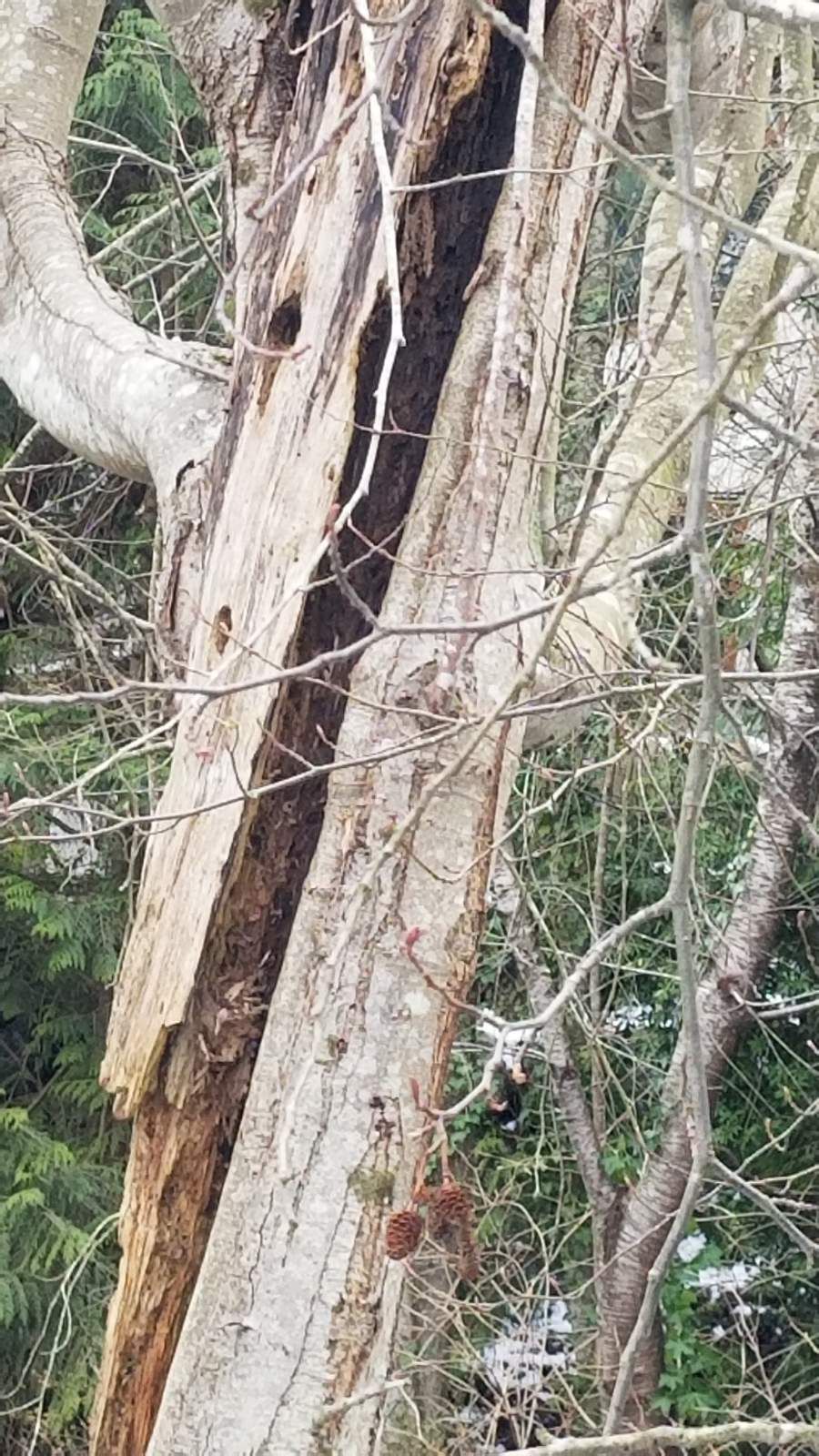
In our experience, the root flare often tells the truth. Homeowners tend to look up at the canopy. Arborists look down first. If the base is buried, decayed, girdled, or lifting, the tree may be unstable even if the canopy still has leaves.
Decay does not reverse. Trees can compartmentalize wounds, but they do not heal like people do. They grow around damage. Sometimes that works for years. Sometimes the decay column wins.
Removing a diseased or decayed tree can protect nearby trees in three ways.
First, it removes infected material from the site. Second, it lowers the chance of sudden failure. Third, it gives the arborist a chance to recommend replacement species better suited to the soil, light, and space.
Species choice matters in Metro Vancouver.
A Douglas fir needs room. A cedar needs the right moisture and space. Big-leaf maple grows fast and large. Ornamental trees can work well in smaller lots, but only when planted with mature size in mind.
This is one reason we like written assessments. An arborist report in Vancouver gives the owner a clear record of defects, risk level, and recommended action. It also helps with permit applications when a municipality asks for evidence.
When Is Pruning Better Than Removing a Tree?
Pruning is better when the tree is healthy enough to keep and the risk can be reduced without harming structure.
A good arborist does not remove a tree just because pruning is harder. We look at the whole tree. If selective cuts can reduce weight, improve clearance, and remove deadwood, pruning may be the right answer.
Pruning works well for:
- Deadwood removal
- Roof and building clearance
- Sidewalk clearance
- Weight reduction on long limbs
- Improving airflow
- Correcting minor structural issues
- Maintaining hedges and screens
- Reducing branch conflicts
But pruning has limits.
Topping is not proper pruning. Lion-tailing is not proper pruning. Stripping the inside growth from a tree and leaving heavy ends is not proper pruning. Those cuts create stress and future failure points.
Professional pruning follows recognized standards, including ANSI A300 standards. The goal is to make the right cut at the right location for the right reason.
Removal becomes the better choice when pruning would leave the tree unstable, ugly, or unable to recover. If the main stem is decayed, reducing a few limbs does not solve the core risk. If roots are failing, canopy work will not anchor the tree. If the tree is dead, pruning is just delay.
A useful question is this: after pruning, will this tree still be safe, healthy, and worth keeping?
If yes, keep it.
If no, removal is honest.
For more background on local removal decisions, see Aesthetic Tree’s tree removal Vancouver guide. It explains how permits, safety, and site access fit together.
What Should Vancouver Homeowners Know About Tree Removal Permits?
Permit rules are one of the biggest reasons to call an arborist before cutting.
In Vancouver, the City’s Protection of Trees By-law No. 9958 applies to trees on private property. The City states that a permit is required to remove any private tree that is 20 cm or greater in diameter, measured 1.4 metres above ground.
That measurement is often called DBH, or diameter at breast height.
The City also says a permit is not needed for a smaller tree unless that tree was previously identified as a replacement tree or is part of a landscape design for a new development project.
Other municipalities have their own rules. Burnaby, Richmond, North Vancouver, Coquitlam, and other Lower Mainland cities do not all use the same thresholds or process. Some rules change by zoning, development status, species, hazard status, or covenant.
That is why local knowledge matters.
A permit can require:
- Tree measurements
- Site plan details
- Species identification
- Photos
- Arborist assessment
- Hazard documentation
- Replacement planting
- Permit posting during removal
The benefit of doing this properly is simple. You avoid fines, delays, neighbour conflict, and rejected applications.
It also protects the broader urban forest.
Metro Vancouver’s Metro 2050 performance target aims to increase tree canopy within the Urban Containment Boundary from 32% to 40% by 2050. That target does not mean every tree stays forever. It means removals should be justified, tracked, and balanced with good planting.
A professional crew can help you understand what applies before work starts. That is far easier than sorting it out after a complaint.
If your tree is part of a renovation or development application, start with an arborist report in Vancouver. It gives the city the information it expects and gives you a clean path forward.
How Does Stump Grinding Improve the Results After Removal?
Tree removal is not always finished when the trunk is down.
The stump can still cause problems.
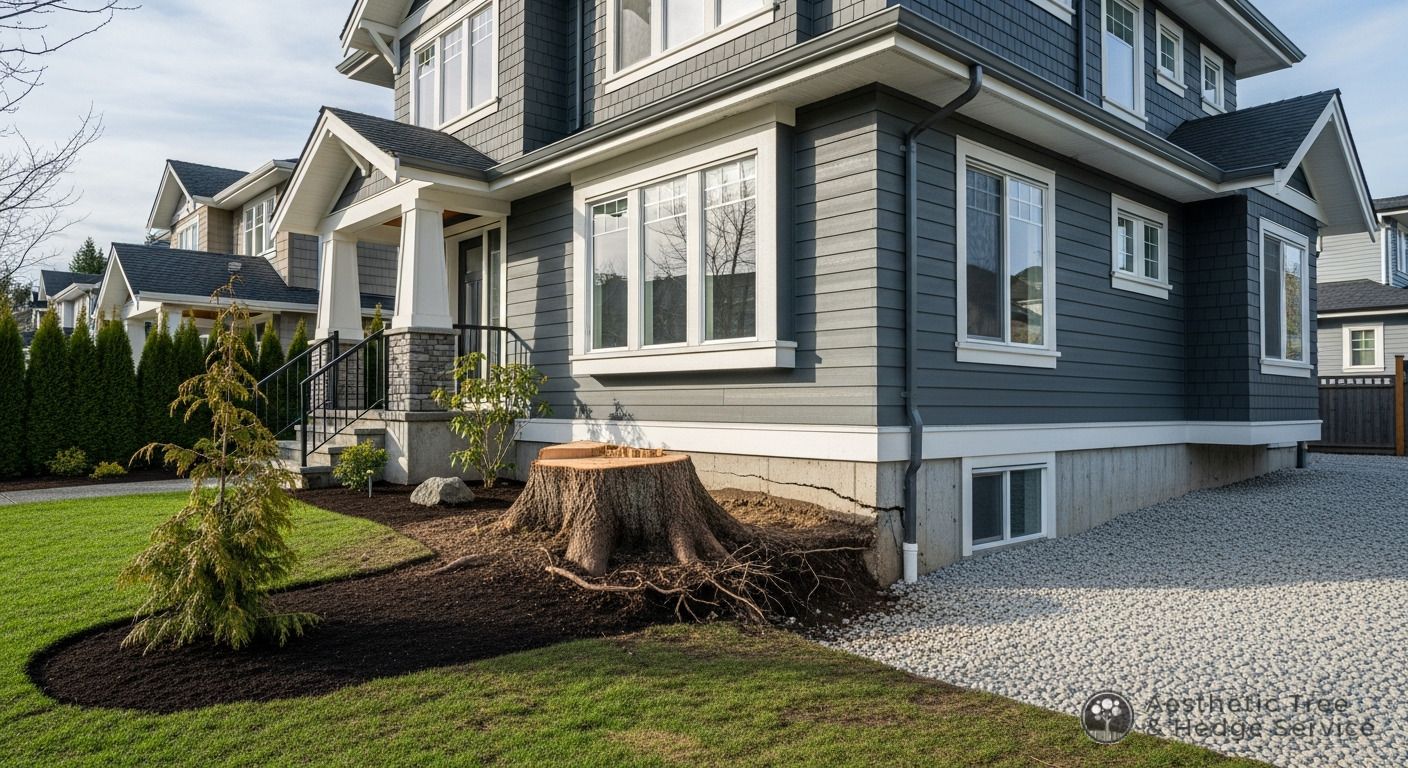
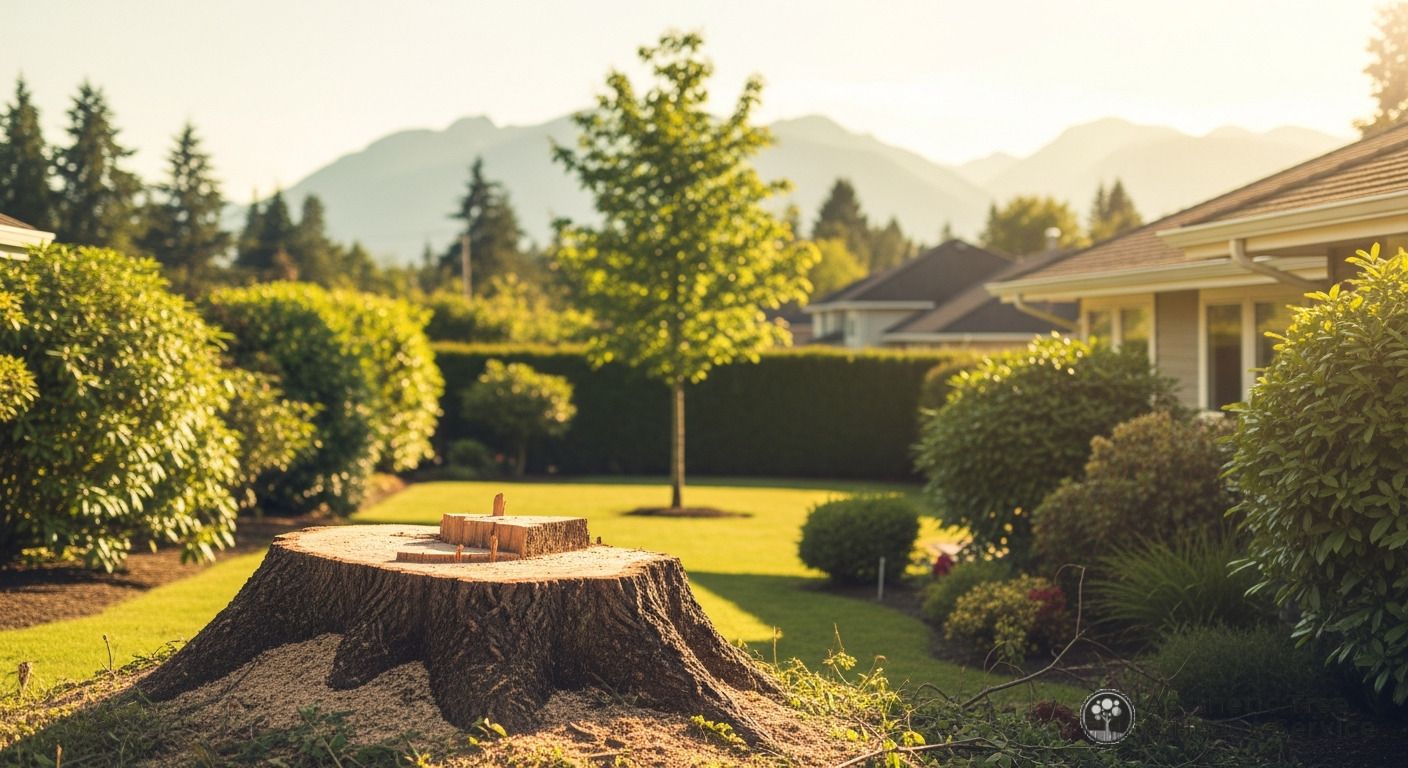
A leftover stump can become a trip hazard. It can block new planting. It can attract insects. It can keep sending up shoots. It can interfere with fencing, patios, lawns, and garden beds. It can also make a clean yard look unfinished.
Stump grinding removes the visible stump by grinding it below grade. The remaining chips can often be used as mulch, depending on site conditions and the homeowner’s plan.
The benefits are immediate:
- The yard is easier to use
- Lawn repair is simpler
- New planting has more room
- Trip hazards are reduced
- The area looks cleaner
- Shoots are less likely to return
Stump grinding is especially helpful after removing trees near driveways, walkways, and small urban gardens. Those are places where every square foot counts.
There is also a planning benefit. If you want to replant, the stump location matters. Sometimes a replacement tree should go nearby, not directly in the old root mass. An arborist can help choose a better location based on sunlight, mature size, soil, and clearance.
If you are removing a tree and want the area usable again, include stump grinding in Vancouver in the plan from the start.
Can Tree Removal Improve Light, Views, and Outdoor Living Space?
Yes, when the tree is overgrown, poorly placed, or blocking the main use of the yard.
This is where homeowners sometimes feel shallow. Safety sounds serious. Light sounds cosmetic. But light affects how a home works.
Too much shade can keep lawns thin, patios damp, and garden beds weak. It can add moss to hard surfaces. It can make basement rooms feel darker. It can reduce the usefulness of a backyard that should be a place to sit, cook, or let kids play.
Removal can open space without stripping the whole yard.
The best approach is selective. We look at the tree’s health, location, and role. We also look at what remains. If removing one declining cedar gives three better trees more room, the yard can feel brighter and still mature.
The goal is not a bare lot.
The goal is balance.
In Vancouver neighbourhoods like Kitsilano, Mount Pleasant, Dunbar, and Renfrew-Collingwood, lots can be tight. A single mature tree can dominate the whole outdoor area. In North Vancouver, larger trees can create major shade on steep or narrow properties. In Richmond, drainage and soil conditions add another layer.
A good arborist will talk about more than the cut. They will talk about what the yard becomes after the cut.
That may include replacement planting, hedge reshaping, canopy pruning, or a phased plan.
For seasonal care ideas, Aesthetic Tree’s guide to seasonal tree care is a useful companion. It helps homeowners think about timing, inspections, and maintenance before problems become urgent.
What Are the Benefits of Hiring ISA-Certified Arborists for Tree Removal?
The main benefit is judgment.
Anyone can say a tree should come down. An ISA-certified arborist can explain why, show the evidence, and recommend the safest method.
That matters because tree removal decisions have consequences. Remove a protected tree without a permit, and you may face enforcement. Remove the wrong tree, and you lose shade and value. Keep a hazardous tree, and you carry the risk.
An arborist brings structure to the decision.
They assess:
- Species
- Root flare condition
- Trunk defects
- Canopy health
- Limb weight
- Decay signs
- Soil and drainage
- Wind exposure
- Nearby targets
- Municipal rules
- Access for equipment
- Replacement options
They also understand when to say no.
Some trees should be retained. Some should be pruned. Some need monitoring. Some need removal soon. Some need emergency work today.
A professional company should also be WCB registered. This protects workers and gives homeowners more confidence that the crew treats safety as part of the job, not an afterthought.
The City of Vancouver says its urban forest includes about 150,000 street trees, 36,000 specimen trees in golf courses and urban parks, and more than 1 million trees across 444 hectares of public forests and woodlands. That is a serious urban forest. Private property work should meet the same level of care.
At Aesthetic Tree & Hedge Services, our ISA-certified arborists work with homeowners across Vancouver, Burnaby, North Vancouver, Richmond, Coquitlam, and the Lower Mainland. We know local trees. We know municipal permit rules. We also know when a homeowner needs a clear, plain-English answer.
That answer should never be vague.
It should sound like this: here is the defect, here is the risk, here are the options, and here is what we recommend.
What Should You Do Before Removing a Tree?
Start with a site assessment.
Do not start with a chainsaw. Do not start by asking a neighbour. Do not start by guessing the bylaw from an old forum post. Tree rules change, and every site has its own facts.
Before removal, do these steps:
1. Identify the tree species. 2. Measure the trunk diameter at 1.4 metres above grade. 3. Check whether the tree is protected by municipal bylaw. 4. Look for visible defects and document them with photos. 5. Note nearby targets, such as roofs, wires, fences, cars, and walkways. 6. Ask whether pruning, cabling, or monitoring is a valid option. 7. Get an arborist opinion if the tree is large, risky, or regulated. 8. Confirm permit needs before work begins. 9. Plan stump grinding and cleanup. 10. Consider replacement planting.
This process saves time. It also gives you better answers.
If cost questions come up, use care. Do not rely on broad averages for your own property. Tree access, height, species, lean, rigging needs, permit needs, and disposal all change the scope. A small ornamental tree in an open yard is not the same project as a storm-damaged fir over a roof.
For general market context only, Aesthetic Tree has a separate guide to tree removal cost in Vancouver. These figures represent industry averages based on third-party market research. Actual costs vary by project scope, materials, and site conditions. Contact Aesthetic Tree & Hedge Services for a personalized assessment.
The most important thing is not the average. It is the plan for your exact tree.
FAQ
What are the biggest benefits of tree removal?
The biggest benefits are safety, property protection, better yard health, and lower storm risk. Removal is most useful when a tree is dead, dying, decayed, structurally weak, or too close to buildings and utilities. It can also make room for better planting.
Do I need a permit to remove a tree in Vancouver?
Often, yes. The City of Vancouver requires a permit to remove a private tree that is 20 cm or larger in diameter, measured 1.4 metres above the ground. Smaller trees can still be regulated if they were planted as replacement trees or tied to development plans. Always check before cutting.
Is tree removal better than pruning?
Tree removal is better when pruning will not reduce the real risk. If the trunk, roots, or main structure is failing, pruning only delays the problem. Pruning is better when the tree is healthy and selective cuts can solve clearance, deadwood, or weight issues.
What happens to the stump after tree removal?
The stump can be left, cut low, or ground below grade. Stump grinding gives the cleanest result for most yards. It reduces trip hazards, frees space for lawn or planting, and stops the stump from dominating the area after removal.
When should I call an emergency tree service?
Call an emergency tree service when a tree has fallen, split, shifted at the roots, dropped a large limb, or is hanging over a roof, driveway, sidewalk, or service line. Keep people away from the area until a trained crew arrives.
A good tree can be one of the best parts of a property. A failing tree can become the thing every storm reminds you about.
If you are unsure which one you have, get an arborist’s eyes on it. Call Aesthetic Tree & Hedge Services for a free estimate at (604) 721-7370. Our ISA-certified arborists are WCB registered and serve Vancouver, Burnaby, North Vancouver, Richmond, Coquitlam, and the Lower Mainland.
Additional Considerations
There are many of the experts who say that saving the tree may lead towards the negative effect. It could be for both environment and the human. The debate is robust, which may also take you towards the disagreement point. However, if you understand deeply about the benefits of Tree cutting, you will even agree upon this fact.
If you hire aNorth Vancouver tree servicefor a well-managed tree cutting, it can provide you with multi advantages. Whenever you cut the trees, our consciousness tells us that we are committed towards the wrong thing. In reality, cutting them down can generate credible and valid results for you.
You can imagine the fact with the wood we are using for unlimited purposes. Moreover, forests stability and health also do require a proper tree cutting process. All of this strongly encourages tree regeneration and the better future of forests or tree.
Many other plants cannot grow well due to the Trees. Most probably when the trees generate too much shade, block the roads, or affect the grass or plants in your lawn. Considering these things, it’s essential to performtree cuttingand make a reason for other plants to grow well. When you do this, you will automatically realize that even tree removal can generate hidden advantages for your plants to survive.
Trees need to get proper water, Soil, and sunlight. Growth of a tremendous amount of trees in an improper way could affect every tree with these three essentials. For that, it’s essential to take the services of an arborist to cut down the tree. Especially for those trees that require a proper photosynthesis process. It enables them to grow healthier and continuous regeneration.
The financial value of the tree comes with the proper management of Tree reforestation and tree removal. It directly benefits all those stockholders who are working on maintaining the trees well in the forest to earn millions of dollars.
The basic necessity of wood requires four to five pounds every day. It doesn’t mean that we have to continuously cut down the trees with the help of tree services. However, there should not be more trees to grow, as well. If you consider a managed tree cutting process, the result will give you continuous wood growth forever.
However, cutting down the trees is essential for all of us in need of wood. It can help us to create wooden houses, wooden products, wooden utility poles, and many more. You can also consider it for the creation of a newspaper, reading materials, toilet tissues, and many more.
The population is growing drastically with every single day. So, there are more demand comes for the product that is made up of Wood. For such reasons, it’s essential to perform tree removal to create products that can help for the human provision needs. However, the tree cutting doesn’t need to be excessive for this reason as well. It does require perfect management, processes, and ways.
Additional Considerations
There are many benefits to remove a tree so that you can make more space in your garden. Removing a dead tree is important because by the time it may damage the surroundings. A dead and old tree can be fallen at any time and may harm someone or the property. The main reason for removing a tree is that the roots start damaging the basics of the property. When a tree stood too close to the piping area then the roots started congested and take a lot of space. Cutting a tree is not an easy task and for this, you require some technician for removal. It is better to hire a trained and professional arborist that can remove tree easily and saves your time. If you don’t want any mess and safely remove the tree then you must consider a professional tree removal arborist.
Less expensive and time-saving: money and time is always the main benefit when you go for any services. Most importantly when you hire a professional for tree removal then you get the advantage of time and money-saving. Because, when you try to cut down by yourself then you have to buy some equipment and then invest double-time on removing a tree. Simply pay for the services and the tools that they use on their own. With a trained arborist there are fewer chances of any damage because they will cut the tree with the right tools and equipment. Hiring a professional will give you services by utilizing less time and will properly do work.
Work with security: many people are worried about the overgrown roots that can damage the base of your property or driveways. In this situation always consider a professional otherwise you have to contact for pruning services regularly. A trained arborist removes a tree by keeping the security of your home in mind. They always make sure to save your house from damage. Do not try to remove yourself because you could injure yourself or others in surroundings. But a professional service provider always knows the exact steps of removing the tree with saving the surroundings.
Correct equipment: another huge advantage of hiring a professional tree removal is you don’t need to spend money on buying any equipment or tool. A professional has all the correct equipment and crane that easily remove the tree. The service provider is fully trained and knows how to use the equipment and machinery. They also save time and keep you from injuries.
Proper quality landscape: doing the task by yourself is a good idea but sometimes you don’t know the proper steps. If you start doing yourself then you may face some serious problems with the cleanup. So hiring a professional tree removal arborist is a good idea. Because service providers not only remove the tree but also provide the quality tree service and landscaping and turn the area into the brand new look.
Before You Go
Where are you in your tree care journey?
Our Tree Care Services
ISA-certified arborists serving Greater Vancouver
Related Articles
Explore Our Tree Care Services
From expert pruning to safe tree removal, our ISA-certified arborists are ready to help across Greater Vancouver.
View Services